
Sergey and Ramona and the Mystery of the Decapitated Desert Palms

Sergey and Ramona and the Mystery of the Decapitated Desert Palms
Our forefathers had civilization inside themselves, the wild outside. We live in the civilization they created, but within us the wilderness still lingers. What they dreamed, we live, and what they lived, we dream.
— T.K. Whipple, in the epigraph to Larry McMurtry’s “Lonesome Dove”
ACT I – FEAR
The decapitated palm trees called to Sergey every time he drove this forlorn stretch of freeway. Now, with a nudge from his bladder, he at long last gave in to their creepy seduction. The sky had turned pink outside Quartzite and darkened mile by mile, a plum and magenta curtain descending so slowly that, as he edged the rental car down the Desert Center offramp, he could still glimpse the modern ghost town’s scattered structures: an abandoned cafe, gas station, collapsing frame houses, rusting mobile homes, a few with lights flickering, and dozens of dead cars, trucks and busses scattered amid the wreckage at crazy angles.
He had persuaded his wife of 35 years to rent the 450-horsepower, yellow Mustang GT convertible at the Phoenix airport on a whim. A guilty rush of raw vitality had sizzled up his spine the moment they roared off, top down, toward Los Angeles, and he had been glancing at Ramona for 200 miles to see if she, too, would acknowledge the thrill.
Turning onto a frontage road, he eased the freshly washed car — thump — into an informal turnout, a crescent of pothole-pocked hardpack. An 18-wheeler hauling a flatbed brimming with steel culverts was parked across the road; another rested along the onramp leading west toward Chiriaco Summit, its generators growling to keep Safeway frozen enchiladas or Trader Joe’s Chinese dumplings cold while the driver dozed.
“Potty break?” Ramona asked without looking up from her iPhone.
“Yeah,” Sergey said. “And I’ve been wanting to check this place out. I’ve gotta know what’s up with those headless palm trees.”
Sergey steered gingerly over the turnout’s array of societal jetsam, fearing what the mangled tie-down ratchets and strands of steel strapping might do to tires. Then the playlist that some previous renter had loaded into the Mustang’s computer landed on a song called “Funky Duck” by a band the screen identified as Volkpuff.
An invigorated bare right foot added pressure. One hand pulled the steering wheel as far as it would go to the left. The other cranked the volume on the stereo all the way to the right – He’s a funky duck! He’s a funky duck! A woo-woo-woo-woo-woo, wah-ooo!
Within seconds the couple and the car became the eye of a dust devil. The Mustang’s tires spit rocks and bits of broken beer bottles into the dusk. Stegosaurus fossils and shards of porno DVDs, shell casings and gold nuggets, obsidian arrowheads and Lego blocks bleached into pale pastels clattered against the car’s mudflaps. Sergey laughed and screamed imaginary Sioux war cries picked up from the western movies he’d watched since he was a boy and still let run in the background sometimes while he worked
When his inner ear began to hint of vertigo, he whipped the wheel in the other direction. His weight shifted mightily. The engine roared with the intensity of ten thousand stampeding buffalo hooves as the car’s tires found and lost traction, eventually straying into the brush. A hedgehog cactus sustained serious injuries before Sergey drifted the car back to where generations of tires had skittered before.
Throughout the rampage, Ramona maintained a firm grip on the armrests and a calm, possibly pleasant, “nothing you do can surprise me” posture. Only when her husband slowed and eased the car out of the sputtering tornado did she turn to face him. He grinned back with such joy that she finally smiled too.
This was the Ramona he hoped to see, the girl-woman who’d conquered him the moment he spotted her reading The Adventures of Huck Finn in frayed cutoff shorts on the bow of an inflatable river raft, mauve toenails dangling in the current of the Tuolumne River. This was the dark-eyed nymph who, when Sergey cockily jerked the line that tied the boat to a sycamore, dirty-looked him so fiercely that he lost his balance and fell; the goddess who snapped a moment later that he was “clueless” for comparing the work Twain produced in the Eastern Sierra’s Gold Country with his Mississippi River tale.
That night Sergey, who’d weaseled his way onto that Stanford outing as a volunteer, had helped the guides serve a trout dinner on a beach overlooking the river’s notorious Clavey Falls. While others washed dishes, he and Ramona, who was there as part of a program for first-generation college students, slipped away, plopping down on the sand to continue their debate. Then, they were holding hands.
Here in the desert, though, he thought he glimpsed something new in Ramona’s eyes. He’d noticed it off and on in recent months. Something worrisome that the last two dizzying minutes might have inflamed.
It was 8:00 PM and 98 degrees on the edge of the I-10. Fumes from the still-settling vortex mingled with the scent of creosote, sage and something dead.
“Best restroom between Phoenix and L.A.” he said, waving toward the vastness.
For most of their marriage he’d have had no doubts that Ramona would be cool with this detour. As an environmental lawyer, he’d managed to merge his history major’s interest in the America West with his career, asserting that he needed to fully understand efforts to “sivilize” the continent if he were going to fight the worst of those efforts. Ramona had teased him since they met about his “cowboy and Indian fetish.” More than once she had pranced about a dorm or apartment yelping “woo-woo-woo, bang bang!” when she’d caught him slumped on a couch watching Fort Apache or the Comancheros.
Luckily, she knew that his fascination with such movies hinged on his intrigue with deeper questions about the clash of cultures, the rise and fall of civilizations, victory and defeat. As a public defender, she understood, deep down, that the heroic quests those movies portrayed had helped energize dozens of battles he’d fought against renegade oilmen, pillaging developers and grifting frackers who rode into towns offering fists full of dollars to worn-out locals folks who often shrugged gratefully at the chance to keep joy-sticking their way through hours of Minecraft on big new screens while, just outside their screen doors, heavy equipment lumbered into fields or forests where their imaginations had once sought bliss.
“Be careful,” was all Ramona said.
Only upon opening the door and bending to grope under the seat for his Tevas did Sergey remember the agony that now defined him every minute that his lower spine was not pressed firmly into good lumbar support. Pain shot along nerve highways leading from his knees, thigh and groin, through channels in his vertebrae and up to his brain’s dorsal posterior insula. The neurochemical jolt slapped life on earth into a different focus.
Wincing, he retrieved his sandals and plopped them into the dirt. Almost subconsciously he tugged on one leg of his shorts, lifting his left foot onto the door sill. He willed the other foot to follow, then lowered both to the ground, persuading his toes to seek their slots in the sandals before forcing his upper body to bend so he could tighten the straps.
In a few hobbling steps he moved beyond the denuded semi-circle and into a spare landscape of brittle bush and buckthorn. Each painful step advised against the expedition. But he made his way. Step, step, pause and breathe. Step, step, pause and breathe. A half-moon illuminated the sand at his feet just enough that he allowed himself to push on. When the toe of his sandal bumped a concrete slab he stopped. He sniffed the air. He listened. Then he unzipped his fly and took aim at a magazine well on its way to decomposition. Palm Springs Life, he guessed.
Specks of moisture landed on his ankles, inspiring him to reorient the stream of urine, and when he looked up he was surprised to make out, just barely, the silhouettes that had lured him here. Why, he again wondered, would someone plant so many of these incongruous but iconic trees in circles and other, seemingly random arrangements? Why, once the non-native flora had, against all odds, taken root, would someone hack off the trees’ glorious crowns, leaving trunks the diameter of sewer pipes to stand there bowing in grotesque fealty to, or supplication to, some unnamable force?
Straining to make out the shapes, Sergey reminded himself that in unfamiliar terrain, it was not illogical to be afraid of the dark. The trees — former trees? — were a ring of giant worms appearing and vanishing as headlights passed on the freeway. His mind had long ago merged histories and scholarly tours of famous Indian War battle sites with movie scenes and he was hardly surprised when his eyes perceived furtive movement just past the slab. The growing desert wind carried to his ears the sound of night-hunting owls, fleeing mice and the wail of settlers and conquistadors as their souls were pierced by painted warriors’ arrows. And a voice. A guttural chant that raised the hair on his neck even as he recognized that his subconscious was interpreting the sound as caricature. “Hey-na-hoy-yah; Hey-na-hoy-yah.”
Sergey turned and, being as careful as his fear allowed, retreated two, three, twenty steps before stopping again in pain. He wanted nothing now but to get back to Ramona. He took another two steps and paused. He thought of the night they’d met on that raft’s bouncy bow. With the scent of coffee and bacon stirring appetites, they’d talked one of Ramona’s classmates into making a switch, allowing them to ride on the same raft. Within seconds the boat hit a rock and then a standing wave the size of a dumpster.
Before anyone could snatch a breath, the raft flipped, condemning guide and paddlers to tumble submerged in the airless dark currents for what seemed like the final hour of their lives. Other guides, in fact, had quickly hoisted them by their life vests onto two other boats. Before either had taken resurrection’s first breath, Sergey and Ramona were desperately scanning the chaos of whitewater for a glimpse of the person they loved. For the rest of their college days, and law school days, and forever after, they returned to rivers often, each trip offering new lessons in how to hold panic at bay.
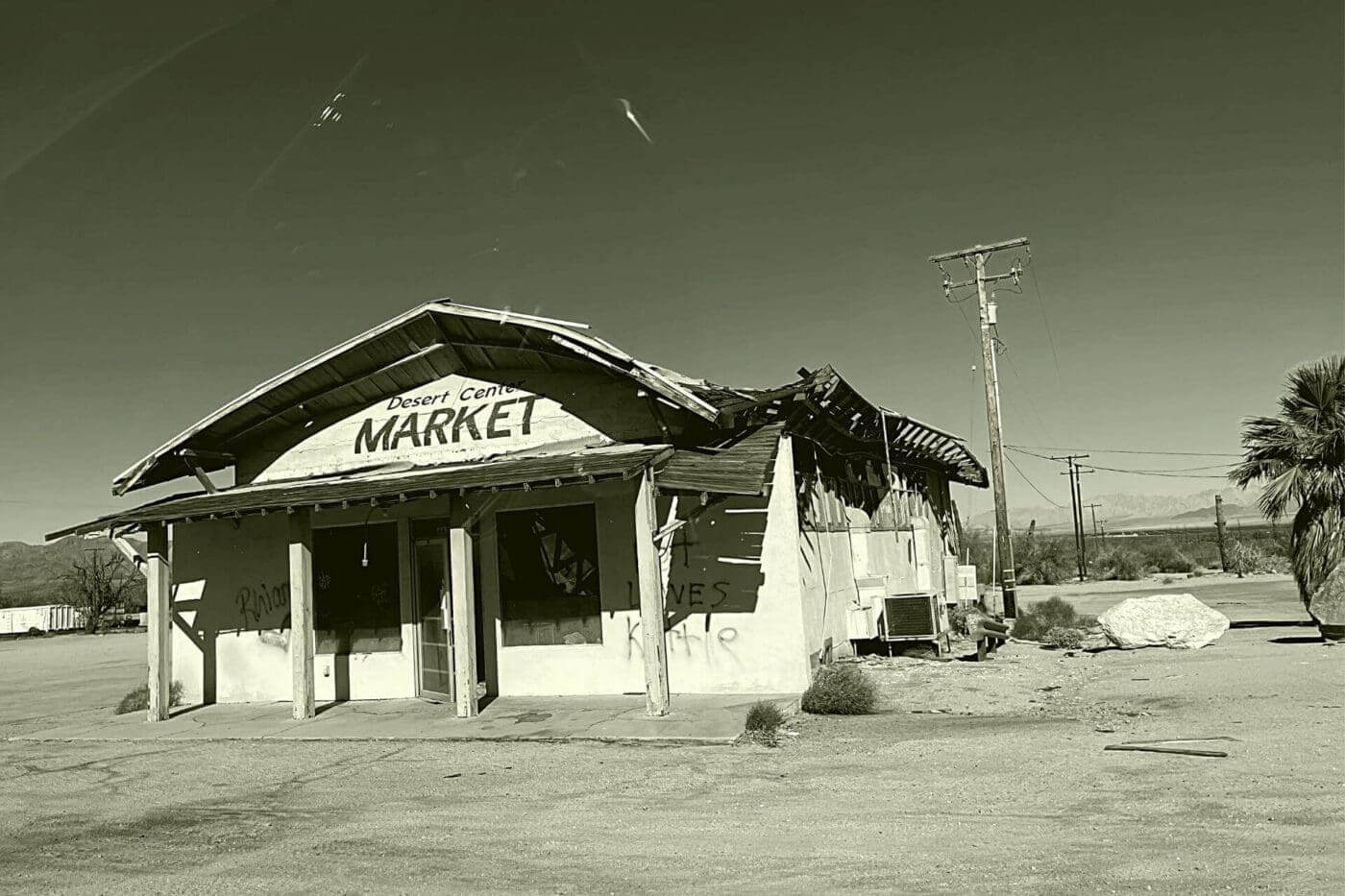
Photo by Bob Sipchen
By the time Sergey could make out the shape of the Mustang he had interrogated his fear, forcing it to confess that it was really just exhilaration at exploring the unknown. The grimace that had accompanied each step became a grin. He plopped his hands on the car’s passenger door and Ramona, still focused on her phone, jerked up her head.
“I was about to call for help,” she said.
“I found one of the palm clusters,” Sergey said. “Then I thought I heard someone singing. I got scared.”
Ramona ’s face softened. Her husband’s hair was short and gray now, but his lips were as intriguingly pensive as when they’d met, his olive-gray eyes as searching.
“Poor Serg,” she said, patting his hand. “Well, guess what? While you were out tempting sidewinders with those sexy ankles, I did some Googling. This place is right up your twisted little alley.”
A truck’s brakes groaned. Sergey adjusted his back and the pain shifted from the apex of his groin across his torso, finding the equilibrium he now defined as bearable.
“Desert Center,” she said, “was founded in 1921 by a preacher named Stephen A. Ragsdale, also known as ‘Desert Steve.’ His vehicle broke down near a well that a prospector had dug by hand.”
“Ah!” Sergey said, bracing himself against the Mustang.
“Yep.” Ramona said, “So this prospector helped the preacher with food and repairs, and he was so moved that he and his wife and four children returned and started a towing service using a Model T truck to haul travelers stuck on what was then just a dirt road. The wife eventually opened a little café then a motel. They hoped they were planting the seeds of a bustling new . . . “
“Let me see,” Sergey said, reaching for the phone.
Ramona moved it out of his reach. The preacher wrote this awful poetry,” she continued, “called the stanzas ‘spasms.’ He’d nail them to fence posts and trees.”
Sergey again snatched at the phone.
“We can read it when we get home,” Ramona said. She slipped the phone into her purse. “We’ve gotta get moving, Scout.”
“Come on, Mo” Sergey said. “We’re not in a hurry. Remember? It’s only Monday. Your hearing’s not till Wednesday.”
“I want to get back in time to get organized,” she said.
Sergey relented. “Let me get my pills from the trunk.”
“You took them at the rental agency, remember?”
“Then let me get my magic ointment,” he said. “Why don’t you get out and stretch for a minute?”
ACT II – SEX
Ramona used a fob to click open the Mustang’s trunk and Sergey hobbled back, reached in, and unzipped his small Patagonia duffel, extracting a plastic vat labeled Dolocrem Forte.
The salve had been a gift from Victor, the Salvadoran gardener who had pretty much come with the house they’d bought in a nook of Westwood twenty years earlier. A soap opera actor in a Tesla had t-boned Victor’s pickup truck on Wilshire the same week Sergey had broken his spine in three places falling from a ladder while hanging a birdhouse in a native Sumac tree. He and Victor commiserated about their injuries, and a month later the gardener returned from El Salvador with what was probably just ground-up aspirin and Vaseline, but a placebo effect was better than nothing, Sergey figured. And if he’d learned anything from his mishap, it was that quantifying pain was as futile as quantifying pleasure.
Ramona moved in beside Sergey and reached into the trunk. She fished in her frayed daypack and pulled out a package of peanut M&Ms. She tore it open with her teeth and poured a few orange and green and blue orbs into her mouth. Sergey leaned on the edge of the trunk and dropped his shorts. He’d meant to catch them with his knees, but they fell to the ground. His briefs behaved better, staying on his thighs while he dipped a finger into the salve and smoothed it into his groin.
Ramona tilted her head back to take in the stars. In the silence, Sergey’s mind wandered. The oil-stained turnout reminded him of his many trips chasing his history fixation across the West. He thought of ranchers’ hard stares as he drove past cattle ramps and a Navajo toddler he’d seen doing dusty donuts in a battery powered mini-Mercedes outside a cluster of ramshackle trailers. When he bent to rub ointment on his other kneecap, he groaned.
Ramona looked down from the Big Dipper, thought for a moment, then sank two fingers into the vat.
“Let me help,” she said. She spread on the menthol-scented balm.
“Thanks,” Sergey said. He sighed.
Ramona gave him another look that he struggled to decipher. Then she dipped her fingers back into the jar and edged them into the space between her husband’s thigh and testicles.
Sergey sighed again, more deeply. Then he turned his wife’s head toward his. Their kiss was a continuation of kisses they’d shared in sleeping bags along Oregon’s Rogue River and between beach chairs as mother whales called out in the dark to calves who had strayed too far in Baja California’s Scammon’s Lagoon.
“Hold on,” Sergey said after a moment.
Ramona pretended to take him literally and did, the mischief in her eyes growing lascivious.
“Yes. OK. But wait,” Sergey said. He fumbled for a minute in the trunk. His hand emerged clutching a bottle of artisanal mezcal. A donor to the environmental non-profit he worked for had given it to him after a fine dinner at the Phoenix Biltmore. Sergey had planned to give the mezcal to Victor.
“No,” Ramona said when she saw the bottle. “I’m too tired to drive and you’re not driving drunk.”
Sergey looked at her. He wriggled out the bottle’s fancy cork, looked his wife in the eyes, took a noisy sip.
“You’re an ass,” she said, taking the bottle. She, too, drank, her face transitioning through a series of adorable contortions. Sergey drank again. They’d made considerable progress on its contents by the time Sergey finally lifted himself off the edge of the open trunk.
The move from the car’s stern began, but did not end, gracefully. Sergey pulled off his shirt. He drew Ramona to him and unbuttoned her yellow-striped summer shift. He unfastened her bra and tossed it over his shoulder. Stepping back, hands linked, they took a second to marvel that a warm desert night could infuse battered old bodies with allure.
Sergey had kicked his shorts off easily if painfully, but now his briefs stuck on his Tevas. Ramona reached to brace him and they toppled together into the sand. She tried not to hurt her husband further as she rose to her feet, but tumbled again, triggering a howl. When Sergio finally pushed himself onto his knees, it felt as if an army of ants were ravaging ligaments.
Standing, Ramona slapped a bottle cap from her palms. Taking charge, she pulled a gallon of water and a vial of a lavender-scented hand soap from the trunk–their long-neglected Covid kit. Naked except for Sergey’s sandals, they washed away the sand and goo.
Sergey opened the passenger door, slammed the front seat forward and helped Ramona into the back. He squeezed in after her, his face telegraphing rapture that was really a reflection of brainstem-electrocuting pain. His wife wondered aloud what the neurosurgeon might say about any new damage when they all examined the next MRI.
“Doesn’t matter,” Sergey said. “This matters.”
“Ah,” she said.
The wind was howling when the fever broke. Giggles, grunts, and disentanglements from seat belts followed. Finally, they were out again, beside the car. Sergey pulled on his shorts. Ramona wriggled into her dress. The truck on the onramp fired up its engine and headed back onto the freeway.
“Are you sure you’re up to this?” Sergey asked, when Ramona had slipped behind the wheel.
“What choice do we have?”
“Let me see if I can find a hotel,” he slurred. “We could go back to Blythe or on to Indio.”

Photo by Bob Sipchen
Ramona turned on the car and turned up the air-conditioner. She put her head back. “Just give me a few minutes.”
Sergey poked the button that closed the car’s top. As the sky disappeared, he took Ramona’s phone from the dash. Her search history was still on the screen. With a click he landed on the sort of blog semi-eccentric desert aficionados create to commune with their tribe
“This is wild,” he said, almost shouting. “His poems were really more like marketing slogans for the town he wanted this place to become. Listen:
‘Decent folks are welcome
Enjoy but don’t destroy.’
It’s doggerel, but you can see what he was trying to conjure out there in that darkness, Mo! Why’d Rancho Mirage blossom and this guy’s vision decompose?”
“Please just find us a room,” Ramona said.
“You’re the one who opened this wormhole,” Sergey said, disappearing back into the parallel universe in which everyone on the planet increasingly lived.
Ramona flopped her head to the side and stared. “Please, Serg! This has been fun, but we’re adults. Old adults. We need shelter. You’re living by whim. It worries me.”
“What’s the difference between decision and whim, Mo? What?”
“A whim is what makes immature dickheads go careering across the desert, tearing up nature! That’s not who you are. Not who I am.”
“I dunno, Mo,” he said. “Who am I? In two seconds one me vanished. Now I’m this me. This me can’t hike a mile on flat ground let alone do flips off a tree swing into a swimming hole. Maybe decisions become more whimmy as life contracts and the end comes into view. Maybe I don’t want to drive a Prius anymore.”
This non-sequitur lifted Ramona’s annoyance to fury. “The Prius was your idea,” she sputtered. “You’re the one who carries a wooden straw just to spite the Koch Brothers.”
“Maybe I’ve changed,” Sergey said.
Ramona stared at the headliner as if she feared the wind buffeting their rental car was about to blow their decades together straight out into the surrounding oblivion. Sergey saw this, but the cork had been pulled.
“We’re doomed,” Sergey said. Maybe it’s time we ripped out the cactus in our yard and put in a lawn to catch the morning dew.”
“We’ve been the good guys!” Ramona hissed. “You have any idea how much I love to watch you whip out an amicus brief and start blasting? We are on the right side of everything! You’ve shut down coal plants! Some of that wildness out there is because of you!”
“Everyone is on a wrong side now,” Sergey said. “Everyone. Look at those solar farms creeping into every canyon. They’re there so that Biff Mcgretakibben can have nice ambient light as he soaks in a whirlpool at Two Bunch Palms during ‘Save the Tortoise’ retreats! Those lovely eagle-slaughtering windmills? I can’t ever, ever, ever again bear to hear Muffy Whitebummer or whatever her name is, get all tremulous about the har-har-harm humans have inflicted on pobracita Mother Nature as we ride the express lifts at Telluride. I loathe her smug invasive species spiel. What a crock! Eucalyptus and jacaranda didn’t invade California from outer space. A species called homo sapiens brought them here. We’re animals too, Mo! Those palm trees, whatever they were, were part of the landscape, just like your parents are.”
Ramona, whose grandparents spoke Nahuat long before her parents drifted north, knew that the last bit of the rant was a clumsy grasp at finding common ground. She let it go.
“It doesn’t matter anyway,” Sergey said, losing momentum. “The forces of decay defile beauty with no regard for virtue.
“I don’t know what you’re trying to say mijo,” she whispered. “Go ahead and surrender.” Then she was asleep.
Sergey reached over and turned off the engine. He picked up his phone.
“Hey Siri,” he said softly. “Text Sergey Lenkov.”
“What do you want to say?” Siri asked.
“New manuscript. Desert Manifesto. Is entropy the work of demon or god?”
“Are you ready to send?” Siri asked.
“Yes,” Sergey said.
“Done” his interlocutor replied, her voice peppy. Supportive.
“Hey Siri . . . ” he said
The next sentence was still unformed in Sergey’s cortex when one eye opened a few hours later. He touched the knee of his snoring wife and fell even deeper out of consciousness.
ACT III – The End
The next time Sergey opened his eyes, blue lights flashed against a pale sky.
“CHP,” Ramona whispered.
“Everything OK?” the officer asked, scanning the car’s interior with a flashlight.
“Yes,” Ramona said. “We needed a few minutes of sleep. Left the air running. Battery died. I called. Hertz is sending a tow truck.”
“You’re lucky,” the officer said. “This is not a safe place.” He surveyed the scene once more, barely pausing at the bra snagged on a windshield wiper, then walked back to his car.
“Ugh,” Sergey said when the CHP car drove off. The nausea was less than he’d expected but hardly de minimis. “Sorry.”
“Yeah,” Ramona said.
She’d been awake for a while, it seemed. She held up her phone. “Don’t take me sharing this as a sign that I forgive you or have forgotten the rubbish you spewed last night. But . . . I think I’ve solved your mystery.”
Eyes closed again, Sergey nodded.
Ramona began: “‘In the early 1990s, Stanley Ragsdale’ – the preacher-poet’s youngest son – ‘commissioned the planting of several hundred palm trees in strange patterns on the town’s frontage with Interstate 10. When asked why, he said he’d always wanted a ‘tree-ring circus.’”
She shot him a look. “But that’s not really it, apparently. This blog says he thought – wait for it, Scout – that planting the palms in weird patterns was a way to communicate with extraterrestrials. I’m not kidding. They planted the palms to call in UFOs.”
“Whoa,” Sergey said. “But why the mutilations? Was the massacre part of the signal?”
“Sorry to disappoint you,” she said. “But everyone seems to agree that when the preacher-poet’s family eventually gave up and moved away, the palms died of thirst. Their fronds fell off and no one has had the energy to chop the cadavers down and haul them off.”
Sergey gave as slight a shrug as possible. “So strange,” he said.
“You ready to roll?” Ramona asked. “The truck will be here in 23 minutes.”
“I have to pee,” Sergey said. “Do you mind if I limp back out there to have another look? It won’t take long.”
“I’ll go with you,” Ramona said.
Together they picked their way through blossoming ocotillos, used condoms and – “Ugh, over there,” Ramona said – the rotting corpse of a large dog, a Doberman probably.
Once, when they paused, a jackrabbit burst from under a tumbleweed, it’s ludicrously large ears translucent in the dawn’s light.
When it was gone, Sergey’s thoughts trickled out again.
“These Ragsdale people lived well,” he said. “They got to see sunlight shining through rabbits’ ears.”
“Hmm,” Ramona said.
“What brings people to landscapes like this?” Sergey continued, his words keeping pace with his pained gait. “Do they come to unravel? Or does the desert lure them here to unravel them? Maybe the preacher’s family was in touch with spirits who moved them to plant symbols to remind us, or our future selves, of what to strive for or avoid, you know? Maybe that rabbit’s a god”
Ramona urged him forward. “Maybe, my dear earthling,” she said, “Demons are worms that someone lets escape from mezcal bottles.”
A few steps later, Sergey said: “There.”
The cluster of headless palms hovered around a graffiti-covered concrete slab. Some were charred and pointing mainly skyward, others bowed to various points on the compass. One stem displayed inverted hearts carved by long-gone lovers. Many had snapped. All were ugly, awful, demoralizing in a way he couldn’t articulate to himself let alone his wife.
Nearby, at the edge of a concrete slab, the frame of a wood-and-sheet metal windmill teetered. Two of five blades, rusted and tweaked by bullets, still clung to a metal shaft. A mounting breeze made the whole mess creak.
“Your monster?” Ramona asked.
Sergey smiled. Weakly. His legs were leaden. His knees and groin ached. Taking a step, he realized that at least his balance was ever-so-slightly improving as the booze wore off.
A truck’s airhorn sounded on the freeway. A family of quail, a mother and five chicks, darted past, plumes bobbing, then vanished into the brush.
“Oooh!” Ramona cooed.
Sergey took her hand. He turned back toward the Mustang, straining to decide whether it made any sense at all to tell her that he now knew what the abandoned windmill was chanting in a language only he could understand: “You know who you are. You know who you are.”
In our ECO LIT series, Red Canary Magazine dedicates space for established writers and emerging voices to imagine better ways of being.
Help us sustain independent journalism...
Our team is working hard every day to bring you compelling, carefully-crafted pieces that shed light on the pressing issues of our time. We rely on caring supporters like you to help us sustain our mission. Your support ensures that we can continue to provide deeply-reported, independent, ad-free journalism without fear, favor or pandering. Support us today and make a lasting investment in the future.

RELATED STORIES


Award Winning


Today’s environmental and social justice challenges are unprecedented, and require an unprecedented collective effort.


Stay updated on our latest features, events and more. Subscribe to our Note From the Nest newsletter!
