
What Lingers in Ocoee
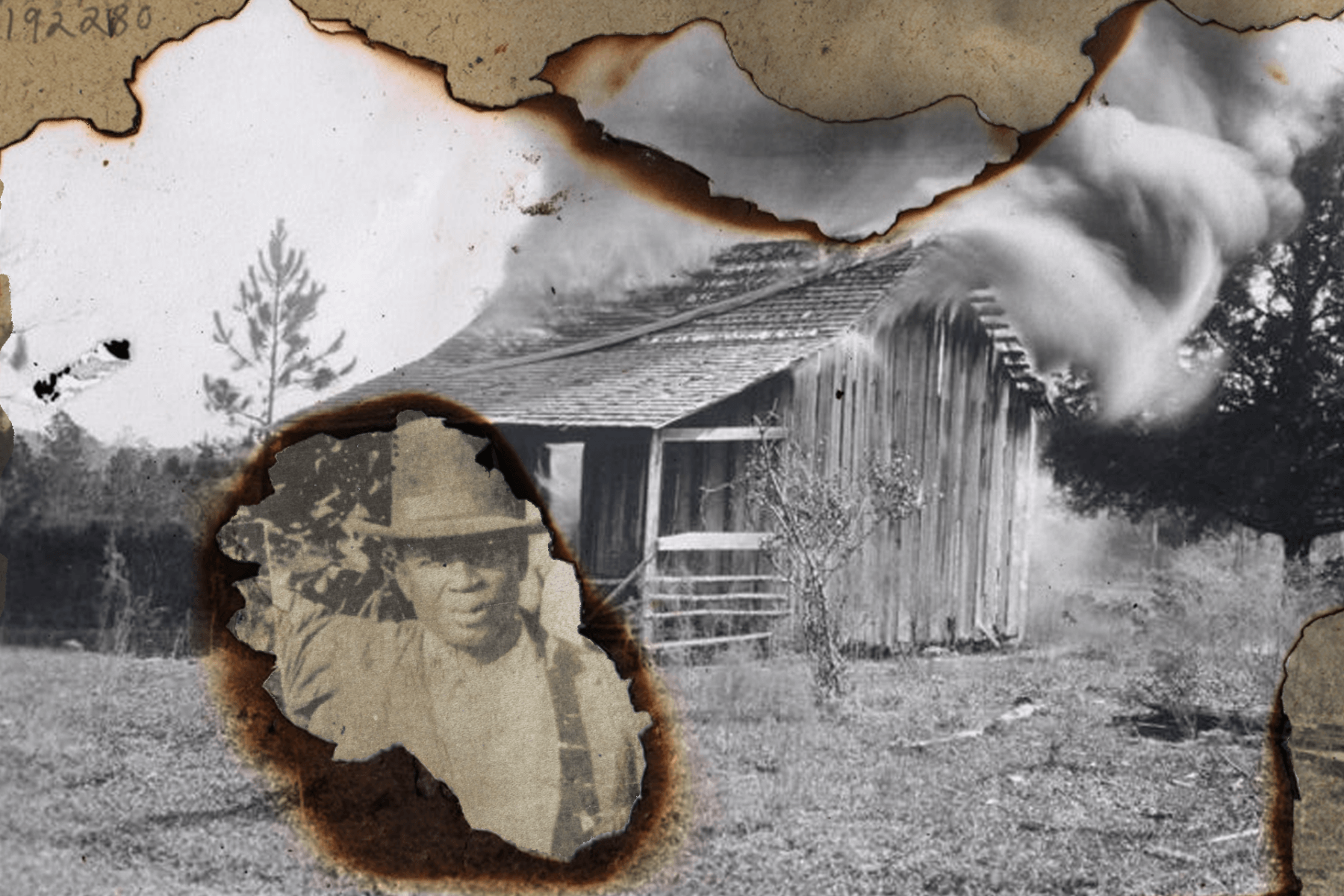
What Lingers in Ocoee
for Julius “July” Perry (1868-November 3, 1920),
first African American killed in the Ocoee (FL) Massacre,
November 2-3, 1920
“When it came to Ocoee, we just didn’t go there, and we didn’t ask why.”
–– Francina Boykin, raised in nearby Apopka.
1. The First Day Women Could Vote Inspired Black Men
Go back to that
eighty-one-degree
Election Day, 1920,
cloudless morning
hot enough for summer.
Watch poll workers
wipe their foreheads
on their shirts’
starched sleeves while
July Perry pulls
from his pocket proof
he and his wife
Estelle paid their
$2 poll taxes:
same slips his workers got
from white landlords
after crating citrus in their groves.
His shoulder leans
into Estelle’s. His cracked
hand cups hers
while stiff-backed Klansmen
turn those carbon copies
in the light and click
their tongues
because they know who he is––
fat-cat labor broker,
the go-between
for Black workers
and white employers
who made sure
everyone
got paid,
loudmouth church deacon
pumping up
the North Quarters––
hear slave quarters––
in this first year women
can vote, taking care
of taxes for neighbors,
helping Black women
register at four times
the rate of white.
If they come out, if
Black men join them,
this is a
whole new world.
***
2. Letter about “the Negroes of Orlando Voting” from the Florida Ku Klucks
The following is a letter sent to lawyer W.R. O’Neal and Judge John C. Cheney, a GOP Senatorial candidate, who held secret meetings at a North Quarters church to prepare African Americans to vote:
Orlando, Fla. Sept. 20, 1920
Mr. W.R.O’Neal, [sic]
City
Sir:
While stopping in your beautiful little city this week, I was informed that you are in the habit of going out among the Negroes of Orlando and delivering lectures explaining to them just how to become citizens, and how to assert their rights.
If you are familiar with the history of the days of reconstruction [sic] which followed in the wake of the Civil War, you will recall that the “Scallywags” of the north [sic], and the Republicans of the South [sic] proceeded very much the same as you are proceeding, to instill into the negro the idea of social equality. You will also remember that these things forced the loyal citizens of the south [sic] to organize clans of determined men, who pledged themselves to maintain white supremacy and to safeguard our women and children.
And now if you are a scholar, you know that history repeats itself, and that he who resorts to your kind of game is handling edged tools. We shall always enjoy WHITE SUPREMACY in this country and he who interferes with it must face the consequences.
GRAND MASTER FLORIDA KU KLUCKS
Copy
Judge Jno.M.Cheney [sic]
You may accept this as a fitting message to you.
Copy
Local Ku Klucks
Watch these two.
***
3. July Read the Room. Mose Did Not.
Stand beside Estelle and July.
Stare until the poll workers’
squinting eyes disappear
within five hundred sheeted
others’, snaking, sheened
in sweat, three days earlier
down Orlando’s Orange Avenue.
[C]owled and gowned in flowing robes,
the Evening Reporter-Star said,
the Klan marched with dignity
to remind the people that the South
was not dead or sleeping,
their fists choking
Christless crosses, droopy little US flags.
Hear July say Judge Cheney,
bucket hat in hand,
basement safe back home
bricked with cash
after his good sense
did the math:
Stay in South Carolina
and make 26¢ picking
a pound of cotton
or head to the Everglades
for 75¢ an orange crate,
save up, buy land,
plant groves of his own.
Hear his boot scuff
the threshold that his partner,
attorney Mose Norman,
will be turned from twice
that afternoon before
a white vet, summoned
to assist with the coming riot,
finds in Norman’s car
a gun he brought just in case
or one the white man planted
or imagined there,
and after he’s clubbed, kicked,
and chased, Mose will run
to Perry’s porch where July
will read the future
in Mose’s eyes, in Mose’s welts
and blood, and whisper
to his friend: Keep going.
So Mose will vanish
down a path, then
into history, first gust
in a coming hurricane,
abandoning the car
whites hated him for––
cloth-top Columbia Six,
white sidewalls, silver spokes,
side windows lost
behind storm curtains––
keys still in it, up for grabs.
***
4. July Shows Coretha How to Shoulder a Shotgun
The storm hits that night around 11:
Sam Salisbury––
Orlando police chief,
Marine war vet,
Klansman––
leads a deputized crew
of shotguns and cigarettes
to July’s front yard.
They yell for Norman.
When July says
It’s just me and my family.
I don’t know what this is about––
they start yelling for him.
Salisbury orders July outside,
says he’s under arrest for a crime
someone will have to
make up after he’s killed,
as others lied
in Tulsa
East St. Louis
Eufaula
Colfax
Vicksburg
Bogalusa
Omaha
Baltimore
Chicago
Knoxville
Elaine
Gadsden
Houston
Charleston…
July stays inside and Salisbury
stomps up the steps.
Just after her father shows her
how to shoulder a shotgun,
July’s 19-year-old daughter
Coretha squeezes an eye
and blasts a slug through the door
into Salisbury’s left arm.
Scene cut: July shoots dead
two men trying to break in
through the back.
Salisbury and his posse
figure a gang’s inside,
tear off to find backup.
Coretha will say later she lay low
and watched bullet tracers flash
through the house’s front walls.
She’ll one day show her
children where she’d been
shot in the bicep,
will tell them what July,
who’d been hit, too, and far worse, said next:
Take your mother and your brothers.
Go as fast as you can.
I’m not going to make it.
***
5. Swamp, Sugar Cane
July’s family follows moonlight
across a field,
crawls into a Lake Apopka
swamp on their stomachs.
They watch
a swarm of boots and shoes
swirl past them
before it blasts hundreds
of bullets into their home.
They know they’ll never
hold July again alive.
They know not to scream,
even when they see him
make it somehow
to a sugar cane patch
behind their barn
without his right arm
before clouds blocked
the moon and darkness
swallowed him.
Some say when he was found,
he was taken to jail,
where a doctor
reported that he’d die
from his wounds.
Some say he was already
bled-empty, gone.
Alive or dead,
he was dragged
behind a truck
straight to Cheney’s house,
which sat where
a country club does now
with no mention of the massacre,
and raised up a pole,
a flag
against Blacks voting
through which Klansmen
blasted shells all night,
cheering deadeye friends
they’ll deny
knowing on a road
they’ll say they’ve never heard of
if any
lawmen come asking.
But none will.
***
6. The End of Black Ocoee
The rest of the evening,
rest of the night until dawn,
a blaze rises
beyond
Perry and Norman,
sparks a smoldering
ember’s idea:
No more.
Time
for the Lost Cause
to have the last word,
grind Reconstruction
into the dirt
like spit or shit
scraped
from a shoe.
The night
becomes a trail
of headlights
and
fuel-filled Mason jars.
Salisbury, Sims,
and Pounds
bark to their minions
their simple orders
for Armageddon:
Shoot
stragglers
on the street
who don’t
leave town
fast enough.
Make
examples
of their corpses.
Burn
their stores, their school,
their Masonic lodge,
their churches.
Burn
every home
whose owner ran off
after you pick it clean
of cash and jewels.
Burn
every home
whose owner
had the gall
to stay.
Break
windows
to feed
the fire.
Shoot
to kill
when they flee
the flames.
Blacks had awoken
that morning
in a mixed-race town.
Overnight,
every Black resident
died or
disappeared.
***
7. Special Bargains: The Clause in the Contracts for Those “Beautiful Little Groves”
The next month in the Sentinel:
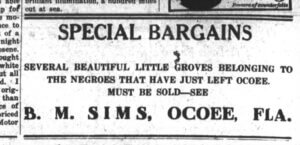
See the clause
in every
new deed:
Only to be sold to members
of the Caucasian race.
See Ocoee
become
all-white
for 60 years
with no one
asking
how it happened.
***
Say
Ocoee
became
all-white
for 60 years
and no one
asked
how it happened.
Say
there was a clause
in every
new deed:
Only to be sold to members
of the Caucasian race.
Say
his name,
Julius “July” Perry,
fat-cat labor broker,
the go-between
for Black workers
and white employers,
church deacon
the Klan
deemed dangerous
for pumping up
the North Quarters––
hear slave quarters––
that first year
women could vote,
first year Black men
and Black
women could vote
together
toward a future
that included them.
Feel his shoulder
leaning
into Estelle’s
on that
eighty-one-degree
Election Day, 1920,
in Ocoee, Florida,
cloudless morning
hot enough
for summer,
his cracked
hand cupping hers
while stiff-backed
Klansman,
who’d hurl torches
that night,
blast buckshot
through his corpse
that night, then pin
a note to his chest––
This is what we do
to n******
who try to vote––
lift our papers
against
the day’s
early light,
chomping
on wet cigars,
sitting on crates
of guns
they brought
just in case,
like
the White League
in Eufaula
and the militias
that led the coup
in Wilmington,
purging
the voter rolls
for whatever reason
they chose
or for no
reason except
I said so,
hellbent––
like others were
and would be,
in 1878
and 1898,
and each year
between
and since,
in small towns
and big cities,
on Martin’s balcony,
in Medgar’s driveway,
on Malcolm’s ballroom stage.
And so many gone
in Mississippi:
Reverend George Lee
while he drove
in Belzoni,
Lamar Smith
while dozens watched
on a Brookhaven
courthouse lawn,
Herbert Lee
at a Liberty cotton gin
by a state legislator
who was never charged,
Louis Allan,
who watched Lee fall
and feared he was next,
on a cattle grid across town
the day before he would
move to his brother’s
in Milwaukee.
All for the crime, like July,
of helping Blacks
register to vote.
On and on,
like rain
and flames
and pain,
in courtrooms
and in Congress,
country clubs
and the White House,
so many
hellbent
to make sure
they held off
for as long as they could
the start of a whole world.
Help us sustain independent journalism...
Our team is working hard every day to bring you compelling, carefully-crafted pieces that shed light on the pressing issues of our time. We rely on caring supporters like you to help us sustain our mission. Your support ensures that we can continue to provide deeply-reported, independent, ad-free journalism without fear, favor or pandering. Support us today and make a lasting investment in the future.
RELATED STORIES



Award Winning



Today’s environmental and social justice challenges are unprecedented, and require an unprecedented collective effort.


Stay updated on our latest features, events and more. Subscribe to our Note From the Nest newsletter!
