
The Ninth Chime
The Ninth Chime
Tertz lay on the cold brick looking at the white sky. Did he know what he was looking at? Maybe he saw it only as a flash before darkness, or blank paper before the typewriter ribbon, or the emptiness of pain he could no longer feel. Maybe he thought he was alone on the square, unaccompanied despite his best efforts. Because who can bring themselves to come to the square for such purposes on such days?
He was not alone, though, because I was running toward him, late as always.
Tertz! Tertz!
A few nights earlier, guitar in hand, he’d sung to friends: Will you come to the square? Perhaps I’ll be there. There was more to the song, but I was drunk. Everyone was drunk, I think, except Tertz, who always had access to the greater intoxication of commitment. Our group tuned him out when he got like this. It was a cruel sort of exclusion, building a soundproof bubble around a man at precisely the moments when he most urgently needs to speak. The social sanction on Tertz was entirely unearned; he was never, even at his most committed, a drag. I always found him personally charming, intellectually acute and athletically effective. He threw a javelin quite well. He wrote a thesis that began as a history of Roald Amundsen, the polar explorer, and ended as a discussion of the absurdist writer Daniil Kharms, who penned the words “Today I did nothing” and was sent to the camps. The thesis was called “Imaginary Frontiers.”
Tertz showed up at every kitchen party our little group held; he even hosted a few in his apartment at K______. He was an excellent guitarist, a fine lyricist and had a sweet mysterious voice that passed among us like a whisper in the woods, unheard but felt, no matter how hard we tried not to feel it. We knew, even those who never looked up to watch him strum, that he would go to the square, and we would not. Eight a.m. would rise icy over the lovely, deathless, dead center of our capital — the tower bells ringing, the sky still struggling to winter life — and he’d be there with his ragged sheet between two sticks, an arrangement that really required another person to hold the second stick, and he’d open his arms as wide as he could to show the message. I wondered what the message would be. Maybe it would be “Today I did nothing,” which would say everything.
We all pretended to be outraged by the things that went on at the upper reaches of power. Gathered in our kitchens, wincing down gulps of homemade wine, or whatever it was, we denounced the insiders and punishers and distributors of privilege as irredeemable bastards, as long as A.S. was not there, because his father, who was a Somebody and knew all the other Somebodies, gave us our hockey tickets. When A.S. was there, he gave us helpful reminders that, even in these years after the tyrant’s death, we were not only not-quite-free, but also not-quite-alone. Whenever Tertz opened his mouth to say something that couldn’t be unsaid, A.S. whispered, “Turn the radio up when you speak.”
We attended the kind of institute that was specifically designed to create thirsty recipients of nectar from the palace gods. We were being harvested as a cultural elite that would remain elite only through submission to the bureaucratic elite. We told ourselves that truth was our calling and proceeded to lie to each other about the brave stand we would make when the time for brave stands arrived. I am perhaps being unfair. What else were we to do but talk talk talk talk talk talk. Were we not dramatists? Couldn’t it be that for us, the great and expertly trained pretenders of the realm, the theater of kitchen conversations was a valid form of battle?
Only Tertz did not pretend. He was always studying the latest pronouncements from the radio or the wall-newspaper or page 1,296 of the Record of the Glorious Last Gathering of Civilians With Medals. He then compared these pronouncements to the dusty, barely bound book that always lay three inches — precisely three inches — from the left side of the third level of his bookshelf, on which he had hand-printed on the spine, in incorrectly selected Latin letters, “Konstitushn.”
We all pretended to be outraged by the things that went on at the upper reaches of power.
After Tertz studied, he wrote. First in tiny words on an old school pad, then in long typed paragraphs, clackety-clacking with a sheet of carbon paper sandwiched between two sheets of lousy newsprint. He would always give the extra sheet to one of us and ask us to retype it and pass it on. To my knowledge, I was the only one who ever accepted this mission. The last piece I copied for him ended with a sentence in a paragraph all its own:
“So, friends, will you come to the square?”
I’d made six copies and given them, or tried to give them, to members of our circle, people who could perfectly well have accepted Tertz’s mission and retyped copies themselves. My friends pushed my hand away when I extended the papers. They could not have even gotten a look at that final sentence, because it was on page two. Of course, they could have known about the square from Tertz’s song, but, as I said, I’m confident no one was listening.
***
The first thing one notices about the square is that it is terribly cold. It is terribly cold in the winter and terribly cold in the summer. We do not have cold summers, but we have cold squares. In the summer, you arrive in shirtsleeves, sweating from the commute, and you walk into the square, and you freeze. There are dead bodies on the square, buried in most cases, though sometimes displayed.
Maybe dead bodies make me cold.
Maybe I am a dead body.
I was still a block away when I heard the eighth chime of the tower bells. I couldn’t grasp how I was covering ground so slowly. It was snowy, and my shoes had no traction; perhaps I walked too gingerly. We are always walking too gingerly, except for Tertz. If we’d noticed the way he walked, we would have been inspired and begun walking like that too. Or maybe we would have reported him to the authorities for suspicious walking.
When I arrived at the square’s edge, Tertz was at its center. By this I mean not “somewhere near the middle,” but that he’d centered himself to a degree of absolute mathematical certainty. I have always been impressed by his attention to detail. He wore a suit and overcoat exceptionally well, though I’m certain the suits and coats were in themselves never suits and coats of any particular distinction. How could someone go so unnoticed while cutting such an elegant figure? Our lack of noticing could only have been willful. We had created a world where it was advisable not to notice the notable.
Maybe we did this, subconsciously at least, for Tertz’s own protection. How could it possibly have been helpful for him to be noticed by us? Surely, he would have been betrayed much sooner. We were good lads and girls, by which I mean that we neither wanted to hurt anyone nor to help them. We talked about helping them, of course; it is fashionable to indicate that one is ready to render aid. We rarely talked about hurting anyone; I can’t recall a single time. Though we must have done more hurting than helping in our time.
Mostly, we tried to do nothing. We joked a lot, and that is at least something.
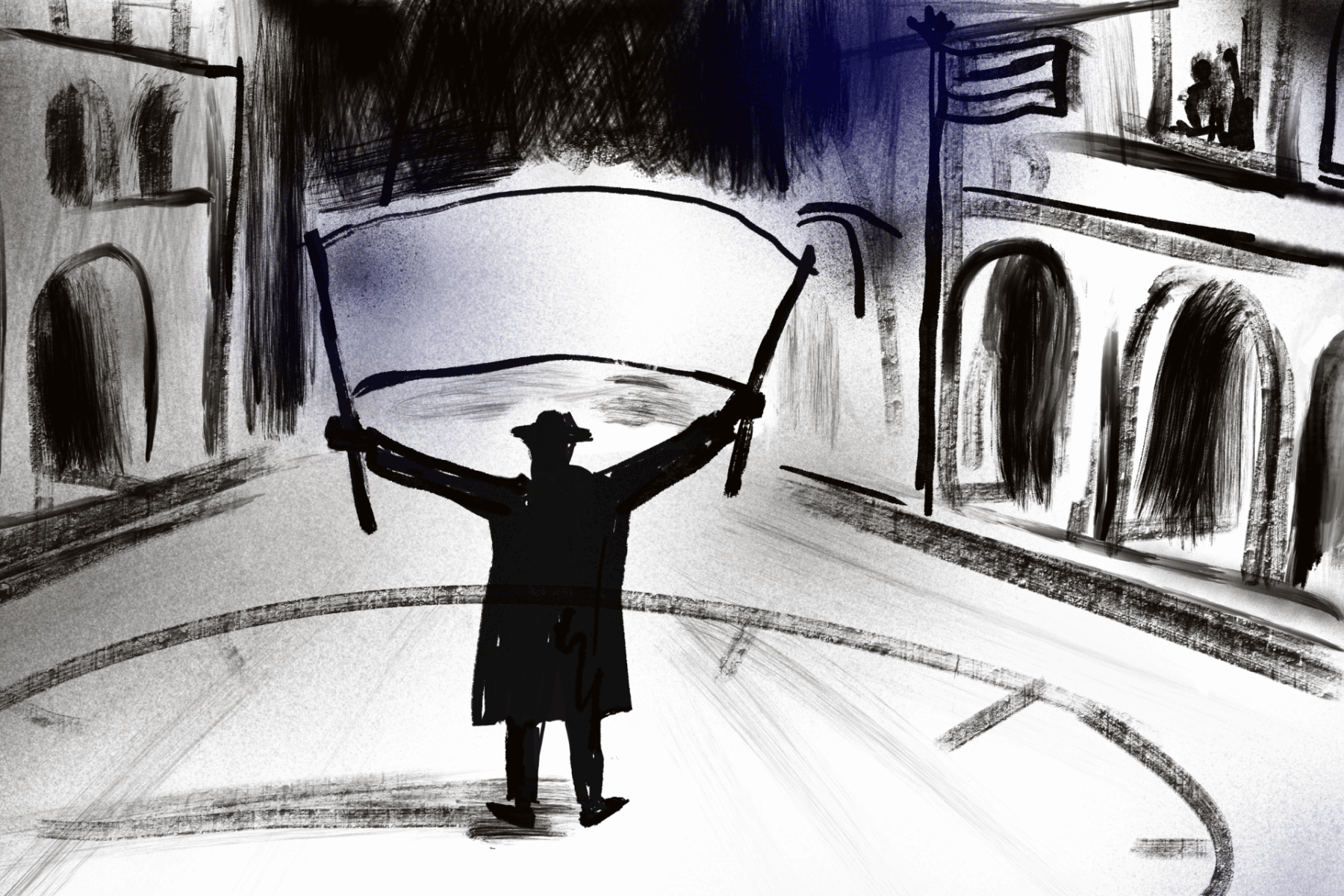
Anyway, Tertz was in the center of the square, looking both notable and noticeable, having stationed himself in such a way that he couldn’t possibly be missed. His face, as far as I could make out from a distance, was placid to the point of blissful, eyes wide, mouth in a curious quarter-smile. His arms were extended to full wingspan on each side to support the tall sticks he’d brought. I don’t know how he managed to get the tall sticks to the square from his little apartment beyond the river. Surely one couldn’t bring such things on the Metro. He must have walked. It would have taken two hours at a fast pace without two-meter-high sticks. I don’t know how long it must have taken with them. He had fastened to the top of each stick a halved white bedsheet, secured at each corner and displayed half a meter above his head. He’d painted red words on the sheet: Your actions can be explained only by greed, sloth and cruelty. The sentence takes up less space in our language.
The wind had picked up and the sheet was distending outward then sucking itself inward like a belly dancer’s abdomen. It had the effect of making the words lively, coming out to get you, then teasingly pulling away. Tertz stood there with disconcerting stillness, his feet rooted like an old oak, unwavering even as the icy gusts threatened to turn sheet to sail and carry Tertz off to some far province.
When the tower clock read exactly 8:15, Tertz began to rotate like a record on a turntable, but counterclockwise and very slowly — yes, a record turned in reverse by the listener’s finger to discern what the singer really meant to say, or just to get a laugh from the sound of humanity turned inside out. What would humanity be like if spun the other way? One would have to check at low speed, in case high speed simply led us in the opposite direction to the same miserable conclusions. Tertz’s rotation, precise, lentamente, wrung new notes from between the grooves. He knew what he was doing. Emperors understand only two modes of motion — inaction and mania. To impress and disconcert an emperor, one must move with slow, steady, unrelenting commitment. The scythe on the horizon is blurry, but it’s coming to cut you down.
But I was comparing Tertz to a record player, not a scythe.
I would like, at this point, to change my metaphor, because I like the new one better, but I won’t. A record player it is. Music can be a scythe, can’t it? What does the Ode to Joy sound like played backwards? Like a scythe in the field of notes. Whoosh, whoosh, whoosh. Revolution: All men will be brothers, but farewell, you bastards. When the record finished turning, I saw that Tertz had written a different message on the other side of the sheet.
He had written this: No.
Tertz could say anything with a song.
I imagined the shock of the men at the palace window, who had bent our country into a remarkable auditory device that only ever fed them the word “Yes.” Yes, we will work for you; yes, we will lie for you; yes, we will die for you; yes, we will be reborn for you, because the next generation must emulate the last with unstinting precision, heroes reenacting the lives of heroes, who themselves modeled their lives on heroes. I once wondered what it would mean if at some point in the chain the heroes were not, in reality, heroes. When I thought about it that way I liked them much better. If my great, great grandfather were indeed as bewildered as I am, we could have a great graveyard talk. Of us all, only Tertz was not bewildered, because he accepted that life was irredeemably bewildering. One night at a party, he struck the strings with unusual force and sang about the harvest:
The beautiful fool in his beaten-up boots
Dug up the turnips and brushed off the roots,
Sat down to give thanks when the candle was lit,
And thanked the old cow for its miracle shit.
Tertz, the believer in miracle shit, stood on the brown brick beneath the burgundy tower with the gray men looking down from the far side of a red wall. It was all lovely; I wish I’d brought my paints. I would call the painting “Miracle Shit.” It would be a pretty painting. Pretty isn’t always pretty; sometimes there’s a scythe on the horizon. What does it take to make us grow? When I was a child, our leader said that the nation must metabolize the lives of its workers. Without telling her the context, I asked my mother, an agronomist, what “metabolize” meant, and she told me that it means to turn food into energy and dispense with the waste, which itself could provide energy. This could only mean that our leader saw us as food, and ultimately as shit. Miracle shit.
But when I heard Tertz sing that song, I knew he had something else in mind: man not as shit itself, but as the modest shepherd of the shit of the world. This was a very different vision than that of our leaders, since it did not involve our being consumed and expelled. Our task was not to grow as replicas from the bodies of our dead and processed heroes, but to emerge unique and unprepared, the living from the living, and learn to put the manure pile of life to better use. Tertz could say anything with a song.
For nearly an hour, he’d occupied the center of the square, and I, a coward, stayed at the edge and watched. I’d brought neither sticks nor sheet. I’d come to the square, but only as a spectator, the sole spectator.
Where was everyone? It was a normal workday; the men ought to have been out in their boxy suits, the women in long winter coats. People should have been standing nervously but bravely at a ten-meter distance from Tertz, unable to come closer lest they be seen as his allies, but unable to look away because what he was doing was irregular and impressive. How is it that a giant can hide in plain sight even when trying so hard not to be hidden? I could only conclude that we’d been so well trained not to see that large portions of the world became invisible.
This led me to wonder: Why could I see Tertz? Why was I the witness to this moment, 9 a.m., when the tower clock sang and a tiny pop echoed from a rooftop and my friend Tertz fell soundlessly to the ground.
I ran to him.
I cradled his head in my arms.
I felt what he felt, I saw what he saw, the sky pregnant with snow, the lightning of death, when life is for an instant at its most intense. I looked at his chest; there was hardly a wound, just a red dot, but the dot got larger and I saw that it was not only on his front but on his back, written on both sides, and that it was pooling at my knees, and that it was on me, the blood, that miracle shit, the energy of a man.
I am lying, of course. We have been so well-trained in the art of self-deception that even in dissidence, we lie. Everyone wants to be a hero for a cause. We are all suckers for the melodrama in which we star, for the epiphany in which we become the men and women we were meant to be. For some, patriotism means obedience to the leader unto death. For some, it means opposition unto death. For some, it means fidelity to a friend, holding a bloody body like the Madonna in a pieta and vowing to do the right thing, to carry on the legacy, to turn this rusted, crusted land into a place where a brilliant fool with an irreverent song on his lips doesn’t need to fight every day of his life.
But the men above the square know this. Of course, they did not fire on Tertz. They are not idiots, after all. They know their codes of conduct and misconduct better than I know mine: These days, tyranny plays coy about good and evil, prolongs suffering amid uncertainty, disappears heretics rather than crucifying them. The rest of us are left to measure our words and speculate on the manner of torture.
When they came, it was not from above.
They rolled onto the square in a black sedan and got out patiently, laughing at a joke, or perhaps a fart, and ambled over toward Tertz in their boots, their dark coats and smug grins — except for the young one, who looked terrified of what he was soon to learn about himself — and they yelled out, Hey, Fuckface. Put down the fucking sign. And my friend the fuckface did not put the fucking sign down.
They struck Tertz not with bullets but with fists, and true to his own patriotism, he did not fall. He held his sign aloft and anchored his feet to the ground as if they were tethered to the core of the earth. Can a man’s legs be so sturdy? What kind of conviction turns a strummer of guitar strings into a century-old oak? They tried to drag him off, and when they could not, they punched and they kicked, and I saw the blood flow from his lips, his eyes. I saw him at last doubled over by knuckles that landed between the ribcage and the abdominal muscles, the plexus at the center of everything, the sun at the center of the body’s universe, the void where only the soul can protect us. I saw him fall and only then did I run to him. But by then, they were carrying him off. I chased after them, shouting like a lunatic, and they put him into a car and closed the door and drove away, pretending not to give me a second thought.
But I knew what was on their mind: That coward will get his, too.
Help us sustain independent journalism...
Our team is working hard every day to bring you compelling, carefully-crafted pieces that shed light on the pressing issues of our time. We rely on caring supporters like you to help us sustain our mission. Your support ensures that we can continue to provide deeply-reported, independent, ad-free journalism without fear, favor or pandering. Support us today and make a lasting investment in the future.

RELATED STORIES


Award Winning



Today’s environmental and social justice challenges are unprecedented, and require an unprecedented collective effort.


Stay updated on our latest features, events and more. Subscribe to our Note From the Nest newsletter!
