
The End of Golden State Exceptionalism?

Editor’s note: This is the second in our series examining the future of the West as both aspiration and a destination. See Erin Aubry Kaplan’s “The Black Middle-Class Deferred,” Jeremy Rosenberg’s “Is The West Still the Best?” and Chris Barton’s “Beyond the Heat Dome.”
When I was about 12, I would often go after school with my friend Eliot to rent movies from the video store in the Chicago neighborhood where I lived. It was the early-’80s and I was expanding my knowledge of the music of the 1960s. On one visit I came across “Jimi Plays Berkeley,” a concert film from a 1970 performance by Jimi Hendrix in California. We paid our $2.50, walked back to my apartment, probably stopping at Wendy’s along the way, and popped it in the VCR.
About halfway through the tape, Hendrix introduces “Machine Gun,” dedicating it to “all the soldiers that were fighting in Chicago that are in jail; all the soldiers in New York, Florida, right here in Berkeley—especially the soldiers in Berkeley, and—oh, yes—the soldiers in Vietnam, too.”
Intercut with Hendrix’s performance are images of antiwar protesters. Crowds of young people march in a line that extends the length of several long buildings, many of their faces covered with bandannas. Uniformed men in gas masks loom on a balcony. A civilian picks up from the street a canister of what might be tear gas and throws it back. The sun shines beatifically over it all, palm trees waving in the distance. At the time, I had a cousin at UC Berkeley, whose matriculation had scandalized some members of my somewhat conservative extended family. Watching the film, I understood why. This, I could see, was the place for me.
In California, I saw the opportunity to shed my identity and remake myself in a place overflowing with the resources necessary to do so.
Seven years later, I walked up the same steps where campus police in the Hendrix video had wielded batons to beat back protesters. I had spent a year living in-state, some of it working for minimum wage at a Berkeley record store, so, entering Sproul Hall to register for my first semester at the University of California’s flagship campus, I qualified for the discounted tuition available to state residents. I paid $748.
I grew up privileged—my going to college was never in doubt, and my uncles and older cousins all worked white-collar jobs—but seeking a new station in California still represented a radical break from my family’s past. My older extended family members’ jobs all looked stultifying, each a version of selling things that I could see no societal benefit to people buying (although—surprise—this may have been naïve thinking). Chicago was losing population, the Rust Belt oxidizing all around it and creeping across city limits. In California, I saw the opportunity to shed my identity and remake myself in a place overflowing with the resources necessary to do so. California’s government provided that chance to anyone who could scrape together $748 ($1,654 in today’s dollars) for a semester of classes. The California State University system was even less expensive, its education accessible to more students.
By the time I got there, I was just the latest in a stream of millions of others that had started more than a century before. In the midst of the Great Depression, drought and unsustainable farming practices devastated the agricultural economy of much of the Midwest—21 percent of rural families in the Great Plains were receiving federal aid by 1937. Many lit out for the coast.
Drawn by the prospect of work in the shipbuilding yards of Oakland and Long Beach during World War II, around 300,000 Black people from the South escaped Jim Crow laws to California. They followed in the paths of homesteaders of the 19th century, whom federal policy allowed to claim property west of the Mississippi as their own if they would make improvements to the land. Of course, homesteading came at the expense of Indigenous peoples and, as settlement of territory acquired through armed conflict, much of it would today be considered a war crime. Abetted, though, by the new railroad linking New Orleans with Los Angeles, which enabled safe passage through the Chihuahuan, Sonoran and Mojave deserts, freedom seekers from America’s South sought refuge in the promised land of California.
Not that California was a paradise for all. Californians of Chinese descent were denied their civil rights and murdered for their ethnicity. About 120,000 Japanese Americans, many of them living in California, were forced into internment camps during World War II, a condition not required of people who had emigrated from the U.S.’s other enemy in that conflict, Germany. And Black people were relegated to reside in certain areas, hindering their economic advancement, through redlining and “restrictive covenants,” which barred non-white people from purchasing some properties—including one I would later occupy—until the practice was declared unconstitutional in 1948. In the 1970s and ’80s, refugees from wars that the U.S. had exacerbated, extended and spread in Southeast Asia and Central America poured into California, enriching the cultures of Orange County, Los Angeles and San Francisco beyond measure.
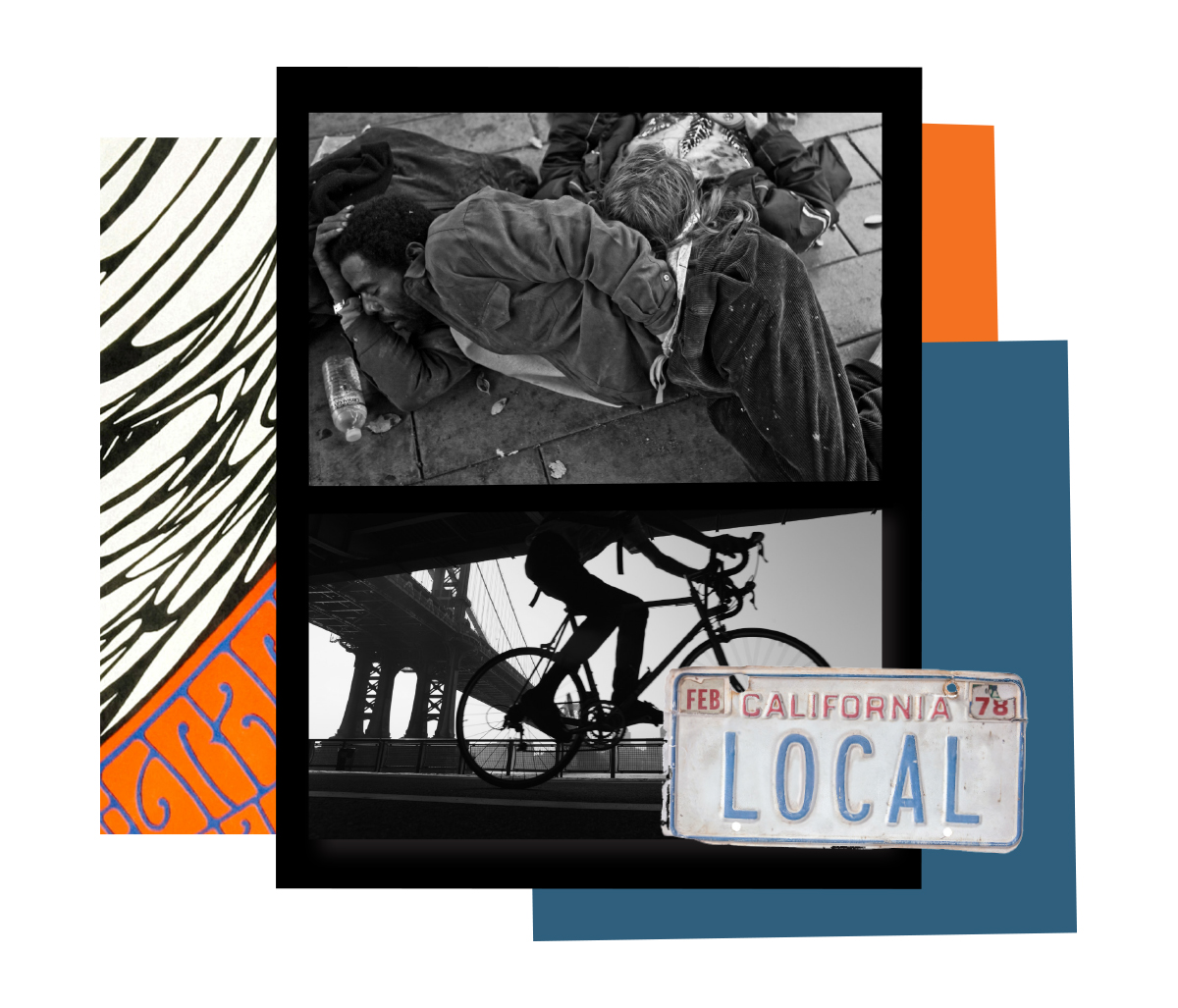
Illustration by Nancy Hope
After enrolling at UC Berkeley, I would spend 26 of the next 30 years living in California. In 1995, I was paying $350 for a one-bedroom apartment in San Francisco. In 2001, my partner and I purchased a house in central Los Angeles for $321 per square foot, not foreseeing that we had arrived as initiate homeowners just in time for the beginning of the end of California’s golden age. The house was sold (not by us) in 2017 for $1,095 per square foot, a 247 percent increase, inflation-adjusted. During my second stint living in the state, a continual search for affordable housing and quality education for our children pushed us farther and farther east in Los Angeles and eventually to Glendale.
I was laid off in 2016, employment in journalism was heading in the same direction as employment in coal mining, and my income dropped by half as I took up freelancing. Unable to afford private school and displeased with the public-school options for our neurodiverse elder child, we moved to Colorado, lured by affordable housing and quality schools (on paper, anyway), both of which were increasingly out of reach in California. Weeks after we arrived, smoke from wildfires in Oregon darkened the skies.
The place seemed great at first, but the smoke proved a harbinger. The public schools, so highly rated on GreatSchools.org, provided an endless stream of worksheets and Scantron tests, but little opportunity for cross-discipline work, learning by doing, or critical thinking. Our eighth-grader didn’t write a single paper the entire year. We spent a lot less time in our car, and nature was even more accessible than in L.A. But we were city folk, we discovered. When Courtney Barnett’s tour bypassed the state, I realized this place just wasn’t for me.
Two years later, we moved to the Netherlands. We had visited and fallen in love with Amsterdam and, crucially, a treaty between the Netherlands and the U.S. allows freelancers to live in each others’ country, basically indefinitely, if they meet certain conditions.
This was not done without some research. The Netherlands is consistently at the top of Unicef’s list of best countries for children and near the top of Save The Children’s list of best countries for girls (we have two, and the U.S. ranks below Algeria and Kazakhstan). It is also among the World Economic Forum’s best countries for women (though it’s considered below the OECD average, but still above the U.S., for working women). The government provides ample opportunities for people to improve their quality of life, and seems to share our values more closely than does Washington. Quality of life was a key issue for us; the FAO has said the Netherlands is tops in the world for food quality, availability and cost, and the grocery stores are empty at 7:00 p.m. because everyone left work two hours earlier—the average work week is 27 hours, compared to 34 in the U.S. People are just generally way less stressed: I remembered getting stuck in a taxi on the way from the airport to our hotel as tourists, before we moved, because a delivery truck had blocked traffic. Everyone just turned off their engines and chilled for a few minutes while the worker completed his task. Nobody honked.
As new residents, we were greeted with headlines trumpeting national outrage that 8 percent of children were at risk of poverty, a rate that wasn’t falling fast enough. (In the U.S., the relative child poverty rate is twenty percent, by the Organization for Economic Cooperation and Development’s count—the highest in the group—and until the 2021 child tax credit expansion was passed, no one seemed to care.) We pay 38 percent tax (on just 70 percent of our income for the first five years), but €267 a month for health insurance for the four of us, including dental, with a €750 deductible and zero copays. The government sends us €110 per month, per child, to help take care of our kids. For parents with lower incomes than ours, Amsterdam helps pay for their kids’ after-school music, art, and dance classes. College here costs $641 per semester. And we have not spent a minute worrying that our children will be shot to death in their schools.
I’m an extraordinarily privileged, white, middle-aged male in good health with a college education and a stable marriage to a fellow professional. And yet I gave up on the American West. If I can’t make it there, who can? My friend group is composed almost entirely of people representing an embarrassingly narrow socioeconomic range, but almost all of them living in California—particularly in formerly economically diverse regions such as the Bay Area and metropolitan Los Angeles—are wealthy by any standard outside the Bay Area, Westside/hipster Los Angeles, and Manhattan-Brooklyn. The state has lost its ability to support a middle class in anything resembling a life I would want to lead. For example, I was spending an extra workday’s worth of time every week just to get to and from my job. My partner’s commute was worse. So that we could live in Glendale—not exactly the cultural center of the city.
After more than a century and a half as the lodestar in American culture and politics, where countless trends and political waves were born, where generations of people from around the world sought fortune, freedom, relative safety, or just a middle-class existence, and often found it, California is facing a reckoning. And just as its style, design, music, economies and wedge issues have spilled eastward in years past, today the accounting for its reckless disregard for the limits of its resources and its failure to grapple with its challenges is also spreading eastward, like the smoke that greeted us in Colorado, polluting the politics, economies and cultures of other Western states. Climate, housing, education, infrastructure—the arenas in which the West will win or lose its future are as diverse as the population of Oakland. And like the population of Oakland, they are interconnected and dependent on one another.
I’m an extraordinarily privileged, white, middle-aged male in good health with a college education and a stable marriage to a fellow professional. And yet, I gave up on the American West. If I can’t make it there, who can?
***
Despite the earlier inspiration, my years at Berkeley were not so virtuously spent as those students’ in the video. Frequent demonstrations filled Sproul Plaza to pressure Bank of America, based across the Bay in San Francisco at the time, to divest from apartheid South Africa, but the only protest I can remember attending concerned rising tuition—an issue that affected me directly. And truthfully, I might have been there by accident.
The recession that started in 1990 had induced the governor at the time, Republican Pete Wilson, to hike fees to $910 a semester for the coming school year. During the demonstration, a past and future governor, Democrat Jerry Brown, stood on the steps outside Sproul and exhorted a much smaller crowd than had demonstrated in the Hendrix film, “You go up to Sacramento and tell Pete Wilson that tuition should be what it was when he went here, and when I went here—FREE!”
Democratic and Republican governors alike have since presided over tuition hikes at Berkeley and throughout the University of California system. State revenue falls during recessions—everyone gets that—but California relies more heavily than other states on taxes on investments, so it feels the busts more acutely. Only in the late ’90s were some of the tuition hikes reversed during more prosperous times. Politicians would point to the higher income of students’ families as justification for the tuition increases, expecting anyone who heard that argument to forget that increased costs would naturally exclude some poorer students from attending, their absence boosting the family-income average of those who remained. Today a semester at Berkeley costs $7,112 for California residents, an increase of 312 percent, after accounting for inflation, from when I started there. A student working all summer at minimum wage could barely cover the fall semester, and that’s not counting living expenses or books.
“This is the face of the Earth as the Creator intended it to look,” wrote Henry Miller.
A superb education at an affordable price, a good job, protection under the law (for most), sure. These were some of the promises of California. But California meant more than that. The cities were hotbeds of arts, culture and political and intellectual ferment. Activists with half-time jobs lived in Victorian landmarks; Wired magazine launched in a former warehouse blocks from downtown San Francisco. In Chicago in the 1980s, an avocado was an exotic fruit that I could only imagine being eaten by a reclining Roman patrician. Sushi did not exist to us. In Berkeley, broke college students ate this stuff.
The climate produced exotic foods, and the landscape offered unrivaled opportunities for recreation and experiencing nature. “This is the face of the Earth as the Creator intended it to look,” wrote Henry Miller of California. In the spring semesters at Berkeley, friends and I would drive to Lake Tahoe in the early morning, ski all day, then come home and sit on someone’s lawn, in T-shirts, drink Negra Modelo and watch the sun set behind the Golden Gate Bridge. (OK, it was Miller Genuine Draft, on sale at Safeway for $5.99 a 12-pack.)
That climate, though, also produced an illusion. During my first years in California, San Francisco received 71 percent of its average rainfall. Months would pass with no measurable precipitation. This seemed great, as long as you didn’t think about the consequences, which I didn’t. Then, in my senior year, after five months during which less than an inch of rain had fallen, a fire broke out in the Oakland Hills, where I lived in a studio apartment. The Oakland Hills is a wildland-urban interface, a geographic designation where more than a quarter of Californians live today. I packed my schoolwork and my cat into my car and decamped for a friend’s apartment in the flats. There, we had the surreal experience, in that pre-live-streaming time, of watching on TV what we could see by looking up the street. The fire stopped, or was held back, at the ridge above my apartment, but more than 3,200 homes were destroyed. Twenty-five people died.
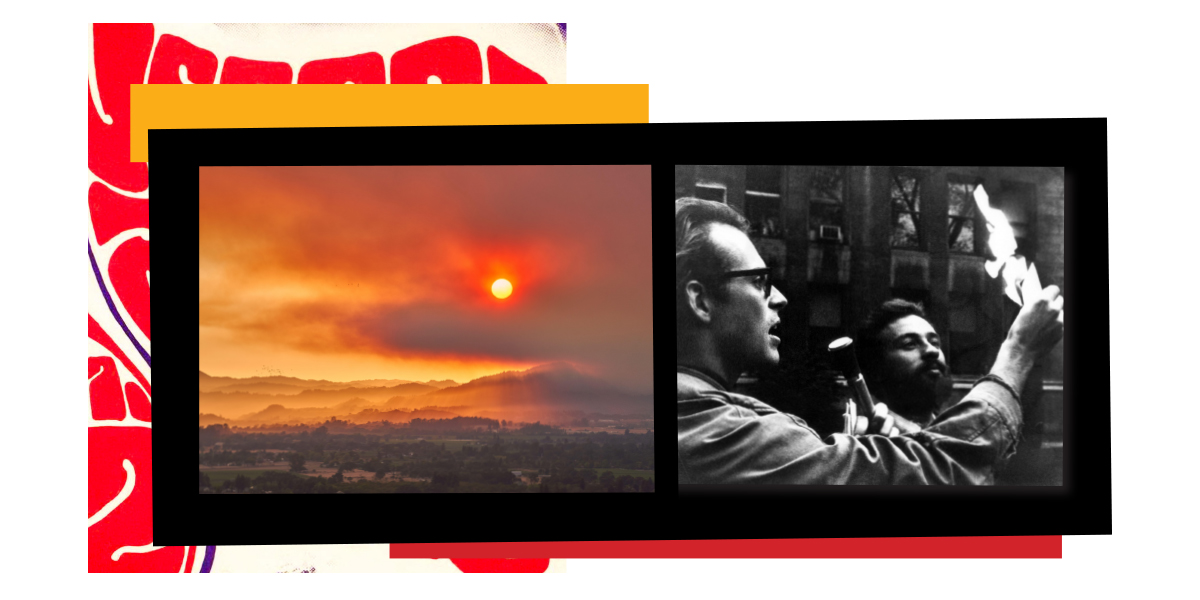
Illustration by Nancy Hope
Thirty years later, Californians dread summer as much as the Dutch I live among now relish it. The West is experiencing a decades-long drought that dendrochronology reveals has not been equaled in 500 years. North of Sacramento, Lake Oroville, which collects snowmelt from the Sierra Nevada mountains, is at historically low levels, as is Lake Mead, which sends Colorado River snowmelt to Phoenix, Las Vegas and Los Angeles. Concurrently, a warming climate is sucking from the vegetation what little moisture it receives. Together with shortsighted forest management practices, these factors produce one historically horrific fire season after another. People in 10 states were advised in August against exerting themselves outside because of smoke from the Dixie fire, in the Sierras, and elsewhere.
California has been a leader in climate policy and action, with its own emissions trading system, stiff regulations on cars and fuels, and enough of an increase to its energy efficiency that it uses no more electricity than it did in the 1970s, when it had half the population. But it can’t shape the climate on its own.
It can, however, shape much of its own water policy, perhaps its most fundamental challenge. Yet, California allocates this most crucial of human needs according to some laws that haven’t been updated in more than 100 years, based on the same principle that dictates restaurant reservations: first come, first served. So, a farmer on the Sacramento River who traces ownership of his land back to a relative who settled there in 1870 is free to take as much water from it as he wishes as it passes by his plot, and at very low cost. So he grows rice, which must be cultivated under several inches of water. It evaporates rapidly in 100-degree heat all summer, but what does the farmer care? It’s virtually free. Meanwhile, to the south, farmers drain the Colorado River to grow grass in the desert and export it to China, where it’s fed to beef cattle. More lettuce—a crop that is 95 percent water—is grown in Yuma County, Arizona, than anywhere else in the country during the winter, also with irrigation from the Colorado.
Meanwhile, one in every 40 Californians lacks access to clean drinking water. That would be about one person on a block in West Hollywood, but of course, none of the people lacking access to clean drinking water live in West Hollywood. They’re in the Central Valley, where they work picking the almonds that go into the almond milk that the people in West Hollywood are drinking. A malicious actor could hardly design a less efficient, more unjust way to allocate the resource most essential to human life.
***
The other areas where California is failing its population, and hence itself, are housing and education, and they are related. In 1991, I moved into a one-bedroom apartment in San Francisco, paying $703 in today’s dollars. Right now, you can get a parking space near there for $380. A much larger portion—45 percent—of primary and secondary public education funding in the U.S. comes from property taxes, compared to other developed nations, which means that schools serving wealthier populations get more money. A cycle then perpetuates, whereby parents who can afford it buy property in areas with more resources, driving up home prices, which produces more revenue for the schools, attracting more wealthy parents. Spending and results are not always correlated, but the top predictor of average test scores at a school or a district (not the best measure, but it’s what we have) is the percentage of its parents with college educations. They earn more, so they can afford more expensive homes. Virtually every state has a formula to correct for this inequity, and some are more successful than others, but ultimately their homes produce more tax revenue for the local schools than do less fortunate families.
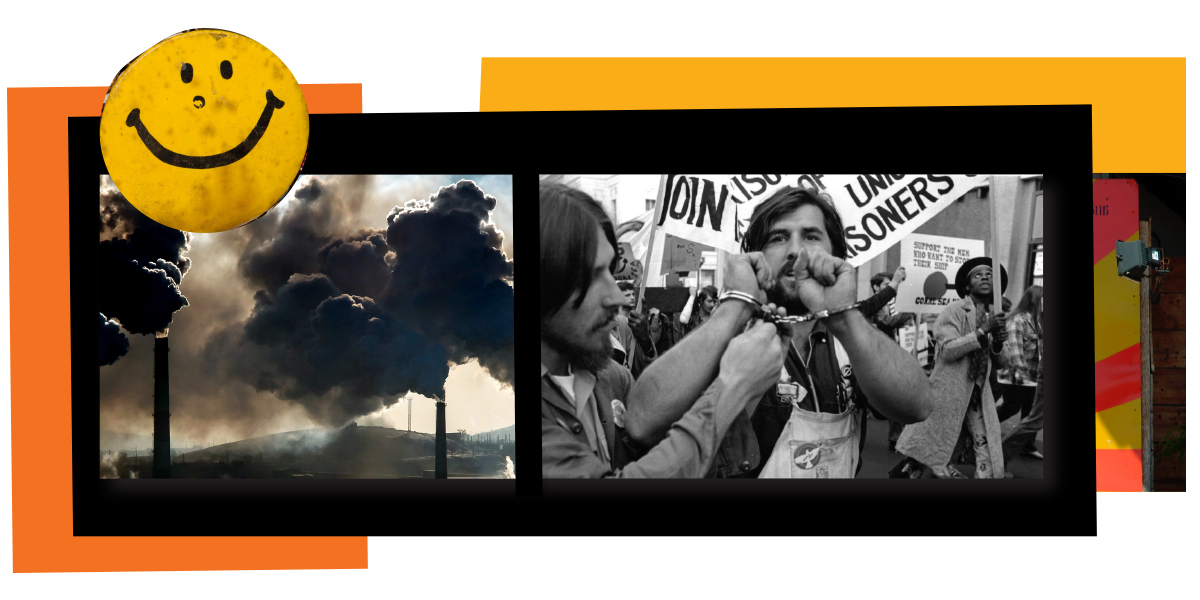
Illustration by Nancy Hope
It would make much more sense to flip this system: Let the neighborhood of 1-percenters pay for the school in the lowest-income neighborhood, the 2-percenters pay for the second-poorest tract’s school, and so on. Wealthy families would then be incentivized to move into poorer neighborhoods, where there would soon be a climbing gym and every kid would have an iPad to take home while their former neighborhood school would need to hold a bake sale to replace the lead pipes and parents in Prada overalls would repaint the hallways. Sure, the wealthiest families would, at first, just send their kids to private school. But middle-income families with ambitions for their kids but lacking private-school incomes would surely start moving in next door to the single mother who bags groceries for minimum wage. The ensuing empathy alone would be worth it.
What the state rebalancing formulas can’t account for, moreover, is the money that wealthier parents pour into their children’s schools directly. During the Great Financial Crisis of 2008-09, budget cuts forced the layoffs of the librarian and the nurse at my daughter’s public elementary school in Los Angeles, which drew students from enormous 1920s Spanish colonial-style mansions north of Los Feliz Boulevard and dilapidated stucco apartment blocks just to the south. Only the contributions of parents enabled their (part-time) rehiring. Other schools nearby didn’t have any 1920s Spanish colonial-style mansions in their catchment area. I was on the beach in Santa Monica one day around that time when I overheard a woman say in conversation, “Santa Monica Canyon is really nice, and it’s not that expensive—houses start at like one-point-one.” As in $1,100,000. That someone could regard this price as “not that expensive” reveals wealthy Californians’ ignorance of the ceiling that hovers over everyone else.
Our public-education finance mechanism enforces this two-tiered society. Kids go to underfunded schools, do not proceed to higher education, therefore grow up to work lower-paying jobs, and can afford housing only in poorer areas, where they send their kids to underfunded schools. This perpetuates a caste system in which it’s often the same people, generation after generation, who are poor. The U.S. now has less social mobility than the notoriously caste-addled United Kingdom or allegedly socialist Sweden: An American born into a family in the bottom quintile of income has less of a chance of dying in the top quintile than someone born in those countries. Our public education funding mechanism makes the American Dream a lie. In 1965, California was fifth in the nation in per-pupil spending. In 1978, a ballot initiative pitched as a means of keeping the elderly in homes whose value had precipitously risen froze property taxes at 1.1 percent of the most recent sale price. But corporate and commercial properties got the same deal and by 2017, the state was 43rd in spending. (Last year, voters closed this loophole, but it’s expected to take years to reassess commercial property values and fight off lawsuits challenging the measure.)
Harvard economist Raj Chetty and colleagues analyzed anonymized tax returns to project what will be the adulthood earnings of kids who grow up in a particular neighborhood nationwide. As measured by this Opportunity Atlas, California, at first glance, isn’t doing too badly by comparison; it’s near the median of the country. But zooming in reveals deep divisions. A person who grows up in parts of South Los Angeles, whatever their parents’ income, has less than a 5 percent chance of reaching the top quintile of income by age 35. A person who grows up in Beverly Hills has a greater than 50 percent chance. Despite Democratic control of the California House, Senate, and governor’s mansion since 2011, the state has done little to ameliorate these conditions.
The history of societies without a middle class is not pretty. Resentments build, political divisions widen.
In 2018, the year after my family and I left L.A., a federal report found that the gap between the median renter’s income and the income required to afford the median rent in L.A. without busting their budget was more than $9,000, second-highest of 20 U.S. metro areas. Our family was making over $170,000, paying $3,800 in rent, and spending more than $30,000 on private school. To move to a neighborhood with a well-funded public school would have been just as expensive as paying for private school.
The point of this essay is not to cultivate sympathy for its upper-middle-class, Gen X, white male author. The point is that when upper-middle-class people feel their children will be better off if they leave a place, that place is truly fucked. The history of societies without a middle class is not pretty. Resentments build, political divisions widen. With California reaching or having passed the limits of its sustainability for human habitation given its resources, climate, and ecology, even if it manages to muddle through for a while, it can no longer occupy the space it once held for Okies, Southern Black people, Vietnamese and Guatemalan refugees, and over-privileged, ambitious brats who watched a concert film one afternoon and fancied themselves rebels.
***
When we arrived in the Netherlands in August 2019, we had no idea how quickly our decision would be validated. The country’s first pandemic lockdown walked a path between the draconian measures of Italy, Spain and France and the almost total lack of restrictions in Sweden: The government closed schools and restaurants and asked people to work at home, but allowed all stores to remain open, and people could move about freely outside. This “intelligent lockdown” relied on compliance, and the Dutch seemed to understand that economy vs. health is a false dichotomy, and that one person’s freedom shouldn’t come at the expense of another’s life. Cases and hospitalizations dropped dramatically, and schools reopened after eight weeks. We had five months of almost completely normal life here in the middle of 2020 (until the resumption of modest levels of tourism and some noncompliance with social distancing among young people sent cases back up). We watched with horror and dismay, and something like chagrin, as friends and family in Los Angeles remained indoors, cut off from one another for an entire year, and the U.S. spiraled into a pit of recrimination, blame and gullibility to disinformation.
I’m gratified to live in a society whose values more closely align with my own, with a better sense of (what strikes me as) the correct balance between individual rights and social welfare. Down the street from our apartment in Amsterdam’s De Pijp neighborhood, bollards outside an elementary school block traffic, creating a small pedestrian zone in front for the children’s safety. An ancillary effect is that parents have space to mill about and chat at drop-off and pickup, rather than squeezing themselves between the street and the building and getting out of there as quickly as possible. The restriction on drivers’ freedom has fostered the community of the school’s parents. Cars need to go around the block instead, big deal.
The Netherlands is not without its problems and its challenges. Rising seas—caused in part by the natural gas the country produces in volumes—threaten the system of dikes and waterways that literally made the country. Housing costs are rising as public housing is disappearing. But these problems are recognized as such, and policymakers are taking action. Windmills are going up on farms across the country, and new and refurbished homes must come with electric ovens, stoves and heating. A new law bars homes in the mid-price range and below from being sold again within four years, to discourage investors from house-flipping.
I became who I am in California, so it continues to tug at me. My adopted home’s monotonous expanses of flat farmland make me yearn for the topographical diversity and dramatic vistas of the West, and I’m rooting for it to rise to the challenge of its problems, and overcome them.
Each path leads to a future that those holding the levers of power can choose.
In the winter of 1987, I stood at the base of Mount San Antonio, a 10,000-foot mountain in eastern Los Angeles County. Though just 13 miles away, the peak was obscured by smog. After rain washed away the pollution that night, I awoke to find the enormous monolith hovering over me like I was looking up at the Empire State Building from Fifth Avenue. To see how close it was, yet invisible the day before, was to quickly understand the burden of air pollution on Southern California. But increasingly strict regulations on auto emissions soon came into force, and when I lived in Los Angeles in 2009, only clouds would hide my view of Mount San Antonio’s peak from my street in Los Feliz, almost 40 miles away. Even on days when it hadn’t recently rained.
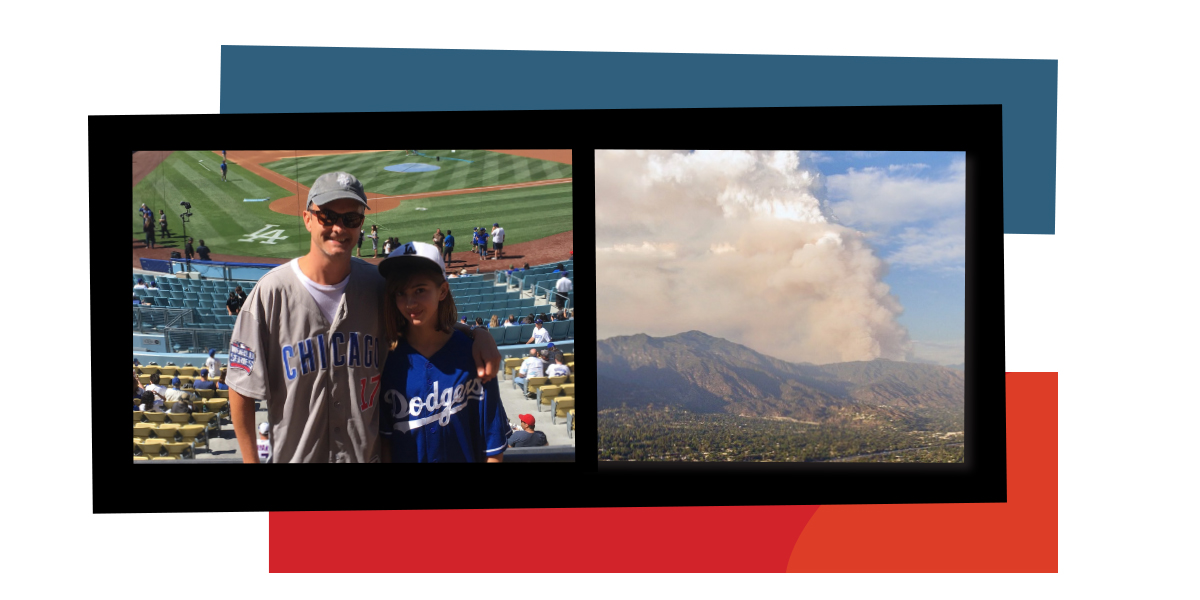
Illustration by Nancy Hope
California can fix its problems. If it so chooses, it can afford to build housing for the 66,000 people experiencing homelessness in Los Angeles County, instead of allowing that figure to nearly double again, as it has in the last decade. If it so chooses, it can stop building and rebuilding in the wildland-urban interface, which necessitates fire suppression that just allows fuels to build up, making the next fire burn hotter and spread faster. If it so chooses, it can reform its water allocation away from subsidizing billionaires so they can grow food types no one actually needs and toward the production of staple crops. And maybe even pitch in for some new pipes for the strawberry pickers of the Central Valley, just as it tunneled under and cantilevered over San Francisco Bay in the past century. Or, it can continue as it’s been doing and hope that its mythology will cloud its reality. Its wealthy can wall themselves off—with their own schools, their home security systems, their private vehicles leading them to parking garages beneath their secured workplaces—from those who will eventually threaten them.
Each path leads to a future that those holding the levers of power can choose.
Help us sustain independent journalism...
Our team is working hard every day to bring you compelling, carefully-crafted pieces that shed light on the pressing issues of our time. We rely on caring supporters like you to help us sustain our mission. Your support ensures that we can continue to provide deeply-reported, independent, ad-free journalism without fear, favor or pandering. Support us today and make a lasting investment in the future.
RELATED STORIES


Award Winning



Today’s environmental and social justice challenges are unprecedented, and require an unprecedented collective effort.


Stay updated on our latest features, events and more. Subscribe to our Note From the Nest newsletter!
