
Ladybird Grove (Lana’s Song)

Ladybird Grove
(Lana's Song)
I have no channel, no verifiable method, for communicating these words to you. The science of life has not yet decoded these wild spaces. I myself do not understand how I came to be here. This is a green and wordless place, shadowed and rainweary. When the sky yawns, light rushes in and drapes the canopy with diamonds and retreats as quickly as it came. So, I have peace and spectacle. Everything else, I am coming to understand, is far away and long ago. But even here the words remain within me, longing for you. All I can do is trust that they will leave my stillness and travel this loamy soil to find you, wherever you are.
***
How can I lament my lot, my bit of land, my plot, my story? In the morning, the herons make a noise that sounds to me like klyak, klyak. I am too new at this to know what they are saying or what they are doing, but the awareness of their beaks, their mighty wings, their young, is as thrilling to me as morning itself, as the days when I would see the top of that little blond head moving by the foot of the bed, the rest of its physical being obscured by the bed itself, by the rise beneath the blankets created by my feet and yours. I had not seen Yasha enter the room, it was too early, and I was too sleepy from staying up caring for him and getting up to care for him and getting up again to care and care and care.
Yasha was walking; there was no other explanation for the moving head at the foot of the bed, coming around the corner to me at the earliest possible hour that could still be considered morning. Yasha was walking; he must have been two, maybe even three. I am speaking in customary tense, of a thing that happened every day for more than a year, so maybe he was both two and three. Maybe he is many ages at once, bearing one age on the outside of him and many other ages on the inside of him. He was walking, but he was still at the age when I had to get up and give and give, not of my body, not of my substance, but of my spirit. He was already drinking, I believe, milk from a cow, milk from the fridge. What he wanted, at this or that walking age, at two or three or seventeen, was a reassuring hand upon his back, a story maybe, a story that he was too distracted to listen to by day, but which by dark he drank like the most primal milk. This is what my body had to give; it had the touch of a hand, and it had words in the half-breeze of his bedroom fan. And when he came in the morning, klyak, klyak, I called him my ptichka, my little bird. The messiness of that child’s hair! My feathered friend.
***
There was Yasha. There was you. I am accustomed to providing an ecosystem. I do not mind the heron, or the kestrel or even the caterpillar. I suppose I should mind the caterpillar. I have brought something of the old me to the newness of all this, a certain obsessive gentleness toward living things that began when I was very little then eased for a while as I made my way in the land of my birth, where one relied on one’s own ruthlessness and resourcefulness to fight back a dwelling’s decay. I patched ceiling cracks and holes on baseboards and set mousetraps and dealt harshly with spiders and, the first time I was alone in an apartment of my own, I staged a poisonous Armageddon for the florid ecosystem of cockroaches. I used dough, as I recall, laced with something horrible.
The roaches were dead by morning. I cannot be sure whether I did any damage to my organism as well. When I became older, the childish gentleness returned. Maybe it was you. You swept into my land, my days, my poems, my sketches, my garden. You knew that, despite my hard ways with bugs, I loved to watch what grew from soil, and soon I was following you to new soil, oceans away. It was not my soil, then it became a little more my soil, until what was yours was mine. Roots do not depend on family trees, not when there are new families to be made in new lands.
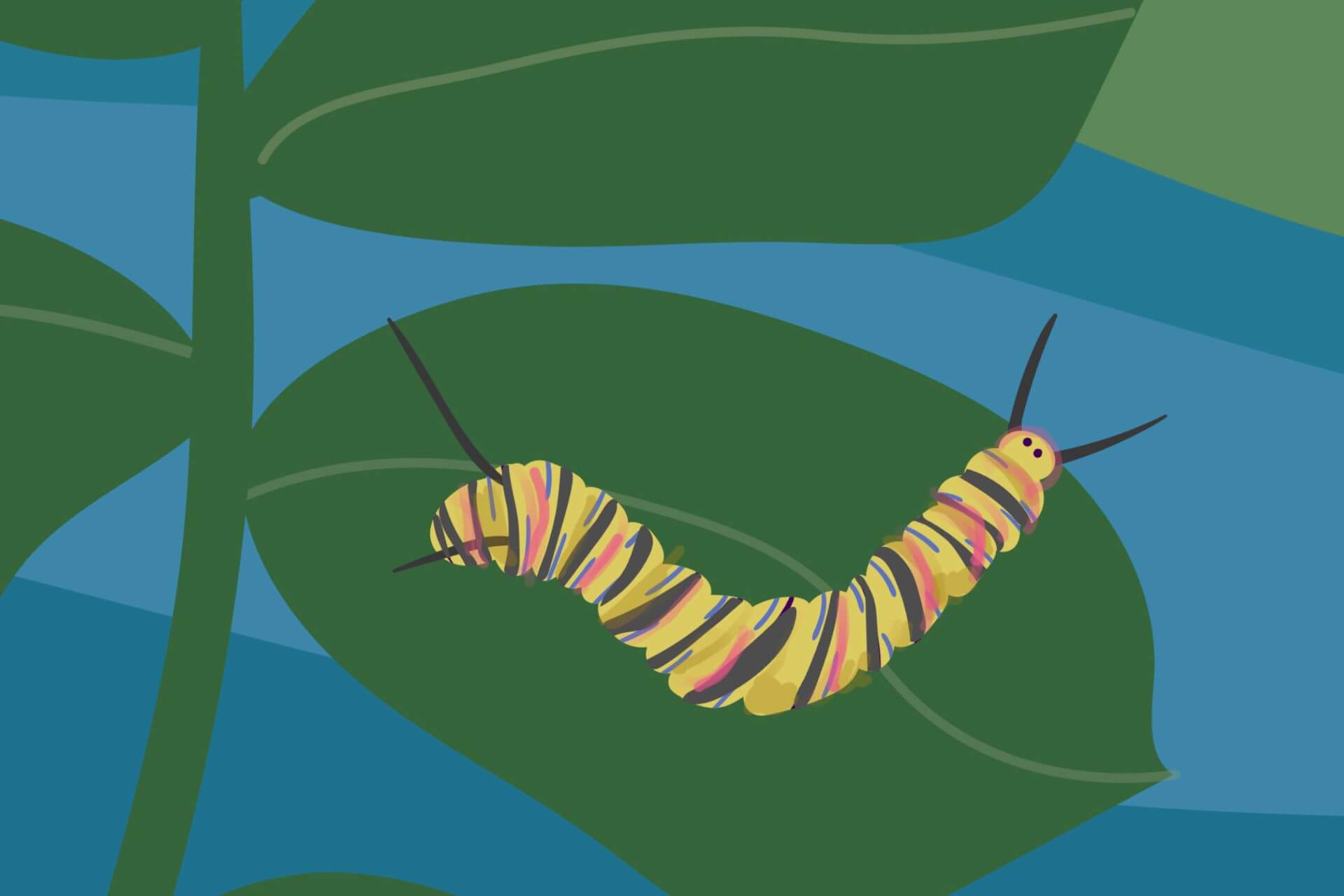
Illustration by Nancy Hope
Do you remember when we moved from the desert to the forest and from closet scorpions to juicy laundry-room spiders? By that time, you had perfected your method of taking a plastic cup and a small piece of cardboard, usually the cardboard that comes in a three-pack of men’s briefs, and putting the cup over the spider and sliding the cardboard beneath it and then carrying the whole assemblage, with the spider bumping about inside, rattling against the edges of the cup, out to the garden, where you released it into the soil where I was trying to grow tomatoes. Do spiders harm baby tomatoes? I do not know. There is so much I need to learn. Do caterpillars harm me? Should I be offended by their presence on me, by the fact that they want something from me? The thing I miss most is the sensation of something wanting something from me. How was I ever angry at Yasha, at that little blond head that came in the morning before morning and insisted that it was, indeed, morning, and that Cheerios and orange juice were an appropriate response to this ungodly hour?
***
In those days, we were told not to give in, not to let the little tyrants tyrannize us. We were told that while tears were indeed a distress signal, a little distress never hurt anyone. A distressed child becomes an adult. An undistressed child remains a child, with a child’s expectations that its needs will be met by others. Tears season the skin, thicken it, make it ready to meet the air and wind and morning mist and blazing sun, to receive the nutrition from life not as wished or as demanded but as lived. The distressed child learns how to control its distress, to save it for when it really matters. The undistressed child learns late and painfully what distress really means and is consumed by it when at 22 years old the Cheerios are not on the table and there is nobody to love him.
Your own childhood had trained you poorly. You caught cockroaches in cups and put them outside. You were still a fountain of need on the day I met you, and I consented to drink from your fountain. Did you ever really learn how to take care of yourself? I worry about you sometimes, even here, far away, when I should probably be worrying about the caterpillars. I am told I can secrete toxins, that I have it in my power to get everyone, if only for a moment, to leave me alone. But it would only be for a moment, and why should I want to be left alone? I am rooted in this soil as I was rooted in yours. I contribute however I can; I provide if I am able. Sugar for the young. We must give sugar to the young.
***
We used to close the door when Yasha cried. He would cry and we would hold the door closed. Again, he was four, or three, or two, or a walking infant, or a levitating fetus — it does not matter, he was and will be all of these things, always and forever. These things are inside of him. We had been told by the good doctor that this was appropriate, a crying cure, tears as an antidote to tearfulness, need denied as an adjustment for neediness. This would result in a more self-sufficient child and a young adult less distressed than the young adult you had been before you met me.
I gave to you not only in the way you were accustomed but in ways that exceeded any custom you had ever known. That is to say, I loved you, and you could trust my love. But in the beginning, I needed you less, because I knew how to kill cockroaches. When you taught me to stop killing, when you made me too gentle, our need became mutual and balanced and dangerous to our ability to be in the world. The decades by your side cost me my ruthlessness. What was I to do when you began to forget things, even the simplest things, the things that enabled your soul to effectively inhabit your body and your body to effectively inhabit the planet?
If I had still been the woman you met, I would have known what to do. If I had still been the woman who knew cities and walked faster than you and had a better job than you and who was less prone to doubt and rumination than you and who resisted you, gently, until the resistance stopped and I put my lips to yours under great falling feathers of January snow in the early-early hours of morning in the middle of a lamplit street with no traffic at all, if I had still been the woman who existed before that kiss, I would have known what to do. But you taught me how to not know what to do, not on my own anyway, because we learned how to do everything, everything, but only together. We communicated through words and gestures and pheromones and the earthy connections at the roots of our souls, where buried lessons pass from one to the next without having to be said.
In the forest this is achieved, I am told, through a network of fungal filament. One of us, whether knowing it or not, attends to the next, and when one of us dies, the other hurts. I cared for you long after you had forgotten me. I was always there, alongside the bed that was not our bed in a room that was not our room, holding your pale hand, saying words that could no longer mean to you what they did to me. My mind without your mind seemed capable only of thinking more and more about your mind. It was intolerable, really. I found you intolerable. I suppose, for both of our good, I should have turned you off and suffered the consequences. After all, the machine was the only thing between the you who was in the room and wherever the real you was. But I could not. So, I imagine you are still there, in that same place, living-not-living in that same way, shrinking but unable to return to the soil, outlasting me in all the ways that do not matter. And here I am, growing somehow, in Ladybird Grove.
***
After one of my visits to your bedside, I called Yasha and told him to come to our home and help me put your things in boxes. He thought it was too soon. He told me that your things would have meaning if they were still on display — your books and your plaques, your strange tangle of cheap malfunctioning one-of-a-kind watches, one of them actually emblazoned with the face of Peter the Great.
He asked me, “What will they mean in a box, Mom?” I said, “Why do they need to mean anything, anymore?”
He put them in boxes and took them away to his house. He did not have a large house, but it was in a fine city. Everything was organized in the small house. Yasha had not done the organizing, not by himself anyway; we had failed to teach him to organize, because we had relented and stopped holding the door closed when he cried and instead opened the door, one fine day, when he was two or five or fifteen, and hugged him, and consented to keep hugging him and putting out the Cheerios and waking with him in the morning and organizing his things. But he’d managed to grow and go off on his own and he’d met a girl and they’d fallen in love and together they were fine, as we had been. They learned how to live. Such an ordinary thing, and yet we were so proud. Do you remember? Of course you do not remember, you forgot everything, didn’t you? How could you have done that to me? When Yasha brought the boxes of your things to his home, 1,200 miles away from our home, his wife said to him, “Where will we put all of this?” And he said, “We will figure it out.”
***
I do not know how long I have been here, only that it is a pleasure to be somewhere. I am learning slowly, at my own pace, which does not seem to differ from the pace of the land, of the forest itself. The difference between remembering and forgetting narrows with the days, or the decades, I cannot tell which. There is no remembering or forgetting, only knowing: It all happened, it all happens still, it will always happen. I am. We were. We are. We will be. Are you out there? Can you hear me?
Help us sustain independent journalism...
Our team is working hard every day to bring you compelling, carefully-crafted pieces that shed light on the pressing issues of our time. We rely on caring supporters like you to help us sustain our mission. Your support ensures that we can continue to provide deeply-reported, independent, ad-free journalism without fear, favor or pandering. Support us today and make a lasting investment in the future.

RELATED STORIES



Award Winning


Today’s environmental and social justice challenges are unprecedented, and require an unprecedented collective effort.


Stay updated on our latest features, events and more. Subscribe to our Note From the Nest newsletter!

Wonderful, just wonderful.
Appreciate the delicate intermingling of loss and life, place and connection. Beautiful writing!