Wild, Wild Horses

Editor’s Note: This story has been edited for reprint by Red Canary Magazine.
To understand Neda DeMayo, you have to understand her lifelong devotion to wild horses. At age five, the same year she began riding lessons near her rural Connecticut home, DeMayo was watching television when she saw a helicopter chase and capture horses, inspiring her to declare to her stunned parents that she would make a place for these horses. Thirty years after witnessing the scene, the visionary behind Return to Freedom Wild Horse Conservation has done just that.
After graduating high school, DeMayo traveled across the United States, studied and worked as a Holistic Practioner, traveling India, and Europe before pursuing fashion design and working as a Hollywood costume designer and stylist. DeMayo was shocked to discover through press reports that by the early 1990s, there had been no end to the helicopter roundups of wild horses she had seen as a child. She decided it was time to take action on their behalf.
Exploring the logistics of what might be involved in operating a wild-horse sanctuary and traveling to observe herds across the West, she quickly understood that America’s wild horses were caught on the front lines in a battle over the use of our federal lands and natural resources. “Competition with revenue-producing private livestock ranching has scapegoated the American Mustang and branded them a trespasser by some and a symbol of freedom by others,” DeMayo says.
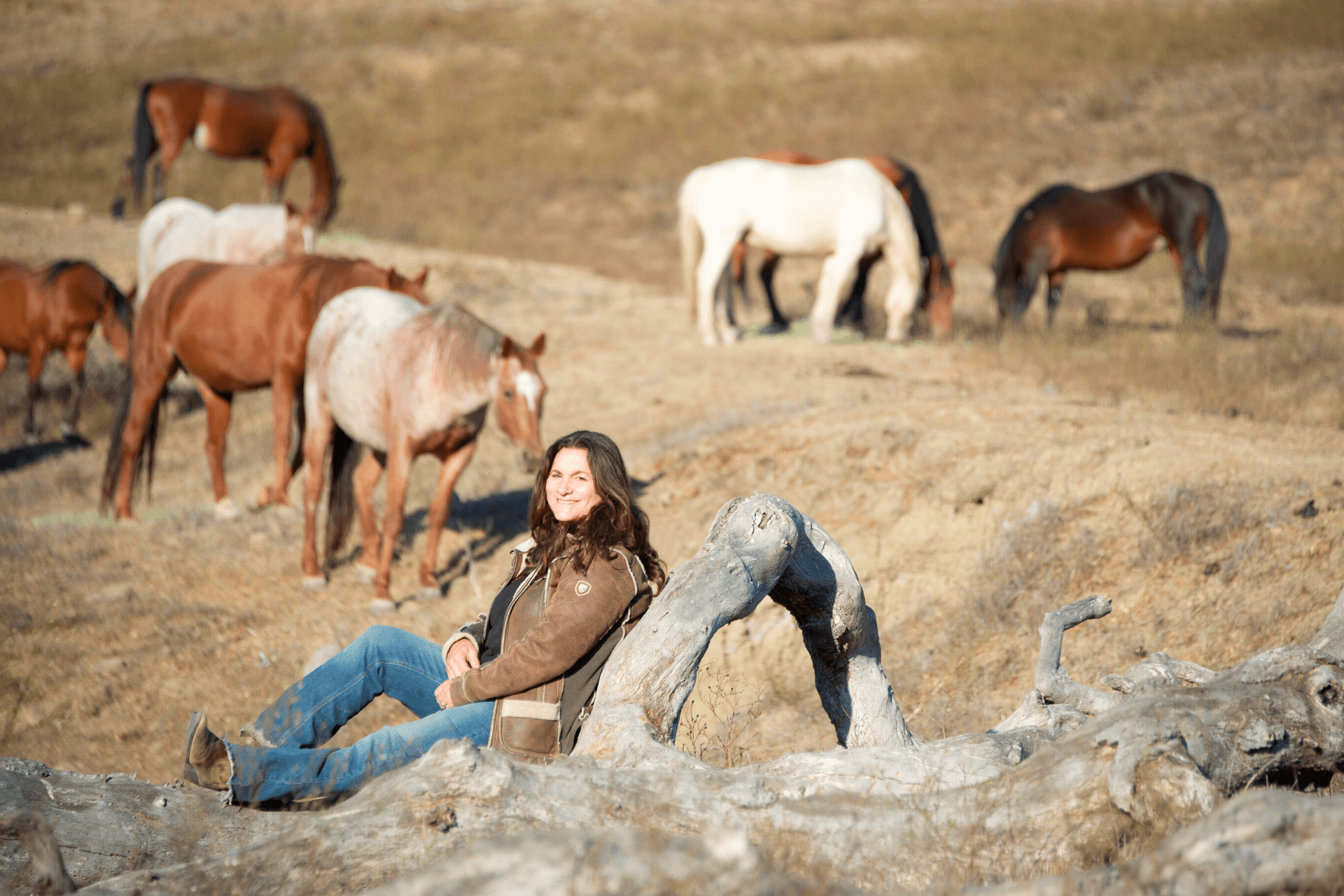
DeMayo takes in the sun alongside Return to Freedom horses. Photo by Meg Frederick
For a few years, DeMayo struggled with how she could bring value to the plight of America’s mustangs. She looked into various state lands programs, and looked at properties where she might begin to establish a sanctuary and educational center. As luck would have it, her father, a former partner with Ernst & Young, started showing an interest in some of the properties she was looking into. DeMayo and her parents had visited a wild-horse sanctuary in Northern California, and they decided as a family that it would be fulfilling to be involved together with something that served a larger purpose. They pooled their assets and bought a rundown 300-acre ranch near Lompoc, California, and, in November 1998, Return to Freedom launched its American Wild Horse Sanctuary.
With it, DeMayo’s dream of a safe haven for many of America’s wild mustangs became a reality. This year, she celebrates the 25th anniversary of Return to Freedom — a wild horse sanctuary that now provides refuge to over 400 wild horses and 51 burros at three locations.
***
DeMayo founded Return to Freedom with a focus on educating the public that horses live in herds made up of harem and bachelor bands and the strong bond that exists between these highly social mammals. Her fundamental purpose for the sanctuary was to explore alternatives to how wild horses and burros were being managed both on the range and after capture. The sanctuary was created as a model for solutions that could be applied on the range to replace the government’s endless and costly capture-and-removal management program.
The first 25 horses arrived at the sanctuary from the Hart Mountain Fish and Wildlife Refuge in Oregon in December 1998. The horses were among 279 that were gathered on horseback from U.S. Fish and Wildlife Service (FWS) land by the late wild-horse advocate Jim Clapp, one of a very few individuals skilled enough to do so. The small herd now had a new home in the hills of California’s Central Coast.
Robert Redford speaks on why he stands with America’s Wild Horses. Courtesy of Return to Freedom on Vimeo
Maintaining the sanctuary for more and more horses would prove an expensive proposition. As more herds arrived on only 300 acres, not only did feed costs increase but costs, supplies, and the need for safe handling equipment as well as hiring help grew along with the organization. “I started raising funds by inviting people to quietly observe the horses who were captured on horseback and therefore maintained in their naturally selected family and bachelor bands and relocated to the sanctuary,” DeMayo says.
The next group of horses came from the Sheldon FWS Refuge in Nevada. Upon hearing that the FWS was planning to remove horses from the Sheldon Refuge, Return to Freedom submitted a proposal that enabled Clapp to once again set up camp for several months and gather horses in their family bands. He subsequently relocated 50 more to the sanctuary. “We got involved there because horses captured off of FWS lands are not branded and most end up with rodeo stock contractors or straight into the slaughter pipeline,” she says. “FWS did not use helicopters at that time and with the help of the late Jim Clapp and his team, we were able to relocate entire bands from a specific area of the refuge to prove that it could be done. We fought FWS for years to keep wild horses at the refuge and manage population with fertility control, but sadly by 2014 the horses and burros were rounded up by helicopter and removed ”
“When you understand how deeply bonded they are — and how they suffer when they are ripped from their herd and their range — if you are able to keep families together and release them into a sanctuary where they can live out their lives, unbothered, it’s all worth it,” DeMayo says. “I don’t regret a single day. As Jim Clapp used to say, ‘It’s a heart condition.’”
Over the next decade, Return to Freedom’s sanctuary became home to harem bands representing the diversity of the American mustang. These include dwindling populations of Spanish mustangs descended from Spanish Barbs, 100 percent pure-in-strain Choctaw Indian ponies, Cerbat, Wilbur-Cruce Colonial Spanish Mission horses, Sulphur Springs horses, and larger horses whose herds returned to a natural state over the past few hundred years in the challenging habitats of the American West.
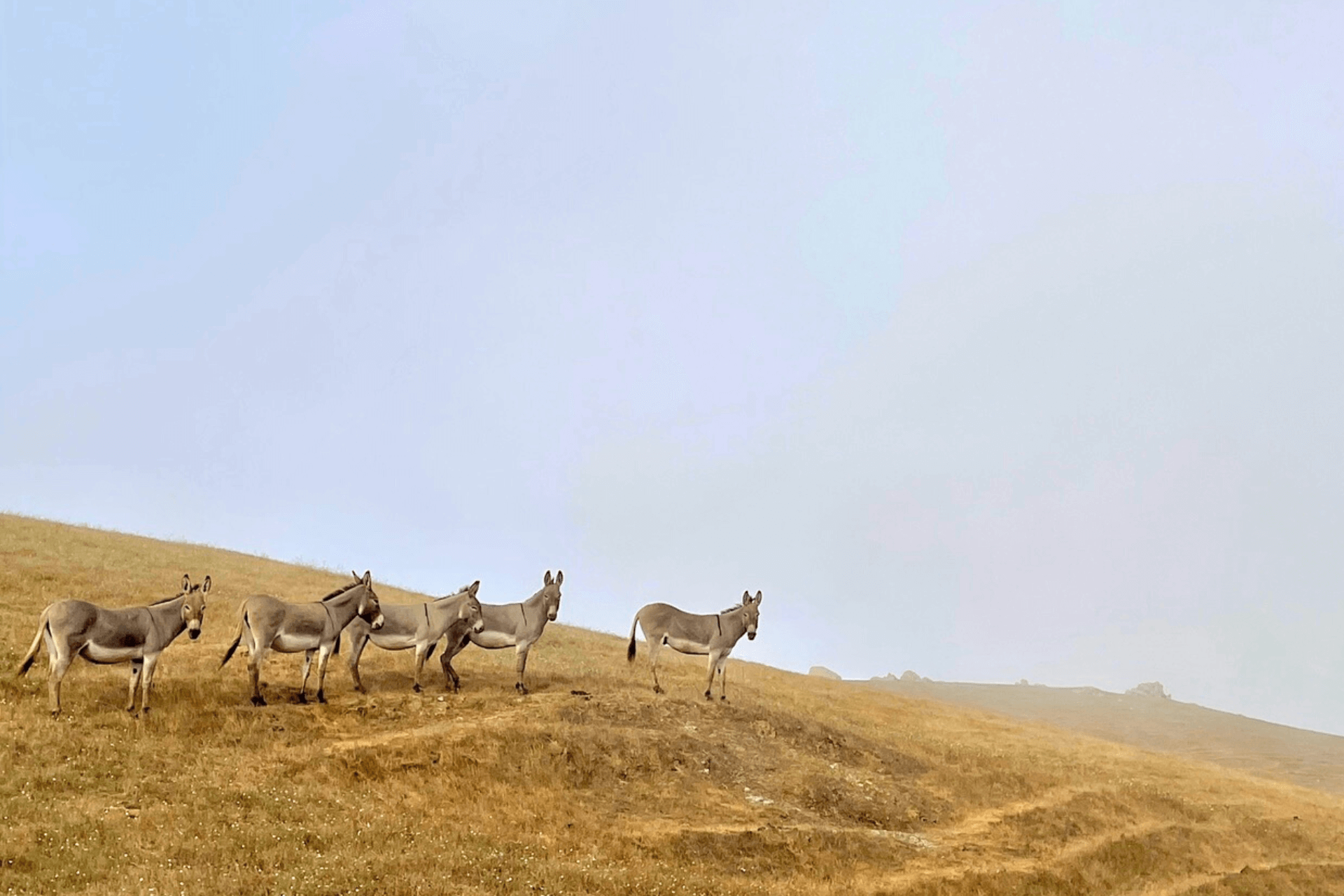
Return to Freedom burros. Photo by Lisa Candela
To maintain their family bands, solutions to expanding herds — whether on private lands or dwindling rangelands — needed exploration. “Reproduction is a reality, and while we agree or disagree as to how our water and grazing rights are allocated on government lands, the horses continue to suffer from capture and separation from their herds and their freedom at great expense to both the taxpayer and the horses themselves,” says DeMayo. “Since 1999, we have sought out the least-intrusive way to manage population growth which would allow the stallions and their harem bands to remain together.”
In 1999, soon after receiving the first horses, DeMayo turned to the Science and Conservation Center in Billings, Montana, and the late Dr. Jay Kirkpatrick, for guidance. Return to Freedom became the fourth fertility-control project in the world, with large numbers of horses overseen by the center.
The vaccine has curbed reproduction at the sanctuary by 91 to 98 percent and mares are living well into their 30s without ill effects. This also allows these majestic mature stallions to remain with their family bands, educate their young and display their natural behaviors so that program participants could better understand horses through sensitive observation.
Advocacy to improve protections for wild free roaming horses and burros both on and off the range remains high on DeMayo’s agenda. Return to Freedom has galvanized support from the Hollywood community to get the message out to the public; some of the celebrities supporting the effort include Return to Freedom board member Robert Redford, singer Carole King, and actors Ed Harris, Wendie Malick, Viggo Mortensen, and Noah Wyle.
Since it’s beginning, Return to Freedom has also advocated for the redirection of funds spent on expensive and traumatic roundups toward viable and minimally intrusive alternatives that would enable wild horses and burros to remain on their designated rangelands, per the Bureau of Land Managment’s 1971 Wild Horses and Burros Act.
“We have to strike a balance that benefits wild horses and other wildlife as well as ranching interests or the conflict over range use and the presence of our wild horses will never end,” DeMayo says. “Congress could change the discussion by creating tax credits or incentives for public-land ranchers who reduce their livestock grazing on designated wild-horse Herd Management Areas and by increasing water and rangeland restoration projects through university and volunteer programs.”
***
In 2015, Return to Freedom was granted the use of a large portion of a 2,000-acre ranch in San Luis Obispo California, provided by the generous and committed Carlson family through Return to Freedom’s Wild Horse Conservator Program.
Two locations are open for guided tours and photo safaris. Guests can photograph and observe the diverse strains of the American mustang and meet “ambassador” horses, such as Spirit, the Kiger mustang stallion who inspired DreamWorks’ 2002 animated feature film Spirit: Stallion of the Cimarron.
“The sanctuary functions as a living history museum so that people can see the important role horses played in the development of our country, as well as their importance as an integral part of the ecosystem,” DeMayo says. “The value of creating a sanctuary is not only to provide refuge for the animals that live there, but to be able to effect change to save thousands more through education.”

Spirit, the Kiger mustang stallion who inspired DreamWorks’ 2002 animated feature film Spirit: Stallion of the Cimarron. Photo by Rich Sladick
The fundamental educational mission of the organization rests on the foundation that horses live in herds, that they are sentient beings, and that they are native to North America. Mitochondrial DNA evidence has shown that equus (a genus family that includes mammals such as horses donkeys and zebras) evolved in North America as far back as three million years ago. However, they fell extinct approximately 10,000 years ago until early explorers reached the continent, bringing with them equus caballus (the modern, one-toed horse) and burros as we know them today.
“The false narrative has to change; it was politically motivated by a powerful livestock ranching minority, to control our resources in the West. With the help of increased social media, regenerative holistic ranching methods are not only receiving more visibility, they are proving to be vital if we are going to shift the increasing desertification in the West,” says DeMayo. “Horses and other hooved grazing animals are all part of the solution, not the problem. We just have to change the way we do things. It’s our responsibility.”
Now, at the two and a half decade mark, DeMayo remains a seemingly tireless advocate. In the coming year, she’ll be focusing on fundraising to improve grazing management and the educational center at the home sanctuary. And, if it’s in the cards, a much larger preserve to expand the model.
Zeroing in on the crux of the matter, DeMayo poses something to all of us: “Is it acceptable to have a future in which there are no wild horses living on their public lands? Return to Freedom contends that public lands are part of our collective inheritance as citizens and that the wildlife, resources, and habitats on those lands — including wild horses and burros — are part of our shared responsibility.”
“We believe our country will be poorer if future generations cannot see wild horses run free.”
Help us sustain independent journalism...
Our team is working hard every day to bring you compelling, carefully-crafted pieces that shed light on the pressing issues of our time. We rely on caring supporters like you to help us sustain our mission. Your support ensures that we can continue to provide deeply-reported, independent, ad-free journalism without fear, favor or pandering. Support us today and make a lasting investment in the future.
RELATED STORIES


Award Winning


Today’s environmental and social justice challenges are unprecedented, and require an unprecedented collective effort.


Stay updated on our latest features, events and more. Subscribe to our Note From the Nest newsletter!
