
The Last Great Restoration

A standing room only crowd at Bozeman Yellowstone International Airport greets my arrival in early August 2019, the sort of now-nostalgic human cluster you’d see at almost any metropolitan air terminal pre-Covid. Here on the doorstep of Montana’s Big Sky Country, though, this small gathering feels cramped. A parade of people with familiar labels on T-shirts, trail shoes and backpacks go by. We may have arrived from many different places, but as I decamp to follow a primal instinct toward the tug of a Yellowstone River cutthroat trout, I realize we’re all here for the same thing: the far-ranging allure of the Rocky Mountains, the proverbial call of the wild.
The geographic connection between where I live in Western Colorado and where I am going fishing rises up from the pastoral Paradise Valley north of Yellowstone National Park to the Rocky Mountain spires surrounding it. Along this great spine of mountains reaching north into Alaska and south through New Mexico is where we find much of what’s left of American wilderness. Over the past few decades, though, Montana has been made a little wilder in a way that Coloradans have only recently begun to take halting steps toward. And now, a reckoning is on the horizon.
In the November election, Coloradans passed a down-ballot measure that would fill a conspicuous void in their wild side by bringing gray wolves back to the state. The measure comes some 25 years after gray wolves had been reintroduced to the Greater Yellowstone Ecosystem in the neighboring Northern Rockies and 75 years since they’d been fully eradicated from Colorado. The narrowly approved ballot proposition instructs state wildlife officials to develop a plan for wolf reintroduction on the public lands of western Colorado by December 31, 2023.
It’s a bold move, aimed at circumventing what wolf advocates believe is the federal government’s premature abandonment of wolf recovery under the Endangered Species Act. The Trump administration recently took wolves off the endangered species list and, aside from ending their federal protection, the delisting ended wolf advocates’ hopes that gray wolves would be reintroduced under the ESA to the Colorado Rockies, widely considered the greatest untapped wolf habitat in the country.
Most of us are brought here by the mountains, the aesthetic and spiritual values we place on the landscape, and that’s made more valuable if all the pieces are intact.
Wolf reintroduction in the West has consistently proved a lightning rod, rendering the region’s geographically aligned cultural divisions in stark relief. The Colorado initiative is complicated by the reality that residents of the state’s populous Front Range largely carried the vote, reflecting what many consider a growing divide between the urban corridor to the east and the more rural Western Slope, where the wolves would actually be living. It could be argued that the Colorado wolf initiative put the state’s values, as well as the wolves, on the ballot.
“It’s not just that people living in cities view things differently than people living in the country. I think it’s that people living life, in a real sense, that’s more akin to that of their ancestors, tend to carry the same values as those ancestors,” said Matt Barnes, a Southwestern Colorado cattle rancher and rangeland scientist who for the past eight years has focused on wildlife conflicts and coexistence. “But ultimately this is about humans recognizing that we live in more than just a human world. I think most people in Colorado value wildness, whether they think of it in those terms or not. Most of us are brought here by the mountains, the aesthetic and spiritual values we place on the landscape, and that’s made more valuable if all the pieces are intact… Some things are impossible to measure, but they are still real, and I think this is one of those things.”
***
In the lore of the American West, there may be no more storied presence than that of the gray wolf. Canis lupus is both apex predator and historical pariah—a powerful symbol of untamed wildness and an enduring challenge to man’s dominion over nature, or at least as it has been defined by our frontier mythos. Among the gray wolves’ ability to influence the systems they inhabit, their infiltration of the human psyche is arguably the most significant, filling our souls with visions at once intimidating and intoxicating.
Rarely encountered, even by those of us who call ourselves Westerners, they remain perhaps the most polarizing species in the nation, a catalyst for controversy sparked by myths, emotions and fanaticism. Even as an abstract, clearly we remain infatuated, if not obsessed, with wolves. Yet, maybe we’ve been focused on the wrong myth.
Consider first the myth of the big, bad wolf, which leading experts will tell you is as wrong as it is strong. Threats to human safety have long since been dismissed, supplanted by recognition of the benefits wolves bring to our environment. Rather than the menacing killing machines of legend, ecologists suggest we view gray wolves as a vital cog in an ecosystem that grows increasingly out of balance in their absence.
“Everything that we see, all of the diversity of life, no matter if it’s a blade of grass or a tree or a hawk, it’s all built on the notion of, ‘How can I better survive?’ Common sense dictates that a system that is complete and has rich integrity has to be in the best possible position to survive. But, my lord, we live in a country of ecological illiterates,” says Mike Phillips, a Bozeman-based conservation biologist who, from 1994-1997, served as project leader for the National Park Service during the wolf restoration effort in Yellowstone National Park. “The mythical wolf is what gets in the way. People think gray wolves have this supernatural ability to exercise their predatory will on a whim and that everywhere they go, they leave waste and desolation as these wanton killing machines. Nothing could be further from the truth. Every day they struggle, failing seven, eight times out of every 10 hunts. Starvation is a common cause of death. In Montana, the average age of a gray wolf is three years.”
There are, of course, extenuating circumstances. Although reintroduced there as an endangered species in 1995, Montana has pushed its gray wolf population pretty hard since the animals were dropped from the endangered species list throughout much of the Northern Rockies in 2011, having met the scientifically debatable, but politically tenable recovery benchmarks as an “experimental/non-essential” species. As a result, gray wolves are now hunted in Montana, Idaho and Wyoming, accounting for more than 600 kills last year. In places like Yellowstone National Park, where roughly 90 resident wolves remain protected within park boundaries, the average lifespan might extend to eight or nine years.
“But it’s a really difficult existence,” Phillips says. “And they’re really so easy to coexist with.”
They might be, but doing so would require confronting a different legend that has stacked the odds against wolves for more than a century. Erudite wolf activists often view prevailing anti-wolf sentiment as an extension of what’s known as the Frontier (or Cowboy) Myth that has long shaped resource use in the American West. Although the West has evolved considerably since the homestead era of the 1800s, many entrenched beliefs and libertarian values of early settlers have remained largely intact, including a strong belief that human dominion over nature is good and vested in God’s will.
To modern adherents of the Frontier Myth, wolf restoration equates to reincarnation of a contemptible enemy, a reversion to the wilderness their ancestors fought to tame, largely by raising cattle and killing wolves. Though often couched in language about the economic hardships that will ensue when wolves come in and start killing livestock, many believe the real issue is that wolves represent a challenge to traditional Western lifestyles and a loss of control over the land, never mind the federal government or some other “outsider” trying to tell these pioneers how to manage their home on the range. Ultimately, wolves are seen as an insult to their heritage.
“That’s the real source of the conflict. The number of cattle actually killed by wolves is so small relative to the amount of social conflict around wolves that it just doesn’t make any sense. The only reason for the amount of conflict about wolves is that it’s just antithetical to the world views and values of the ranching world,” said Barnes, who put his master’s degree in range science to work with the U.S. Department of Agriculture for several years before running a cattle ranch just west of Gunnison, Colorado.
“We look back on the last 100-200 years of Western history and see it as this heroic thing, taking credit for developing the landscape. But there are some wrinkles in that narrative. We know that humans had lived on this landscape for thousands of years before white settlers came and they managed to get along with wolves. It wasn’t until we arrived and essentially stole the land to develop a livestock industry that we had conflicts with wolves… So the wolf restoration tends to get taken as a repudiation of their entire world view, and I think that’s what the conflict is really about.”
The hackle-raising quarrel over the gray wolf’s place in the West rose to a new level during Colorado’s recent election. The ballot question known as Proposition 114 was straightforward enough: Do you or don’t you support reintroduction of gray wolves on public lands west of the Continental Divide in Colorado? Yet there was an unwritten subtext to the initiative that blurred the black-and-white ballot question and ultimately asked the state’s citizens to consider something significantly more. Beyond balancing the ecosystem, approving the reintroduction of gray wolves signals a shift in Colorado’s balance of power.
***
Colorado has always served as a major American frontier, whether as an intersection of expansive Hispanic and Anglo American societies or a biological meeting place for animal species converging among a mosaic of mountain, prairie and semi-desert ecosystems. The cultural rift raised by the prospect of reintroducing gray wolves adds a new sociopolitical layer to the landscape.

Canis lupus Gray Wolf next to a road
While public polling has consistently favored wolf reintroduction since the early ‘90s, Proposition 114 ultimately passed by fewer than 60,000 votes. A slim majority (51 percent) of voters still believes Western Colorado needs wolves in order to restore the balance of nature. Others maintain that the gray wolf’s time in Colorado has already come and gone.
As they had in every other state in the U.S., along with Canada and Mexico, wolves previously thrived in Colorado’s Southern Rocky Mountain ecoregion for thousands of years. And, as with everywhere else south of the Canada border, decades of persecution by homesteaders, government trappers, bounty hunters and ranchers shot, trapped and poisoned the wolf to the brink of extinction. The Endangered Species Act was signed into law in 1973 and the gray wolf was listed as endangered in 1974. Twenty years of conflict and compromise later, wolves were brought back to the Northern Rockies under a limited application of the Endangered Species Act.
This (was) the last resort. We did our due diligence over a quarter-century. The only way we were going to get this done (was) to go to the ballot.
Colorado by then had long since done away with its wolves in order to make the region “safe” for livestock, people and progress. A state hunter in Conejos County, near the border with New Mexico, killed Colorado’s last known wild wolf in 1945, arguably rendering the landscape biologically and ecologically incomplete. That argument has gained strength in the years following the successful reintroduction of gray wolves to the Northern Rockies in 1995 and the more recent subsequent delisting of gray wolves as endangered in Montana, Idaho, Wyoming and portions of Oregon, Utah and Washington.
Meanwhile, a tenuous and ongoing effort to restore Mexican wolves to Arizona and New Mexico leaves Colorado as the lone gap in a chain linking restored wolf populations along the spine of the Rockies from the high Arctic to the Mexican border.
For the moment, gray wolves remain a federally protected species in Colorado, although with the nationwide population now exceeding 6,000, the Trump administration — on election day — published a rule that removes gray wolves entirely from the federal Endangered Species list, effective January 4, 2021. Previous federal attempts to completely delist gray wolves have routinely run into legal challenges, and that pattern is expected to continue. Regardless of what happens on the federal level, the species remains listed as endangered under Colorado state law.
Wolf advocates expect they will once again be successful in overturning the Trump administration’s delisting because the Endangered Species Act typically mandates restoring listed species where suitable habitat exists and restoration is feasible to meet recovery goals. In order to appease opponents, however, gray wolves were reintroduced to the West with more modest recovery goals than many advocates are comfortable with.
The correct number of wolves in the West may be debatable, but what is more clear is that with some 17 million acres of federally managed public lands supporting deer and elk herds numbering more than 700,000 on large swaths of wilderness, Western Colorado is eminently suitable habitat. The nation’s leading wolf biologists consider the region “a gold mine of opportunity,” even better than the Greater Yellowstone Ecosystem where reintroduction has exceeded recovery objectives with some 500 wolves sustained by about a third of the prey biomass and two million fewer acres of habitat to roam than available in Western Colorado.

Photo Courtesy: Rocky Mountain Wolf Project
Although opponents of wolf reintroduction argue that the state’s burgeoning human population of 5.8 million is certain to increase conflicts between wolves and people, the reality is Western Colorado compares favorably with the Northern Rockies. Only about 15 percent of Colorado’s population resides west of the Continental Divide. Along with the mountains and river valleys, public lands define both regions—a mixed portfolio of productive Bureau of Land Management (BLM) acreage and national forests linking rural ranching communities, second-home ranchettes and tourist-town attractions ranging from ski areas to golf courses, hot springs resorts, hunting and fishing lodges, and the like. With public wildlands spanning from New Mexico to Wyoming, Western Colorado has long been viewed as the Holy Grail of wolf restoration.
Yet, the U.S. Fish and Wildlife Service, which administers the Endangered Species Act, maintains that gray wolf recovery is complete and has resolutely refused to pursue reintroduction in the state. That decision ultimately triggered wolf advocates to seek reintroduction by other means—using the ballot measure to route reintroduction efforts through state-based authorities.
“The only way a state is likely going to jump into the deep end of the wolf recovery pool, even an administration that might be as inclined as the (Colorado Governor Jared) Polis administration, is they have to be pushed. And there’s only one way to push an administration into action. That’s a vote by the electors,” said Phillips, whose current roles as director of the Turner Endangered Species Fund and member of the Montana State Legislature for 15 years, uniquely qualifies him for his role as an advisor to the two partner groups behind the push for wolf reintroduction in Colorado. “So we’ve been working on what is now the Rocky Mountain Wolf Project and the Rocky Mountain Wolf Action Fund since late 2013, all with the aim of giving Coloradans a chance to say ‘we do’ or ‘we don’t’ want wolves to be a part of the state’s future.”
The ecological and political significance of this unprecedented vote to restore a species to its native habitat can’t be ignored. Direct democracy has never been applied to the Endangered Species Act before, and this experiment carries with it potentially revolutionary ramifications on the prevailing standard of representative democracy when it comes to wildlife management. Rob Edward, the Boulder-based president of the Rocky Mountain Wolf Action Fund believes that putting wolves back on the ground by first putting them on the ballot is as much a social change movement as it is an environmental movement. “This (was) the last resort. We did our due diligence over a quarter century,” Edward said before the election. “The only way we were going to get this done (was) to go to the ballot.”
***
For more than a century now, U.S. wildlife management has fallen to appointed bureaucrats serving on wildlife boards and commissions tasked with making decisions ostensibly based on science and public input. The system is founded on what’s known as the North American Model of Wildlife Conservation, championed by the likes of Theodore Roosevelt and Aldo Leopold in response to the near extinction of several native species. Although it has no formal legal powers, the widely accepted model is built around the principles that fish and wildlife are held in the public trust for all people and should be managed at optimum population levels, with science recognized as the proper tool to discharge wildlife policy. States serve as trustees of wildlife, with appointed commissions making policy decisions and overseeing agencies like Colorado Parks and Wildlife (CPW).
Therein lies the rub.
Here in the West, the makeup of state commissions has led to accusations of wildlife management becoming increasingly politicized, thereby undermining the science-based foundation. While hunters and anglers rightfully claim credit for funding wildlife management through license fees and excise taxes, reputable science-based organizations like The Wildlife Society have criticized policy makers for favoring game species like elk and mule deer at the expense of predators.
This is largely in deference to hunters and ranchers who benefit from disproportionate representation on boards like Colorado’s Parks and Wildlife Commission. CPW itself relies primarily on funding from hunting license sales and depends upon cooperation from ranchers for things like hunter access, creating a potential conflict if a threatened or endangered species should hinder hunting success and license income.
There are pertinent details in Proposition 114 to address the science behind the reintroduction of gray wolves to Colorado, including a clause delegating authority to develop the management plan to CPW using stakeholder input and the “best available science.” Now that voters have approved the measure, the agency will have three years to develop a management plan launching the effort. Funding for the anticipated $5.6 million, eight-year program will come from a mix of federal and state sources and, as with other Western states, will include a compensation program for livestock losses caused by wolf predation. Should gray wolves remain under the protection of the Endangered Species Act, state officials also will be required to consult with the U.S. Fish and Wildlife Service.
Although CPW takes no formal position on the reintroduction effort, it’s worth noting that big game herds have generally increased in size since gray wolves were reintroduced in the Northern Rockies. Still, hunter advocacy groups like Safari Club International and the Rocky Mountain Elk Foundation were among the fiercest opponents of Proposition 114, labeling it “ballot-box biology” and condemning the plan as an assault on traditional wildlife management in North America. Despite Colorado’s claim to the largest elk herd in the nation and a majority of game management units currently meeting or exceeding herd objectives, hunting outfitters fear that wolves will kill so many elk and deer that the state will be forced to reduce hunting licenses.
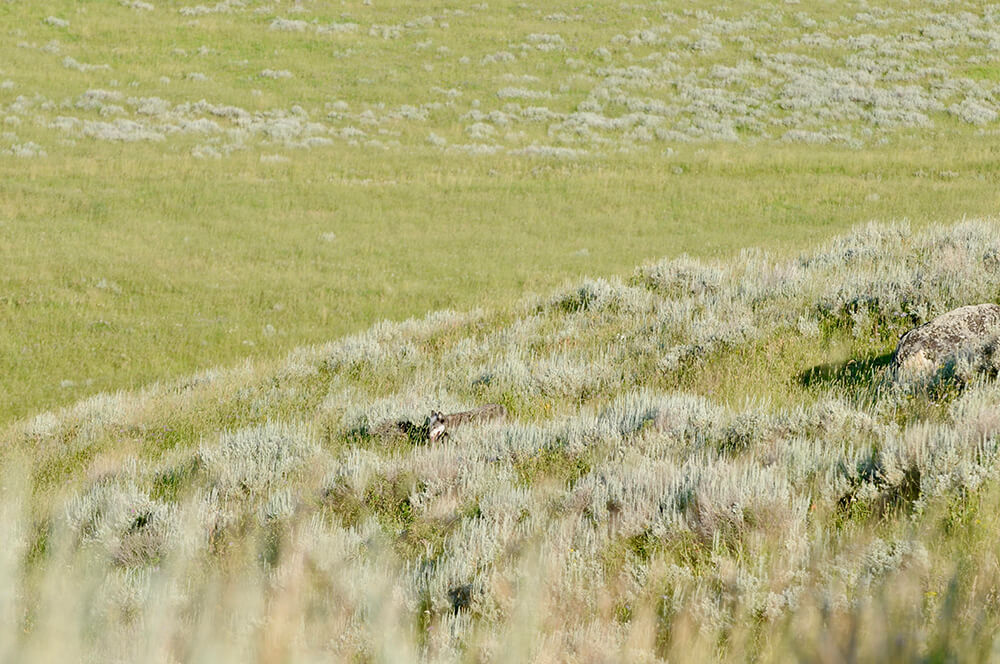
Wolf on the high plains, near Yellowstone River, Montana. Photo by Scott Willoughby.
Certainly gray wolves will have an impact on the land and wildlife resources in Western Colorado as well, but researchers at Colorado State University’s Warner College of Natural Resources recently concluded that any impact on big game populations or hunting opportunities is likely to be minor and that the low percentage of livestock mortality caused by wolves translates to a small economic cost to the industry as a whole. The threat posed to ranchers and hunters by wolves is one of influence, or the perceived diminishing of it.
“The ranching community in the West has had a lot of power. Part of that is because ranching has been a huge part of the economy out here. Land is capital. Livestock is capital. Having a lot of both can give you power. But the West is changing,” says Mark Harvey, a wolf advocate whose family has raised cattle on three ranches around Colorado for the past 60 years. “I love the Western culture, a lot of it, and I don’t think we should lose it. But I just think we have to take a look at the times and have a modern mindset. A lot of Coloradans believe that we’re way out of whack with our ecology, our environment. And wolves can do a little bit to help that.”
Having a modern mindset is easier said than done. Public land ranchers, many of whom also profit immensely from big game hunting, have held almost undisputed political power throughout much of the region since statehood. Western Colorado is about 70 percent public land, and the ranching establishment has long enjoyed preferential treatment by federal, state and local officials in the form of leveraged opportunities to exploit our collective natural resources through subsidized grazing fees set at rock-bottom prices along with favorable land-management decisions that offer livestock grazing on 80-90 percent of the region’s public lands despite the acknowledged negative impacts to vegetation, wildlife and endangered species.
The notion of urban recreationists and tree-huggers wresting away some of that political sway through a statewide vote to determine public land use generally does not sit well with the community that has dominated that resource for so long. “In the ranching world, we have probably way more influence per person than anywhere else in the country. If you’re a Westerner and in the livestock industry, you have a lot of social clout and a lot of political clout that goes along with that,” says Barnes, the rangeland science and coexistence expert. “Those of us who have a hand in the ranching world have to be careful how we use that clout. It can be used for benefit in some ways, but also in ways that alienate the larger public that are consumers of our product. In this case, the larger public that wants wolves.”

Mike Phillips, former Yellowstone National Park Wolf Restoration project leader and current Montana State legislator, near Bozeman, MT. Photo by Scott Willoughby.
Or, as Mike Phillips, the Montana state legislator who helped lead wolf reintroduction in the Northern Rockies puts it, “People get all caught up in the notion of private rights. And private rights are important, but in this country, so, too, are public rights. These laws are a manifestation of collective desire. And if the collective that owns something — a piece of land — says we want gray wolves on our public lands, and that then becomes a challenge for a rancher, well, there are challenges in life.”
Adds Phillips, “And I would say to the rancher who is challenged, what system would you want governing the use of that public resource? If not one that has, at least theoretically, the capacity to capture a collective ideal and bring it to life—if not that system, what system do you want? Give me an alternative, mindful that this asset we are talking about is publicly owned.”
***
Opponents of reintroduction found their best answer to that question when CPW this year confirmed a pack of six gray wolves in Moffat County in northwest Colorado along the Wyoming and Utah borders. There have been numerous reports of lone wolves along the borderlines in recent years, but this “Pioneer Pack,” as it’s been dubbed, is the first that seems to be staking a claim in Colorado. “Wolves are here, and they are going to naturally reproduce,” Scott Axton, Colorado chapter president for Safari Club International, surmised following the report. “They are federally protected, so we just don’t need to add more to the mix.”
Putting his biologist hat back on, Phillips disputes that assessment, pointing out that it has taken a quarter century for the first breeding pack of wolves to make its way from the Northern Rockies to Colorado. Phillips and other veterans of wolf restoration consider 25 wolves a more realistic starting point to establish a population. His team would propose releasing between 30-40 over the course of five years, spreading them out in an effort to keep them from straying off for a while.
We can choose to be restorative in nature rather than exploitive.
Moreover, individual wolves from the Northern Rockies that have roamed south are invariably either found dead or simply disappear without a trace. Three wolves were shot and killed this summer just beyond the Colorado border in Wyoming. Their killing underscores a point advocates have made since undertaking this campaign: due to a predator management plan in Wyoming that allows any wolf to be shot on sight just about anywhere outside Yellowstone National Park, it’s nearly impossible to envision enough breeding pairs surviving the 400-mile “firing line”, as Phillips calls it, between there and Northwest Colorado to reestablish a population on their own.
And yet they try, driving home Colorado’s importance to scientists as the pivotal final piece of North America’s restoration puzzle at a time when humans are pushing tens of thousands of species to the brink of extinction. The very fact that wolves are so determined to risk their hides to repopulate the Southern Rockies on their own would seem to demonstrate both the biological connectivity of the broader landscape and the need for them to inhabit it.
“When you think about that just from a connectivity standpoint and landscape conservation, if you can establish a population of gray wolves in Colorado, it will be the archstone connecting gray wolves from the high Arctic to the Mexican border. That’s a really compelling ecological narrative,” Phillips said. “That’s why it’s fairly considered, I suppose, the last great restoration campaign. I think it illustrates that restoration is an alternative to extinction. And in this day and age, that illustration is sorely needed. It reminds us that we can choose to be different. We can choose to be accommodating. We can choose to be restorative in nature rather than exploitive.”
The people of Colorado have made their choice.
-
Canis lupus Gray Wolf next to a road
-
Photo Courtesy: Rocky Mountain Wolf Project
-
Wolf on the high plains, near Yellowstone River, Montana. Photo by Scott Willoughby.
-
Mike Phillips, former Yellowstone National Park Wolf Restoration project leader and current Montana State legislator, near Bozeman, MT. Photo by Scott Willoughby.
Help us sustain independent journalism...
Our team is working hard every day to bring you compelling, carefully-crafted pieces that shed light on the pressing issues of our time. We rely on caring supporters like you to help us sustain our mission. Your support ensures that we can continue to provide deeply-reported, independent, ad-free journalism without fear, favor or pandering. Support us today and make a lasting investment in the future.

RELATED STORIES


Award Winning



Today’s environmental and social justice challenges are unprecedented, and require an unprecedented collective effort.


Stay updated on our latest features, events and more. Subscribe to our Note From the Nest newsletter!


Scott, I could hardly get through your wonderful article because I was sobbing! I have been an advocate for the wolf for a long, long time. I pray their time is here again! Thank you so much! Sherry Luhman
It really came down to a vote between the educated and the poorly educated. The anti wolf crowd are the same people who still think Q-Anon is real and covid was a hoax