
Think Small
A slow-motion catastrophe. An existential threat. An extinction-level event. The onset of the Anthropocene. It’s hardly surprising that people reach for weighty, oracular phrases to characterize what is, after all, the defining calamity of our age: climate change.
“Defining” because so many of our most pressing social, political and ethical issues are (or ought to be) shaped by the effects, both enormous and subtle, of a rapidly warming planet. Millions of people are uprooted from their homes and sometimes their countries by what the United Nations Human Rights Council terms “climate-related displacement”; Brobdingnagian wildfires plague multiple continents; temperatures rise beyond what humans and other creatures, both great and small, have evolved to withstand; infrastructure everywhere is stressed, straining or in need of re-imagining on a gobsmackingly expensive scale. These are just a few examples of the fallout. And yet, people everywhere — in particular, the world’s putative leaders — are stuck, going nowhere, mouthing the right words, signing the right protocols, and in practical terms, falling short of the minimum daily requirements for treating a planetary health crisis.
All of which begs the question: How do we solve the problem of inertia? How do we realistically address an issue that appears so stubbornly, scarily beyond our collective grasp? As it happens, Elizabeth Kolbert’s new book, H Is for Hope: Climate Change From A to Z, offers a potential and, in light of the scope of the threat, a counterintuitive prescription. Namely, one small, deeply informed, determined step at a time.
A Pulitzer-Prize winner for her 2014 book, The Sixth Extinction: An Unnatural History, a two-time National Magazine Award honoree and longtime environmental writer for the New Yorker, Kolbert certainly has the pedigree to tackle the topic. What’s surprising, then, about H Is for Hope is … well, almost everything.
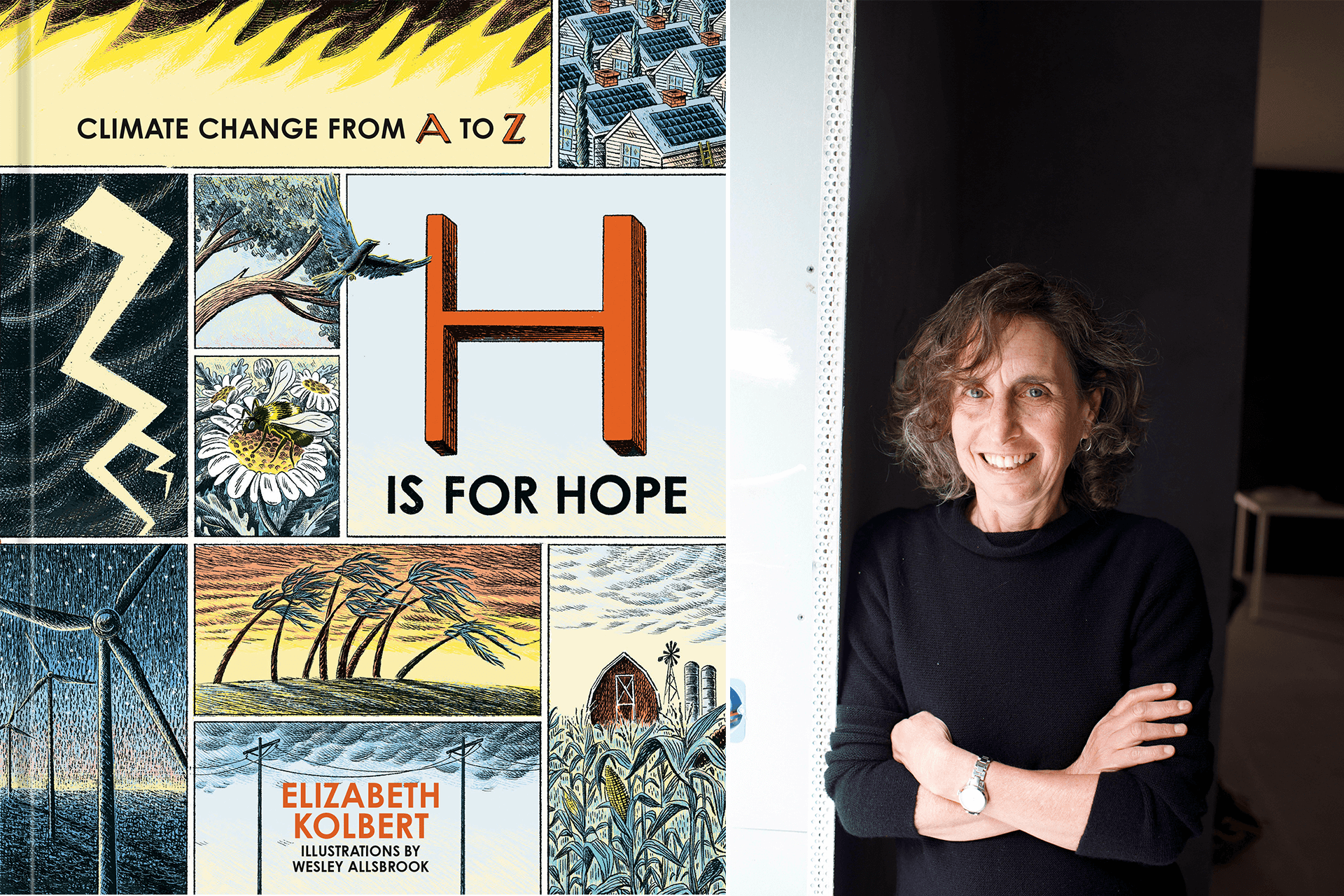
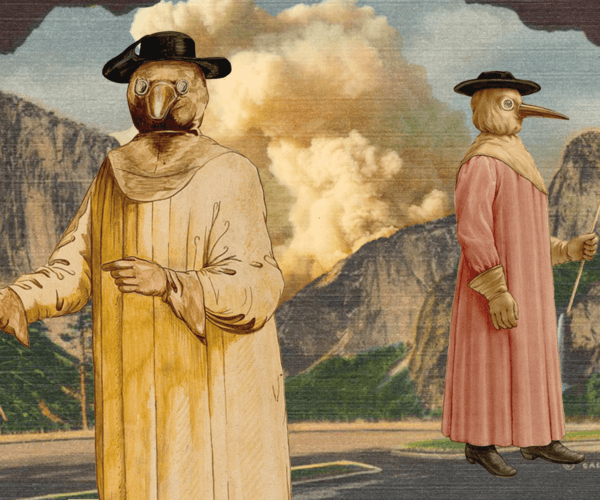
Illustration by Wesley Allsbrook ©
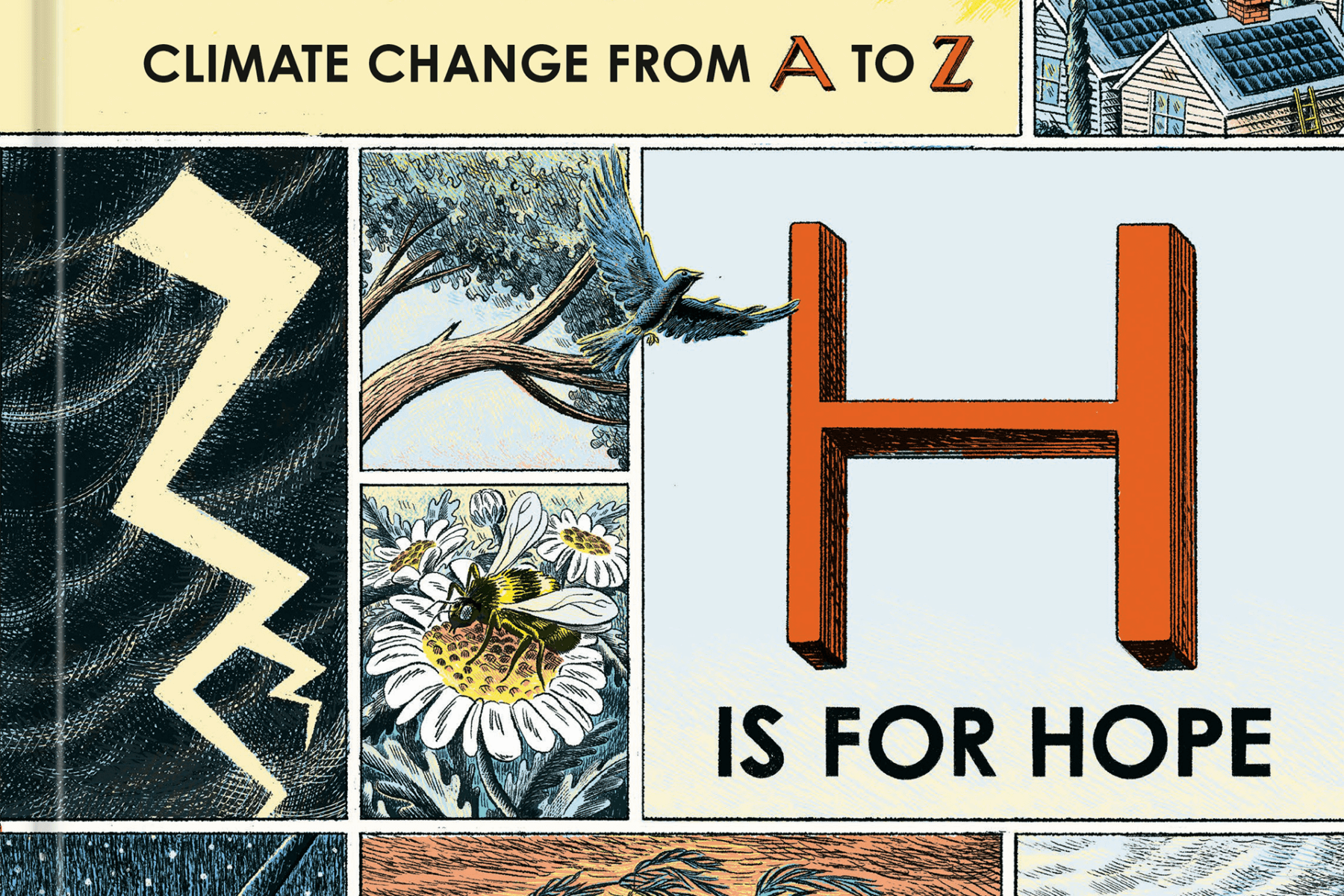
Consider, for a start, the look and feel of the book. From a writer and reporter of Kolbert’s stature, one might expect another solid, Cassandran work along the lines of The Sixth Extinction or 2021’s Under a White Sky. But even before glancing inside, the reader is struck by Wesley Allsbrook’s (@wesleyallsbrook) illustrations on the book’s dust-jacketless cover. We catch something of kids’-book vibe from the pictures, drawing from the powerful visuals of old-school classics like Mike Mulligan and His Steam Shovel, perhaps, or Mary Azarian’s marvelous work for Jacqueline Briggs Martin’s 1999 Caldecott winner, Snowflake Bentley.
In short order, though, it’s evident that Allsbrook’s uncanny, woodcut-inflected illustrations hint at something deeper. Something curiously, uncomfortably urgent.
Open the book, and Kolbert’s literal A-to-Z approach is immediately apparent. H Is for Hope comprises 26 chapters, ranging in length from a single page of text with a couple illustrations to three or four pages with multiple illustrations, with one notable outlier clocking in at eight words and a lone illustration. A motivated reader could finish the book in a sitting. But that would, in a real sense, dilute its power and its appeal. In fact, each chapter’s brevity invites us to take H Is for Hope as it’s offered — in one, or two, or maybe three small, sustaining portions at a time.
When approached sequentially or randomly, each chapter and topic stands on its own. In that sense, H Is for Hope resembles a beautifully illustrated monograph — a work of manifest complexity, on a single topic, presented in chapters ranging in tone from sober to chilling, from quietly furious to near-whimsical.
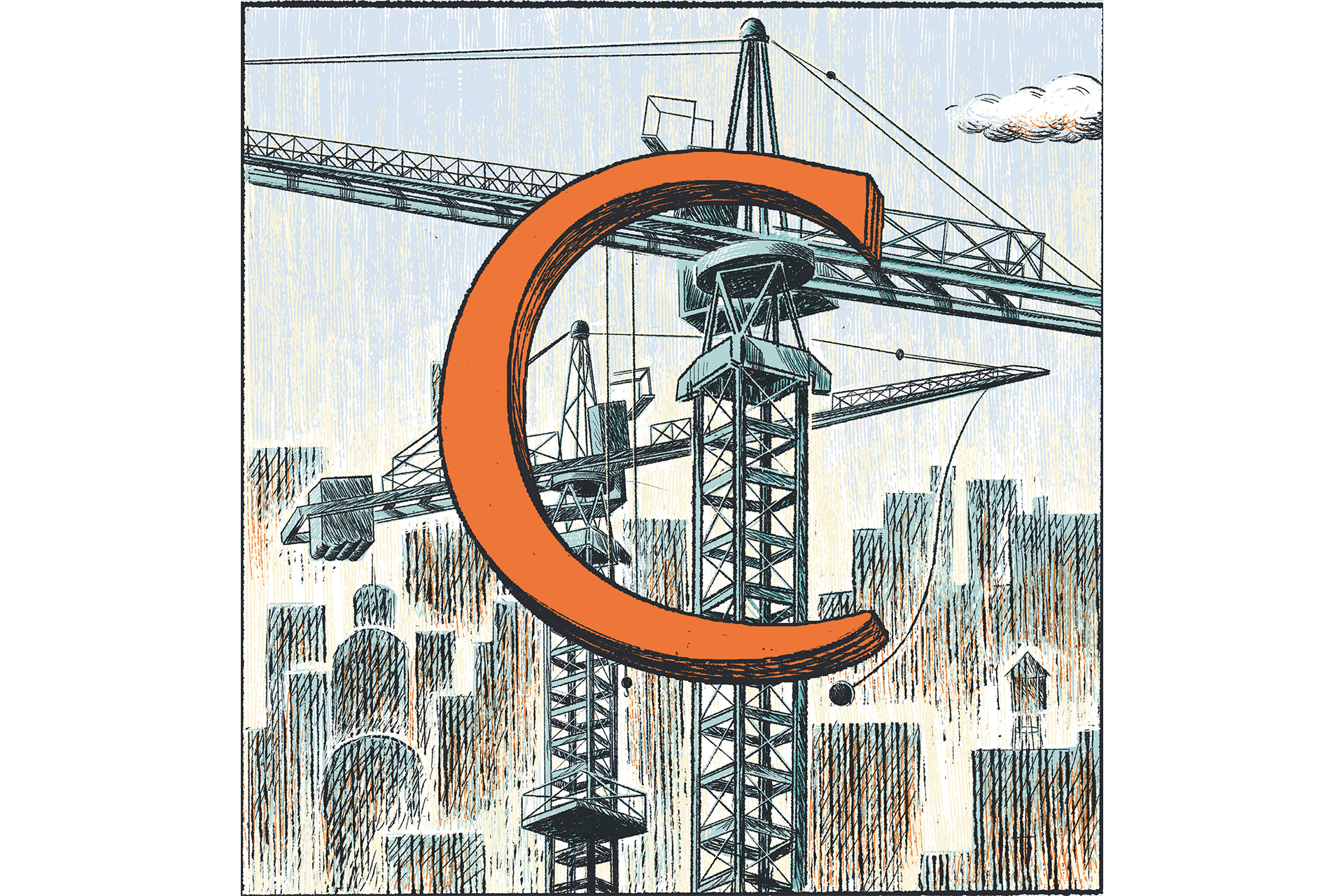
Illustration by Wesley Allsbrook ©
What the book is not, despite its chipper title, is a litany of feel-good stories. Sure, the narrative is not unrelentingly bleak. Yes, there are some relatively uplifting chapters. But Kolbert is about as Pollyannaish as a grizzly bear, and her hard-won, tough-minded understanding of climate change ensures that some of the book, while never entirely hopeless, makes for pretty grim reading.
In the S chapter, titled “Shortfall,” Kolbert outlines the way that the world’s five largest greenhouse-gas emitters — China, the US, India, the EU and Russia — pay earnest lip service to the goal of a net-zero future while barreling ahead with the construction of new coal-fired generating plants, for instance, or the reopening of dormant coal mines. At the same time, they (translation: we) shy away from enacting meaningful legislation or enforcement mechanisms that reflect a true understanding of, or the commensurate alarm about, the crisis at hand.
What’s more, Kolbert notes, “The broken promises extend in all directions.”
At COP26, held in Glasgow in 2021, a hundred and forty countries vowed to put a stop to “forest loss,” another major source of greenhouse-gas emissions. (A single full-grown tree can store as much as seven tons of carbon.) Among the signatories … was Brazil; in the six months following the conference, deforestation rates in the country soared to new highs.
Leaving aside that bit about full-grown trees’ carbon-storing capabilities (Seven tons?! Humans don’t deserve trees.), the image of self-satisfied climate conference attendees publicly celebrating their commitment to the cause, and predictably bailing on their promises the moment the conference ends — if not sooner — is at-once familiar and riling.
On a more intimate, and consequently more visceral level, in the T chapter, Kolbert discusses how people in places like South Asia and the Persian Gulf are already enduring temperatures close to the human “survivability limit.”
According to a recent study, two hundred and seventy-five million people around the globe are subjected to life-threatening temperatures at least one day a year, and this number could easily grow to eight hundred million by the middle of the century… In the summer of 2023, heat record after heat record fell. In the city of Ahvaz, in western Iran, the mercury hit a hundred and twenty-three degrees, and in Sanbao, in northwestern China, it reached a hundred and twenty-six degrees. Phoenix saw a hundred and eighteen degrees, Tucson a hundred and twelve …
And so it goes. Amidst the dread, Kolbert does unearth stories and trends — largely driven by cogent data — that feel like oases in a thrashing sea. The E chapter, “Electrify Everything,” for example, finds Kolbert on a boat 15 miles off the coast of Rhode Island, visiting the Block Island Wind Farm, America’s first up-and-running offshore wind operation.
“BIWF2 is a wind turbine that sticks up out of the Atlantic Ocean,” she writes of one of the farm’s colossal machines.
[BIWF2] is six hundred feet tall, which is taller than the Washington Monument, and its blades are more than two hundred feet long…. The captain maneuvers right up to the metal stanchions that hold the turbine in place, so the blades are rotating directly overhead. They make a fantastic whooshing sound that builds and fades, builds and fades. The effect is at once thrilling and terrifying, as if some gigantic bird were trying to land on the deck…. Staring up at the blades, I am looking into the future—or at least a future—and it’s inspiring.
I’ve been there, too, on a boat directly beneath one of the Block Island turbines — fishing, not researching — and Kolbert’s description is on the nose. When seen and heard and felt up close, the sheer scale of the venture’s five turbines (far from the largest in the world, by the way) and the audacity of their conception and construction are “thrilling and terrifying,” indeed.
Illustration by Wesley Allsbrook ©
At another point, Kolbert puts the sense of possibility and the admiration of human ingenuity that she touches on throughout the book in plain, stirring terms: “Go looking for hopeful climate stories and they turn up everywhere.”
That more of the chapters here elicit unease, fear, anger or a kind of fuming resignation than a sense of confidence or cheer doesn’t negate the buoyancy that, like an unexpected guest, animates so much of the book. In this light, an oft-cited quotation from the Anglo-Irish Arctic explorer, Sir Ernest Shackleton, optimism is true moral courage, sounds about right.
Will one book save the world? No. (Sorry, fans of the Bible, the Koran, the Upanishads, Atomic Habits, Dianetics.) But some books can serve as psychological and intellectual speed bumps. Or, a series of speed bumps. They jolt us, caution us, remind us that we’re here, now, and while our machines and devices and networks might be on cruise control, we don’t have to be.
“Go looking for hopeful climate stories and they turn up everywhere.”
In a late chapter of H Is for Hope, Kolbert provides us one of the book’s most effective jolts. “For the last thirty years — more if you go back to 1965 [when a report from Lyndon Johnson’s Science Advisory Committee first warned of the threat posed by carbon dioxide from fossil fuels] — we have lived as if someone, or some technology, were going to rescue us from ourselves. We are still living that way now.”
The passing decades have not changed the essential fact: no one is coming to save us. For better or for worse, it’s up to us. And if that’s not just about the most thrilling and terrifying prospect imaginable, well, what is?
Help us sustain independent journalism...
Our team is working hard every day to bring you compelling, carefully-crafted pieces that shed light on the pressing issues of our time. We rely on caring supporters like you to help us sustain our mission. Your support ensures that we can continue to provide deeply-reported, independent, ad-free journalism without fear, favor or pandering. Support us today and make a lasting investment in the future.

RELATED STORIES


Award Winning



Today’s environmental and social justice challenges are unprecedented, and require an unprecedented collective effort.


Stay updated on our latest features, events and more. Subscribe to our Note From the Nest newsletter!
