
White Light, White Heat
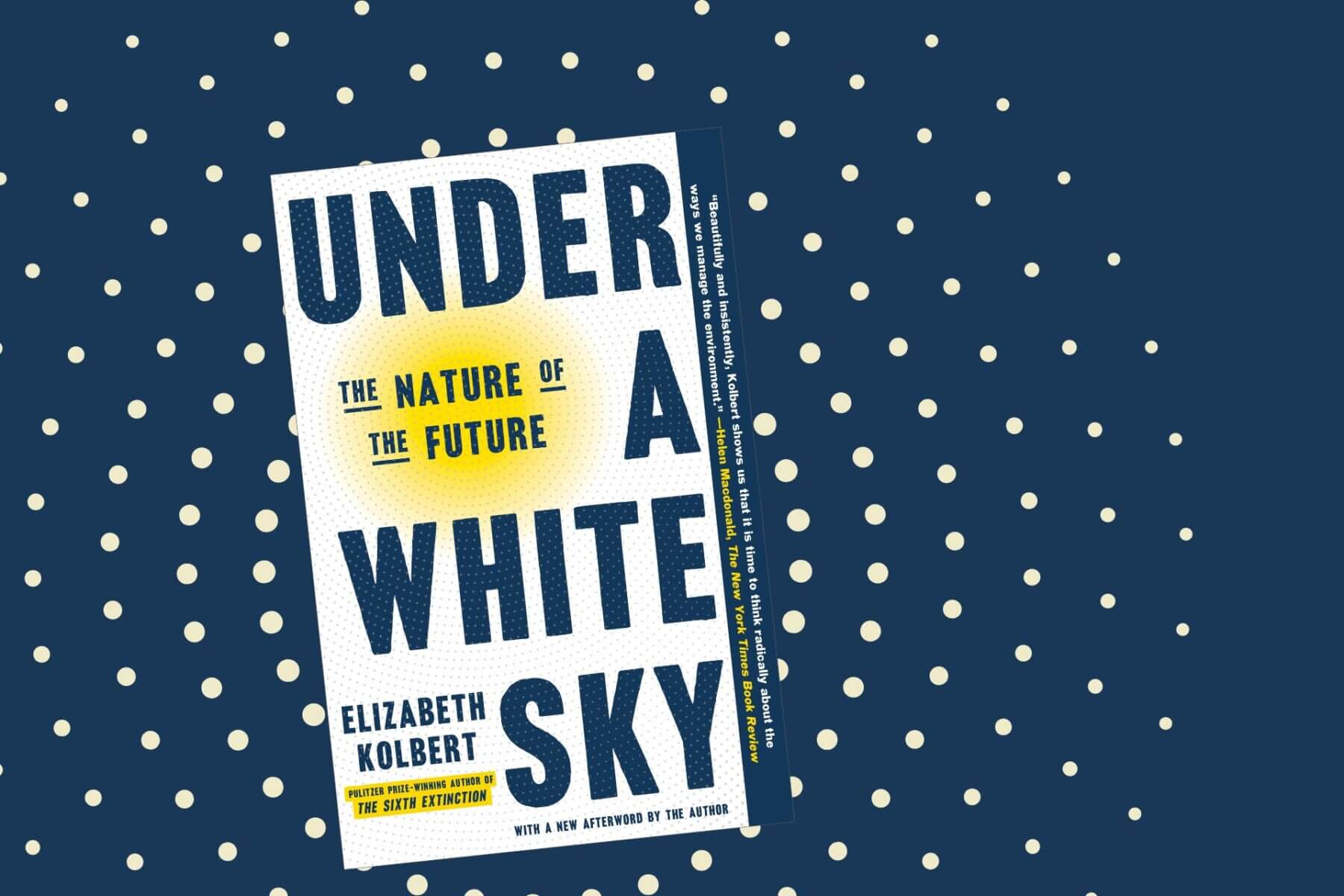
Elizabeth Kolbert is among the nation’s preeminent chroniclers of the imperiled relationship between the third rock from the sun and the living creatures it supports. Or, at least, has supported, for the past many millennia.
Kolbert is a skilled reporter, brilliant travelog-ist, and such a sound and curious inquisitor that it is easy to read her New Yorker articles (she’s been a staff writer since 1999) and her books (including Field Notes from the Catastrophe, and the Pulitzer Prize winning, The Sixth Extinction) and be completely taken with her wordsmithing, ideas, and access while simultaneously scared and stunned by the startling content between the covers.
 In her most recent book, Under a White Sky: The Nature of the Future (2021), the author traveled across continents visiting places such as Australia, Iceland, the Mojave Desert and a sewage canal in Chicago while meeting with biologists, physicists, engineers and others who just might (or, might not) have the technological prowess to save imperiled species. Whether that species be a coral reef, the world’s smallest fish or humans, everything — bioengineering, geoengineering, genetic engineering, carbon capture — is on the table, everything is complicated, and much of the writing would sound right at home in an absurdist comedy, not an environmental book. It’s no coincidence that Kolbert quotes Franz Kafka early on.
In fact, the book’s title is a reference to what might happen if a solar-engineering plan works and we successfully launch tiny particles into Earth’s atmosphere to reflect away some of the sun’s rays. One small side effect: our blue skies turn white.
As the book points out time and again, our technologies are in great part what got us into this mess in the first place. So, will doubling down work? Or, will Kolbert’s collected works turn out to be existential eulogies?
On an early summer morning, Kolbert spoke by video chat with Red Canary Magazine about White Sky and the least-bad options in front of us. This interview has been edited for length and clarity.
Here’s a composite of my reactions while reading White Sky: “We’re doomed. Wait, here’s a solution. We’re saved. Wait… chaos theory… unintended consequences. We’re doomed again.” Is that a fair reading?
I think that’s a pretty accurate reading.
How do you keep producing such beautifully written works while chronicling these existential woes?
It’s not unique. People are out there reporting on the war in Ukraine. People report on terrible things all the time — things that are on some immediate level way more viscerally depressing than climate change, which is this slow-moving catastrophe.
People often ask me how I keep going, which is interesting because I don’t know that they ask people who are war correspondents, ‘how do you keep going?’ And I think what is at the heart of that really is that we are all implicated in this. You and I are not really implicated in the war in Ukraine, or we don’t feel implicated. But we are all causing this [climate] disaster and we don’t particularly want to think about that. I don’t think it’s so much that it’s innately depressing, though. It certainly is depressing, but I think it has to do with our own culpability that people don’t particularly want to face.
Your book is subtitled, The Nature of the Future. Until this book, my thinking on this was informed by some Dutch cultural provocateurs I met years ago, who have a project or philosophy called Next Nature. They showed a slide of a cell phone tower shaped like a tree, and basically said, that’s now a tree. Nature has never been this one set thing. Humans have always had influence. How should we think about what nature is, and what is the ‘nature of the future?’
I’m really interested in the book in this extraordinary moment that we live in, where it is increasingly difficult to draw the line between humanity and nature, because we’re such a powerful force on planet Earth. For example, anywhere you go now, obviously the climate has been affected by human activities. Even [when it rains in the rainforest] is now being influenced by people. A Japanese crew took a submersible to the bottom of the Marianas Trench, and there was plastic down there. In the top of the stratosphere, you find chemicals that humans didn’t put there, but they drifted up there.
So everywhere you go, you can see that humans have altered the natural world, and we didn’t do it consciously in many cases. (In some cases, we did, and in many cases we didn’t.) We are realizing that we are implicated in everything, but we don’t control it. And that realization that we’ve set in motion these processes that are sort of now impossible for us to control the impacts of what we’re doing, is leading us in the direction that I focus on in the book – which is, we now are going to have to intervene again to try to manage the impacts of our initial intervention.
And that I think is a pattern that we see, and we’re going to see repeated over and over again. And the reason for that is because that’s what we’re good at. We’re really good at technology. We’re not so good at other things. So we’re constantly trying to think of ways to solve our problems by applying new technologies.
That feels like a paradox. On one hand, there are over 8 billion of us and we’ve already done too much to the planet. We can’t stop. We won’t stop. Which… is why we need to do more? It’s not easy to read.
We’re not quite over 8 billion; we’re almost at eight billion. But yes, exactly. To use a bad cliche, we’re between a rock and a hard place. We don’t have a way out of this situation. There are many schools of thought on this, but two big ones are: Let’s just stop doing things, let’s go back to simpler ways of doing things. One of the points of the book – and many of the characters in the book make this point – is that you can’t go back from climate change. That’s just not possible. The only way it is even theoretically possible is by removing CO2 from the atmosphere, which would require these new technologies which I talk about in the book.
Then there’s a group of people who are very enthralled with the idea of a technological future. One of the reviewers of the book (who I won’t name right now) says, well, we should just geoengineer because we can. We should just change the stratosphere because we can. It would be, like, cool. There are a lot of people out there who are techno-futurists. That’s huge right now. It’s especially huge in California. I think that is also not taking a realistic look at where we’re heading.
So, in a sense, it is an argument that all of our easy answers to what we should be doing are unfortunately turning out to be wrong. Now that doesn’t present us with a good answer, and I understand that people will be disappointed by that, but that’s unfortunately where we are.
There are a lot of people out there who are techno futurists. That’s huge right now. It’s especially huge in California. I think that is also not taking a realistic look at where we’re heading.
Forever, we all had the climate change metaphor of the frog in boiling water, simmering, not noticing. The solution was to turn the stove off. But now, I’m guessing from your book, we need to use CRISPR (gene editing technology) to bioengineer a new kind of frog.
That’s a nice metaphor – but it’s not just a metaphor, talking about breeding heat resistance into creatures. I think there is going to be more conversations around that because otherwise, you’re going to lose them. One of the chapters of the book deals with the fact that evolution is simply too slow; it cannot keep up with climate change. So, here we have this really nifty new technology, CRISPR. Are we going to use it now to produce creatures that can withstand the impacts of humans having destroyed – having heated up – the world?
There are many questions that arise. Is it genuinely possible? I don’t know. Is it possible at a large scale? I don’t know. And is it wise? I don’t know. The book is really asking a series of questions more than it is trying to provide answers of which, as I said, I don’t think there are any particularly good ones right now available.
Since White Sky came out, have people who could make a difference come to you and said they’re inspired to make change? Alternatively, have those people said, we’re cooked?
One heartening response I have gotten is we really need to look at the governance of a lot of these things. I talk about these technologies — some of which are simply theoretical and some of which are already being used. CRISPR falls in that middle space – it is very widely used in labs, [but] it’s not out there in the world yet very much. Our technologies are racing ahead of our ability to think about them clearly. I have gotten contacted by people who say we really need to think about that. I think that is the only sort of reasonable response to a lot of these things. It’s not like the book is saying yes, we should do them, or no, we shouldn’t, but it is saying don’t be naive about what the possible impacts are. Try to think them through, because our record is not so great on things that we’ve unleashed into the world.
In your afterword, you let readers know that while some books would end on a high note, you didn’t choose to do that.
In the original version of the book, it just sort of ended, and I regretted not having informed people that I understood that this was not what people wanted. They wanted either a happier ending, or this is the message you should take from this ending. Environmental books tend to end with this litany of terrible disasters, but then [say] there’s still time, and how we’re still going to avoid disaster. I wanted to be frank and say, I don’t think we’re going to avoid — I don’t necessarily want to say disaster — but very serious impacts.
I also didn’t want to end with, you know, the apocalypse, because I’m not convinced that we’re heading towards the apocalypse, either. We’re heading towards something grindingly difficult. I can’t tell you exactly where we’re heading, or how we’re going to react to the problems that we ourselves have caused. I can only say in defense of the book that I hope it’s a good read. I mean, I wanted to compensate for the lack of a spiritually uplifting ending by saying, well, this is a dark comedy. I tried to take a different tone than most environmental books take.
Environmental books tend to end with this litany of terrible disasters, but then [say] there’s still time, and how we’re still going to avoid disaster. I wanted to be frank and say, I don’t think we’re going to avoid – I don’t necessarily want to say disaster – but very serious impacts.
Many years ago, I pitched a book and a project called, The Real Estate Guide To Climate Change. It was satirical, too snarky, and a bit brutal. Bangladesh: Sell. Houston: Like Hell, with better hats. The Arctic: Buy. That sort of thing. In 2022, asking seriously, is there any place to live now, at least for the percentage of people who can afford to uproot?
I don’t know the answer to that. There were stories about the rich who could afford to buy into New Zealand doing that. And, you know, if I could afford to buy into New Zealand, maybe I would too. I don’t know what the social ramifications are going to be. Certainly I would say some places are going to be hit worse than others.
Predictions are hard to make, unanticipated things happen. I’m not sure anyone would’ve said Yellowstone is the worst place to live and now they have terrible flooding. That being said – as you said – don’t buy real estate in Bangladesh. I wouldn’t buy real estate in Miami. I think we can be pretty confident that over the next few decades [very low lying places near the sea] are going to get hit pretty hard. But the big question mark for trying to wall yourself in somewhere, or migrate somewhere in anticipation, is what the social upheaval is going to be? Unless you’re planning to have a guarded perimeter and also planning to grow all your own food, you’re part of this global system, and it’s not clear to me that there’s going to be anywhere to run and hide. A lot of people will try, definitely.
A couple more topics. You write about CHANS. I’ve never heard of it. Perhaps it’s new to others as well.
I’ve encountered it in the Mississippi Delta. It stands for a coupled human and natural system. And in that case, the coupled human and natural system is the flood control system. We have successfully prevented the Mississippi from flooding, and that prevents sediment from arriving. And so the natural geology of the place is very heavily impacted by human activities. It’s a phrase that applies to so many systems now – they’re not either fully natural, nor are they fully human controlled. There are these coupled systems that are where nature’s impacting what humans do, humans are impacting natural processes, and that seesawing effect is now sort of perpetual. It’s very hard to get out of that at this point.
Is it fair to say that you kind of covered some of that topic in a New Yorker piece about Lake Mary Jane? (“A Lake In Florida is Suing to Protect Itself.”) Similar concepts or no?
That piece was about this idea of, does nature have rights? In a way, it’s an attempt to give the natural world a voice in the relationship. But that’s much more of a let’s leave things alone. Lake Mary Jane is already highly impacted by human activity and is connected by canals to waterways that it normally would have been connected to in a sort of more of a sheet flow way. It’s a highly artificial water system in Florida. So, you could say that any kind of intervention on behalf of Lake Mary Jane is also an intervention on behalf of this weird, created, new nature.
Between your piece and Lawrence Wright’s piece about Happy the elephant (“The Elephant in the Courtroom”), and the work of the National Resources Defense Council, is there a line of thinking that if we give personhood and rights to non-humans we can save nature by making nature more like us?
Certainly we can imagine that animals have their own interests separate from us. And we certainly do acknowledge that for sentient animals. We have laws already against cruelty to animals. And the question of whether they should be caged, or in the case of Happy, confined to the Bronx Zoo? Or in the case of a natural feature like Lake Mary Jane, should we allow that to be violated for the sake of humans? I think that all of those efforts, which I applaud, are attempts to correct what you could argue is a kind of grotesque imbalance in our legal system — we only consider our own interests as humans. Often, that is also in someone’s financial interest… pretty grim consequences for the natural world and pretty grim consequences for all of us on some profound level.
We’re just very bad at considering interest outside of our legal system. So this is an attempt to interject those interests into the legal system. Now is it going to work? Happy’s case was just turned down. Happy is going to stay at the Bronx Zoo. We haven’t gotten the decision on Lake Mary Jane, but I think that raising these ideas and just introducing these ideas can make people think about thing, even if they aren’t entirely successful as a legal strategy.
People talk about the Earth being in a cosmic Goldilocks Zone – as in, it’s just right for us. You note that the past 10,000 years here on Earth, ever since the last ice age, climate conditions have been just right for human civilization. Is our Goldilocks era over?
It’s not exactly an original argument, but in the book I argue that it’s no coincidence that civilization developed at this moment of unusual climate stability, even though anatomically modern humans have been around for quite a lot longer, 250-300,000 years. The fact that we used this moment of climate stability to create instability – it should be very sobering to people to realize we just take it for granted, the climate or civilization. We tend to give ourselves a lot of credit.
It’s like the old Anne Richards line about George Bush. You know, he was born on third base and he thought he hit a triple. We think that we’re so smart that we tame the elements. But in fact, civilization emerged at this time of unusual stability. The last thing that you would want to do, if you thought about it, is destroy that climate stability. But that’s what we’re doing.
I do urge people to not throw up their hands – we cannot afford to throw up our hands.
Climate change has been a well-known fact for decades. People in power – corporate, government, military and otherwise – have long been aware. Why has it proved so difficult for all different constituencies to agree on solutions?
We did get a lot of environmental legislation in the early `70s when a lot of problems were clear and glaring — air pollution or water pollution. Legislators did try to deal with that. Since then, I don’t need to give you a lesson on modern politics and our inability to move forward on any front. And climate change is a really difficult one – anyone who tells you that dealing with climate change by decarbonizing our economy is easy is kidding themselves. There’s forced optimism around a lot of this stuff, but it’s actually really, really hard. Modern society is just completely dependent on fossil fuels. Everything we do, you and I talking on Zoom – we’re using fossil fuels.
For a long time, the problem seemed prospective. Even scientists argued about it for a long time: How serious is it? Are we really seeing it? And then by the time the sort of scientific consensus emerged, folks like ExxonMobil had already figured out how to introduce doubt. We wasted a lot more time. There’s a lot of vested interest and it’s hard and you add all those things together. And I would argue we are simply in a politically dysfunctional state in the U.S. right now. Add all that together and you say wow that’s not a good recipe. If you have a world-altering disaster, that’s looming, this is not how a rational species would respond. We’re also learning that humanity’s capacity for irrationality is greater than we might have hoped.
You and I have reached the end of this interview, but what about the human story? Have we reached the end of that?
Even though the message of the book is pretty humorously bleak, this is obviously really serious. And I do urge people to not throw up their hands – we cannot afford to throw up our hands. Even though we’ve already guaranteed a lot of problems, the end of the story still hasn’t been written. And it can be written badly, it can be written terribly, or it can be written catastrophically. We need to choose the least bad option. And we are not doing that right now. We’re absolutely not doing that. So I really do urge people to inform themselves and get involved politically around these issues. That’s the only hope that I see.
Help us sustain independent journalism...
Our team is working hard every day to bring you compelling, carefully-crafted pieces that shed light on the pressing issues of our time. We rely on caring supporters like you to help us sustain our mission. Your support ensures that we can continue to provide deeply-reported, independent, ad-free journalism without fear, favor or pandering. Support us today and make a lasting investment in the future.
RELATED STORIES


Award Winning


Today’s environmental and social justice challenges are unprecedented, and require an unprecedented collective effort.


Stay updated on our latest features, events and more. Subscribe to our Note From the Nest newsletter!
