
Canyon Fodder
On March 9, 2024, a massive landslide spilled debris across Route 27 in Los Angeles following days of record rainfall. The slide closed rugged Topanga Canyon’s main artery from the beach to the valley. Along with being heavily inconvenienced, artist Lauren Bon, who moves between her Topanga home and Lincoln Heights studio, became deeply curious.
After three months of “bitching about not being able to drive to work my normal way,” Bon brought tea and cookies to the engineers working onsite at the landslide — and asked many questions. She learned that roughly 5,000 truckloads of soil needed to be moved to a dump, and that Route 27 would likely be closed until September.
This set off alarm bells. If you live in Topanga Canyon — or anywhere in the Santa Monica Mountains — you know that fire season is never to be taken lightly. With access to the PCH side of the road closed, residents faced a serious threat.
Bon wondered if moving out of Topanga until the road opened back up might be a solution. Then, bigger questions emerged: “Where does the soil from landslides go? What if disturbances in ecology create abundance? What if we were to retrieve this material instead of discarding it?”
These questions were not far afield for Bon, whose last two decades of work spans architecture, performance, photography and sound to explore themes presented by the landscapes of LA. In “Not a Cornfield” (2005), she planted a cornfield in an abandoned railyard, rehabilitating a polluted site and offering a surreal image: downtown LA rising behind tidy furrows of corn. In “Bending the River Back into the City” (begun in 2012), she’s doing exactly what the title claims by redirecting water that would normally go out to sea, cleaning it, filtering it and using it for irrigation.
Bon’s newest art-meets-civics project has its roots, literally and figuratively, in the epic landslide. Her ideas focused in after she learned that Caltrans had contracted to have the dirt hauled away at $100 per load. “If you do the math,” said Bon, “that’s a half-million dollars that’s going to take virgin soil to a dump, where it doesn’t just sit, but is toxified by all of the things in the dump. Those are our taxpayer dollars — and that’s just not good financing, right?”
***
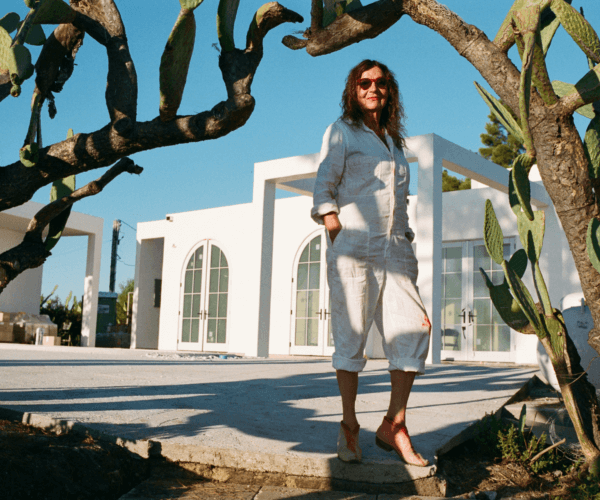
Bon and I meet at Metabolic Studio, the Lincoln Heights art studio/laboratory/research center founded by Bon in 2005, adjacent to the Los Angeles River. Metabolic Studio investigates city planning, social practices and ecological precarity through large-scale, site-specific projects. Curly black-grey hair and a warm gap-tooth smile, Bon wears sneakers, faded jeans and a Southwest-style shirt, her relaxed outdoorsy vibe offset by her hyper focus and precise manner of speech. With us are project manager Kelly Majewski, and biologist Diego Zapata, who recently received his master’s degree from UCLA. Lining the office walls are whiteboards covered in extensive notes and detailed maps about the project in question: Moving Mountains. In short, Bon adopted 1,000 truckloads (about 20 percent) of the Topanga landslide and transplanted it on her site along the industrial corridor of the LA River. An experiment, a proposition, a spur, the idea is to see just how fertile — and, how resilient — that mountain soil actually is.
“Thinking to scale is really critical to me,” Bon explains. “Thinking about speculative ecologies, thinking about what is ‘new nature.’ So if you choose, like I have, to live in Southern California, ‘new nature’ would be thinking through what happens when lands slide, because that’s the logic of this place: the fertility and the growth are connected to landslides, rains and floods. Much of the abundance that comes from Southern California comes from what we’d now call ‘disasters,’ but in ecological thinking would be called ‘disturbances.’”
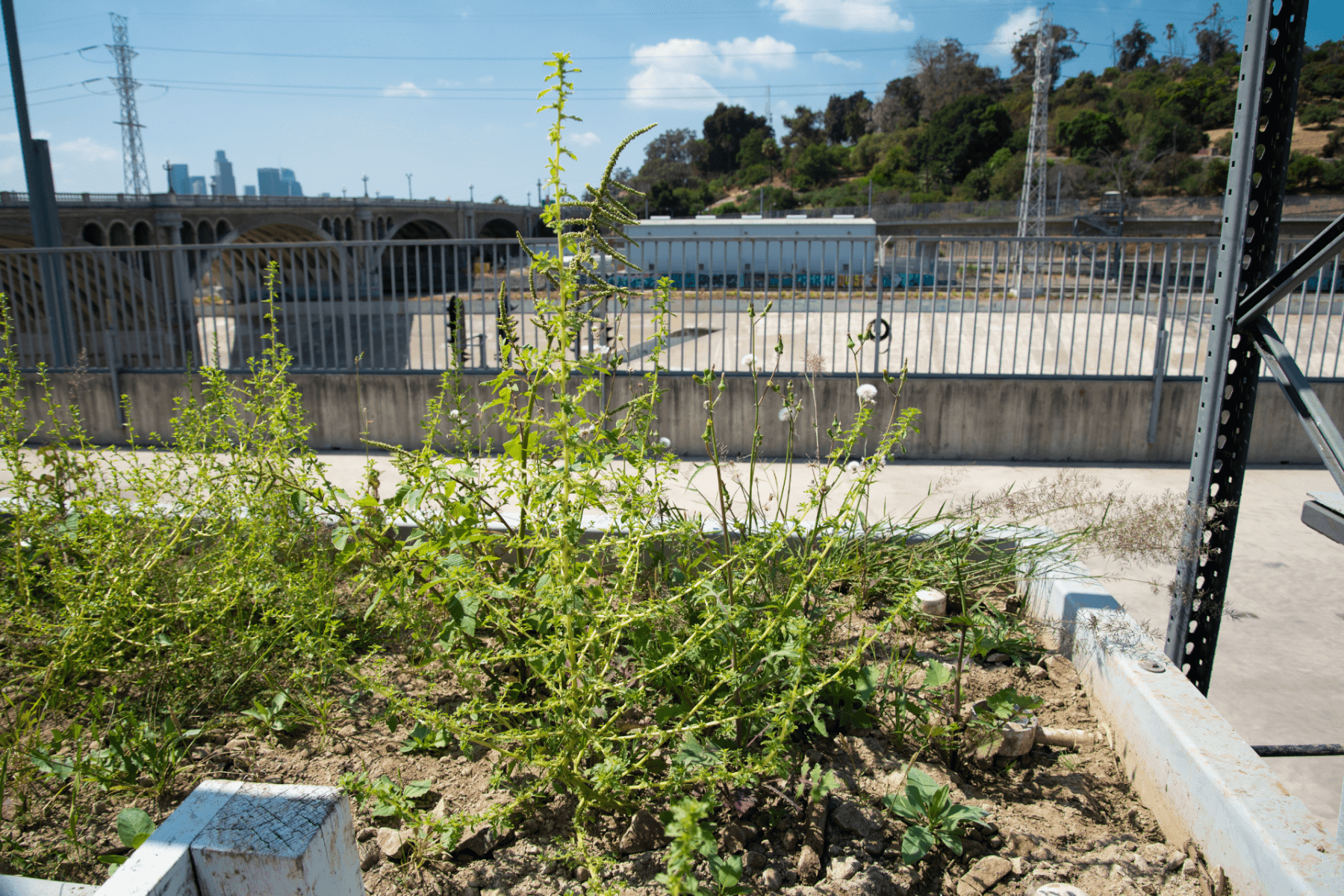
Just along the concreted LA River, Metabolic Studios is busy “creating a network of micro-forests along the LA River” to support biodiversity. Photo by Shannon Aguiar
Bon explained that the urgency to reopen roads often overshadows the great opportunity. “The second most important thing we’re missing in big cities like LA, or big counties like LA, is clean soil to do all of the things that we want to do, like breathe, right? Because embedded in that soil are all those seeds and fertility. So how can an artist’s action, like adopting a landslide, become a provocation to policymakers about just status quo protocol of what should be done? This is a no-brainer. It doesn’t cost anything; you’re already paying for it. So it’s simply a protocol to change the normative into something that would become a reparative concept. Not only is it a good idea ecologically to take landslide debris and consider it an asset rather than a liability, but it makes financial sense.”
“Much of the abundance that comes from Southern California comes from what we’d now call ‘disasters,’ but in ecological thinking would be called ‘disturbances.’”
Bon, 62, studied dance as an undergraduate at Princeton University. As a graduate student at the Massachusetts Institute of Technology (she has a Master of Architecture degree), she was inspired by Fluxus artists like Nam June Park and Charlotte Moorman.
“It was through movement and architectural form that I started to think about living systems,” she tells me. “9/11 really impacted me. I realized that everything could change in an instant, and that maybe it could be a good idea to know your neighbors. And maybe it would be a good idea to build a community that was based on care and not just assuming your credit card was going to get you everything you need if the financial systems collapse.” Bon takes a sip of water. “I started to think about art practice as a way of live-action role-playing, these new modalities of being that I thought needed to be developed, just being a good person as a goal of art practice, doing the right thing as a form of conceptual art.”
We head outside. The sky is a hazy blue; the September sun is hot and oppressive. The Metabolic Studio is a sprawling compound in Lincoln Heights, one of LA’s oldest suburbs. Spread about the yard are tractors, giant drill bits and hunks of industrial metal. At one end stands a row of old cars, at another a kind of nursery. Fertility is not the first word that comes to mind, but when Bon leads us to a row of cylindrical planter containers, there it is.
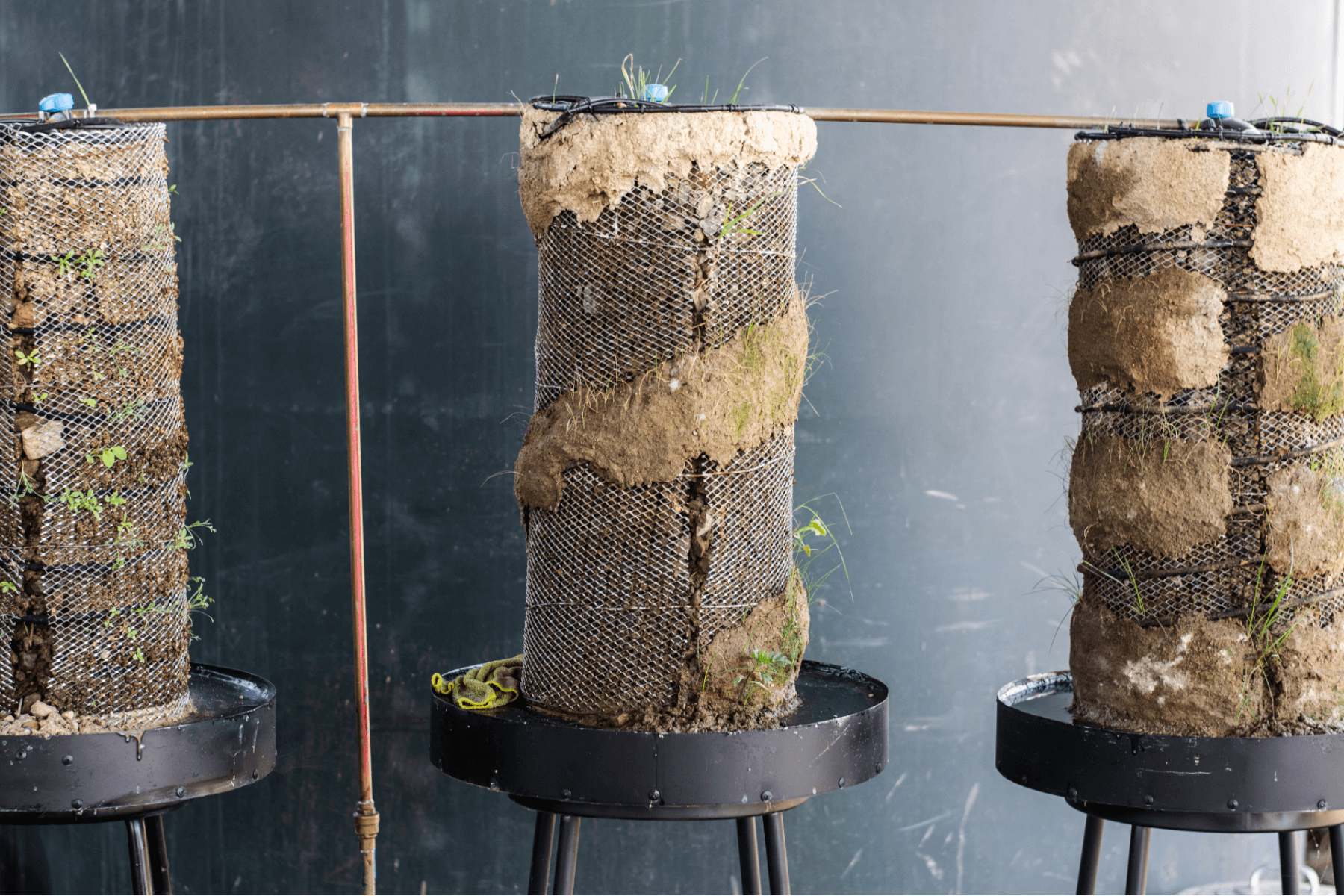
Through experimentation, Metabolic Studio is tracking the different germination and growth patterns from the landslide soil. Photo by Shannon Aguiar
“This is just Topanga soil with rocks, which help create the right microclimate to hold the water in.” She points to vibrant flowers in full bloom. “And these are the morning glories, and these are amaranths.” Bon indicates a reddish vine with big green leaves. “Things we look at is all of the insects and pollinators that are here on an old parking lot in what’s thought of as a blighted part of LA. And these are our propositions about how you could do this in a single parking spot.”
She points to verdant green tendrils. “See all the things germinating out of it? So these are the models of how to take up less space but create forests. And all the water here”—she gestures toward a barrel of water— “this is all salvaged water from the rain. So, to answer the question: ‘If you move a landslide to East LA, will it grow?’ Okay, this is four months, no seeds. This is what’s come out of that landslide material.”
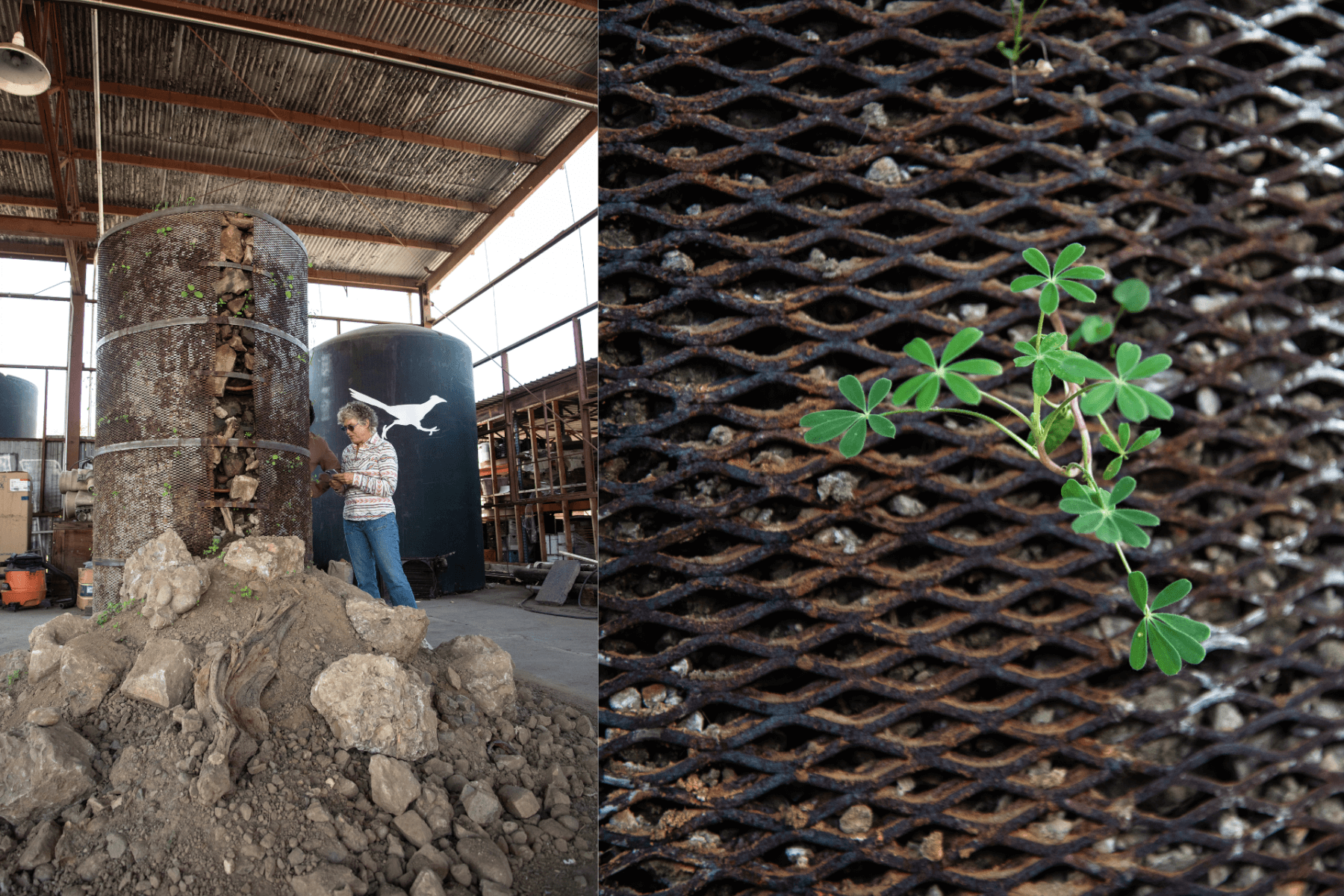
The resilience of nature demonstrated through plant growth with just a little water and sunlight. Photo by Shannon Aguiar
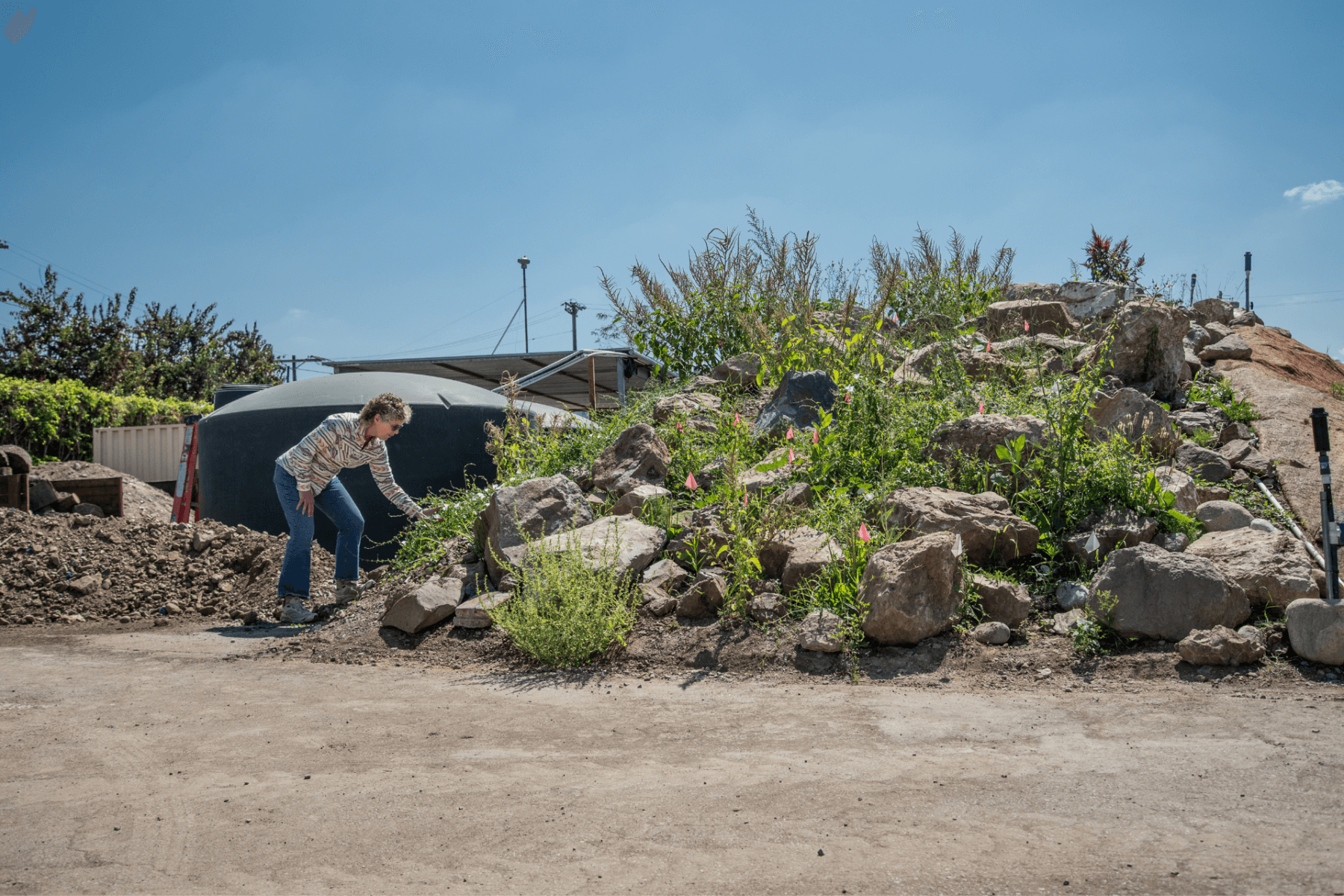
Stretching across the yard is a rectangular-shaped mound of dirt roughly 15 feet high and 100 feet long. “That’s what we call the Topanga Mound,” says Bon. “It’s all the Topanga soil. And it’s sitting on top of asphalt. We can climb it if you want.”
We approach from the northern, less steep side. Poking out of the rocks is greenery, thick and lush, and flowers of purple, red, white and yellow. Bon leads us across the spine to a California Morning Glory. “This was the first vine that came up, then sunflowers and native amaranth, and trees like laurel sumac. So, you can see that the soil barely noticed that it wasn’t in Topanga. It was like, ‘Oh, that’s great, sunlight, water. Let’s do it! Let’s go!’”
We take a moment to admire it. Bon says, “This has been one of the biggest surprises of the project. People said nothing would grow here, but here’s this most resplendent goddess of fertility, this beautiful and powerful diva energy rising out of the soil as if to say, ‘Thanks for voting on me. Now I’m really going to shine for you.”
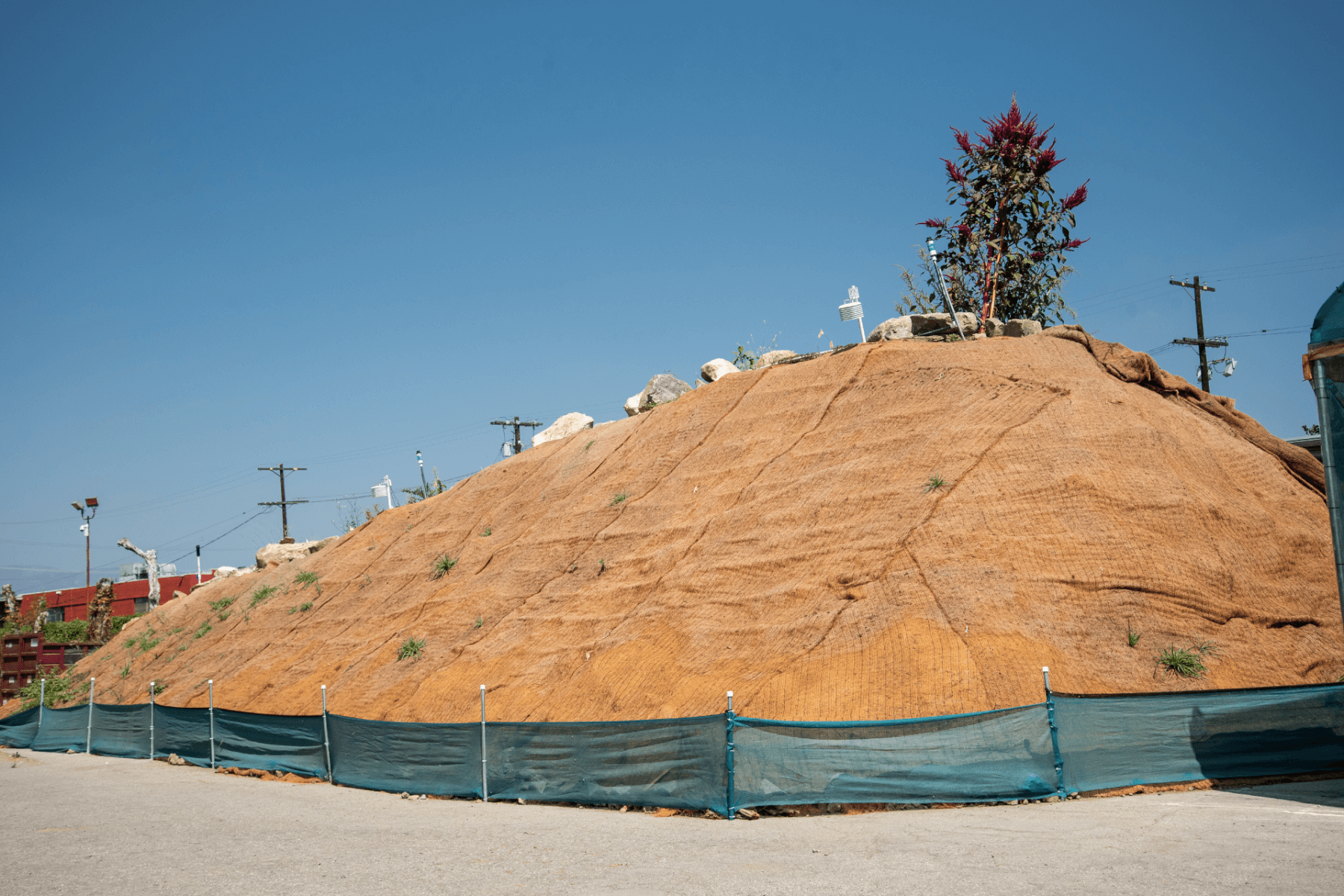
The “mother mound” of the Topanga landslide soil bares an exciting and unexpected amaranth bloom towering over 6 feet tall thriving in the heat of the LA sun. Photo by Shannon Aguiar
Diego calls us over to a little nook in the shade of a boulder. There is plenty of growth under it. Bon continues, “One of the things we’ve noticed is how important the Topanga rocks are that came out of the landslide, because in this particular case, we just used them to hold the mound together. But when things first started to grow, they would grow under the shade of the rocks, where the sprinkling water that we gave it would be held by the rocks.”
She points to an amaranth. “This one’s native. We’ve documented over 50 species.” Then, we see a tiny forest of sprouting things. “This is a beautiful example of how, literally, the architecture of the landslide can cause these little pockets of regeneration. Here we have white sage and California poppy. This is arroyo lupine, black sage, yarrow. These are trees. This is a laurel sumac, native to Topanga. This is the dominant tree from the landslide area.”
“We should be using our landslides to repair land that has been depleted by industrialization and fires.”
Located in the Santa Monica Mountains, Topanga is the name given to the area by the Indigenous Tongva tribe, and roughly translates to “where the mountain meets the sea.” Topanga Canyon has long been a bohemian enclave. The actor Will Geer moved there in the early 1950s to escape the Hollywood blacklist. Woody Guthrie lived on the property. In the late ‘60s, Neil Young bought a house on Sky Line Trail and recorded most of After the Goldrush in his basement studio. Up the canyon was Elysium Fields, a bustling nudist club. On Old Topanga Canyon Road resided the Buddhist musician Gary Hinman, who’d become the first murder at the hands of the Manson Family.
But Topanga’s rich cultural history merely scratches the surface. It’s a place of rugged canyon steeps and soft light. Bon’s work reaches back to its natural history — the ancient, geological past — and into the future.
“In the works I make with the Metabolic Studio, catabolic and anabolic processes are at the core of the practice: things that get torn down and things that build up,” she tells me. “The objects I make are meant to be catalytic, systemic works that are not about their own formal elements, but instead are catalyzing formal elements in a kind of prophetic challenge.”
Metabolic Studio is part of the Annenberg Foundation, of which Bon is a vice president and director. (Her mother is philanthropist Wallis Annenberg.) Many of Bon’s projects involve navigating LA bureaucracy. The foundation funds other projects at the intersection of infrastructure and ecology, including a wildlife crossing over the 101 freeway in Agoura Hills, currently under construction.
I ask Bon what she loves most about living in Topanga.
“I feel in Topanga that I’m so supported by the sea oak forest interface, that it fills my nervous system with calm and peace. And it takes me a moment when I get there for the urban systems in my psyche to quiet. I start to hear the crickets and the frogs, and I can feel the moisture at night on my skin. I’m literally surrounded by ancient oaks that remind me of my place in the universe in an entangled relationship with all living things all around me. I think I need that to balance what was missing in my educational background, coming from European ancestry, Jewish, intellectual, push, push, achieve, achieve.”
And what about working here at Metabolic?
She surveys the concrete LA River, the palm trees up there on the hill beside Dodger Stadium. The Metro Rail streams past. “What I feel here is that I’m in a still-living piece of human history that I feel honored to be close to. And that is the amount of Indigenous people who over the 20 years that I’ve been here have taught me that relationships to the unseen land and relationships to the not-necessarily-felt water are going on everywhere all around, all the time here and that I could not be a part of it directly as a non-Indigenous person. But, if I sensitize myself to these things, there’s a whole lot I could learn about making the kind of art I want to make, which is about metabolic systems and not about objects that are going to sit in the basement of a museum in an air-conditioned room until all the power goes out and there’s no air conditioning. That’s not motivating. That doesn’t motivate me.”
A helicopter whirs overhead. Bon continues, “So, I’m interested in thinking about how physical objects that I can make can be a part of the transformation of places without controlling it. So, it’s a different kind of object making. I don’t see the things as fixed in place.”
Concrete is Fluid, Bon’s most recent solo show at Honor Fraser, is part of the massive PST Art: Art and Science Collide. For the show, she suspended two huge copper sheet cylinders etched by the water flow of her Bending the River project from the ceiling. The main gallery features two metal mesh towers filled with soil from the Topanga landslide — and its sprouting plants and flowers. In late October, she’ll conduct a how-to workshop in the gallery parking lot where she’ll literally poke holes in the asphalt, revealing the compacted soil beneath — “which will come to life with rainfall and runoff.”
We move over to the hoop house, a tunnel-like greenhouse. In it is a long mound divided into sections.
“We’ve done a micro-experiment,” says Bon, pointing across the mound. “This part of the soil’s been covered in coconut fabric to keep the soil from depleting. This part has mulch from Topanga Forest on it. That part has mulch and native seeds that we’ve thrown onto it. And that has just native seeds and no mulch, and the part at the far end has nothing. And surprise, surprise, the one that’s doing best is the one that has nothing.”
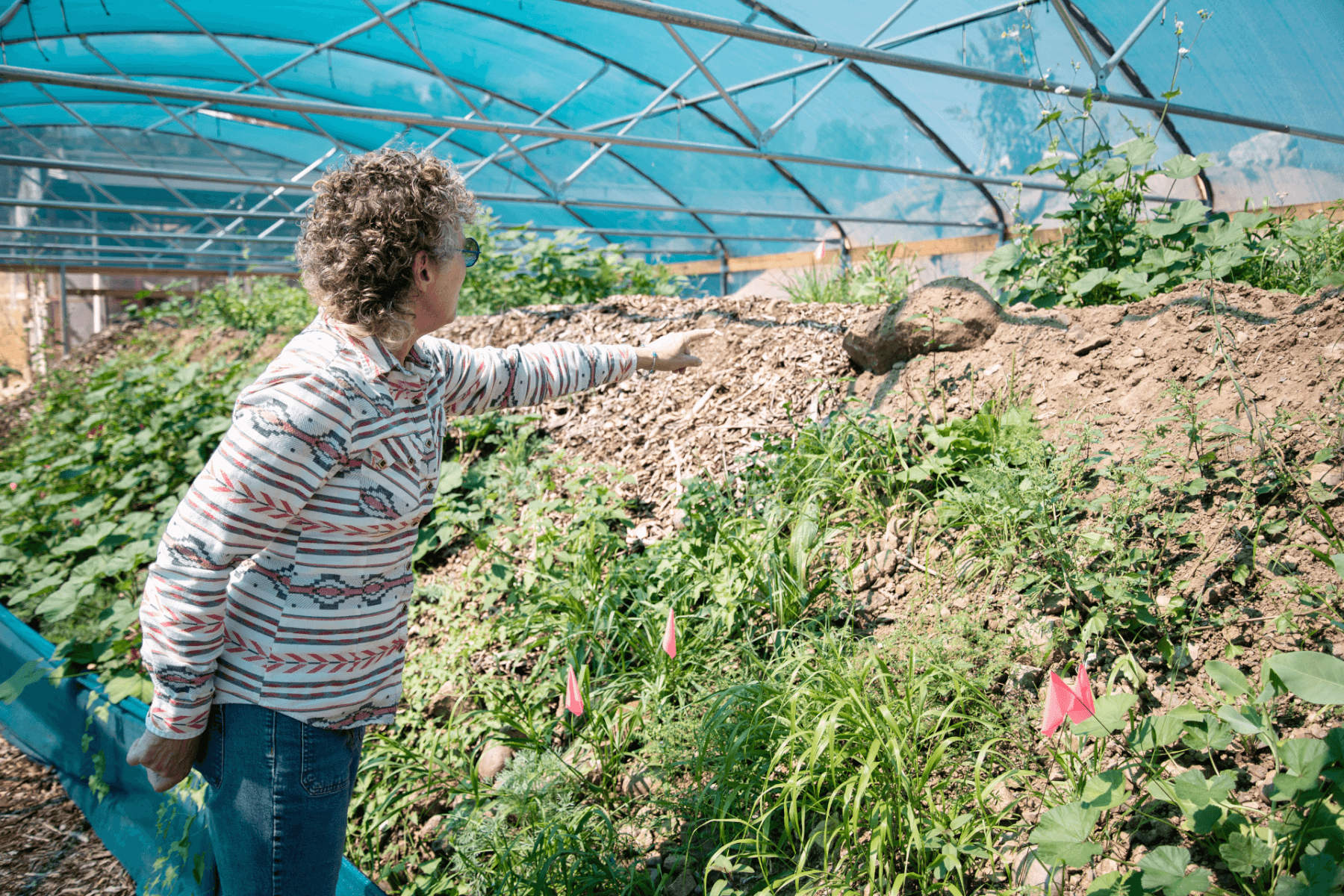
Bon shares the various species of vegetation sprouting under her carefully constructed green house setup. Photo by Shannon Aguiar
We go in for a closer inspection. Indeed, the part with nothing was by far the most fertile. “So that’s good news because it means that you don’t have to do anything but move the soil and add water. They all need water. They really do. That’s the biggest observational thing that we’ve discovered. So we think it’s time to go straight into saying, ‘Well, we have the proof. Let’s go to the theory.’ And the theory is that we should be using our landslides to repair land that has been depleted by industrialization and fires and other kinds of things because we’re going to keep having landslides, and it’s fertile.”
We head into a studio that houses more plants. There’s a terrarium-like section of greenery covered in clear fabric. Under it is a button.
“Go ahead,” says Bon. “Press it.”
I do. With a certain Willy Wonka charm, fog fills the terrarium. Misty, deep green, I’d seen this scene a hundred times in the canyon, but here it is in miniature.
“We were prepared to have to do something like this with the soil. But it turned out that we don’t. We just need water. Water in any form is good enough. So, our ultimate takeaway is that wherever the landslide ends up going it will end up adapting to wherever it’s taken based on those environmental qualities.”
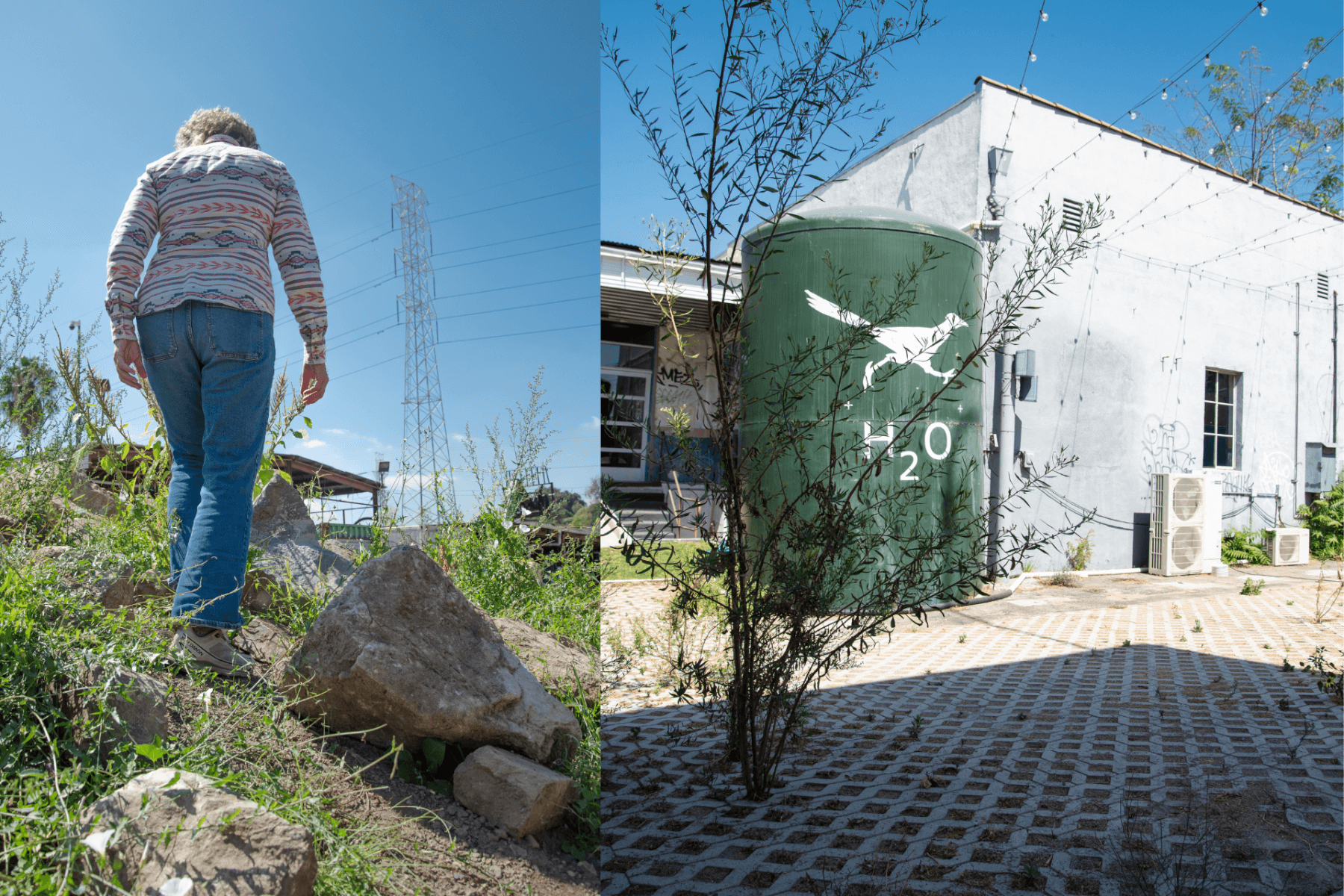
Bon scales her “moved mountain” (left). With water central to many of their projects, Metabolic Studio experiments with potential usage and storage of collected rainwater (right). Photo by Shannon Aguiar
I ask Bon what she hopes to achieve with Moving Mountains.
She doesn’t hesitate: “I hope it inspires a patchwork ecological network of forests in the most blighted parts of the city where animals, people and living systems need the most help.”
Bon ushers us over to look at some plants under lights.
“This is our hospital,” she says. “This is where we keep the plants that weren’t doing well.” There are single vines that look carefully tended to and flowers that appear frail. “When I was trying to stake out the amaranth, I broke a limb, and we picked it back up and she grew again. Now she actually thrives. So we’re trying to learn about what can be mended. And I’m just constantly surprised by how adaptive and how resilient these plants are.”
Help us sustain independent journalism...
Our team is working hard every day to bring you compelling, carefully-crafted pieces that shed light on the pressing issues of our time. We rely on caring supporters like you to help us sustain our mission. Your support ensures that we can continue to provide deeply-reported, independent, ad-free journalism without fear, favor or pandering. Support us today and make a lasting investment in the future.
RELATED STORIES

Award Winning


Today’s environmental and social justice challenges are unprecedented, and require an unprecedented collective effort.


Stay updated on our latest features, events and more. Subscribe to our Note From the Nest newsletter!
