The Map of Our Illusions
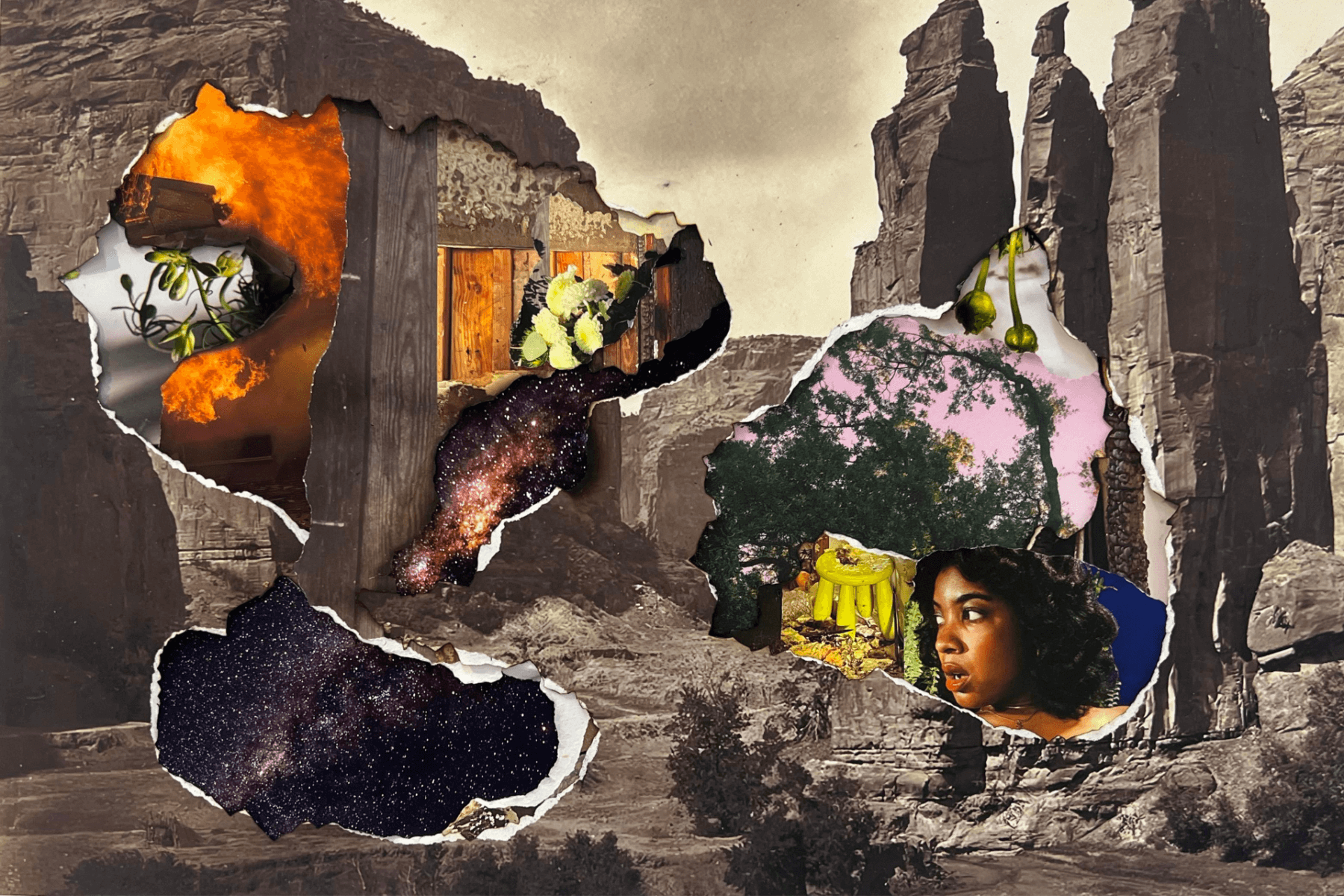
It was fitting that I met with artist Naomi White in July, while California slogged its way through its hottest month on record. When we met at the artist’s studio in Lincoln Heights, White was preparing for her upcoming group show, Landscapes of Illusions and Possibilities: Maps, Materials and the Lens, which opens September 7 at the nearby Keystone Gallery. For inspiration, she had initially drawn on the work of Octavia E. Butler. A Pasadena native, the late Butler is a genre innovator in science-fiction writing who crafted the foundation for Afrofuturism with novels such as Parable of the Sower, Kindred, and Wild Seed.
Butler’s 1993 Parable of the Sower also happens to be set in the not-so-distant future of July 2024. Parable’s main character Lauren Olamina, a young African American girl from a city outside of Los Angeles, finds herself in a future United States that is increasingly on the brink of total collapse due to corruption, late-stage capitalism and climate change. Butler’s work confronts culture, race and technology, especially as they impact Black people worldwide. And, while White’s meditations on Butler regarding this show evolved over the summer to focus more on the omissions and distortions of history, photography and landscapes, the main themes in Butler’s work remain ever-present — especially in conversations about climate change, power and the future. Similarly, White’s work has also focused on the effects of political ecology and the oppression of marginalized people throughout history.
For this show, which also features artists Beth Davila Waldman and Alicia Piller, White specifically examines how photography, politics and maps distort ecological history. Landscapes interrogates the essence of landscape photography as objective truth. Through this work, she examines how maps, freeways and borders serve as man-made disruptions to the environment and history.
During our visit, the sound of passing trains, helicopters hovering overhead and power tools penetrate the industrial walls of White’s Lincoln Heights studio. Her workspace is filled with numerous in-process collage projects and finished pieces from previous exhibits. Photography clippings of waterfalls, maps, animals and humans are arranged on multiple canvases on white walls surrounding us. A large collage occupies a table in White’s workspace. The piece features images of x-rays of fossils, a rodeo, vintage wallpaper and a human eye. Seen in person, White’s collages capture a unique visual depth, supported by a mix of textures and variety of images. The large collage on the table isn’t quite done yet, she tells me.
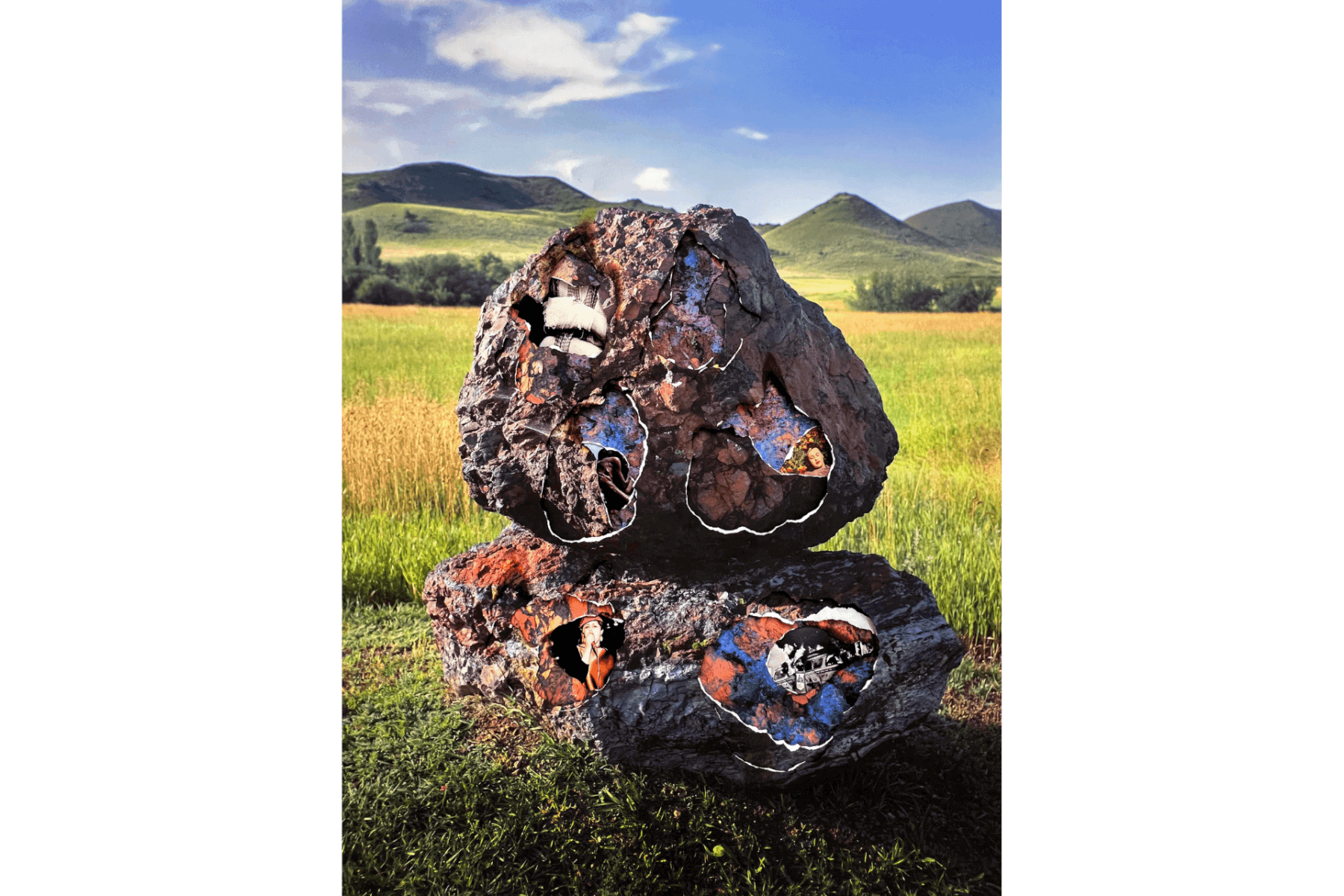
Excavations #1. Courtesy of Naomi White
White is a 2023 Hopper Prize finalist and the recent winner of the Brand Library & Art Center’s 2024 Associates’s Award for their Brand 52 exhibit. Her work has been exhibited throughout North America and Europe. White is also the current faculty chair of the photography department at the New York Film Academy in Burbank, California. Her 2022 solo show Excavations presents rocks as natural symbols of truth. While rocks contain an internal history of the natural world, Excavations wrangles with the idea of cameras as complex recorders of racial inequality and innovation. White’s collage work in Excavations examines the ontological role of the camera in our history, as a violent perpetrator of oppression and as a tool for political activism for the future.
Another 2023 collage series from White, The Erotic as Power draws on the 1978 Audrey Lorde essay to examine the value of eroticism as a tool for regaining connection to our senses. In The Erotic as Power series, White represents the sensory experience of eroticism as a possible pathway to the natural elements of the environment by photographing different textures and weaving them into vintage erotic photographs from the 1850s to the 1900s.
An urgent embrace of photography as an attempt towards a more equitable future serves as a through-line in White’s contributions as both a visual artist and educator. The following conversation has been edited for concision and clarity.
***
Karen Romero: Could you explain how you became drawn to the main themes/concepts of your newest series?
Naomi White: I’ve been investigating the surface of the photograph — how it’s impenetrable in many ways. I’ve been thinking of all the things we do not see in there and all the things that you are excluding from the frame, and how that is similar to maps, the way that maps are intrinsically omitting so many stories and qualities of a landscape that they are trying to track or transcribe.
Similar to history, there are countless ways that we don’t understand what we’re looking at. We will never be able to, most likely, but we can honor what may have happened and imagine what can happen in the future. I’m thinking about these illusions and possibilities in the landscapes.
When you say maps, it makes me think of borders. They’re man-made and not necessarily aligned with the natural landscape.
Yes, one of my favorite punk rockers, may he rest in peace, Jack Terricloth wrote a song, “Borders are porous to cats” which points to the way nature goes around those human-made structures and the porousness of them — such a beautiful image to think about, imagining no limits nor obstacles. It gives you a lot of hope, because flags and borders are just such problematic things, powerful in “othering” people, serving to exploit and harm.
At the end of May you attended the Futurity as Praxis: Learning From Octavia E. Butler at The Huntington in Pasadena, in Butler’s hometown. Were you able to explore the Butler archive?
My mom is an English professor and she’s been going to The Huntington for around 30 years. My mom introduced me to Black feminist writers early on — authors that she taught, like Zora Neal Hurston and Toni Morrison. I was also an English Major in college where I read Butler’s Mind of My Mind and Kindred. In 2023, when I moved back to LA from New York, my mom told me that Octavia E. Butler had left her archive to The Huntington. Initially, I was interested in her collective of newspaper articles tracking the media’s response to climate change. Smog, flooding, heat and homelessness prevailed. And now we have a worsening of all these (except maybe smog thanks to pushback against the oil and gas industry), but we also have severe gun violence, mass incarceration and exploitation and wildfires.
Butler exposes the way the media approached climate change in a compartmentalized way, where the ethics are sort of on the side. They talk about the weather and homelessness, for example, as if they are completely separate, and then throw in a story asking, “Is this climate change?” and all the kind of neo-liberal aspects of that, and the criminalization of poverty through the 70’s and 80’s and 90’s scuffle the realities of the oppressive nature of late-stage capitalism.
Her archive and writing registered with me. When I delved into the archives of National Geographic and LIFE magazines in my Excavations series, I saw and felt similar blind spots. And then to find that the Butler’s archive is riddled with her shouting back at Reagan in the margins of the newspapers and her handwritten notes, was exciting. Like, yeah, give them hell. She’s just such a great thinker and ideator, so that was inspiring to me.
As an early way to connect with her, I started making some imitations of her photographs, because she was an amateur photographer. Because she was always struggling to make ends meet before she made any of her writing, she took photographs at home and tried to teach herself how to do still lifes and things like that. Then, later, she traveled, which she didn’t like to do, but she made herself do it for research.
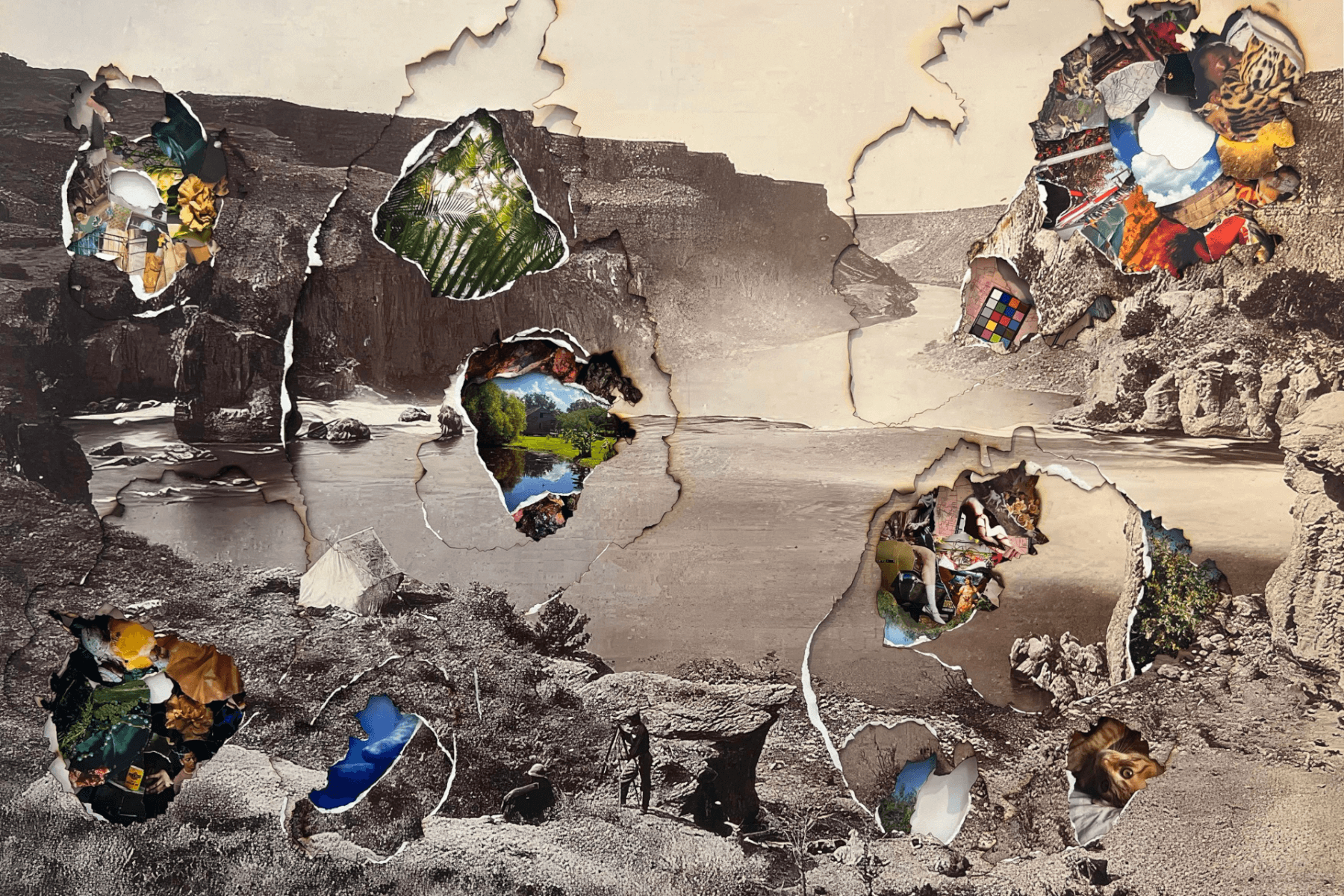
Time Enters The Landscape, 44″x 61″. Courtesy of Naomi White
She researched plants and infrastructure in the deserts, California, Peru and other places. Thinking about the connections she makes in Parable to Indigenous strategies for survival was really exciting. I would go to The Huntington every single Tuesday and meet my mom for lunch. I did that for over a year. It was really fun. I took all these notes and I’m still sort of trying to figure out what that looks like.
Butler’s archive inspired me to reflect on my own relationship to the city; of course, in Parable, you have all of these freeways becoming paradoxical symbols of freedom and safety, as well as entrenched symbols of racism and oppression of poor people, evicting them from their family homes or bringing down the value of their homes, harming their families for generations. She names all those freeways, and having grown up here too, that felt familiar.
In Butler’s Parable of the Sower, the main character Olamina begins documenting the societal and ecological upheaval in July of 2024 within Butler’s imagined yet not far-fetched world. Did the uniqueness of the timeline in Parable of the Sower spur any new reflections on our current political, ecological and economic landscape?
We’re living in this time that she planted [the story] in, and when I first read it, like 10 years ago, it felt really far-fetched. Now, it’s right at our door — the fires, the politics, the fascist kind of leanings and the way that things feel lawless even at the Supreme Court level.
The flip-flopping of negative and positive associations with empty and full were really based on the land grab and power.
[I think about] the lawsuit that the judge kept delaying over Trump and the documents in Mar-a-Lago, and it’s so bizarre. It feels like everyone’s in his pocket, and that’s sort of what happens in second book, Parable of the Talents. We know society has collapsed, and we can no longer trust anyone. It’s not like we all, especially people of color, had much faith in policing [in the early 90s when Butler wrote Parable]. But now, it seems even more clear that we are alone. As Naomi Klein said. Even Trump agrees with Biden, and Biden agrees with Trump, when it comes to unequivocally supporting Israel, even while watching a murderous genocide unfold before our eyes. It just feels like everyone in power is only protecting the moneyed class, and that’s really terrifying.
In some of your past series, like the Erotic as Power collage series, the work draws on ideas from Audre Lorde’s essay “Uses of the Erotic: The Erotic as Power.” Your upcoming series invokes concepts from Butler’s fiction. How does text or written work inspire your visual work?
I am totally inspired by people’s writing and ideas. This project is also about W. J. T. Mitchell’s Landscape and Power, where he talks about landscape as a verb. That sounds really liberating and true. I’m also responding to Wendy Harding’s The Myth of Empty Spaces, which is kind of like a wonderful rumination on “the early days.” She talks a lot about how when people, or white settlers, first came to America, there was this idea that it’s empty, it’s beautiful, it’s paradise. Then, it quickly became, “it’s empty so we need to fill it.” The flip-flopping of negative and positive associations with empty and full were really based on the land grab and power, and she does a wonderful breakdown of that.
When we look at the Mojave Desert, for example, we see nothing there, but all kinds of critters and people there, so seeing can be deceptive. I’m thinking about that early mindset and how it has contaminated the whole way we have set up or made lives here from that point of view. I’m trying to make those connections between what is and what isn’t.

Looking Ahead As An Act Of Hope, 44″ x 68″. Courtesy of Naomi White
With the Landscape as Power, I am looking at where these early photographs come from. You think of a landscape photograph as pretty much the most benign, non-controversial thing you could ever make a picture of, and it turns out, it’s kind of steeped in issues. Like in Ansel Adams’ work, which I love, or the Timothy O’Sullivan early survey photographs of the west, they are stunning images that required great effort to create. But they also went to great lengths to exclude the Indigenous people who were living there and get them out of the frame,so the viewer has a feeling that the landscape is being discovered for the first time.
While engaging with your past work/series, the collage aspect of your visual work really forces me to contend with surfaces and images of our world in totally different perspectives and contexts than I’m used to absorbing them in. Do you find collage work to serve a uniquely political function in this way?
Something I love about collage is multiplicity of voices that is innate. I work with some of my photographs, but then I also have a bunch that aren’t, and so I love that conversation that happens. It feels uniquely much more political and inclusive because it’s not just you.
Collage brings things together in a way that helps you, and helps me to think through ideas. I think that relates back to the writing. I read a fair amount and love to engage with ideas because it can be overwhelming to work in collage. It’s just like all of these clippings; you’re dealing with a ton of material. If you don’t have your through-line, you don’t know exactly what it is, so you keep trying to ask questions and see where the material takes you.
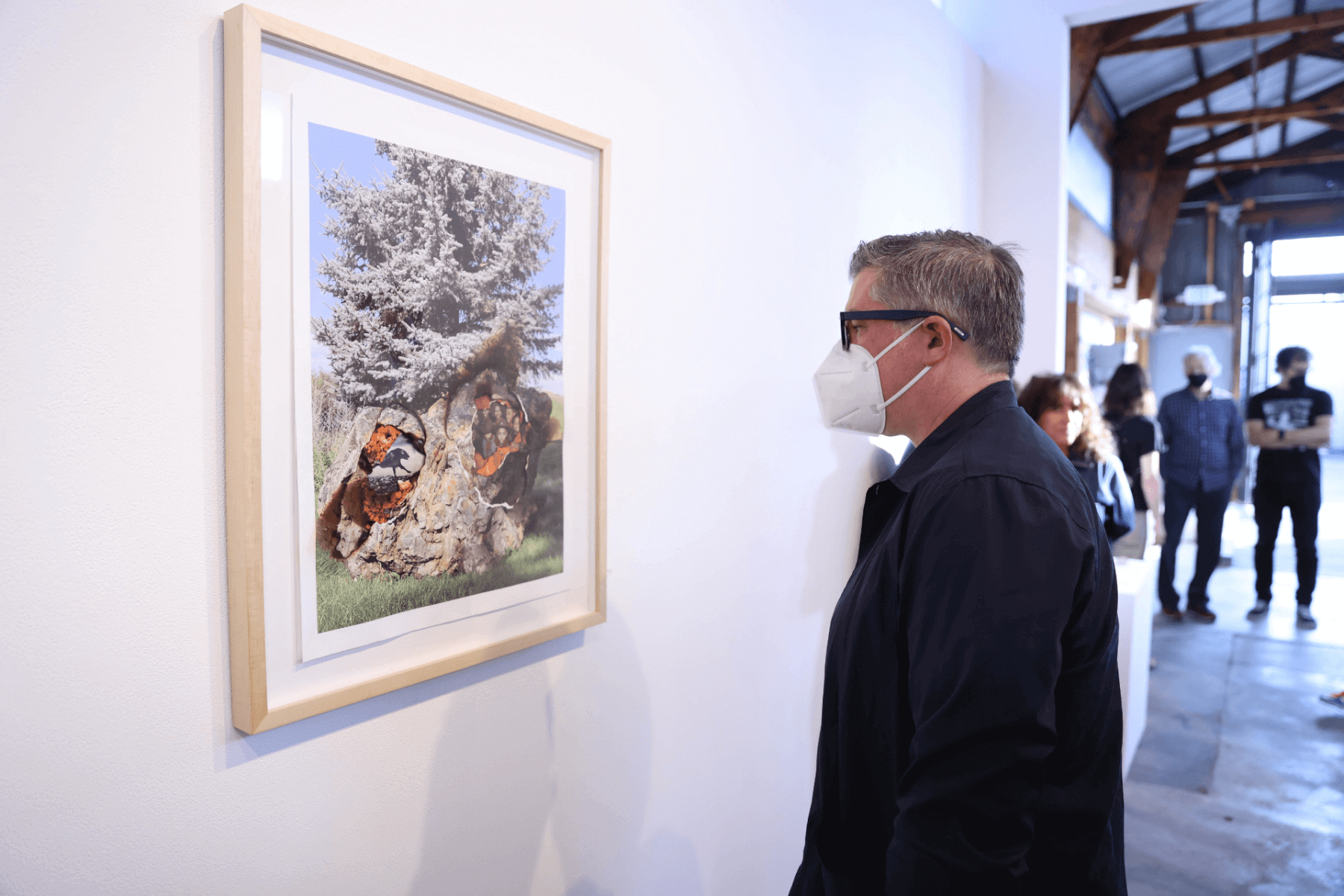
Peeling back the layers of collage from White’s 2022 exhibit, Excavations. Courtesy of Pamela Garcia
Has teaching against the backdrop of this current political moment informed your ideas/contemplation about the future?
There’s so much that I learn in teaching. I learn about myself, I learn about the subjects, and I also learn from my students. I think that being in conversation with people who also care about art is vital. I think a lot of students are struggling with the value of it, as we all do.
People are dying. So, who am I to be in the studio making art?
When I was at Kolajfest, I went to the Whitney Plantation — the only plantation that is talking about slavery from the enslaved people’s perspective. That was the only one, which is alarming. I had no idea. Everyone else is doing weddings.
But the Whitney is amazing; they did such a good job of telling the story, honoring the enslaved people that have been there, naming everybody on these beautiful granite, mausoleum kind of things, telling their stories and talking about their real names, their slave name, their nickname — just so many details. Then, they asked artists to come in and make these memorials which were kind of stories and sculptures honoring people that died and suffered. It was so powerful and so well done. For example, one of them was honoring the organizers of one of the many, many, many uprisings.
I feel like that’s also something that’s not talked about. There were so many uprisings. It wasn’t like anybody was lying down and taking this. But there was one huge uprising where over 500 people got together. They were caught and the organizers’ heads were cut off. I think there were around 27 of them, and they put them on sticks; it was horrific. But in the art piece [depicting this], it’s outside but you cannot talk. It’s silence. They have cast heads and bronze sculptures that have their names and story. They are set in this beautiful way that is so powerful. You become overwhelmed with emotions.
That’s the power of art — to help you feel what’s actually happening, because sometimes too many things are being told to you and you actually can’t access the information emotionally because there’s too much information coming at you.
Collage brings things together in a way that helps you, and helps me to think through ideas. It feels uniquely much more political and inclusive because it’s not just you.
That’s what I just told one student who said, “I don’t want to talk about beauty. It doesn’t mean anything. People are dying.” There have always been wars. There have been wars my entire life. People have been dying and people have been dying your whole life too. There’s all kinds of injustice but art is powerful, when wielded the right way.
Your work is devoted to amplifying notions of equity, through social, economic, and political pathways and perspectives. How would you say your visual art aims to capture assemblages of identity such as race, class, gender, and sexuality in your own perception of what our future could be? How do all these moving parts work together in your view and within your collage work?
I’m a white person who grew up in a multiracial city. I have always been really interested in the construct of race, the fakeness of it; it’s not a real thing. Race was created by white people to account for their racism. So, I have always felt some kind of responsibility towards making things better. I was at San Francisco State, a political campus, which had Women’s studies and the first African American studies department. I had classes where there were no men allowed. These early experiences influence how I see interconnections between injustices and climate.
Growing up in LA, our close family friends were East Indian, Latino, Japanese, Greek, Black, white and Jewish. The realization that most people are racist was really upsetting. I didn’t know. I didn’t realize it because I was in a bubble. So I, of course, just want to minimize the harm I do with my identity as a white woman and make work that tries to get people to see how these larger forces are manipulating us and how that is not helpful to everyone’s betterment. I want to make things better for young people, like my son, niece and nephew.
But I also feel like art has a limitation in that sense. I do try to organize as much as I can in political circles and Indivisible. I take part in a tikkun olam — a Jewish idea of do no harm and make things better to heal — where my son is studying for his Bar Mitzvah. We’re active, especially around the environment and climate justice. There’s a place for everything, and art can only do so much. But I love the way art can suggest ideas, bring joy, plant seeds and hopefully, inspire change.
***
Landscapes of Illusions and Possibilities: Maps, Materials and The Lens is open at the Keystone Gallery in LA. The opening reception is on Saturday, September 7 from 5 p.m. to 9 p.m. and the artist talk and closing reception is on Sunday, September 22 from 12 p.m. to 3 p.m. Gallery hours are Tuesday through Saturday 12 p.m. to 5 p.m. and by appointment. For more information, visit the Keystone Gallery website.
Help us sustain independent journalism...
Our team is working hard every day to bring you compelling, carefully-crafted pieces that shed light on the pressing issues of our time. We rely on caring supporters like you to help us sustain our mission. Your support ensures that we can continue to provide deeply-reported, independent, ad-free journalism without fear, favor or pandering. Support us today and make a lasting investment in the future.

RELATED STORIES


Award Winning


Today’s environmental and social justice challenges are unprecedented, and require an unprecedented collective effort.


Stay updated on our latest features, events and more. Subscribe to our Note From the Nest newsletter!
