
The Haiti Factor
This article is supported, in part, by the Charles M. Rappleye Investigative Journalism Award, a project of the Los Angeles Press Club.
On September 10, 2022, two young men stood at the edge of a gathering in a small park with a big stage in Tijuana, Mexico. One of them, James (not his real name), was a young migrant from Haiti, who had arrived in Tijuana just a few days earlier. Around 4 p.m. that afternoon, the sun was still high in a bright blue sky that was spotless save for the remnants of a dumpster fire that left a thick layer of grime hanging in the air like a brown smudge on a clean canvas.
The racket of traffic, barking dogs and music blasting from passing cars competed for attention, but it was all just background noise at the crossroads of humanity here in Tijuana. Just another day at the office for a journalist covering the Southern border since 2018, when the migrant caravan from Honduras sparked a media-feeding frenzy that drew news crews from all over the world.
On this day, a small scrum of journalists had set up cameras, waiting for the scheduled event to begin. Tijuana is a small town, in some ways. The journalists know all the advocates; the advocates know the journalists. They’ve been doing this dance for years. The violence and corruption that Tijuana is infamous for has created a sort of transactional solidarity among journalists that transcends political predilections. They’ve developed safety protocols, coordinating their movements and communication in the field. Career journalists in a place like this have seen things they’ll only discuss among themselves, if at all. They have each other’s backs, in theory.
About 2.3 million people are pushed up against the border in Tijuana. Migrants seeking to cross into the U.S. comprise a small percentage of them but occupy an oversized space in our news cycles. They come from all over, but mostly from Central America and Mexico. Despite the headlines they garner, the well-known tales of murderous illegal immigrant invasions, their numbers are declining precipitously. Objectively speaking, illegal migrant crossings are not the story right now. Yet, it continues to dominate the political epistemology north of the border and may be the critical wedge issue in the presidential election.
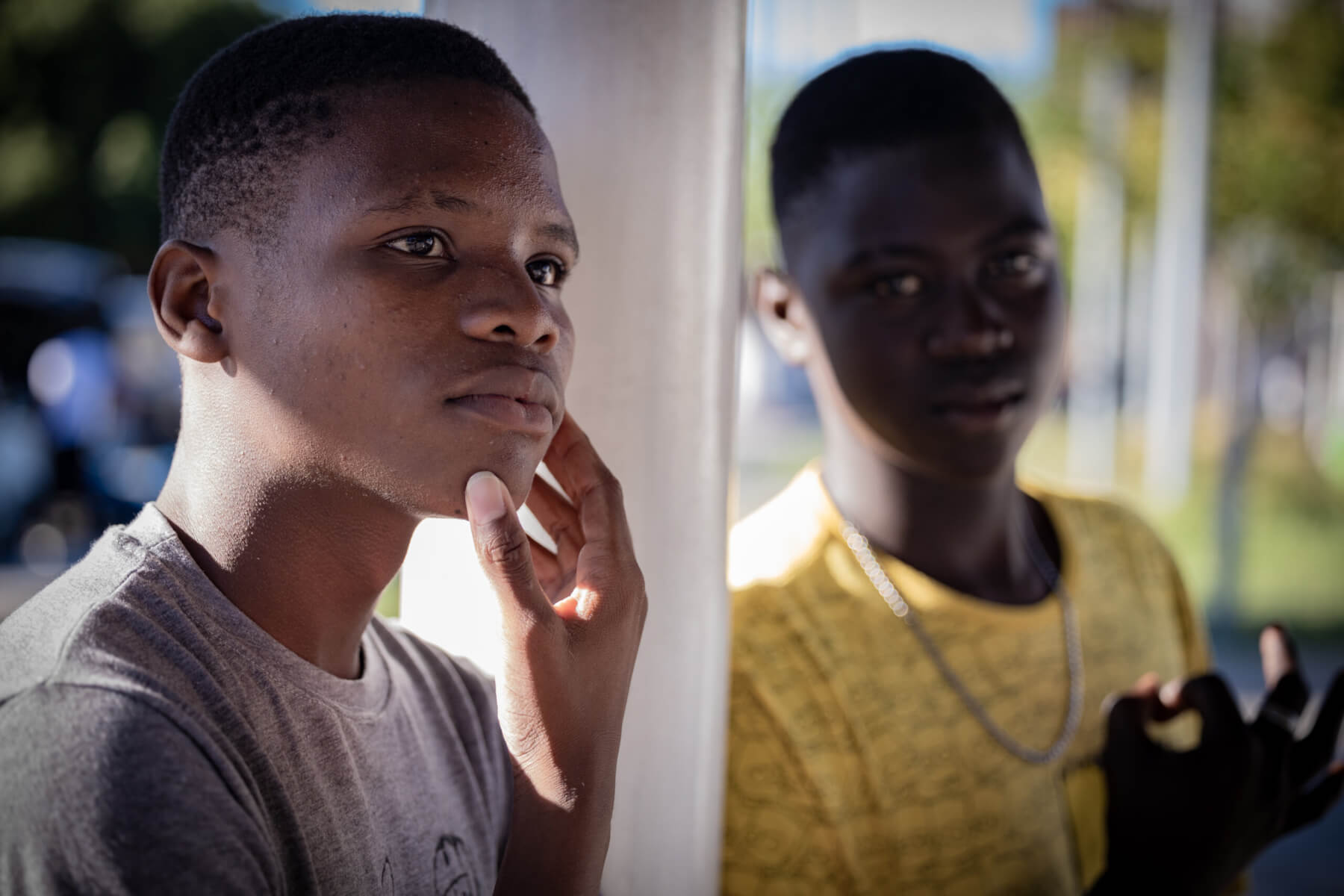
James and friend at Parque La Ocho in Zona Centro in Tijuana for the commemoration of the Del Rio incident. Photo by Sam Slovick
Neither the border nor the migrants that wax and wane in numbers are a monolith. Most are refugees fleeing violence, climate crisis or places with no future. Others are opportunists seeking advantage. The small number of Haitian refugees in Tijuana who have fled violence and deprivation at home are among the most vulnerable.
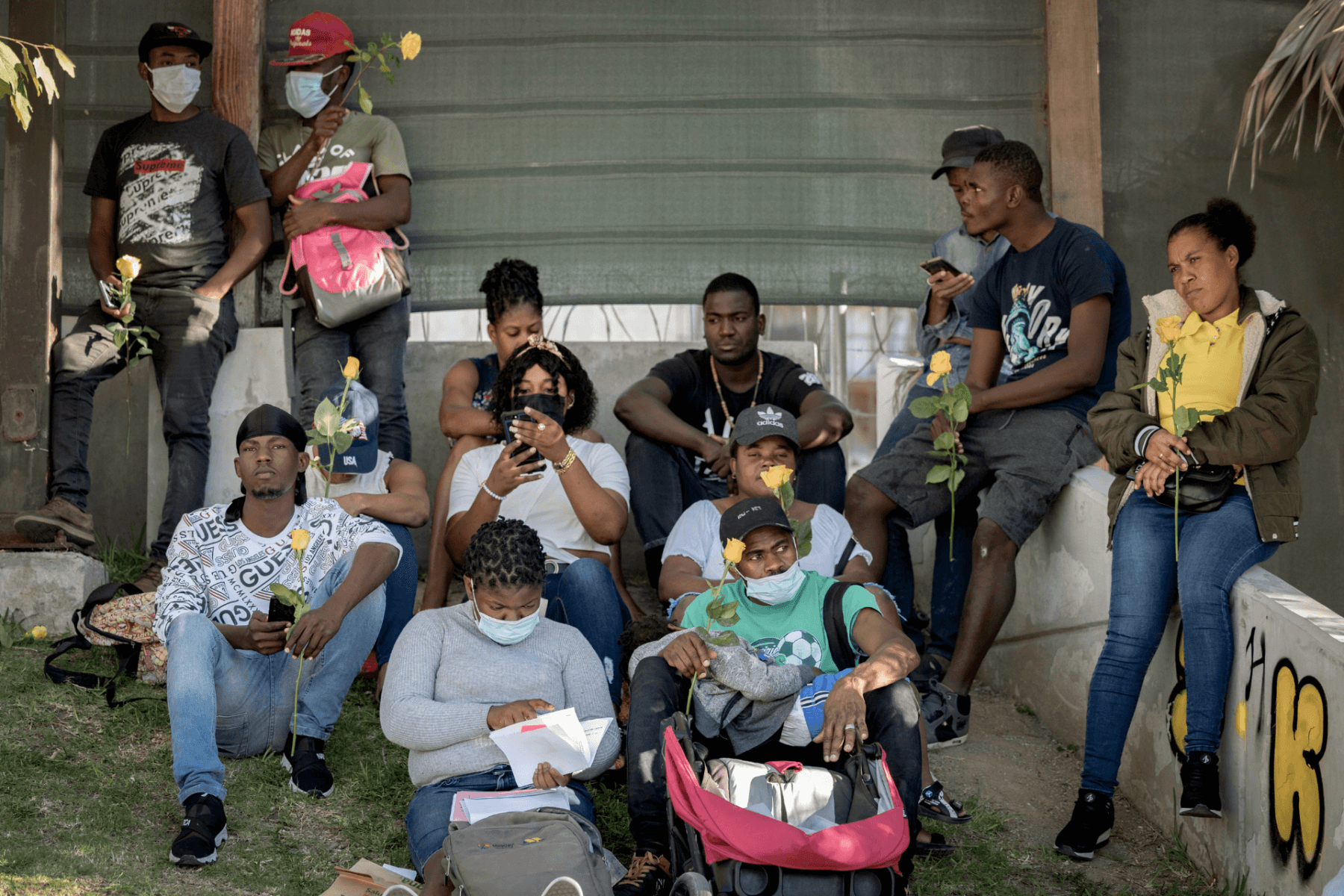
Late in the afternoon, a couple of men with official-looking vests were seen setting up a canopy on the stage bearing the advocacy group Haitian Bridge Alliance (HBA) logo as women checked the mic. This was a well-oiled machine. The migrants in the bleachers held yellow roses and a big yellow banner with black letters spelling out, “Love, Care and Protection for Asylum Seekers.”
The people in the bleachers were all from Haiti and they were here to commemorate a bad memory from a year prior, when agents from U.S. Customs and Border Protection (CBP) confronted a group of Haitian migrants crossing the Rio Grande River near Del Rio, Texas. Thousands of Haitians had been living under the International Bridge, which spans the river between Del Rio and Mexico, in a makeshift refugee camp. The confrontation produced some regrettable optics: uniformed men on horseback aggressively confronting migrants attempting to cross the river. Though some say images were taken out of context, they were immediately condemned by the Biden administration.
The one-year anniversary event in the park was organized by HBA to “uplift the voices of Haitian migrants on the one-year anniversary of the racist abuse against Haitians seeking asylum in Del Rio.” The event was relocated to Parque La Ocho in Zona Centro at the last minute after a body was discovered at the original site a few blocks away.
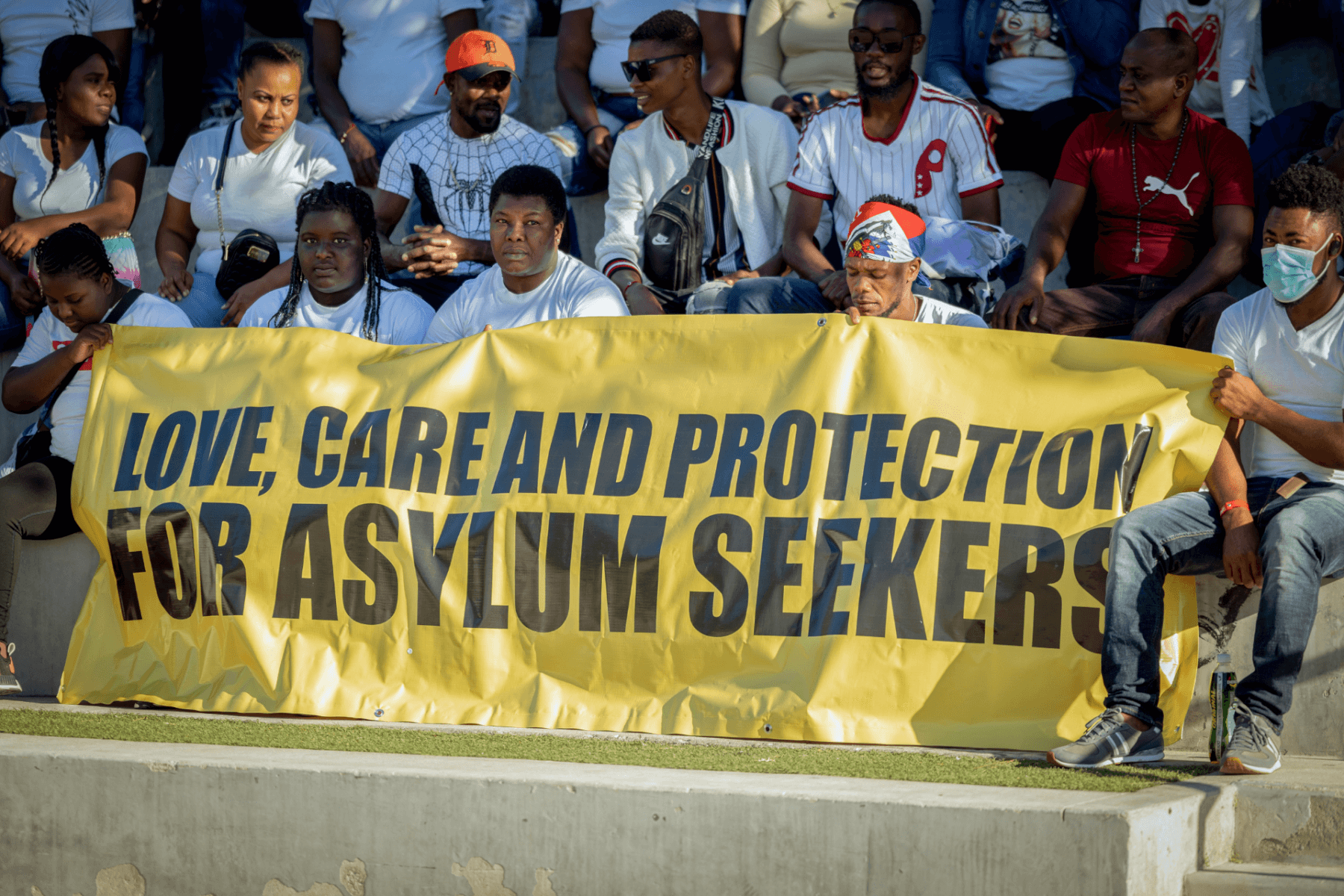
Haitian immigrants advocate to reframe the way the U.S. treats immigration. Photo by Sam Slovick
During the event, James looked on from the edge of the park, poised as he leaned on a pole in a small patch of shade. He was peering past the journalists, past the stage and past the past. He was gazing into the future in Florida where he’d reconnect with his mother. From his vantage point, the future was looking good — much better than it did from Haiti, which had been overrun with gang violence, pummeled by climate crises, and, most important for him, lacked any real possibility for economic advancement.
It’s now been three years since the Del Rio incident and Haitian immigrants have been in the news again, mostly as a source of campaign cannon fodder for right-wing fear-mongering. Collectively, though, we remain disassociated from the history of Haiti, the site of the only successful slave revolt in history, and its impacts on present-day Haitians and the rest of the world.
James was 15 when he attended that Haitian Bridge event in Tijuana. He had left a small village in Haiti and caught a connecting flight from the Dominican Republic to Mexico. He eventually made his way to the U.S., his entrepreneurial spirit guiding him into a post-George Floyd America. James moved through the immigration process faster than many because he was an unaccompanied minor. He reunited with his mother who had already settled in Florida’s east coast.
Seeking asylum is a process that has been streamlined by the CBP-One app launched in 2023 which, lets migrants schedule appointments for ports of entry. The CBP reports that some 852,000 people have successfully used it as of September 2024.
This year, though, border crossings have slowed significantly since peaking in December 2023 under Biden, whose term began with a surge of migrants heading for the border before he was even inaugurated. Haitian migration to the U.S. was also rapidly trending down, even with the escalating gang violence and ongoing political instability this year in Haiti. The instability roiling Haiti can be placed inside the contextual history of the African diaspora dating back to the 16th-century slave trade.
That history explains in part why the wave of Haiti refugees in the last four years is in-country with Temporary Protected Status (TPS). They’ve also been welcomed — outside of partisan politics — as a needed addition to the workforce and, more subtly in some circles as an opportunity for America to circle back to its complicated origin story.
On the other hand, individual Haitians, of course, are being targeted by xenophobic foment while getting a crash course in divisive American politics. Vice President candidate J.D. Vance’s cat-and-dogs libel sadly does not denote any new depths of disingenuity. He just adeptly harnessed the current climate for weaponizing migrants — especially Black ones — as the sum of all fears. The truth is, Haitian immigrants in Springfield, Ohio, are more likely to be the victim of a crime than commit one, and more likely to become naturalized citizens than other immigrant groups, according to both the Migration Policy Institute and reports by the United States Census Bureau.
In the wake of Vance’s comments, the HBA fired off a cursory press release condemning racism, a signature of the Southern California non-profit. Here’s an excerpt:
September 10, 2024, FOR IMMEDIATE RELEASE
HAITIAN BRIDGE ALLIANCE STRONGLY CONDEMNS COMMENTS MADE BY SENATOR J.D. VANCE, IN WHICH HE FALSELY AND OFFENSIVELY CLAIMED THAT HAITIAN IMMIGRANTS ARE EATING PETS IN SPRINGFIELD, OHIO AND WE URGE HIM TO RETRACT
These false allegations are a clear example of the anti-Black racist and xenophobic nature of people like Vance whose goals are to dehumanize Black communities around the country.
A few weeks later the HBA would file a high-profile lawsuit against Vance, also on brand.
Haitian immigrants in the U.S. are asylees, meaning they’ve sought asylum and are recipients of Temporary Protective Status (TPS). They are provided Employment Authorization Documents, making them a temporary, legal and — just ask the mayor of Springfield, Ohio — much-desired workforce in a near-full employment economy. They shop; they pay rent and taxes. Ohio Gov. Mike DeWine recently said something people in Tijuana echo: Haitian immigrants have a work ethic that earns respect.
Undocumented labor is the backbone of America.
Asylum seekers stay temporarily in the U.S. as “parolees,” joining the backlog of over eight million pending immigration court cases, 80 percent of which are denied. If that happens, most opt to stay here illegally, rather than return to the places they fled. In this case, they join the ranks of 11 million, non-voting, undocumented laborers who pay over $97 billion in taxes but get no benefits. Undocumented labor is the backbone of America.
DeWine also credits Springfield’s economic “resurgence” partly to the influx of working Haitians. The Biden administration granted Haitian immigrants in the U.S., recipients of TPS Status through Feb. 3, 2026 for those Haitians who arrived before June 3, 2024. The American Immigration Council says as of March 31, 2024, there were approximately 863,880 people with TPS living in the United States, about a quarter of them Haitian, with an additional 486,418 initial or renewal applications pending at U.S. Citizenship and Immigration Services. In addition, an estimated 316,000 people may be eligible for TPS under two redesignations since that date. Many of these are Haitian, even though they comprise just two percent of the U.S.’s 47.9 million immigrants.
***
In Tijuana, Haitians are the fourth-largest migrant population behind Mexicans, Central Americans and Venezuelans. The 4,000 to 6,000 Haitians in Tijuana waiting for what’s next have both kept their distance and simultaneously assimilated. If they have the legal right to work and Mexico is their final destination, they become a functioning part of Tijuana’s $17 billion economy. But without work papers, it can be a dicey proposition, wherein Tijuana becomes a holding cell for migrants waiting to get into the U.S. They are all vulnerable, but some more than others. Black migrants aren’t passing as Mexicans.
During a recent visit to her office, Adriana Espinoza, Baja’s Undersecretary for Migrant Affairs, sits behind a large wooden desk in an office in a government building. Secretaria General De Gobieno, Gobieno do Baja California is spelled out on an oversized awning that wraps the top of the building near the Otay Mesa port of entry at the U.S.-Mexico border.
Espinoza was at Human Rights Watch, an international NGO based in New York, before taking this job. Like Mexico’s new president and Baja’s new governor, she is a woman in a position previously occupied by men. A framed official portrait of the governor, ever watchful on the wall behind the undersecretary, states plainly that she is here to do the government’s business.
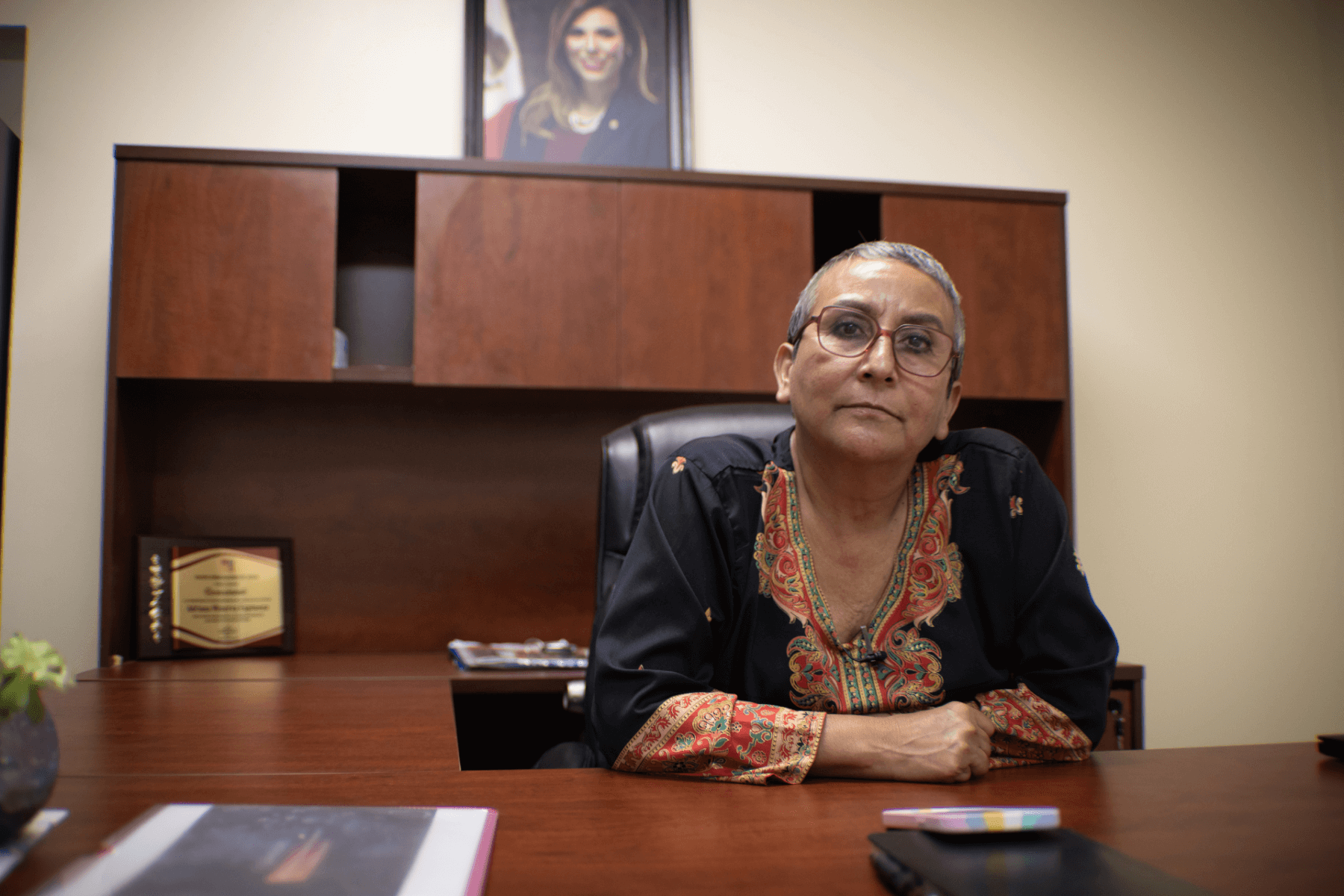
Like Mexico’s new president and governor, Undersecretary of Migration Affairs, Adriana Minerva Espinoza is a woman in a position previously occupied by men. Photo by Sam Slovick
“Yeah, [Haitian migrants] are here living in Baja. And we need to do more [work] with them so that they have formal jobs, their own homes and economic autonomy,” she says, estimating that there were some 5,000 Haitians in and around Tijuana last year.
“I know that some of them are trying to get the CBP appointment and are going to try to get into the United States. But I think the path of [Haitian] people living here in Tijuana are not from shelters,” she says. “Haitian immigrants have their own communities. They have been here over the years.”
What she’s saying is that Haitians tend not to stay in shelters, government-operated or otherwise. Mexico is a violent country, and there were 1,844 homicides in Tijuana in 2023. Yet Haitians here don’t live in shelters for a variety of reasons, including how they’re easily targeted and taxed. Instead, people live on their own in different communities and camps in and near Tijuana in Baja, California, and also among the locals.
[Title 42] afforded presidential authority to exclude migrants from select countries where communicable disease is present. Rivera says, “It was used in a malicious way against non-whites.”
Haitians are subjected to systemic racism on both sides of the border, HBA founder Guerline Józef told Al Jazeera in an interview. She says that Haitians receive longer detentions and are deported at a higher rate than other migrants. Espinoza isn’t sure about that, and also pushes back on the assertion that Ukrainian refugees got preferential treatment. “I think that we have to be very clear with this situation about the Ukrainian people and all the other nations’ immigrants. I have to explain that this didn’t happen. I mean, we just [offered] the beds and medical services as we do with others.”
Many Ukrainian refugees had their own resources and some Faith Based Originations (FBOs) advocating for them. And though the Mexican government may not have shown any preference, the U.S. invoked a public health policy from the 1940s that did, according to some who work with migrants here. “The Trump administration used Title 42 in a discriminatory way,” says Pastor Albert Rivera, founder of the Ágape Misión Mundial migrant shelter in the Nueva Aurora in Tijuana.
Rivera says that Ukrainian refugees “did not need to show proof that they were negative of COVID. Haitian migrants could not cross because the Trump administration believed that Haitians could spread COVID. The Trump administration felt safe even though there was no evidence to prove that Ukranians were immune from COVID.”
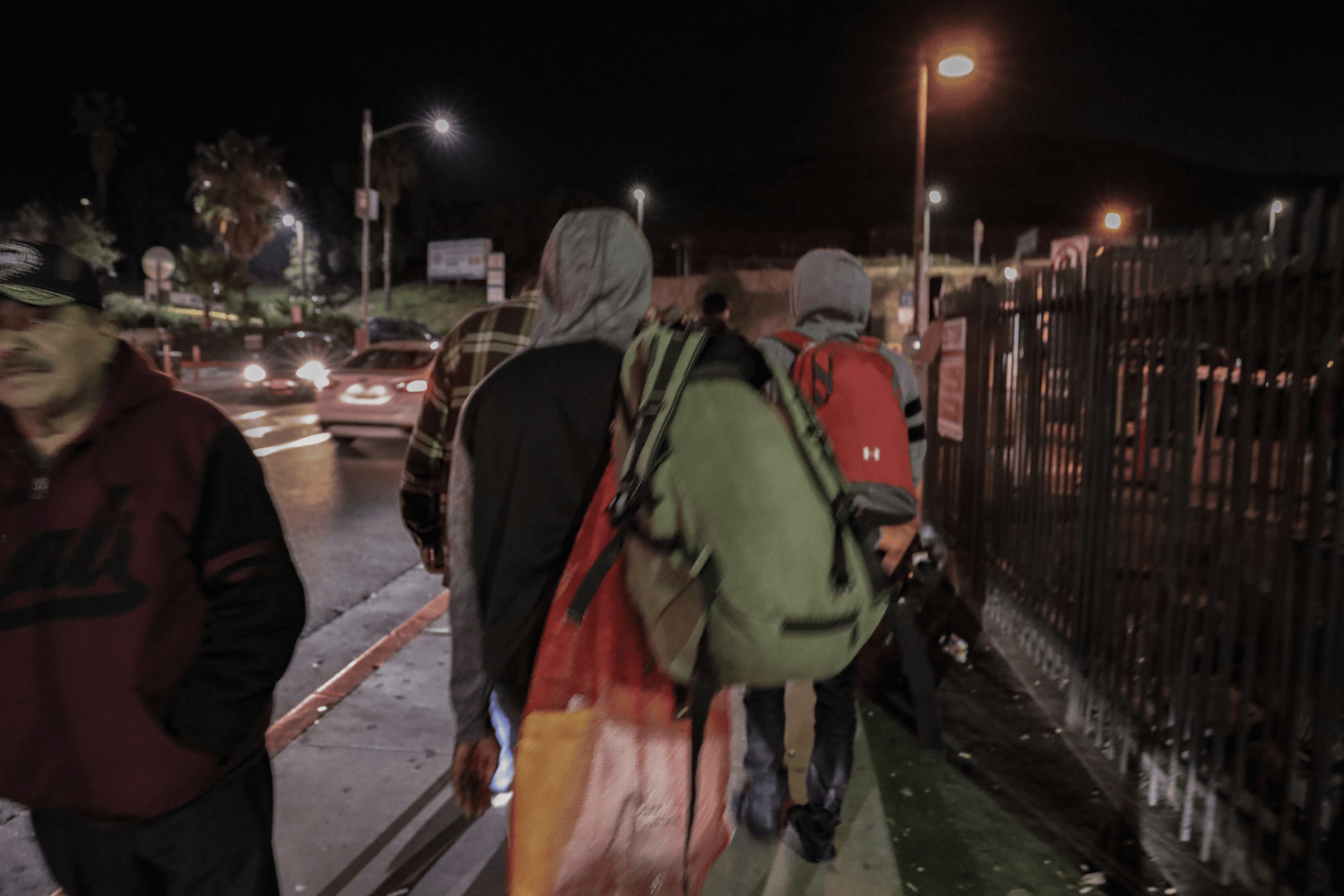
Recently released immigrants in Tijuana. Photo by Sam Slovick
Title 42 was created in 1944 as part of the Public Health Service Act in response to a cholera epidemic. It afforded presidential authority to exclude migrants from select countries where communicable disease is present. Rivera says, “It was used in a malicious way against non-whites.”
Rivera is speaking from anecdotal experience, but an NPR analysis of Department of Justice data supported his notion that Haitians faced the highest rate of asylum denial during the time Title 42 was in effect from March 2020 to May 2023.
Nonprofits, NGOs, FBOs and legions of volunteers at any southern U.S. border are an essential safety net for migrants released on the street by CBP who may or may not speak English or have resources or a way to communicate with relatives or sponsors.
Haitians in the U.S. who have applied for asylum can remain in the country until their case is adjudicated, or apply to enter the country legally for two years with a financial sponsor in the United States. Where they will ultimately end up on the immigration status spectrum has yet to be figured out on a policy level. An attainable path to citizenship is available for the moment, but the future of America’s immigration policy is not.
***
Haiti covers approximately 10,000 square miles and sits just 800 miles from the Florida Coast in the Caribbean. It is a small island with a big legacy. It’s the plantation colony where the slaves fought and beat imperialistic France. As demagogues ride a wave of anti-immigration and illiberal populism globally, he sees Haiti as central to the current context and conversation.
“For me, every time Haiti is in the news it is an opportunity to educate people about that history, right? About the importance of Haiti. And I think this is very much one of those opportunities,” says Jake Johnston is the author of Aid State: Elite Panic, Disaster Capitalism and The Battle to Control Haiti. “And instead of seeing it degenerate into a conversation strictly around eating pets—it’s just like, why is that the conversation we’re having about Haiti? We don’t need to fall into the narratives that exist, right? You don’t need to operate in that terrain. You can do other things.”
Johnston says that people can understand their own government in the reflected glare of Haiti’s history from colonization till now. And when they do, they are going to have a lot of questions. “And so, I think this is not an accident in a lot of ways. Right? I don’t mean to say it’s not an accident in that this is an ongoing top-down conspiracy…” What he means is that Haiti didn’t become a so-called failed state out of the blue. “There’s a reason why it happened.”
Haiti’s history is inseparable from the legacy of colonial slave trading. At the end of the 18th century, Haiti accounted for over one-third of the entire Atlantic slave trade — importing 40,000 slaves per year. Ultimately, 800,000 Africans were forced into Haiti’s colonial plantation system. The life expectancy for a slave in Haiti was 21.
In August of 1791, a full-fledged slave revolt began in Haiti (then Saint-Domingue), pitting Black slaves — rebels from the Indigenous Taíno who had survived colonization and Yellow Fever — against France. The conflict, and the island, a great source of wealth for its colonizers’ coffers, soon became a pawn in global, mercantilist machinations. Spain and Britain entered the fray, with Britain seeing the revolt as an opportunity to wrest final control of the West Indies from France.
At one point, France abolished slavery in an attempt to pacify the revolt. Then, Napoleon tried to take it back. In the end, approximately 345,000 were killed in the long conflict. The casualties were mostly Haitian slaves and some Indigenous Tiano. The remaining Europeans were killed by the rebels after the revolt. Haiti gained its freedom, but it cost more than lives, though. In 1825, France pressed Haiti for compensation for lost slave-plantation assets as the price for recognizing Haiti’s independence. Haiti paid $30 billion to French slaveholders over 122 years, up through 1947. The debt crippled Haiti’s economy. France apologized for a “moral debt”, but no retribution is forthcoming beyond a forgiven $77 million loan. France published a database of compensation paid to French slaveholders.
The wars and their toll on France’s treasury and its imperial entanglements spurred Napoleon to sell half of what we now know as the U.S. for pennies on the dollar–the Louisiana Purchase. The Jefferson administration wanted easy access down the Mississippi to New Orleans, then a major port and the center of the U.S. slave trade. Napoleon’s ghost is still in the machine.
***
Florida hurricanes and J.D. Vance haven’t dampened James’ mood or impeded his progress. Mexico seems like a pit stop now over two years later. He assimilated easily to his new home. School has been a breeze as the education he brought with him was more advanced than that of his new peers.
Things have fallen into place nicely for James in his senior year in high school. He joined the debating club, got his driver’s license and his first car. He took a sales job on summer break to generate capital to seed his two fledgling businesses: e-commerce and web development. James holds traditional values as part of his plan to ensure success.
His short-term goal is to make money to support his larger plan. “I just want to help people,” he says. “That’s really what I want to do. I want to help people, but especially veterans. They fought for their country and somehow, they’re homeless. So yeah. That’s what I want to do. Just basically be a good person.”
“Rather than dismissing the lived realities of these communities, our focus should be on supporting their resilience, recovery, and dignity.”
James is on a path to citizenship, but that’s just a part of it. He’ll graduate next year and he sees himself inside the larger picture — here in the world’s largest economy, where business is booming, unemployment is low and the possibilities are limitless.
James speaks three languages: Haitian-Creole, French and English. He’s currently studying Russian. Despite his facility with language, he’s not interested in explaining Haiti or the legacy that has led him here just yet. “I’m not ready to talk about it. It’s a whole thing,” he says. “I don’t care what corrupt politicians have done in the past.”
As for the present, he loves the U.S. and says he’s grateful to be a part of it. Acrimonious politics aren’t really on his mind. “Only if I’m watching it on TV right now and I’m thinking about it [politics]. I watch with my mom, and we argue, but really, we have the same perspective,” he says, and then wonders, “How do these people have all this time to sit around and talk about Haiti and abortion all day?”
Meanwhile, in a target-rich media environment, where vulnerable migrants are always fair game, new opportunities for fear-mongering are always at hand.
October 30, 2024 FOR IMMEDIATE RELEASE (excerpt)
HAITIAN BRIDGE ALLIANCE DENOUNCES OFFENSIVE REMARKS ABOUT PUERTO RICO AT TRUMP RALLY San Diego, CA –
Haitian Bridge Alliance strongly denounces the harmful and demeaning language used at a recent Trump rally, where Puerto Rico was referred to as an “island of garbage.” Such remarks are not just offensive; they are rooted in ignorance and promote harmful stereotypes that demean entire communities, undermine their humanity, and exacerbate racial and social divisions.
This type of language does a disservice to the shared history and struggles of Caribbean nations like Puerto Rico and Haiti, which have long faced challenges including colonial exploitation, economic marginalization, and environmental injustices. Rather than dismissing the lived realities of these communities, our focus should be on supporting their resilience, recovery, and dignity.
Help us sustain independent journalism...
Our team is working hard every day to bring you compelling, carefully-crafted pieces that shed light on the pressing issues of our time. We rely on caring supporters like you to help us sustain our mission. Your support ensures that we can continue to provide deeply-reported, independent, ad-free journalism without fear, favor or pandering. Support us today and make a lasting investment in the future.

RELATED STORIES


Award Winning



Today’s environmental and social justice challenges are unprecedented, and require an unprecedented collective effort.


Stay updated on our latest features, events and more. Subscribe to our Note From the Nest newsletter!

Haiti had severe earthquake, then a hurricane next year. 2008 $100 Million raised to help. Operation Can-Do Eric Klein from Los Angeles went to help. The society never recovered from the disasters