
Rise of the American Favela


Honorary mention, “Activism Journalism,” Los Angeles Press Club’s 2023 SoCal Journalism Awards.
UPDATE (as of March 6, 2022): Early morning on February 28th, Los Angeles Sanitation & Environment (LASAN) cleaning crew with an LAPD escort swept the corner of 5th and San Pedro Streets, leveling the White House Community Center (WHCC). Tenants scrambled to gather belongings, retreating to the edges of the sidewalk as the LASAN crew filled three garbage trucks and power-washed the sidewalk. Some belongings were damaged, and some were confiscated to be returned in the future. LAPD and LASAN have not yet responded to RCM comment request. Stephanie Styles was live streaming the sweep when her sister, Queen Unity, was handcuffed and arrested after staging a one-person sit-in.
On March 3rd at 7:05 AM, Styles was live streaming from the newly reconstructed WHC that is reportedly receiving more donations than usual.
The streets are still damp from a late-night, midwinter rain just a few blocks from Los Angeles City Hall. Skid Row, 50-square blocks of squalor, where thousands of people have been living in various states of homelessness for decades, saw just enough of a downpour to stir up some toxins and chase away the rats.
As morning breaks, the stink of wet garbage and car exhaust meld and a city bus squeals to a halt, commencing the day’s symphony of racket. The sidewalk is already washed and swept as the unvarnished procession stirs to life. The scene is chaotic, sometimes violent, but mostly peaceful as people — some with aid of crutches, canes, wheelchairs and walkers — navigate around a woman who has overdosed on fentanyl and is lying motionless on the sidewalk.
Meanwhile, the advocates and caregivers serving the community take up their positions at storefront agencies, community centers and in the streets as loft dwellers descend from their high-end, downtown real estate.
A few dark clouds linger, but just when things are about to get gloomy, they part nicely, the sun breaks through and Stephanie Arnold Williams (a.k.a. Stephanie Styles, a.k.a. Stephanitely Styles) emerges from the White House, as she calls it — a large, white, gazebo tent that is her home.
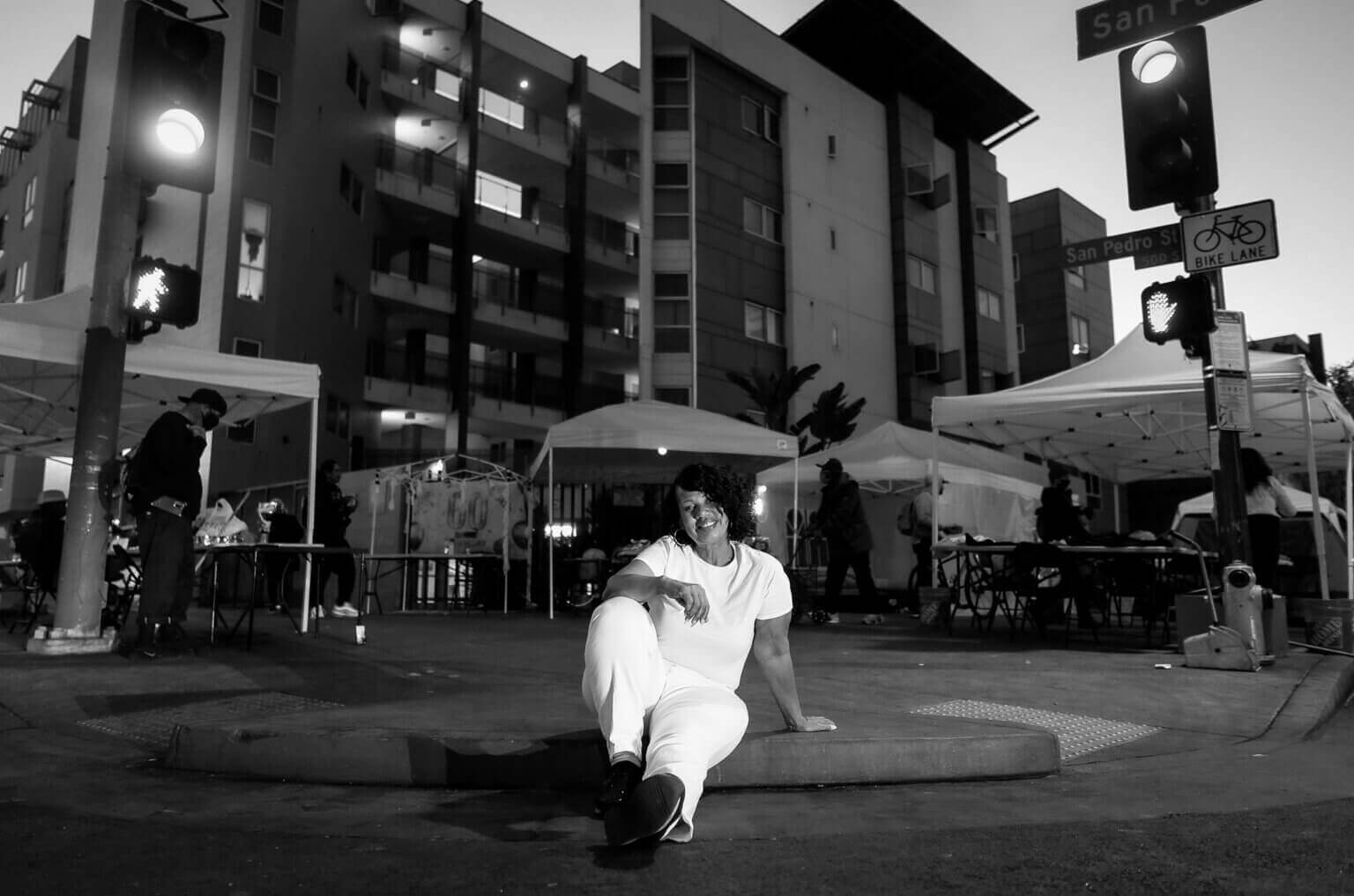
Stephanie Styles surveys her domain. Photo by Luigi Ventura
Consistent with her color scheme, Styles is dressed in a crisp, white-shirt and freshly pressed white jeans as she surveys her domain: one block extending south and east from the corner of 5th and San Pedro streets in Downtown LA. “I’m a Skid Row, free-tent landlord. I occupy the Gateways Apartments,” she says, smiling.
The Gateways Apartments building is the non-profit, SRO Housing Corporation’s $28 million complex with 108 units of supportive housing for chronically homeless people. Everything between the Gateways and the street is hers. People camping on the sidewalk here are under her protection as she serves as a self-assigned caregiver. She keeps track of them and others in the community. She’ll call an ambulance and do whatever is required in the middle of the night. If things get threatening, or even violent, she’ll handle that too.
This is, as they say, ground zero on Skid Row, just a stone’s throw from the shiny high rises in the financial district where you can’t walk more than a couple blocks without stumbling into a multimillion-dollar mega mission — the large facilities with big budgets that feed, shelter and offer a variety of other services to the houseless denizens.
Styles has created something she calls the White House Community Center (WHCC), a pop-up, sidewalk, tent complex that serves as a donation and distribution hub for food, water, clothes and hygiene products. WHCC provides everything from individually packaged catered meals and children’s toys to sleeping bags and whatever ever else of use shows up.
The WHCC consists of five canopy tents with removable side panels, butted up against each other, with smaller tents wedged in between and a few big, white plastic tables offering a place to sit out of the sun. People drop donations here, and then Styles and her younger sister Queen (a.k.a. Queen Unity, a.k.a. Dionne Leslie) distribute them directly to the people on the sidewalk.
Street savvy with a gift for marketing and promotion, Styles live streams while offering coffee and a nicely displayed selection of donuts, served with paper plates and napkins, to homeless people. “I have a secret. I love Skid Row,” she confides as the woman who had overdosed on the sidewalk comes back to life and sits up just as the paramedics arrive.
***
Stephanie Styles, who describes herself as a former clothing designer, retired seamstress and mother of four adult children, moved to Skid Row in May of 2013 after she says she had some beef with the cops in Indianapolis who she claims broke her leg. “I chose Skid Row to be around some people while I was healing,” she says.
In the beginning, she was alone here in a tent on this corner and was initially unable to pursue her craft. “When I first came, I had a broken leg so I couldn’t sew. It was my right foot that was broken. I had to train my left foot to sew.” She also wanted to do something to help the community. “What could I do? What does Skid Row need?” She started sewing pillows with characters and sports logos to give to people. Humble beginnings. Now, her WHCC operation is bustling. Her Facebook Live, found under the name StephanitelyStyles, is Skid Row, 24/7 with no filter. The stream is unpredictable and designed to let her network know exactly what the community needs in real-time.
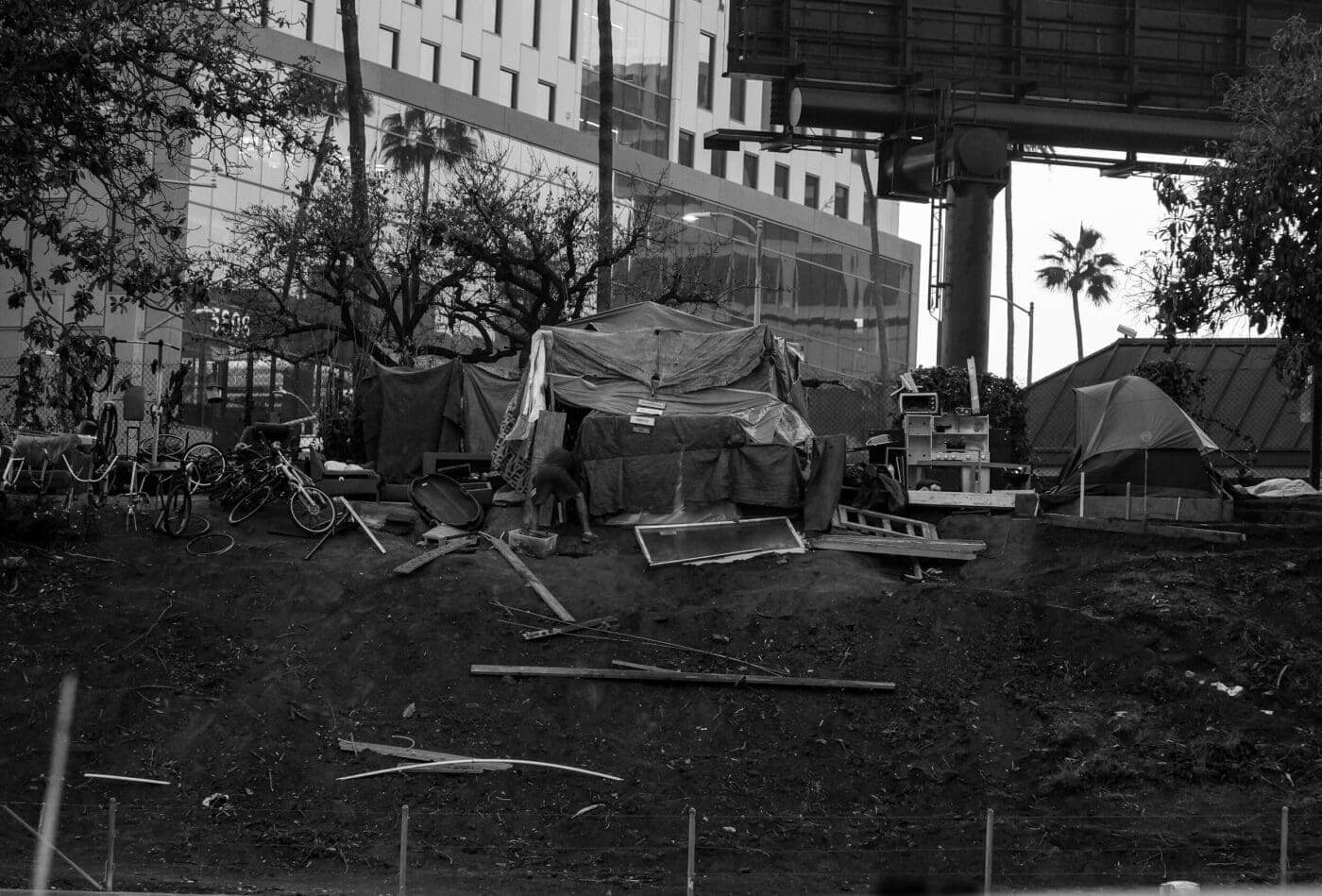
Photojournalist Luigi Ventura captures the Rise of the American Favela.
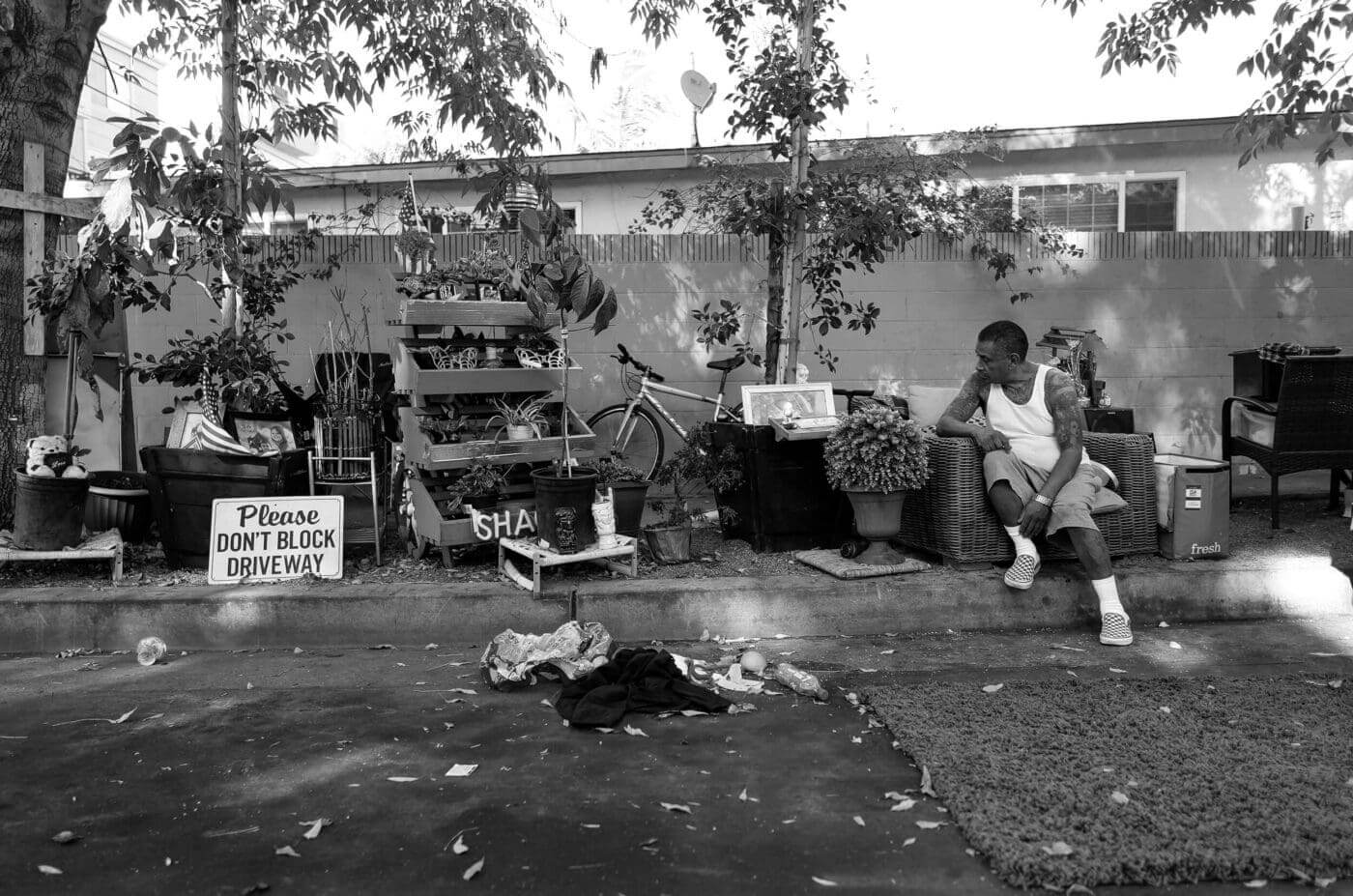
Julian, recently homeless, looks at a photograph of his deceased mother.
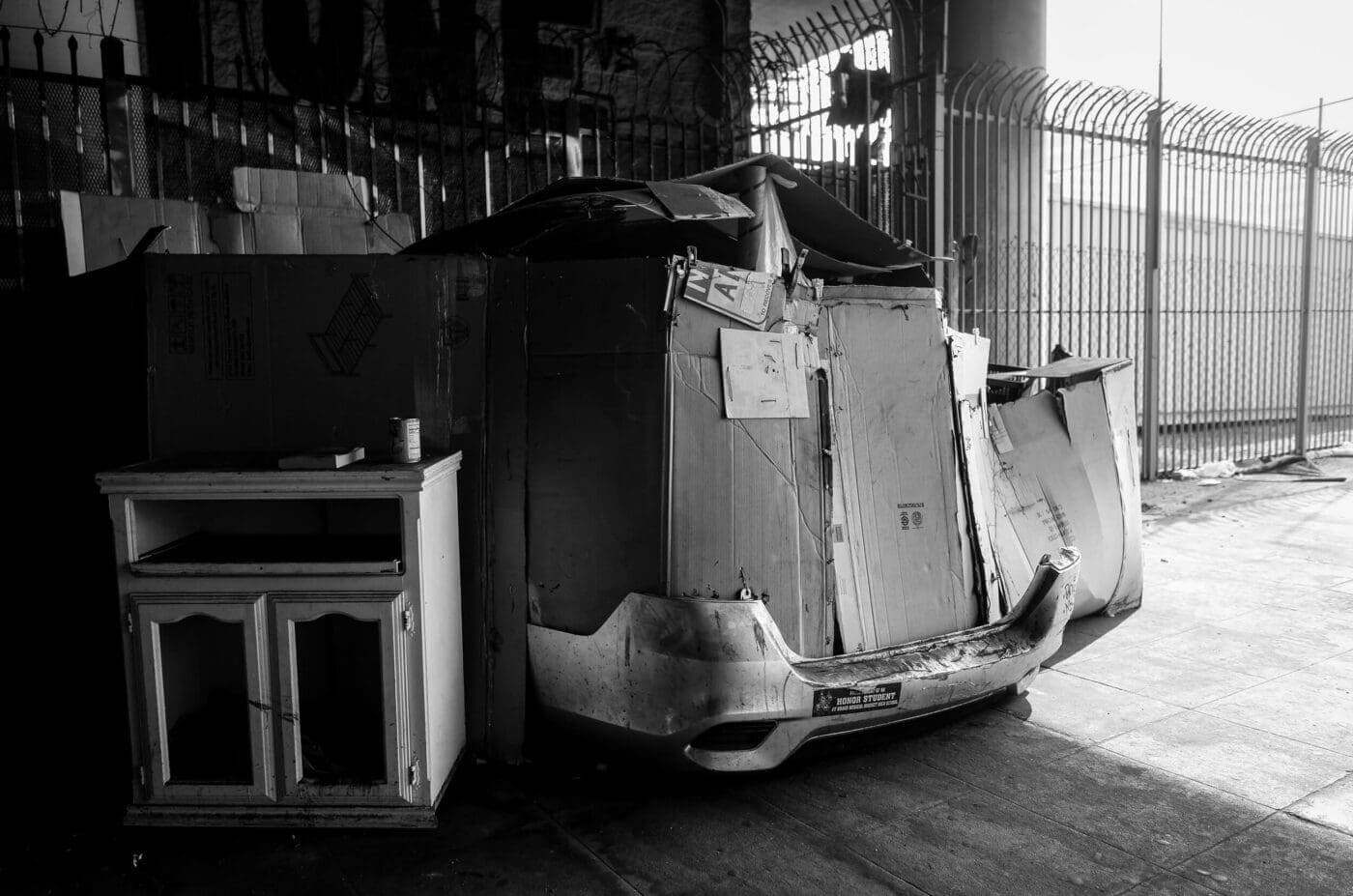
Car bumpers form an improvised structure under Interstate 10 Freeway.
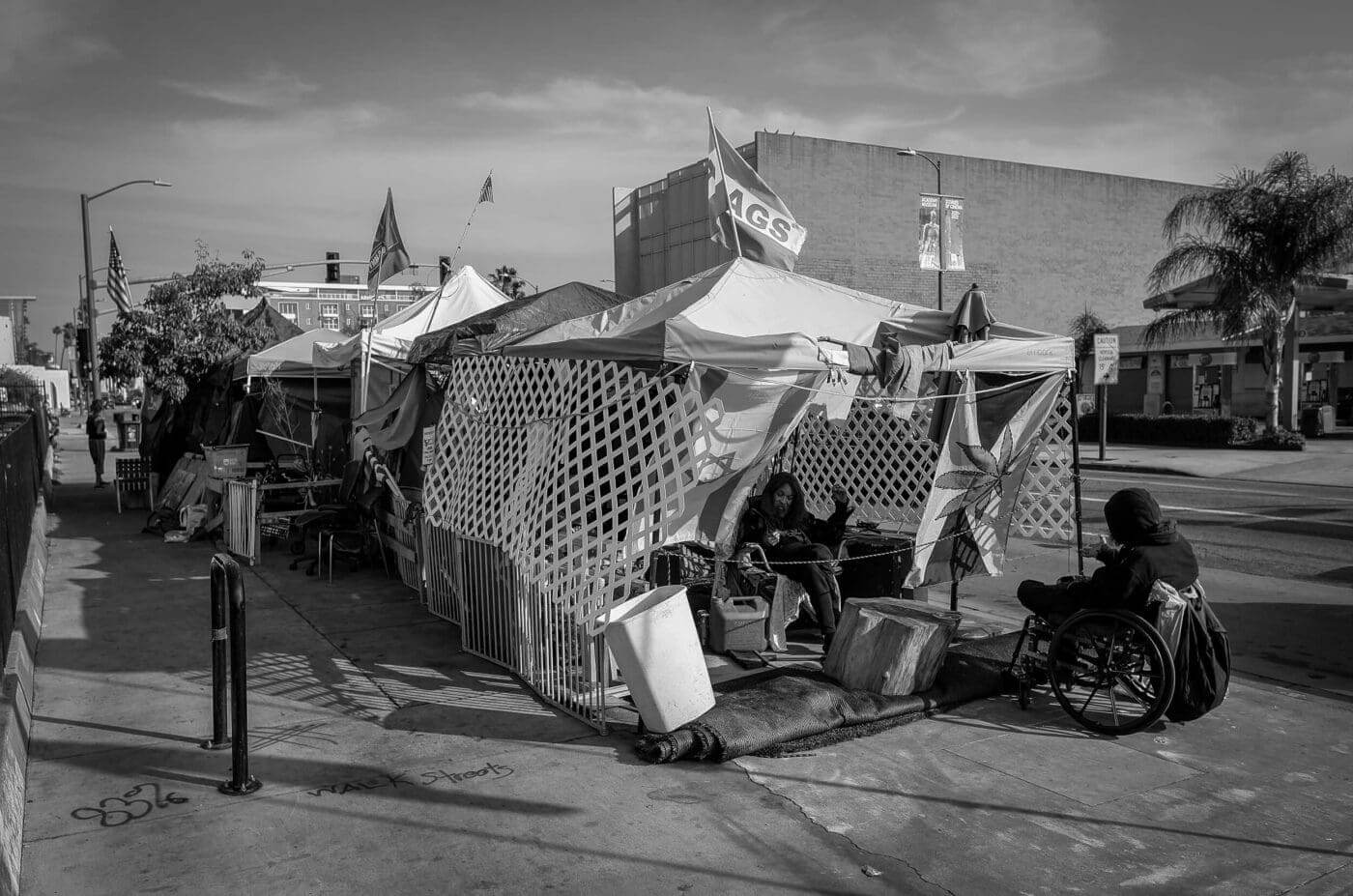
“Flagastand,” a tent and home on Hollywood Boulevard, where flags are sold.

A handcrafted palm tent in the Westlake neighborhood.

Van-and-tent structure near Downtown Los Angeles.
This morning the vibes remain high despite the near-fatal overdose just outside the White House. Styles and Queen, by boundless energy, live stream and greet people while stacking pallets of donated plastic water bottles. Outside the tent, it’s an open-air, sidewalk market where they coexist with a panoply of non-profits, volunteers, county-funded outreach and other groups such as The Good Karma, Feed The Streets LA, Urban Alchemy and others.
Beyond her borders, though, it’s anybody’s guess what’s going. This is Skid Row, after all, and while service providers, caregivers and advocates are everywhere here, there’s also money to be made. The heroin, crack and deeply branded Fentanyl and Oxycodone epidemics all thrive here. P2P methamphetamine is the leading zombie maker. The latest meth variant emerged in the wake of international crackdowns on ephedrine, replacing it with chemicals that are even more damaging neurologically and physiologically. A steady flow of P2P meth from super factories in Mexico makes it cheaper than tacos.
“This isn’t a homeless crisis; this is the obvious result of failed policy.”
Nevertheless, Styles diverts traffic on San Pedro Street, directing an unannounced church minivan loaded with food to a space at the curb where its cargo can be unloaded and distributed from her de facto headquarters.
Free as she wants to be, with no rent and no boss, she is flourishing in her role as a service provider. Some think the city could take a lesson from the success of her independent operation at a time when so many are struggling on the streets of LA.
“This isn’t a homeless crisis; this is the obvious result of failed policy,” says Skid Row community health worker Adam Rice, pulling his Dodge Durango to the curb in front of Styles’ White House. In his signature walking cap with short ginger hair spilling out from underneath, Rice leans out the window and shouts, “Hey Stephanie!”
Styles smiles and walks towards him, “Oh hi Adam. I’ve expanded. I’m a community center now!”
Ten years ago, Rice did an eight-month stint in a tent a few blocks away at 4th Street and Towne, but today he’s a vital part of the Unsheltered COVID Response Team that goes into the streets to provide everything from testing, vaccinations and basic on-site healthcare by nurse practitioners while also connecting people to housing and other essential services. Housing for Health (H4H), a division of the Los Angeles County Department of Health Services, which Rice says is funded with state and federal COVID-19 relief money.
Rice’s job requires situational awareness and a specific skill set. Before H4H, he was a Human Right to Housing Organizer at Los Angeles Community Action Network. Having worked and lived around Skid Row for a decade, he’s part of the community.
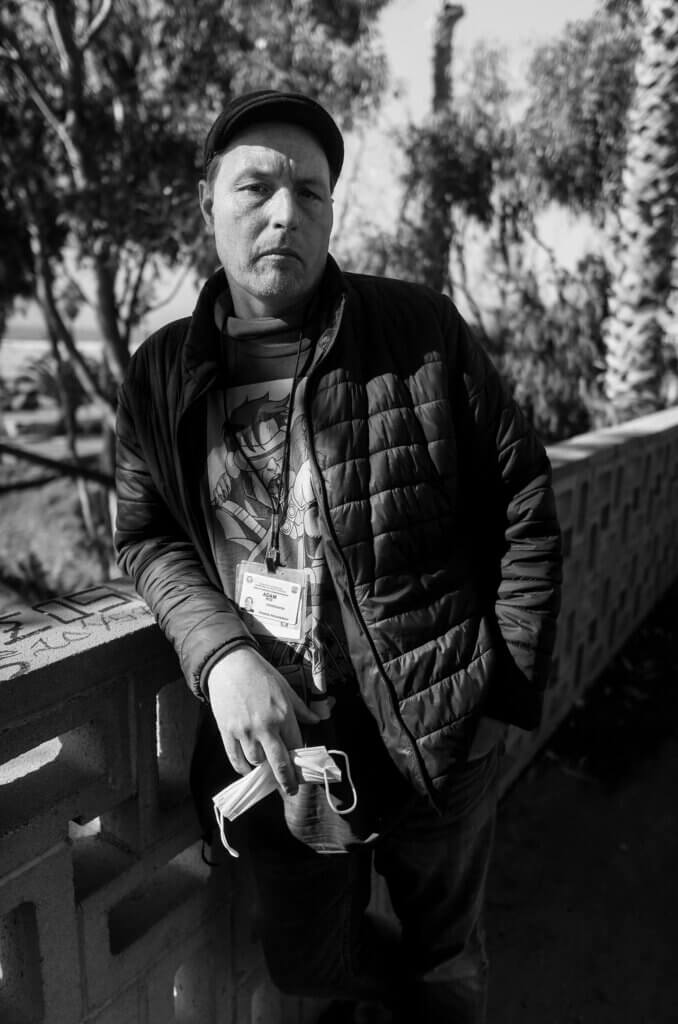
Housing for Health COVID Response worker Adam Rice. Photo by Luigi Ventura
“I have been down here a time. Right here is where I used to sleep,” he says, indicating the now vacant sidewalk at 4th and Towne. “You can see that hostile architecture — useless plants. Plants to discourage people from sleeping against the buildings,” he says, pointing to the shrubs against the buildings.
But strategically placed anti-camping shrubs aren’t going to reverse the transformation that has been occurring all over LA for years — a transformation that is epitomized by Styles’ elaborate WHCC enterprise and tent structure. These sort of improvised, semi-permanent living structures occupying sidewalks and underpasses are not specific to Skid Row. They are increasingly part of the county’s landscape, serving as landmarks that could signify the seeds of something new and in many ways previously inconceivable: an American favela.
“This is not a mystery,” says Rice. “This is the new face of homelessness. You see trailers everywhere… forget the tents. People will create structure. They need it to feel human. They need to feel safe, and there’s no safety on the streets of Los Angeles.”
***
Los Angeles Homeless Services Authority (LAHSA), an agency created in the 1970s to distribute General Relief to homeless people, now coordinates housing services for all unhoused people in LA County, receiving $3,000 a year to administer the nearly $1 billion in annual funding from federal, state, county and city sources. They also do an annual count of un-housed people in the county, but they skipped the count the past two years because of the pandemic. The official LAHSA number of homeless in the county is 63,706 — a study conducted in 2019. Media has latched onto the figure, but even LAHSA says its “point-in-time” count, conducted by volunteers, is a low estimate.
“There are easily 160,000 homeless people in Los Angeles. Probably more than 160,000. I mean there are 426 square miles in the city,” says Rice.
Rice says that H4H and the COVID response team resonate with him “because they recognize all of Article 25 of the United Nation’s Declaration of Human Rights… All human beings have the right to a standard of living adequate for themselves and their families including food housing, medical care and all necessary social services.”
He’s offering this while driving east on 6th Street through a tent camp that sprawls in every direction, far beyond downtown. “The human right to housing is constant a battle; it’s not a simple thing.” It’s also a personal thing with Rice, who was homeless as a teenager.
When it comes to its homeless, LA failed to make any substantial progress even before the recent onslaught of tents.
In 2006, then-Los Angeles Police Department (LAPD) Chief William Bratton and the city launched the now notorious Safer Cities Initiative (SCI) in response to media and public pressure to deal with the Skid Row problem during a period of intense downtown gentrification. To clean up downtown, Bratton put the force of the LAPD behind the little-used municipal code 41.18(d), ratified in 1968, which states that, “no person shall sit, lie or sleep in or upon any street, sidewalk or other public way.”
According to a UCLA School of Law study, the SCI initiative cost $6 million annually for 50 additional LAPD officers (more than the $5.6 million total budget for all homeless shelters and services at the time). It also cost the city $4,300 to process and manage each arrest. By 2009, after 12,000 citations and some 800 monthly arrests, SCI had cost the city $118 million. Meanwhile, the number of tents on the streets went up.
In 2014, the Ninth Circuit Court of Appeals decided in favor of the American Civil Liberties Union of Southern California and the National Lawyers Guild which were seeking an end to the criminalization of homelessness. Jones v. City of Los Angeles argued that the banning of sleeping on the streets or sidewalks when there aren’t enough shelter beds was cruel and unusual punishment. Following the court’s ruling, 41.18(d) became unenforceable.
Other policy failures followed as rents increased, wages stagnated and the opportunity to create new, affordable housing for low and no-income Angelinos were squandered. Five years ago, LA residents voted for Proposition HHH, a $1.2 billion bond measure to deliver 10,000 new apartments within 10 years for people experiencing homelessness. Halfway through that timeline, nearly all the money is committed, yet only about 1,000 HHH-funded units have gone online at an average cost of more than $500,000 each, according to the office of LA Mayor Eric Garcetti. The city says HHH will meet its goals on time or close to it, but even so, its goals are modest considering the need.
The public’s acceptance of tent camps is wearing thin, though, and Rice says different levels of camp sweeps by county workers and law enforcement have continued through the pandemic. He expects them to increase in frequency and intensity. In the past, LA hasn’t supported the kind of aggressive sweeps that places like Houston have deployed to clear the streets, but LA seems to be reaching its tolerance for unhoused people living in public space.
For example, LA County Sheriff Alex Villanueva recently gloated on his official Facebook page after Venice Beach was cleared of all tent and beach sleepers under mounting community pressure. On the other side of town, the tent community that consumed Echo Park has also been cleared, with a chain-link fence placed around the entire park to prevent future camping. Half of nearby MacArthur Park is now also fenced in for a conveniently timed “upgrade.”
Politicians and police chiefs come and go, but the song remains the same to Adam Rice. “The blame is always shifted to the people in the street. There wouldn’t be any people on the street if we had sensible economic policies in this city,” he says.
***
Larry Gibson smiles when he sees Adam Rice’s Dodge approaching. He’s an H4H client and now a friend of Rice’s. A smooth-talking septuagenarian with a velvety voice, his uniform is a well-worn dark suit, leather cowboy hat and gold Jesus pendant. It’s been a couple of days since his last shave and a nice grey stubble with a salt-and-pepper mustache completes the look.
“This is my house. Everything I own is in here,” he says as he pats the back of an old van with expired tags. A nearby encampment is made up of four or five big tents draped in tarps on each side of a street. A watchful Shepard mix named Arrow looks on from a cushion placed outside a big tent on the sidewalk next to his van. Gibson lost his right eye in a fight, had hip replacement surgery and spent the last year recovering after a pitbull ripped his forearm apart.
“I’ve been through some changes here — dog bite, hip broke — but God keeps waking me up,” he says.
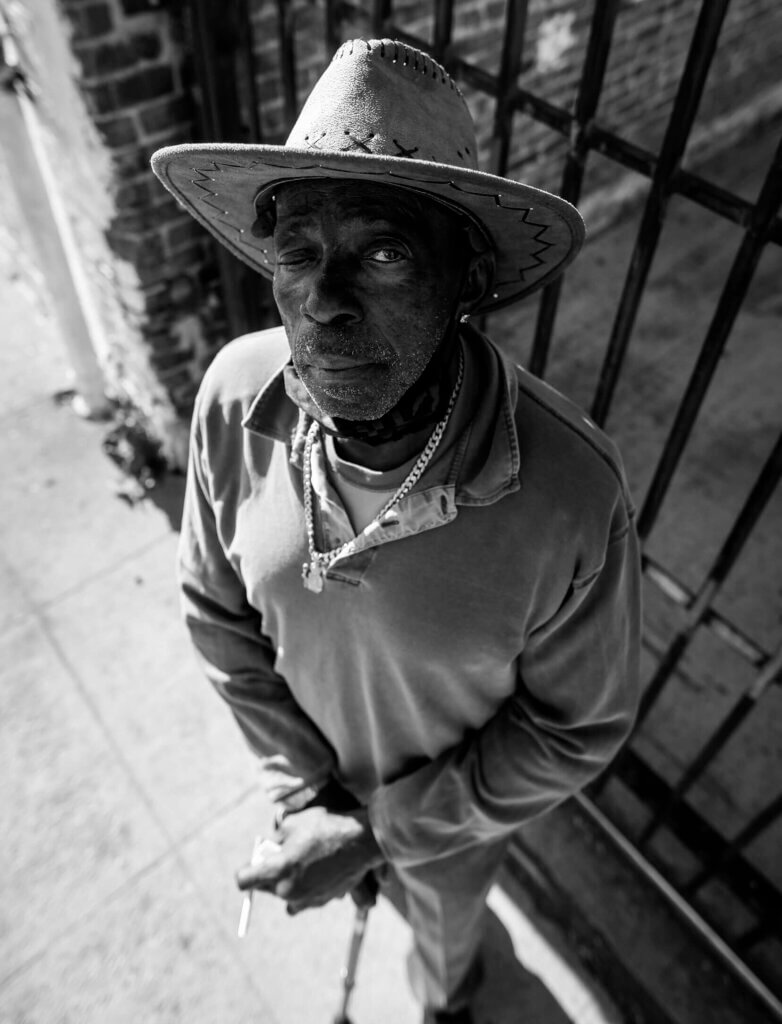
Right where he is meant to be: Larry Gibson keeps watch with his one good eye. Photo by Luigi Ventura
Though Gibson is dwelling a little outside the main radius of Skid Row chaos, he’s not too far from its centralized services. Due to its massive homeless population, though, no place on the LA streets is private. “Police go through there all the time,” he says. “Never a dull moment. They shut a party down last night. The kids were coming through here drunk and vaping… all that shit. They don’t bother me, and I don’t bother them. They’re good people, man,” he says about the cops.
When H4H first contacted Gibson, his right arm was torn apart from the pit bull attack, and he was treating it with peroxide. H4H gave him medical care and followed up to check on him regularly. He got vaccinated for COVID-19.
His wounds have healed on the outside, but the inside job is a work in progress. “I always try to remember, ‘Revenge is mine, sayeth the Lord.’ That’s the hardest part. Waiting on Him to do His thing,” says Gibson. He’s thinking about the guy who took his eye, but he says that he isn’t really looking for revenge. “Happened for a reason,” he points to his bad eye. “Hip broke for a reason. Dog bite for a reason.”
Adam Rice looks on quietly, grins at his friend and client, and gets back in his Dodge.
“If we were out in the streets 10 years ago doing what we’re doing now, I know six or seven people off the top of my head who wouldn’t be breathing,” Rice says, parking his van across the street from MacArthur Park. Here, Enrique, a Salvadorean immigrant has set up a large, tarp-draped frame, with a palm frond presentation on the front entrance. He lives here with his brother and a woman. They survived the long journey from El Salvador, but Enrique ended up with a different American dream than expected: working construction all day while sleeping in a rat-and-gang-infested park in LA during a pandemic.
Not everyone will have a seat on Elon Musk’s Mars shuttle or a down payment for Jeff Bezos’ space condos. Some people will still struggle with the essentials here on earth — food, shelter, and a loose grip on their basic mental and physical wellbeing. We’ve all learned to cry here in LA these past two years, but not all tears hold the same value. There were 1,383 deaths among the un-housed in LA County in 2020, increasing to nearly 1,500 in 2021.
Not everyone will have a seat on Elon Musk’s Mars shuttle or a down payment for Jeff Bezos’ space condos. Some people will still struggle with the essentials here on earth—food, shelter, and a loose grip on their basic mental and physical wellbeing.
***
Back at the WHCC, it’s reasonably peaceful on 5th and San Pedro, where the free noodles and chips are a big hit, laid out nicely on the big plastic tables as people cue up politely. Stephanie Styles is live streaming and planning the schedule for the upcoming week. It’s already pretty full with karaoke, open mic, coffee and donuts, a fish fry, some workshops, a regular preacher on Sundays and now she’s adding a movie night. Is this the new normal? Has Styles figured out some part of the math that adds up to what amounts to the good life here in the brave, new world of the American favela?
“There’s nothing wrong with it. Not enough housing, so we’re here,” Styles says as Queen arranges clothing donations at one of the tables. Styles sees the community beyond judgment. “I don’t think you can get rid of homelessness. I think it’s ok the way it is.” She pauses, and then, says, “If you’re gonna help, you’re gonna help, just leave them alone. If you’re not gonna house them, then don’t criminalize them.”
And while Styles and others are making things better for people here, Skid Row is still a toxic environment where typhus and staphylococcus were pressing public health problems long before COVID-19. People suffering from serious untreated mental and physical health problems are living outside everywhere in LA, and the numbers are growing.
Basic housing is beyond the reach of a growing number of formerly middle-class families in LA. The governor is considering options for California’s record budget surplus, but real estate is a precious commodity here and thousands of empty investment units will remain empty while families sleep in the street or in temporary homeless shelters called “bridge housing.” LA has over 93,000 vacant housing units according to the Strategic Actions for a Just Economy Vacancy Report.
A fresh crop of mayoral candidates seeking to replace Mayor Garcetti will promote short-term “bridge housing” and street sweeps in response to a recent Los Angeles Times poll that said 94 percent of people acknowledge the seriousness of the housing problem. They have a point; no one wants to see tents and tarps on their block. Even small camps can be a biohazard with no running water, bathrooms or waste disposal. If there’s alcohol, substance abuse and the usual associated drama — violence and drug dealing — it compounds public health problems.
While homelessness in LA County has exploded, it has decreased 10.3 percent since 2007 nationwide. LA hasn’t decided to end its housing crisis. A good place to begin would be an updated, better-functioning version of LAHSA with new approaches to new realities.
On 5th and San Pedro, though, Stephanie Styles isn’t concerned with politics. She’s future-focused, with a few irons in the fire. “I’m gonna do ‘Ms. Styles Tiny Pop Up Houses,’” she says. Her tiny homes will have wheels and will come in all colors, “except white. I’m the only one who gets white,” she says, smiling over her shoulder as she walks the woman who overdosed on Fentanyl, now back on her feet, across the street. The whole thing is live on Facebook.
Help us sustain independent journalism...
Our team is working hard every day to bring you compelling, carefully-crafted pieces that shed light on the pressing issues of our time. We rely on caring supporters like you to help us sustain our mission. Your support ensures that we can continue to provide deeply-reported, independent, ad-free journalism without fear, favor or pandering. Support us today and make a lasting investment in the future.

RELATED STORIES



Award Winning



Today’s environmental and social justice challenges are unprecedented, and require an unprecedented collective effort.


Stay updated on our latest features, events and more. Subscribe to our Note From the Nest newsletter!

Well done, Sam Slovick.