
Why You Want a Wolf

“During nearly all the history of our species, man has lived in association with large, often terrifying, but always exciting animals. Models of the survivors, toy elephants, giraffes and pandas, are an integral part of contemporary childhood. If all these animals became extinct, as is quite possible, are we sure that some irreparable harm to our psychological development would not be done?” – G.E. Hutchinson
In April 2025, a wildlife tracker named Martyn LeNoble was out in the Mojave Desert on non-wildlife business when he ran across wolf prints. He was in northern Los Angeles County, as he described it, “way, way east of Lancaster.” For years, LeNoble has been tracking wolves from the Yowlumni Pack in the Sequoia National Forest, east of Porterville in Tulare County — the southernmost wolf pack in California — and has done work for the state. But this desert wolf was a surprise. He followed the prints until he was sure it was not a large dog. Having seen more than his share of wolf prints, LeNoble knew what he was looking at, but since this wolf had not been radio-collared, the sighting isn’t official
A black wolf had been seen moving through the eastern end of the Tehachapi Mountains in Kern County in February; it could have been the same one, as a wolf could easily cover the 60-80 miles from there to where the tracks were found in a couple of days. Then later, in June, a gray one came through the Tehachapis too. Neither of them had collars, but the sightings were confirmed by biologists from the California Department of Fish and Wildlife (CDFW).
From where LeNoble stood, looking at the prints and the trail, it was only a short jog to the rugged Angeles National Forest and beyond that, the Los Angeles Basin.
Wolves are moving through California with incredible speed, traveling the spine of the Sierras in less than a decade and expanding to 60-70 individuals, by last year’s count, living in ten named packs. And as they spread, a lost awareness or faculty in our minds becomes sensible to those of us who live here — tracks in the desert, a shadow moving behind the trees.
That shadow is not all joy and wonder; wherever they linger, wolves often run into trouble. In late October, four wolves from the Beyem Seyo Pack were killed by CDFW in Sierra Valley, about 50 miles north of Lake Tahoe in Plumas County. They were the first to be culled since a breeding pair took up residence in California in 2015, reestablishing wolves here, and the state only took this action after the pack had killed at least 87 cattle in the area. Three six-month-old pups orphaned by the action will be removed to a sanctuary.
In fact, you could say it was a bad year for the state’s wolves. The Yowlumni Pack may have broken up. Established in 2023, the breeding pair had two sets of pups, but in 2024, the breeding female developed a debilitating case of sarcoptic mange, and this year her collar stopped signaling. She is presumed dead. Similarly, the collars on two other pack members also stopped signaling, and were confirmed dead by the CDFW with their mortalities still under investigation. A black female who dispersed from the Beyem Seyo pack began traveling with the Yowlumni wolves in early 2025 and was thought to be the new breeding female. Though LeNoble has seen this dark Beyem Seyo wolf on his cameras fairly recently, he notes that he has not seen the big breeding male for over a year.

A grey wolf, likely part of the Yowlumni pack, recently captured on one of LeNoble’s trail cameras. Courtesy of Martyn LeNoble
“I was really, really hopeful that this pack was going to do really well, but it’s been just as tough here as it’s been in other places,” said LeNoble.
But even this bad year is still evidence of wolves’ tenacity. When packs fall apart, the wolves immediately search for a new social situation. They are relentless in their quest for increase. As fragile as their California residency may still be, their wild voices are turning up on the night air in surprising places. Yowlumni wolves may be those seen in Tehachapi or crossing the desert to LA. Dispersing wolves from other packs in Northern California have been seen by other trackers traveling into new territories on the Nevada border. As wolves probe the state’s best habitat, looking for food and mates, a debate rages about how to best coexist with the world’s second-most-successful large predator (after humans).
That coexistence will involve keeping them away from livestock, of course, and building crossings to keep them from being killed on the roads. But it will also involve recognizing that they are part of what made us, and that the trouble and fear they bring represent a return to a mindset and an ecological framework that contemporary culture desperately needs.
The Heart of the Matter
I asked Doug Smith what it means for human beings to live with a wolf, and how that affects our minds. Smith was the lead biologist on the team that reintroduced wolves to Yellowstone National Park beginning in the early 1990s and continuing until he retired in late 2021, and is one of the world’s foremost experts on their behavior. As in California, all the living things in the Yellowstone area experienced the shock of having wolves return after a long absence. Including the people. What does a wolf do to our awareness? Or our identity?
Smith was driving through Wyoming on the other end of the phone, and he took a beat.
“I think I’ve been asked every question by a journalist possible, and I actually haven’t been asked that one. I personally think that’s the heart of the matter,” he said.
“I’ve been in and out of wolf country my whole life, and it’s totally different. I can’t give you an explanation as to why because it’s a feel, and it’s probably mental or psychological. For me, wolf country is like no other. How do I say it? Everything else seems dead. It’s a human-dominated landscape. It’s not interesting. It isn’t vibrant. You don’t have this feel that it’s an intact ecosystem and you have top-level carnivores. Most people use a grizzly bear because grizzly bears kill people. Wolves don’t. They have, but in general, they’re not dangerous to people. But there’s that element: humans aren’t top dog. There’s this really amazing predator out there that is mysterious and secretive and makes the landscape and all the animals in it different.”
He went on to add, “That’s the fundamental issue of why we do recovery: do you want to live in a world that’s dominated by humans and everything you see is there because a human put it there, or a human wants to use it for economic gain? Or do you want to have an aspect of it that is mysterious and out of our control? To me, those are dramatically different places.
“I believe that to the bottom of my soul, a hundred percent,” he added.
Do you want to live in a world that’s dominated by humans and everything you see is there because a human put it there, or a human wants to use it for economic gain? Or do you want to have an aspect of it that is mysterious and out of our control?
For years, I was a neighbor of P-22, the burly mountain lion who for a decade was the undisputed king of LA’s Griffith Park. We live right off the park, and my neighbor across the street had camera footage of the puma eating a deer in their yard. The big cat ran afoul of human constructs every now and then. He ate a few dogs and even once got into the LA Zoo and ate a koala. But he forced you to acknowledge that your human understanding did not constitute the world. There were parts of your own mind that you had forgotten about because you just didn’t use them. In fact, P-22 showed that our human bubble was actually pretty thin; you could still obsess over your TikTok reels and your DraftKings debts or that text she sent you or whatever, but you better damn well pay attention to that big rustle in the bushes. It wasn’t fear. It was respect, and the respect for the cat extended to its home, to the trees, the little creeks, ravens, mule deer, coyotes — the whole place that lived just beyond our backyards.
In other words, when the neighbor is a puma, you have to think about what a puma wants, instead of exhaustively thinking about yourself.
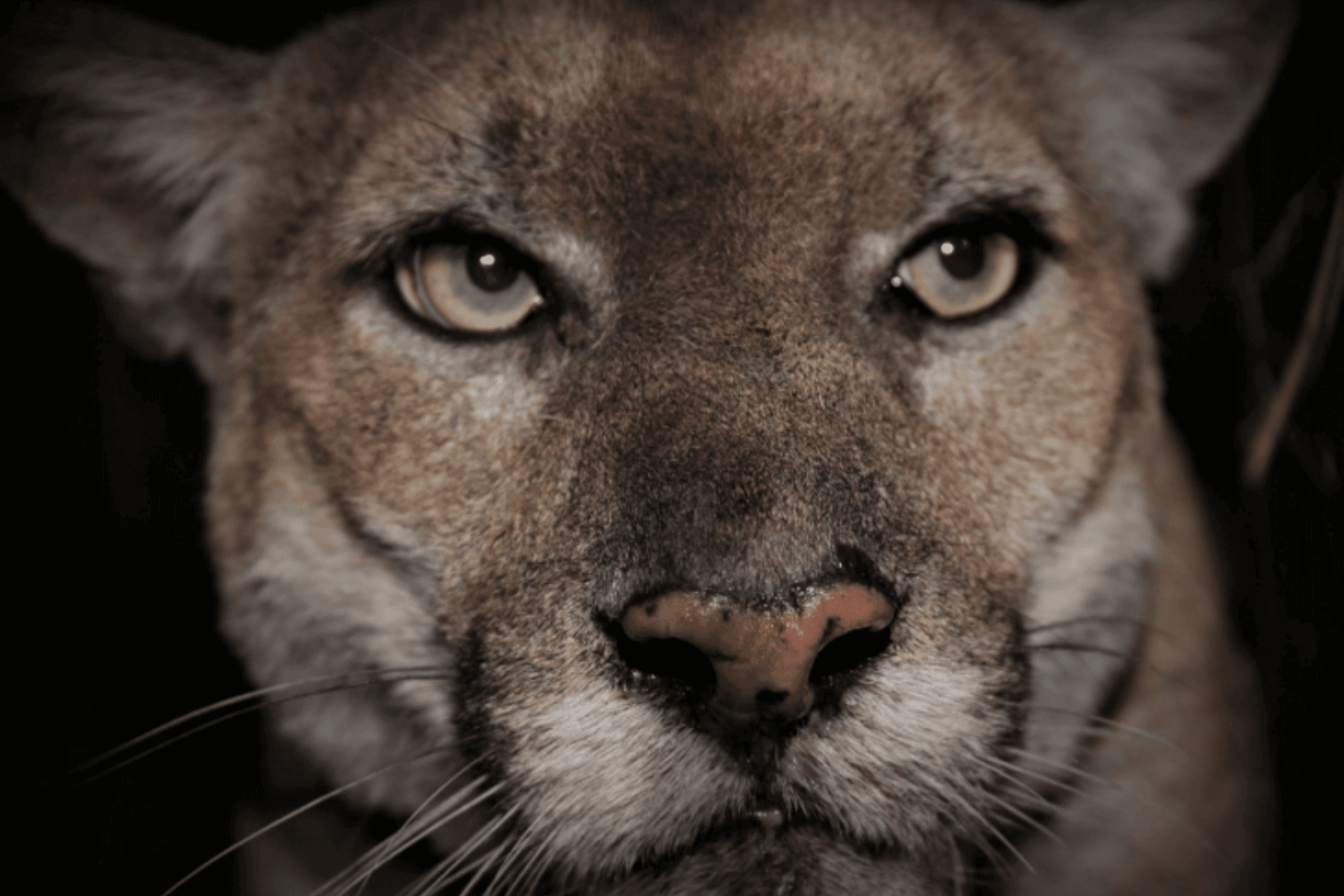
P-22 photographed in February, 2021. Courtesy of Santa Monica Mountains National Recreation Area
Yes, Smith agreed, this is good for human beings. But he also pointed out that wolves will be good in a different way. The puma is a stalker, and its ability to melt into the underbrush of Griffith Park, or the nearby Santa Monica Mountains whence P-22 came, makes it easier for it to live in the background of our shared spaces. The wolf, however, is a courser: it trots right out in the open and tests who’s in charge here.
That hunting style requires ungulate prey and the absence of people, so it’s unlikely that millions of Californians will have the experience we had with P-22. Instead, the wolves will be watchers on the hill. The howling will wake you up.
“I’ve read all the wolf management plans for the states; California has the most forward-thinking plan of any state by far,” Smith noted. “I think that there are great opportunities to recover wolves in the state, learn something about them and provide a place for them to live and enhance human existence, really make life better for people.”
That stays with me: wolves are going to make life better for people.
Better, and harder, too. Better because they might shock us out of the entrenched narcissism that has destroyed our awareness of other living beings and our shared habitat — an arrangement we once considered to be common sense. Harder, because wolves are going to be a challenge wherever they go in California. There are 40 million people, so many roads, and such diverse and fragmented ecosystems.
The Urge for Going
We humans have borrowed the idea of the “lone wolf” from dispersing wolves that have left the pack to embark upon long journeys seeking new mates and new territories. I imagined that wolf trotting across the Mojave all by itself. I can’t attribute emotions to wolves, but they are fiercely devoted to their packs, and when they do go, it’s mostly in search of companionship.
“When wolves reach about two years of age or beyond, they do have an instinct to disperse so that they don’t have to mate with their related family members,” says Axel Hunnicutt, the State Gray Wolf Coordinator for CDFW, who is in charge of implementing wolf policy for the state. “A wolf pack is an adult male or an adult female that are breeding, and their offspring; it’s really a nuclear family. So, the wolves want to leave to try to find a mate so that they can form their own nuclear family.”
Hunnicutt and I talked in early September, before he was called away to oversee so-called “strike teams” that were formed to haze the Beyem Seyo wolves killing all those beef cows in Sierra Valley.
For weeks, according to CDFW and the California Wolf Center at the University of California, Berkeley, the teams chased the wolves away from livestock, shot them with beanbags, put up fencing and flew over them blasting music and human voices from speakers mounted on drones. News outlets have noted that the drone program, spearheaded by the U.S. Department of Agriculture, has been using AC/DC’s “Thunderstruck,” Five Finger Death Punch’s cover of “Blue on Black,” and even Scarlett Johansson and Adam Driver’s raging argument from the film “Marriage Story.”
Despite the harassment, the pack kept taking down cows, and in the end, the breeding pair and two other adults were killed. The aim is to eliminate wolves that might teach their offspring to hunt cows. The hope is that a wolf dispersing from that pack — if they do — won’t take its cow habit with it somewhere else.
“The problem,” noted researchers from the California Wolf Center in an opinion piece in The New York Times, “is that wolves tend to recolonize the same areas, restarting the cycle of conflict.”
Some areas are just wolfy. Consider the trajectory of the wolf that started California’s recent recovery, OR-7: like all wolves in Washington, Oregon and now California, OR-7 was a descendant of wolves Doug Smith helped reintroduce to Yellowstone and Idaho in the mid-90s that have been migrating west. Radio-collared, he left the Imnaha pack in Northeast Oregon and trotted 1200 miles south along the Cascades until he crossed into California, to finally end up nosing around Lassen County, only a couple of miles from Litchfield, where the last known wolf in California had been shot in 1924. The spot is wolfy.
OR-7 — later renamed Journey by school kids — didn’t find what he was looking for in California, but just over the border back in Oregon, he met an uncollared female wolf that no one knew about and formed the Rogue Pack. He had wandered about 4,500 miles by that time. One of his offspring later dispersed into California to form the Lassen Pack, which still survives, and another was the now-missing breeding female for the Yowlumni Pack.
This speedy repopulation is fraught and has been met with fierce resistance. The first pack to reestablish in California, the seven-member all-black Shasta Pack, was confirmed in Siskiyou County in 2015 but very soon disappeared, and may have been the victim of poaching. But since then, California’s wolves have been spreading across the north and then probing south, moving over 200 miles to the south in one jump to form the Yowlumni Pack.
In fact, we have a pretty good idea of where they are going. In 2016, buried deep in the CDFW’s bible-thick “Conservation Plan for Gray Wolves in California,” is a map of potentially suitable habitat for wolves.
The map was made by overlaying areas of prey abundance, public lands and forest cover (which wolves favor) with areas devoid of both humans and domestic sheep (wolves don’t like people nor sheep). There’s no guarantee that wolves will go to these places — for instance, none of them seem to have yet gone to the prime Trinity Alps region near the northern coast — but so far, they do seem to favor the spots on the map.
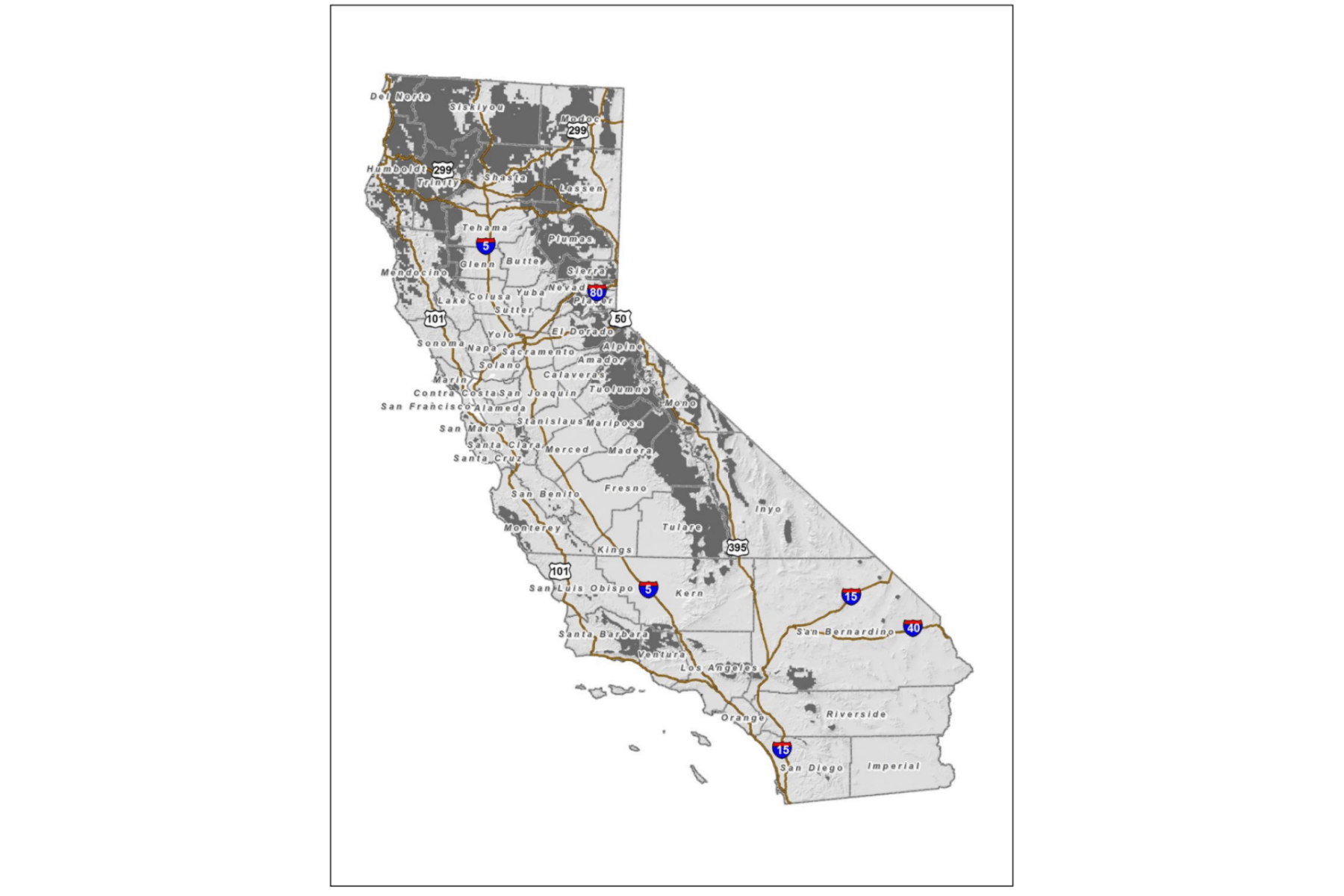
Potentially suitable habitat for wolves in California delineated in dark gray. Model is based on habitat used by wolves in the northern Rocky Mountains states. Prey abundance, public land ownership, and forest cover increased the probability of wolf occurrence, whereas human influences and domestic sheep presence decreased the probability of wolf occurrence. Courtesy of the CDFW, “Conservation Plan for Gray Wolves in California” Part II
The Angeles National Forest is on there; so is the Los Padres National Forest in Ventura and Santa Barbara Counties. In January 2021, a globe-trotter named OR-93 from a pack near Mount Hood entered California, followed the Sierras to Fresno County, then veered southwest across industrial farm country to enter Monterey and San Luis Obispo Counties, then back into Kern, and then dipped into the Los Padres in Ventura. How did he know the Los Padres were over there, across all those highways and human infrastructure? In November 2021, he was hit by a car and killed while crossing the I-5 in Kern.
The wolves seem to know where the wolfy spots are.
“My take on, not just mountain lions, but deer and all these animals that travel, is they have an archeology,” said Beth Pratt with the National Wildlife Federation. She worked with Doug Smith in Yellowstone and is well known for championing P-22 and spearheading the Wallis Annenberg Wildlife Crossing in Agoura Hills.
“Maybe there’s wolf ruins. Maybe they do pass down landmarks or smells. But something. I think it’s no accident OR-7 leads the way, and then all of a sudden, the wolf parade starts. Obviously, the other wolves are following him.”
Pratt points out that P-22 was the first puma in Griffith Park in many decades, but as soon as he died, another turned up in the park. That one left, but then another turned up and was hit by a car. Pumas know about Griffith Park now.
When they disperse to these places, they often follow the same routes, which Hunnicutt called “ecological highways.”
“And it’s not necessarily specific to wolves, but it’s these corridors of connectivity,” Hunnicutt added. “Within California, we have a whole program now in our agency looking at connectivity and trying to build wildlife crossings and looking at how we can minimize human impact on these corridors that are used not just for wolves but for other species. So, whether it’s migratory deer or animals like wolves that disperse sometimes thousands of miles, they’re looking for generally the same areas.”
As they spread, wolves prove to have salubrious effects on the local ecosystem — rebalancing the health and number of prey species, improving vegetation, mending riparian areas and even changing the course of rivers.
The spot along I-5 where OR-93 was hit, for instance, is a place where deer, coyotes and other animals are also struck. The low mountains where the Annenberg crossing is being built was also a hotspot for lions, bears, deer, coyotes and other species.
In 2023, professional trackers Tanya Diamond and Ahiga Snyder were studying northern corridors when they found a wolf moving into new territory. The Wildlands Network hired the two partners in Pathways for Wildlife to study Highway 395 along the Nevada border from Reno up to Susanville in Lassen County — a stretch they called a “slaughterhouse” for migrating deer — so the state could consider new wildlife crossings.
Wolves, they were told, were not close to 395 in that area. But then, near Hallelujah Junction, a mile or so from the border, an uncollared wolf walked past their cameras through a culvert under the highway that was also used by deer and pumas. It was headed east toward Nevada, a few miles north of Cold Springs. They didn’t tell anyone.
“At the time, we kept the wolf in the bag because we didn’t want local folks to freak out and think we were trying to build wildlife crossings to get wolves into people’s backyards,” said Diamond.
This is the first time they’ve felt comfortable reporting the wolf, as now plans are well underway for wildlife crossings on that stretch.
“That was the first video of a wolf crossing through a culvert in California,” said Snyder excitedly. We watched it a few times, and the wolf is very tentative — tail tucked, steps uncertain. It seems not to like being in the tunnel, but it is tracking, nose to the ground, probably following the deer.
When CDFW published its wolf conservation plan, there were an estimated 23,200 square miles of suitable wolf habitat north of I-80 and population estimates for that area of 371 to 497 wolves. They never published estimates for the area south of I-80, meaning they left out two-thirds of the state.
But now we know they are going there. Wolves are the ultimate generalists; they live everywhere. There were a handful living in the whole Lower 48 of the U.S. in the 1980s, and now there are more than 8,000. There are several thousand in India. The Arabian population is on the rise. The North African wolf is thriving. There are more than 2,000 wolves in Greece.
Yellowstone studies have shown us that, as they spread, wolves prove to have salubrious effects on the local ecosystem — rebalancing the health and number of prey species, improving vegetation, mending riparian areas and even changing the course of rivers. But we have only begun to understand the psychological effects mentioned by Smith. The wolf represents a piece of the human mind that is returning; it was only gone a few human generations, but the effects on us and our culture show why we need the wild in our lives.
The Curved Mirror
In 1993, the noted ecologist Paul Shepard published an essay titled “On Animal Friends,” a contribution to a book of collected papers called The Biophilia Hypothesis, in which he addresses why wild wolves and other species are necessary for the health of the human mind. In it, he identifies narcissism as a state of degraded identity and even presages the rise of the selfie (long before there were cameras in phones) as evidence of that degradation.
As an ecologist particularly interested in human beings, Shepard is known, in his books like The Tender Carnivore and the Sacred Game and The Others, for asserting that our human minds were largely shaped when we were Ice-Age hunter-gatherers, and that other animals and plants were critical to our metaphorical mode of thought. In this particular essay, he notes that subsistence cultures, whether contemporary or Paleolithic (he studied living, relict tribes), are almost always characterized as not recognizing much difference between themselves and the non-human world, as though they are “one” with nature — but in fact, the total opposite is true.

Grey wolf captured on trail cam in November 2024. Courtesy of Martyn LeNoble
Our biophilia, he argues, or deep affinity for other living creatures, is based on our insatiable drive as hominids to parse precisely how we are different or similar to all other living things. We are built specifically to scrutinize otherness in infinite detail. We eat the other. We use them for clothing. We know what our own guts look like because of them. They have ritual or ceremonial duties in our culture. We are most decidedly “two” with nature.
And if this scrutiny of the other, he writes, “characterizes the evolutionary origin of human cognition, a root of biophilia, it is in us still, the tug of attention to animals as the curved mirror of ourselves — not as stuff or friends, but as resplendent, diverse beings, signs that integrity and beauty are inherent in the givenness of the world.”
For minds like ours to keep on working right, the givenness of the world has to keep its integrity. It cannot be subsumed into human culture. Amazonian tribes do not try to make a pet of the jaguar, the monkey or the parrot. Closer to home, wolves cannot become dogs.
Shepard notes, “Very few species cross the borderline to live in the human domain. They are like refugees from a ruined nation or guerrillas in support of a failing ministry. Once across, captive and bred, domestic animals become numerous, docile and flaccid — their brains diminished, their anatomy and physiology subject to dysfunction, and their ethology abbreviated. At the same time, the remaining wild fauna recedes from human sight and table.”
And that is the point: without the wild wolf to demand our attention (or the puma, or the bear, etc.), we no longer see the bird, or the field mouse, or the live oak, or the wild oats for their role in the natural system that actually keeps us alive. We lose knowledge of them and end up, like Narcissus, staring into a pool where we only see ourselves, and fairly quickly we die. Any species that has no consciousness of others becomes maladaptive.
For minds like ours to keep on working right, the givenness of the world has to keep its integrity.
Shepard, who died in 1996, spotted a change in our cultural focus. He marked the rise of portraiture in art, calling it “narcissism magnified.” He might be rolling in his grave if he could witness the intense, unrelenting commodification of human attention 30 years later. Phone cameras have turned portraiture into the highly addictive “selfie.” More importantly, no algorithm anywhere will encourage you to put down your phone and pay hunter-gatherer-quality attention to the puma or wolf in your local woods. Indeed, it will fight like hell to prevent you from doing that. You’ll feel like you failed if you don’t mediate the experience by making a video and posting it, as though the post itself is the “real” thing that happens.
And AI will go further: it will argue quite convincingly that it is now the mirror, and that the behavior of the wolf on your screen represents all the reality you need to know. A lot of other things might soon happen that will damage the real earth and our ability to survive — mining for rare-earth minerals on the bottom of the ocean, for example, or geoengineering to block out climate-warming sunlight — but the supplanting of reality by a digital and commodified facsimile is the worst. Digital culture, including AI, is maladaptive by definition. It is an evolutionary dead-end.
In fact, in that context, we need to acknowledge that livestock ranchers probably see the wolf a little more clearly than the rest of us. Tracks in the pasture are not an abstraction; the paws are connected to teeth, and farmers are forced to physically protect their animals.
A 2025 study by economists at the American Farm Bureau estimated that losses to ranchers by direct depredation of beef calves across the U.S. cost farmers $18 million annually. That’s a relatively low number, and losses are compensated by state programs to a degree, but it matters when it’s your ranch; wolves attack relatively few farms, and those operations that do lose cattle lose about 1.9 percent of their animals, and the Bureau says that stress on the surviving stock can drop their weight by 3.5 percent each. With other management costs, it can reduce the farm’s income by as much as 28 percent. Not many businesses can easily absorb that kind of loss.
We lose knowledge of them and end up, like Narcissus, staring into a pool where we only see ourselves, and fairly quickly we die.
When California had to basically eliminate the Beyem Seyo pack in October, they had to live out the contradiction: acknowledge that the recovery of wolves is good for our mental health and bad for some of our farmers at the same time.
“Several things can be true simultaneously,” said CDFW Director Charlton H. Bonham in a press release. “Wolves are one of the state’s most iconic species, and coexistence is our collective future, but that comes with tremendous responsibility and sometimes hard decisions. The Beyem Seyo pack became so reliant on cattle at an unprecedented level, and we could not break the cycle, which ultimately is not good for the long-term recovery of wolves or for people.”
The Restoration of Experience
In August 2025, Miles Richardson, a professor of nature connectedness at the University of Derby in England, published a study finding that human exposure to wildlife has dropped 60 percent since 1800. That’s 225 years, but that’s a lot of missing contact. In fact, that’s essentially living in a whole different world. In his memoir The Thunder Tree, Robert Pyle called this the “extinction of experience.” Meaning that even if the living creatures may still exist, you just don’t experience them anymore.
Historically, “experience” can be wonderful and also bad. If the wolf is allowed to be a wolf, killing to survive, then our relationship is going to be fraught. But the restoration of the experience is essential, either way, because it awakens other returns.
When the wolves arrived at the reservation of the Tule River Indian Tribe of California in 2023, Christina Jaquez thought they were a sign that she and others in the tribe were doing something right. Jaquez, director of the Tule River Yokuts Language Project, has been engaged along with a growing number of colleagues in an intensive effort to revitalize the Yowlumni language.
The pack settled in the Sierra foothills east of Porterville, in and out of tribal lands, and was officially named after the Yowlumni Band of Yokuts Indians, one of the bands that live on the Tule River reservation. The CDFW press release announcing the naming included a quote from tribal elder Vernon Vera saying that his mother, Agnes Vera, who was one of the last fluent speakers of the Yowlumni dialect and co-created a dictionary of the language, taught that they were speakers of the “wolf tongue.”
“Yowlits” means “wolf” in this dialect, so the Yowlumni are literally the wolf people. In a phone call with Jaquez and four other program teachers — Poyomi McDarment, Cecilia Chavez, Fatima Cota and Pam Clark — it was noted that their program has grown as hunger for the language increases, and in this context, the return of the wolf was very significant.
“It was regarded as something good, something that was meaningful to our ways coming back, our traditions coming back,” Jaquez said. “Just like Tulare Lake coming back, it was something that seemed like it was meant to be. It was returning to our people.”
Heavy rains brought back the phantom lake in 2023 (see Red Canary Magazine’s “A Fabled Lake Returns”). Jaquez and the others point out that besides the wolves and the lake, condors and beavers have also returned, and just in the last days of October, the tribe saw the return of about 17,000 acres of land from the state and the release of Tule elk on that acreage, which have not been in the area for many years.
“All of that, to me, is bigger than just a species returning. It’s something that’s returning to us spiritually,” Jaquez added.
Agnes Vera, who was one of the last fluent speakers of the Yowlumni dialect and co-created a dictionary of the language, taught that they were speakers of the “wolf tongue.”
Spiritual doesn’t mean easy. Some tribal elders feel that the state foisted these wolves upon the tribe and created trouble for their cattle contractors. They acknowledge the bloody reality of this experience.
Tracker Martyn LeNoble has had to face this, too. As of this writing, the wolf pack he tracked near the reservation appears to be gone. But just like they shaped the Yowlumni people and their language, they shape the landscape.

Wolf prints. Courtesy of Johanna Turner (left) and Martyn LeNoble (right)
“With this female wolf, and the male wolf, [the original breeding pair], there are some spots where they’re so baked into the mud that their tracks are still there, even though they are not physically there anymore, which is such a strange feeling.
“But when I found those tracks in the mud, I kind of got a little teary-eyed,” LeNoble added. “This animal I’ve been following now for two and a half years, and this is probably the last evidence I’ll see of her.”
That landscape is going to want another wolf. They’re probably already on their way.
Help us sustain independent journalism...
Our team is working hard every day to bring you compelling, carefully-crafted pieces that shed light on the pressing issues of our time. We rely on caring supporters like you to help us sustain our mission. Your support ensures that we can continue to provide deeply-reported, independent, ad-free journalism without fear, favor or pandering. Support us today and make a lasting investment in the future.

RELATED STORIES


Award Winning



Today’s environmental and social justice challenges are unprecedented, and require an unprecedented collective effort.


Stay updated on our latest features, events and more. Subscribe to our Note From the Nest newsletter!
