
Beautiful Illusions
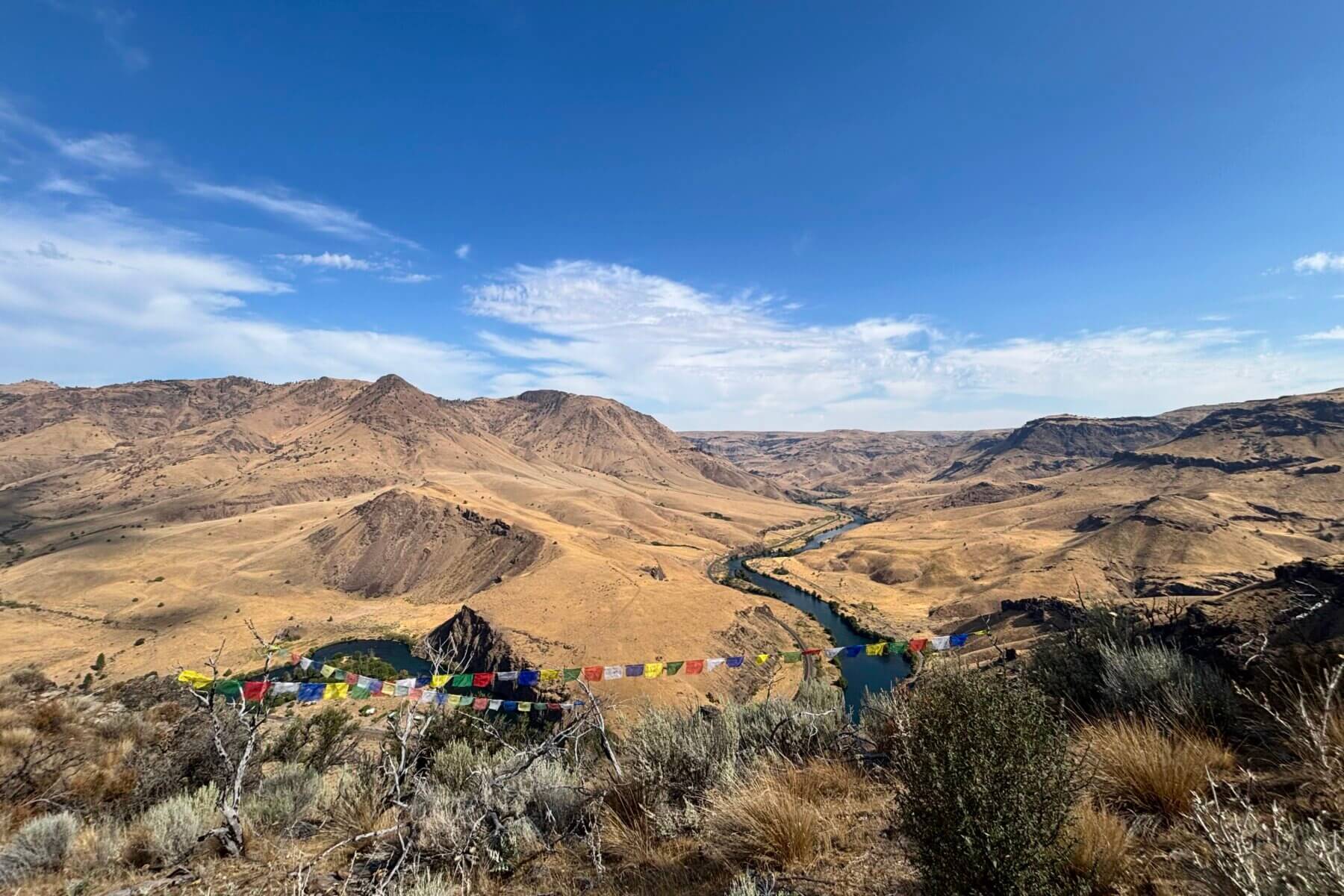
I am standing at the edge of a cliff within a slot canyon, 90 feet above the Deschutes River in the sagebrush steppe of central Oregon. The sun is just about to sink beneath the basalt canyon rim across the river, bathing the rolling hills of the desert in a soft golden light and throwing into stark relief the haphazard geometric shapes of the volcanic cliff I will soon be suspended from.
The anchor point on which my life depends for the moment—nylon webbing and two carabiners wrapped around a boulder—is out of view up the canyon by the time I am ready to begin the third rappel of our adventure. I double check that I am correctly tied into my belay device, sit back over the edge of the cliff, and begin descending. I look down and am surprised to see something I have yet to encounter in this arid environment: a natural pool of standing water.
My feet touch a rock ledge as I finish the repel. I unclip from the rope, alert my companions that I am off belay, and crouch down next to the pool. Having newly relocated from New England to the small high-desert town of Maupin, I am amazed to discover that this stagnant, rapidly evaporating pool of rainwater at the low point in this isolated bench, halfway up a cliff face in a slot canyon above the Deschutes River, is absolutely teeming with life. Hundreds of marvelous, tiny tadpoles are darting around in the pool. As my friends take turns rappelling down to join me, I watch these creatures nibble on algae growing in the warm water. Some of them wriggle to the surface, taking tiny breathfulls of air into their newly developed lungs, their gills now obsolete. As dusk approaches, we tie in to the final anchor and take turns descending the cliff to the river bank, leaving the tadpoles behind.
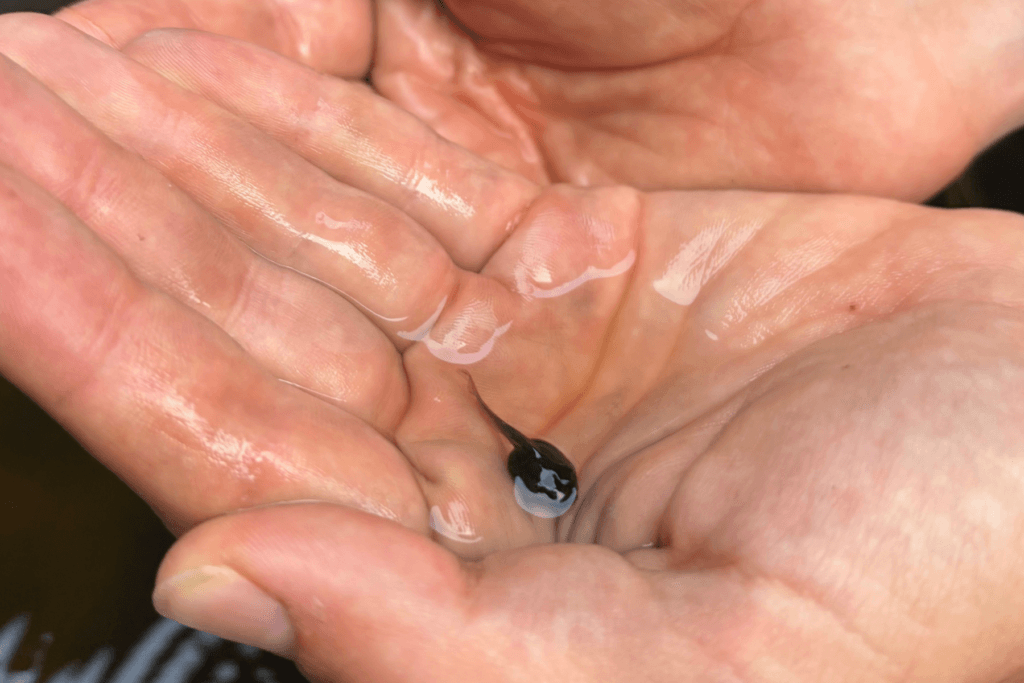
Tadpoles can be found in rainwater pools around the Deschutes River region. Photo by Haley Campbell
The Deschutes River basin is a beautiful and complicated environment where interests have collaborated, competed, and collided in spectacular ways for thousands of years. Flowing just over 250 miles from its headwaters in the Cascade Mountains to its confluence with the Columbia River, the watershed drains an area of more than 10,000 square miles of high-desert landscape. The Warm Springs, Wasco, and Northern Paiute tribes have called the region home for millenia, relying on the anadromous and resident trout and salmon, as well as wild game, roots, berries, and trade for sustenance.
As Europeans came west along the Oregon trail and colonized the tribes’ ancestral homelands, they began diverting the river water to support agriculture while working to subdue and erase the presence of the tribes. In 1855, the tribes relinquished about ten million acres of land to the U.S. government in exchange for the establishment of the 644,000-acre Warm Springs Reservation. In 1937, under the federal Indian Reorganization Act, the tribes reorganized as the Confederated Tribes of the Warm Springs (CTWS) and have been practicing tribal self-governance as this confederacy ever since.
Multiple dams along the Deschutes have been built over the last century to support electricity generation, timber conveyance, agriculture, and recreation. This last contribution of the dams was what brought me to the river: In the spring of 2025, I began working as a whitewater rafting guide on the lower Deschutes, leading guests on multi-night wilderness trips. Every day on the river proved to be unique, but all of the trips share a basic itinerary. After driving our guests, rafts, and gear about 50 miles upstream from Maupin, we launch the morning of the first day at the confluence of the Deschutes and Trout Creek, a small tributary that supports spawning steelhead and juvenile fish. We spend the next two-and-a-half days floating downriver, admiring the everchanging views of a canyon that has been carved by falling rocks and water for the last 18 million years, relying on quick swims to cool us down during 100-degree days, and sleeping at one of the many campsites maintained by the Bureau of Land Management on the banks of the river.
A desert summer experienced from the lower Deschutes River is a unique and wondrous thing to witness. Lupins, paintbrushes, lilies, and other flowers decorate the arid hillsides with improbably vibrant dabs of color in the spring. Butterflies float by along the breeze, landing on the banks to drink from the small pools we inadvertently deposit as we climb in and out of our boats. Sporting their distinctive mohawks, flocks of merganser chicks bravely stare down our boats from afar and sprint atop the water to the safety of their parents as we float by. Ospreys—singular among North American raptors for a diet that consists primarily of fish—provide non-stop drama as they hover above the river and plunge down into the water, emerging often with a fish firmly grasped in their razor-sharp talons.
Unique in the region to the lower Deschutes, the river hosts a famed salmonfly hatch each spring. Having spent years latched onto boulders resisting the river’s current, countless salmonfly nymphs migrate to shore, crawl out of the river, and molt, leaving behind their distinctive exoskeletons. The newly emerged two-inch-long flies immediately seek out a mate and the females return to the river to lay eggs. The event provides a feeding frenzy for the river’s resident trout as they leave the comfort of deeper pools to feast upon this abundant and ephemeral food source. While the river is a popular flyfishing destination most of the year, anglers flock to the river in May and early June to take advantage of the increase in fish activity during the salmonfly hatch.
During the first summer spent on the river, I learned what a rattlesnake’s warning sounds like from just a few feet away. I learned that praying mantis nymphs, emerging as tiny versions of their adult counterparts, are often pure, almost glowing white when they first hatch. I learned the best places to spot wild horses drinking from the river in the early mornings. Serenaded by the constant sound of the rapids in my hammock most nights, I learned what thousands of bats look like as they emerge at dusk to feast on various insects, their erratic silhouettes darting around under the starlit sky. Thanks to the generosity and kindness of my fellow guides and our guests, I learned about the geology and history of the canyon, the hydrology of the river, and the joys of being present in nature.
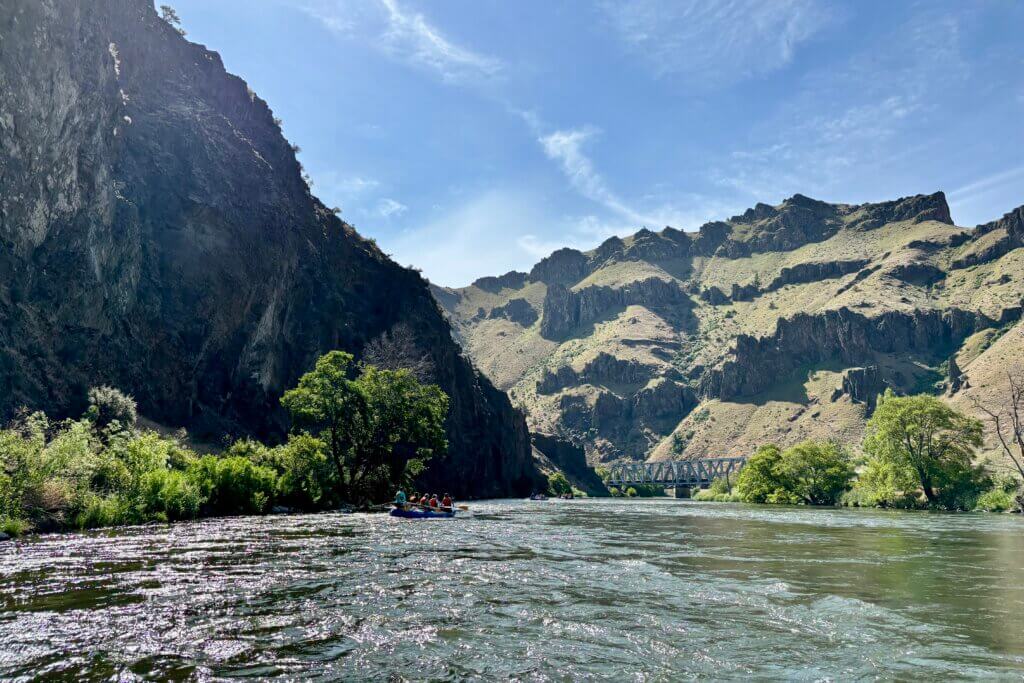
Many flock to the region to participate in various recreational activities such as hiking and rafting. Photo by Haley Campbell
I also learned that the lower Deschutes Wild and Scenic River Corridor, one of the most beloved sections of river in the entire west, is not at all as it should be. What I thought I had been witnessing—a pristine, healthy ecosystem more or less in its natural condition—was really an illusion. I’d been tricked by a little-known phenomenon called “shifting baseline syndrome.”
Originally introduced in 1995 in a one-page paper by a marine biologist named Dr. Daniel Poly, the concept of shifting baseline syndrome (SBS) was based on a recurring practice he observed in the fishing industry. He realized that all new fisheries scientists use the state of the species they encounter at the beginning of their careers, and measure any environmental changes they observe against this baseline. The result, he argued, is that our understanding of what is “normal” is slowly shifting from generation to generation, leading us to accept significantly degraded conditions as natural.
What I thought I had been witnessing—a pristine, healthy ecosystem more or less in its natural condition—was really an illusion. I’d been tricked by a little-known phenomenon called “shifting baseline syndrome.”
Since the paper’s initial publication, SBS has since been used as a lens to view conservation issues more broadly—we would be hard pressed to find a conservation issue that has not been influenced by its effects. We are beginning to understand that the generational environmental amnesia our society suffers from has had profound effects on the way that we see the world around us, and the policy decisions that we make as a result.
***
While the dams on the Deschutes River have been influencing the ecological conditions of the river for decades, one three-dam complex called the Pelton Round Butte Hydropower Project has had significant impacts on the river in the past fifteen years.
Co-owned and managed since 2001 by CTWS and Portland General Electric (PGE)—the only hydropower utility project in the country co-owned by a utility company and a tribal confederation—the project generates a substantial amount of Oregon’s electricity and is helping the state towards the goal of reducing greenhouse gas emissions to 75 percent below 1995 levels by 2050.
Environmentalists initially fought against the entire Pelton Round Butte Project, arguing that the Deschutes and Metolius rivers (which, along with the Crooked River, flow together above the project, together creating the Lower Deschutes River) should remain dam-free fish sanctuaries. PGE offered two compromises: they built a third dam below the power-generating stations to prevent dramatic fluctuations in water flows that harm river life, and they installed a fish ladder.
While fish ladders have been successfully used for centuries around the world to promote fish passage over dams, this one was quickly abandoned for multiple reasons. Its extreme length—measuring over three miles, it was the longest fish ladder in the world at the time it was constructed—coupled with the high water temperatures created by its proximity to the hot canyon walls into which it was built created unsustainable conditions for the river’s cold-water fish. Moreover, ocean-going juvenile fish could not seem to find it: Navigating through a massive, murky reservoir presents very different challenges than following a shallow river’s strong current, and the young fish were not up to their new task. The ladder was completely abandoned as a solution for fish passage in 1968, with PGE instead investing in fish hatcheries as compensation for the project’s detrimental effect on the river’s fish populations.
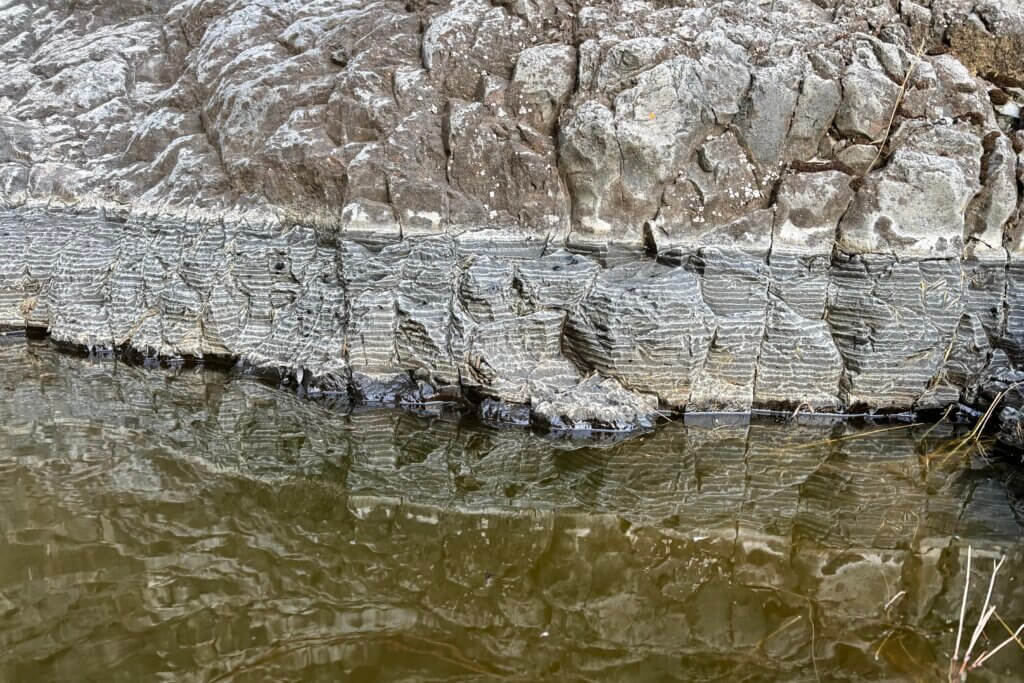
The pool of tadpoles in Nena Canyon seen from the opposite side. Each line represents a day when the water level in the pool was higher. Photo by Haley Campbell
In 2005, the project was up for federal relicensing for the first time in 50 years. To receive their renewed license, the project’s owners were required to reevaluate and effectively address fish passage around the dams. The proposed solution the utility owners came up with was a novel one: They designed a complex called a Selective Water Withdrawal facility that was built into the downstream end of the reservoir created by the project. The centerpiece of the facility is a massive tower that uses pumps to draw water along the surface of the reservoir, creating an artificial downstream current for migrating juvenile fish to follow. As they reach the facility, these fish are captured, driven downstream around the dams, and released back into the river. (Spawning fish migrating upstream are captured at the base of the lowest dam and released upstream.)
PGE has touted the success of the endeavor, stating that more than 1.6 million juvenile fish have passed downstream since the facility came online in 2010, and that it has helped reconnect more than 250 miles of historic fish habitat that had been blocked for 50 years. They also maintain that the facility now releases water into the lower basin that better matches the conditions of the river had the dams never been built. Notably, if the facility were to be deemed a failure at effectively addressing fish passage, PGE and CTWS would be required to reimburse the ratepayers who funded the $108 million facility. PGE got the green light for the project, but it’s not on the hook if the it fails.
While rivers naturally experience fluctuations in water quality and quantity on monthly, yearly, and longer-term time scales, all rivers have a natural baseline. The complex ecological web of life that rivers support requires the river’s water to remain near this baseline to thrive. A group of concerned citizens, scientists, and longtime river users, organized collectively as a non-profit conservation-based advocacy group called the Deschutes River Alliance (DRA) since 2014, maintains that when the facility began operating, multiple water quality parameters in the lower Deschutes suddenly shifted.
The DRA is unequivocal in its claims, which, while anecdotal at first, they now support with years of data diligently collected at various water quality monitoring stations installed along the lower Deschutes. They argue that this shift has negatively affected the ecology of the river: They have observed “changes in aquatic insect abundance and diversity and hatch timing…, increases in fish parasites that affect trout and spring Chinook salmon,” and a dramatic increase in nuisance algae.
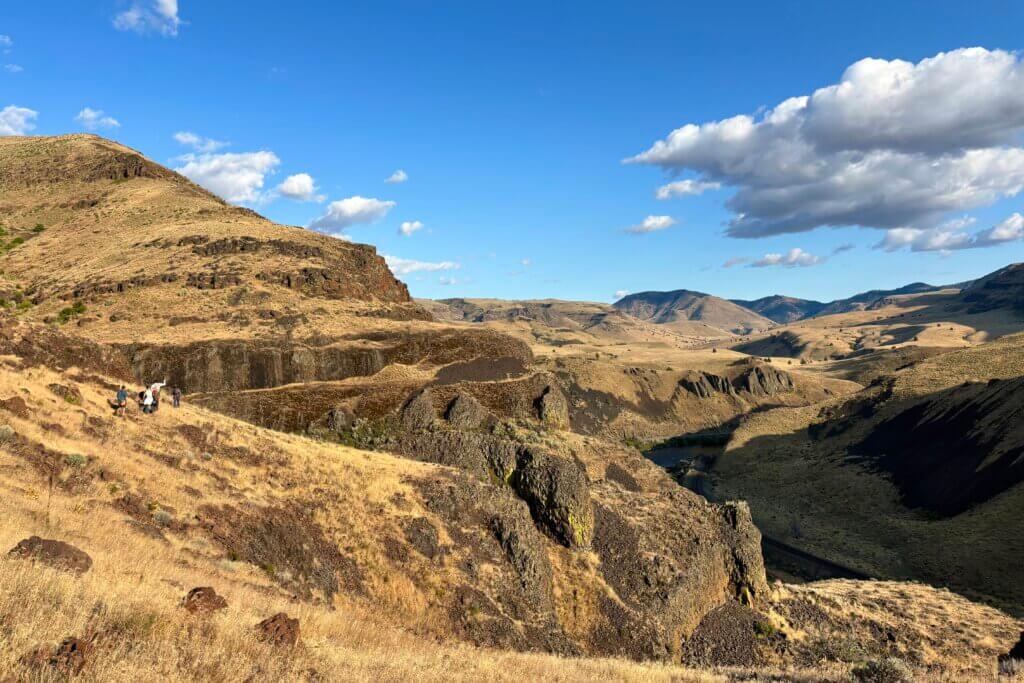
A view from a hike up from the Deschutes River to the first anchor point to rappel into Nena Canyon. Photo by Haley Campbell
The DRA attributes these changes not to the existence of the facility, but rather to the utility’s decision to release water from the top of the reservoir rather than the bottom, as was the case before the facility came online. The three rivers that fill the reservoir are dramatically different in water temperature and nutrient loads, and temperature and density differences between water sources naturally cause stratification. In the reservoir, the Metolius River contributes cold, clean water that sinks to the bottom, while the warmer, more polluted waters of the Crooked River remain largely at the surface. The seemingly innocuous change in the level of water release is now putting the river out of compliance with Oregon state water quality standards as well as the terms of the Clean Water Act, argues the DRA.
The DRA filed a lawsuit in 2017 on behalf of the river, arguing that “water discharge from the three dam complex violates state water quality standards for pH, oxygen, and temperature,” and accusing the Oregon Department of Environmental Quality of failing to live up to its legal obligations to enforce these standards. The initial case failed in district court, where the judge stated that the DRA did not have adequate data to support their claim. The case then went to the Ninth Circuit Court of Appeals but was dismissed without weighing the merits of the DRA’s claims—he judge ruled that the Confederated Tribes of Warm Springs have sovereign immunity here and as owners cannot be sued.
The founding members of the DRA were motivated to come together because they noticed a dramatic shift in the state of the lower Deschutes, and they refused to accept this sudden shift as the river’s new baseline. Despite their legal setbacks, the group is continuing to fight for the health of the river and the return of clean, cold water to the lower Deschutes through education, advocacy, and sound science.
***
Last summer, the rafting company I worked for hosted the DRA-sponsored screening of The Last 100 Miles: The Fight for the Deschutes River. Set against the backdrop of stunning footage of the river, the documentary showcases the group’s history and explains what they’re fighting for. If not for their work, I may have been none the wiser and accepted that the river I encountered was a healthy, thriving ecosystem rather than one that has been dramatically altered from its natural state thanks to policy decisions hidden upstream. I can’t say that I’ve been cured of shifting baseline syndrome, but I can say that I will try to be more aware of it as I continue to move through our fragile, changing world.
As I drifted off to sleep in the evenings on many of the nights spent on the river, my thoughts often returned to the pool of tadpoles. I had observed a series of concentric white lines above its surface, each one perfectly level when viewed from the opposite side and encircling the pool completely—natural mineral chalk lines for the many iterations of the pool’s past lives. Viewed together, these lines presented a time lapse of how quickly water disappears in the desert. Clearly shrinking and growing murkier by the day, I worried that this aquatic oasis would evaporate completely before the tadpoles had time to grow legs; I feared that if I were to return to the pool, I would find their tiny shriveled bodies laying together, baked onto the hot, dry rock.
I didn’t have time that summer to rappel back down to determine if my fears were warranted. I occasionally thought about them over the winter, and eventually decided to do some research on amphibians in this region.
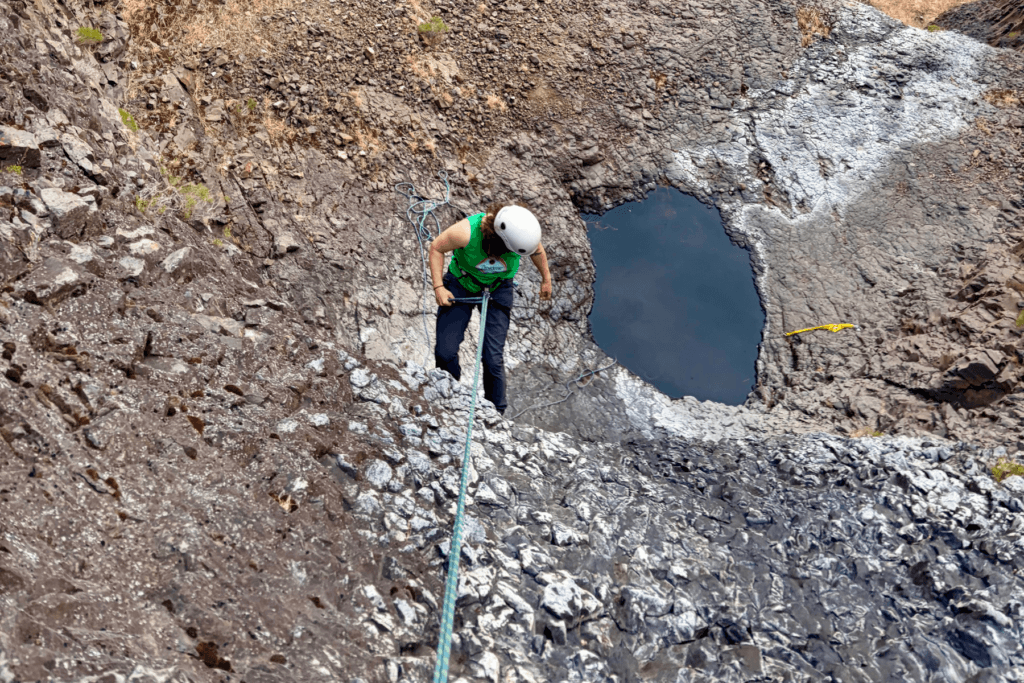
The author rappelling down toward a pool. Photo courtesy of Haley Campbell
I learned these tadpoles were one of two species of toad endemic to this region. I also learned that like many species of tadpole, they have evolved an incredible adaptation when threatened with diminishing and declining water: They are able to speed up their development process, losing tails, sprouting legs, and growing lungs faster than they would in a safer and more stable environment. My worries had most certainly been misplaced: This pool has likely been a reliable breeding spot for these toads for countless years. When I finally made it back recently, I dropped back onto the ledge and peered into this season’s pool. The waterline was higher than it was when I last saw it, and, again, I found the pool to contain a school of tadpoles.
Maybe, though, like these tadpoles, when confronted with rising temperatures and a degrading ecosystem, we can use all of the tools at our disposal to confront the problem until it is solved.
It is nice to imagine that like these tadpoles, nature can simply adapt to the myriad effects of dams and other large-scale development projects. But what is happening to the lower Deschutes is nothing like the natural cycle these tadpoles experience each spring. The Selective Water Withdrawal facility—and the dams more generally—created sudden, dramatic baseline shifts in the river’s ecosystem that many plants and animals cannot simply adapt to, particularly as the changes are amplified by the effects of climate change. Maybe, though, like these tadpoles, when confronted with rising temperatures and a degrading ecosystem, we can use all of the tools at our disposal to confront the problem until it is solved.
Help us sustain independent journalism...
Our team is working hard every day to bring you compelling, carefully-crafted pieces that shed light on the pressing issues of our time. We rely on caring supporters like you to help us sustain our mission. Your support ensures that we can continue to provide deeply-reported, independent, ad-free journalism without fear, favor or pandering. Support us today and make a lasting investment in the future.

RELATED STORIES

Award Winning



Today’s environmental and social justice challenges are unprecedented, and require an unprecedented collective effort.


Stay updated on our latest features, events and more. Subscribe to our Note From the Nest newsletter!
