
What the River Carries
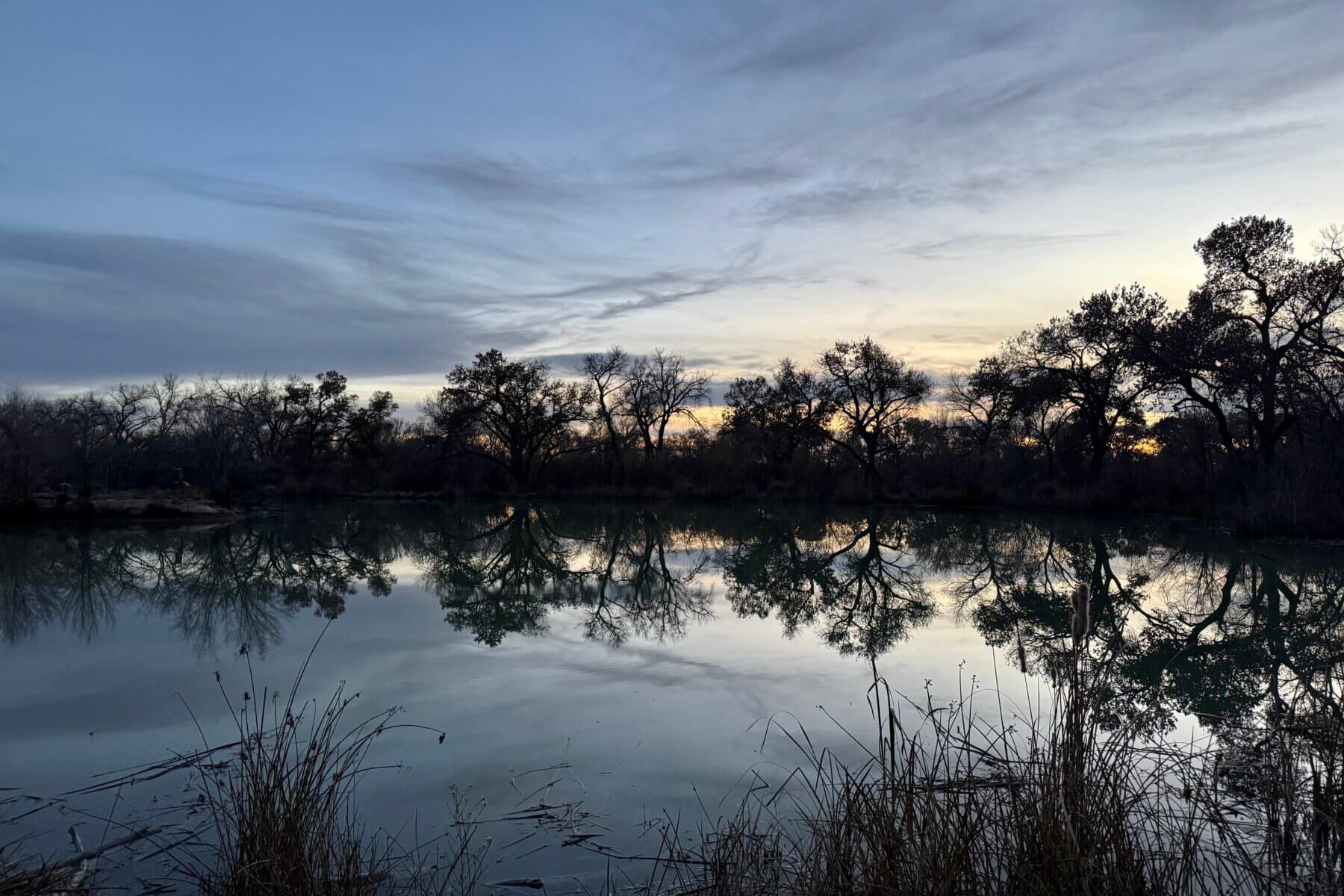
Step off the cracked, sun-bleached sidewalks of Albuquerque, off the dark, black parking lots radiating heat like lasers and walk into the Bosque, a forest that borders the Rio Grande River as it courses through the heart of the city.
Something shifts here. There is a micro-climate in the Bosque, along these banks, that does not exist anywhere else in New Mexico. It’s more humid, though not exactly the kind that poofs up hair and makes you sweat. But here in the arid high desert, where the air pulls moisture out of you before you’ve noticed it’s gone, the cottonwood corridor along the river feels like a different world. Alive in a way the rest of the landscape isn’t.
The Bosque is a green corridor running through the spine of Albuquerque. In some ways, it is the spine of Albuquerque, holding the city together. Trees grow up to the very edge of Montaño Road NW, the major east-west corridor, deep. Inside the Bosque, it’s overgrown, threaded with dirt paths worn down by generations of joggers, dog walkers, and couples moving slowly in the afternoon light.
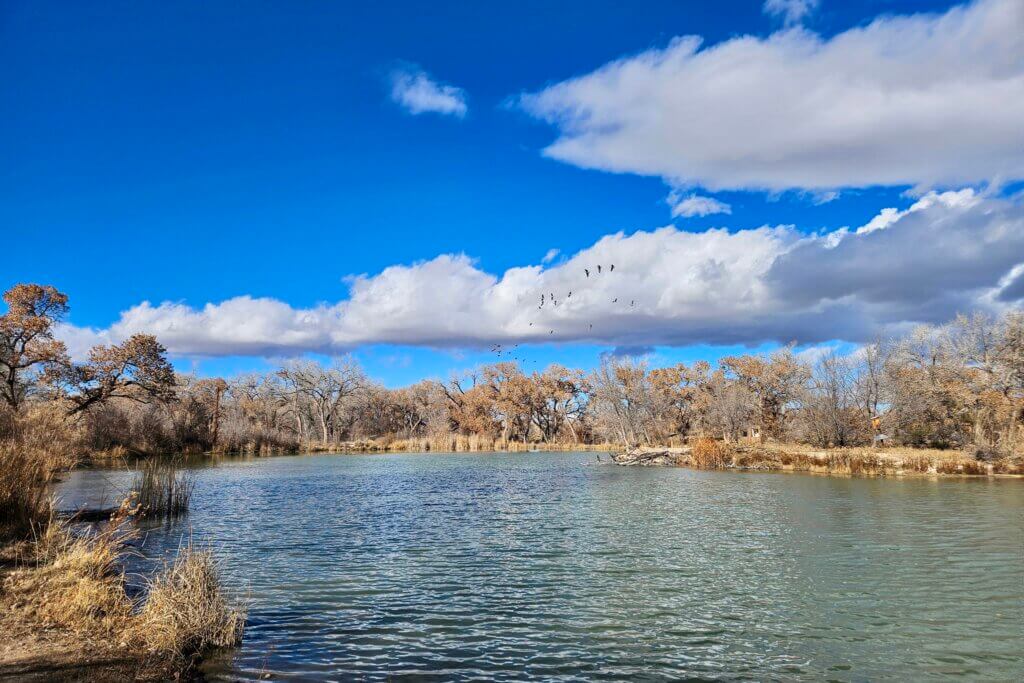
A flock of birds cuts across the Bosque on a clear afternoon. Photo courtesy of Isabella Cabral
One of my favorite entrances to the forest is a thin opening between two adobe fence walls about half a mile down from Coors Boulevard and Montaño. The gap between the adobe is no more than shoulder width, as if builders ran out of material for the wall and the opening was accidental. Tufts of rabbitbrush push through at the base and hit your knees when you turn to the side to pass through. Stubborn yellow weeds mark the entrance. Cottonwoods take over instantly and the canopy stitches together about thirty feet overhead. The cooled ground shifts beneath your feet from packed light-brown dirt to loose, sandy earth threaded by the exposed roots of the cottonwoods.
It is, by any measure, one of the most beautiful places in Albuquerque.
Oh, and it also contains some of the most chemically contaminated water in the American Southwest.
The traffic on Montaño gets drowned out by the papery rustle of cottonwood leaves catching breezes and the small birds poking around on the Bosque’s floor. In the fall, crossing the bridge on Montaño where the road arches over the river on the west side, the cottonwoods turn yellow and orange, their branches laced overhead like a cathedral. It is, by any measure, one of the most beautiful places in Albuquerque.
Oh, and it also contains some of the most chemically contaminated water in the American Southwest.
***
Kimberly Beisner, a hydrologist with the U.S. Geological Survey’s New Mexico Water Science Center, has been walking into the Rio Grande near Albuquerque taking water samples since 2020. She wears gloves and cleans her equipment using a specific decontamination protocol before each sample run. She carries a sampler that moves up and down through the water column, drawing water into a bottle at the same rate the river is flowing. She calls it “a snapshot” of the river’s cross section at that moment.
What she is looking for are PFAS, or per- and polyfluoroalkyl substances, a class of roughly 12,000 synthetic chemicals that have been manufactured and used in industrial and consumer products since the 1940s. PFOA (perfluorooctanoic acid) and PFOS (perfluorooctanesulfonic acid) are two chemicals within the PFAS family that are most heavily researched. They are found in non-stick cookware, waterproof clothing, firefighting foam, food packaging, and hundreds of other everyday items.
PFAS do not break down. Not in the environment nor in the human body. Scientists call them forever chemicals, and the name is not hyperbole because the carbon-fluorine bond at their core is the strongest in organic chemistry—essentially indestructible.

Hydrologist Kimberly Beisner of the U.S. Geological Survey’s New Mexico Water Science Center collects samples in the field. Photo courtesy of Kimberly Beisner
Beisner’s research, conducted in partnership with the New Mexico Environment Department, produced two landmark studies published in 2024. The first study was a statewide assessment of PFAS in New Mexico, first launched after PFAS contamination was discovered at military installations in the state. In that study, the U.S. Geological Survey sampled 117 wells and 18 surface water sites from August 2020 until October 2021. The majority of wells sampled did not turn up PFAS, but all the major rivers in the state surveyed had a presence of PFAS, with the highest concentrations downstream or in urban areas.
The second study produced a finding that should stop in their tracks anyone who has ever run the Bosque paths, walked a dog along the riverbank, or simply lived in this city: between the Alameda gauging station in the north and the Valle de Oro station near the southern boundary of the urban area, PFAS concentrations in the river increase by approximately tenfold. The Rio Grande enters Albuquerque carrying a baseline load of forever chemicals. It leaves carrying ten times as many due to urban contaminants.
Beisner identified two primary PFAS sources in her research. The first is the Albuquerque wastewater treatment plant, which discharges treated effluent directly into the Rio Grande. The problem, she explained when we recently spoke by phone, is that most wastewater treatment processes do not remove PFAS. They are built to handle biological waste, not synthetic compounds with no known natural degradation pathway.
“That’s not just a New Mexico problem,” Beisner said. “Globally, wastewater treatment plants have a lot of PFAS and they don’t treat it out currently.”
The second source is stormwater. During the July to September monsoon season, from those afternoon thunderstorms that roll in from the Sandia mountains, rainwater picks up PFAS from roads, parking lots, lawns, and rooftops across Albuquerque and carries it through the city’s network of diversion channels directly into the river. These are shorter-term influxes, Beisner says, but measurable ones.
Both sources are functions of the city itself. Albuquerque is, her research found, the largest single contributor to PFAS contamination in New Mexico’s surface water. The river comes in relatively clean, and the city hands off its chemical legacy to everything downstream.
PFAS contamination rarely has a single origin point that can be pinpointed and prosecuted. Wastewater treatment plants and stormwater runoff are themselves secondary sources of contamination, meaning the chemicals didn’t begin there. They began in nonstick cookware, food packaging, waterproof clothing, and hundreds of other consumer and industrial products, and make their way into the system from there.
By the time PFAS washes off from some parking lot in Albuquerque, tracing it back to a specific responsible party becomes extraordinarily difficult. Federal law does provide some tools to mitigate against source contamination: The Comprehensive Environmental Response, Compensation, and Liability Act (also known as Superfund), does allow regulators to determine who manufactured or used hazardous substances and compel them to pay for cleanup. But these laws and regulation routes were useful for a different era of contamination, such as hazardous spills or toxic effluence from heavy industries including manufacturing, chemicals, and oil refining. PFAS have mostly existed outside the reach of federal regulation.
***
Everything downstream is not nothing. Below Albuquerque, the Rio Grande continues south through the Middle Rio Grande Valley, passing through farmland, tribal lands, and smaller communities that have been depending on the river for water and agriculture for centuries. While most don’t draw from the river directly, some— particularly farmers—rely on groundwater through an elaborate irrigation canal system that the river feeds.
Beisner is careful when asked about risk. “Probably most immediately at risk would be aquatic organisms: fish and macroinvertebrates that live in the river because they’d be exposed to those chemicals,” she explained.
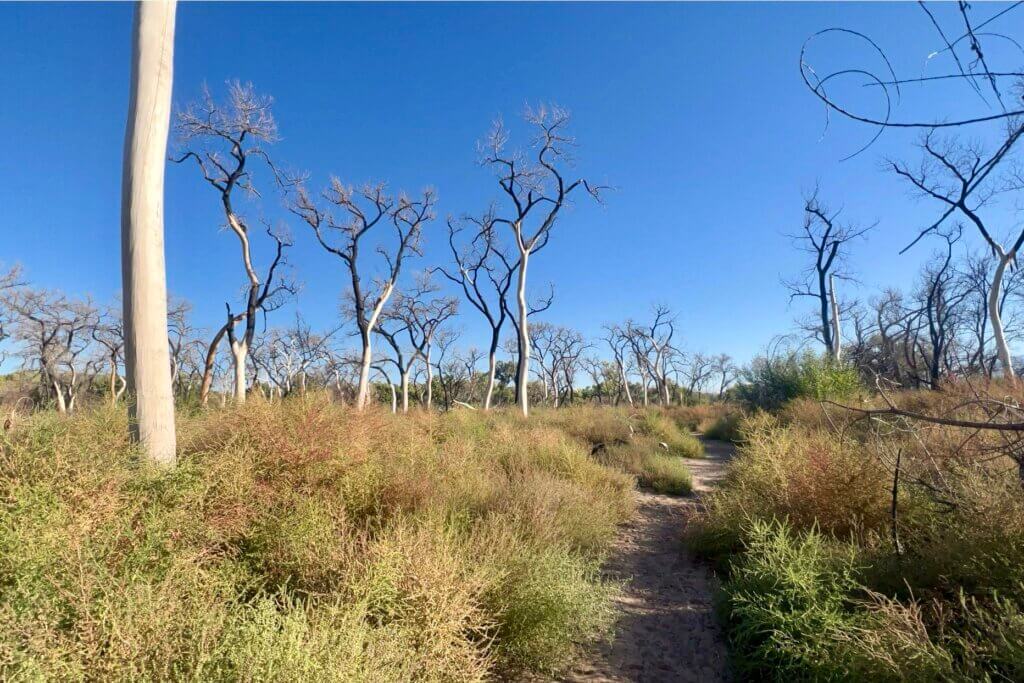
The Bosque’s cottonwoods rest through winter. Photo courtesy of Isabella Cabral
Downstream water users that do pull directly from the river face exposure depending on what treatment systems are in use. Many currently available treatment processes do not remove PFAS. Farmers whose fields are irrigated with river water may face a separate risk that is still being studied: if and how PFAS compounds are absorbed into crops and whether they concentrate in roots or fruit is the subject of continuing studies.
Then there is the drought.
The Rio Grande is already under severe “hydrological stress,” as Biesner puts it. Over the past several decades, reduced snow pack in the Rockies and increased temperatures have diminished the river’s flows. There are stretches of the year—increasingly long ones—when the river runs thin or disappears above certain points.
Two slow-motion disasters converging. A river already strained by drought also is carrying an increasing load of chemicals that cannot be removed by rain, diluted by time, or washed away by weather.
There are always whispers about the once much-higher river. Beisner was direct about what that means for contamination: “There are times where the river does dry up above the wastewater treatment plant inflow, and then for a period, the whole river is wastewater treatment plant effluent.”
Two slow-motion disasters converging. A river already strained by drought also is carrying an increasing load of chemicals that cannot be removed by rain, diluted by time, or washed away by weather.
***
As of February 2026, state testing revealed that 15 water systems downstream of Albuquerque serving approximately 4,500 people exceed federal PFAS limits set by the EPA. Among those affected: a veterans hospital and an elementary school in Placitas, where PFOS was measured at four times the federal limit. The well serving Joy Junction, Albuquerque’s largest homeless shelter, tested positive for PFOA at three times the limit. Marcos Atwood, Joy Junction’s Chief Operating Officer, told reporters earlier this year that the state had not yet contacted the shelter about next steps.
Broader PFAS contamination in New Mexico comes from a different source: the military. Three Air Force bases, Cannon near Clovis, Holloman near Alamogordo, and Kirtland in Albuquerque, used aqueous film-forming foam, or AFFF, for decades in firefighting training exercises. AFFF is saturated with PFAS. AFFF plumes have spread into surrounding groundwater. In Clovis, dairy farmer Art Schaap was forced to euthanize 3,665 cows after they drank PFAS-contaminated groundwater traced to Cannon Air Force Base.
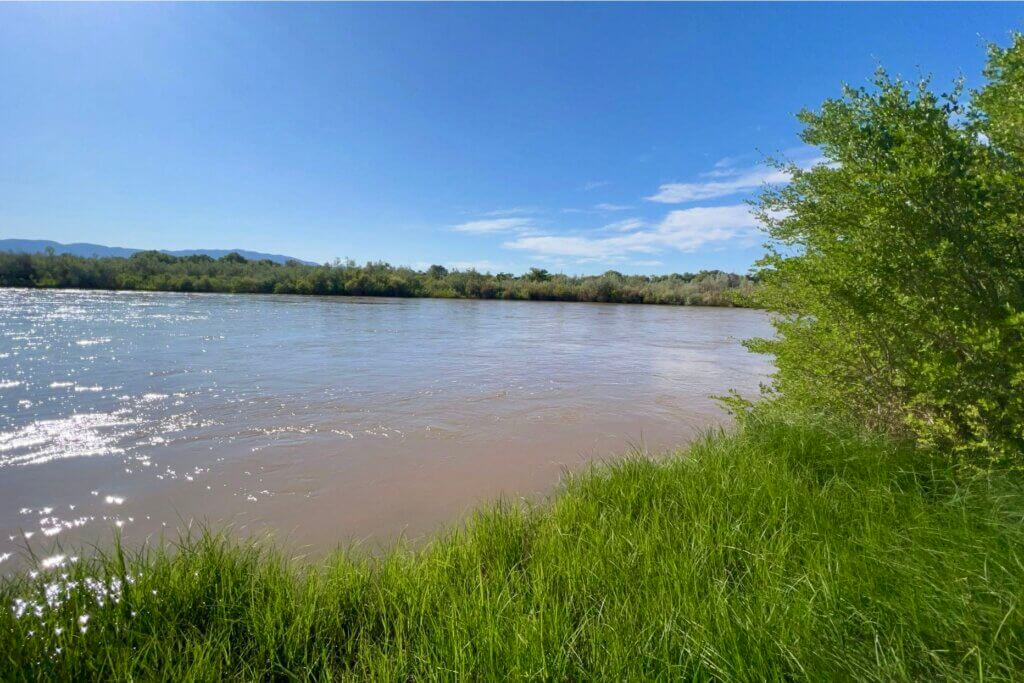
The Rio Grande and the Bosque during the warmer months of the year. Photo courtesy of Isabella Cabral
The legal options are limited but are increasing in volume. Private tort lawsuits, wherein individuals sue for harm caused by contamination, are one avenue. Given the correlations researchers have drawn between PFAS exposure and increased cancer risk, that could be a legal tact. Currently, New Mexico is a part of a national multidistrict litigation (MDL) regarding AFF firefighting foam cleanup. It’s a massive consolidated federal lawsuit where thousands of individual plaintiffs are suing manufacturers of PFAS chemicals, primarily 3M and DuPont.
Additionally, New Mexico is suing the U.S. Air Force Force Base, which has tainted drinking water for tens of thousands of people, damaged crops, and poisoned dairy cows in Clovis. New Mexico’s lawsuit was first filed in 2024 and claimed the Air Force contaminated groundwater with PFAS chemicals from firefighting foam.
Crucially, a federal judge has allowed the case to move forward as a potential national bellwether case for PFAS claims under federal Superfund law. A bellwether case is a test case, meaning one lawsuit selected out of thousands of similar ones go to trial first and its outcome will signal how the rest of the litigation is likely to go. New Mexico’s case is significant because it would be one of the first cases to test whether the federal government—not just private manufacturers like 3M and DuPont—can be held liable under Superfund laws for PFAS contamination.
However, lawsuits and tort law are an after-the-fact remedy for communities and people who have already been harmed. The strongest and most established link between PFAS and harm to people is kidney and testicular cancer. In 2023, the International Agency for Research on Cancer updated the classification of PFOA to “carcinogenic to humans” (Group 1)—is the highest classification—with the strongest evidence pointing to kidney and testicular cancer.
The frustrating nature of these forever chemicals is that they are already in the water, already in New Mexican bodies, and a lawsuit does not change that.
Seeking some relief, the state of New Mexico is seeking millions from the Department of Defense to address the groundwater contamination resulting from the Cannon and Holloman use of firefighting foams. The state’s Department of Justice recently expanded the suit to include repair of PFAS contamination at Kirtland Air Force Base, White Sands Missile Range and other DOD operations around the state. The Air Force has reportedly spent $125 million on cleaning up a decades-running fuel leak that seeped into the water table at Kirtland, with critics saying the contamination could take 800 years to fully remediate at the current pace.
At the federal level, the EPA under the Biden administration established maximum contaminant levels for PFOS and PFOA (PFOS and PFOA are the two specific types of chemicals within the larger PFAS family that have been most heavily researched) in drinking water. The Trump administration delayed compliance enforcement until 2031 and proposed changes to federal toxic chemical rules that could override state-level bans. These changes in federal rules could pose a direct challenge to legislative gains that New Mexico has made in recent years with their lawsuit against the federal government regarding Air Force Base contamination.
These regulatory rollbacks at the federal level could impact the structure of American environmental law itself. Most major federal environmental statutes such as the Clean Water Act and the Clean Air Act are designed to establish a minimum acceptable level for contamination, not a ceiling for how much contamination is allowed. State governments are generally permitted to regulate more stringently than the federal requirements. The current administration’s proposed regulatory changes appear to be aimed at this structure directly, potentially preempting state action rather than simply weakening federal standards.
Simply put, it pulls the legal rug out from states to enforce its standards, even, or especially if they are more stringent than the federal standards. This leaves states, companies, and contaminated communities with no clear answer about what legal remedies can be used against polluters.
***
Beisner keeps going back to the water. She and her team completed a new round of statewide sampling across all of New Mexico’s major rivers in early 2026, continuing the longitudinal record that began in 2020. The data will soon be added to the USGS’s publicly accessible database. More papers will follow as the 2026 sampling round will only record the further damage.
When asked what goes through her mind while she is standing in the river taking samples, processing what she collects, she answers the way scientists often do, with a focus on the work rather than the weight of it. “I think continuing to monitor the system while those changes are occurring is really important,” she said. “Are there things that are happening during those conditions that we need to learn more about?”
Like so many environmental issues these days, it’s hard to feel like an issue this big can be contained because of how prevalent PFAS are in everyone’s lives.
In late November when there is a lull before all the holiday rush, I love nothing more than mornings in the Bosque, when everything feels most alive. For two short months, the Ross geese—and my favorite, the sandhill crane—make the Bosque their home. Each night they settle into the shallow water to guard them from predators while they sleep. When they wake in the morning, just before the sun comes up, hundreds of geese lift off as one to find the day’s feeding fields throughout the Middle Rio Grande Valley.
The sandhill cranes do the same. Running beneath the cranes as they take flights feels like a refreshing, deliberate break from whatever small thing I was stressing about the night before. Their massive wings pass overhead while they glide on top of the air like expert swimmers. There’s something almost comical about them, too, because they’re among the only migrating birds that fly with their necks stretched fully forward, with their slender legs trailing behind. And then comes their call: that loud, trumpeting cry rolling across the water announcing to everything below that a new day has begun.
The Rio Grande has been running through the heart of New Mexico for longer than Albuquerque has existed. The Bosque cools the air and softens the light, and gives the city a natural place where living things can escape the blaring heat. People walk their dogs there in the afternoon in the soft sand so their puppies aren’t burning their paws on the cement. Residents cross the Montaño bridge and look at the beautiful cottonwoods even when they are stuck in traffic. The Bosque handles a lot, but as someone who was born and raised in New Mexico, it’s painful to know that that beauty is also tainted by PFAS, just like we are.
The New Mexico Environment Department’s PFAS testing data is found within the publicly accessible USGS water database, searchable by site.
Help us sustain independent journalism...
Our team is working hard every day to bring you compelling, carefully-crafted pieces that shed light on the pressing issues of our time. We rely on caring supporters like you to help us sustain our mission. Your support ensures that we can continue to provide deeply-reported, independent, ad-free journalism without fear, favor or pandering. Support us today and make a lasting investment in the future.

RELATED STORIES

Award Winning



Today’s environmental and social justice challenges are unprecedented, and require an unprecedented collective effort.


Stay updated on our latest features, events and more. Subscribe to our Note From the Nest newsletter!
