
If Luck Should Run Out

At press time, more than 70,000 acres in Northern Minnesota and across the Canadian border are ablaze in 18 different wildfires. The beloved Boundary Waters Canoe Area Wilderness, a pristine preserve that has long been a place to retreat from the follies of modern life, has suffered the brunt, with more than 30,000 acres on fire at this writing from lightning strikes. The USDA Forest Service announced the closing of the entire 1.1-million-acre Boundary Waters Canoe Area Wilderness beginning July 14, 2026. Forecasts call for more extreme heat and low humidity, turning the land of a thousand lakes into a tinderbox. Governor Tim Walz has declared a peacetime emergency and mobilized the National Guard to assist firefighters as they work to get the blazes contained and protect neighboring communities.
Wildfires in Canada and along the Minnesota border are sending hazardous air across the Upper Midwest and as far as New York, affecting millions. As of yet, most of the fires are burning out of control. A look at the national fire map offers little consolation as the summer and fall fire season is off to an early and alarming start following a dry, hot winter.
For Carl Ehlenz, it must feel like bad déjà vu all over again.
***
Friday, May 15, 2026, was a hot, dry, and windy day along the North Shore of Lake Superior. Temperatures were in the 80s, which is unusual that early in the spring, especially so close to the water. Still, Carl Ehlenz the owner of Betty’s Pies, a favorite stop-off just north of Two Harbors for people traveling along Highway 61, wasn’t paying the spring heat wave that much attention. Not at first, anyway.
Ehlenz bought Betty’s Pies in 1998, and he and his wife Jen live in a house on a few acres back in the woods behind the restaurant, alongside the Stewart River. It was around the lunch hour that Friday when Jen got a ping on her phone letting her know that the internet was out at their house. Since Carl had forgotten to take his cholesterol meds that morning, he figured he’d just drive up the road, take his pills, and see what was what.
“I get about halfway up my driveway,” recalled Ehlenz, shaking his head. “I’m like, ‘Oh, that’s weird, there’s a lot of smoke across the river at my neighbor’s property, and I can see fire—the trees are on fire. I’m like, ‘Oh my God, our neighbor’s property is on fire!’ And I drive up the rest of the way to our house, which is another 500 feet, and I went, ‘Oh my God, the woods are on fire behind our house!’”
The fire was about 50 feet from their home. Ehlenz called 911; two squad fire trucks pulled up within minutes and began fighting the blaze. He went to hose down his house but quickly realized that without power, he couldn’t get water from his well. He returned to work. At about 3:30 p.m., the sheriff pulled up and told them the whole area was being evacuated; the wind had shifted from the southwest to the south, and the fire was working its way up Highway 61.
The Ehlenzes spent the next few days at a friend’s place in Two Harbors. In the end, the fire burned right up to the edge of Betty’s Pies’ upper dirt parking lot, but neither the restaurant nor the house were damaged. Others were not so lucky; the blaze jumped two highways as it moved north, charring more than 350 acres and destroying 34 buildings—including eight homes—in the process.
The cause of the fire? High winds knocked a dead tree into a power line, which surged and sparked.
While Northern Minnesota is no stranger to wildfires, Ehlenz never really thought of wildfires as a potential threat in his area until last year, when there was a fire in Brimson, about 35 miles away. “That was really our first experience of something that was relatively close,” he said. “Other than that, there’s been nothing down along the shore since I’ve been here.”
Wildfire activity reached historic levels this past spring across the United States, even in places not typically associated with wildfires. Rising temperatures, shorter winters, and longer dry seasons make it likely that many regions of the United States will see more wildfires in the months and years to come.
Fire in the Forecast
Jon Gottschalck is the chief of the National Oceanographic and Atmospheric Administration Climate Prediction Center’s Operational Prediction Branch, which produces outlooks for temperature and precipitation extending as far out as a year. He says the warm summer is not going to let up and the gathering El Niño weather pattern is not going to help fire conditions in the short term.
“We have pretty high odds for above-normal temperatures for the West, but the whole West Central and Southern Plains is what we’re favoring for above-normal temperatures,” he said. “The highest odds are actually across parts of the Intermountain West, Northern Rockies, Pacific Northwest—places like that.”
“. . . they call that ‘virga’—it’s basically precipitation that evaporates before it reaches the ground, but the lightning still reaches the ground, and so it will spark the fuels.”
Gottschalk adds that models show a high likelihood of a strong El Niño system developing this fall and winter, flipping the typical jet stream patterns. In the north, that translates to a milder winter with less snow, leading to an even longer, drier spring next year, increasing the chances for wildfires. In the south there will likely be more storms, but Gottschalk says storms don’t necessarily mean fewer fires.
“Because . . . before it gets sufficiently moist, you get these dry thunderstorms,” he explained. “There’s lightning that occurs, but the precipitation that falls from the thunderstorm is so dry that it evaporates—they call that ‘virga’—it’s basically precipitation that evaporates before it reaches the ground, but the lightning still reaches the ground, and so it will spark the fuels.”
Gottschalk says some parts of the country are difficult to forecast. He points to the West Coast—particularly California—which in the past 10 years has seen some of the biggest wildfires in U.S. history.
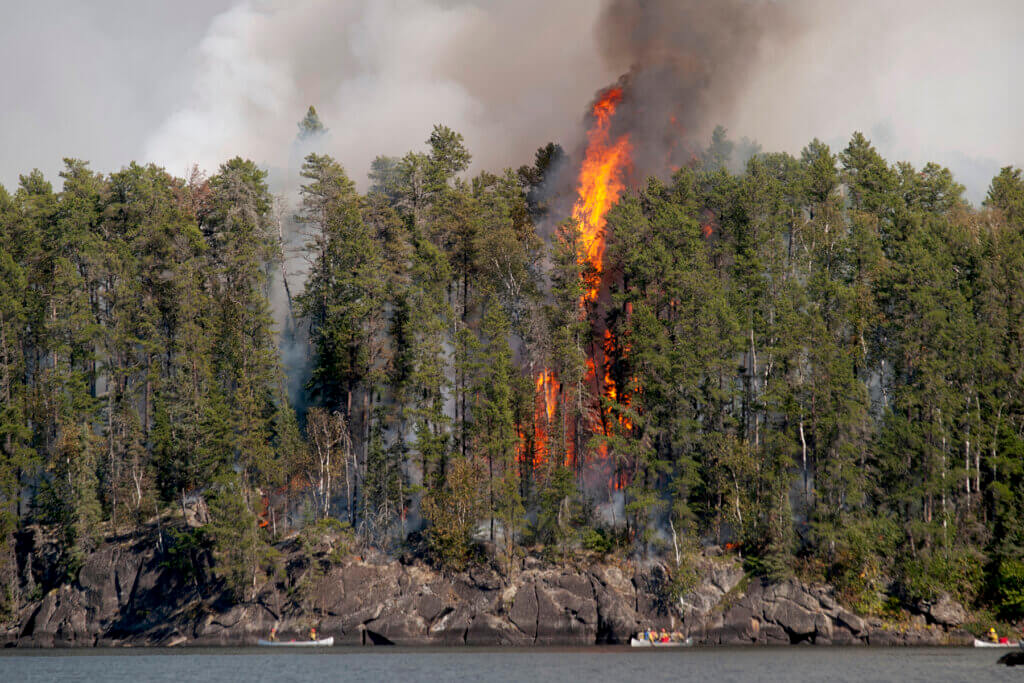
Firefighters from the Superior National Forest and Huron-Manistee National Forest approach an active fire from Lake One during the Pagami Creek Fire in 2011, in Minnesota’s Boundary Waters Canoe Area Wilderness. Photo by Kari Greer/USFS
“It’s a minefield for our climate forecasters; it really varies from event to event. Most often, though, [during an El Niño] it’s drier in the Pacific Northwest and wetter across parts of Central and Southern California, but that is very often driven by variations within the winter season that really aren’t predictable this far ahead,” he said.
Another minefield: Staff cuts and buyouts by the Trump administration’s Department of Government Efficiency have resulted in the loss of approximately 600 Weather Service staff. As a result, weather stations are launching fewer weather balloons; climatologists say this means they’ll be forced to make severe weather predictions with less data.
Resistance, Resilience, and Transition
Climate change is presenting forest managers with complex challenges as they work to protect threatened ecosystems. Stephen Handler is a climate change specialist with the USDA Forest Service’s Northern Research Station. He says milder, shorter winters are changing the competitive balance between species.
“These milder winters are opening the door for non-native species and damaging insects—and in some cases, diseases—to colonize areas that would have previously been inhospitable or inaccessible,” said Handler.
This imbalance has knock-on effects. Milder temperatures mean higher overwinter survival rates for insects like the eastern spruce budworm and the mountain pine beetle, Handler said, and longer summers give them more time to breed, rapidly increasing their population growth. This leads to even more stress and disruption to forest ecosystems.
In addition, he says, while climate change models for the Upper Midwest predict increased annual rainfall, that rain will be coming in larger, more intense downpours.
“When you get 6 or 8 inches at a time in a big rain event, that looks impressive in the rain gauge, but it’s hard for forest soils to actually absorb that level of rain in one pulse,” explained Handler. “So you tend to also lose more of that rainfall rather than effectively recharging soil moisture.”
Handler said the runoff often leads to erosion, which in turn contributes to more drought stress during the intervening longer dry seasons.
Some research suggests that increasing temperatures could lead to more frequent derechos, which are storms characterized by powerful straight line winds capable of taking out entire swaths of trees.
All those dead trees—whether they’re killed by pests, disease, drought, or severe weather events—create a massive amount of fuel for potential wildfires.
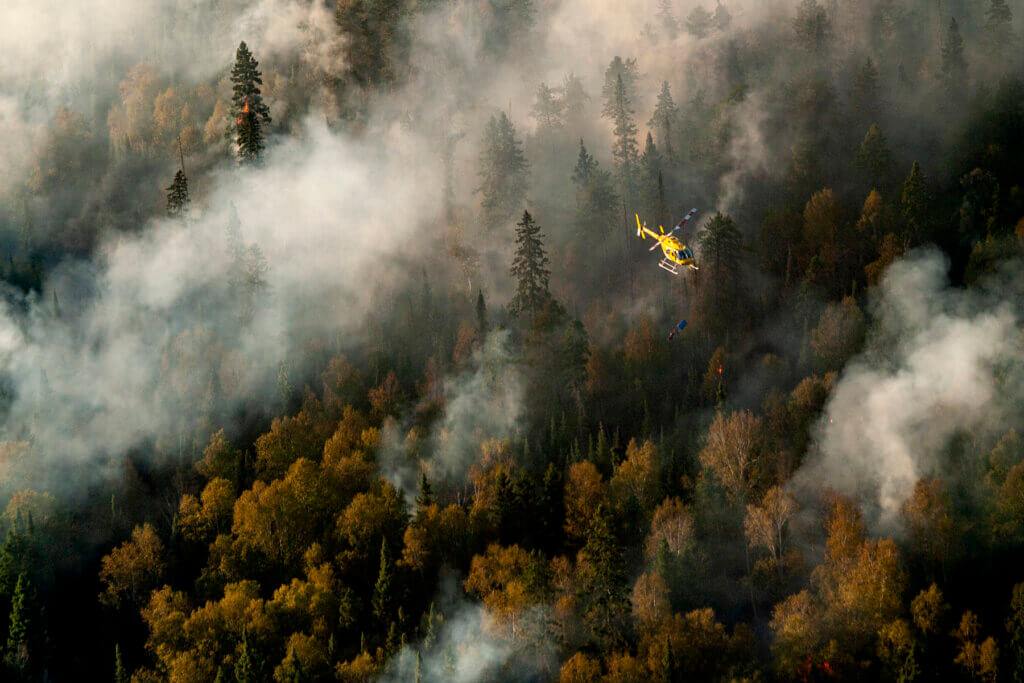
Helicopter working on the Pagami Creek Fire in 2011. Photo by Kari Greer/USFS
Handler and his colleagues are part of a long-term project called “Adaptive Silviculture for Climate Change” (ASCC), testing a variety of habitat management strategies in fourteen sites across the United States and Canada. ASCC collaborates with more than 200 partners, including scientists and land managers. Natural-resource professionals are now being trained in the findings of the research sites from the past decade.
Handler said the strategies boil down to “resistance, resilience, and transition.” Resistance is about maintaining the status quo, whether it’s protecting the habitat of an endangered species or seeing a red pine forest through to its final lumber harvest.
“In a resilience sort of mindset, we are seeing land managers really try to emphasize species diversity,” said Handler. “How can we encourage a full array of native species that are accustomed to living in a particular ecosystem? How can we ensure that there are growing conditions that are suitable for a full array of species, rather than just having one species dominate?”
Finally, transition involves assisted migration: introducing a new species into an area, or a hardier variety of the same species that thrives in hotter, drier climates. But Handler said it’s critically important to look at numerous factors before tampering with the natural ecosystem.
He recalled working on a team that contributed to the Superior National Forest Assisted Migration Plan in 2023. One of the ideas floated involved introducing more of a certain oak species which was already doing well in Minnesota.
“You’re trying to maybe tip the scales in the direction of a species that you anticipate to do well in a future climate,” Handler said. “But one of the unintended consequences of that activity would be providing more acorns, which would further enhance the whitetail deer population in northern Minnesota.”
An increase in whitetail deer might not seem so bad, but those deer host a parasitic brain worm that, while not lethal to them, is deadly for an already threatened neighboring moose population. Ultimately the plan recommended planting oaks only within existing pockets of oak on the landscape, and to avoid planting oak within the designated “primary moose range.” In those areas, it was recommended to plant trees that are preferred moose food sources, such as birch, maple, and willows.
Good Fire vs. Bad Fire
Long before Europeans arrived in North America, Indigenous peoples used fire regularly as a tool to clear land, promote healthy flora and fauna, and facilitate hunting. In some areas, they would do controlled burns as often as every few months; in other places, only once every several years.
“It was an incredible land management tool, because they could treat large areas with a relatively low amount of labor. So they could burn 10,000 acres and beat back the vegetation or shift the vegetation to something else, and the wildlife all responded to it,” said Morgan Varner, director of fire research at Tall Timbers, a nonprofit based in Tallahassee that examines the impact of prescribed fires on land, animals, and public health.
With the rise of the lumber industry, fires became taboo; the focus was on growing as many trees as possible as close together as possible. Varner said that had unintended consequences for the environment.
“A lot of [animal] species that are rare, it’s because fire is so relatively rare now compared to 250 years ago,” explained Varner. “A lot of species—the vast majority of southeastern species that are federally listed on the Endangered Species Act—they’re related to the loss from fire.”
Varner pointed to the red-cockaded woodpecker, a bird that was once abundant in the pine forests of the southeastern United States. The bird thrived in old forests that were kept open thanks to regular fires. Over the course of the 20th century, the woodpecker’s population plummeted from an estimated 1.5 million to just a few thousand, resulting in it being added to the U.S. Fish and Wildlife Service’s endangered species list in 1970. But in 2024, the red-cockaded woodpecker was downlisted from endangered to threatened. Varner said that’s because its numbers are growing in response to better habitat protection and management, including prescribed burning.
“That’s what they call them—‘prescribed fires’—because there’s a prescription,” explained Varner. “The prescription will have management objectives . . . primarily for wildlife habitat or some sort of ecosystem restoration, or to diminish the wildfire hazard, to make future wildfires have lower intensity and make them a lot easier to control.”
According to the Forest Service, federal land management agencies now complete between 4,000 and 5,000 prescribed burns each year. That’s just a fraction of annual wildfires, but recent studies conducted at Stanford University found that prescribed burns can reduce the severity of subsequent wildfires by an average of 16 percent.
“I’m a cold-hearted scientist, but it breaks my damn heart to see ecosystems suffer calamities that are going to last centuries, and that’s what’s happening across the West,” said Varner.
Varner said prescribed fires are only allowed during ideal climate conditions—low wind, not too hot—in order to reduce the risk of spread or air pollution. He says while a controlled fire can do an amazing amount of good for a forest, an out-of-control wildfire will destroy everything in its wake.
“I’m a cold-hearted scientist, but it breaks my damn heart to see ecosystems suffer calamities that are going to last centuries, and that’s what’s happening across the West,” said Varner.
Where There’s Fire, There’s Smoke
Not only are wildfires destroying precious habitats, they are also undoing years of work to reduce air pollution. A study published in the journal Science in June this year found that, while ozone levels dropped across the United States from 2003 to 2014 in the wake of new federal regulations on auto emissions, air quality has worsened steadily since then due to an increase in wildfires. The study found that surface ozone pollution stemming from wildfires has contributed to more than 300 additional premature deaths each year in the country, with significant spikes in premature deaths in 2020, 2021, and 2023.
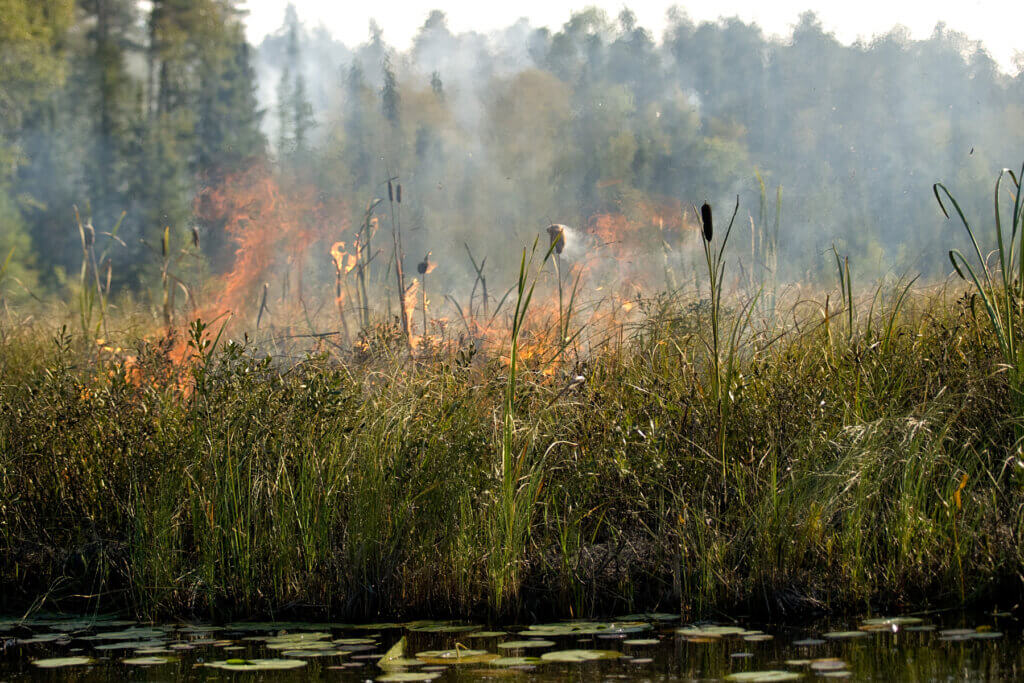
Active fire in the marsh along Pagami Creek during the Pagami Creek Fire. Photo by Kari Greer/USFS
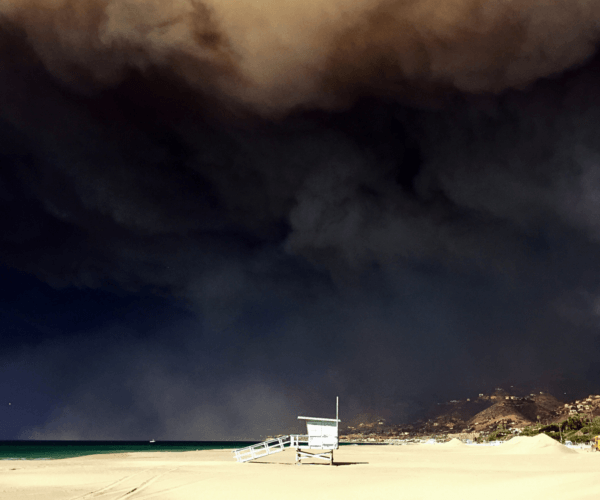
Catastrophic wildfires in western Canada in 2023 incinerated 41 million acres of Canadian forest, turning skies orange all the way to New York City, and causing an estimated eighty thousand premature deaths globally from smoke inhalation, including an increase in strokes.
Kristie Ebi is a professor at the University of Washington’s Center for Health and the Global Environment. She said one of the most important facts about smoke from large wildfires that spread into developed areas is that it’s three to 10 times more toxic than standard air pollution.
“Because when you think about what burns, it’s not just the wood buildings that burn,” she said. “Gas stations burn, asbestos[-containing materials] burn—all kinds of stuff burns in a wildfire.”
Ebi lives in Seattle. During the Canadian wildfires, she said they had two weeks where the smoke concentration was about 200 micrograms per cubic meter.
“Anything above 60 is unhealthy for anybody to breathe,” she said.
In high enough concentrations, smoke inhalation can be deadly for anyone, but Ebi said there are certain populations that are more vulnerable: children, the elderly, people with asthma or chronic obstructive pulmonary disease (COPD), and pregnant mothers, because wildfire smoke can cross the placenta and harm the fetus. In times of high smoke concentration, she recommends installing a box fan filter in your home, staying indoors as much as possible, and wearing a KN95 mask when you have to go outside.
Only You Can Prevent Wildfires
Travis Verdegan is with the Minnesota Department of Natural Resources (DNR) and the Minnesota Interagency Fire Center. He points out that four of the five deadliest wildfires in U.S. history happened in the Upper Midwest: Minnesota, Wisconsin, and Michigan. But they all date back to the late 19th and early 20th centuries; the most recent was in 1918.
If you look at more recent trends, Verdegan said you’ll see that the number of wildfires in Minnesota has actually been on the decline since the early 2000s, when significant changes were made to the burning permit system. According to the Minnesota DNR, burning vegetation such as brush and yard waste is the number one cause of unintentional wildfires in Minnesota. Restricting this type of burning in spring has helped reduce wildfires by 30 percent.
“A lot of those fires that would have occurred in the ’80s, ’90s, 2000s would have been debris fires,” Verdegan said. “[In rural areas,] it used to be commonplace to have a burning barrel behind every house, and that’s just something that isn’t seen in the same light today as it was then. So, honestly, when you look at the numbers, it’s encouraging to see that things like that can help.”
The truth, Verdegan said, is that most fires are our fault. Depending on the year, 85 to 95 percent of wildfires are caused by humans, whether from burning trash, leaving a campsite unattended, dropping a cigarette, or even idling a car on the side of the road, where hot exhaust can ignite dry grass.
Verdegan stressed that while the number of fires have been on the decline in Minnesota, the conditions conducive to fire have been increasing, so fires that occur still have the potential to cause massive destruction. Last year, a powerful derecho downed an estimated nine million trees in north-central Minnesota. Those dead trees are now fuel for future forest fires, just waiting for a lightning strike or a careless camper.
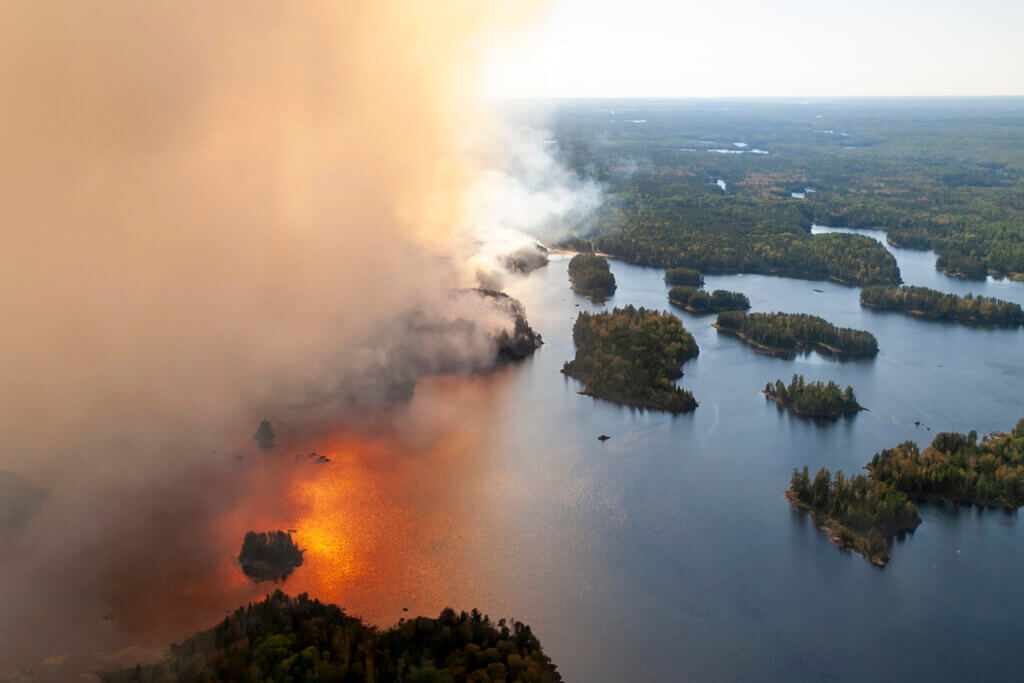
Another view of Lake One during the 2011 Pagami Creek Fire. Photo by Kari Greer/USFS
While it’s too difficult and costly for foresters to clear out dead trees in the middle of a forest, Verdegan said homeowners can help slow the spread of wildfires and protect their homes in the process, especially if they live in the wildland urban interface.
“We have what’s called the Firewise program, which describes the types of activities—like not keeping firewood stacked up on your porch, or keeping the gutters clear, or if you think about how wind will blow around a house, oftentimes you’ll find piles of leaves that occur,” said Verdegan. “Those are areas where, if a forest fire is passing through, even if it doesn’t have direct impingement on the house itself, an ember can land and then start a fire next to the house that then can spread into the house.”
***
Which brings us back to Carl Ehlenz and Bettie’s Pies. Two weeks before what’s now being referred to as the Stewart River fire, a local guy offered to come and clear out the dead trees and branches in the woods around the Ehlenz house.
“He even went back on the power line and mowed the tall grass down right behind our house,” recalled Ehlenz. “We had them clean out behind our house and alongside our house on the riverside.”
Ehlenz says he wasn’t thinking about fire prevention—he was worried about dead trees falling on the house. But in the wake of the fire, a Forest Service agent visited their property to survey the damage; she told him if they hadn’t cleared the dead wood, it’s almost certain they would have lost the house.
The Ehlenzes were lucky. With increasing temperatures, longer dry seasons, and more volatile weather patterns on the horizon, it will take massive effort, collaboration, and a lot more luck to keep the Midwest from becoming the most dangerous wildfire region in the country yet again.
Help us sustain independent journalism...
Our team is working hard every day to bring you compelling, carefully-crafted pieces that shed light on the pressing issues of our time. We rely on caring supporters like you to help us sustain our mission. Your support ensures that we can continue to provide deeply-reported, independent, ad-free journalism without fear, favor or pandering. Support us today and make a lasting investment in the future.

RELATED STORIES


Award Winning



Today’s environmental and social justice challenges are unprecedented, and require an unprecedented collective effort.


Stay updated on our latest features, events and more. Subscribe to our Note From the Nest newsletter!

As a resident of Northern California with family in Minnesota I found this article very interesting.
As the world warms, the fire risks we have been living with and adapting to in California for decades are becoming more and more evident in heavily forested areas subject to drought throughout the world. Thanks Marianne, for relating how this is affecting life in Minnesota and peoples’ consciousness of the risk and impact.