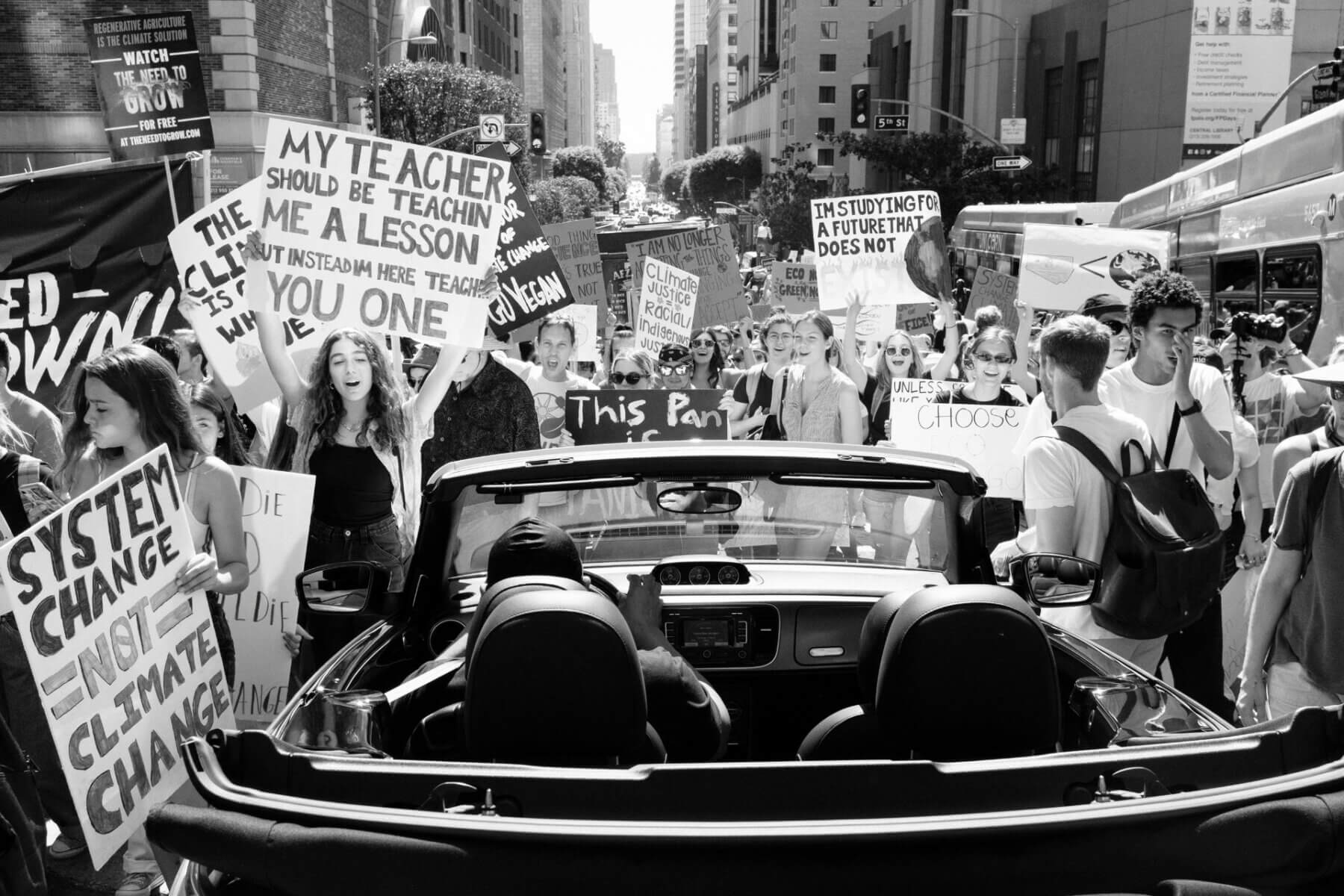
Geographies of Hubris and Grief
Traveling against the tide of a mass exodus is a surreal experience and not one I can recommend, even as I know I will inevitably do so again, as I have done before. Our expansive societal failure guarantees this cycle repeats.
Each experience has its specifics, even if they bear the same hallmarks of disaster. Here’s how the latest one unfolds. The Honolulu airport greets me with mayhem when I arrive there on the morning of August 11, 19 hours after Lahaina’s fire is declared 80 percent contained. Lines of people are fleeing their vacations on homeward trajectories, hindering those desperate to go the other way — back home to Maui, worried sick to learn whether family, pets, livestock and homes have survived the wildfire that tore through Lahaina and Kula with a ferocity we can no longer call singular. We’ve seen it too many times now for that.
Landing at Kahului, I walk from the jetway into a bardo of numb-faced vacationers clad in the garb of a mainlander’s vision of a Hawaiian holiday. They are standing arms crossed, mouths pressed into something between a frown and preparation for a blow. It may have been the quietest airport gate I had ever navigated. It will be 25 more days before the Lahaina fire is declared 100 percent contained.
This is what it is to work as a reporter passing through congregations of people blasted by varying degrees of preventable horror, either rushing to escape it or to return to the scene to measure the extent of their imminent suffering. Five years ago in Paradise, California, I had seen what I would see in West Maui, and the solemnity of the people facing vacations, homes and lives crashed by a pop-up crematorium and its charred, apocalyptic wake felt like a rebuke.
It taught me this and more: that a new archetype of experience — the previously improbable disaster — was taking shape in the smoldering ruins.
The specifics of what I saw kept coming, but began turning increasingly, disturbingly, typical: I had the pleasure of sailing into Lahaina on the ferry from Lana‘i just two months prior. Now, driving in my rental car toward Lahaina, I envisioned with dread what I knew I’d find. I knew that a fire like this would change the physical properties of the soil of a place, making it an agent of mudslides, poisoner of water, preventer of rejuvenation, mutating it into a hazardous material requiring remediation.
We now know that the Lahaina wildfire was the deadliest in the U.S. in a century. According to a sprawling examination of the fire published in The New Yorker in late October, so far, 99 people perished in the inferno. Half of Lahaina’s 13,000 residents had to flee their homes, with 2,200 structures destroyed or damaged and the estimated cost of rebuilding is 5.5 billion dollars. The piece is comprehensive and valuable, but it describes the fire as “unprecedented.”
I disagree.
I knew from my past reporting that steel begins to deform and slump against gravity at somewhere between 1,000º and 2,200º — depending on what form it took, like the household object that I found now warped and grotesque in what had once been a garage, or a kitchen, or living room, or bedroom. Sometimes, the devil is in the details. I knew that everything ordinary would be rendered into a moonscape of ash by the combustion that, in just minutes, extinguishes from the landscape — a building that once held tonnages of materials, furniture and memories. I knew that aluminum wheels and engine blocks would melt and ooze into the streets, their flow eventually arrested by the relative cool and calm that follows a fast-moving inferno.
I knew that, walking amidst the immolated ruins of Lahaina’s agony, the untrained eye might not be able to discern what is a charred stick or a charred limb. I also knew that the slightest disturbance, an incautious footstep, would reduce both forms indistinguishably to dust. I knew the scent that would greet me in the burn zone. Elemental. Chemical. Distressing. I knew that what I was going to see would defy common assessment and summon comparisons to wartime devastation.
I knew that the lists of missing would again swell to incomprehensible highs before being reduced to an inventory of hopelessness and foreboding, even as they might still possess the distant promise of a miracle. I knew that circulating among refugees would push my eyes to well and my heart to break. Honestly, I knew too much. I understood the inevitability of my ghastly trip to Maui, here in my island home, where those who could imagine this happening — the scientists, foresters, fire service personnel, the too few politicians, journalists and game changers — could fit in the bleachers of a poorly attended high-school football game. Reporting in Paradise, California, and other scenes of “unprecedented” wildfire taught me this.
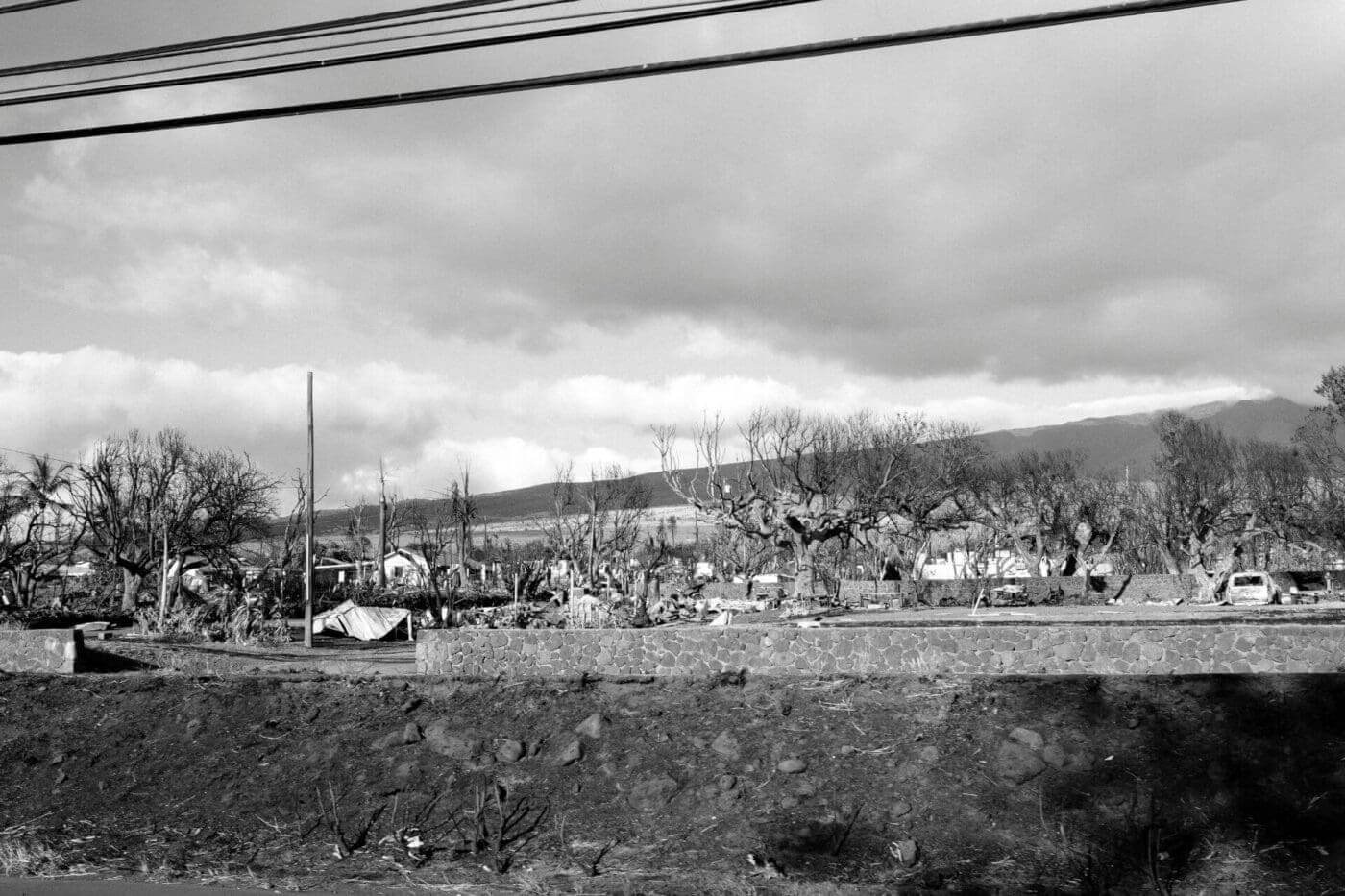
The Old Lahaina town was largely destroyed as the wildfire spread at a terrifyingly rapid spread in part due to the winds of passing Hurricane Dora during early August 2023. Photo by J. Matt/ZUMA Press
It taught me this and more: that a new archetype of experience — the previously improbable disaster — was taking shape in the smoldering ruins. The word I see and hear constantly, and which comes merely close to a satisfactory description of my state in the face of all this is grief. Grief. Grief. Grief. Voiced as a mantra, the word comes closer to accepting the weight placed on it, but it still fails its burden. No single word can encapsulate the anguish, heartbreak, pain and fury that follows fires like these.
More than five billion dollars to rebuild? What, exactly? Why do we return so readily to failure? To loss? To trauma? To places we know we should not frequent even as we continue to build paths pointing to them? Lahaina, Kula — I’ve already been, and I understand I will be again. I’m next headed to Paradise, California to cover the fifth anniversary of the Camp Fire, which incinerated Paradise, Magalia and Concow in a matter of hours. It was the deadliest, most destructive fire in the U.S. in a century. Until this one. Where’s next?
***
My first encounter with a wildfire invading what we commonly understand today as the “wildland/urban interface” came in October 1991 when the Tunnel Fire engulfed the hills of Berkeley and Oakland. A grass fire incompletely extinguished flared up and cost 25 lives, 150 injuries and the destruction of 3,280 housing units. At the time the Tunnel Fire was that thing Californians still believed in — a “hundred-year fire.” In other words, it was yesterday’s unprecedented.
Since the Tunnel fire, nine of 10 of California’s largest wildfires have burned, along with half of the state’s ten most lethal fires. The destruction of Paradise in 2018 by the Camp Fire made it the deadliest U.S. wildfire since 1918. Five years after Paradise, Lahaina has usurped that distinction. In the intervening years between the Tunnel and Maui fires, the frequency of consequential wildfire in the Western U.S. has ramped up and this century is disproportionately represented. We appear headed into a period in which wildfire is no longer a principally human-caused phenomenon, but instead climate-driven thanks to our warming of the earth’s atmosphere.
The hundred-year designation means little in California today, just as it’s hard to continue believing in “drought” when lack of rain appears to be a new climate pattern in so many places. Is the Lahaina and Kula fire earlier this year Hawai‘i’s hundred-year fire? It’s possible, but scientists are telling us that extraordinary fire seasons will be more likely and that wildfire behaviors will increasingly exceed our expectations as our atmosphere warms.
And it’s not only fire. A roughly four-fold increase in worldwide natural disasters over the past 50 years indicates something grim is afoot. The summer of 2023 was America’s most climatically chastening summer to date, with previously improbable extreme weather events and ensuing disasters near constant here and around the world. This year, Phoenix broke its record for the most days with temperatures above 110 degrees — 54 days. It recorded 31 straight days at or above 110 degrees, also a record.
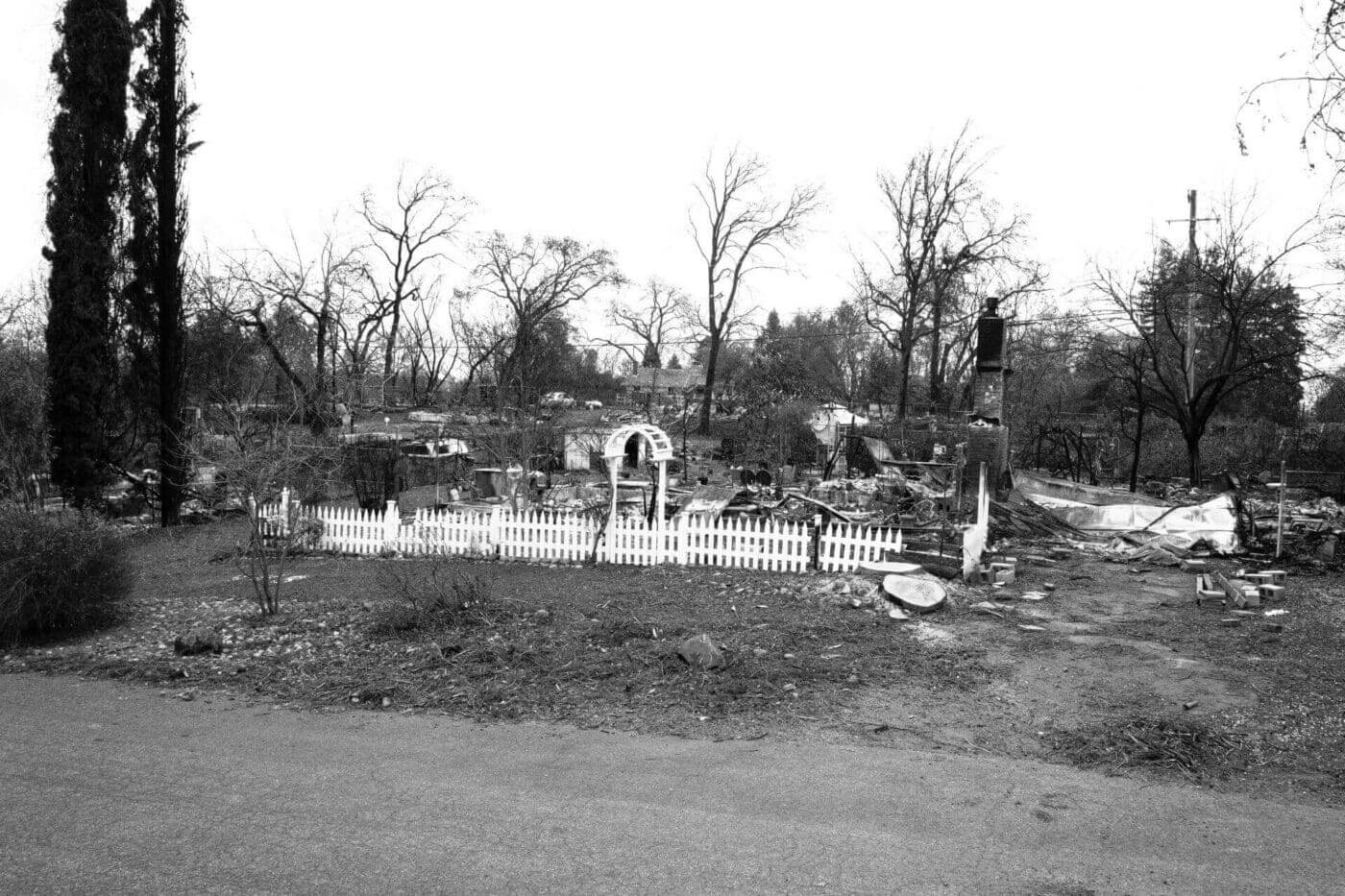
The remnants of a single family home after the Paradise Fires in 2019. Photo by J. Matt/ZUMA Press
This was the summer that rendered global “warming” no longer piercing enough of a descriptor for our intensifying and increasing (un)natural disasters and their consequences. Maybe we will remember this summer as the one during which the earth’s revolt against our treatment of it became real for Americans, the year the earth waged war against our stewardship. The year I sought a new language to describe what’s happening with our climate because the received language is failing us in this new epoch.
I used the martial analogy because the editor here compared my climate journalism to war reporting. I demurred — nobody shoots at me! But the ruined landscape, the sense of loss and the subsequent trauma, he maintained, is similar. He had a point. Trauma upon trauma, recurring with shorter and shorter recovery times. Fire, smoke, flood, death… annihilation — the elements of total war with the insidious addition of heat. The aftermaths of war are what we face as we heat the atmosphere. After this agonizing summer, our environmental devastation must become actionably real to us. To not accept our flaming truth can only be hubris, right?
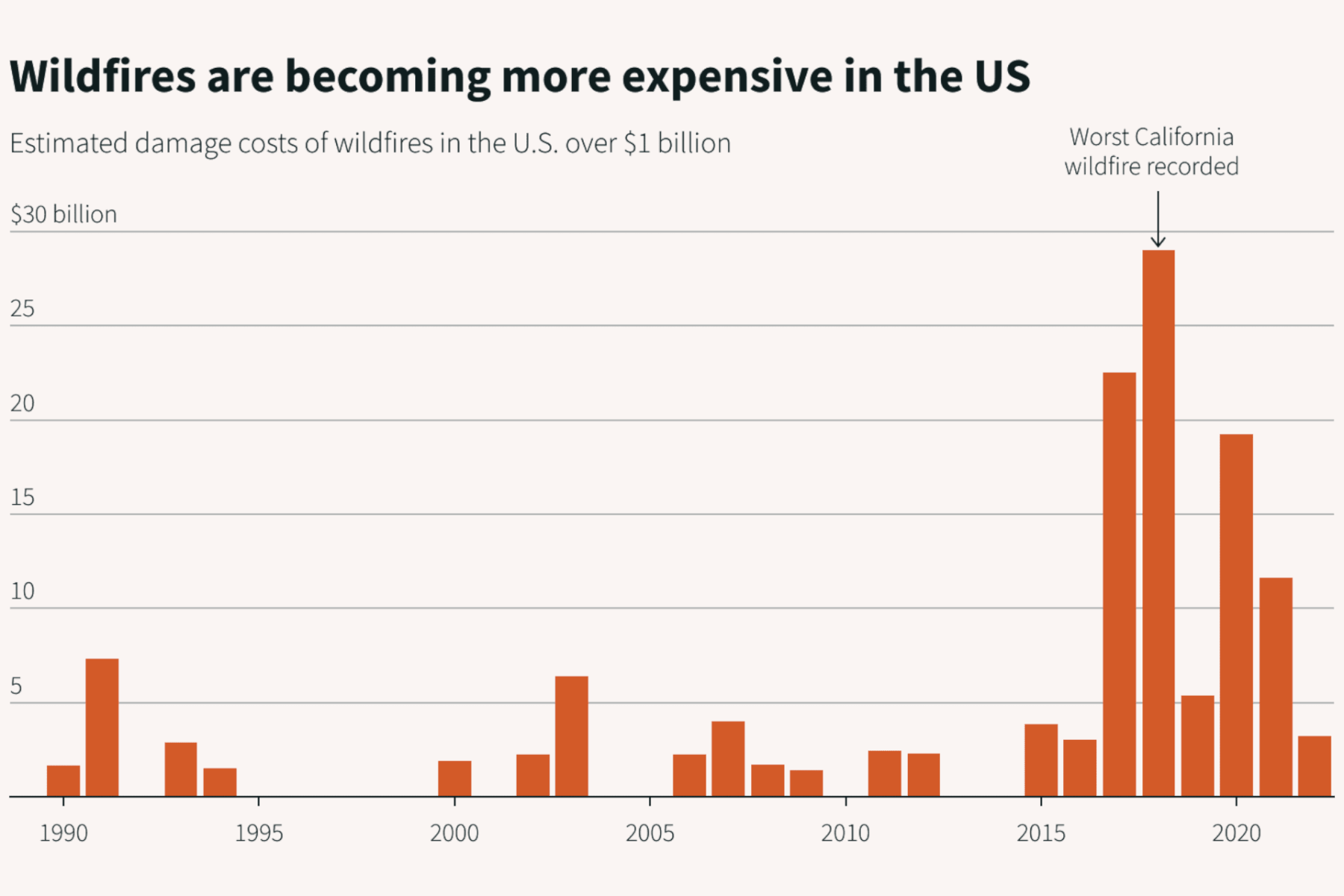
Costs are inflation-adjusted. Data only cover wildfire events over $1 billion or higher. Current as of August 15, 2023. Courtesy of U.S. NOAA | Reuters
But perhaps this isn’t that summer. Domestic, social and political skirmishes appear to overwhelm our concern for acting to mitigate the global warming juicing these previously aberrantly confluent fires, floods and heat waves that bring death and decimation to humans, flora and fauna alike. A Marist Poll in March put “Climate Change” in fifth place in the hierarchy of American concerns, behind the economy, preservation of democracy, healthcare and immigration. Those are important concerns to be sure, and part of the larger picture of our climate calamity and its consequences. But, just eight percent of those polled put the heating climate at the top of their list.
When divided into Democratic and Republican voters, that Marist poll becomes thirteen percent and two percent, respectively, who consider the earth’s warming atmosphere to be the biggest issue today. That it has become partisan is not accidental. The terms “global warming” and “climate change” illustrate the daggers drawn. In the late 1990s, Frank Luntz, a conservative political strategist who knew the power language had to define the terms of engagement, wrote up the focus-group work he had completed for the Republican party:
“It’s time for us to start talking about ‘climate change’ instead of global warming… ‘climate change’ is less frightening than ‘global warming.’ While global warming has catastrophic connotations attached to it, climate change suggests a more controllable and less emotional challenge.”
Luntz’s paper circulated in George W. Bush’s White House and became a part of administration messaging about global warming. Luntz needed nomenclature in the service of protecting our carbon status quo and the spoils it begets. In 2019, Luntz told a Senate panel on climate, “I was wrong in 2001,” and that he wanted the federal government to “do more, right now to address it [global warming].”
Katherine Gasdaglis, who teaches philosophy at California Polytechnic University, Pomona, writes in “Moral regret and moral feeling” that regret reminds us we once had other options. Luntz, too, had other options, but his work, and subsequent Republican and oil industry disinformation building on it, shows the powerful role language and stories have played in the global warming crisis. The language with which we describe our world and our impact on it is critical to developing the narratives necessary to respond wisely to the crises we’ve made. Given the problems’ urgency and immensity, what language and stories might aid us — aid me — in articulating the psychological landscape I repeatedly find myself navigating while at work? And at home, which is no longer a respite from that work.
***
In a callback to Luntz’s dirty work in recognizing “catastrophic connotations” of meaning, I offer a term as a way of putting such connotations to better use, as a way of designating the historic, existing and still-developing land and resource exploitations contributing to our undoing as the planet heats: geographies of hubris. I don’t propose this to scold or make any of us feel any worse than we might — I for one feel pretty damn bad about all of this most days. Instead, I offer it to succinctly identify in shorthand the ways we continue to contribute to our climatic and environmental demise.
The obvious corollary to geographies of hubris, then, must be geographies of grief. With geographies of hubris inevitably come geographies of grief. If we mapped our hubris in the face of global heating across the globe, would it not also foretell a landscape of grief, even if not always in the same locale? If we hope to rise above our distracting social and political din to face global warming’s consequences, which will continue to give that din no quarter, new language will be necessary to tell a story we hope to inhabit, a story that allows us to plot the course of our futures, even as global warming continues apace.
Tom Mould wrote Overthrowing the Queen: Telling Stories of Welfare in America, which elucidates the history, use and falsity of the term “welfare queen.” A student of well-kept and tightly held popular stories, Mould understands their development and evolutions. Changing them is not easy work. He believes, though, that it is possible to overturn an entrenched paradigm and the stigmas that often support it. As a folklorist, Mould grasps that folklore is in part how we codify and disseminate the specifics of something like my reporting journeys to Maui in the fire’s wake. Folklore reshapes my and others’ reporting into how we understand events — as “fake” news, or a broadly cautionary tale, or maybe as something that happened somewhere else and can’t happen here.
When we spoke by phone recently, Mould told me that “choosing one word over another bring[s] connotations with it that move beyond the meaning of a word.” This is what Luntz understood when he seeded “climate change” into the vernacular in favor of “global warming.” For example, Mould described how by speaking “the word ‘genocide’ you actually invoke certain kinds of protocols that have to be followed,” understandings born of the weight of history and responsive law. It is a word that stigmatizes an action.
“We can think anything, but words help us think. I can talk about global warming a lot more effectively if I have a big lexicon.”
Transposing this notion to global warming (and Luntz’s “climate change”), Mould tells me that by not addressing the crisis of carbon pollution itself, we risk merely “dressing it up with new terms…beating our heads against the wall,” working to merely to frame a problem killing many while enriching a few, instead of acting to solve that problem. In the realm of global warming, we have been left with linguistics operating independently of commonly accepted ethics. Some in the United States believe it to be ethical to continue to burn carbon and heat the atmosphere, disregarding the physics of the greenhouse effect and its consequences for life on Earth, while some do not. That is the knot, woven with greed, stasis, and fear, but without a singular event “dramatically huge in scale and scope that you can’t miss, like 9/11”, Mould reminds me.
Of course, with that, my mind returns to Paradise and Lahaina and the question of whether optimism is sustainable in the climate crisis. “I’m optimistic that if we actually use the language that brings home the dire consequences [of global warming], that can be a good thing,” Mould says. “We can think anything, but words help us think. I can talk about global warming a lot more effectively if I have a big lexicon.”
Paradise, a town of 26,218, was almost completely destroyed by a firestorm in an hour and sixteen minutes — an event “dramatically huge in scale” but still unable to enlarge the lexicon. Slogging through the aftermath of The Camp Fire seemed to demand an expansion of our vocabulary of possibility, both in a heating climate and in response to that heating climate.
Now, I believe Paradise to have merely revealed the scope of acceptable losses in the U.S. as global warming accelerates — if even that. Paradise’s burning, it turns out, was an existential event for only Paradise, not the nation. It provided no new vernacular to aid us in apprehending our situations. What will Lahaina’s destruction allow us? A broadening of the language of possibility and threat, an understanding of national and global existentialism, or revising acceptable losses? Will it become the beginning of a new story or merely a footnote to the old?
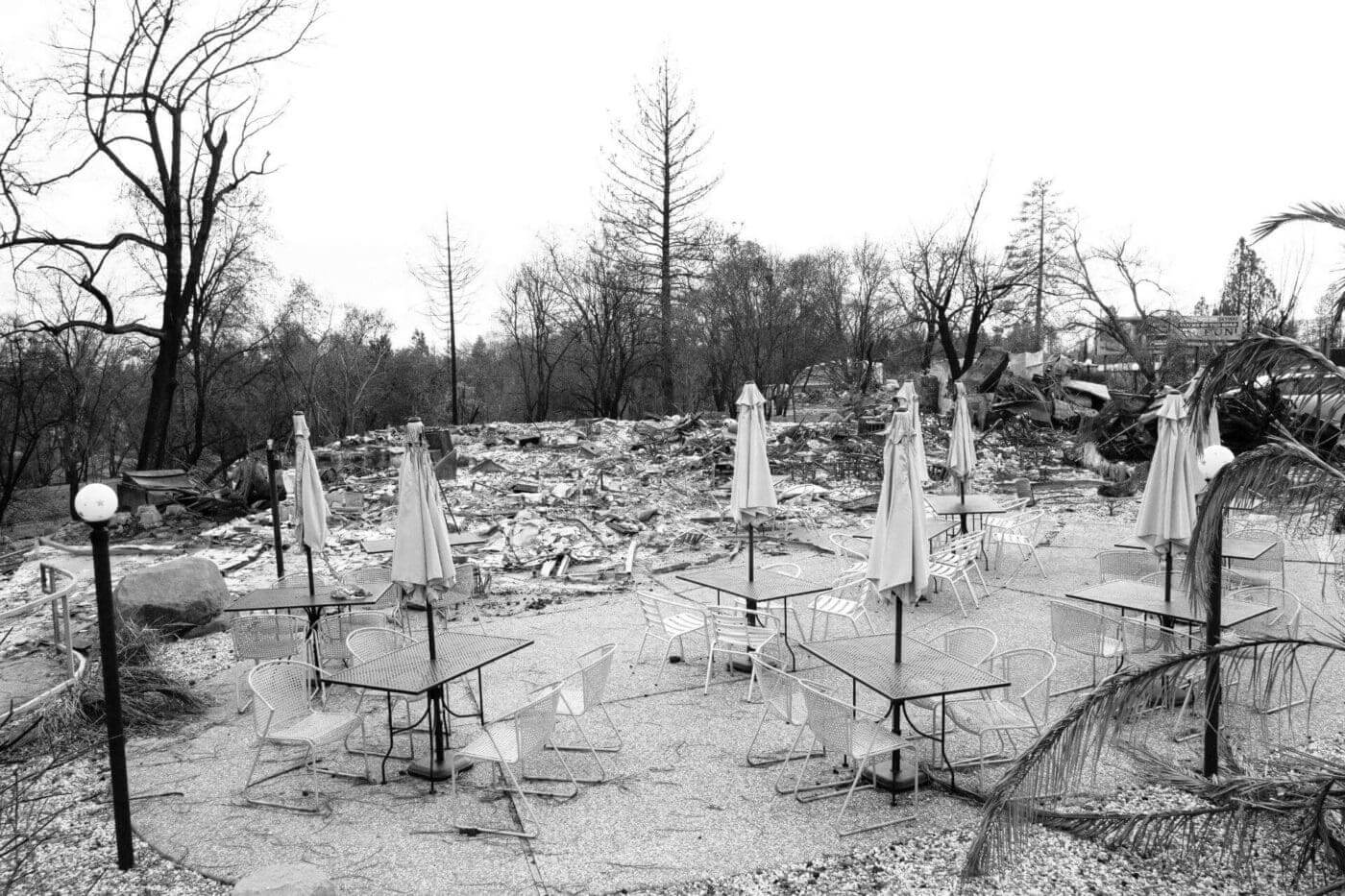
One of many restaurants destroyed in the Camp Fire was Mama Celeste’s Pizzeria. The enormous number of structures burned by the Camp Fire presents a unique problem with regards to the disposal and recycling of the resulting debris. It is estimated that the nearest landfill to the Camp Fire burn area, Anderson Landfill, has about sixty years capacity remaining. A Waste Management executive estimates that Camp Fire debris alone will use five years capacity. Photo by J. Matt/ZUMA Press
Facing climate-influenced disaster after disaster, each followed by staggering national inaction to address root causes, journalism is plotting a new narrative that leavens ongoing distressing environmental and climate reporting with notes of hope and individual agency as people careen into depression and malaise reading the stories of our moment. Meanwhile, American political discourse puts more energy into arguing about drag queens and trans kids than facing a planet in revolution against our custodial conduct. Resource-sucking light trucks and SUVs remain the biggest sellers in America, with 1.09 million light trucks and SUVs sold versus 291,000 passenger cars this past June. We became the world’s largest exporter of natural gas in 2022 and remain so, with none of those exports counting towards our national carbon pollution debt as we burn gas offshore. Neither our politicians nor we ourselves, seem to be able to grasp the thread unraveling before our eyes these past summers. We bunker in our narratives without the language to see beyond them.
It is understandably unpleasant to face compounding reporting about accelerating climate chaos. Malaise would seem an appropriate reaction if we truly didn’t understand the sources of our unhappiness. But we know enough to know that our national mood is a culmination of wealth disparity, apparently intractable racism, impotent political processes facing off against increasingly rigged minoritarianism; a politicized Supreme Court; the devastating social and economic legacies of Neo-liberal financial policies; innate human tribalism and stories that can’t be made to reconcile. Global warming is a distilling accelerant for all of it, and vice versa.
We cannot continue to inhabit this story’s deficient narrative if we care about the future and those who will inhabit it. Yet we remain stuck in it.
We have built an inequitable society dependent on fossil carbon resources for fuel, comfort, leisure, and our food supply. And we can’t seem to wean ourselves from what we view as our entitlements: overstuffed comfort, perpetual growth and cashing in on everything, everywhere. We cannot continue to inhabit this story’s deficient narrative if we care about the future and those who will inhabit it. Yet we remain stuck in it. New obscenities such as Lahaina’s destruction supersede old ones like Paradise’s, establishing new normals instead of new narratives.
Lahaina’s present geography of grief is plain and broad. Its contemporary geography of hubris began to intertwine with its historical grief when nation-toppling plantation agriculturalists undertook the draining of its wetlands, kalo patches and fishponds to satisfy the outsized thirst for sugar cane, itself planted to slake our hunger for sweets and profit. Lahaina’s dual hubrises of grief and geography are nurtured by the past and current political leadership’s failure of imagination in the face of the destruction of Paradise, California.
It could, did and will happen again. The hubris we map onto the landscape guarantees it. Billions of dollars will go to rebuild and more fires will follow. It is the same story at our coasts and floodplains, rebuilding in place will not reduce the odds of ruinous calamity.
***
It shouldn’t take the parable of Daedalus fashioning wings for his and Icarus’ flight from imprisonment to illustrate the ancient nature of our hubris and the continuing, tragic dilemmas that stem from the hubris we’ve shown in causing the climate crisis to take flight. Our hubris is indeed an affront to whatever gods you name.
We Americans are now learning firsthand the desperation our carbon-intensive way of life visits on the climate-afflicted who live on the sharp edge of the knife: the Guatemalans, Burmese, Indians, Filipinos, Vanuatuans, among many others on the frontline of climate disaster. Their tribulations are just beginning to gain on us, living as we do, insulated by our mostly temperate latitudes and comparative wealth. Our Icarus moment was deferred and exported, and now it is home to roost.
This summer, The New York Times reported about a man in Laredo, Texas who pulled his pick-up to the shoulder, turned on the hazards, and succumbed to the record-breaking hot spell. His heat-struck body was recovered in the driver’s seat and awaiting identification. Icarus in a pickup truck? But when our systems of government and business fail us so rigorously, it’s hard to see anything but another victim, one with a poignant demise and easy relatability. By the first week of September, a partial count of counties in Arizona, Nevada, and Texas reported six hundred seventy-four heat-caused or heat-related deaths with investigations ongoing.
This workaday misery will increase on a heating planet as we fail to designate geographies of hubris or to make socially indefensible an agenda of new fossil-fuel projects, the exportation of natural gas, the continuing sales of giant autos and homes, our habits of consumption and many of the entitlements taken for granted as our American ways of life. When considering the climate crisis, it’s important to bear in mind that COVID-19 demonstrated America has a vast appetite for accepting excess death when mitigating peril proves too inconvenient.
But preaching fire and brimstone benefits from offering a carrot. Both Tom Mould and I have hopeful insights, even as our insights represent what I’ll call a “traumatic hope.” My insight comes from observation. The heartening, ad-hoc community response I reported from Maui demonstrates mutual aid as a model of sustainable social organization new to most Americans mired in our bootstrapping identities. Mutual aid is simple to envision in times of disaster and demonstrates that a benefit supplied to a person in need by a community aiding itself does not add up to a handout, but rather solidarity in the face of the systems failing that community.
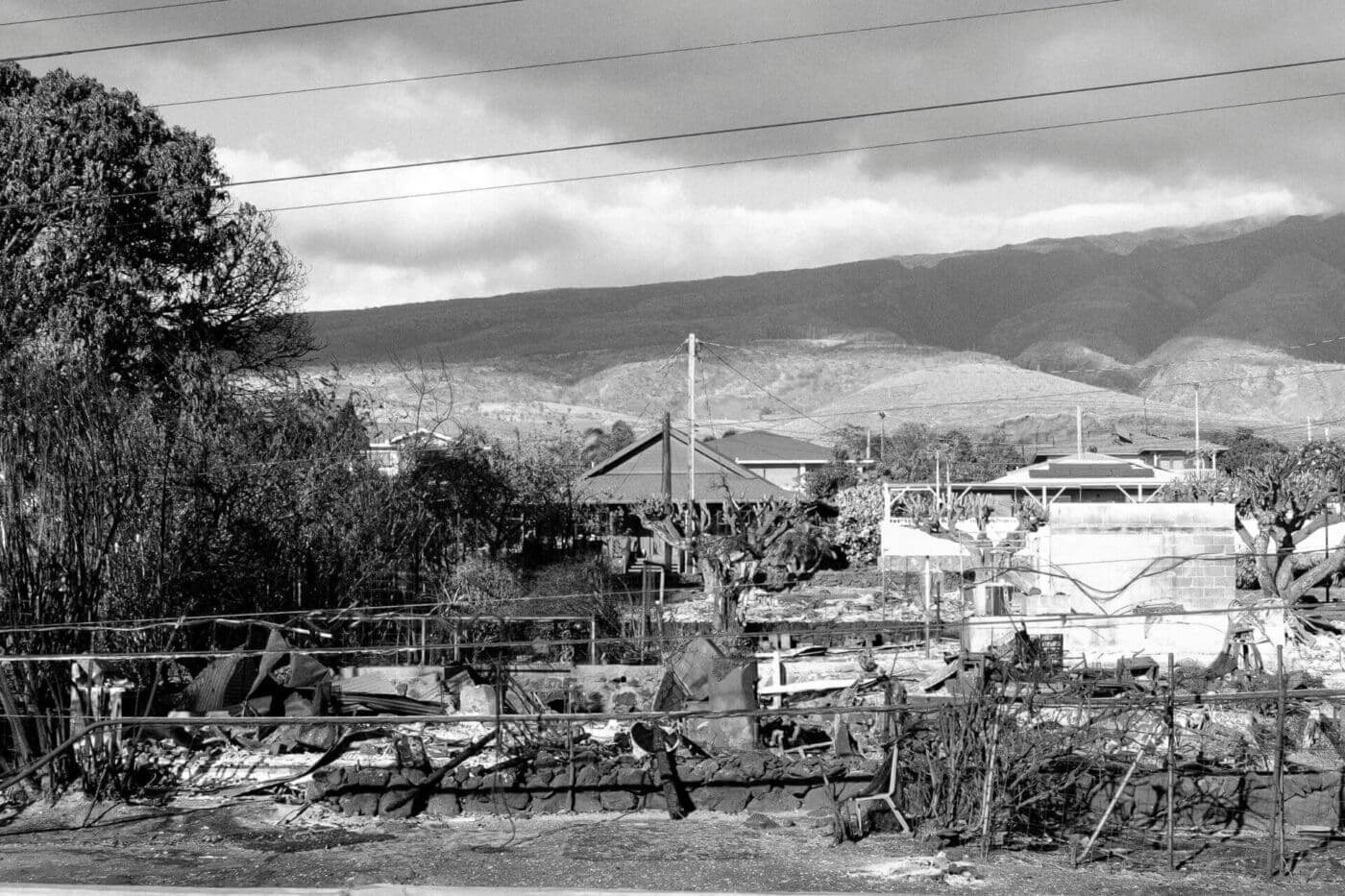
The personal impact of the devastating fire in Lahaina is everywhere about the town, with nearly a hundred deaths confirmed so far. Photo by J. Matt/ZUMA Press
Mould’s hope is of a more jaded sort. He doesn’t disagree that giving a shorthand name to the troubled geographies we dwell in could help. But his research for Overthrowing the Queen showed that kernel narratives such as “welfare queen” are proxies for deep-rooted, hard-to-shake beliefs. “With welfare, I mean, the problem there is at the end of the day, people just don’t care as much about the poor,” Mould explains.
Still, Mould sees an opportunity for recasting the narrative of global warming in productive ways. “I’ll be honest, I think we can [positively change global warming] in a way that I don’t think we can with welfare,” he says, because “there are so many politicians talking about it — not just during election season — and there’s money, there’s a lot of environmental agencies and lobbyists.” In other words, we have a chance to recast the climate-crisis narrative because the effects of a heating climate are less easy to stigmatize since they will fall also, but not equally, on the middle and upper classes, voters, campaign donors and shareholders.
***
As a writer, I may be biased in my belief that language can set new terms for engaging with a crisis, or creating one. But there is precedent. During the postwar era, we recast “empire” as something not aspirational, but as an evil perpetrated by the Soviets and Red Chinese. We stopped using the word relative to our goals overseas. Narratively, if not in practice, “Empire” became a thing our enemies pursued and we fought against under the banner of freedom and democracy.
This sort of disinformation gave Americans license to overlook, and excuse, immoral American colonial excesses. Today, an evolution of this deceptive paradigm continues relative to global warming. If the polity continues to perceive “climate change” to be a non-threatening, or merely ordinary variability, our federal and state governments are granted license, and the industries that often capture them, to maintain deadly geographies of hubris in the face of all evidence of looming landscapes of disaster and grief. If “freedom” gives license to consume resources disproportionately and at the cost of our planet’s stability, geographies of grief will continue to mount.
If “freedom” gives license to consume resources disproportionately and at the cost of our planet’s stability, geographies of grief will continue to mount.
The science fiction writer Ursula Le Guin warns us that as far-fetched as it seems now, the divine right of kings once seemed unassailable. If that is true, and it was, then telling a story that casts us as a part of nature, rather than apart from it, with the agency to overturn our geographies of hubris and limit their accompanying geographies of grief, cannot be impossible.
I’m from Hawai‘i. I have known Lahaina and I have seen Lahaina laid bare. I have briefly known Paradise, as I briefly knew the Oakland and Berkeley Hills. I will see, and know them again. That is my fear. I am invested in the planet’s ecosystems as I have experienced them in my lifetime; invested in the people I have met and love, and the students I teach. Who can be an unbiased correspondent when reporting increasingly revolves around greater and greater climatic, environmental, and human trauma?
I need a new story, one told with terms that show the world I see. I need a story I can believe in, told about the world I know. I can’t be alone in this hour of my need.
Help us sustain independent journalism...
Our team is working hard every day to bring you compelling, carefully-crafted pieces that shed light on the pressing issues of our time. We rely on caring supporters like you to help us sustain our mission. Your support ensures that we can continue to provide deeply-reported, independent, ad-free journalism without fear, favor or pandering. Support us today and make a lasting investment in the future.
RELATED STORIES


Award Winning



Today’s environmental and social justice challenges are unprecedented, and require an unprecedented collective effort.


Stay updated on our latest features, events and more. Subscribe to our Note From the Nest newsletter!
