
A Supreme Conundrum
One of the season’s more provocative legal theories is that the former president and leading Republican candidate is Constitutionally (never mind constitutionally) unfit for office. The theory goes that by encouraging zealots to attack Congress, by targeting his Vice President for violence, by bullying the Georgia Secretary of State to “find” votes to alter a certified election result, and by plotting to appoint fraudulent electors, Donald Trump has engaged in or given aid and comfort to an insurrection and, therefore, should be ineligible to run for President under Section 3 of the 14th Amendment to the U.S. Constitution.
An ethics watchdog group in blue-state Colorado has already filed a lawsuit that aims to force its Secretary of State to bump Trump off the ballot. State election officials in other states have engaged in similar discussions, while red-state officials will certainly reject this theory.
The legal theory behind barring Trump from ballots has gained enough momentum that legal battles attempting to compel state officials to do so figure to blaze their way through state and lower federal courts right to the U.S. Supreme Court.
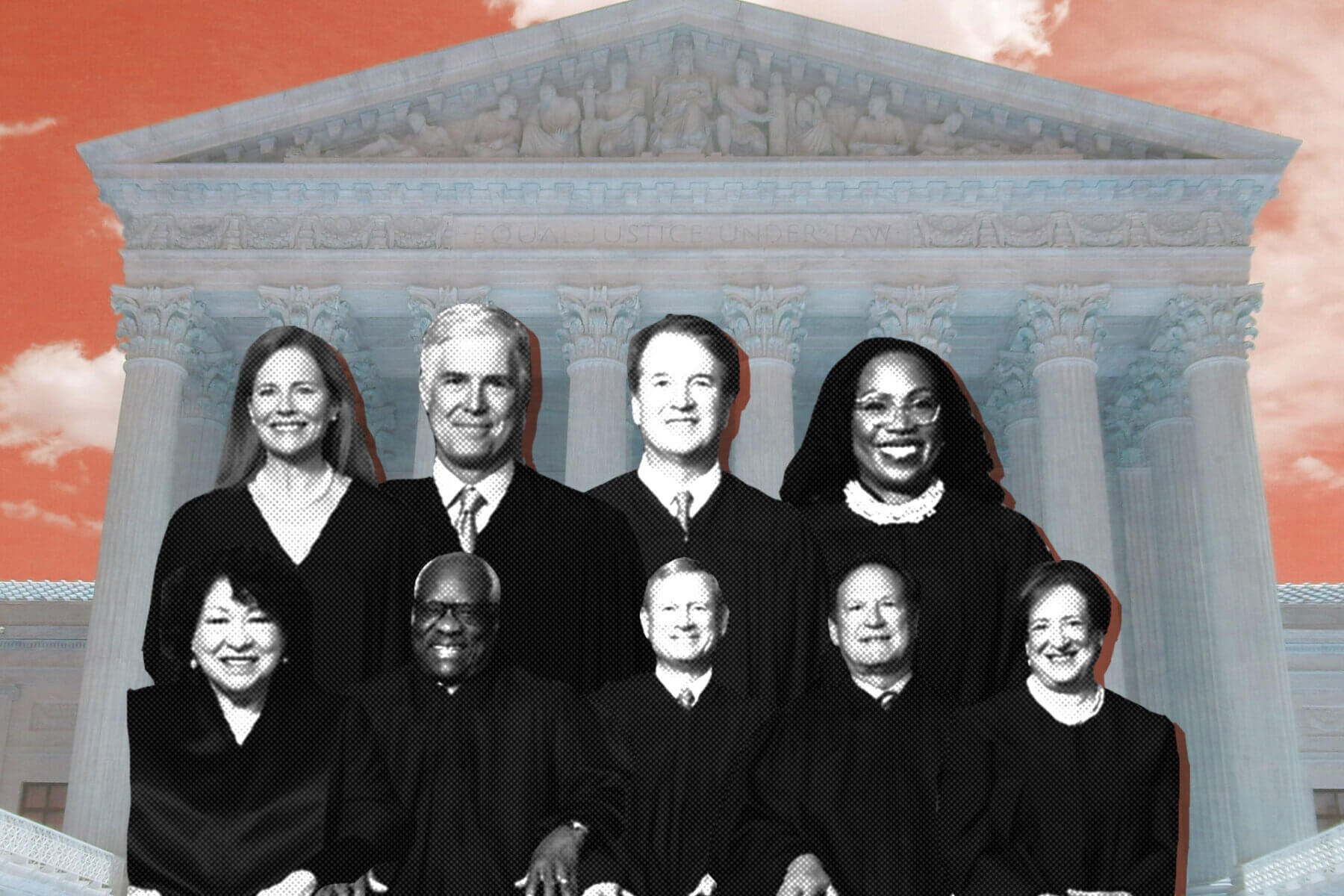
If that weren’t perilous enough, the U.S. hurtles into an election year with an array of legal clashes on the court’s docket for the new term, including the challenges to the authority of federal administrative agencies, states’ ability to regulate social media platforms, and the constitutionality of congressional redistricting plans that could determine which political party seizes control of the U.S. House of Representatives in the 2024 elections.
To many, it is a chilling thought, a quarter century after the Court’s ruling in Bush v. Gore halted a Florida recount in the 2000 presidential election, that the 2024 election could be decided by a judicial body with a lowly 40 percent approval rating in a recent Gallup poll; a body that according to a Quinnipiac University survey, 63 percent of Americans say is motivated mainly by politics, with just 32 percent saying it is motivated mainly by the law.
The dismal ratings follow a slew of skewed rulings last term by the Court’s ultra-conservative majority. Foremost among them is the June 2022 decision in Dobbs v. Jackson Women’s Health Organization — the ruling that overturned Roe v. Wade, the 50-year-old decision upholding a woman’s right to choose abortion. Several Justices had sworn under oath that they regarded this ruling as settled precedent.
All this comes amid brazen ethical transgressions by conservative Justices Clarence Thomas and Samuel Alito, both of whom appear impervious to criticism or public disapproval over the lavish gifts given them by wealthy, partisan patrons, raising questions over whether members of the court have been bought off, or in other words, are corrupt.
“If over time the court loses all connection with the public and with public sentiment, that is a dangerous thing for democracy.”
The trepidation greeting the court’s current term would likely not be so great had Senate Republicans not taken the unprecedented step of refusing to act on President Obama’s nomination of Merrick Garland to replace Antonin Scalia for 10 months following the conservative justice’s death.
Instead, they voted within three months of Trump’s inauguration to fill the vacancy with Justice Neil Gorsuch. When Justice Anthony Kennedy retired and Justice Ruth Bader Ginsburg died, GOP Senators pushed through the confirmation of Justice Brett Kavanaugh within three months and shoehorned Justice Amy Coney Barrett onto the bench in just a month — one week shy of the 2020 election — therefore making way for the overturning of Roe.
Perceptions of arrogance, ideologically driven decisions and imperiousness over ethical breaches have left legal observers and laymen looking sideways at the Court. In recent remarks at the University of Oxford’s “Reputation Symposium,” journalist, pundit and Yale Law School scholar Linda Greenhouse cut to the chase when she said, “The court’s diffuse legitimacy has been erased.”
Greenhouse noted that in the past, when the Court enjoyed high approval ratings, “even people who disagreed with particular decisions were willing to grant the legitimacy of the court that issued them.” She also noted that a generally positive view of the court, based on perceptions of its independence, endured in some sense even until 2020, when 68 percent of Democrats and 65 Republicans still approved of the Court.
That changed when Trump’s promise to evangelical voters that he’d appoint anti-abortion Justices came to pass with such speed and consequence. No one could have known that he’d get to appoint three in one term, setting the stage for Dobbs, in which the Court ruled for the petitioners seeking to ban abortions after 15 weeks of pregnancy, except in the case of medical emergencies and fetal abnormalities.
According to the PEW Research Center, three-quarters of Americans disapprove of the Dobbs decision. After Dobbs, Greenhouse noted, Republican approval of the Court increased to 70 percent, while Democratic approval nosedived to 13 percent, the lowest rate Gallup has ever observed. “It is impossible to overstate the shock to the system that was the Dobbs decision,” Greenhouse said.
Or, as Justice Elena Kagan wrote in her dissent: “If over time the court loses all connection with the public and with public sentiment, that is a dangerous thing for democracy.”
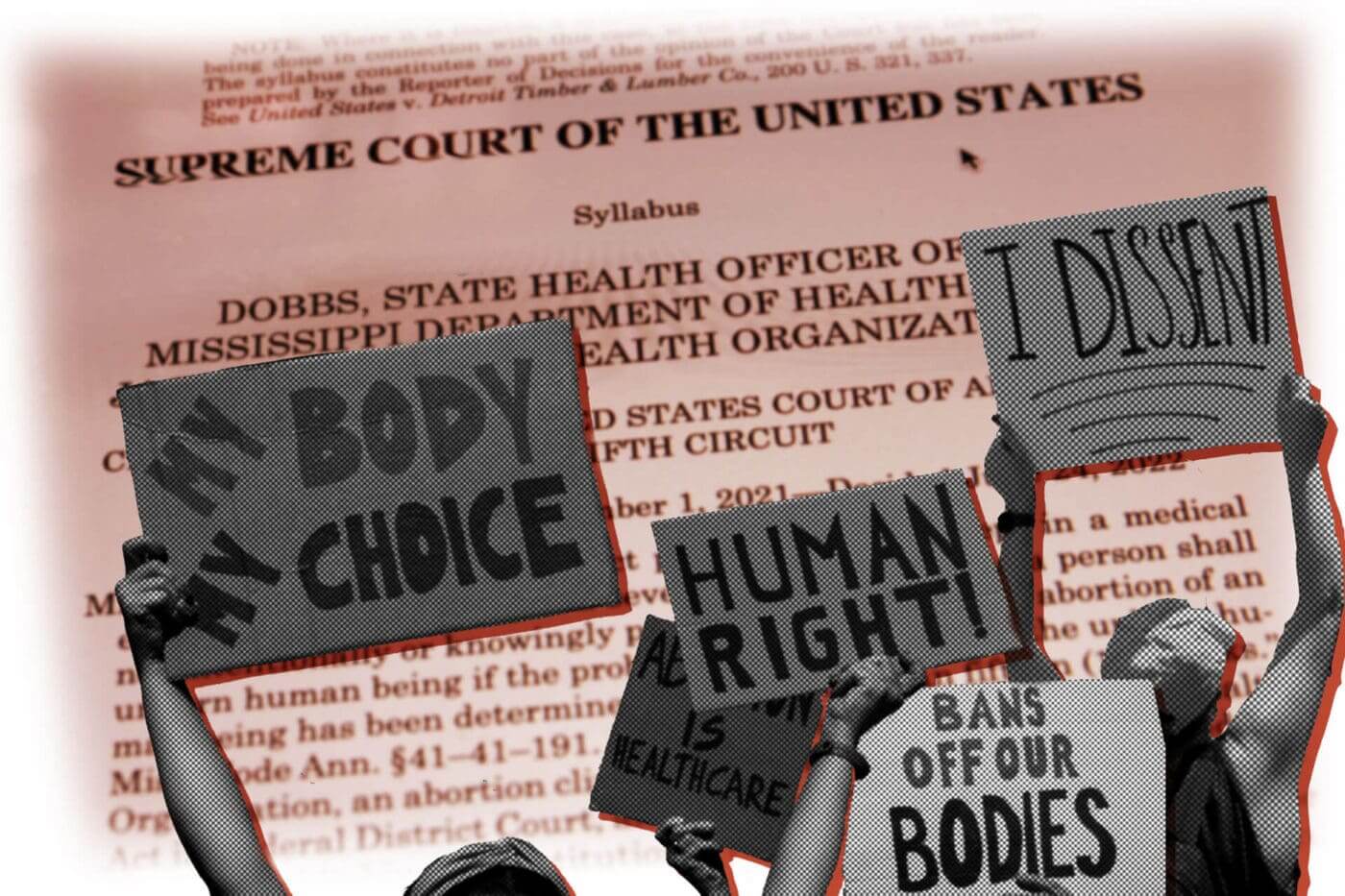
Even after the Dobb’s decision, Pew Research found that 62% of Americans say abortion should be legal in all or most cases. Illustration by Tori O’Campo
As both the political and ideological gap in support for the Court expanded, so did the generational one. Just 37 percent of 18-to-29 year-olds expressed “public support” for the Court, according to the Quinnipiac poll. “The only age group that expresses public support for the court is that of people over 50,” Greenhouse said. “Younger people are much more skeptical — understandably, because they have no memory of when the Supreme Court was acting like a court.”
So, given the public’s antipathy towards the Court, why isn’t there more pressure from academics and constitutional scholars, not to mention grassroots movements, or even in Congress, to preserve its legitimacy? Or, simply to justify its existence?
***
Article 3, Section 1, of the Constitution provides that, “[t]he judicial Power of the United States, shall be vested in one supreme Court, and in such inferior Courts as the Congress may from time to time ordain and establish.”
The Supreme Court was created in 1789 by authority of the Judiciary Act and was organized on February 2, 1790. But, it wasn’t until 1803, in Marbury v. Madison, that Chief Justice John Marshall penned a unanimous decision granting federal courts, in the name of “balance of powers,” the authority to declare legislative and executive acts unconstitutional.
The case established the principle of “judicial review,” a power not specifically granted in the Constitution, to prevent either Congress or the President from becoming too powerful. Since then, the Court has remained accountable to no other governmental entity but itself.

First morning of the U.S. Supreme Court in 1789. Illustration by Irwin Smith. Courtesy of the National Archives
Such unchecked autonomy, along with the political machinations over the way the Justices are seated, the contorted logic with which they upend decades of precedent, and the overt appearance of corruption — or some combination of the above — has put some momentum behind questions about the court’s legitimacy and the search for remedies.
In “The Supreme Court’s Legitimacy Dilemma,” Tara Leigh Grove, a professor at the University of Texas School of Law, tackled the subject for Harvard Law Review while commenting on Harvard Law professor Richard Fallon’s 2019 book Law and Legitimacy in the Supreme Court. Grove found it striking that so many constitutional scholars and members of Congress were publicly questioning the Court’s legitimacy.
“This onslaught is jarring,” she wrote, citing corrective proposals such as rethinking life tenure, “packing” the Court with additional members, initiating impeachment proceedings against miscreant justices, and perhaps loosening its unchecked grip on democracy by limiting its jurisdiction or refusing to obey its rulings.
Grove refers to Fallon’s analysis of the legitimacy question, which began with three categories: sociological legitimacy, moral legitimacy and legal legitimacy. Sociological legitimacy derives from the public notion that the Court is acting within the scope of its legal authority. Moral legitimacy focuses on whether the Court is worthy of respect and obedience. Legal legitimacy is rooted in whether the Justices interpret the law using methods that are applied consistently “with candor and in good faith.”
That latter test of legitimacy depends on whether the Court appears to be acting within its authority and is worthy of respect, according to Fallon’s methodology. But a dilemma arises, Grove wrote, when, say, a Justice switches his or her vote, fueling speculation about their motives.
A commonly cited example is when Chief Justice Roberts voted in a private conference — a closed meeting during which justices preliminarily vote on cases — to strike down the individual insurance mandate at the heart of the Affordable Care Act and to uphold Medicaid expansion for those near the poverty line.
The mostly Republican opponents of the Affordable Care Act challenged the policy on the grounds that mandating the purchase of a baseline of healthcare insurance was unconstitutional. After protracted briefings and behind-the-scenes negotiations among his fellow justices, though, Roberts found a way to save President Barack Obama’s signature policy achievement by upholding the mandate while curtailing Medicaid expansion. What motivated the chief justice’s reversal — politics, public pressure, lobbying, newfound legal insight — remains a mystery, because Roberts has remained opaque about his decision, never offering a rationale.
So much for legal legitimacy.
Although many Americans think the Court needs reform, Grove believes the legitimacy dilemma has always been an issue. But she denied that the radical polarization of our current society has intensified it. “The dilemma was always there,” she said in a phone conversation, “and the basic idea holds true today.”
But has there ever been a more blatant misuse of power for the sake of building a conservative majority on the Court than in the Trump era of the GOP?
Grove is equivocal on whether the GOP has “weaponized” the Court for unpopular, ideological purposes such as overturning long-standing precedent like Roe, or, more recently, slashing the regulatory authority of the Environmental Protection Agency under the Clean Water Act: “It’s very much a matter of perception, and many believe it is creating a strain on the Court,” she said. “But others think the Court’s composition has transformed naturally via death or retirement. It’s in the eye of the beholder.”
That’s hard to reconcile, given the contrast between Garland being denied a hearing during Obama’s final year and Coney Barrett being rushed to confirmation on the eve of a presidential election. At the same time, Grove said, there just aren’t many swing votes like Justice David Souter anymore, the mild-mannered President Bush appointee who replaced liberal stalwart William Brennan. Souter turned out to be a moderate with an independent streak, later to be branded by conservatives as a turncoat.
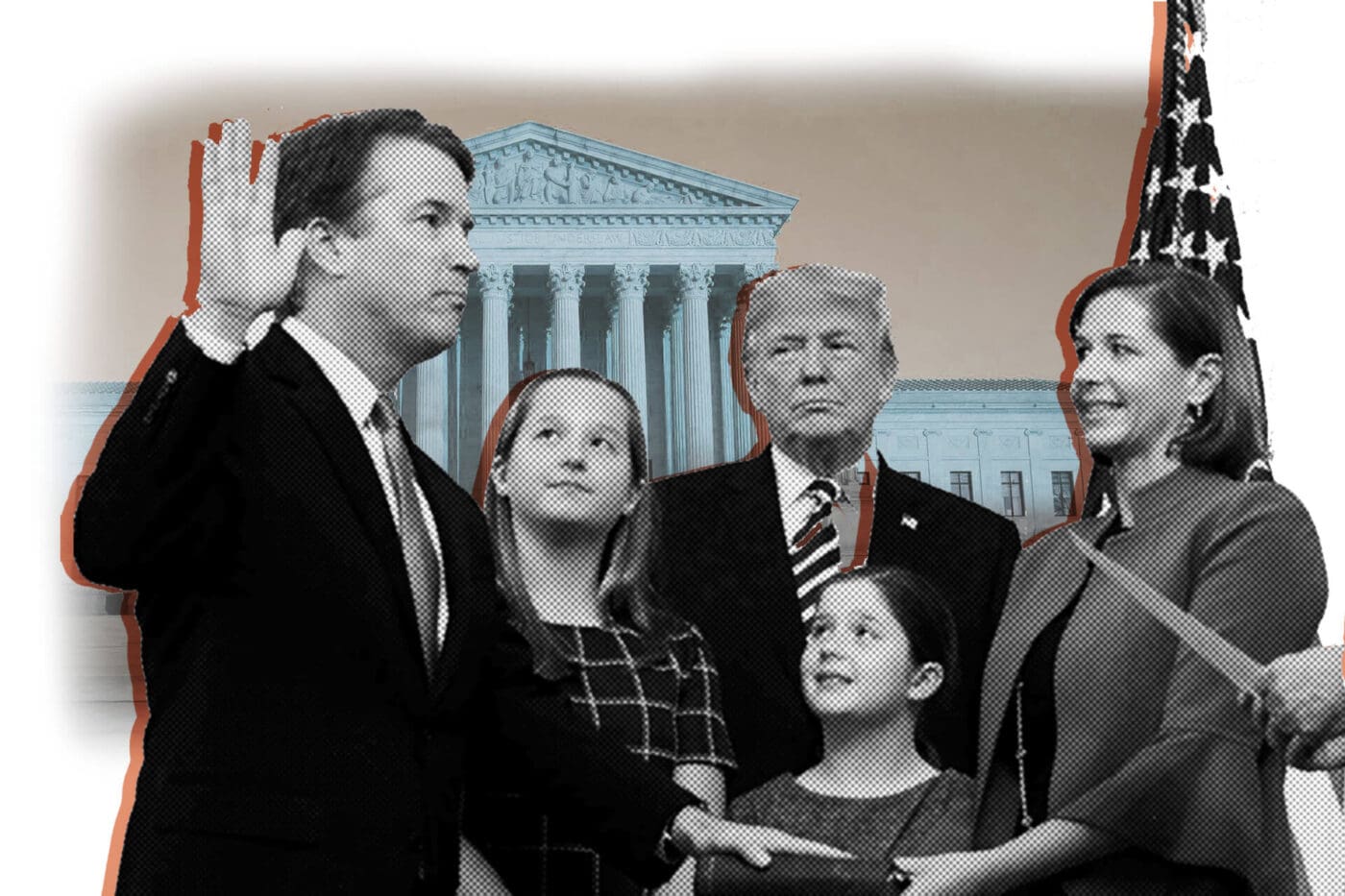
Just a month before he was sworn in, about 39% of Americans were for Justice Kavanaugh’s confirmation and 42% were opposed, according to a poll conducted by Gallup. Illustration by Tori O’Campo
As Justice Kagan said during the confirmation hearings for Justice Kavanaugh in 2018: “Part of the court’s legitimacy depends on people not seeing the court in the way that people see the rest of the governing structures of this country. It’s been an extremely important thing for the Court, that [over] the last 40 years, starting with Justice [Sandra O’Connor] and continuing with Justice Kennedy, there has been a person who found the center.”
Even if the public cannot identify a reliably independent swing vote in the current Court’s makeup, there are still “surprises,” says Grove. She points to its recent ruling in the Voting Rights Act in favor of Black voters in Alabama, and its rejection of the independent state legislature theory that would have allowed states to apply their own constitutional standards to federal elections law. “In the end much of it is Monday Morning Quarterbacking,” she shrugged.
Fallon seems to agree with Grove. “I think when people say the Court is losing its legitimacy, they mostly believe they have lost confidence in the Court,” he said in a recent interview. Critics from the left might fall prey to this perception, he said, whereas in prior decades, “people had confidence in the Court even if they did not agree with its decisions.”
Two other factors might explain why academics such as Fallon and Grove hedge on the legitimacy conundrum: Public approval polls regarding the Court seem to reflect the extreme partisan differences in the country in general, and disapproval of the Court on the left is equal to approval of the Court on the right. There is very little middle ground. So, who is to say the Court lacks legitimacy?
And, whereas acrimonious confirmation battles during much of the 20th century were rare, with most nominees receiving unanimous approval, contentiousness in the confirmation process over the last several decades has become the norm. (Contrast Scalia’s confirmation in 1986 with just two votes against him, to the liberal uprising against Robert Bork the very next year, despite being regarded by commentators as the most impressive nominee they had seen in years.)
“I think when people say the Court is losing its legitimacy, they mostly believe they have lost confidence in the Court.”
Though Fallon acknowledges the partisan divide in America has left people feeling there is more political influence on the Court than in the past, he sidesteps the obvious reasons for this: political maneuvering in seating justices — particularly during the Mitch McConnell (R-KY) era of Senate leadership; the court’s disregard of precedent in rendering ideologically-rooted decisions; opinions lacking legal or intellectual integrity; and the defiance of some who welcome lavish gifts and perquisites from wealthy partisans.
“If the question is, do people have cause to lose faith in its legitimacy, I’d say that it goes up and goes down,” Fallon said.
If there is any conviction or consensus among Court watchers, commentators and academics, however, it does concern ethics. Obviously, Thomas and Alito have lowered the bar there, to the point that Alito has thumbed his nose at both critics and members of Congress. Congress did not create the Supreme Court, he has argued, and Congress has no lawful authority to impose ethics standards on it. A bold application of the, “You’re not the boss of me” deflection.
Alito has not hesitated to use the bully pulpit, either: When a case that came before the Court involved a billionaire who had flown him on a private airplane to a fishing expedition, he not only refused to recuse himself, he got out front of the story by writing a preemptive rebuttal in an op-ed in the Wall Street Journal. “I know this is a controversial view, but I’m willing to say it,” Alito said in an interview with the Journal in July. “No provision in the Constitution gives [Congress] the authority to regulate the Supreme Court — period.”
Thomas, ordinarily stoic in the face of withering criticism, has seen fit to go on the offensive as well. Earlier this year, when his 2022 financial disclosure revealed private jet trips courtesy of real estate mogul and prolific GOP donor Harlan Crow, Thomas’s attorney Elliot Berke issued public accusations that “left-wing” groups had “weaponized” the issue of ethics against Thomas:
“No Justice, Justice Thomas included, should be subjected to such political bloodsport. It is painfully obvious that these attacks are motivated by hatred for his judicial philosophy, not by any real belief in any ethical lapses.”
As investigative reports from the likes of ProPublica into his ethical breaches pile up, Justice Thomas did see fit to recuse himself from a case regarding the January 6, 2021, attack on the U.S. Capitol that involved his former law clerk, John Eastman, who has been indicted for his role in advising the former President in his attempt to overturn the 2020 election. Thomas’s wife, Virginia, meanwhile, has been tangled up in the election-denier conspiracies at the highest levels.
Senator Sheldon Whitehouse of Rhode Island (D), a former State Attorney General and former U.S. Attorney, is willing to connect the dots between these ethics controversies and the legitimacy of the court. Whitehouse has been a dogged investigator and outspoken critic of what he describes as a “dark money” machine that has enabled the GOP to establish an ultra-conservative grip on the Court.

Senator Whitehouse displays a painting that hangs in Camp Topridge — a property owned by Harlan Crow — which depicts Justice Thomas smoking a cigar next to Crow. Illustration by Tori O’Campo
In addition to mocking Alito’s argument that a flight on a friend’s private airplane for a fishing expedition was exempt from ethics disclosure, Whitehouse, throughout some 25 presentations on the floor of the United States Senate, has detailed how a monied network of conservative activists has deployed secret funds to hijack the Court.
Whitehouse uses storyboards in the classic style of courtroom exhibits to demonstrate how these secret funds are scrubbed of any affiliation to their original source through nonprofits and super PACs controlled by Senator McConnell, assuring the loyalty of Republican political figures seeking to align with influential, conservative and libertarian organization The Federalist Society and lobby for the next Supreme Court nominee.
This has been going on for years, Whitehouse contends. When Merrick Garland was up for confirmation, Trump benefactors gave millions of dollars to The Federalist Society, so that it could funnel the money to conservative activist Leonard Leo’s Judicial Crisis Network to run a campaign to block Garland’s Senate confirmation.
In her June 25 op-ed, under a headline that declared, “The Supreme Court is corrupt,” Washington Post columnist Jennifer Rubin cited Whitehouse’s claim that Leo put together a list of acceptable high court nominees for Trump to choose from when he was President. (ProPublica has a long read on Leo, known as the “hidden architect” of the Supreme Court’s conservative majority, for having influenced the appointments of the six sitting members of that right-wing bloc.)
The nexus of ethical lapses, compromised rulings and dark money that fuels the effort to, as Whitehouse puts it, “capture the court,” has led to the Court’s “unprincipled, outcome-oriented and partisan decision-making,” Rubin writes. “Never has there been more evidence to bolster [Whitehouse’s] claim.” (Chief Justice Roberts only fanned the flames by skipping a Congressional hearing that included a discussion of his administrative role in such matters.)
Allegations of inappropriate conduct have been leveled against other Justices, including liberals, as well. Justice Ketanji Jackson Brown’s disclosure omissions, Justice Sonya Sotomayor’s non-recusal in a case involving her book publisher, former Justice Stephen Breyer’s numerous trips funded by left-leaning Pritzker Family Foundation, and Justice Ruth Bader Ginsburg’s work with the National Organization for Women, also speak to a need for bipartisan reform.
Just this week, Whitehouse introduced the “Supreme Court Biennial Appointments and Term Limits Act,” to establish 18-year term limits and regularized appointments for justices. The Senator called it “a bill that is overdue,” and pledged that the legislation “will clean up the mess at the Supreme Court.” Said Whitehouse, via X, formerly known as Twitter: “It will ensure that future appointments are way less politicized, and it will signal that there can be a new day at a Supreme Court that, so far, has disgraced itself.” Sen. Cory Booker (D-NJ), Sen. Richard Blumental (D-CT), and Sen. Alex Padilla (D-CA), all Democrats, co-sponsored the bill.
The bottom line, according to Erwin Chemerinsky, the dean of the School of Law at the University of California, Berkeley, is that something has to change. Citing the Court’s unwillingness to adopt its own ethics code in a June op-ed for The New York Times, Chemerinsky insisted that Congress “step in and pass a statute imposing standards.”
The ordinarily tempered scholar said it was “inexcusable” that state and federal judges throughout the country are bound by ethical rules, yet the high court’s judges are not. “Congress should not wait on the court any longer,” Chemerinsky wrote. “It has the authority to hold justices to a code of conduct. If it fails to do so, it will share responsibility for the ethics mess at the Supreme Court.”
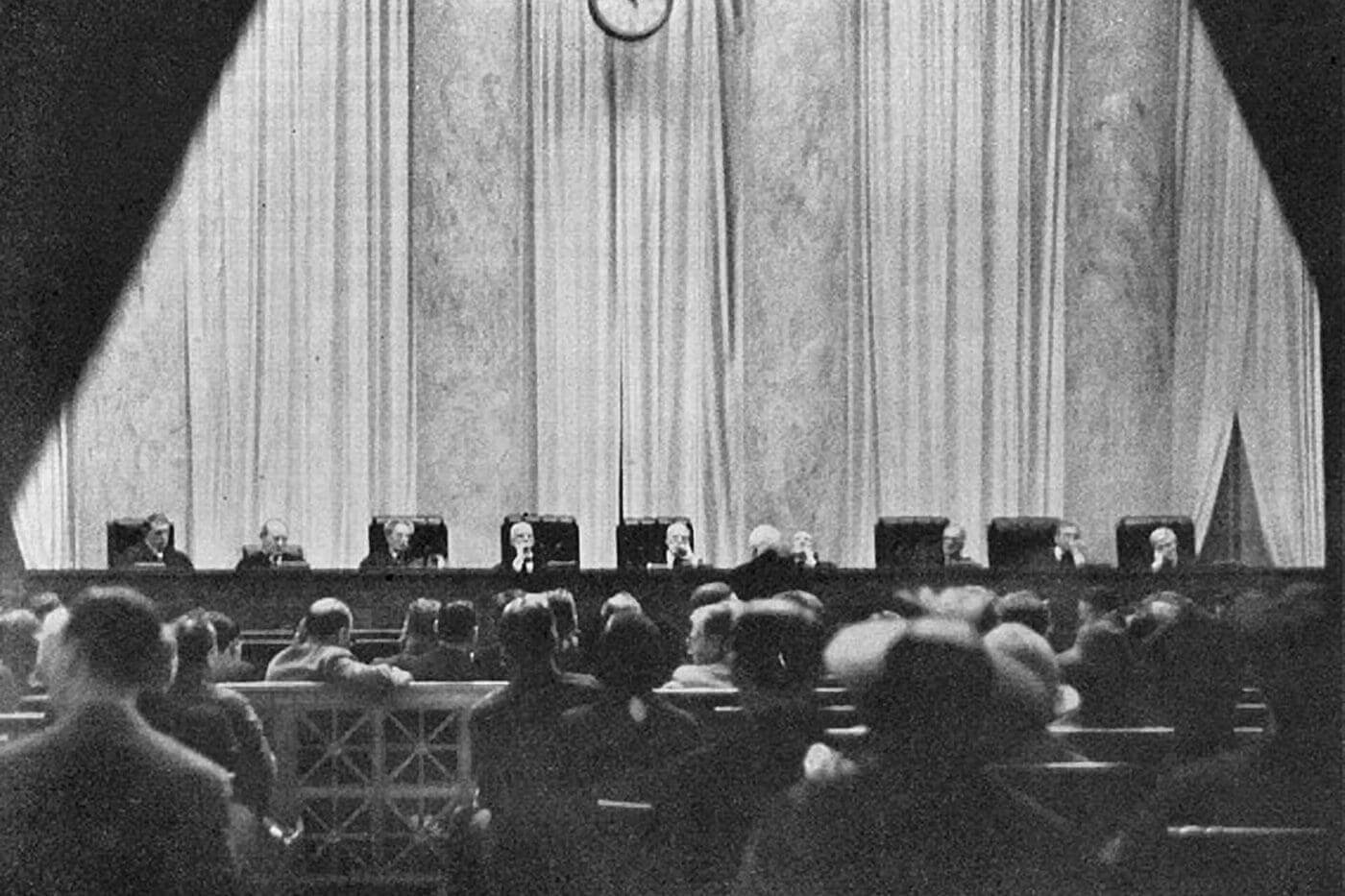
One of the only existing photos of the Supreme Court in session in 1937, as photos of courtroom were made illegal in 1946. Courtesy of Time
When asked about the court’s legitimacy, though, Chemerinsky deflected questions, saying it simply reflected a time in which all government institutions have low approval ratings. “At a time when the country is so polarized, we have a Court that has come down on one side more often than not. It’s not a moderate Court. In fact, it’s the most conservative court since the 1930s.”
But that does not delegitimize the Court, Chemerinsky said. “Of course, it’s a legitimate institution, it’s existed since 1789, and it has always had its ups and downs in its public esteem and its quality of jurisprudence.”
Ever since Marbury v. Madison, he noted, the Court’s rulings have mirrored the political leanings of the justices: “From the 1890s to 1936, the Court struck down 200 federal, state and local laws that protected workers. It was a very conservative, pro-business time in America.”
Conversely, he said, the Chief Justice Earl Warren Court ended segregation and expanded the rights of criminal defendants and the right to vote. “Those rulings were very much a reflection of the ideology of the Justices at that moment in time,” Chemerisky added.
“If it’s too late for the Supreme Court, it may be too late for the rest of us.”
And so there’s the rub in the legitimacy debate: Academics and expert observers dismiss the ideological underpinnings of the Court’s rulings as par for the course, while reformists insist that “dark money” influence and partisan maneuverings in the White House and the Senate that dictate how Justices are confirmed, incentivized, and compromised go unaddressed.
Linda Greenhouse is having none of such a laissez-faire attitude. For her, the Court’s legitimacy is a problem for it to solve, not some other political branch. “Can the court decide its way out of its current problem? Is there anything it can or is likely to do to restore its reputation?” she asked the Oxford symposium attendees. “I hope so. Speaking as an American, if it’s too late for the Supreme Court, it may be too late for the rest of us.”
Help us sustain independent journalism...
Our team is working hard every day to bring you compelling, carefully-crafted pieces that shed light on the pressing issues of our time. We rely on caring supporters like you to help us sustain our mission. Your support ensures that we can continue to provide deeply-reported, independent, ad-free journalism without fear, favor or pandering. Support us today and make a lasting investment in the future.

RELATED STORIES



Award Winning



Today’s environmental and social justice challenges are unprecedented, and require an unprecedented collective effort.


Stay updated on our latest features, events and more. Subscribe to our Note From the Nest newsletter!
