
The Tornado Chaser

I do not live in the South Bay city of El Segundo, California, but I have walked it with my dogs for a dozen years. In that time, I developed an intimate knowledge of the place — its streets, houses and its seasonal rhythms —but not of the people. I never expected to. Like many places in Southern California, El Segundo has a lingering Jim Crow vibe from its days as a “sundown town” — a place that Black people had to vacate before dark, or else. I have had various reminders of this history over my years of walking. Once, I got a lengthy warning from a local cop that walking more than three dogs at once is against a California state law (it is not). Another time, a white teenager who hung out of the window of a passing car startled me when they screamed, “Where are you from, Compton?”
With the election of Donald Trump, I started noticing an aggressive proliferation of American flags and hand-lettered “Drain the Swamp” signs that seemed to confirm what I already knew about the core nature of El Segundo. And then came 2020, and George Floyd. Next to the flags, I started to see Black Lives Matters signs. One day, I had the courage to strike up a conversation with a woman who had a BLM sign in her garden and made a first friend. She was very distressed about the state of things racially and felt gloomy about the prospect of change. I began to realize that in El Segundo there was more belief in justice than I imagined. Yet, there was also a sense of paralysis about what to do in an intensifying cold civil war in which the wrong side was gaining traction, despite — and because of —the reformist energy around justice movements like Black Lives Matter that seek not just policy changes, but confrontation with whiteness itself. A tall order, even in the best of times.
Then, I met Clara Mack.
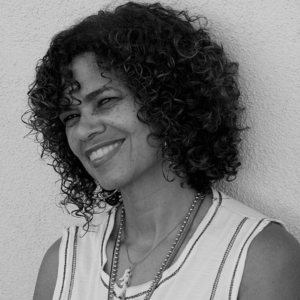
Not in El Segundo, though. She came to Inglewood, where I live, to adopt a cat I’d advertised online as needing a home. She mentioned on the phone that she is a photographer who shoots portraits of, among other things, animals. She showed up wearing a t-shirt, jeans and tennis shoes, with her hair pulled back into a loose ponytail. Her expression is serious but also mischievous – twinkly for a 61 year old. Her love of animals was reason enough for me to connect with a white stranger, and more than enough to hope she would be as conscious as the new friend I had recently met. And then I discovered that Clara Mack has a whole different kind of commitment to justice, one I frankly had not expected to encounter anywhere in El Segundo, certainly not in a white woman. Clara Mack is a self-described tornado chaser.
Since 2020, Mack (not her real name) has been attending and documenting far-right rallies around Southern California — including but not limited to MAGA followers, Proud Boys, anti-vaxxers, anti-abortion Christians, QAnon conspiracists and unapologetic bigots. She does not capture these from a distance. She gets up close to the rally-goers, wades into the eye of the storm to photograph, record and bear witness to what’s going on, what people are saying, what the mood is. The mission is to document, but it is also personal: Mack says she is there to hold up a mirror to a culture of anger and retribution she believes is ruining the country and what chances it has left to make good on racial justice in particular and democracy in general. That she is there as a white person seeking to confront these regressive stances in all their iterations, to expose their arrogance and moral incoherence to other white people who have been reluctant to do the same, strikes me as heroic.
Mack posts the images and videos to social media, chiefly Twitter. Many of the photos are mundane, but together they capture the ire of the radical right wing and the emotional volatility that routinely erupts into name-calling, profanity and sometimes physical violence. In Mack’s video of the 2020 BLM rally in downtown El Segundo, white counter-protesters hoisting American flags scream nonstop as a young Black man talks earnestly about his experiences with racism. In a clip from a QAnon rally in Hollywood a few months later, rallygoers attack liberals for being part of a conspiracy to encourage pedophilia and urge spectators to save the children. The photos and video clips can at times seem ridiculous, even entertaining — a sideshow to the sober business of governance. But Mack says it is a mistake to minimize, even for a moment, what is grotesque, dangerous and relentless. “This stuff,” she says of the rallies , “is not normal.”
Or, perhaps more to the point, wasn’t normal not that long ago.
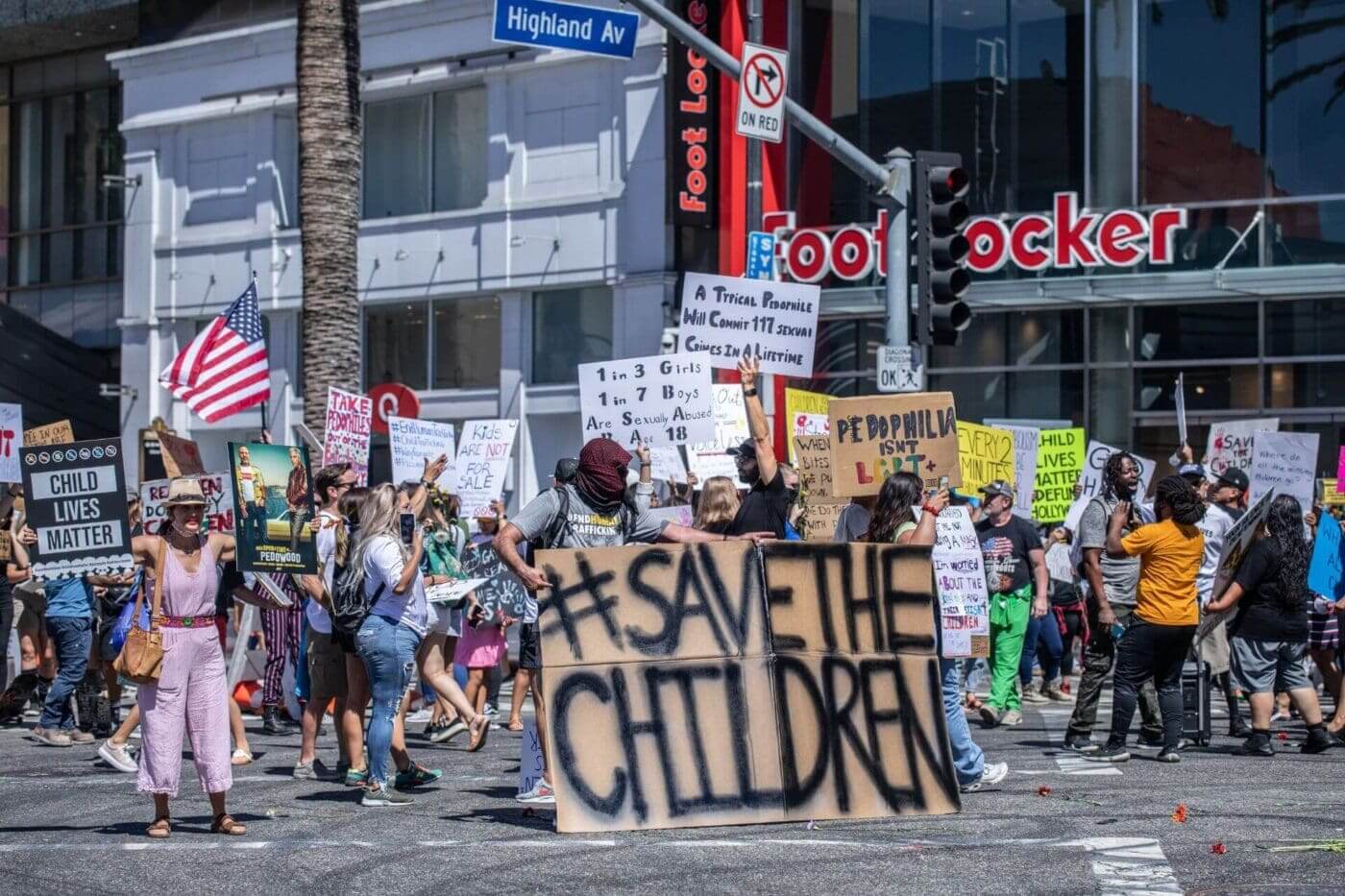
Over 100 protestors gathered for the Save the Children “Child Lives Matter” march and rally on Hollywood Blvd on July 31, 2020. Photo by Clara Mack
Mack’s presence at rallies and subsequent postings has caused fierce blowback and targeting from the right, which is why I’m not using her real name here. She has been harassed by rallygoers, heaped with insults and outright threats by Proud Boys and their ilk, in person and online. At a downtown Los Angeles event in August 2021, she held off a menacing clique of Proud Boys with a taser while she and a friend waited for a car to rescue them from the scrum. But Mack is undeterred. She continues to chase the tornadoes — to expose, rally by rally, a pattern and practice of white toxicity that we all hear or read about or have seen in video clips of armed militia menacing voters or the searing footage from the January 6, 2021 insurrection. It is a toxicity we usually condemn from a distance, but almost never see on the ground ourselves.
Ultimately, Mack wants to deconstruct and demystify the racism that seems to have become such a fearsome and unstoppable force in the era of Trump, what many see as the source of America’s inevitable undoing. She wants us to see that at the end of the day, the animating force of racism is people — flawed, confused and stubbornly misinformed. While Mack calls the collective energy at rallies “scary,” she has also seen how none of the people there are endowed with any magical powers. “I used to get sick to my stomach when I went,” she says. “But once I learn who they are, the fear goes down. There’s something about knowing each person that makes it less scary.”
***
In 2020, Mack was ripe for a new direction. At 59, she was working at a local restaurant in her native El Segundo, trying to figure out the next chapter of her life. A playwright as well as a photographer, she had lived for 10 years in New York teaching playwriting at Columbia University and living in the Bronx with her daughter, son-in-law and grandson. In her spare time, she photographed the city’s theater scene and the spontaneous theater of people dancing in the streets and public spaces. But, a lifelong interest in social justice drew her to photojournalism.
Around 2012, she began showing up at protests against fatal police shootings that were becoming common news stories, and that usually involved Black victims. She befriended some parents of these victims — the first protest she covered was for 16-year-old Kimani Gray, shot and killed by NYPD. She became skilled in “shooting grief and mourning,” as she puts it, capturing the emotional nuances of families and communities who had lost not victims of police violence, but loved ones. New York felt like home, but then Mack lost her job at Columbia. Making a living got tough, and making it in the Bronx even tougher. In 2017, she and her family returned to El Segundo and moved back in with her parents to regroup. The journalistic work she had grown passionate about was put on pause.
Mack was working at the restaurant in 2020 when George Floyd was murdered, and the country erupted. She was working the day she heard that students had stages their own Black Lives Matter event across the street from El Segundo High, and that they had been harangued by adult counter-protesters who were part of a local right-wing group called Mass Resistance. When she heard that the group was planning its own Back the Blue/anti-BLM rally in a quad next to the police station, something in Mack ignited, or re-ignited. “I thought, ‘Fuck it,’ I’m going to photograph everybody, record it,” she says. “So, I went down there with my camera.”
What she saw and heard in the thick of the rally was jarring, to say the least. She expected ideological clashes, but not the viciousness that was almost entirely one-sided. It was also strategic. When BLM advocates tried to speak, right-wing provocateurs “were saying awful things to the teenagers to try and provoke them, so they could film it, livestream it,” she says. “Kids would say, ‘You’re a racist,’ and they’d say, ‘You’re a pedophile, and I’m going to the police and telling them you’re a pedophile.’ These are girls who are 14 and 15 years old. That livestream was really disgusting.”
“Disgusting” is a word Mack uses a lot, but not lightly. She posted what she had seen and heard that day on Facebook, and got immediate blowback from Mass Resistance. Curiously, as out there and in-your-face as these rallies are, participants do not like to be known. One of Mack’s major objectives is identifying people at rallies who routinely wear masks, costumes, tattoos or gear to maintain anonymity and foment chaos based on that anonymity. Mack found the initial confrontation — the outing — thrilling, in a weird way. “They found out who I was, but I found out who they were,” she says.
The blowback was unsettling for sure, but she was hooked: “I went looking for another rally.”
That turned out to be in Hollywood in August, a QAnon protest featuring the now-infamous QAnon shaman of the furry headdress and horned helmet. From there, Mack kept following other MAGA events throughout the Southland from Los Angeles to the beach cities of Hermosa and Redondo Beach (El Segundo’s neighbors), and down south to Orange County, where a pro-Columbus Day rally in San Juan Capistrano in October 2021 praised the history of conquistadores in what was essentially an anti-Indigenous People’s Day.
Occasionally, she chases storms outside of SoCal. In September, she travelled to Modesto to shoot the ‘Straight Pride Parade,’ an annual gathering of largely Christian activists who oppose abortion and LGBTQ rights and support traditional lifestyles, starting with white supremacy — the typical right-wing mashup.
***
It has become hard to keep up with all the storm fronts, as the perverse fury of Trumpism has mounted and melded with a whole host of right-wing causes old and new — from anti-abortion, anti-vaxxism and anti-LGBTQism, to maximalist gun rights, to anti-democratic election denying. The melding and aligning has made conservatism more radical, more strident, and more amenable to violence which now overshadows the political arguments that defined conservatism in an earlier age. Mack says she has no illusions that she can break the feverish, fortified delusions of the modern right, which boil down to a conviction that America is being brought down by wokeness, liberalism and/or elitism.
What Mack wants is for the rest of us to clearly see the unapologetic oppressiveness and meanness of a movement that mainstream media too often glosses over, or avoids altogether, when discussing right/left divisions it blandly calls “polarization.” The term suggests equal culpability for the state of things, which is not the case. The oppressive right continues to dig in, with too little counteraction from the left.
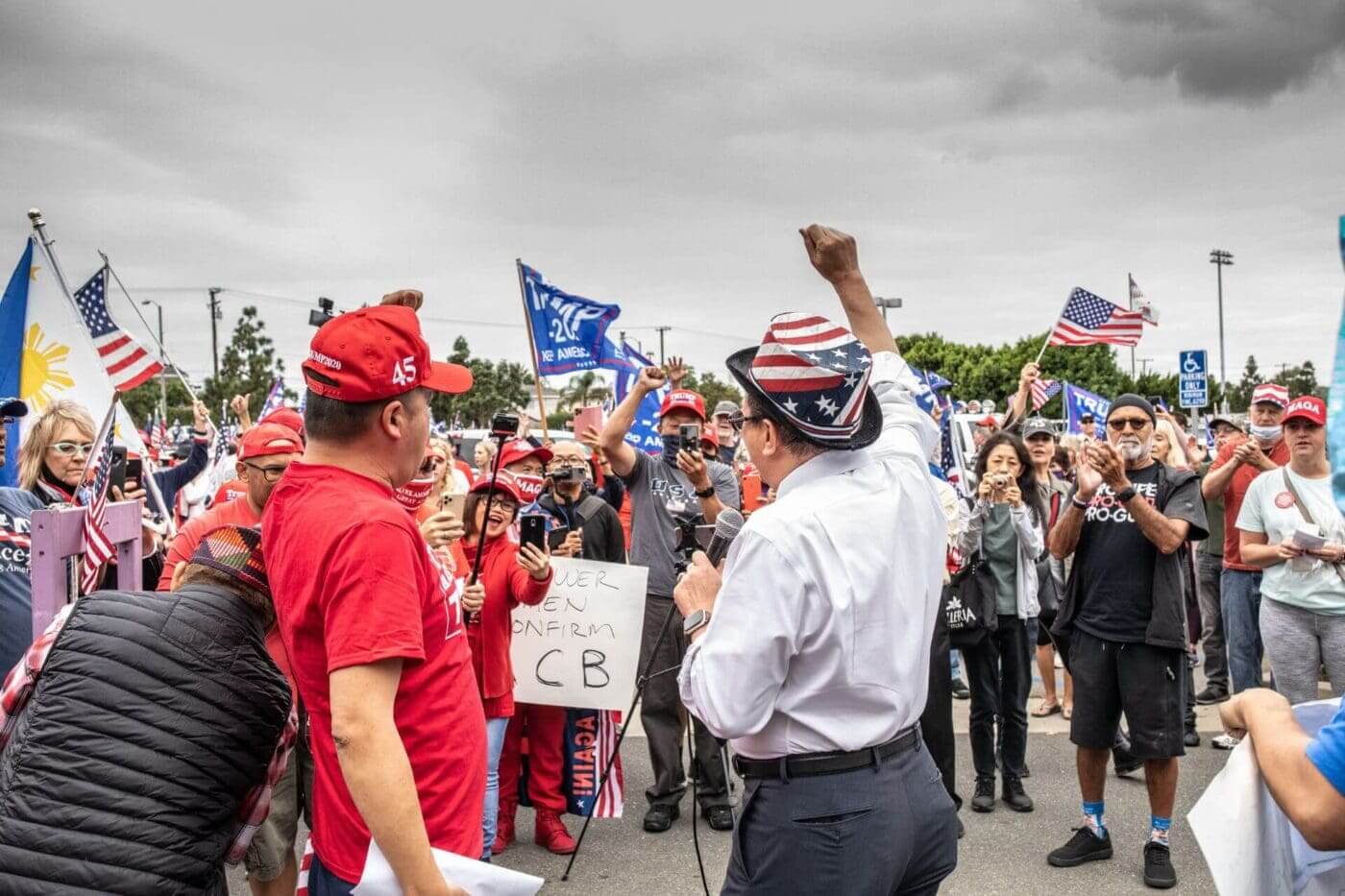
In August 2020, Trump supporters rallied and honked their horns as they drove their cars through Manhattan Beach, Hermosa Beach and Redondo Beach during the “South Bay Tour Trump Massive Car Rally. Photo by Clara Mack
Mack shares a wider frustration in the country that too much unsavory and/or criminal activity on the right, from assaults at rallies to the web of Trump transgressions under investigation by various law enforcement agencies, is going unchecked. “I won’t change things,” says Mack. “I thought at first people would get arrested, get held accountable.”
Being white at the mostly white rallies makes Mack both invisible and a target. At first, she says she tried to stay neutral by not talking to people as she wielded her camera — “I didn’t answer questions”— which of course aroused suspicion among the rallygoers who are nothing if not paranoid. Mack concedes that in this take-no-prisoners milieu there is no such thing as neutral, especially if you’re white — not that she’s trying to be neutral.
Eventually she couldn’t resist making comments or questioning people about their political logic and what brings them to these rallies at all. As much as she condemns the extreme right, she is curious about what makes it tick. “I wanted to see who’s there, who are these people, what’s drawing them together,” she says. “It was hard for me to understand.”
In the quest to understand, Mack also began tracking the social media posts of the folks she was documenting. Throughout 2020, she started realizing that the people she photographed at that first Mass Resistance rally in El Segundo were turning up at other events. She began to map their movements and the movements of the rallies themselves in a process she calls spreadsheeting. Post-January 6, she admits to becoming “obsessed” with spreadsheeting, essentially connecting dots, as it became clear that the rallies were coordinated, with the same players popping up in different, but related rallies that all fed into the frenzied energy of the January 6 riot.
“The patterns fascinate me,” she says. “It’s like a puzzle. It seems like these events are spontaneous. But if you follow it, you see that it’s planned; it’s the same characters over and over. It’s strategic. The intention is to get more people into their movement.” To that end, she added, “They all have people running for office.”
“It’s like a puzzle. It seems like these events are spontaneous. But if you follow it, you see that it’s planned.”
As she continued to post her documentation of these rallies online and on Twitter, Mack found herself being contacted by others who were also tracking political extremism. Though she sometimes wasn’t entirely comfortable with it nor could she ignore the attention, her mission from the beginning was to share with the world what she knew (which is getting harder to do: many figures on the right are not as visible on social media as they once were).
It was clear to her in 2020 that something like January 6 was afoot. When the attempted insurrection happened, Mack was appalled but not surprised. One pattern that was evident right off was the common obsession among rallygoers to belong to something they saw as powerful and affirming. If it was also culminating into something destructive and violent, that was okay — maybe even preferred.
“This rightwing stuff gives them meaning,” Mack says. “They’re marginal, troubled. They just want group acceptance.” She says they also crave the political spotlight, like their de facto leader, Trump. “With George Floyd, they saw America going in a different way, and they said, ‘No, no, we want to be the center,’” she says. “It’s envy.”
***
Over time, Mack has become more or less known at rallies, though that hardly means she’s accepted. “They scream at me, call me a crackhead or a ‘groomer,’”which has become right-wing parlance for someone who encourages behavior in others that leads to child abuse (the right is markedly, bizarrely obsessed with pedophilia). But she does occasionally connect. Conversations with people she has questioned and challenged have yielded stories that Mack says are sobering, and sometimes, heartbreaking. “One man had drug problems, told me he tried to kill himself, jump off a building,” she says. “I thought, this person has gone through a lot of pain.”
Her empathy sometimes extends to cops, who she often has experienced as part of the right-wing zeitgeist. At the rallies, she says, police almost always present as threatening, especially to the “other side,” or, progressives and journalists like her. She got schooled back in 1999, when she shot a protest at the Democratic convention at the Staples Center near Downtown LA. There were music and anarchists at that event, an atmosphere Mack describes as almost “cool and fun.”
Then, the police gave an order to disperse, and suddenly 5,000 people had to leave within ten minutes through a single entrance. Mack had a clear view of the chaos that came next: officers charging on their horses, “shooting things out of guns.”
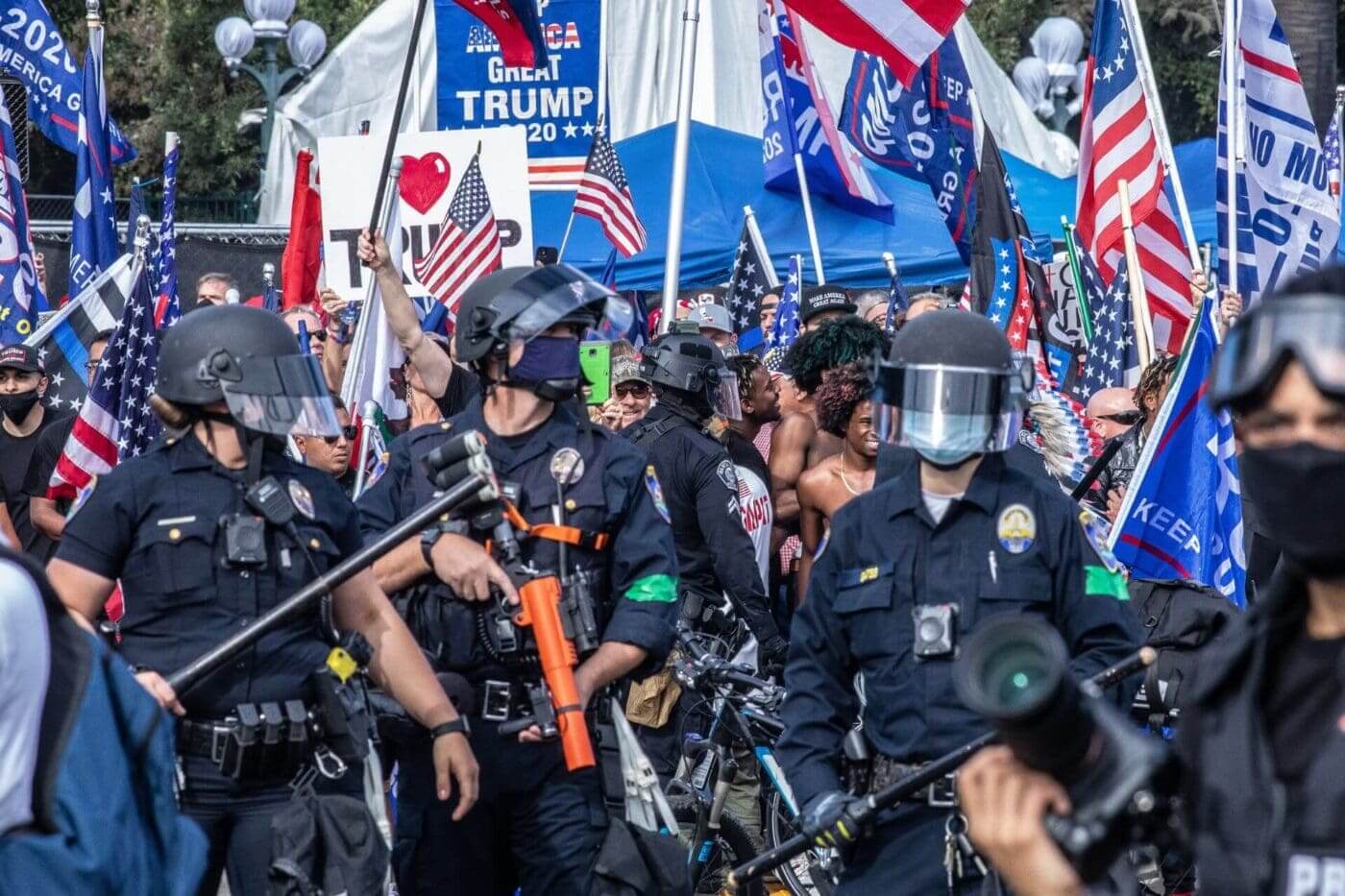
Police presence at the USA Freedom Rally in Beverly Hills on October 31st, 2020. The rally was later declared an unlawful assembly by police forces after an altercation between a Freedom Rally protestor and a counter-protestor. Photo by Clara Mack
“It was just insanity,” she recalls. ”It’s the first time I ever thought, ‘They could slaughter everyone.’” At the far-right rallies she’s attended, “their backs are always to the Trump people, their front always to the left, or to journalists,” says Mack. “They’re always facing the enemy.”
And yet, that is not the whole story. Mack’s photos of police do capture the threat, but they also capture unguarded moments that reflect uncertainty, exhaustion or ambivalence. This is true of all her subjects. The camera indicts them, but it also probes. “When you photograph, you see humanity,” Mack says, “You look long enough, you see somebody scared or lost or an asshole.”
Nonetheless, hate and anger are always in the air. At one event, a Proud Boy threatened Mack for taking photos. He and his group later taunted her from across a street with a bullhorn. “They said, ‘Come get some bitch. We know where you live. We know your ride,’’” she recalls.
She went to the El Segundo Police Department to report the threat and was told by one cop that he didn’t know who the Proud Boys were. Another officer eventually agreed to take her report, but Mack got the message. At a rally to recall California governor Gavin Newsom last year, a man with a sign declaring himself “super straight” walked up and shoved her telephoto lens, causing her to stumble backwards. Mack recovered and kept shooting, but she was peppered with questions. “’Are you on our side? Are you right wing or left wing? Are you antifa? What are you doing here? Why do you want to photograph us?’”
At every rally, she is careful about security, conscious of where she parks and how to get back to her car. “That’s what I stress out about the most,” she says. “I work alone. I try to go with someone, but it doesn’t always work out.”
***
While the far right has consolidated in a kind of raging monolith in many people’s imaginations, Mack sees a lot of fracturing and infighting. Sometimes, it works to her advantage. “There was this person who was a [January 6] rioter and an anti-vaxxer who ran afoul of the Proud Boys for not being sufficiently loyal,” says Mack. “They shunned this person.”
Mack engaged with this protester, and they struck up a dialogue that has continued, somewhat improbably. “It’s weird, they are kind of a friend,” says Mack. “This person’s not a white supremacist, or they don’t think of themself that way… They’re always telling me, ‘In ten years, you’ll see what I’m talking about, you’ll understand.’” Mack says that while they will not agree to disagree on the issues, having a better handle on how this person thinks feels like progress to Mack, if not exactly friendship.
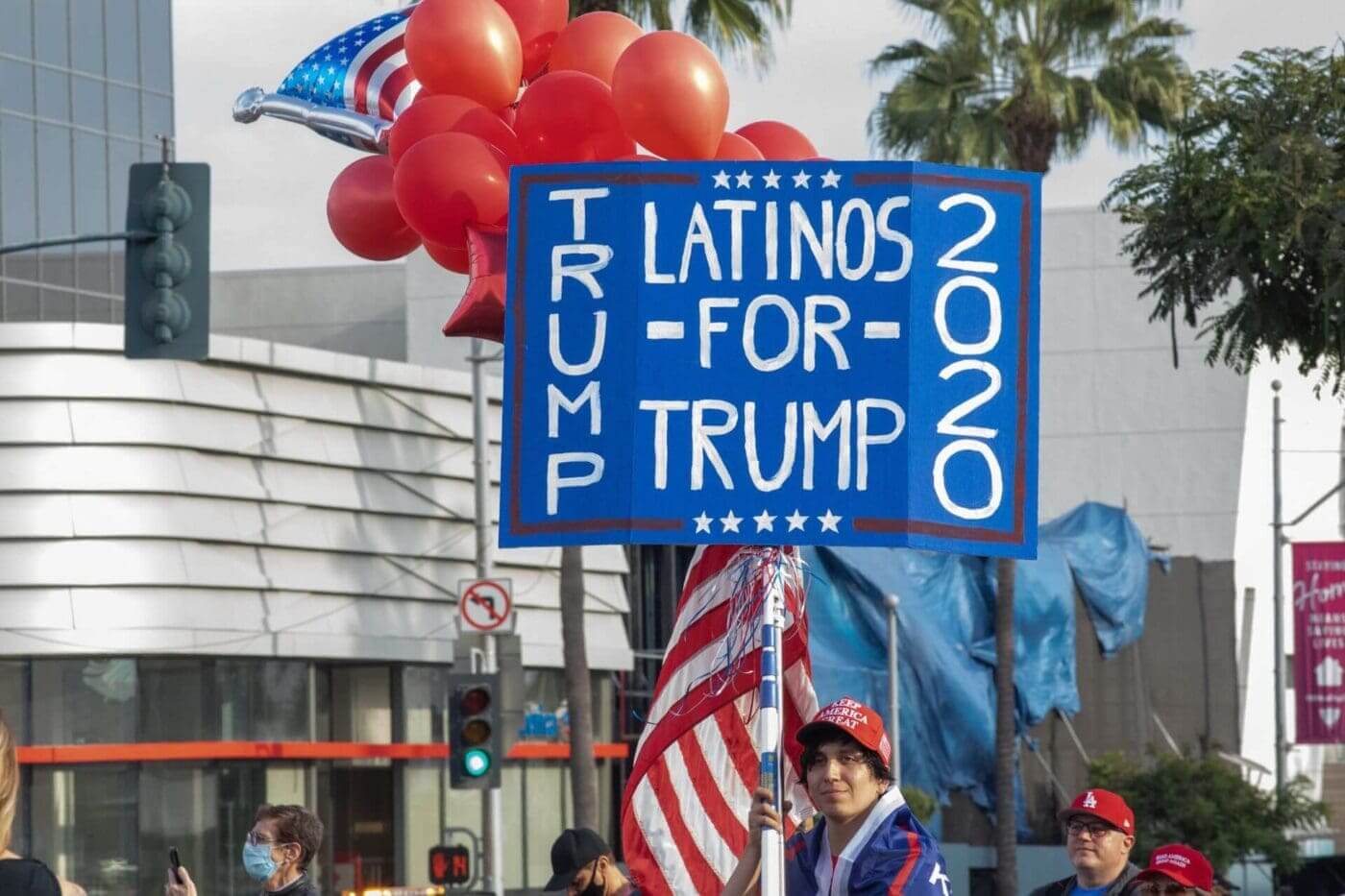
The USA Freedom Rally was part of a weekly political rally in Beverly Hills, California in the weeks leading up to the 2020 election. This photo was taken on October 31, 2020. Photo by Clara Mack
One unsettling paradox among the many documented by Mack is the involvement of non-whites, notably Latinos, in the far-right movement. Carmen Estel, for example, whom Mack met at the 2020 El Segundo rally, was part of Lexit Movement USA, a national campaign led by Latinos to reject Democrats and embrace Trump’s GOP. Filming a rally in Norwalk earlier this year, Mack was accused by a group of Latino Proud Boys of being a white supremacist, “because they said I was stalking minorities,” she says.
As a Black woman who has spent a lifetime navigating and too often accommodating the micro and macro aggressions of racism — and writing about it — I find Mack’s one-woman campaign desire to bear witness and hold supremacists accountable to be inspiring, and rare. The fact she’s from the South Bay, one of the more racially hostile regions of Los Angeles County, makes her willingness that much more admirable.
That energy is partly fueled by family reality: Mack’s daughter is married to a Black man, and she has a Black grandson. But that is not the source of her motivation; She was attuned to the encompassing nature of racism long before that. Mack says her upbringing was typical in that she grew up around so much casual racism, starting within her own family. It made her more aware of the problem, not less, and of her own privilege. “If you grow up white, you’re going to have racist attitudes,” she says. “I know I did. People around me did. My great-grandfather — I just learned this — was a member of the KKK in Arkansas.” Her father has broken that chain, in part. “My dad has evolved, gotten less racist as he’s gotten older because he’s got a Black great-grandson,” she says. “And because I’m always in his face.”
Though encouraged by her father’s shift away from the worst excesses of the right (he voted for Obama), she worries about Republicans like him: “the type who likes the status quo and doesn’t want things to change, but doesn’t want to be thought of as a racist.”
That type of Republican, which I once thought of as insidious, would be downright virtuous now. The near-total MAGA takeover of the GOP should have forced a reckoning in the party years ago, and amongst white people about what they stand for and what their antipathy toward social change is really made of. But, the not-as-apocalyptic-as-expected midterms withstanding, it has not.
“The disinformation is killing us.”
Mack is trying to make that reckoning happen. But the more she sees — the more her camera sees — the less faith she has that the right will see light. It has become too wedded to anti-democracy, from embracing voter suppression to coddling the Big Lie to dog-whistling or straight up advocating for political violence without a twinge of conscience or sense of consequence.
The poor showing in the midterms prompted some in the Republican party to publicly sour on Trump, but the reflexive opposition to all things democratic and Democratic (an ideology that Trump helped legitimize and then institutionalize) remains intact. In other words, the storms continue to gather. Mack shrugged off over-analyzing the midterms well before November 8. “If they win, they’re empowered,” she says. “If they lose, they fight. In both instances, they’re empowered. There’s no reasoning with them. The disinformation is killing us.”
She adds, “These people see us as the sheep who are sleeping and need to wake up.”
***
El Segundo was Mack’s jumping off point, and it has remained a place to watch. In the tense lead-up to the midterm elections, she tracked the campaigns of a few right-leaning candidates for local office. Robin Patch, who ran for El Segundo city council, posted an agenda on her flag-festooned website that included being a “Constitutional purist” and restoring the America she grew up in. (When I asked her about that agenda at a public information booth on Main Street, she asked, “Do you live here?”)
Patch did not win the seat, but she got over 500 votes, which Mack says is alarmingly high in a town with a voter base of only several thousand. It is a reminder that races like these that were once sleepy, provincial affairs have become what academics call “highly contested sites” where much more than a council or school board seat is at stake. Small-town battles for the white supremacist conservative soul of America are assumed to be happening elsewhere, such as Texas, Florida, or the Midwest, but not in Southern California. We are not supposed to have storms like that, or if we do, they are not supposed to matter. But, it all matters now.
“People say to me, ‘I don’t go to that.’ And I say, ‘Well, it’s going to come to you eventually.’”
While Mack has found her passion again and a new purpose, she still scrambles for daily bread. In addition to working at the restaurant, she gigs as a portrait photographer and photographer’s assistant. She tries to balance monitoring threats to democracy with other, more immediately gratifying passions, like animal rescue, and, always, family. Her grandson is in middle school in El Segundo, which, like similar enclave in SoCal, has always prided itself on the quality — i.e., whiteness — of its schools.
Mack says the high school, at least, is much more diverse now than it was when she was growing up. She then says that she knows all the Black people in town (“It’s a handful,” she says sheepishly), which means it is not diverse in any meaningful way. It is the love-hate relationship many of us have with our hometown. In Mack’s case, it is infused with the same conflicted feelings —ownership, alienation, familiarity and contempt — she has about the country. Ultimately, she says, “I don’t fit here.” But that only stokes her ambition to make it a place where she does fit.
In chasing tornadoes, Mack is chasing that place. In capturing a white America that has been so bamboozled, she is encouraging the non-bamboozled majority to reveal themselves, to stake out space they might have thought was assured, but now must be fought for. In 2022, white people taking any action for racial good, or even just for racial sanity, first means mounting opposition. It could be the only thing it means. “We need normal suburban people, old grandmas to come to the right-wing rallies and dare them to attack,” Mack says. “People say to me, ‘I don’t go to that.’ And I say, ‘Well, it’s going to come to you eventually.’”
Help us sustain independent journalism...
Our team is working hard every day to bring you compelling, carefully-crafted pieces that shed light on the pressing issues of our time. We rely on caring supporters like you to help us sustain our mission. Your support ensures that we can continue to provide deeply-reported, independent, ad-free journalism without fear, favor or pandering. Support us today and make a lasting investment in the future.
RELATED STORIES


Award Winning


Today’s environmental and social justice challenges are unprecedented, and require an unprecedented collective effort.


Stay updated on our latest features, events and more. Subscribe to our Note From the Nest newsletter!
