
How the Far Right Is Going Farther, Deeper and Wider
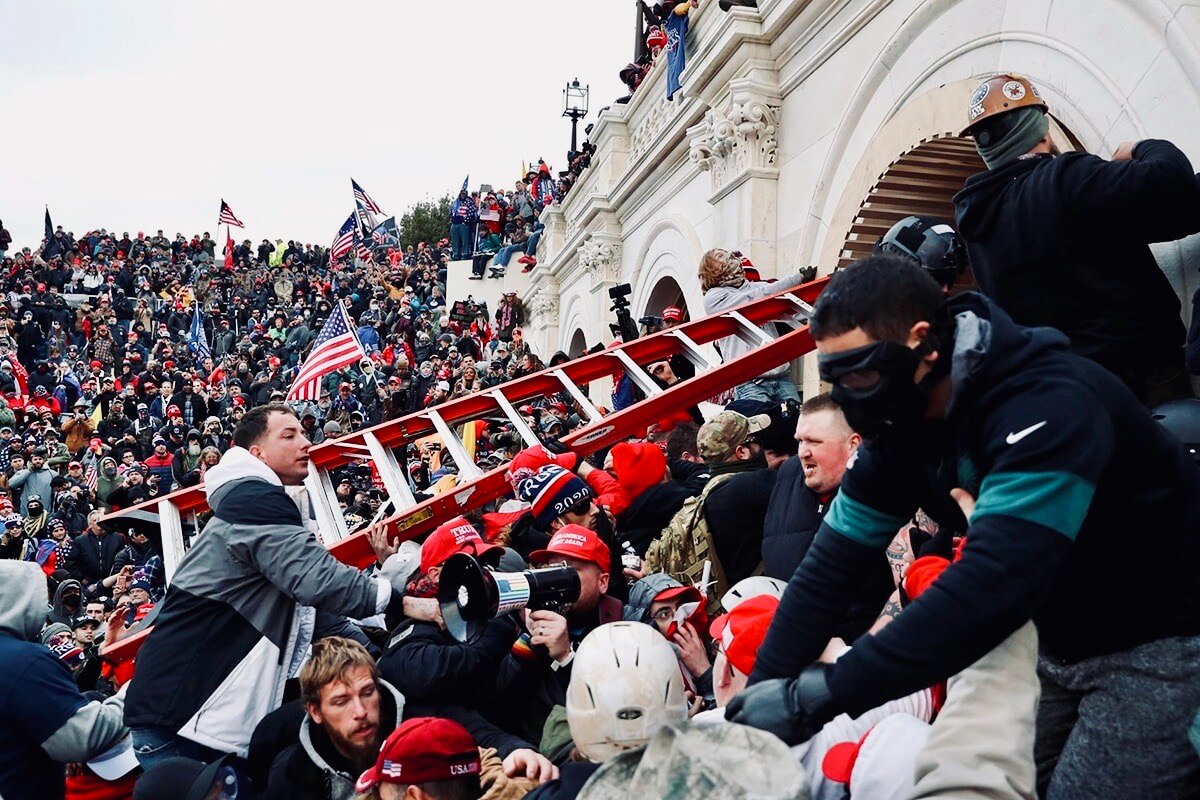
Listen to an audio version of the story, read by the author.
Close to 30 years ago, an American who was nobody’s idea of a plausible elected official gave an incendiary speech that scared the crap out of the country’s law enforcement officials and anti-extremist activists. The man’s name was Louis Beam, and the speech he delivered to an enthusiastic crowd of white supremacists, far-right survivalists and anti-government agitators at a Colorado mountain resort called for armed insurrection in the name of liberty against the “stinking, murdering, corrupt” forces that, he said, were holding the country in their thrall.
It wasn’t long before a hard core of activists and revolutionaries who, like Beam, believed the feds were coming to take away their rights and livelihoods started preparing for all-out war. They stockpiled weapons and ammunition, manufactured grenades and explosives, robbed banks to raise money for the cause and planned attacks on abortion clinics, gay bars and federal courthouses. Two-and-a-half years after Beam’s speech, a massive truck bomb detonated outside a federal office building in Oklahoma City, killing 168 people including 19 young children – an opening salvo, or so the radicals believed, in a much longer struggle to change the face of the country.
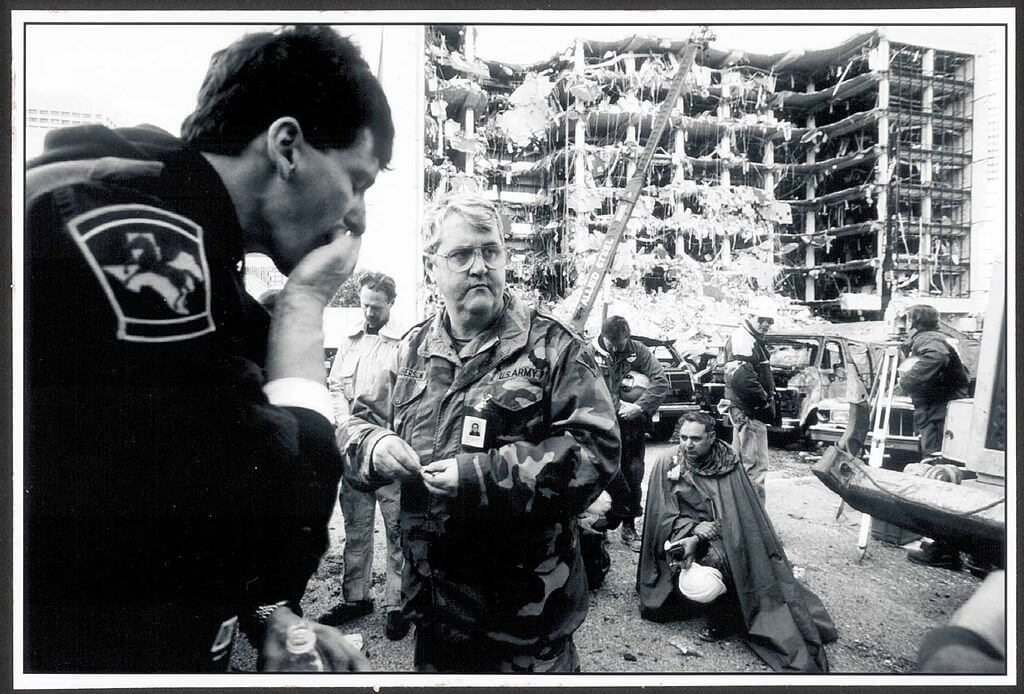
In this photo, U.S. Army Chaplain Lt. Col. Roberson gives communion to search and rescue workers across the street from the Alfred P. Murrah Federal Building in Oklahoma City. The building was devastated by a truck bomb on April 19, 1995 that killed 168 people and injured hundreds of others. Photo from the U.S Department of Defense
Are we on a similar trajectory now?
In the wake of the January 6 attack on the U.S. Capitol – and other, unsuccessful plots to kidnap Michigan Gov. Gretchen Wittmer and blow up Democratic Party headquarters in Sacramento — we are hearing the same full-throated calls for white patriots to arm themselves and defend their definition of what the country stands for. Gun sales are through the roof. And the risk of homegrown violence is once again sounding alarm bells at the Federal Bureau of Investigation and in the White House.
In many ways, in fact, things look bleaker now than they did a generation ago. And here’s why: At the time Beam made his Colorado speech, he was the chief propagandist of the far right, a Ku Klux Klan luminary with an ugly history of race-baiting and attacks on left-wingers and other political adversaries that at one point put him on the FBI’s 10 Most Wanted list. He was, in other words, about as reviled in mainstream American society as anyone could be.
Now, though, many of the things that so scared the establishment in the 1990s are coming out of the mouth of a recently unseated American president, Donald Trump, and his acolytes in and out of Congress. The idea of an uprising against the system no longer appeals just to a fringe audience, but to tens of millions of people who have expressed sympathy for the January 6 rioters, and who increasingly believe they are engaged in a battle of good versus evil in which the very future of the republic is at stake.
Guns remain a key issue, not only as a symbol of the freedoms believed to be under threat, as conservatives have been arguing for a generation, but also as the tools by which the new radicals now intend to reassert their power. Large chunks of Beam’s speech would not, in fact, have sounded out of place on the morning of January 6, when Trump’s allies on Capitol Hill attempted to hold up certification of Joe Biden’s election as president and thousands of their supporters showed up in Washington to engage in what Rudy Giuliani, the president’s private lawyer, described as “trial by combat.”
“Let those who are honest and good in this country join with us,” Beam told his supporters from the Aryan Nations and the Klan in 1992. “Let those who harbor secret crimes in their heart, and who wish to shield the guilty, scurry for the holes of darkness from which you have come… We bear the torch of light, of justice, of liberty, and we will be heard! We will not yield this country to the forces of darkness, oppression and tyranny.”
If that doesn’t sound disconcertingly familiar in itself, then consider Beam’s belief, echoed loudly by Trump supporters over the last six months, that it is up to insurrectionists to restore the true spirit of the constitution while there is still time – by force of arms, if necessary. “It is only by eternal vigilance and the patriot’s blood,” Beam said, echoing language used two centuries earlier by Thomas Jefferson, “that the tree of liberty spreads its arms over each of us.”
Or as Lauren Boebert, the QAnon-friendly freshman member of Congress from Colorado, tweeted more succinctly on January 6: “Today is 1776.”
The point here is not only how far – and how fast – these ideas have traveled from the fringe to the very heart of our politics and civic life. It is also the astonishing fact that the anti-government stances articulated by Beam and the right-wing revolutionary fighters of a generation ago have wormed their way into the machinery of government itself.
Back in the 1980s and 1990s, the Ku Klux Klan and Aryan Nations saw no meaningful distinction between Republicans and Democrats. Both, in their view, had colluded in the collapse of rural America during the farm crisis of the 1980s, and both were apologists for federal law enforcement – whom Wayne LaPierre of the National Rifle Association notoriously described at the time as “jack-booted thugs… wearing Nazi bucket helmets and black stormtrooper uniforms.” Both were also part of what the movement called ZOG, the Zionist Occupied Government — a conspiracy of Jews, Blacks and foreigners out to dispossess the “true” white owners of America.
Now, though, the Trump Republicans in Congress have somehow contrived to position themselves both inside and outside government, adopting the language of incendiary opposition to the system whether they are in power or not and essentially threatening revolution from within. Thus, they are able to react with fury at the death of Ashli Babbitt, the insurrectionist shot dead by Capitol Police as she sought to breach a barricade close to the House Chamber, yet at the same time minimize or ignore the four other people who died, overlook the pitched battles that left 138 police officers injured (15 of them seriously enough to require hospitalization), and disregard the death threats made against several elected officials including Trump’s own vice president, Mike Pence.
Paul Gosar, an Arizona Republican whose ties to white nationalists have come under increasing scrutiny, told supporters in a fundraising email this month that Babbitt, the only victim he saw fit to name, was “executed in cold blood by an unidentified killer” and that the FBI had a role in “planning and carrying out” the riot itself.
Accusing the FBI of mounting an inside job, a fact-free smear that flatters the Bureau as all-powerful while also insulting its operatives as supremely evil, is straight out of the 1990s extremist playbook. Making such an accusation as a member of the House of Representatives, which has budgetary control and oversight over the FBI, is significantly more unusual, however, and was until very recently regarded as a form of career suicide.
There’s something else screwy going on, too. The far-right extremists of the 1990s might have had alarming ideas about the way the world worked and equally alarming remedies to address their grievances, but those grievances were at least rooted in concrete issues, unlike Trump’s baseless claim that the 2020 presidential election was stolen from him.
When Beam gave his speech in Colorado, he was reacting to an inarguably horrifying event that had hit the headlines two months earlier, in August 1992: a botched federal raid on the lonely mountaintop home of an Idaho survivalist named Randy Weaver, in which a misguided attempt to pressure Weaver into becoming a government informant had degenerated into a multi-day siege and shootout involving several federal agencies bristling with weaponry. Among those killed were Weaver’s wife, targeted by an FBI sharpshooter while she was cradling a baby, and their 14-year-old son.
Not only was the siege in Idaho real; so was the principal underlying issue stirring Beam and his followers to anger: the militarization of law enforcement. That anger would only increase the following year when heavily armed federal agents made an even bigger mess of a second siege, of an eccentric religious sect holed up at a compound outside Waco, Texas. After 51 days of aggressive posturing by the feds, including ear-piercing noises blasted through loudspeakers day and night and the deployment of military Bradley fighting vehicles, the entire compound went up in flames, resulting in the deaths of more than 70 people.
Beam traveled to Waco during the siege, as a reporter-provocateur for a far-right magazine, and thoroughly enjoyed being thrown out of a news conference for asking what he later termed “the forbidden question” – whether the United States was becoming a police state. Another visitor to Waco was Timothy McVeigh, the U.S. Army veteran whose freshly scrubbed face and brush haircut would soon become synonymous with the horrors of the Oklahoma City bombing on April 19, 1995.
McVeigh was just as upset as Beam by the heavy-handedness of federal law enforcement and kept a list of what he believed to be instances of abusive behavior by the Bureau of Alcohol, Tobacco and Firearms (ATF) and the Drug Enforcement Administration. McVeigh correctly saw a link between the purchase of paramilitary equipment for these agencies – Blackhawk helicopters, Bradley fighting vehicles, night-vision scopes, microwave communication systems – and the war on drugs. In his view, the government was looking for an excuse to take away people’s gun rights, and one way to do that was to argue that guns were being used to empower criminal drug gangs. The 10-year assault weapons ban signed into law by President Bill Clinton in 1994 as part of a crackdown on drug-related violence only reinforced this viewpoint.
The far right of the 1990s was hardly immune to conspiratorial thinking about sinister government plots, of course. This was especially true on the subjects of race, religion and power, all encapsulated in the view that America was being held hostage by a cabal of Jews, communists and “new world order” internationalists.
Many far-right adherents were members of the so-called Christian Identity church, which held that Adam was the father of the white race and that black people were literally the spawn of Satan – a result of Eve coupling with the serpent in the Garden of Eden. Even non-religious warriors like McVeigh were prone to paranoid, fantastical thinking. He believed, for example, that the military had injected him with an electronic tracking device while he was on combat duty during the first Gulf War. After Waco, he didn’t just blame the feds for provoking the final inferno (the origins of which remain unclear to this day), he became convinced, based largely on repeated viewings of a misleading anti-government propaganda video, that the feds had deliberately burned the place to the ground.
What McVeigh couldn’t count on – and here’s the really screwy part – was any semblance of sympathy for his views from within the political establishment. One freshman GOP congressman with ties to the militia movement, Steve Stockman of Texas, made a single ill-fated attempt around the time of the bombing to insinuate that the Clinton administration had concocted the Waco crisis as a way to ram through the assault weapons ban. With the country reeling in shock at the hellscape unfolding in a sleepy heartland city, Stockman was promptly labeled a conspiracy theorist and lost his seat after a single term. (He subsequently served another, starting in 2013, as well as a prison sentence for campaign finance law violations.)
Accusing the FBI of mounting an inside job is straight out of the 1990s extremist playbook. Doing so as a member of the House of Representatives, which has budgetary control and oversight over the FBI, is significantly more unusual.
Now, though, conspiracies and politics go together like toast and butter. Not only is the “Stop the Steal” rallying cry based on a lie; the assertions underlying that lie – that voter fraud is rampant, particularly in Democrat-run cities; that noncitizens are voting illegally in droves; that ballots are being “harvested” rather than legitimately cast — are themselves false and politically driven. Roughly 30 percent of the electorate now believes that the 2020 presidential election was fraudulent, which means that an entire mindset, what the historian Richard Hofstadter famously called the paranoid style in American politics, is being subjugated at least temporarily to the will and self-interest of a single individual: Donald Trump. We don’t have to worry that this subjugation might lead to institutional chaos and violence, because the events of January 6 show us that it already has.
***
Last month, the Biden administration issued not one but two separate warnings about the risk of a surge in homegrown political violence. The first was an FBI assessment that adherents of the QAnon conspiracy may be growing frustrated that predictions spewed by the online visionary-provocateur known as Q may not be coming true fast enough. The more violent among them, the FBI said, “likely will begin to believe they can no longer ‘trust the plan’… and that they have an obligation to change from serving as ‘digital soldiers’ towards engaging in real world violence.”
The second warning, from Biden’s National Security Council, alluded to the long-standing threat of “lone actors or small groups of informally aligned individuals who mobilize to violence with little or no organizational structure or direction” but said the threat has become much more pressing. “Newer sociopolitical developments, such as narratives of fraud in the recent general election,” the NSC document said, “…will almost certainly spur some… to engage in violence this year.”
Some of the ingredients of this threat have changed remarkably little over the past 30 years. Beam was a firm advocate of “leaderless resistance,” the notion that revolutionaries should act as much as possible on their own to minimize the risk of being ratted out. That notion has remained very much in vogue, if not as a tactical preference then out of necessity, because the far-right is riddled with informants and it’s almost impossible to bring a violent attack to fruition if more than a couple of people know about it. Ideas and theories are shared widely, as they were a generation ago, and of course, thanks to the Internet, are far more readily accessible than they were in the days of underground newsletters, printed bomb-making manuals you had to send away for, and gatherings on the fringes of gun shows. The racist political novel that inspired McVeigh, The Turner Diaries, is plainly influential today too: many aspects of the January 6 riot, particularly the gallows set up on the steps of the Capitol building, recalled an event in the book called the Day of the Rope, when right-wing revolutionaries hanged people they viewed as traitors en masse.
What has changed most starkly, perhaps, is the visibility of radical activity. In the 1990s, the gun-show circuit provided a social outlet as much as an organizing forum for isolated men on the disillusioned end of the American Dream. One gun safety organization in D.C. memorably called the shows “tupperware parties for criminals.” The feds knew who the players were, by and large, and used a variety of informants to keep tabs on them even if they didn’t generally do a whole lot to rein them in.
Now, though, the Internet makes it much easier to self-radicalize, accumulate weaponry, and hatch plots without saying a word to anyone. Generally speaking, the people making most noise online, on sites like 8kun (previously known as 4chan, 8chan and a number of other names), are not the ones most likely to move from talk to violent action. That’s not just true of the radical far right. It’s true of school shooters, Islamist extremists and other perpetrators of mass violence who, according to behavioral analysts, have much more in common than their disparate ideologies and motives might suggest.
McVeigh was far from invisible. The citizens of Oklahoma City might have been blindsided by the attack, but advance word of at least the rudiments of the plot spread far and wide across the movement. Three weeks before the bombing, Beam visited the wife of an old right-wing radical awaiting execution in Arkansas and told her to reassure her husband that “Armageddon was coming on the day of his death.” The head of the Arizona Patriot Movement, a one-armed war veteran named Jack Oliphant, told people something big would happen before the end of April 1995 (the bombing was on April 19). At a dingy motel outside Spokane, Washington, a violent skinhead named Chevy Kehoe banged on the manager’s door and insisted on watching his TV about 10 minutes before the bomb went off.
The author’s book. Photo courtesy of Andrew Gumbel
There are indications, too, that the government was aware of the threat – just not the specifics of it. Two Air Force bomb disposal experts were dispatched to Oklahoma City a few days before the bombing, suggesting a heightened state of alert, at least. Three out-of-town agents from the Oklahoma State Bureau of Investigation came into Oklahoma City the night before, for reasons they have never elucidated, and the head of the state highway patrol’s tactical team showed up with a bomb truck a couple of hours before the explosion. With a little more luck – and, perhaps, better coordination between agencies and their informant networks – the bombing could have been averted, as the then-head of the ATF, John Magaw, acknowledged to me years later.
Contrast all that with the arrest of Lonnie Coffman, a participant in the January 6 storming of the Capitol who drove from the backwoods of Alabama to Washington, D.C. in a truck bristling with weapons. According to prosecutors, these included an assault rifle and two other firearms, hundreds of rounds of ammunition, several machetes, a stun gun, a crossbow, smoke bombs and several jars of a homemade version of napalm.
It was largely happenstance that two Capitol Police officers patrolling the street where the truck was parked spotted what appeared to be a gun handle on the front seat, which prompted them to search the vehicle. Coffman, who is 70, had no criminal record, had attracted no law enforcement attention, was barely known in his small town and did not appear to have social media accounts. His intentions were far from clear, but prosecutors say that when he set off to join in the protest he had two handguns on him that were recovered on his arrest. “These are the people who keep law enforcement up at night,” Clint Van Zandt, a former FBI criminal profiler, told NBC News.
***
Degree of difficulty aside, there is a broader question about the readiness of the country’s prosecutors and law enforcement professionals to take on the threat of domestic political violence. It’s been a notoriously tricky area of policing for decades, in part because of the politics of the FBI and its longtime leader J. Edgar Hoover, who was more than willing to go after civil rights leaders and Vietnam War protesters but showed little inclination to think of conservative white guys with guns, no matter how extreme their beliefs, as any sort of threat.
One senior former FBI agent who made a career out of chasing right-wing extremists told me that agents in today’s bureau don’t want to be dragged into cases involving right-wing, anti-government agitators and “probably have some sympathy for the cause.”
After Watergate and the exposure of Hoover’s secret programs to surveil and dig up compromising information on people he perceived as political enemies, the Justice Department put severe limits on the Bureau’s ability to conduct intelligence operations as opposed to more straightforward criminal interdiction. That, in turn, made the FBI leery of domestic terrorism cases for a new reason: No agent wanted to get in trouble for breaking the Justice Department guidelines, and it was inherently difficult to tag people as domestic terrorists without surveilling them for a while and learning something about their politics and associations.
In practice, the FBI – and other agencies – preferred to pursue white nationalist criminals for other offenses like bank robbery or illegal acquisition and transport of explosive materials. This was a constant source of frustration to the bureau’s dedicated domestic terrorism unit, which was forever fighting turf battles with other departments and finding itself overruled when it proposed hunting down a known fugitive, say, or raiding a hideout known to be frequented by right-wing radicals. “We had to fight with everything we got [to be assigned cases], unless it was an absolute gimme [sic] like the Oklahoma City bombing,” Horace Mewborn, who worked in the unit in the 1980s and 1990s, told me. “There’d be a hue and cry that we were taking jobs away from the criminal division people.”
In the wake of the Oklahoma City bombing, many promising leads were overlooked or dropped in part because of these sorts of bureaucratic obstacles. A gang of neo-Nazi bank robbers who almost certainly knew McVeigh and may have used him as a getaway driver on a job were never investigated in connection with the bombing; indeed, vital evidence potentially linking some of them to the bomb plot was never even shared with the Oklahoma City task force. A religious community in eastern Oklahoma frequented by many known far-right criminals was deemed untouchable, and, as a result, no serious investigation was conducted even though the feds had ample evidence that McVeigh had passed through multiple times and may have sought recruits for his bomb plot there. Louis Beam, meanwhile, was never questioned in connection with the bombing at all.
The Justice Department guidelines were relaxed after 9/11 to make it easier to track Al Qaeda suspects, but a new problem arose: the focus was now on Islamist extremism, and budgets were adjusted accordingly, even though, in the years after 2001, homegrown white nationalists consistently caused more deaths in the United States than Islamist radicals. The election of Barack Obama as the first nonwhite president led to a new proliferation of far-right hate groups and a particular concern that military veterans were being recruited by those groups to use their expertise and combat experience to pursue a violent political agenda. The Republicans in Congress at the time refused to accept this, however, and accused the Obama administration of both disrespecting the military and looking for excuses to conduct politically motivated surveillance against conservatives.
The Trump presidency only deepened these faultlines, while at the same time emboldening many Trump-supporting law enforcement officers to express their political opinions more openly than they would have dared to in the past. Given what Trump stands for, this appears to have further blurred what was already a fuzzy line within law enforcement between tolerance or even admiration for the white guys with guns, and the constitutional duty to stop them from hurting or killing people. One senior former FBI agent who made a career out of chasing right-wing extremists told me a few years ago that agents in today’s bureau don’t want to be dragged into cases involving right-wing, anti-government agitators and “probably have some sympathy for the cause.”
The aftermath of January 6 indicates that such sympathy within law enforcement is only growing. Participants in the Capitol riot included a number of off-duty police officers and firefighters, and while many of them were subsequently disciplined they also received support from colleagues across the country who posted pro-Trump, “Stop the Steal” messages on social media.
It’s hard to overstate how extraordinary this is. Police and firefighters usually race to express support for fellow officers under fire and condemn anyone who attacks them in the most trenchant terms. That they did the opposite, standing on the same side of the issue as the Proud Boys and the Oath Keepers and the Three Percenters, who are seen on video assaulting police officers, is a disturbing indication of how strong the pull of Trump’s political and media power remains even six months removed from office. It’s also a sign of creeping normalization as the events of January 6 continue to seize the Republican imagination.
Will the Biden administration’s commitment to strengthen enforcement against domestic extremism be enough to counter this trend? The political numbers don’t look especially good. A Monmouth University poll last month found that 47 percent of Republicans – including, presumably, large numbers of law-enforcement officers and FBI agents — view the events of January 6 as “legitimate protest.” Granted, 62 percent of those same Republicans also describe the events as a “riot,” but that doesn’t necessarily imply condemnation.
When James Cavanaugh, a seasoned senior officer with the ATF, first heard Louis Beam’s 1992 speech, he thought Beam was the most dangerous man in America and likened the meeting in Colorado to the Wannsee Conference, where the Nazis planned the holocaust. Now, American citizens are talking once again about refreshing the tree of liberty with the blood of tyrants – only this time, tens of millions of people are nodding their approval.
Help us sustain independent journalism...
Our team is working hard every day to bring you compelling, carefully-crafted pieces that shed light on the pressing issues of our time. We rely on caring supporters like you to help us sustain our mission. Your support ensures that we can continue to provide deeply-reported, independent, ad-free journalism without fear, favor or pandering. Support us today and make a lasting investment in the future.
RELATED STORIES

Award Winning



Today’s environmental and social justice challenges are unprecedented, and require an unprecedented collective effort.


Stay updated on our latest features, events and more. Subscribe to our Note From the Nest newsletter!
