
When Is a Mountain Range a Wilderness?
- Lays out the different future visions for a place that is both a Yellowstone wildlife superhighway and outdoor enthusiast playground
- Follows along with the obstacles that these types of proposals encounter in Congress
- Identifies what activists from both sides do agree on when it comes to protection of the land
Tom Ross points to the mountains and valleys like they’re constellations. There, to our right, is a jagged line of rocks called the Sawtooths. Below us is the Tom Minor Basin, where Ross says the ranchers are trying to coexist with the grizzly bears.
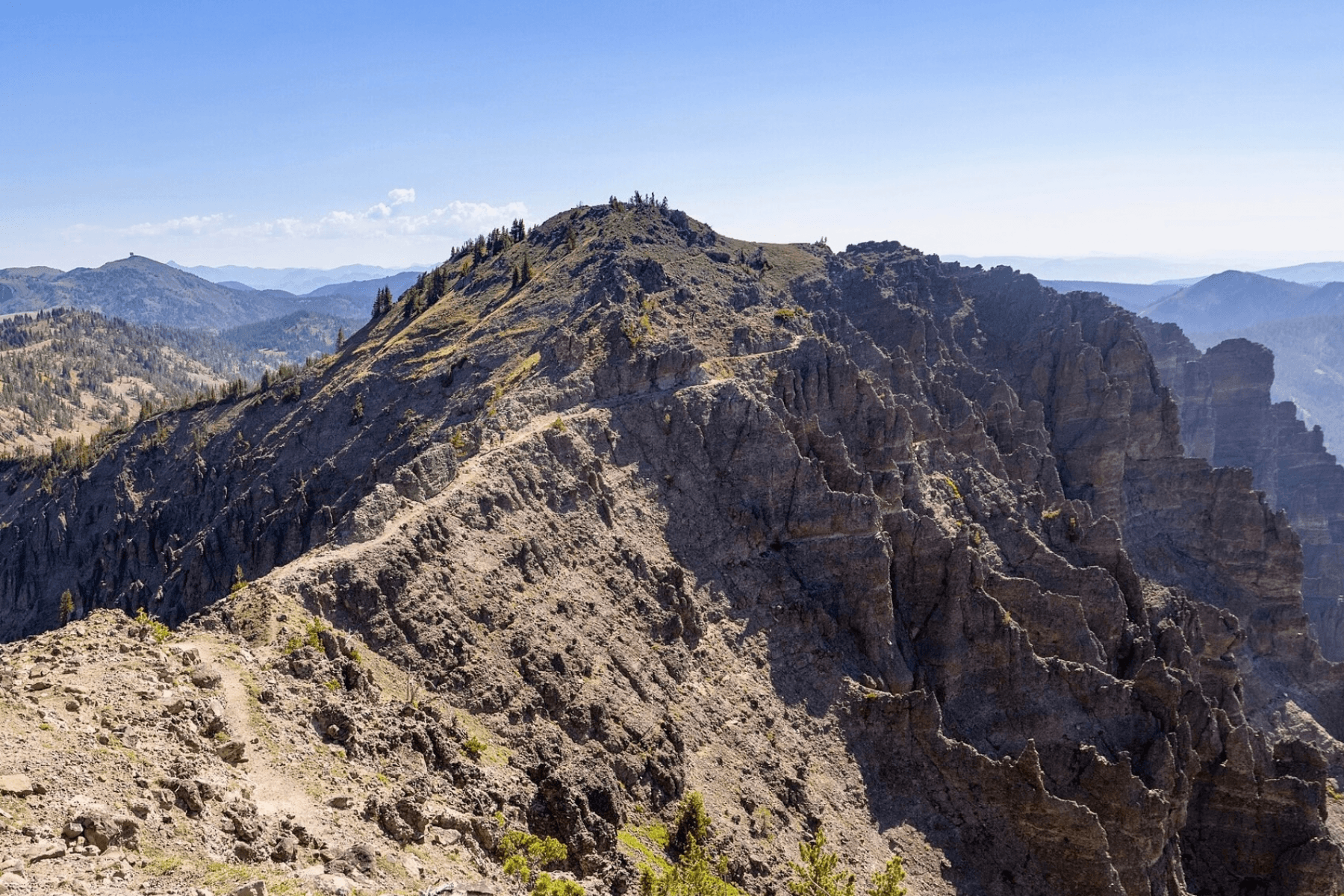
Ross, hiking partner Loren Miles, and I are perched on a 9,900-foot ridge near the geographic center of the Gallatin Range. The range’s summits are covered in October snow, its drainages in Engelmann spruce. The mountains rise from our vantage point, snaking around the basin and blocking our view of Bozeman, the 59,000-person city 50 miles north. Behind us is a wooden signpost letting us know that we’ve left Yellowstone National Park and entered one of the most contested parcels of public land in the country, the Hyalite-Porcupine-Buffalo Horn Wilderness Study Area.
Ross and Miles are both in their seventies, lifelong adventurers and self-described “capital ‘W’ wilderness guys.” Miles wears a full white beard and a pack sewn with patches; Ross has a clean-shaven face and atop his head is a beanie emblazoned with the logo of Wild Montana, the nonprofit they both volunteer with. The pair have led me here to convince me of their organization’s vision for the landscape in front of us. At times, they seem to be talking themselves into it as well.
Areas designated as wilderness by Congress are protected by the nation’s strictest environmental law. They have no commerce—no mining, no drilling, no logging, no agriculture—and limited recreation: no cars, ATVs, snowmobiles, or even bicycles. Unlike most national parks, they have no roads and no permanent structures. Activists speak of them with religious zeal. Many scientists call them the gold standard in preservation. Congress, however, has largely stopped designating them.
In Montana, where Ross and Miles live, a new wilderness hasn’t been created since 1983. Wild Montana sees an opportunity to change that, here in the Gallatin Range. But its plan to do so comes with fresh risks.
The range is both a superhighway for Yellowstone’s wildlife—connecting elk, wolves, wolverines, and grizzly bears to critical habitat outside the park—and an outdoor playground for humans, wedged between the fast-growing communities of Bozeman and Big Sky. Much of it is currently managed by the U.S. Forest Service as a wilderness study area, or WSA: a placeholder designation that freezes development while Congress decides if it deserves full-fledged wilderness status.
While WSAs don’t have expiration dates, they are supposed to be temporary. The one in the Gallatins, however, has remained in effect for nearly half a century; decisions about its future repeatedly put on hold. Two attempts to designate wilderness there fell short in Congress, while a third was pocket-vetoed—or simply ignored—by President Ronald Reagan in 1988. Since then, the mountains have grown increasingly popular for mountain biking, dirt biking, and snowmobiling—wildlife-displacing activities that would be banned if the area became a wilderness.
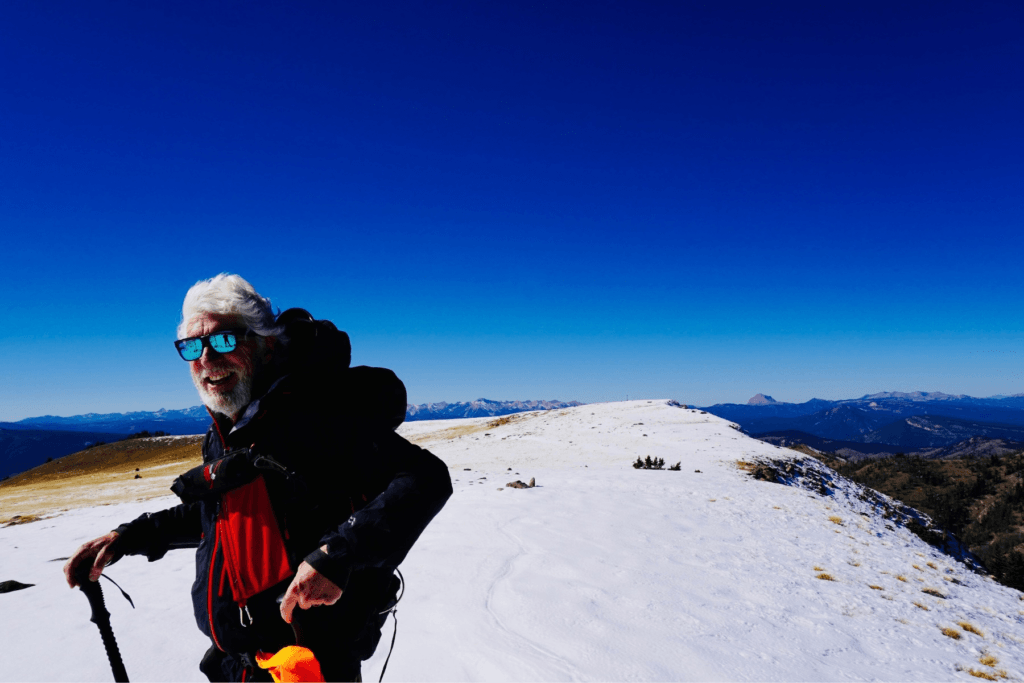
Wild Montana volunteer Loren Miles. Photo by Matthew Morris
To break through the deadlock, Wild Montana supports a compromise with the recreationalists. For more than a decade, its leaders have participated in a working group of NGOs, bike clubs, and business owners called the Gallatin Forest Partnership (GFP). In 2024, the partnership unveiled proposed federal legislation it calls a “permanent” solution: a split between about 100,000 acres of new wilderness and 55,000 acres of land open to mechanized travel, albeit with limits on future trail construction.
So far, their proposal remains unsponsored in Congress; the Hyalite-Porcupine-Buffalo Horn WSA intact. But the plan’s rollout has unearthed bitter divides in the broader wilderness community: between purists and pragmatists; large NGOs and lone-wolf activists; those who see the growing recreation industry as an ally; and those who see it as the land’s newest exploiter.
In December 2025, a full-page advertisement appeared in the region’s local paper, the Bozeman Daily Chronicle, featuring photographs of a bull elk, a grizzly bear, and her two cubs. Without naming the GFP, it criticized “private interests” looking to split Greater Yellowstone’s last unprotected wildlands. Along the page’s right-hand side were the names of more than 200 who oppose the GFP’s proposal, including two past presidents of Wild Montana. One of those presidents, Joe Scalia, in a separate op-ed, compared the proposal to Solomon, the biblical king who threatened to cut a baby in half to test two women claiming to be its mother. By splitting the Gallatin Range, he wrote, the bill could destroy the ecosystem it was intended to save.
Ross and Miles both back the GFP’s plan. While they worry that more motor vehicles and mountain bikes in the backcountry will displace wildlife, they know that those riders are already there. Asking Congress to take back that access feels to them like a fool’s errand.
“The WSA has been sitting there for 50 years waiting to be designated,” said Ross. “Every year, the wilderness character gets degraded.”
Ross’ concerns actually make him an effective pitchman for the proposal. He’s not arguing it’s a perfect solution, just the one that could finally work. Ross is a pragmatist. This is his idea of how to change the world or, at least, protect a mountain range.
But Ross isn’t the only one I’m talking to. There are other advocates, with their own ideas. By the time I’m finished taking their calls and hiking their favorite trails, I’ll be a little less sure of my own.
***
As long as Americans have demanded that their government keep some of its land in its natural state, they’ve offered two reasons why. The first: that nature is inherently worthy of space. The second: that people need places to relax and recreate; “pleasuring grounds,” in the parlance of the 1872 law establishing Yellowstone National Park. For most of the 20th century, preservationists saw those goals as one and the same. Now, some worry that the growing number of humans in the backcountry is an ecological threat all its own.
“When I was young and pitching for wilderness, it was always against gold mining or drilling or big open-pit mines. Those were the enemies. Today, more than ever, it’s [recreation],” said Dorothy Bradley, a former eight-term member of the Montana House of Representatives and one-time gubernatorial candidate. “We have met the enemy, and he is us.”
Bradley came of age in a simpler era of conservation. She was born in 1947 and grew up in Bear Canyon, at the northern edge of the Gallatin Range. Her father was a founding member of the Montana Wilderness Association, the group now called Wild Montana. As a young woman, Bradley joined him in the cause. At 22, she helped organize Montana’s first Earth Day; at 23, she ran for the state legislature. Her campaign distributed trash bags reading, “DOROTHY IS FOR THE BIRDS and the elk, and the bears, and the flowers, and for MONTANA.’
When she won, she became the youngest person—and only woman—in the statehouse.
Now 79, Bradley has seen staggering changes in her lifetime, many driven by Montana’s $3.8 billion outdoor recreation industry. As a teenager, she worked at a dude ranch, leading horse tours to Ramshorn Lake in the current WSA, and to Lone Mountain, across the river in the Madison Range. The only other structure she saw on those rides was a small chapel at the base of Lone Mountain.
Today, Lone Mountain is the site of Big Sky, once a modest ski hill and now the fourth-largest ski resort in North America. Surrounding it is a spiderweb of gated communities and faux-rustic mansions owned by some of America’s wealthiest people. The last time Bradley hiked to Ramshorn Lake, she found clear signs of overuse: trails trenched by mountain bikes, fields over-grazed by stock animals, loud engines that scared off the wildlife.
“When I walked those mountains [as a girl], they were pristine. But I started up the trail to Ramshorn Lake, and my heart was so sick, I turned back,” said Bradley. “I don’t go in the Gallatins anymore.”
Bradley, like Tom Ross, is a pragmatist. She spent her career working within the system and understands the value in hard-fought compromise. But while Ross sees the GFP’s proposal as a reasonable step forward, Bradley calls it a nonstarter. For her, it’s a continuation of the destruction she’s been fighting all her life, not an abatement of it.
Bradley’s case is a relatively straightforward one: Wherever humans play, wildlife tends to flee. A review of 274 scientific studies, published in the journal PLOS ONE, found that recreation changed animal behavior in 93 percent of the cases. In a 2013 study from Yellowstone National Park, grizzly bears were twice as likely to be in places where human presence was restricted. They were also twice as likely to move into recreation areas when humans were absent.
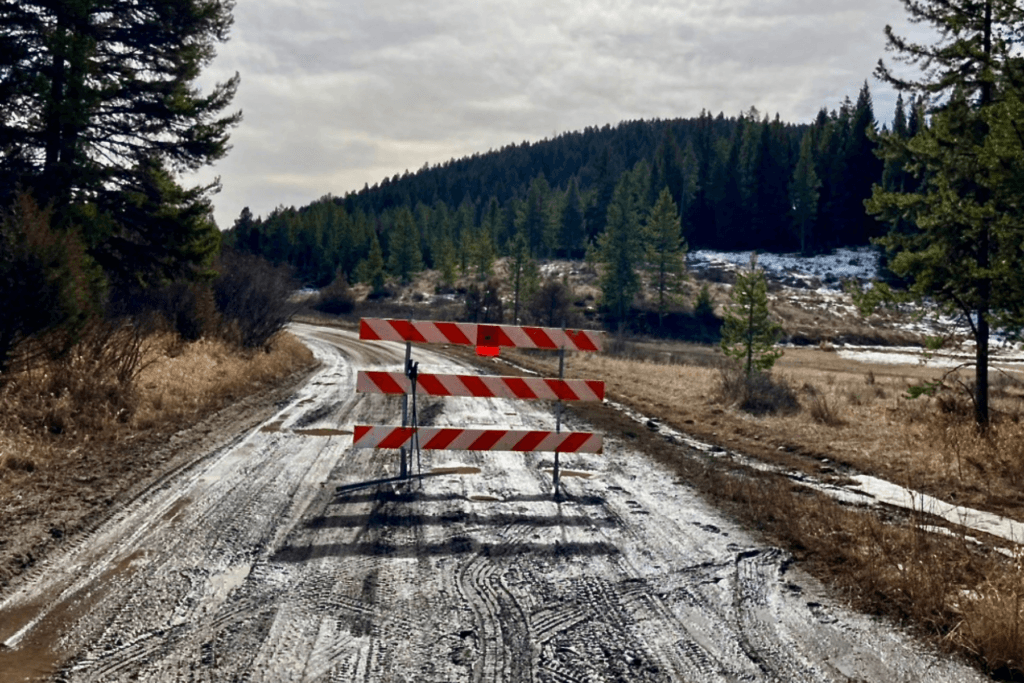
An entrance to Porcupine Creek is blocked due to bear activity. Photo by Matthew Morris
The study’s conclusions were clear: “Human presence can displace grizzly bears if people are allowed unrestricted access.”
Nearly every GFP backer I spoke with acknowledged these facts. Some even say it’s why they support its plan. The Gallatins, they believe, have enough space for both well-managed recreation and a healthy ecosystem. By limiting the expansion of motorized trails, their proposal could help ensure the mountains remain healthy.
Bradley isn’t convinced. Her dream for the range is more akin to the Absaroka-Beartooth Wilderness, a 940,000-acre designation east of the Gallatins that she advocated for as an elected official in the 1970s.
Before it was designated by Congress, the Absaroka-Beartooth was mired in conflict, much like today’s Gallatin range. Timber companies wanted to cut in its forested drainages, while snowmobilers and dirt bikers wanted to maintain access. One possible compromise would have created two separate wilderness areas, divided by a paved tourist road from Yellowstone to Interstate 90. Wilderness activists stood together against the idea. Ultimately, they won. The Absaroka-Beartooth Wilderness Act passed Congress in 1978, without the carveout.
“People love those things today,” said Bradley. “We still have a chance to do that one more time.”
***
Despite Bradley’s hopes, wilderness designations of all sizes are less likely to pass Congress today than they were just a few decades ago. Of the 111 million acres of wilderness in the United States, fewer than eight million were designated in the 21st century. Even the Absaroka-Beartooth success story is complicated. Many of the senators who voted for its designation did so out of respect for Montana’s late senator, Lee Metcalf, an advocate for the designation who had suffered a fatal heart attack in his sleep just months earlier.
When today’s advocates travel to Washington, they face a deadlocked Congress and a hostile executive branch. So far, no new wilderness areas have been designated under the second Trump administration, while the Forest Service has proposed rolling back protections for 45 million acres of currently roadless land.
This is what Zach Angstead is up against as Wild Montana’s federal legislative director. Angstead’s job is to steward his organization’s proposals through Congress. That includes the GFP bill, plus legislation to preserve parcels along the Continental Divide, in the Blackfoot and Clearwater River watersheds, and in the Kootenai National Forest.
All four proposals are what activists call “collaborative” bills, meaning they combine proposed wilderness with elements such as new mountain bike trails, recreation areas, and even parcels for logging. None of them are backed by Montana’s current congressional delegation.
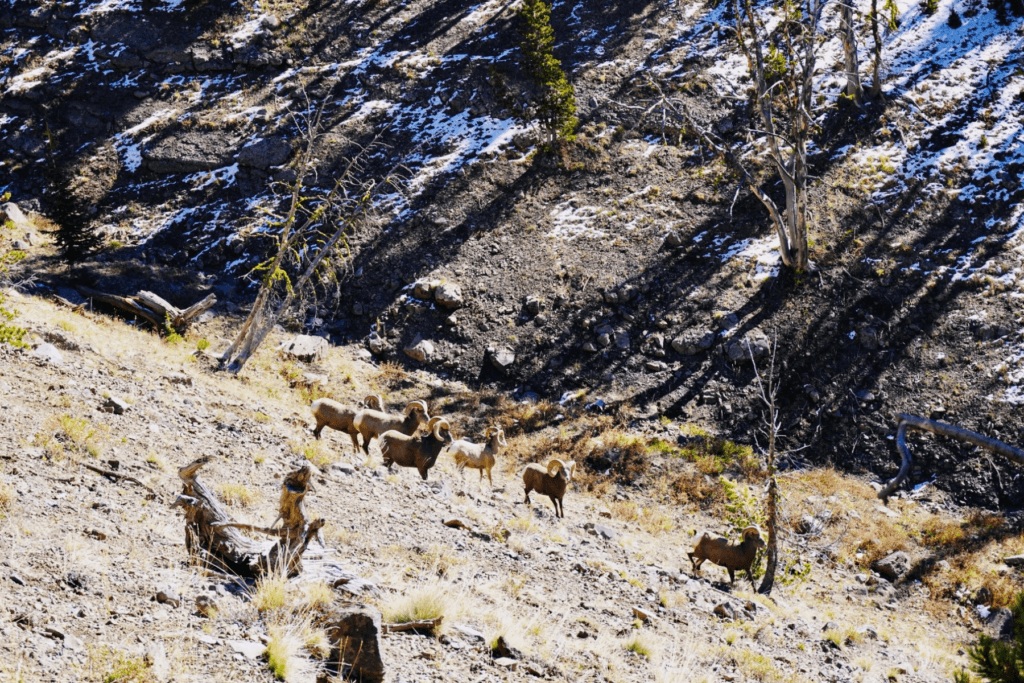
Bighorn sheep in the Gallatin mountains. Photo by Matthew Morris
Nevertheless, Angstead believes that these collaboratives, rather than the “pure” wilderness proposals favored by activists like Bradley, are Wild Montana’s best path forward. He thinks that meeting people where they are, not fighting for every possible acre of wilderness, results in bills with greater community buy-in.
“There are going to be 10 percent of people who want to ride every mile of trail on their motorbike or log every acre. There’s 10 percent who want to see every acre of roadless land designated as wilderness,” said Angstead. “The 80 percent in the middle can generally come to an agreement.”
Last summer, Angstead traveled to Washington, D.C. to put his approach to the test. He was joined by a backcountry horseman and a downhill skier, both volunteers with GFP. The trio met with staffers from each of Montana’s four congressional offices, then briefly saw the senators and congressmen themselves at “Montana Coffee,” an unofficial gathering on Capitol Hill for Montanans far from home.
When Angstead and I met for our own version of Montana Coffee—back in Montana, not in D.C.—he was cautiously optimistic about those meetings. He was especially interested in the reaction of Montana’s ranking senator, Steve Daines. Daines is an environmental boogeyman—in 2025, he received a 6 percent rating from the League of Conservation Voters—with a history of introducing bills to reopen WSAs for development, not designate them as wilderness. Nevertheless, Angstead thought he saw a small opening.
“Senator Daines loves that area of the state,” said Angstead. “He’ll tell you if you go to his office that he got engaged to his wife on top of Hyalite Peak. He really loves the Gallatins.”
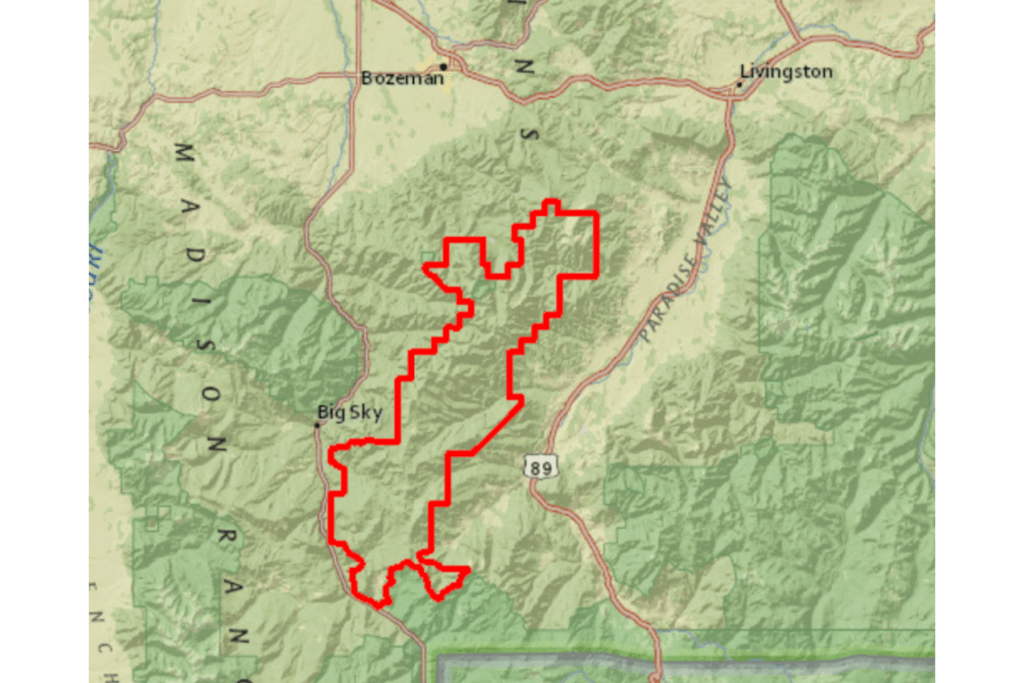
Map of the Hyalite WSA. Illustration by Lance Craighead
By our next meeting, in early 2026, Angstead wasn’t so sure. Daines had recently introduced another piece of WSA-killing legislation, the Montana Sportsmen Conservation Act. Versions of the bill, which would remove WSA protections from three areas in Montana but spare the Gallatins, had already failed in 2022 and 2023. Daines may have thought the bill could find new momentum in a Trump White House. This would turn out to be only half true.
On March 4, 2026, Daines’ bill passed the Senate Energy and Natural Resources Committee, backed for the first time by the directors of both the Forest Service and the Bureau of Land Management. Later that night, Daines withdrew his name from November’s midterm election, just hours before the filing deadline. The senator had given no previous indication of his plans to retire.
All of this has put Angstead back on defense, where he’s spent so much of the last few years. Instead of rallying Montanans behind a bill he supports, he’s once again fighting one he opposes. The Montana Sportsmen Conservation Act is still alive but treading water. It’s had to contend with a war in Iran, rising prices, and aheated campaign season. In Washington, D.C., those all take precedence over public lands proposals; both the ones Wild Montana backs and the ones it doesn’t.
Whoever takes Daines’ seat next, Angstead will undoubtedly find himself back in D.C., back at Montana Coffee, a map of the Gallatin Range in his hand, explaining his organization’s ideas to a new crop of twenty-something staffers.
***
A couple of weeks after Daines’ announcement, I drove to the Porcupine Creek trailhead, a popular entry point to the Hyalite WSA. It was an unseasonably warm March day, and the dirt Forest Service road had turned muddy in the thaw. As I jittered my low-clearance sedan around potholes, I thought about what I’d heard so far. On one side was Angstead’s vision of conservation through collaboration. On the other were outcomes like those envisioned by Dorothy Bradley: wildlands that were large, connected, and protected. How to square the two remained elusive.
A quarter mile from the trailhead, my thoughts, and my car, were interrupted by a striped orange and white barrier in the middle of the road. On it was a laminated neon sign with a familiar animal silhouette.
“WARNING,” it read. “BEARS ARE CURRENTLY ACTIVE IN THIS AREA.”
For years, the animals of Greater Yellowstone have been behaving strangely. Grizzlies are waking up from hibernation earlier or not hibernating at all. Elk herds are migrating shorter distances. From the birds to the beetles, species are showing up in unexpected places and at unusual times. Yellowstone is also getting drier and hotter. Its mountains hold less snow, and its rivers run high earlier in the year. No one knows exactly where it all will lead.
“Climate change is putting the ecosystem in a continual state of flux,” said Cathy Whitlock, professor emerita of paleoecology at Montana State University.
Whitlock is a lead author of both the Greater Yellowstone Climate Assessment and the Montana Climate Assessment. Taken together, the reports present a harrowing portrait. Average temperatures across Montana may rise by as much as 9.8 degrees Fahrenheit by the end of the century. The Upper Missouri Watershed, which includes the Gallatin Range, could lose nearly half of its snowpack compared to 1986-2005 averages. After the publication of the Montana Climate Assessment, Whitlock traveled the state with a panel of researchers, meeting with everyone from small town farmers to the state’s governor.
“When you start out, you think, ‘Oh my God, how can I talk to a bunch of ranchers in the basement of a church,’” said Whitlock, chuckling. “How’s that going to go for me?”
Since the tour, Whitlock has grown more comfortable in the limelight. For decades, she was reluctant to take policy positions. Now, as a retiree, she’s gone full activist, in opposition to the GFP and its proposal to end the Hyalite WSA.
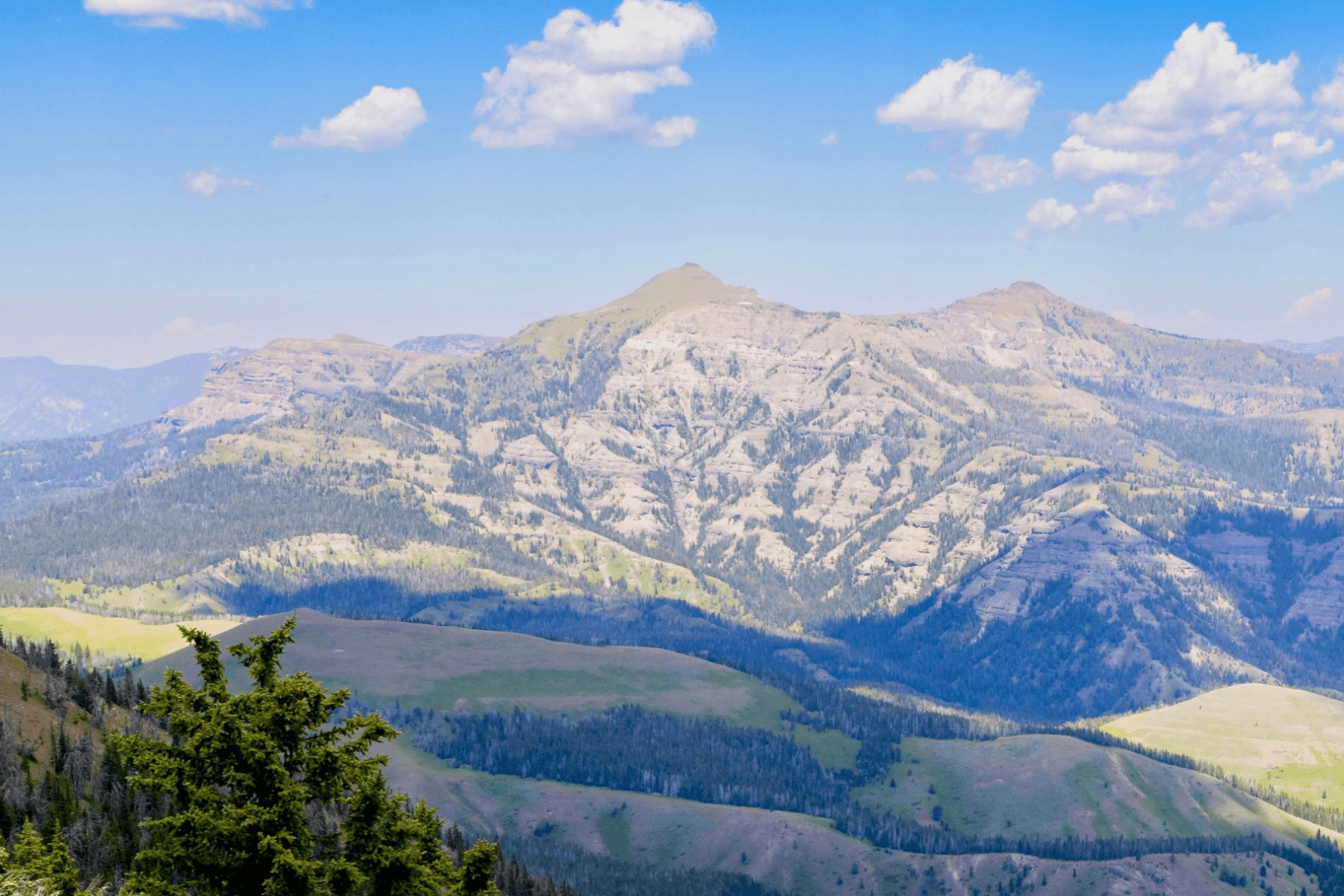
The Gallatin mountain range’s Ramshorn Peak. Photo courtesy of U.S. National Park Service
In February 2025, Whitlock and two colleagues, both fellow MSU retirees, published a white paper on the management of the Gallatin Range. They followed it up a few months later with an opinion piece in the Bozeman Daily Chronicle. Both derided the GFP’s proposal for ceding too much land for recreational use, while relying too little on scientific research.
The scientists started with what they knew. The Gallatin Range is a biodiversity hotspot, home to grizzly bears, wolves, wolverines, a 6,000-head elk herd, bighorn sheep, and cutthroat trout. For many of these animals, the mountains are a bridge between Yellowstone and the Northern Continental Divide ecosystem, which includes Glacier National Park. The importance of that connectivity is only growing, as more landscapes become inhospitable to the creatures that currently call them home.
The researchers then pivoted to what they did not know. No one, they wrote, had conducted a peer-reviewed study on the impacts of increased recreation on wildlife in the WSA. Nor had any scientists studied how climate change would shape the range’s ecosystem in the years ahead.
“The Gallatin Range is too important to wildlife for land-use decisions to be made without rigorous scientific information,” their editorial concluded.
Despite the written exhortation, Whitlock says she has no ill will towards the proposal’s backers. As we talked, she drank from a mug with the logo of the Greater Yellowstone Coalition, a GFP member that she worked closely with on the region’s climate assessment.
“Everybody wants a healthy Greater Yellowstone Ecosystem,” said Whitlock. “But what tradeoffs do you need to get to that point? The die-hard, older conservationists are like, ‘We don’t want to trade anything.’ The other group is like, ‘Well, no. We want a new generation of people to enjoy it.’”
If you’re in the latter group, like the leaders of the Greater Yellowstone Coalition, said Whitlock, then you need to compromise something. She sipped from her mug. “I’m not sure this is a topic where there should be compromise.”
***
As the flora, fauna, and waters of the Gallatins change, so too will the people who care for them. The debate over the range has raged for nearly half a century. Some of its fiercest partisans are no longer with us. Others have simply changed their minds with the years.
In 2006, Joseph Scalia III became president of the Montana Wilderness Association, now called Wild Montana. It was a period of growth and transition for the nonprofit, away from its grassroots origins and towards a more professional setup. At the time, Scalia saw this as a positive. More donations and staff members, he believed, meant the nonprofit could fight for more wilderness. “I bought the company line without realizing I was doing that,” Scalia said.
But the organization kept backing compromises Scalia didn’t agree with, the kinds of collaborative bills that Angstead would one day champion. In 2009, it endorsed a proposal to designate nearly 700,000 acres of new wilderness in Montana, while also mandating at least 100,000 acres of logging. The bill did not pass Congress.
Scalia stayed on the Montana Wilderness Association’s board for another year after that. Then he moved on. He became the president of a second conservation group, the Gallatin Yellowstone Wilderness Alliance. This one was sufficiently uncompromising but had far fewer resources. In 2025, the organization reported less than $50,000 of revenue to the IRS. Wild Montana, meanwhile, reported nearly $4 million.
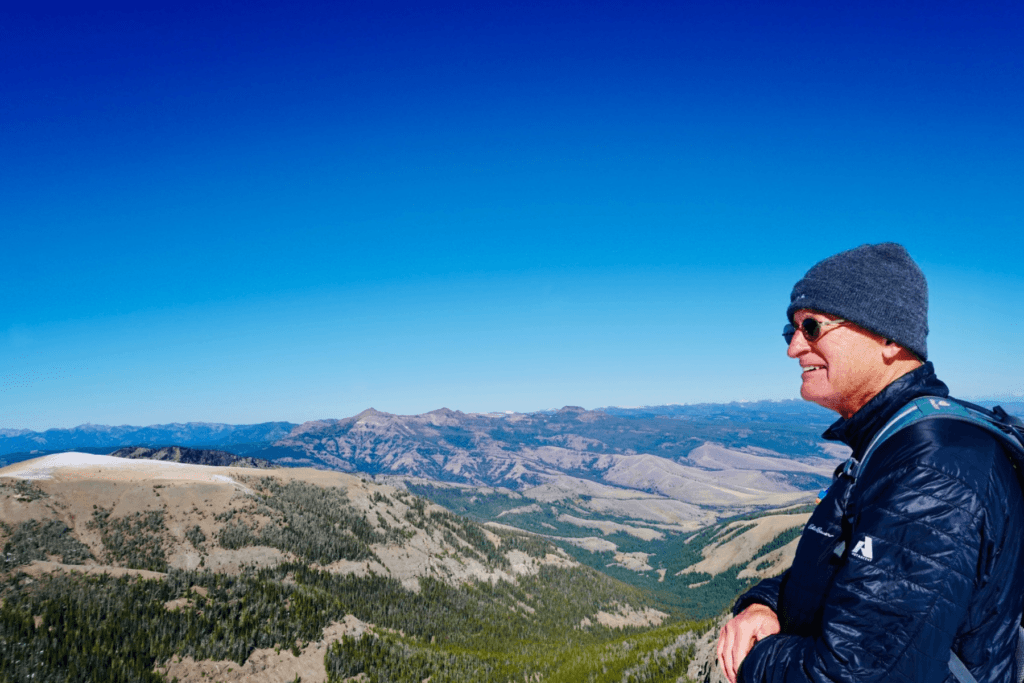
Wild Montana volunteer Tom Ross, near Bighorn Peak. Photo by Matthew Morris
In lieu of large events and lobbyists, Scalia published regular newspaper op-eds. He voiced his support for wildland protections and opposition to any attempts to divide them. He also repeatedly criticized his former organization. “I deeply lament that I was president of Montana Wilderness Association,” began one such editorial. Another, an open letter co-signed by 10 other former board and committee members, called the association a “tool of the timber industry, motorized/mechanized groups, and elected officials.” (He also authored the quip about King Solomon.)
These days, Scalia lives in Colorado, down the road from his son, daughter-in-law, and young grandchildren. He says he’s no longer involved with the Gallatin Yellowstone Wilderness Alliance and that his views don’t fit neatly on either side of the debate. To hear Scalia tell it, wilderness organizations are spending too much time fighting over individual designations, like in the Gallatins, and too little changing how people think about nature.
“I’m troubled by the groups that don’t want to look at societal concerns,” he said. Those groups, he now believes, include the two he used to lead.
Scalia’s ideas remind me of something I’ve been hearing from activists on both sides of the WSA issue: Wilderness designations alone are not enough. When Congress passed the 1964 Wilderness Act, it was essentially making a promise: Under the government’s watch, some places would be protected from humanity’s worst excesses. That was always going to be a tall, maybe impossible, task.
It’s gotten even harder since I started reporting this story.
Last year, the Forest Service laid off nearly 6,000 employees, more than a sixth of its workforce. Many wilderness areas now have no dedicated staff. The Department of the Interior, meanwhile, cryptically announced in June that it was “evaluating whether existing wilderness study areas and lands with wilderness characteristics policies should be updated, clarified, or revised.”
Whatever the federal government calls these places, it will be up to everyday people to advocate for their continued existence. The question is, how? Does this perilous moment demand greater tradeoffs or bolder demands? Those questions could decide the fate of the Gallatins—its cool creeks, roadless acres, and abounding wildlife. It could shape a lot of other landscapes, too.
As our time winds down, I asked Scalia about his last trip to the Gallatins. He said he hasn’t been back since his move to Colorado. But his last hike in the range was a special one.
The hike covered about 20 miles, up to Ramshorn Lake by way of the Porcupine and Buffalo Horn drainages. Along the way, Scalia retraced the path where Bradley rode horses as a teenager, 60 years earlier. He also wasn’t too far from the ridge that Ross, Miles, and I visited. Joining him was an old friend, a former wilderness ranger. The friend, said Scalia, now has advanced Parkinson’s disease.
It was winter, and the pair didn’t see many people. That was fine with Scalia. They also didn’t see many animals. That felt right too. On that day, no bighorns were pushed from their perch, elk displaced, or hibernating grizzlies awoken. For once, it seemed, there was enough space for all to roam.
“It felt like we were in an intact ecosystem. That wasn’t lost on us,” Scalia said. “There’s just not much left.”
Reporting for this story was supported in part by the University of Montana Wilderness Institute’s Matthew Hansen Endowment for Wilderness Studies.
- See the list of wildlife study areas across the country by state
- Interact with a map of the Gallatin Forest Partnership’s proposed protections
Help us sustain independent journalism...
Our team is working hard every day to bring you compelling, carefully-crafted pieces that shed light on the pressing issues of our time. We rely on caring supporters like you to help us sustain our mission. Your support ensures that we can continue to provide deeply-reported, independent, ad-free journalism without fear, favor or pandering. Support us today and make a lasting investment in the future.

RELATED STORIES

Award Winning



Today’s environmental and social justice challenges are unprecedented, and require an unprecedented collective effort.


Stay updated on our latest features, events and more. Subscribe to our Note From the Nest newsletter!
