
The Season of the Tick
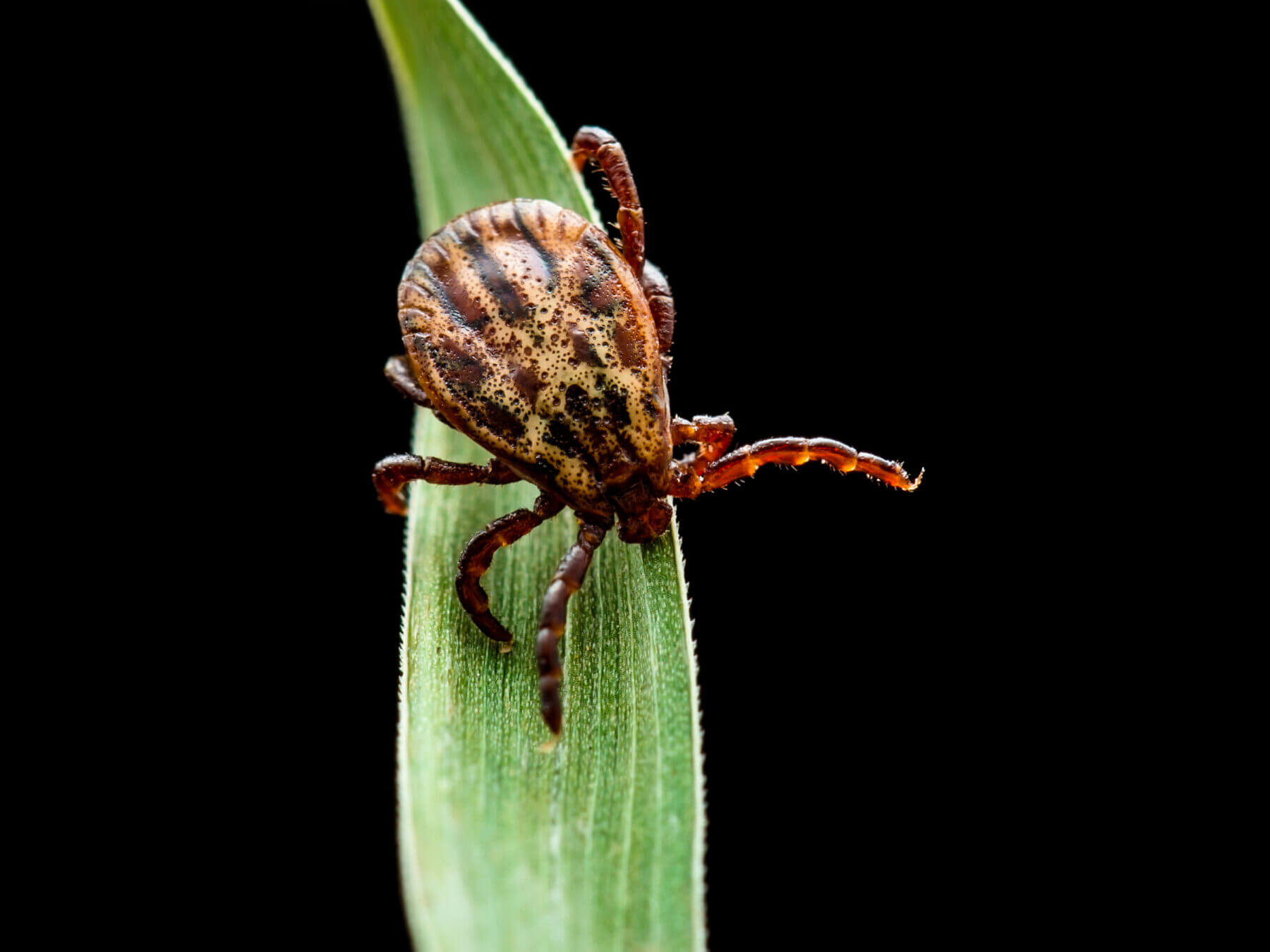
The 42-year-old man arrived at the hospital feeling weak, dizzy and seeing double. He was having trouble speaking and swallowing, both indicative of damage to a cranial nerve. If he’d been an older patient, or suffering from diabetes or hypertension, doctors would have immediately suspected a stroke. But the man was otherwise healthy and relatively young; a stroke was unlikely. “We did a CT scan just to make sure,” said Igor Dumic, the first doctor to treat him that night.
As Dumic suspected, the results were normal.
Since the patient’s symptoms suggested inflammation of the encephalon, or brainstem – a condition known as rhombencephalitis — Dumic turned his attention to the possible causes. Listeria can bring about rhombencephalitis, as can the common herpes simplex virus. “So we said, ‘OK, until we get results, we have to treat for those two conditions,’” Dumic said. He immediately began administering the antibiotic ampicillin and acyclovir, an antiviral moderately effective against herpes.
Dumic works the night shift at a Mayo Clinic-affiliated hospital in Eau Claire, Wisconsin. He took full advantage of Mayo’s comprehensive testing facilities, ordering tests for every disease he could think of that might trigger brainstem swelling, from E. coli to human immunodeficiency virus to Epstein-Barr. Then he left for the day, handing off the case to a colleague.
But he didn’t forget about the patient and his unusual symptoms. Dumic continued checking the patient’s lab results as they came in over the next few days. A week later, an answer arrived: The man had been infected with Powassan encephalitis, a potentially lethal viral contagion carried exclusively by a tiny tick of the Ixodes genus.
In one way, the diagnosis made sense: Northwestern Wisconsin is “one of the epicenters of tick-borne infections,” according to Dumic, and the man had returned from a deer hunting trip two weeks before he fell ill. He also reported that the deer stand he used had been infested with mice, one of the tick’s preferred hosts. In another way, the test results came as a shock. Ticks are generally active in the late spring and early fall, when the weather favors their hunt for a blood meal. But this man had showed up at the hospital in December.
The diagnosis of a tick-borne disease in the dead of a Wisconsin winter was so out of the ordinary, in fact, that Dumic and Madrid felt compelled to document it for other researchers.
Dumic had already noticed an unseasonal rise in other tick-borne diseases, possibly related to climate change. He wondered if the chaos of a changing climate, the sudden warm spells and harsher cold snaps in the Midwestern winters had brought ticks out when they’re typically resting. “I wasn’t thinking it was the only reason,” he said. The spread of zoonotic, or vector-borne, diseases is influenced by a lot of different human-involved changes to the landscape: the reforestation of farmland, the decline in predators that would cull populations of deer and mice, human intrusion into wilderness areas. “But it’s an accepted fact that [climate] is one of the main ones,” he said.
After the patient’s lab results came in, Dumic ran into a colleague, Dr. Cristian Madrid, in the hallway. “He said, ‘Hey, do you know what [that guy] has?’ And I said ‘Yes, I saw. It’s unbelievable.’”
The diagnosis of a tick-borne disease in the dead of a Wisconsin winter was so out of the ordinary, in fact, that Dumic and Madrid felt compelled to document it for other researchers. At the end of last year, they, along with University of Vermont neurologist Danilo Vitorovic, published their findings in the International Journal of Infectious Diseases. “[We wanted] other people to know what we did, what our thought processes were,” Dumic said, “so they can replicate them” when a patient presents with similar symptoms. Even if those symptoms present in December.
***
Powassan encephalitis belongs to a genus of contagions called Flaviviridae, which spread via mosquitos and ticks and incubate in mammals and birds. Mosquito-borne West Nile and Zika are flaviviruses; so are Dengue and yellow fever – flavus means “yellow” in Latin. Powassan is but one of many human pathogens carried by Ixodes ticks, in particular the groundhog tick, Ixodes cookei, and its cousin the deer tick, Ixodes scapularis, the main vector for Lyme disease.
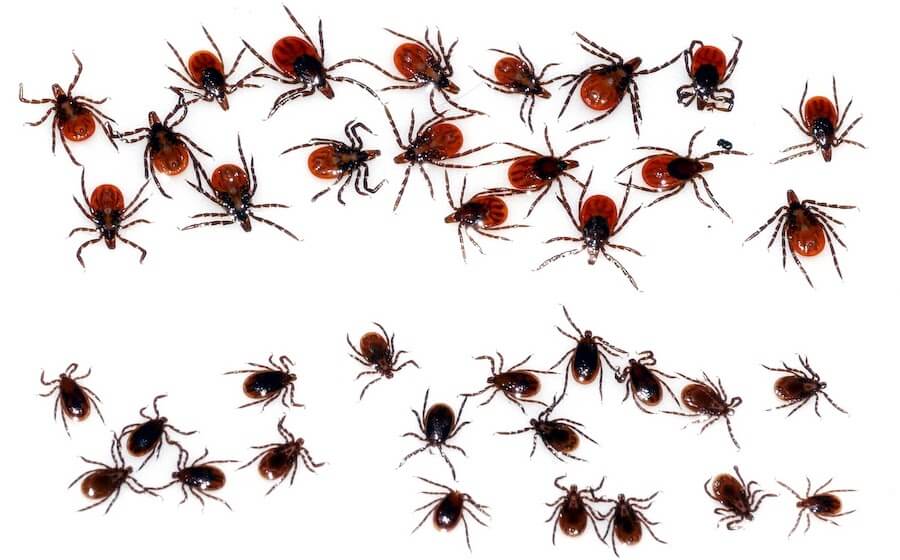
Possibly due to climate change, every season is fast becoming tick season. Here, the adult black-legged tick (Ixodes scapularis) is sorted by females at the top and males at the bottom. Photo by Graham Hickling/University of Tennessee
Powassan is so far relatively rare – in a typical year, fewer than 50 infections are reported to the Centers for Disease Control and Prevention – but cases appear to be on the rise. In 2010, only eight people in the U.S. were diagnosed with the disease; in 2019, there were 43. More have been infected and never know it since the disease is often asymptomatic. Of those who develop symptoms, roughly 10 percent will die. But as with other viral and bacterial illnesses, Covid-19 among them, Powassan also has a “long-haul” syndrome: As many as half of its symptomatic victims may go on to suffer persistent neurological damage. Others may die of the virus after suffering for years: In April of 2020, former North Carolina Sen. Kay Hagan succumbed to Powassan three years after she first fell ill.
Other tick-borne pathogens have increased in recent years as well: Cases of babesiosis, caused by a protozoan parasite, Babesia microti, and sometimes called the “malaria of the West,” have become more common; reported cases of Lyme disease diagnoses have doubled from around 15,000 to 30,000 since 1998 (although the CDC estimates that in reality closer to half a million people are treated for the disease each year). Another tick-borne illness, anaplasmosis, a bacterial illness that causes fever, chills and body aches, only became reportable in the year 2000, but since then official cases have increased exponentially, from fewer than 400 to 4,000 in 2016, with a peak incidence of 5,762 in 2017.
Part of the reason for the rise in numbers is no doubt due to better diagnostic tools and reporting. According to CDC researchers Rebecca Eisen and Lars Eisen, the black-legged tick wasn’t much recognized as a disease spreader before 1970, when a woman on Nantucket Island in Massachusetts fell ill after a tick bite and was diagnosed with babesiosis (known for a time as “Nantucket fever”). But researchers generally agree that the rise in infections is due at least in part to warmer weather in the regions where the ticks are prevalent and their diseases endemic. The spread of Lyme disease, in fact, is so tied to climate change that the U.S. Environmental Protection Agency uses it as an indicator of the planet’s warming.
To Dumic, tick season has begun to imitate California wildfire season. “The ‘season’ is all year long,” he said. Even in December, medical professionals can’t rule out tick-borne disease when a patient shows up with a Lyme-like rash, or a fever and chills suggestive of anaplasmosis. Both illnesses can be successfully treated with doxycycline if diagnosed promptly. Left to progress, both can be fatal. “This is why we publish,” Dumic told me. “We wanted doctors to know, ‘Hey, you can see these diseases any time of the year now. Don’t rule them out because of the season.”
***
It’s not entirely clear how climate change has increased the spread of tick-borne diseases. For mosquitos, the calculus is more straightforward: Mosquitos thrive in warm, humid weather, which, in certain parts of the world, is becoming more the norm as temperatures rise. But ticks typically like colder weather – in fact, many species of tick only proliferate in climates with cold winters. Scientists do know that ticks’ range is spreading northward, perhaps by as much as 28 miles every year, which is conclusively climate related. Beyond that, it’s all up for debate.
One theory is that milder winters in certain regions enhance the probability of certain diseases because weather influences the timing of ticks’ emergence during each of their four lifecycle stages: egg, larva, nymph and adult. “Ticks are asynchronous” in their feeding schedule, explained Maria Diuk-Wasser, professor of environmental biology at Colombia University. In most of their range, larvae emerge from their eggs in the fall, “quest” for a blood meal and go dormant for the winter. The following spring, if all goes well for them, the larvae re-emerge as nymphs, and once again quest for blood – usually from a small rodent, a deer mouse or chipmunk, although they can also bite larger animals; in particular, white-tailed deer.
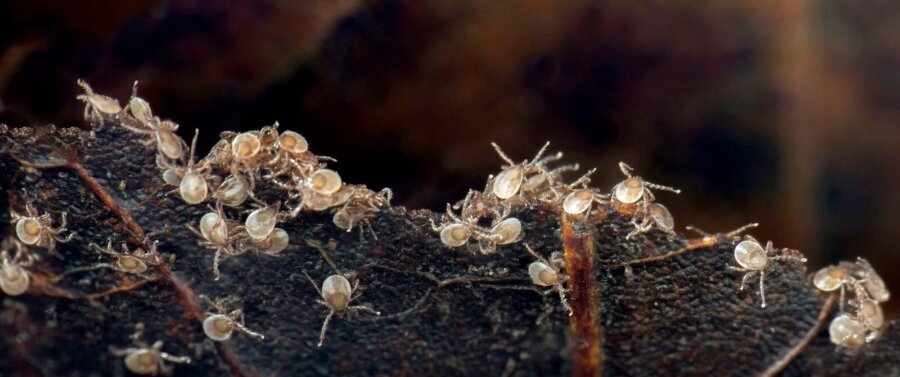
Black-legged ticks in the larvae stage. Photo by Graham Hickling/University of Tennessee
For the transmission of the Borrelia burgdorferi bacteria that cause Lyme disease to happen, “the nymphs have to be active first and infect the mice, and then those larvae of the new generation have to feed on the mice and get infected,” Diuk-Wasser explained. In a milder climate, such as in the Northeast United States, that’s what usually happens. May and June are peak nymph times; August and September are when the larvae are out in force, and ticks complete their lifecycle in two years. That’s part of the reason diseases like Lyme have been so much more prevalent in those places. (The disease bears the name of Lyme, Connecticut, where a 1975 epidemic of arthritis in children was later traced back to Borrelia-infected ticks.)
But in colder regions, where the shift from fall to winter is more abrupt, the larvae might not find a host before winter closes in and shuts them down. That means they have to wait until the following spring to find that one blood meal that will transform them into nymphs. That adds another year to the ticks’ development from larva to adult – exposing them to more life-threatening perils and reducing the density of the tick population. That sharper difference between fall and winter also puts nymphs and larvae out feeding at the same time, in the spring, meaning larvae have fewer chances of encountering a rodent that’s been around long enough to be bitten by an infected nymph. (Unlike ticks, mice in the wild rarely live out the year.)
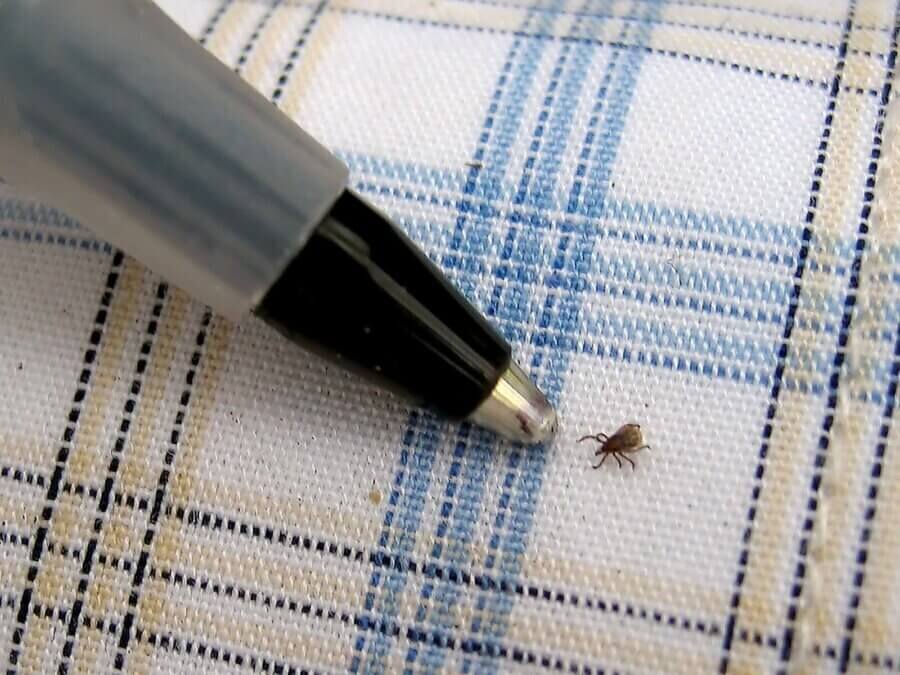
More people are infected by ticks at the nymph stage, when they are almost imperceptible to the naked eye. Photo by Graham Hickling/University of Tennessee
In 2015, a group of researchers led by Taal Levi of Oregon State University hypothesized that a longer lag time between nymph and larval feeding times meant more transmission of persistent strains of Lyme disease. To find out whether they were right, they looked at 19 years of data on black-legged ticks and weather. They did indeed find that warmer years put more space between nymph and larval feeding times, making disease transmission more likely.
Tick season has begun to imitate California wildfire season.
But here’s the rub: That’s just for Lyme. Other diseases — Powassan and anaplasmosis in particular – might actually benefit from nymphs and larvae feeding together in the spring. Powassan is a short-lived pathogen; a rodent’s immune system will clear it quickly. If nymphs and larvae don’t bite the same mouse in quick succession, the nymph won’t pass it on. In that way, climate change may in fact reduce the overall incidence of Powassan encephalitis.
Which does nothing to explain why Dumic’s patient came down with Powassan at the start of a Wisconsin winter. Diuk-Wasser suggests another factor may be in play: adult ticks. Mature ticks go into a sort of quiescence when the weather’s too cold for them and emerge to bite again when it warms up. Although fully mature ticks are more likely to get noticed than the tiny nymphs are, they do bite, and they carry with them every pathogen they’ve acquired since they first emerged in larval form. And while Lyme Borrelia doesn’t invade the human body until a tick has attached for 36 hours, Powassan transmits within 15 to 30 minutes.
Levi and Diuk-Wasser both emphasize that this is by no means settled science. “It’s still very unclear what climate does [to the tick lifecycle],” she said.

Adult black-legged female and male ticks on a deer. Only females become engorged. Photo by Graham Hickling/University of Tennessee
Climate’s effect on mosquitos, which Diuk-Wasser also studies, is easier to track. “They live 10 days, so you can put them in an incubator and change the temperature and see how they survive. With ticks, you have to wait two years.” Another Lyme-spreading tick, Ixodes pacificus, only thrives in the cool periods along the Pacific coast; the drier, hotter winters meteorologists predict for the region may spell the tick’s doom.
There may also come a time when winters everywhere warm up so much that the cold-hearty arthropods don’t survive anywhere at all. But at that point humans might not, either.
***
Dumic, who also teaches medical students in the Mayo Clinic system, kept his Powassan virus case on what he calls his “interesting list,” which he maintains to track what he calls “diagnostic dilemmas” for teaching and “because it’s important to have closure” with a perplexing case.
In this case, closure came with success: After treatment with corticosteroids, the man made a complete recovery. So did a 25-year-old Wisconsinite Dumic treated, who came in with weakness in his lower extremities and difficulty urinating. Only the characteristic rash, erythema migrans, suggested Lyme disease, which a subsequent blood test confirmed.
“This one we also published about, because Lyme doesn’t [usually] cause this type of symptom,” said Dumic, who wanted other doctors to recognize trunk-down paralysis as an unusual, but possible, indicator of Lyme. Only after reviewing medical literature from Turkey and Belgium did Dumic and his colleagues arrive at a potential treatment, which they reviewed with the patient and employed. Three weeks later, the young man walked out of the hospital on his own and continued to improve over the following weeks. “Those,” Dumic reflected, “are the rewarding moments.”
Not everyone has been so fortunate: Dumic treated a man in his 80s who recovered from a simultaneous infection of Lyme and Powassan, but two years later, “has still not recovered his cognition.” Fully independent before the infection, he now lives in a nursing home and requires 24-hour care.
As the planet’s increasingly freakish weather evolves, health professionals need to be prepared for such outcomes, Dumic said. Awareness is key. Ten years ago, microbiologist Bobbi Pritt discovered a new Borrelia species, the “sister of Lyme,” which she named Borrelia mayoni after the Mayo Clinic. Pritt also discovered another tick-borne disease, Ehrlichiosis eauclarensis, and named for the Wisconsin city itself. Both have been making people sick in ways similar to the more common Lyme pathogen, Borrelia burgdorferi, with a characteristic rash and fatigue. These new diseases, Dumic said, need to be on clinicians’ radars as more zoonoses proliferate in the warming world.
Dumic expects more tick-borne diseases to evolve as they become more common. Anaplasmosis, for example: “It’s only a matter of time before it becomes resistant to doxycycline,” Dumic said. “We have to be forward thinking about how we’re going to treat it.”
To the public, he advises vigilance – the Ixodes nymph is often so small you won’t even know what bit you. “Use repellents, wear long sleeves, long pants,” Dumic said. Even if it’s winter in Wisconsin.
To report a tick in your area and help Diuk-Wasser and her team at the University of Wisconsin-Madison and Columbia University learn about the risk factors for tick-borne disease, download The Tick App. It also features a guide to identifying ticks and more.
Help us sustain independent journalism...
Our team is working hard every day to bring you compelling, carefully-crafted pieces that shed light on the pressing issues of our time. We rely on caring supporters like you to help us sustain our mission. Your support ensures that we can continue to provide deeply-reported, independent, ad-free journalism without fear, favor or pandering. Support us today and make a lasting investment in the future.

RELATED STORIES


Award Winning



Today’s environmental and social justice challenges are unprecedented, and require an unprecedented collective effort.


Stay updated on our latest features, events and more. Subscribe to our Note From the Nest newsletter!
