
Going Coastal

I was a red-haired 5-year-old, just arrived from Chicago, when the California coast began peeling my pink skin and reshaping my body and brain.
Now I’m old.
On the edge of the Pacific, though, age loses relevance. The scent of Mojave sage, Lake Tahoe pine, San Francisco smug and L.A. ozone infuses my cells. But only the aroma of salt air and decomposing kelp atomize me and make vital again every fragment of who I was and who I am and who I might still become.
When this is truly over, and please don’t tell me you don’t know what I mean by “this,” I’m going to persuade the editor of this strange little birding magazine to let me expense an electric VW camper van and then I’m going to nag and plead until you agree to join me on a road trip down California’s coast. All 1,100-plus miles of it.
Our trip won’t be the sort of soul-depleting jaunt — “10 Must-See Beaches” — chirpy travel influencers want to sell you. It won’t always be pleasant. But it will be worth your time. Even if you’ve explored more of this landscape than I have. Especially if you’re new to the state or have been letting something — timidity, inertia, a misguided belief that you can’t afford it — hold you inland.
We’ll strap surfboards and boogie boards and beach chairs to the van’s pop-top, fill the refrigerator with good IPAs, create a litoral playlist and meander down Highway 1, from the Oregon border to the Tijuana Sloughs. Our mission will be to forge you into a Californian.
Until then, might you join me in a quick hopscotch along the coastal time-space continuum as I try to understand the forces that shaped this happy mess of a man?
Let’s get the sound system pumping and stab our first pin into the map at:
Rosarito Beach, Baja, California
It’s only fair to warn you: On our real trip, when we finally reach the border at San Ysidro, I will beg and browbeat you into continuing. I’ll whine that Baja’s rugged shoreline is geographically, historically and culturally part of the California whole. My main reason for starting our virtual tour here, though, is to give you some personal background.
It was to this stretch of open shore that Dr. Ethel Chapman, a psychiatrist and my aunt, one day took the sprawling family that had incrementally invaded her three-bedroom, state-subsidized residence on the sprawling grounds of Patton State Hospital in San Bernardino, “the Southern California Asylum for the Insane and Inebriates,” as it was originally named.
Over the years and in overlapping combinations, Ethel would take in: her mother, whose Alzheimer’s got her into fistfights with other doctors’ kin; her older brother, a gambler who eventually arrived with his wife after handing off their nine kids over the years; her alcoholic brother Buzz; her younger sister, and her husband and their five kids, one of whom would develop schizophrenia and threaten neighbors with a rifle, perhaps the weapon she’d use years later to kill herself; and my family, including my astonishingly stable father, and my mother, Ethel’s youngest sister, whose agoraphobia and other psychological travails gave Dr. Chapman and her peers plenty of opportunity for pharmaceutical experimentation.
After a year, my own family moved into a small house in the smog-shrouded foothills a mile away. But we hung out a lot at Residence 14 where at times more than a dozen family members lived, stacked in bunk beds and fueled by Buzz’s spaghetti, bulk powdered milk and fresh juice from oranges the patients picked from the groves.
I don’t know if Ethel’s instinct to escape San Bernardino’s suffocating summers had anything to do with psychiatry’s on-and-off again enthusiasm for hydrotherapy. I do know that it worked and still works for me.
And so here I am. What? Maybe 8 years old, bouncing in the surf with my cousins, too elated to care that the hazy sun is adding freckles to my nose as I yell, “Steve, John, watch this one.” Each wave washes away a layer of the loving craziness that accrued to all in our wonderful, sprawling family of lunatics, addicts, drunks and their happy-go-lucky-but-sometimes-troubled offspring. Over and over I crouch then rocket up, eyes open, through swirling green water toward dizzying blue sky.
Why can’t we stay here forever? I wonder. Even after my feet fail to touch bottom. Even as I watch the older boys and then the shore fading from sight.
We can come back to this later, though. For now, let’s head north to:
The Smith River outlet, just south of Oregon
We’ve just crossed back into California from Oregon and my dad pulls the station wagon onto a dirt road. Lose track of your cursor on a Google map here and you’ll find yourself lost in blue. But the Pacific Ocean is not always the cheery azure so many maps depict.
Here, today, it’s a churning wilderness in the color-obliterating fog. I’m the 5- or 6-year-old boy noting the lack of distinction between the water and the air. My mother’s hand is warm, but it scares me to discern that the wind banshees ripping at this strong, fragile woman’s clothes and copper hair know nothing about love. These brutally neutral forces have work to do grinding down redwood stumps the size of submarines and making grains of sand smaller still.
San Onofre State Beach, San Diego
I sit on my swallowtail with only my shoulders and head above water. The sun dropped into the ocean so long ago that Rick, 30 feet or so away, is a ghost, barely visible in the dark. Earlier, I’d lain on my back just beyond the lineup, lazily watching the upside-down cliffs bob against the sky and pondering why I remain so stupidly fragile for a married man in his late twenties. Why I let petty things like too little money and too much Sartre and Camus get me down?
The ocean, though, is good at recalibrating one’s perception of reality. An airborne dolphin may look me in the eye, a sea lion stare up from the kelp, a school of grunion flash by in a translucent wave. The void can’t compete.
Now a shape like a gray whale is upon me and I paddle only a stroke or two before feeling the familiar lift, the momentum transferred from the world’s watery mass to my muscles. I fly. I thrum. I ride until my board’s fin catches sand, then I stumble barefoot over the rocks.
Rick has already ignited a driftwood bonfire. He hands me a beer. We are roaring sea lions. We’re the phosphorescence washing in on the tide. Our laughter is all life expects of us.
Corona Beach, Baja, California
The Ensenada dock smells of fish, rotting and freshly grilled. We move past the open-air stalls until a man gestures. My dad and I follow him over winding dirt roads into the hills above town. We step into a shack with a concrete floor. The man empties one gunnysack after another until dozens of lobsters clack and scrabble at our feet.
Back at Corona Beach, where my parents have plopped an old trailer onto leased sand, our Gringo and Mexican village sets up tables just past the high-tide line, places big pots on a roaring fire and drops the crustaceans in to boil. Mariachis play. The adults sing and pass around bottles of Tecate and tequila.
Word of this paradise has spread through our smog-choked inland neighborhood. At Corona, 10-year-old me will build and blow up sand castles, 12-year-old me will fight bottle rocket battles in the sand dunes, 14-year-old me will grimace at my first taste of beer and sleep so close to the water that I’ll wake up with foamy surf lapping my feet. When stray fireworks ignite one of the trailers-turned-ramshackle cottages, 15- or 16- year-old me will join an unsuccessful bucket brigade from the ocean.
The waves synchronize our heartbeats. Love and the sea are forever merged in my mind.
Tonight, the father of a girl from my fifth grade class, a sheriff’s detective, gets plastered and gleefully surrounds our fiesta with a few dozen road flares. He spends the night shouting cheerful threats to shoot anyone who crosses “the perimeter.” This distresses his daughter, whom I comfort with a walk along the dark beach, bare feet on wet sand. The waves synchronize our heartbeats. Love and the sea are forever merged in my mind.
Campus Point, University of California, Santa Barbara
I’m a long-haired college student walking barefoot with a new roommate whose dark-eyed beauty ignites my sun-inflamed instincts. I scramble onto a rock. I clown. I stretch out my arms like seagull wings. I dive. The wave retreats. Staggering to my feet, I wipe blood from my balding head. The woman laughs. I blush.
Not long after that, I take an even more beautiful woman snorkeling. We skim the water, heads down, eyes seeking life. Our hands touch. Our fingers intertwine.
On shore, we realize that our faces are covered at the mask line with the black ooze of oil tar. We clean our hair with turpentine. The next morning, we grin at the smell when we awake. Years later, I propose on an ocean bluff below San Francisco. Pam is still my wife.
Russian Gulch State Park, Mendocino
I swim to my friend Brian’s inflatable dinghy, grab the line that anchors it to a strand of bull kelp, measure the abalone I’ve pried off a rock 15 feet down and drop it into a mesh bag. Then I barf on the boat’s bow. The undulating seagrass through which I pawed my way in search of the well-camouflaged monopod at first hypnotized. Then it triggered motion sickness.
It could be worse. Every year, people die hunting abalone in Northern California’s rocky coves and shallow reefs. Great white sharks lurk.
The faint recognition of danger only increases after I slither my wetsuit-slick body back into the boat. Brian and I’ve already fussed over Ashley’s, Emily’s and Rob’s weights, masks and “ab irons.” Now, I watch as one by one my college-aged children drop overboard and disappear into the dark waters below. I envision what they’re seeing: shafts of light slicing deep into the kelp forest and then dissipating, rendering decisions about what’s up and what’s down tricky to calculate.
My chilled flesh resonates with what they are feeling: bodies kneaded by swell-powered currents whose assertiveness can resist even the kick of absurdly long dive fins. My ears imagine the silence of submersion. And the solace it brings. Or the fear that all too easily can sweep in and overwhelm.
Back in camp, wetsuits draped over branches, and fleece and wool sherpa hats donned, our multi-family tribe of divers drinks wine and margaritas, pounds sliced abalone to tenderness and then dives into our yearly traditional feast under a canopy of fog-drenched redwoods. We whoop with exhilaration. We toast the initiates.
Salt Creek, Orange County
Rick and other high school friends and I drive from San Bernardino to the coast as we do often now. This time we head south. Sensing opportunity, we rumble down a rutted road onto a bluff that a bulldozer has recently cleared of buckwheat and scrub oak. We carry our boards down a trail to the water and paddle out.
At dusk, we return to the van, brimming with endorphins and adrenaline and agitated by an enhanced awareness of the threat to our rapture.
As we’re ready to go, Rick leaps onto the dozer. He easily starts it. Then he drives it, lurching and sputtering, to the edge of the cliff. Here, what little sound judgment simmers in his adolescent brain momentarily prevails. He refrains from sending the Cat clanging into the sea. Instead he pulls down his trunks and takes a dump on the enemy war machine’s leather seat.
We should consider every inch a public resource and remember that those who covet what’s left — men and women who see money in oil fields, desalinization plants, wetland destruction, housing tracts — never seem to retreat.
Forty years or so later, Pam and I walk down a long, concrete stairway not far from that spot. The cliffs are now packed with houses, some dull but preening, others architecturally dazzling. Having hitchhiked along the Dalmatian and Amalfi coasts, having studied historic pictures and paintings of shorelines around the world, I know that the human desire to stack ourselves like barnacles on the edge of seas and oceans is hardly new.
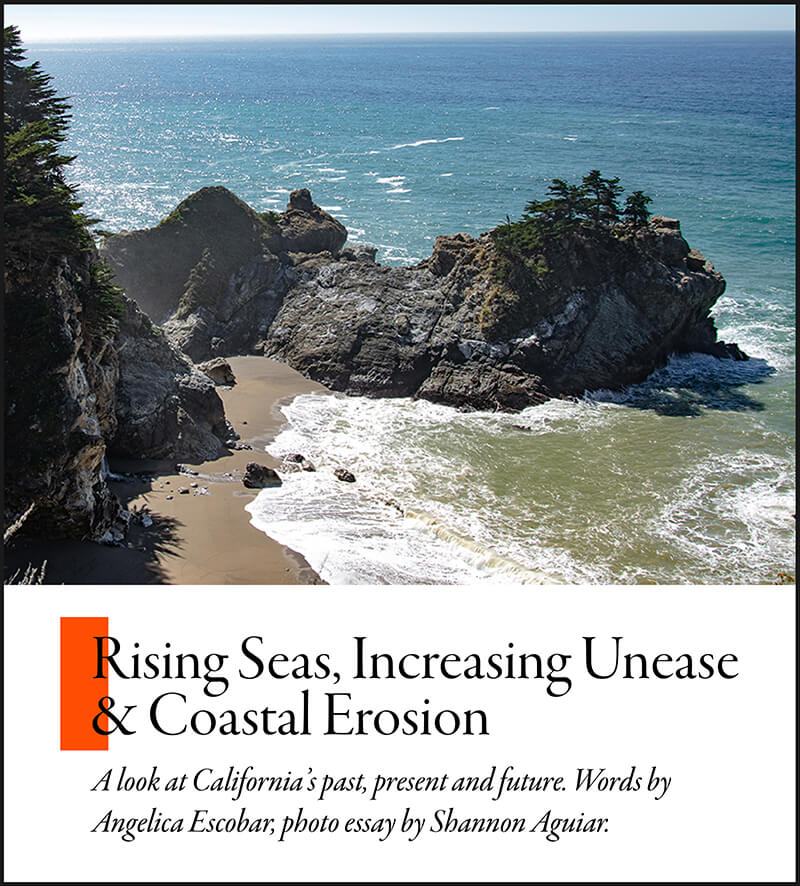
The pain I feel when I see new development along a stretch of California coast that was once untamed is tinged with envy: that house in Encinitas or Big Sur, the one with the glass walls and cantilevered decks reaching toward Hawaii? I’d buy it — or a faux Tudor monstrosity with similar view — in an instant if I could.
But I also believe that California’s coast, like its air and water, is vital. We should consider every inch a public resource and remember that those who covet what’s left — men and women who see money in oil fields, desalinization plants, wetland reclamation, housing tracts — never seem to retreat.
Toward the end of my years at the Los Angeles Times, I served as environmental editor and worked with columnist Steve Lopez on his insightful series on the coast. Lopez’s investigations into sleazy deals and greedy power plays got results. Your descendants will thank him. Yet I heard whispered complaints from staffers that the paper was investing too heavily in a story that concerned only well-to-do white folks.
I’d love to take those who think that on this road trip. We’ll party next to campsites brimming with families of Asian and Latino abalone divers. We’ll fish alongside Black men, women and kids who’ve passed the tradition down through generations. Maybe we’ll time our adventure so we can swing by one of the Doheny State Beach birthday parties we throw for my now nonagenarian mother-in-law. I know you’ll pick up the contagious joy as the scent of kimchi and carne asada wafts from one picnic table to the next and women in burkas play horseshoes in the sand and Banda blends into Kanye and the Beach Boys. I dare you to tell the turbaned Sikh running a metal detector along the waterline that he’s out of his realm.
Crystal Cove State Beach, Orange County
The kaboom of wave on sand awakens me from a glorious nap. I step out of a claustrophobic room with beds reminiscent of summer camp and cross a creaky linoleum floor into a shared kitchen with 180-degree views of Catalina Island and tidepools brimming with urchins and starfish that may have ridden in on currents from Africa or China.
Crystal Cove, I am certain, has fused myth and reality from the moment the first Tongva pried an abalone off a submerged rock and became mesmerized by its iridescent inner shell. Like every coastal cave, cove, sandspit and estuary, the place remains haunted by ghosts and spirits malevolent and benign.
A film company planted palm trees here around 1917, and in 1920 some director shot the first of many movies here, including Treasure Island. Imaginations tingled. People began leasing camping spots from the Irvine Co., and their tents and “kit cabins” grew organically onto the bluff, like mussels on a pier.
But only the aroma of salt air and decomposing kelp atomize me and make vital again every fragment of who I was and who I am and who I might still become.
By 1937, they’d cobbled together 47 cabins. A 1950s photo captures the ethos that drew these settlers — a stern bugler celebrates the setting sun as a clutch of well-tanned men, women and children stand or sit in the sand, smiling and saluting a slowly rising flag emblazoned with a martini glass.
Eventually, of course, developers began to lust for what these “covites” relished. This time, though, people fought back with the zeal that only those who fear the death of something they worship can muster. They won. We won.
When leases expired in the 1970s, the state stepped in and began renovations. In 2006, the Crystal Cove Alliance rented the first re-funkified cottages to the public. Years later, Pam and I finally hit the online reservation lottery, earning our first of several stays.
Only as we’re leaving, transformed as always by the sound of waves and gulls and the smell of sea air, do we notice a bronze plaque. The dormitory-style cottage in which we stayed is named for Peter M. Douglas, the “radical pagan heretic” who did as much as anyone to pass the 1972 initiative that led to creation of the California Coastal Commission and the California Coastal Act of 1976.
Those victories bolster our current and future efforts to preserve the coast. They blazed the way for the even tougher battles against the mighty forces, global and within us all, that so myopically clog oceans with plastic and poison and plunder its riches and gnaw tenaciously at what’s left of its shore. It’s why Pacific Coast Highway road trips still offer wild places ripe with the dangerous beauty that we need to fully live.
Back near Rosarito Beach
Most of the adults have headed into town for groceries, leaving several of my cousins and I laughing and throwing kelp at each other and diving through the breakers. Uncle Buzz has stayed behind to chaperone. He’s probably napping on the sand as I feel the rip current take control.
Back at Patton, on a day when he hadn’t turned to whiskey to wash away his days in the infantry, my kind uncle stood beside me in the doctor’s vinyl-lined pool and taught me how to float. That’s what I do now.
I raise my feet and swirl my hands. Waves wash over me. I choke and gasp. Then, out past the surf line. I hover weightlessly under wispy clouds, sensing that a force, neither ally or foe, is trying to reclaim me. My mind clears. I drift up and join a gull looking down at a little boy being carried out to sea long after time has evaporated, though, another current imperceptibly takes control.
Without me sensing it, though, another current takes charge. I hear a distant shout. I turn my head. A man in a straw cowboy hat canters into the surf, leaps from his horse and wades toward me until he is chest deep and I am in his arms. He carries me toward shore.
The grocery expedition has returned. Family members are in the water.
“Gracias, gracias, gracias,” Aunt Ethel says.
Dad clutches me, his face anguished but stoic, hinting that he’d already flung skyward a litany of Catholic prayers. My mother, a Methodist, offers a more pointed emotional response.
Years later, teenaged friends and I will come upon a clutch of people on the sand near Corona Beach. We’ll watch the fading rivulets of ocean swells wash over the bluish corpse of a Mexican boy about the age I was when I almost drowned.
His mother’s shrieks and my mother’s sobs are with me still. They’re part of who I am.
Manhattan Beach
Our granddaughter is 18 months old. Pam and I whisk her to this stretch of coast from our home near downtown Los Angeles while her parents work. We build a sand castle and she laughs and splashes as the waves knock it down.
I take her hand and walk her to the surf. She’s tentative. A wave knocks her down. With her hand clutching my finger, she wobbles back up. Another tsunami of white water barrels up and I lift her over it. She laughs. Then, boom, she’s down again, pondering, perhaps, the distinctions between liquid and solid, safety and danger, exhilaration and fear.
Eventually I deliver her, diaper sagging under a full load of wet sand, back to Pam.
But the girl wants more. She leads me back into the water, kicking foam and charging the horizon, babbling joyously about a secret I need to share with you so that I never forget.
Help us sustain independent journalism...
Our team is working hard every day to bring you compelling, carefully-crafted pieces that shed light on the pressing issues of our time. We rely on caring supporters like you to help us sustain our mission. Your support ensures that we can continue to provide deeply-reported, independent, ad-free journalism without fear, favor or pandering. Support us today and make a lasting investment in the future.

RELATED STORIES


Award Winning


Today’s environmental and social justice challenges are unprecedented, and require an unprecedented collective effort.


Stay updated on our latest features, events and more. Subscribe to our Note From the Nest newsletter!
