
When the Black Guy Ran for Mayor of Santa Barbara

I was in the Samarkand neighborhood, a “Santa Barbara, middle-class,” moderately dense neighborhood of under 1,000 homes located just about the center of town. Assisted by an app that provides deep voter data, I strategically canvassed, knocking on the doors of higher-propensity voters. That is, those that had voted in three or more of the past five elections.
Early in the day, I had knocked on a door of a single-family home and a middle-aged, white woman appeared, apparently having just completed her workout or yoga. I had just introduced myself as a candidate for mayor when I noticed a woman coming across the street, arms full with a box of goods and her dog, some kind of herder breed, in tow. No leash. Evidently, she was cleaning out some cupboards and it was customary to share the spoils with her neighbors. The dog seemed pleasant, too.
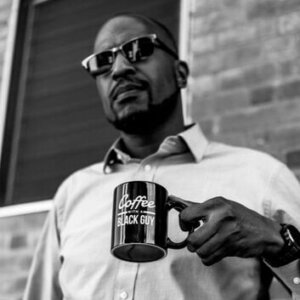
I shared that I was running for Mayor of Santa Barbara, and a little about my background: a former newspaper reporter who spent most of the past decade serving as district director to Hannah-Beth Jackson—the California State Senator representing this area—running the day-to-day presence in a district of just under 1 million constituents. Additionally, in 2016, I launched a community initiative called Coffee With A Black Guy (CWABG) and, for the past five years, I have been community building by convening uncomfortable conversations about race. CWABG is now my consulting business. I told the women that these were the skills that I’d like to bring to our city leadership as mayor.
The dog relaxed at our feet, while its owner, the woman who was not in my voter database list, sized me up. Her posture stiffened. She had a question.
“What do you think about CRT?” she asked.
Not calibrated to that particular acronym at the time, I asked her for clarification.
“Critical race theory,” she snapped.
“Oh, the truth?” I interjected.
Now standing arms akimbo, this woman appeared to grow visibly agitated.
Apparently, in her mind, CRT meant teaching that America is a racist country and that we eventually would have to do away with the Constitution and the Declaration of Independence to rid our country of racial division. She claimed that discussing these issues would only further divide us.
For the record, her understanding is a complete misrepresentation of Critical Race Theory, which is a legal and academic framework for the study of institutionalized systems of racism in America. It was developed by scholars in the 1970s and 1980s following the Civil Rights Movement to highlight the intersection of race with the Black American condition. By my understanding, it is a conversation that had mostly been relegated to the ivory towers.
We tend to be more informed when we know the whole story, not just a version of it.
However, as Americans of all hues grasped for a better understanding of racism following the mass awakening ignited by the public killing of George Floyd, CRT has become something of a reductive shorthand deployed mostly by fragile conservatives in the latest wave of backlash against commercialized wokeness. It’s a backlash that parallels, in some ways, the virulent anti-Blackness policies and violence that followed Reconstruction. Ironically, or not, this is the period in U.S. history that codified much of the institutional apparatus of anti-Black racism—from segregation to redlining, from housing covenants to jurisprudence and more—that are the primary concerns of CRT.
I didn’t give that lesson that day. I did, however, remind the woman that this topic had next to nothing to do with the governance of our fine city of under 90 thousand. I further explained that we tend to be more informed when we know the whole story, not just a version of it.
This mindset will destroy our country, she claimed. I remained confused at her argument.
She shakingly thrust my literature back into my hand and stormed off in a huff. I was more taken aback by the return of my literature than I was with her seemingly misplaced vitriol. Her dog remained resting at my feet. She called and then whistled for her pooch, who eventually obliged. I thanked the neighbor for her time. On to the next house.
This was the first of a couple memorably contentious interactions I experienced specifically about CRT while canvassing neighborhoods in liberal-progressive Santa Barbara, California as I campaigned to become mayor, the first that would have happened to be Black.
***
Santa Barbara is a relatively small town situated about 100 miles north of Los Angeles, just at the knuckle on California’s central coast. It’s been a convenient getaway for both Southern and Northern Californians and has been dubbed the “American Riviera.” Recognizable for its picturesque Spanish-colonial architecture and its topographic situation between the ocean and mountains, it’s a city with a strong reputation for education, with one of the top community colleges in the nation, the University of California Santa Babara, and a handful of private colleges. The city has a culture of philanthropy, and is known for being the birthplace of the modern environmental movement. Santa Barbara tends to be viewed with a progressive tint, as well as the place where celebrities such as Jeff “The Dude” Bridges, Julia Louis-Dreyfus, Oprah, Ellen DeGeneres and Portia DeRossi, Meghan and Harry—just to name a few—like to call home.
It is also a city with a rich racial history, including memories of Ku Klux Klan cross burnings as a signal to Black residents to stay on their side of town. There are plenty of stories of contemporary experiences that register more subtly than cross burnings. The city didn’t elect Babatunde Folayemi, its first African American to serve on City Council, until 2002. Despite its 38 percent Hispanic or Latino American population, it didn’t seat Cathy Murillo, its first Latina mayor until 2018.
Working as a staffer for a local elected official put me in the sphere to run for office. Being in the rooms where decisions are made and challenges are solved affords quite the hands-on education. I also learned a lot working as a newspaper reporter—prior to the mass shrinkage of the industry—when I covered local governments, education, crime, and more. In retrospect, my running for mayor held an uncomfortable mirror to a city whose culture purports to be inclusive.
Although the specific language may change, encounters such as the one with the CRT woman, have been happening in some form throughout my four decades of life. Having grown up in a conservative East Coast community in the Mason-Dixon state of Maryland, and then attending college in Southeast Ohio in the Appalachian foothills, I have had my fair share of tense encounters rooted in a clear difference of experience.
Leaning into that personal discomfort feels in alignment with my purpose.
In some ways, this has been by design. I recall that very vital time during my formative teenage years while determining which college to attend. I weighed the consideration of attending a Historically Black College and University (HBCU) or a Predominately White Institution (PWI). My conclusion for myself was that life in America would not be all Black, and if the goal of college was to prepare you for a successful career and life, why would I prepare for success in such an environment?
One thing that I discovered while attending Ohio University in Athens, Ohio, is that it’s not in my personality to be drawn towards comfortability. My life has always felt most fulfilled when overcoming obstacles or solving a challenge. For example, as a Black student attending a PWI, there is always the option to be perceived as the example or the exception in your interactions in the classroom. Inside of either choice, there is always a moment when all eyes are on you—the speck or two of pepper in a room full of salt. Leaning into that personal discomfort feels in alignment with my purpose.
This applied when I decided to run for mayor in Santa Barbara, a city I had plunged into as a public servant for a decade prior. Although I was in the sphere, I was never the staffer who aspired to be in office myself. I had long been a critic of the amount of money in politics and had grown a slightly cynical view of those who aspire to office as self-serving and disingenuous. So, I was a reluctant mayoral candidate even as community members encouraged my decision to run.
Yet, in deciding to run, a flashback of that formative process of selecting a college popped into mind. That, coupled with the timing for both the city of Santa Barbara and myself on a personal (single, no kids) and professional level, led me to set aside personal comfort and offer the next five years of service to my community in a way that I hoped would be most useful. On February 1, 2021, to kick off Black History Month, I publicly stated, “I’m all in” for my run to be the 51st mayor of Santa Barbara, effectively becoming a part of Black history.
Just months earlier, in early June 2020, the thought of running for mayor had not entered my mind. I mean, I may have joked that, with the name-bearing literary allusions in town with a bar by the same name, I could be mayor. But that was just joshing around.
Maybe things started to change after seeing the masses react to the killing of George Floyd. My work already had me tuned to the pulse of the community. So, when I was asked by the leader of the NAACP branch in the adjoining county of Ventura to speak at a rally during the public outcry over the Floyd murder, I decided to deliver the message myself rather than write down talking points for others.
CWABG has been driving conversation and bridging gaps since 2016. Photo courtesy of CWABG
I had already developed a partnership with Ventura County’s NAACP through my years of working for elected officials and through my work to facilitate conversation around issues of diversity and inclusion through CWABG. Keep in mind that Santa Barbara is 1.4 percent African American and 58.5 percent White, according to 2020 Census data. Not where you’d expect something called “Coffee With A Black Guy” to launch, but when it did, the community gave nothing but support. And this was years before more than 3,000 people showed up at the Sunken Garden at the historic Santa Barbara County Courthouse to proclaim that Black Lives Matter.
Santa Barbara is home to or the backyard of some of California and the nation’s wealthiest and most influential people. It is the birthplace of companies like Sonos, Kinkos and Yardi Systems; not to mention the Egg McMuffin. It’s blue on the electoral map, but it has a deep conservative undercurrent and powerbase. The area where the late President Ronald Regan had his “Western White House.” Santa Barbara is also where Donald Trump received his first 2016 general election endorsement from a daily newspaper, the Santa Barbara News-Press. The paper had previously endorsed him in the primary.
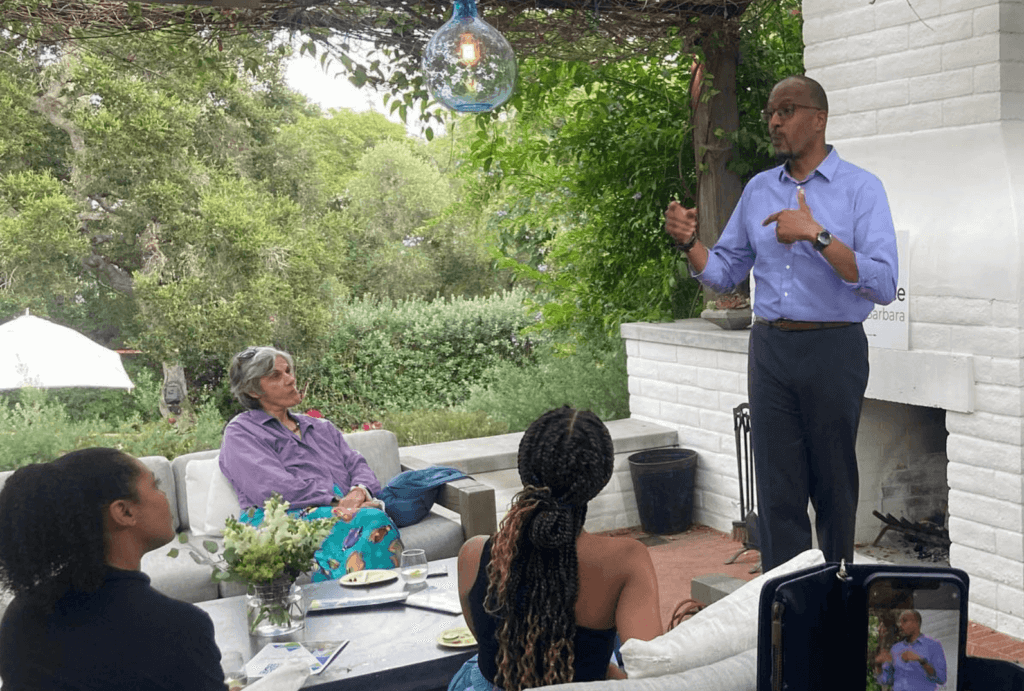
Sharing experiences and hearing diverse perspectives is CWABG’s main game. Photo courtesy of James Joyce III
What started as me extending myself to have group coffee conversations with members of my community quickly grew into a movement. I’ve since built CWABG into a sustaining business by expanding those developmental conversations into specific communities—corporations, educational institutions and nonprofit boards—to help them identify and reach goals for more inclusive environments and better intercultural understanding.
***
Throughout the early months of COVID and the racial reckonings of 2020, it was my thought that perhaps, because of social isolation, Black Americans were able to see themselves in a slightly different light. Maybe even a bit more emboldened, as we weren’t bombarded with daily reminders of ourselves in a racial context. By staying in our highly curated familial and social pods, Black Americans weren’t as hemmed in by pervasive national racial caste.
Arguably, the last time in American history that such a social situation existed was during the 1918 Spanish Flu Pandemic, after which followed the Red Summer of 1919—when thousands of Black Americans were attacked, killed or wounded in coordinated racial violence that took place in dozens of cities across the country.
All of that was in mind a few short months after the rally in Ventura when I started having initial conversations with trusted community members about the possibility of running for mayor of Santa Barbara—the city where I spent the past decade gaining perspective on the inner workings of the City and its connectedness, or lack thereof, with surrounding governments. So, by late summer-early fall 2020, when talks were kicking around about my potential for a mayoral run, I began to think to myself that maybe it was time.
It felt like a message from my ancestors, all of them, going back centuries.
This provided the context for me to deliver a message on the spring 2020 day of solidarity rally for the slain Floyd. My message provided us with a call to action and a way forward through the fog of a mass racial reckoning in our country, including our local communities. An apparent newly discovered understanding of the Black American experience among those who saw themselves as allies—the collective epiphany that blossomed out of the combined toll of a global pandemic and chillingly horrifying video captured by a teenager—was disorienting.
The message I shared at the rally urged an amplification of the community building that I had seen happen firsthand through several years of convening frank conversations via CWABG. The title of this piece was, “It’s Time.” It was an emotional piece for me, partially because of the way that the message came to me, which seemed to be from something outside of myself.
It felt like a message from my ancestors, all of them, going back centuries.
It’s Time. It’s Time. It’s Time. The mantra roared in my head while I stood in the shower that evening, tears streaming down my face as the water poured over me. Then, the entire message came to me, just as it was delivered that day and then later published in the Santa Barbara Independent. I hopped out of the shower, still weeping as I dried myself. Emotional not only from the context of the moment, but from the inspiration of those ancestors. I gathered myself and started putting down in black and white what I was going to try to accomplish.
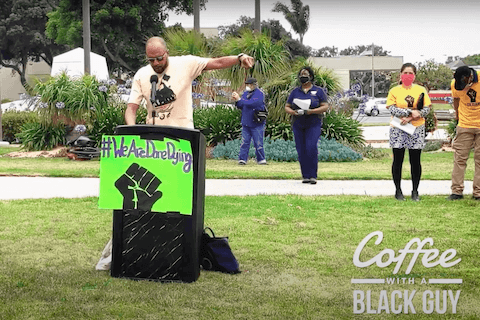
Joyce speaks to a cultural experience larger than his own at through his “It’s Time” speech. Photo courtesy of James Joyce III
Weaving the geographic and cultural link of the controversial Rodney King trial in the neighboring Ventura count nearly 30 years prior, a few select hip-hop references that describe the Black American experience, and a line or two quoted from the Congressional Record, I delivered a rally call derived from my work with CWABG. I urged all those within earshot to build community by getting involved and getting uncomfortable. I urged allies to expose themselves to “the other” and forge meaningful relationships. I had seen it work in real life. This building of bridges across differences would become an underpinning of my mayoral campaign.
***
When I’m in the rooms in Santa Barbara—especially in those rooms where Cash Rules Everything Around Me (nod to Wu-Tang Clan’s “C.R.E.A.M”) but in a cloaked kind of way—people usually engage on issues.
In the past, that had given me a unique perspective as an observer—kind of like knowing that you are in the room, but not feeling a part of the room. After I launched CWABG in 2016, on the heels of months of racial and ethnic tumult in American society and beyond, Alton Sterling and Philando Castile were the hashtagged names at the time. As the news headlines and issues had turned to the brutality against and the killing of Black bodies, I noticed that the people in Santa Barbara seemed to have started avoiding eye contact with me. They didn’t seem to know what to say about these issues when I was around. These observations helped move me from the seemingly unempowered perspective to the inverse: addressing the uncomfortable head-on and on my terms with CWABG.
During my time working for the State Senator, I ended up on the phone assisting a constituent. The gentleman, who had obviously seen me in the community, felt it was appropriate to suggest that I must be proud of myself, because I probably never thought that I’d get this far in my life. These sorts of microaggressions are real. But, sometimes things are a bit more obvious—such as the vagabond who decides to insert the unabbreviated n-word into his diatribe only when I ride my bike past him, or someone at the cookout down the street from my house who felt the need to continuously yell the unabbreviated n-word with the hard “er.”
Then, there was the time that I was representing the Senator at a state-of-the-city address being held at a beachfront hotel. It was a morning event and I had been drinking my fair share of coffee, thus requiring a bathroom break. While standing at the urinal, a man situated a few urinals to my left felt it appropriate to make small talk by asking me how I liked having a noose around my neck. The Pacific Ocean was right across the road from where I stood in that restroom, stunned and feigning focus on the task at hand, presuming that he was referring to my necktie.
These encounters coupled with years of convening difficult conversations in predominantly white classrooms, with friends, on campuses, in newsrooms and more only grew my understanding of the need for people to have an opportunity to learn through the discomfort. Santa Barbara seemed like the perfect place to get people talking about what’s real.
These observations helped move me from the seemingly unempowered perspective to the inverse: addressing the uncomfortable head-on and on my terms.
But being the “Black Guy” running for mayor, I experienced things that were unique to my candidacy, even among supporters. Some voters I engaged with while canvassing neighborhoods would peer at the literature while I mentioned running for mayor. They would look at the picture on the flyer, look up at me, and more than once a smirk came to their faces. Occasionally, the rhetorically inquisitive “you” would be audible.
Or, there was that time in September, on a Wednesday, just after wrapping up an in-person CWABG session for a nonprofit in the area, when I got a text from a supporter: “Have you ever been arrested?”
I simply replied, “no,” and made my way to a media interview. I later learned that the supporter asked the question because she was the only one in a group of women discussing my candidacy who felt comfortable enough to inquire rather than speculate.
These encounters afforded a reflection of the latent nature of racism in this supposedly model community. I would have been doing an injustice and not living up to my understanding of leadership had I not shown up as my full self and not brought my Blackness to my mayoral candidacy. That may mean being asked whether I have ever been arrested when the five other candidates were asked no such thing. That may also mean spending 20 minutes discussing CRT when given the opportunity to connect with a fellow community member who sees things from a different perspective.
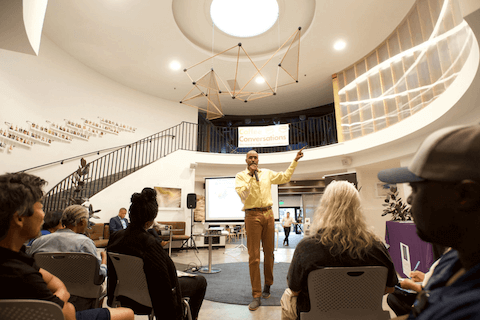
Joyce encourages community members to see things from new perspectives. Photo courtesy of James Joyce III
On one Saturday morning, when I was out campaigning, a gentleman greeted me at the door with serendipitous energy. He quickly shared with me that he plays an instrument in a band and that, “I’m not going to believe this,” but the previous night his band had played at a venue where he had just learned about me. Turns out the owner had been telling him about one of my CWABG events the venue hosted earlier in the week. He allowed me to gently roll out my rap before he interrupted with the CRT question. By this point on the campaign trail, I recognized the acronym immediately.
In so many words, he wanted to know how I thought bringing up such divisive issues, like CRT, is supposed to bring us together, even though I hadn’t brought it up. Having just come off a great community conversation with panelists about mental health and athletics, I had time that morning. So, I dove into the comparison to Dr. King—how he is heralded as a great American hero today, but suffered far more detractors than supporters while alive and active in the Civil Rights Movement. Then, I questioned how he thinks that same Dr. King will be viewed after the sealed FBI documents on him are unsealed in 2027?
There, on his doorstep, I argued that the more you know about a person or subject, the more informed your perspective is moving forward and that the same logic should apply to our complex American history. For example, there is no denying that George Washington was a visionary founding father of America. But that doesn’t negate the fact, and isn’t negated by the fact, that both he and his wife enslaved other humans, as was customary for wealthy individuals of the times.
The encounter got a bit heated, and there was a point when I was sure the neighbors heard something resembling a commotion. Everything remained respectful, though, and we were actually listening to one another through our disagreement. At one point, the gentlemen indicated his Christian beliefs. I connected with him on that, saying it was Jesus who is loosely quoted as saying that the truth shall set you free. He paused, taking in my argument, and said that I had given him some things to think about and that he shouldn’t take much more of my time. I thanked him for his time and engagement, asked for his vote, and continued to the next house.
When I ran for mayor, I offered Santa Barbara—a city that had been signifying its aim to be a model anti-racist city—something aspirational: a candidate who was not only the first Black person to run for that office, but one who showed up wholly as such. My run, in some ways, held a mirror up to the community and asked voters to step away from their tech bubbles, (surf)board meetings, microbrews and yoga classes to entrust leadership to the Black guy who’d been in the rooms—the inside outsider, or, outside insider, if you prefer.
Midway into the campaign, at a fundraising event, a supporter asked me how I liked being a candidate. No one had asked me that yet, and I had to think about it. When I finally arrived at a response, it was this: I guess I never really saw myself as a candidate. I just had another platform to be myself.
I came in second in a field of five, winning 27 percent of the votes cast.
Help us sustain independent journalism...
Our team is working hard every day to bring you compelling, carefully-crafted pieces that shed light on the pressing issues of our time. We rely on caring supporters like you to help us sustain our mission. Your support ensures that we can continue to provide deeply-reported, independent, ad-free journalism without fear, favor or pandering. Support us today and make a lasting investment in the future.
RELATED STORIES


Award Winning


Today’s environmental and social justice challenges are unprecedented, and require an unprecedented collective effort.


Stay updated on our latest features, events and more. Subscribe to our Note From the Nest newsletter!
COMMENTS

I voted for you and most everyone I know did as well. I was sort and surprised to see that you didn’t get the majority of votes. I truly believe that many Democrats voted their party’s backed candidate. I have voted Democratic all my ice and I believe they made a bad mistake. You finished second with only half of the Democratic votes in this city.
Please try again.
He fails to mention that he ran against the first Latina mayor and that his candidacy helped a cranky old white guy become mayor.
“I came in second in a field of five, winning 27 percent of the votes cast. ”
Thereby splitting the vote and throwing the election to the least liberal candidate, since SB’s mayoral election goes to the top vote getter with no runoff. It’s notable that you don’t mention this.
“I guess I never really saw myself as a candidate. I just had another platform to be myself.”
This is so casually irresponsible. There are many ways that you could have had a platform that didn’t throw the election to the conservative.
I think you ran an inspiring and thoughtful campaign. Our voting process should include a run off for the top 2 if no one got over 50%. If we did this you would have won because all the people that voted for our former mayor and other main democrat would have voted for you. Coming in second place with a fraction of the funding is also remarkable… Randy Rowse raised 263,000. Murillo 197, 000. and James Joyce 45,000. Santa Barbara has racism like everywhere else. Just last week an 8th grade black student was called the horrible “n-word” multiple times and then pummeled by three male classmates one who put his knee to his neck and said “George Floyd” and another put knee on head and also called him “George Floyd”.
It took 7 SBUSD admin. 6 days to stop stonewalling his brave mom who spoke out a public board meeting.
The admin did not call the police even though this is a hate crime. The students who did this did not even get expelled. When asked why the district did not respond immediately to the mom and let the public know as well simple said” communication is a growth area for us”, Santa Barbara does not even know how badly they need you . You are not afraid to talk about hate crimes and have experienced this directly yourself. Who better to get it and make change than someone who has experienced that kind of racism and pain. Communication, and listening should not be a growth area but a given. I am grateful you ran. You have a unique lense and a talent for deep listening and building bridges to those who don’t fully understand. Thank you James Joyce.
Santa Barbara is racist, just like the rest of America. Santa Barbara is controlled by racist white “progressives.” James’s candidacy proved how progressives are no different than white conservatives.
The white women who controlled the power base elected the incumbent Latina mayor. I witnessed the moment that told her she was a failure – she tried to be as white as possible, and it got her tossed aside. If Kathy had been true to the Latino community, they would have stood up for her – she had the lowest Latino turnout in the history of the city.
James brought to light what most of us already knew about race and politics in Santa Barbara.