You Should Know A Farmer

Food Sovereignty and the Need to Reconnect
There’s a slight lull between August heat waves on this Monday in Compton and the crew at Alma Backyard Farms is in recovery mode. The day before, an overlong line of cars crawled past on Redondo Beach Boulevard as the Alma team gave away grocery kits to South Los Angeles residents needing food during the pandemic: boxes stuffed with the farm’s organic produce, tomato sauce from Hank & Bean, even pesto from one of the farm’s clients, LA fine dining restaurant Rossoblu. The 250 boxes go fast, and the need hangs like a question over the well-tended rows of purple, yard-long beans and tall, late-summer stalks of kale: How can we increase access to this good, organic food? Alma co-founder Erika Cuellar and I sit in the produce packing area as a mercifully cool Pacific breeze blows through, talking about how to find healthy food in a neighborhood purposefully left without good grocery stores?
“I grew up in Watts, which is the neighborhood down the street, in the ‘80s,” says Cuellar, speaking through her mask. “In the neighborhood I was in, food insecurity was a big issue, gang violence was a big issue and incarceration. Having safe spaces was an issue.”
I ask how she feels now that white middle class people are all screaming that the food systems are broken?
“You’re right,” she says, “when you say the white middle class suddenly has a food supply problem, and so it becomes a problem, or everyone’s aware of it now, but in neighborhoods like South LA County, this has been an ongoing issue before a pandemic even existed here.”
When the Covid-19 pandemic shut down many of the country’s meat-packing plants last spring and stranded billions of pounds of produce in the fields, voices from food activists to Farm Bureau directors declared that the nation’s food systems were “broken.” The ruthless, Wall Street-driven push for corporate efficiencies among food companies had so thinned the supply chains that they snapped under the strain of the new illness and farmers had nowhere to go with food meant for our plates. The country watched in horror as farmers resorted to plowing onions back into the earth, killing millions of undeliverable chickens and pigs, dumping truckloads of milk and eggs, or at best giving away whole warehouses full of potatoes, while grocery store shelves sat empty.
The resulting panic over the lack of bacon, or pasta, or toilet paper was palpable. One marker? Gun sales went through the roof. But that sort of precipitous panic is also a kind of privilege enjoyed only by those accustomed to having good food readily available in the first place.
Cities and neighborhoods such as Compton or Watts do not simply experience food insecurity, they lack food sovereignty. Food sovereignty was codified at an international conference in Mali in 2007 as “the right of peoples to healthy and culturally appropriate food produced through ecologically sound and sustainable methods, and their right to define their own food and agriculture systems.” Basically, it’s the ability to have some agency in what you eat. Many Americans take it for granted, and part of the shock of this pandemic is that it’s the first time since probably WWII that a significant proportion of the white and outwardly middle class population, now facing unemployment and grocery shortages, have had to take what they can get from food charities.
In Compton, like a lot of locales in the U.S., this problem festered like an underlying condition long before Covid-19. When you have to drive past mile after mile of corner liquor stores and fast-food joints to reach a green grocer, and organic vegetables are non-existent, choices are limited and those limitations are structural: few people are growing or selling healthy produce in these communities. As a direct result, Compton has the highest obesity rates in the county, skyrocketing diabetes and hypertension and heart disease, poor school performance; even higher crime rates have been traced back to diet.
The term “food sovereignty” was coined in 1996 by an international family-farmer organization founded in Belgium, La Via Campesina, as a declared human right and rhetorical weapon in the fight against the dumping of cheap surplus food, often on impoverished populations, where it destroys their native agriculture and negatively affects their health. This doesn’t just happen in third world countries. It is happening in neighborhoods, urban and rural, all over the U.S.
Richard Garcia, co-founder of Alma Backyard Farms, talks about this as food injustice.
“Food injustice oftentimes will be referred to as a lack of access to healthy and nutritious options. There are more liquor stores on the corners than there are grocery stores. That sounds easy, like, ‘Oh, okay. So let’s get Whole Foods and Trader Joe’s in here,” he says.
“But the battle we face, the injustice, is one where people in lower-income, impoverished neighborhoods are bombarded with messages that healthy, nutritious food is something for other people. It involves a mindset.”
It wasn’t that long ago that neighborhoods such as this were brimming with fresh food. From 1909 to 1949, Los Angeles was the top-producing agricultural county in the U.S. and this area was heavily farmed. Even today, parts of Compton are zoned for Residential Agriculture, and there are a fair number of horse stables. One of the neighbors told Cuellar she could remember when Alma Backyard Farms’ location on the former softball diamonds of St. Albert the Great Catholic Church was a strawberry field.
In a way, the pandemic has evened the playing field, showing all Americans that we are no longer connected to our food sources. When the grocery stores are empty, where do you turn? The need to reconnect to the land led to a gardening frenzy in 2020, with nurseries and seed companies running out of stock, and some got involved with gleaning operations, pulling produce out of unpicked fields. But most people who could just went online, scouring Amazon and eBay and other sites for sundries to fill their pantries. Low-income neighborhoods live with this paucity of access all the time, and that disconnect destroys community and exacerbates environmental problems.
Alma Backyard Farms started in 2013 with a mission to reunite the community via the intimacy and earth-sense of fresh vegetables. “Alma” means “soul” in Spanish. Garcia, whose family is Filipino, is a former Jesuit seminarian who has done prison ministry work—he and Cuellar, whose family is Mexican, were working for Father Gregory Boyle’s Homeboy Industries when they started inviting formerly incarcerated people to work on urban farms. Their purpose was to reunite their community by empowering those released from prison to give back: to feed their neighborhood organic food. They started in backyards and built this main farm at St. Albert in 2016, opening a stand to sell to the public. They now have a second space in San Pedro, and they have seen these farms transform the neighborhoods.
“This space does what a grocery store cannot do,” says Cuellar. “Walking down a grocery store aisle isn’t going to bring you that sort of sense of belonging, that sense of ownership, the sense that we belong to each other, and that your well-being depends on my well-being.”
It’s love, in other words, that you can eat.
“Persons in low-income neighborhoods, persons of color, black, brown – too often the mindset is one where these better, nutritious foods are not relevant to the culture,” Garcia adds. “The transformation of mind and heart has to do with the transformation of your palate.”
Know A Farmer, Build A Food Community
Choking smoke from the Bobcat Wildfire just east of Los Angeles pours through my little office as I write this, a stark reminder of what’s at stake in that transformation. Industrial agriculture is a major driver of climate change. Make the connection: those same industrial food systems that are destroying the health of our low-income neighborhoods, and leaving grocery stores bare in times of crisis, while hanging the cost on farmers, are also setting our world on fire. Bad food not only expresses itself as obesity and diabetes, but also as conflagration and lung-scarring smoke.
Food sovereignty is thus also the right to control your climate future. Don’t look for that sovereignty in big technological solutions, or a new app, or corporate salvation. Look to policy, to your neighbors, and to the dirt under your feet.
That’s what my wife Lauri Kranz and I have been doing at our small urban farm in Northeast LA, where we grow organic vegetables and edible flowers. As farmers, our goals are the same as those at Alma: to reconnect people to the land and thus to one another. When Angelenos eat the modest amounts of food we grow, in a local delivery system that has proven resilient during pandemic, we want them to feel connected to us and the soil right here, where they live. We also want them to reflect on our farming methods and why they matter. Building on Lauri’s work for the past 15 years growing food in backyards, schools and institutions, we focus first on restoring soil health, meaning we can grow in perpetuity without relying on the fossil fuels and the chemical fertilizers, pesticides, herbicides, pharmaceuticals and other dangerous additives (many of which are also made from fossil fuels) that define industrial methods. We also don’t have to process or ship this food using supply chains that break down.
The food coming off such a small-production farm not only bursts with flavor, it’s a reclamation of our own health. Without it, we are all at the mercy of Nestlé (Oh, you haven’t served any Hot Pockets during quarantine?) and Yum Brands and PepsiCo and whatever it is they decide to feed us – which, as Michael Pollan so definitively demonstrated in The Omnivore’s Dilemma, is mostly derivatives of fossil-fuel-drenched industrial corn.
The pandemic made the choice between good food and just plain food real stark, and real quick: Lauri and I had only been working our little 1/3-acre farm for about six months when Los Angeles issued its Safer-at-Home order. Right away, people started contacting us about receiving home deliveries of produce. Since, as Wendell Berry wrote (borrowing a line from E.M. Forster), care for people and the land “all turns on affection,” we said yes and started scrambling.
Our first winter planting had produced an overwhelming amount of a particularly delicious arugula and borage, and some decent amounts of mustard greens, radishes, lettuces and fava beans, but nowhere near enough to make a righteous farm box. So, we got on the phone with some of the legendary farmers who supply LA’s high-end restaurants, whose unreal tastes (and unreal prices) are rooted in small, organic production. Lots of them sell at farmers’ markets, but when dine-in restaurant service was halted, these farmers lost 60-70 percent of their income overnight. They needed a kind of “food hub,” which aggregates and distributes food, to get their produce to new buyers. There wasn’t one to fill this particular gap in LA. Within about 48 hours of the first requests, Lauri and I started buying up produce from farms familiar at farm-to-table restaurants – Schaner, Weiser, Finley, Coleman, Flora Bella, T&D, Tehachapi Heritage Grain Project, Windrose, Milliken, Bub and Grandma’s Bakery and others – and making contactless deliveries to people’s homes. We became a small hub.
Since March, this is what we do five days a week, 12-14 hours a day. We lug arm-deadening crates of heavy flavor from Reed avocados to radicchio and put together farm boxes delivered by the hundreds all over the county.
It’s backbreaking labor, but I was struck immediately by the fact that we didn’t have to work nearly as hard as Alma or the other food activists toiling to change low-income foodscapes. Our market – the community of people who eat locally grown organic food – was already on board. Our delivery service fell together in two days because these relationships were already established. Lauri’s clients and contacts had known her for years. When Covid-19 disrupted the world, these people said: Oh, I know a farmer who can get us the most delicious, healthy food. And they called us.
The key to a resilient food system is relationships and community.
The pandemic has shown us that growing new, healthy food systems means using food to grow new communities. The bigger that community is, the more local food is available and the more we can drive the prices down. Hungry Americans turning to food pantries and food giveaways across the country are discovering that healthy options are rare: If you’re looking for apples or lettuce, you’re just as likely to get donated potato chips or a plastic tray of pastries. In order to control your own diet, you need to know a farmer. Do you?
The Hub
Susan Lightfoot Schempf, Associate Director at the Wallace Center, a national nonprofit widely recognized for its support of good food as a tool to build stronger communities, takes some issue with my assertion above.
“I want to be careful of assigning some particular value or goal to communities that I don’t live in,” Schempf says as we talk on the phone. “What I believe is food sovereignty is that every person and every family, every community has the agency and the ability to determine their own food future. And if that means having an ethnic market that’s importing stuff from Mexico because that’s what people value and that’s what they want, I am not going to say that that’s not okay. For me, it’s about self-determination.”
In other words, sovereignty means we have the right to grab a plastic tray of pastries or an imported bottle of French wine if we want. But if collard greens are our culturally relevant green, and climate-friendly, locally grown organic collard greens are healthy options, those need to be within reach, too. Even though the massive array of food giveaways around the country has freshly exposed the lack of food sovereignty, there is some great and interesting work being done to fill those gaps.
Asian Pacific Islander Forward Movement (APIFM), for instance, a nonprofit focused on public health and environmental justice, runs a program called Food Roots that provides access to “culturally relevant” produce for LA’s Asian American, Native Hawaiian and Pacific Islander (AANHPI) communities. The group started in 2007 and was originally called the Asian Pacific Islander Obesity Workgroup, which puts a fine point on the need for healthier food.
“One of the main things we are trying to do with that program is really reach folks who have a hard time accessing fresh and local food – whether that’s an issue of accessibility or price point,” says Program Manager Kyle Tsukahira. “Especially folks who live in food desert communities, areas that don’t have a farmers’ market [or] grocery stores where they can get these items.”
Community Supported Agriculture (CSA)-styled farm boxes have sometimes been available to his constituents, but they were usually full of vegetables that AANHPI don’t eat. Food Roots addressed this by working with Hmong growers at LA-area farmers’ markets to source sustainably grown bok choy, gai lan (a Chinese broccoli), daikon radish, Napa cabbage, Japanese sweet potatoes, taro root, and other essentials in AANHPI cooking, originally delivering them as free or pay-what-you-can farm boxes.
The boxes were popular, but in order to get off the endless cycle of grant funding, APIFM switched to a hub, aggregating similar produce from five different farms and selling it to LA-area restaurants, schools, hospitals and other nonprofits that were distributing to their constituents. The current list of participating farmers includes Dream Farms in Fresno, Yao Cheng Farms in Camarillo, Ken’s Top Notch Produce in Reedley, Rancho La Familia in Santa Maria, and Fair Hills Apple Farm in Paso Robles. AANHPI are enjoying increased access to the food and APIFM turns the profits back into programing. (Tsukahira notes that Food Roots is once again distributing food boxes during the pandemic, but they’ll go back to the hub.)
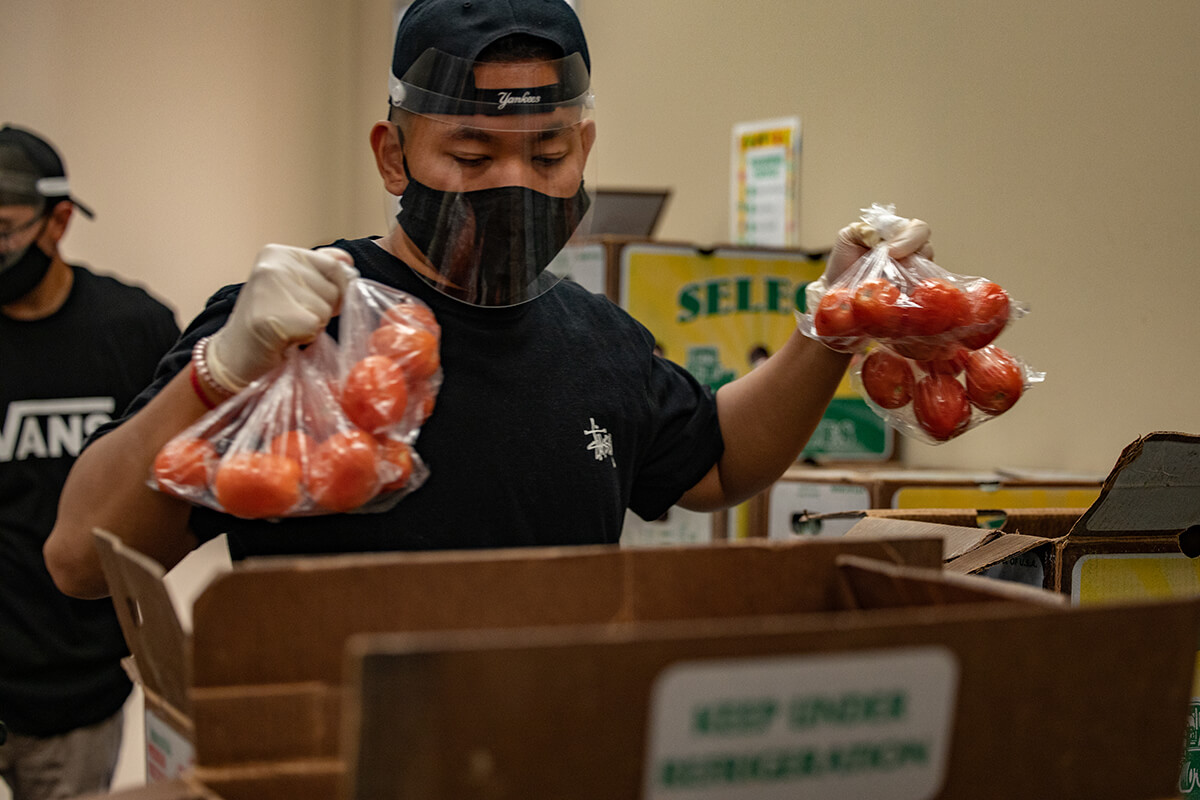
As Lauri and I discovered, the hub is a powerful tool for increasing the availability and demand for specific food items. Farmers are encouraged to put more crops in the ground, knowing the hub has multiple market outlets and thus expands their reach. A reliable buyer can even convince new farmers to start up.
It is worth noting that some of the farms participating with Food Roots make a five-hour drive to LA, which stretches the notion of even regional eating. But the same issue exists in LA’s black communities, Latinx communities, Indian, Vietnamese, Thai, Persian, and most of the other 224 language groups that reside in LA County: while they may have thriving ethnic markets, market suppliers can be disrupted; their farmers and producers are often hundreds or even thousands of miles away.
The Village Market Place Food Hub, a grocery and café set up by longtime LA action group Community Services Unlimited, offers fresh organic produce at the Paul Robeson Community Wellness Center in South LA. Süprmarkt, a pop-up market in Leimert Park spearheaded by activist Olympia Auset, is also focused on changing the situation in South LA, offering low-priced 100-percent organic produce. Both services are restricted to pick-up and delivery orders during the pandemic.
One of the groups that could really use their own hub and wholesale accounts are LA’s 10,000 street food vendors. With many restaurants closed, street vendors have become more important than ever, and they are sourcing their ingredients wherever they can get them, usually at retail prices. We think of them as offering commercial-brand ice cream on the beach or bacon-wrapped hot dogs outside a club, but they have a deeper dietary influence in the neighborhoods.
“Food street vendors are really the most accessible form of mini-restaurants for low-income communities that maybe can’t necessarily afford to go to a brick-and-mortar to access both healthy foods and culturally appropriate food,” says Erika Hernandez, associate in economic development initiatives at Inclusive Action for the City. The group has been working with vendors for years, developing the permit and food safety systems that have just gone into effect mid-summer, but also offering micro-loans and even standardizing the carts and commissaries where they park them in off-hours.
But wait, did she say “healthy” foods? Yes, when you dig deeper, many vendors are now offering options that could improve the diets of their typically low-income customers.
“I’m a pescetarian,” she notes. “Whenever I speak with the street vendors and they offer me some of their foods, I’ll be like, hey, I don’t eat that. They almost always have something else.”
One vendor named Karinna’s Catering, for instance, offers mulitas, sopes, huaraches and other dishes with a choice of protein: along with carne asada or chicken, choices include mushrooms, squash blossoms, and huitlacoche (edible corn fungus, a delicacy) and beans. Some ice cream vendors make their own ice cream using significantly less sugar than name brands. Others sell raw fruits or even raw food desserts.
“We’ve had programs in the past where we work with California FreshWorks and actually support some folks with technical assistance so that they can change their menu and create something that’s healthier for their communities,” Hernandez adds. California FreshWorks is a lending program specifically for those providing healthy food to low-income neighborhoods. “Not only are street vendors filling the food desert gap, they’re also creating culturally appropriate food.”
Is Co-operating the Key?
Tsukahira and I commiserated about the amount of work required to run a hub with only a few people. It’s hard labor. But we make it profitable for farmers and encourage them to grow more and grow better. I wrote this piece because I am thinking day and night about how to get more of our produce into underserved communities. Farmers and stable markets are the key. No Black or Latinx or Chamorro farmer is going to put crops in the ground unless they know they have a buyer who can pay their bills.
Dawn Thilmany, a well-known agricultural economist at Colorado State University, told me that hubs and co-ops are being considered everywhere now because we have to look past the farmers’ markets and direct-to-customer sales to find regional, mid-sized options for organics—options that enable wider distribution and let farmers grow at a big enough scale to make a real profit. That doesn’t mean megafarms of thousands of acres. It just means bringing in $250k instead of $60k, so that the farmer can actually pay themselves a salary.
“Some producers have definitely decided that they want a new model. But I have to tell you, [building a hub or co-op is] overwhelming and intimidating, and it’s probably why I teach it instead of do it,” admits Thilmany. “You look at the hours and the sweat and tears people put in, trying to rebuild this from scratch when the other system runs so efficiently and so effectively, it’s hard.”
By “the other system,” she means the industrial systems in which a tomato grower sells to a big packer or processor like Heinz, or a distributor like Sysco, and they come in and take everything in a matter of days, hand over a check, and the season’s done. If you want small production and sustainable and good-tasting, it’s going to be labor-intensive. If you want that as culturally relevant produce for low-income communities, it’s either going to be subsidized or the community has to go DIY.
There is precedent. Co-ops for everything from dairy to tobacco are an old idea. In the early 1980s, dairy farmers Dorathy and Phillip Barker started organizing primarily black farmers within a 50 mile radius of the town of Faison, North Carolina, aggregating, grading and distributing organic produce in a “packing shed” they called Operation Spring Plant. They didn’t call it a hub, because that word wasn’t used then. Dara Cooper, a national organizer with the National Black Food and Justice Alliance, wrote about them in a fascinating report she published in 2018, “Reframing Food Hubs: Food Hubs, Racial Equity, and Self-Determination in the South.” Operation Spring Plant sold daily to grocery stores, hotels, the local school system, and via roadside stands, creating a stable market that convinced many black farmers to transition to organic. The hub faded out in 2009, after groceries started rejecting shipments because they needed uniformity in the produce, but the Barkers are still active in this work.
The biggest and most successful hub in the U.S. is probably La Montañita in New Mexico, which started in 1976 as a co-op grocery in Albuquerque. After expanding to four stores and with 16,000 current members, it launched a distribution hub in 2006 because it was having trouble getting enough organic or sustainable produce. Restaurants and stores up and down the Rio Grande Valley through New Mexico and into Southern Colorado started clamoring for that good produce, too, so La Montañita teamed up with a famously successful co-op, the dairy people of Organic Valley, to create shared distribution routes. In the last 14 years, the hub has handled as many as 900 products from a network of 1300 local producers.
“We have so many talented growers and producers here in New Mexico, and a lot of the community just doesn’t know about it, because you’re used to going to a big-box store, because it’s just easy and convenient or financially that’s the answer for you,” says Knapp. “I know all these farmers and producers and I want to see them thrive.”
La Montañita has not, however, made serious inroads into communities of color, or into New Mexico’s several Native American communities. The produce is still too expensive and is probably not relevant.
Knapp said that when the pandemic hit, she got a call from a vegan group that wanted to distribute farm boxes to indigenous communities. “They’re like, ‘We want to get food to the native communities.’ I was like, ‘Okay, is this vegan food? Because, no offense, I don’t think that’s going to work.’
Let’s get people what they need. People are starving.”
Getting people what they need is tricky. Talking to A-dae Romero Briones, Director of Programs at First Nations Development Institute, showed me just how tricky. Native Americans farm, of course: indigenous growers in North, Central and South America were cultivating New World crops including maize, beans, squash, tomatoes, and potatoes long before Europeans arrived. But food sovereignty for First Nations doesn’t necessarily mean just having their own farms.
“Indigenous people are always interested in producing their own food, but maybe not necessarily in the farm style,” Briones told me on the phone. “So, like, all up and down the [West] Coast we have salmon people who are interested in protecting salmon and protecting their water rights because that’s their food source. In California, we have a lot of people who gather and hunt. So there’s a lot of interest in protecting those land bases. And in reality, those kinds of food production and food gathering and hunting or fishing, they have a lot of implications for the agricultural community in California, too.”
Imagine Alaskan native diets of whale, seal, walrus, ducks, berries, moose, birds and wild eggs. You’re not going to farm that stuff. You’re not going to hub it.
Native communities across the continent experience the same (or worse) inequities as most other low-income communities: lots of convenience stores and no groceries, fast food instead of healthy food, no one delivering to the rez. Briones calls these “structural weaknesses” in the food systems. And they get more global, too.
“When I say structural weakness, I’m also talking about our production practices,” she notes. “If half of our farm lands are producing corn and soy for exportation, that’s a weakness. With the pandemic, there was news of protein shortages all across the country. And we had to review, like, ‘Okay, who’s producing our protein?’ And we find out most of our protein is being shipped from other places because it’s not advantageous economically to produce our own protein anymore. So when I talk about structural weaknesses, I’m talking about the whole gamut of how America produces its food.
“But the thing is, these structural weaknesses in our supply chains and our production have always been there. Native communities have been talking about these structural weaknesses for quite a long time, but the pandemic just exacerbated them. The pandemic is only showing us who we really are.”
For all its very real horrors, the pandemic is also showing us who we can be. As Susan Lightfoot Schempf of the Wallace Center says, food sovereignty requires not just crops in the ground but also policy, and the virus has forced a few very substantial breakthroughs in the last months.
Recipients of Supplemental Nutrition Assistance Program (SNAP) benefits, America’s food stamp program, for instance, were not previously able to order groceries online. The pandemic required loosening that rule, and grocers love the new income. All manner of online apps have been born out of the pandemic, actually, including some that put consumers in touch with farmers directly. Even though many of us have romantic notions about keeping such transactions face-to-face, the current need for distancing may be showing a way to make good, local food more accessible and affordable.
Schempf also points out that it’s not just outfits like Alma or Lauri and I who are delivering farm boxes; the USDA, through its Agricultural Marketing Service (AMS), has paid for 87.9 million CSA boxes nationwide as of September 14, increasing the availability of fresh food. “A lot of people are accessing really high quality food in a way that they never have before, thanks to the Farmers to Families contractors who prioritized purchases from highly diversified local and regional farmers,” Schempf notes. “CSAs have often been too expensive for a family to be able to really buy, or just, like, the model is not understandable. I think this could actually open up a whole new consumer base of folks that are more interested in having that farm-direct food.”
Most of those getting USDA contracts to aggregate the “Farmers to Families” boxes are farms and large produce distributors. But with the USDA now deep into consumer food purchasing, some creative thinking could change the healthy food landscape in a big way. SNAP is already being accepted by groups like Süprmarkt, and some existing CSA programs accept SNAP and use the USDA-funded Gus Schumacher Nutrition Incentive Program, or GusNIP, to make them more affordable. Government procurement could be leveraged in smart ways to further drive purchases of healthy food directly from farmers.
The Farm Bill, a fine-print behemoth that governs all federal farm policy including SNAP, is revised every five years, also needs to be reframed. It heavily incentivizes the overproduction of commodity corn and soy and feedlot beef that end up producing those high-calorie, low-nutrient processed foods that are driving obesity and food-related illnesses. These policies are not chiseled in stone; they were created during the 20th Century and can be changed. It’s just going to require votes and creative, systems thinking.
“I think that if we were to reframe food as a right, that that would open up a lot of processes. In other places across the world, it is seen as a right,” says Schempf. “It ultimately comes down to issues of power and access to decision making, because we could change that framework pretty quickly if we had different people making the rules.”
Engage
Alma Backyard Farms, Urban Farming in Compton, Los Angeles – almabackyardfarms.com
Food First, The Institute for Food and Development Policy – foodfirst.org
La Via Campesina, International Peasant’s Movement – viacampesina.org
Michael Pollan, The Omnivore’s Dilemma – michaelpollan.com
Asian Pacific Islander Forward Movement – apifm.org
Süprmarkt – suprmarkt.la
Inclusive Action for the City – inclusiveaction.org
National Black Food & Justice Alliance – blackfoodjustice.com
First Nations Development Institute – firstnations.org
Edible Gardens LA – ediblegardensla.com
Wallace Center – wallacecenter.org
Food Systems Leadership Network – foodsystemsleadershipnetwork.
-
Photo Credit: Sam Slovick
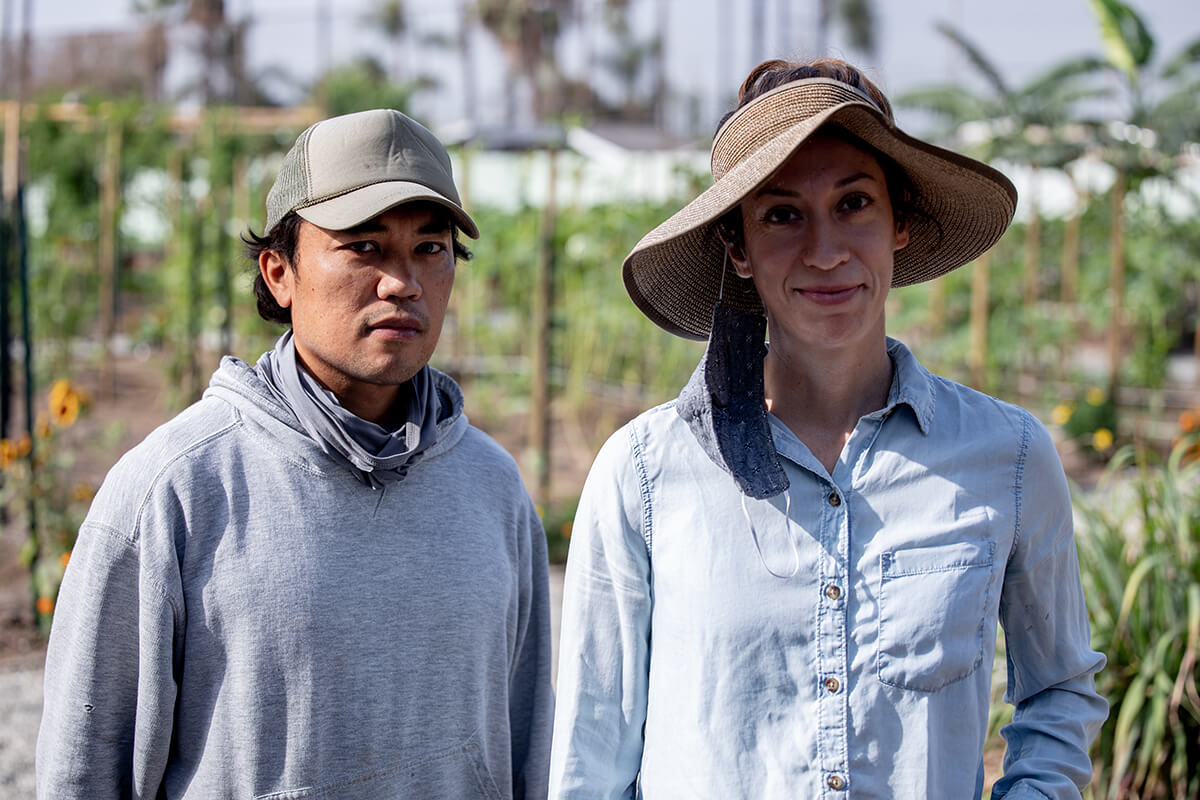
Down on the Farm: Alma Farm’s Erika Cueller and Richard Garcia
“We create food security and safe places,” says Cueller, “and we do this through training, education and access to good, high quality, fresh food.” -
Photo Credit: Sam Slovick
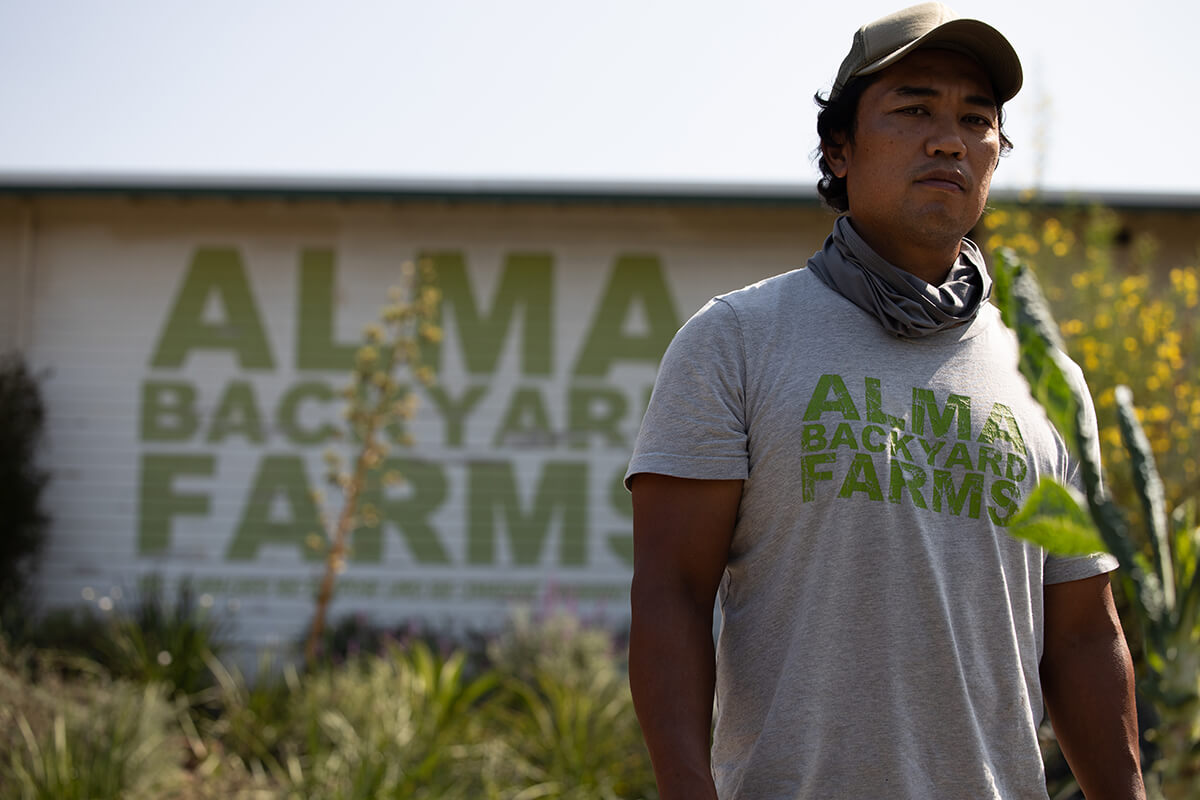
You Should Know This Farmer: Richard Garcia of Alma Farms
Every two weeks, Alma Farms gives away 200 grocery kits, filled with fresh produce, pantry staples, prepared foods and water to communities of color in Compton. -
Photo Credit: Sam Slovick
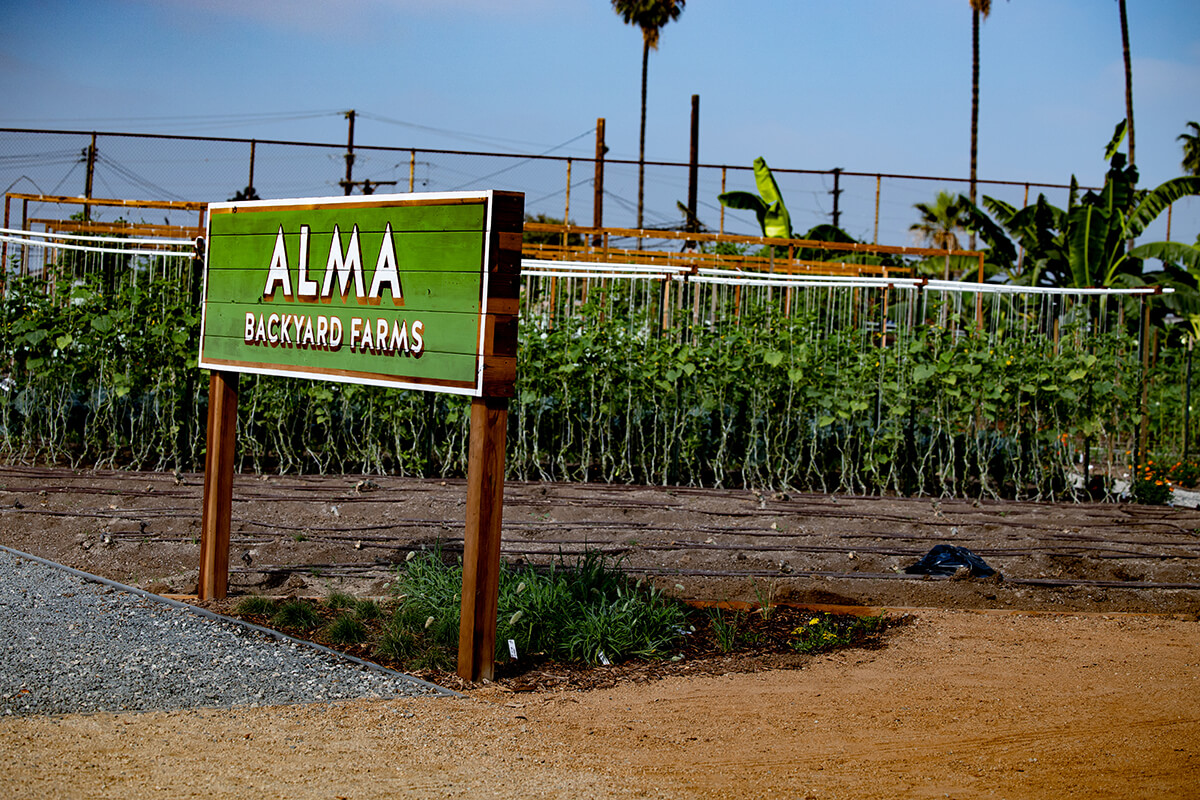
Urban Oasis
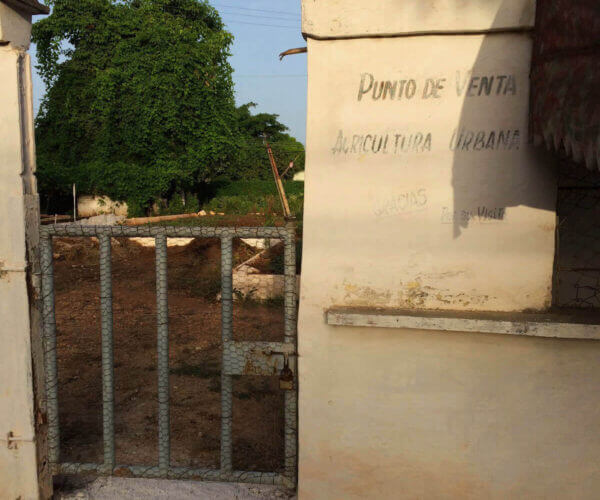
This sign points the way to food sovereignty. -
Photo Credit: Sam Slovick
Getting back to healthy roots
The Asian Pacific Islander Forward Movement (APIFM) “Food Roots Program,” located in downtown Los Angeles is partnering with local Asian American growers and serving communities all over L.A. county. David Mey of APIFM helps pack a food box. -
Photo Credit: Sam Slovick
Teach The Children Well
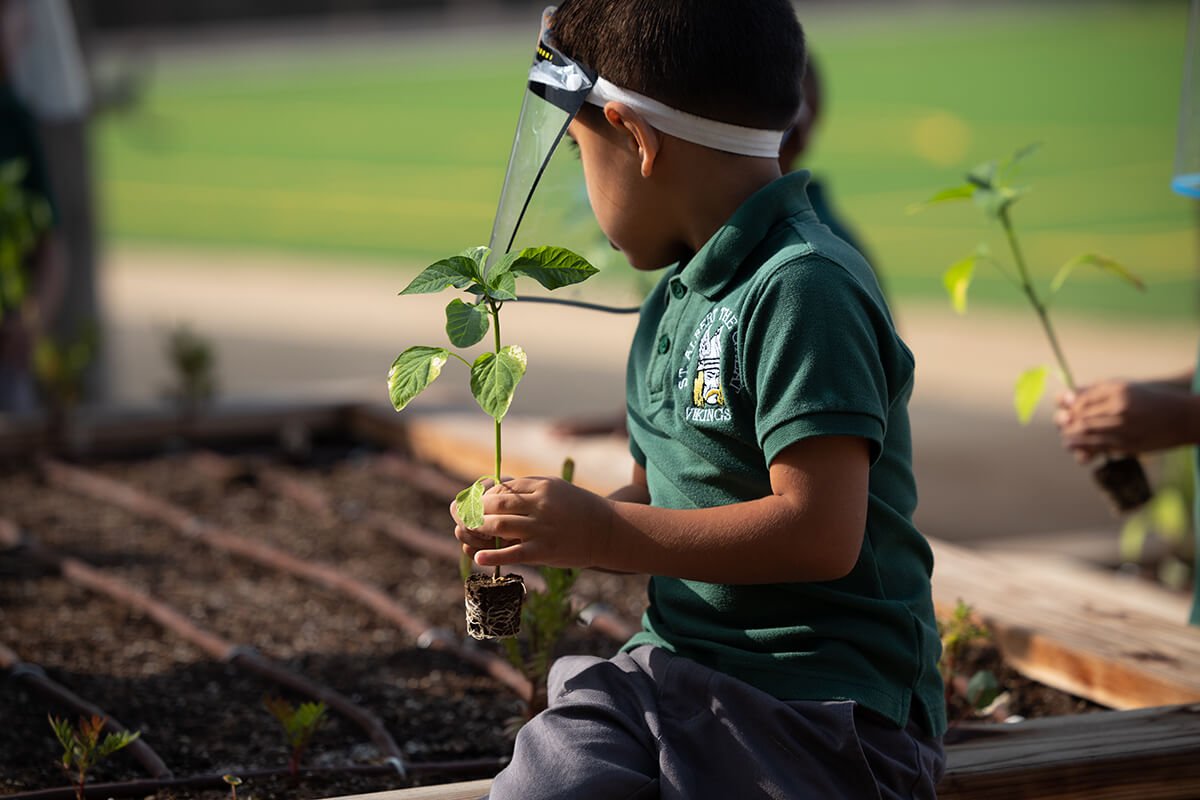
“I think the hope in all of this, and the light, ” says Erica Cuellar, “is that we get to teach people how to work the dirt. That connection will help transform the way that people live.”
Help us sustain independent journalism...
Our team is working hard every day to bring you compelling, carefully-crafted pieces that shed light on the pressing issues of our time. We rely on caring supporters like you to help us sustain our mission. Your support ensures that we can continue to provide deeply-reported, independent, ad-free journalism without fear, favor or pandering. Support us today and make a lasting investment in the future.

RELATED STORIES

Award Winning



Today’s environmental and social justice challenges are unprecedented, and require an unprecedented collective effort.


Stay updated on our latest features, events and more. Subscribe to our Note From the Nest newsletter!

You ought to think about creating this blog as a significant authority on this market. You evidently have a grasp of the topics everyone seems to be trying to find on the internet. In any case, you could actually even earn a buck or two off of some advertisements. Only a thought, good luck no matter you do!
This article was extremely interesting, especially since I was searching for thoughts on this subject last Thursday.