Coffee, Community, Connection

The first thing to greet you is the aroma of fresh-brewed coffee. The second is the lone bottle of hand sanitizer positioned directly in front of the door and a sign that says “Wear a Mask.” Working the cash register, or what would be deemed a cash register in today’s age, is a tall, African American man. He has no hair on his head and a smile in his eyes. He’s wearing a black shirt with the name of the café written on his chest, and a black mask underneath a relatively clean face shield. In the left corner of his chest is a name tag with a simple name: Joe. To the right of him, written on the wall, are three words in all caps: COFFEE. COMMUNITY. CONNECTION.
You can find the bustling, mom-and-pop coffee shop called South LA Cafe on the corner of South Western and Browning. There isn’t a long line of people wrapped around the block, but the shop maintains a constant flow of customers, with an individual or group of people walking through the front door every few minutes. Joe, the co-owner of the South LA Café, personally makes sure to say hello to any and all customers that he sees.
Joe Ward-Wallace has lived in South Los Angeles his entire life. And, prior to owning this spot, he had worked nearly every variety of job under the sun. Exterminator, firefighter, car salesman, insurance agent, high school basketball coach; you name it, and he might have done it. But, Ward-Wallace aspired to open a café for nearly two decades. Despite his long simmering desire, though, it was a misstep that finally led him to open this one.
It happened like this. Ward-Wallace was in the process of leaving his job as a firefighter when one day he was driving down Western Avenue — something he claims he wouldn’t have done had he not missed his off ramp at Normandie. His late mother had lived in the area, so he knew it well. But, he never paid much attention to the corner where his cafe now operates. What he did know was that the space on the corner of Wester and Browning had hosted several businesses before, and was even a church at one point. As he drove by, he noticed a giant sign that said “For Lease” and decided to take a look.
“It was a mess!” he says, describing the dirty, rose-colored exterior with patches of missing paint and tagging all across one of the walls. Still, he couldn’t help but immediately think “Coffee!”
***
Ward-Wallace is not one to play it safe, but he rarely takes risks that could financially ruin himself and his family. This coffee shop idea, though, was definitely a risk. It had basically drained his finances even before he opened the store. Still, he knew he wanted to take this risk for his community.
“This shop wouldn’t exist if it wasn’t for the community,” he says. This was the first of several occasions Ward-Wallace would tear up when speaking of the four months leading up to the opening of South LA Cafe — a topic that softens his usual animated mannerisms.
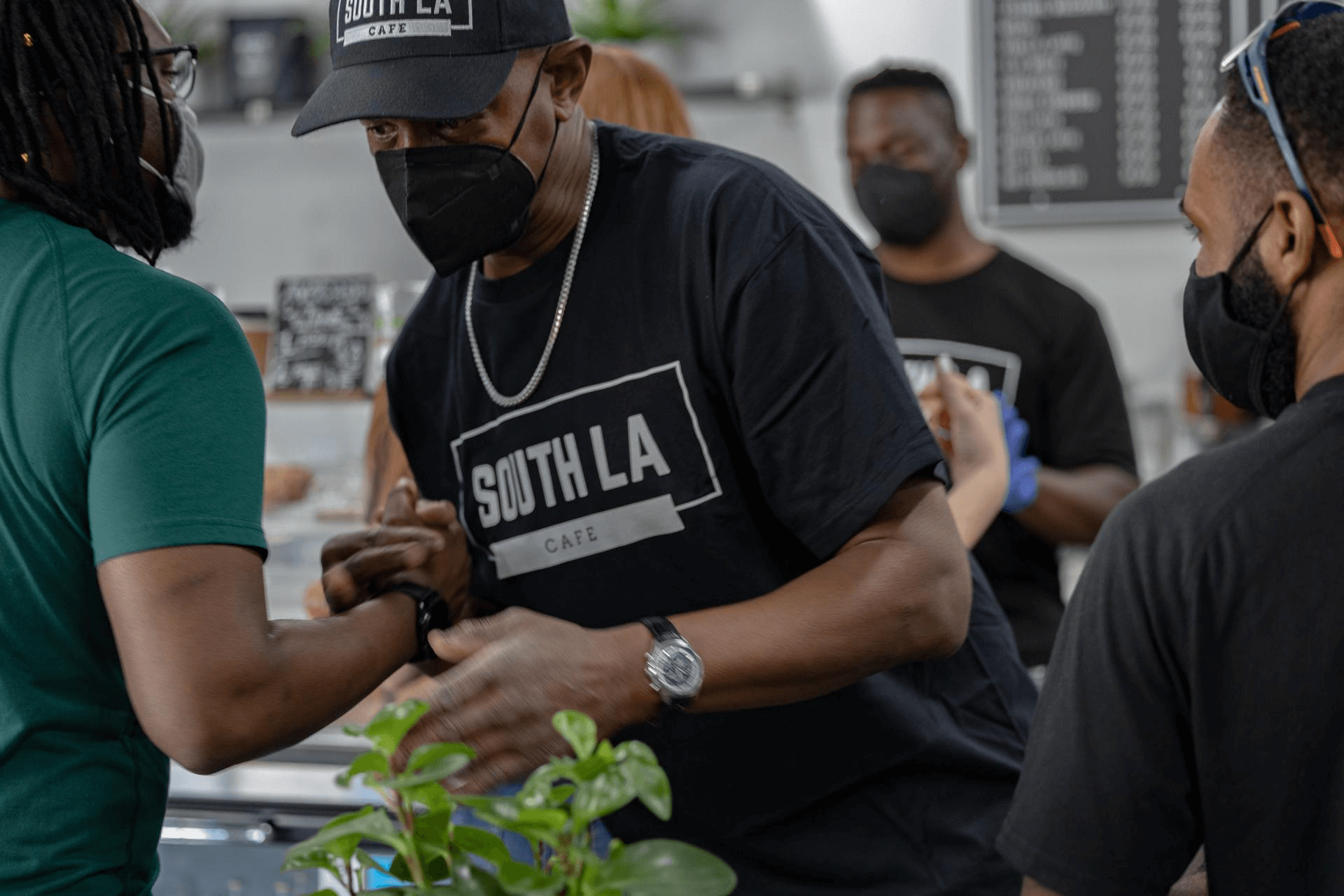
Building community within their community. Photo by Sam Slovick
When he was in the process of building out the space, Ward-Wallace ran out of money. He couldn’t get a loan to finish furnishing the café without having the city sign off on it being a occupiable space, which also cost money he didn’t have. His only option was to ask his community for help — help he wasn’t entirely sure he would get.
“We needed $30,000 at that point, or we weren’t going to open. That’s where we were. We had spent all this money, and I knew God was gonna make a way. But I was in the position of reality! Nobody’s coming to my rescue,” is how he puts it. Obviously, we know where this story goes, since we are talking during a bustling afternoon at the cafe. Still, how could Ward-Wallace or his family have expected the community would rally together and donate over $30,000 to help him realize his dream?
He remembers the day his community came through for him. He was traveling with his wife for their anniversary, which was an annual tradition that he had no intention of breaking, regardless of the pressure he felt to complete the Cafe. During the trip, he refused to check his phone or the GoFundMe account they had set up as a last effort to call upon their community.
Ward-Wallace had no way of knowing that when he would check his phone and look at the the account, he would see $30,000 of funds raised by the people in the community. There was one anonymous donor who gave $15,000. Ward-Wallace attributes much of the cafe’s success to this donor, though they still remain unknown.
Ward-Wallace says his community helped him when he needed it the most and continue to help when he gets another outlandish idea to provide more resources to the community. Due to their support, Ward-Wallace is able to host weekly grocery giveaways and maintain the South LA Market, the tiny grocery store that had opened months before the café was fully built and now remains open despite not really earning a profit.
“I know this place. Whatever we do with this community turns to gold. I could say anything, and this community wraps their arms around us and say, ‘You’re going to be successful.’ That was the beginning. That was the proof,” he says, chuckling a bit to avoid sentimental tears.
***
It would be hard for a customer to feel anything but ease inside the Cafe. Before the COVID outbreak, the space felt like a scene from your favorite sitcom: four-person black-colored tables that always seem to be occupied, faux plants strategically placed around the room to add color and life, and music that plays at just the right volume so as to not drown out conversation. On your left, there is a small couch with a faux grass wall behind it. Look to your right, and there is a giant portrait painting of Nipsey Hustle — who Ward-Wallace actually met before his death — occupying the majority of the wall space in the conference room (or, as the owners call it, the Nipsey Hustle studio).
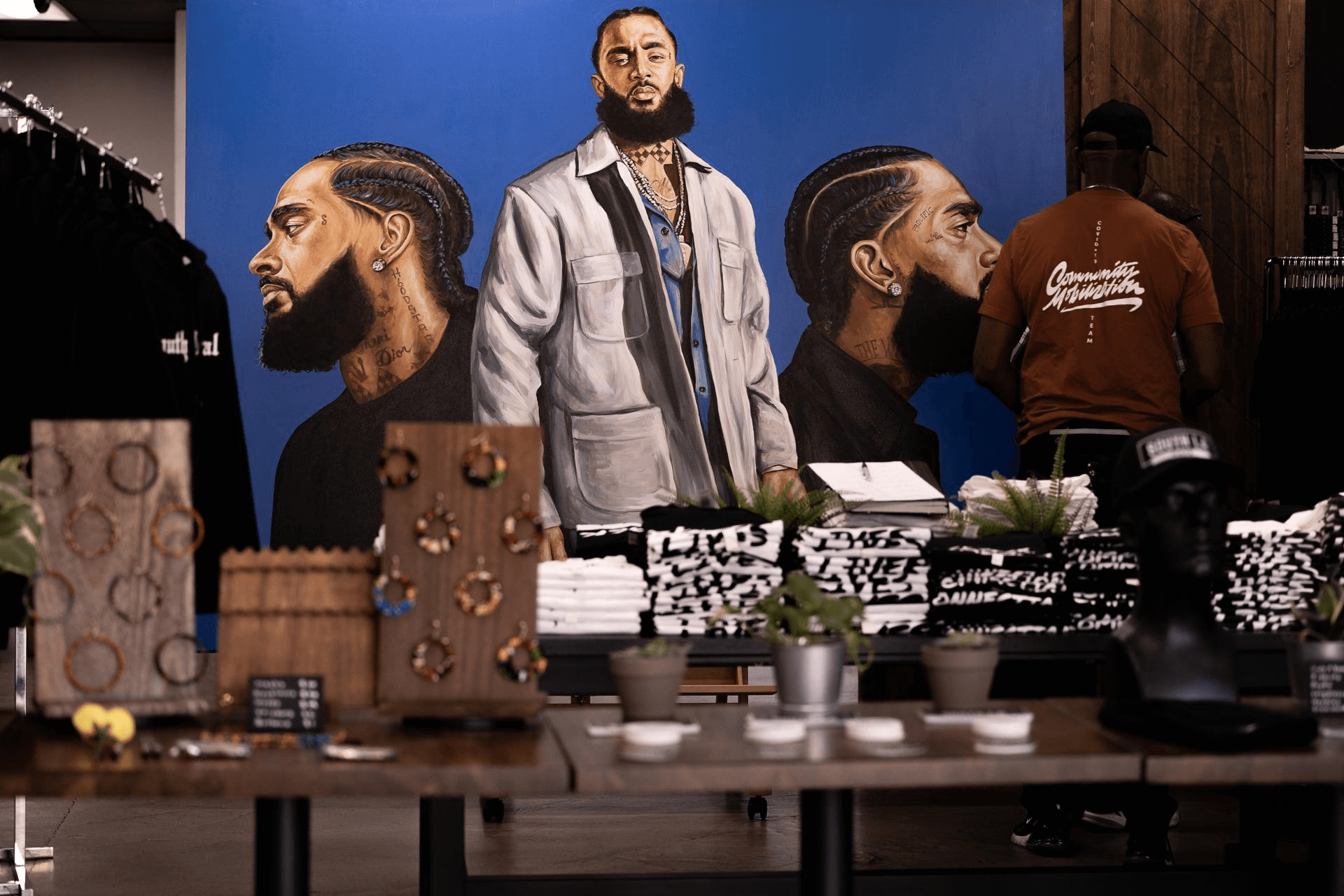
Entering the “Nipsey Hustle studio.” Photo by Sam Slovick
One customer, a teacher at the charter school directly across the street from the South LA Café, admits to buying their coffee at least once or twice a week. “All of the other teachers always come here. You know, it’s kind of a food desert out here. There’s not a whole ton of appealing options. And, [that’s] not to say that this was a last resort. When you do come here, you realize how incredible it is and you just want to keep coming back,” they say, while picking up their order.
As part of his commitment to the community, Ward-Wallace periodically hosts several community events in the cafe space. They’ve hosted panels that open discussion around mental health, community party nights, college date mixers and open mic nights. Throughout the pandemic, South LA Cafe has provided free, rapid COVID tests and healthcare clinic events. At one point, a church even decided to hold service at the café.
They’ve also collaborated with authors like Bethanee Epifani, business owners like Fatima Dodson and organizations like Community Coalition to host watch parties, workshops and promote other local businesses. While Ward-Wallace may lead some events himself, many of these were run by community members coming to him and asking if they could use his space.
He rarely ever says no to his community’s requests and needs— a sentiment could not have been conveyed more than during the initial COVID outbreak.
He and his family were worried, not just for the safety of their young daughters — who they had stopped allowing to work at the café — but also for their community as a whole. While he did worry about whether or not his business was ready to make the mandatory shift, he couldn’t help but focus his concerns around the community.
“I was thinking the worst. I thought the streets were gonna be closed. So, I said, ‘they gotta have groceries. People around here are gonna die.’ I mean, not die. But they’re gonna start getting desperate — you know,” he says. “I don’t want my neighbors and my community any worse than they are.”. And, his worry did not come without reason. According to the LA County Economic Development Corporation, over 437,000 jobs were lost and 354,000 fewer workers held living wage jobs in LA County by the end of 2020.
Small businesses and restaurants across LA County had to either switch to delivery only — in which delivery services splits part of the business’ revenue — or close for the foreseeable future and hope that they had enough money to not have to close permanently. Sadly, the latter outcome was the reality for over 15,000 small businesses in LA County since 2020, according to the LA County Department of Workforce Development, Aging and Community Service.
South LA isn’t the poorest neighborhood in the city, but it’s not a wealthy one either. Ward-Wallace talks about how the area where his café is situated doesn’t get a lot of attention from city provided-resources. When your community doesn’t have anyone’s attention, you often get forgotten. Being forgotten during a pandemic means missing out on resources — including necessities such as access to testing and hospitals, protection from illness and infection and a better chances at surviving.
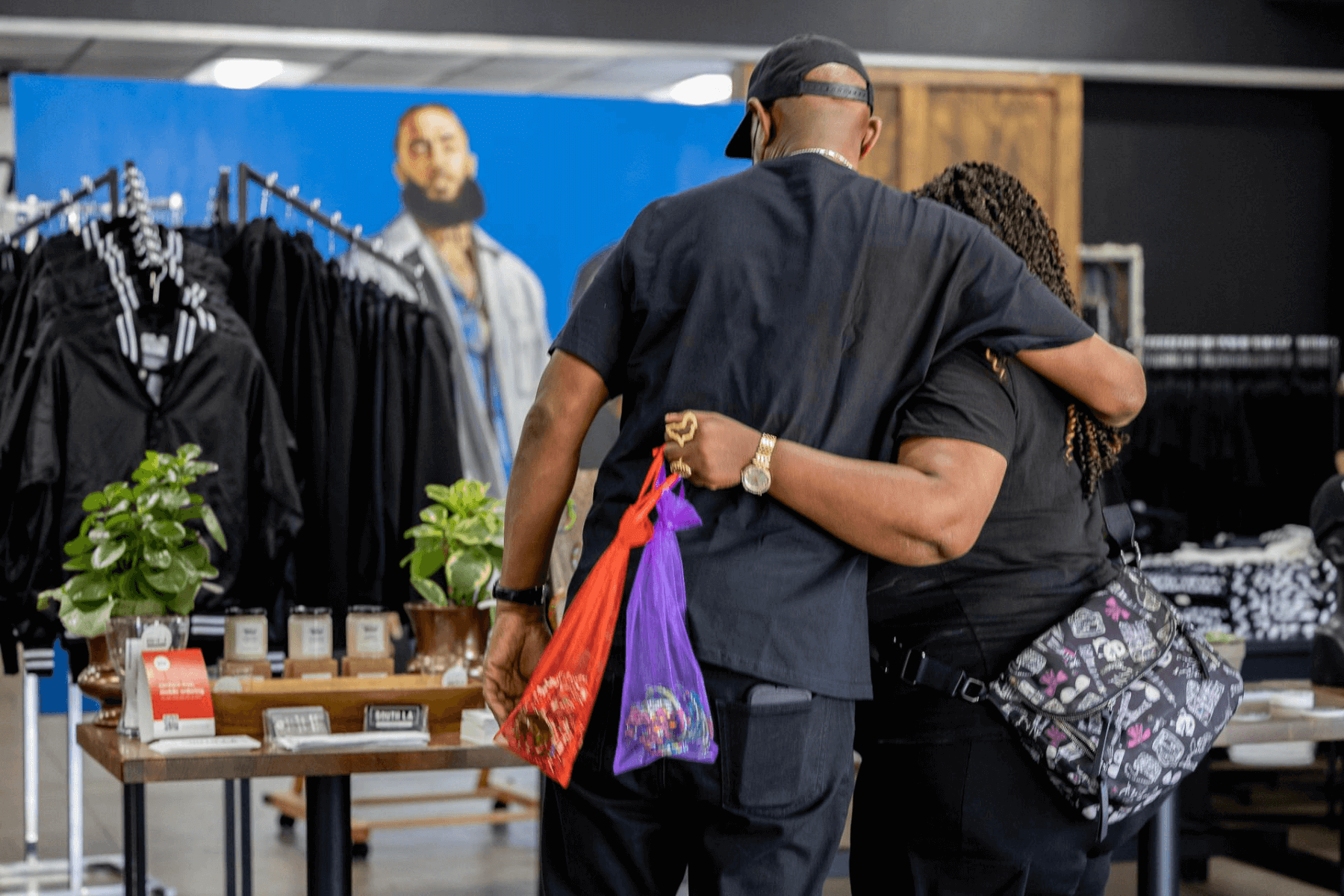
Ward-Wallace has built special connections and provided a support system for his community. Photo by Sam Slovick
Ward-Wallace didn’t want his community to be ignored and forgotten at a time when they needed the help from others the most. He brainstormed the grocery giveaway, which allowed others to buy themselves or buy someone else a box of groceries with the goal of feeding those who can’t always get themselves to the store. But, he needed support to make this happen, and again, he didn’t want to expect much during an already difficult time. He definitely wasn’t expecting the constant ringing of his phone at 4:30 in the morning with hundreds of people buying or sponsoring boxes shortly after the program launched.
“We had built some kind of crazy cult following! It was crazy, man,” he says, still in disbelief that people are still donating thousands of dollars on a monthly basis to support the program. In the beginning, he had a rented U-Haul filled with boxes of food and was personally delivering each box to houses and families in South Central. The labor-intensive system was not physically sustainable for his body, so he realized that he could have those in need come to him when they needed their groceries. Nowadays, when you walk into the café, you may get a chance to see the six or seven rows of black, reusable bags filled with food and groceries — lined up like soldiers, waiting for people to take and use.
***
Ward-Wallace genuinely loves people, and he genuinely loves his community. He fights for the rights of Black people and uses his café as a means for activism. He doesn’t turn away small businesses who wish to collaborate with him and his space, and he welcomes people who use his cafe as their office. His regulars have picked up on his genuine intentions and understand his philosophy to help his community.
“Community is one of their values,” one customer says. “And that really shows in the way that they connect to their customers and the overall work that they do.”
It’s because of this connection that South LA Café is as successful and charitable as it is today. Though it started as an idea for a 600 square foot, relaxed place for his friends and his daughters’ friends, the Cafe morphed into this community hangout and pseudo-workplace — a space for coffee, conferences, business meetings and parties. It is a space where you could feel comfortable sitting down and staying all day, even if you had no intention — or ability — to buy something. It is a space with, in my opinion, the best butter croissants I’ve had.
“We want to make this place feel like home,” Isaiah Coronado, one of Ward-Wallace’s employees, says. And it feels like that’s what they accomplished. Ward-Wallace created a space that could feel like home — not just for him and his family, but for him and his community.
Help us sustain independent journalism...
Our team is working hard every day to bring you compelling, carefully-crafted pieces that shed light on the pressing issues of our time. We rely on caring supporters like you to help us sustain our mission. Your support ensures that we can continue to provide deeply-reported, independent, ad-free journalism without fear, favor or pandering. Support us today and make a lasting investment in the future.
RELATED STORIES


Award Winning


Today’s environmental and social justice challenges are unprecedented, and require an unprecedented collective effort.


Stay updated on our latest features, events and more. Subscribe to our Note From the Nest newsletter!

You’re not an amateur writer, Jayson. You’re clearly a pro.
A wonderful story!
Prof. Wendy Furman-Adams