
Proof of Life
Readers seeking what the British evolutionary biologist Richard Dawkins once described as “that authentic tingling up the spine” sparked by great popular-science writing are fortunate these days. Rebecca Skloot (The Immortal Life of Henrietta Lacks), Carl Zimmer (She Has Her Mother’s Laugh), Helen Macdonald (H Is for Hawk), and a host of other writers routinely transmute arcane research, subject-specific jargon and hard data into something indistinguishable from literature.
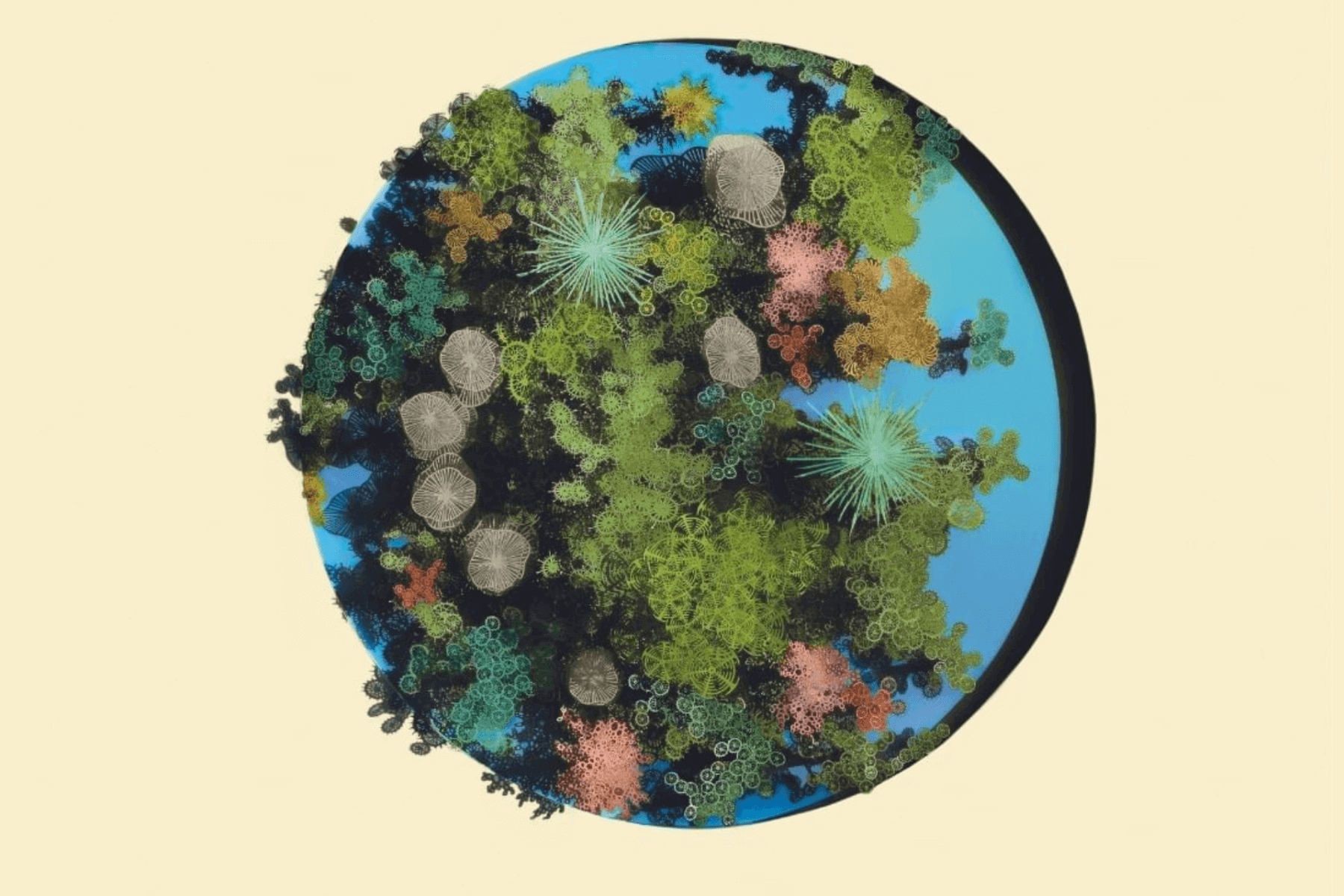
Now, in Becoming Earth: How Our Planet Came to Life, the young journalist Ferris Jabr — a contributor to The New York Times Magazine, Scientific American and The Atlantic, among others — has produced an electrifying debut that earns its place alongside the best of today’s essential popular science books, as well as acknowledged classics like Natalie Angier’s Woman, Carl Sagan’s The Dragons of Eden, Loren Eiseley’s The Immense Journey, and other groundbreaking works.
In fact, Becoming Earth might just outstrip a few of those other titles in one respect: its sheer audacity. In a book roughly as long (or short) as, say, Flannery O’Connor’s Wise Blood, Jabr ranges across continents, eons, theories, counter-theories and, often, acrimonious disputes in order to examine nothing less than why the Earth’s geological, biological and chemical systems behave the way they do.
In the Introduction, Jabr notes that “conventional [scientific] wisdom holds that life is subject to its environment…Life evolved on Earth because Earth is suitable for life.”
That assertion, however, is not the sum of it for Jabr. Without dismissing what he calls the “prevailing scientific paradigms,” e.g., that “the ever-shifting demands of the environment largely dictate how life evolves,” Jabr widens the lens through which we view everything from the rise and fall of mountain ranges to the astonishing stores of energy latent in microscopic plankton. The acknowledged truth of the Darwinian paradigm of environment-driven natural selection and species change, he writes, “has an underappreciated twin: life changes its environment, too.”
In Becoming Earth Jabr proposes, in effect, a contemporary, data-based view of our planet as a living organism — a view widely known as the “Gaia hypothesis,” named after the goddess who personified the Earth in Greek mythology and articulated in the 1970s by British chemist James Lovelock.
At the risk of oversimplifying, Gaia proposes that far from a lump of lava, water and dirt surrounded by a gaseous membrane of nitrogen and oxygen and upon which life goes about its evolutionary business, the Earth itself is alive.
The hypothesis is more nuanced and complex than that, of course, and Lovelock himself revisited and reconfigured the basic premise again and again over his long life. (He died in 2022, at 103 years old.) While self-evident to numberless cultures and faiths, Gaia was met with resistance and even vitriol by scientists across virtually all disciplines when Lovelock and the American microbiologist Lynn Margulis first formulated the hypothesis not long after the first Earth Day was celebrated in April 1970.
Ironically, perhaps, the most compelling argument against Gaia is one of the simplest: in short, regarding Earth as alive also demands that we look for, or show in reproducible experiments, evidence of the planet’s evolution as a whole. As W. Ford Doolittle, a professor in biochemistry and molecular biology at Dalhousie University in Canada, has noted when weighing the solidity of the “living organism” argument:
Lovelock even ventured that algal mats have evolved so as to control global temperature, while Australia’s Great Barrier Reef might be a “partly finished project for an evaporation lagoon,” whose purpose was to control oceanic salinity…. Viewing many Earthly features as biological products might well have been extraordinarily fruitful, generating much good science, but Earth is nothing like an evolved organism. Algal mats and coral reefs are just not “adaptations” that enhance Earth’s “fitness” in the same way that eyes and wings contribute to the fitness of birds. Darwinian natural selection doesn’t work that way. (Emphasis Doolittle’s).
To Jabr’s credit, he acknowledges the holes in the Gaia hypothesis. He also helpfully provides an Author’s Note, “The Evolving Definition of Gaia,” that outlines the slippery nature of the concept over time, as well as how, in one of those perverse twists that arise when politics and science collide, “Gaia [eventually] became a tool of climate change denialism” for the fossil fuel industry and others.
Ultimately, Jabr stops short of claiming that a living planet evolves in the classic, Darwinian sense. What he does claim, and what he sets out to show in every chapter of the book, is that Earthly life itself serves (as he put it in a recent interview) “as an engine of planetary evolution…It is not exactly the same as standard Darwinian evolution through natural selection, but it is very much a type of evolution.”
With that proposition in mind (that “life gives our planet an anatomy and physiology — breath, pulse, and metabolism”), he sets off on a journey around the globe, seeking data to fortify his position. And it’s here, alongside the men and women he encounters on his travels, that the book’s strengths and its humane charm are most evident.
***
Among the scientists Jabr accompanies on their often strange and daring pursuits is Vitul Agarwal, an oceanographer in Rhode Island who spends his days on, near, and in the ocean. When he’s on land, Vitul is often peering through powerful microscopes at almost magically multivariate plankton. We also meet Agarwal’s graduate advisor, Susanne Menden-Deuer, who is, if possible, even more plankton-struck than her student. ”Plankton…are literally the engines that make biogeochemical cycles work. Plankton make Earth habitable,” she tells Jabr.
Then, there is Sergey Zimov and his son, Nikita, who created and maintain an experimental nature reserve in Siberia called Pleistocene Park, which they hope to populate with megafauna to combat the destruction and warming of the tundra. In Brazil, we encounter atmospheric scientists and others working at the Amazon Tall Tower Observatory who climb a slender, 1,066-foot-tall steel observation tower (taller than the tallest building in South America) to a point “halfway between the trees and clouds…to see the Amazon make its own rain.”
At every juncture, Jabr finds scientists who, whether they adhere to Gaia or not, are driving a “major reformation” of “the scientific understanding of life’s relationship to the planet.” In Jabr’s eyes, the implications of this research are elemental and profound.
We and other living creatures are more than inhabitants of Earth; we are Earth – an outgrowth of its physical structure and an engine of its global cycles. Earth and its creatures are so closely intertwined that we can think of them as one.
Evidence for this inclusive — one might say holistic — take on what hugely popular YouTuber, novelist, and science guy Hank Green winningly calls “by far, the best planet,” is apparently everywhere. One just has to look.
It’s in subterranean microbes that “carve vast underground caverns…and may even have helped to construct the continents.” It’s in the Arctic tundra, where roughly 50,000 years ago, the behavior of megafauna like mammoths, bison, and rhinoceros, predators like bears and dire wolves, and grazers like horses, reindeer, and sheep “created and regulated the mammoth steppe ecosystem.” It’s in the forests of giant kelp, enormous “carbon-sucking machines,” in the waters just off Catalina Island.
At every stop on his global jaunt, Jabr encounters data suggesting that “the history of life on Earth is the history of life remaking Earth” — not the other way around.
In the end, Jabr’s choice to let the words of the scientists he encounters, and their data, bolster his argument about “how our planet came to life” gives the entire endeavor a dramatic, and convincing, air: the narrative seduces as it persuades.
Which is to say, the book is a joy to read. It’s not just the striking lines that Jabr drops, like small gems, along the way. (Wrangel Island, he writes, is “a toupée-shaped blob of tundra” 90 miles off the coast of Russia. Look it up on Google Maps; it’s shaped exactly like a toupée, but only a singular imagination would see it that way.) There are longer passages, too, that glitter in the reader’s memory, as when Jabr describes a heart-stopping encounter in Sergey Zimov’s Pleistocene Park:
I was drawn to a yak with a coat of mottled cream and cinnamon. Her curtains of fur were so gloriously long and thick they obscured her belly and flowed halfway down her face. I moved closer until I was just a few feet from where she was grazing. She didn’t bellow or startle or move a single limb. For several minutes she didn’t seem to notice me at all. Eventually she lifted her head, tossed her bangs to the side, and appraised me with an obsidian eye. Then she lowered her gaze and resumed chewing.
Scenes of this sort, and there are a lot of them, are marvelous not only because they’re written in sharp, unfussy English, but because with a bit of literary legerdemain — diving deep into the science, then abruptly drawing us into the unscientific everyday — Jabr readies us for wonder.
We push with him through thickets of unassailable research, alarming facts, vivid personalities and sobering speculation. When we emerge, a bit dazed, and are faced with something that in other circumstances might be unspectacular — a yak, supremely in her element, minding her own business, chewing her cud — we see the planet that sustains it, and us, more clearly, as if with new eyes. We see Earth for the revelation, the anomaly and the prodigy that it is.
Help us sustain independent journalism...
Our team is working hard every day to bring you compelling, carefully-crafted pieces that shed light on the pressing issues of our time. We rely on caring supporters like you to help us sustain our mission. Your support ensures that we can continue to provide deeply-reported, independent, ad-free journalism without fear, favor or pandering. Support us today and make a lasting investment in the future.

RELATED STORIES
Award Winning



Today’s environmental and social justice challenges are unprecedented, and require an unprecedented collective effort.


Stay updated on our latest features, events and more. Subscribe to our Note From the Nest newsletter!
