
Echoing the Past, Processing the Future
In 1965, Joan Didion expressed her frustrations with the inaccurate chronicling of Southern California by outsiders, writing: “Easterners commonly complain that there is no ‘weather’ at all in Southern California, that the days and the seasons slip by relentlessly, numbingly bland. This is quite misleading.” Yet, this misunderstanding of California’s climate spans past its weather and its mild Zone 6 climate. The art scene is also much more diverse — in personalities and mediums — than non-natives would speculate.
Beneath the superficial idealizations of what Los Angeles life is presented as in movies and television rests a complex space where art and culture collide. To the mere visitor of Southern California, street murals might be the most frequent encounter with art amidst the everyday freeway-filled landscape. Yet, the collection of 44 artists curated by Tlaloc Studios and Thinkspace Projects in this summer’s AHORA exhibit shines a light on more, countering the one-dimensional myth of West Coast artistry by intertwining themes of nostalgia, Southern California and the intricate now across varying mediums.
Tlaloc Studios, named in reference to the Aztec god of rain, debuted their first exhibit in South Central Los Angeles last March. Founded by Compton-native, Ozzie Juarez, the exhibition and working space replaces former owners, Dalton Warehouse. Amid a wave of anti-gentrification protests directed at Dalton Warehouse from community activists, Tlaloc Studios’ dedication to bolstering LA-native artists stands out from the previous occupants of the studio space, offering an artistic space for mediums that are traditionally found on the streets.
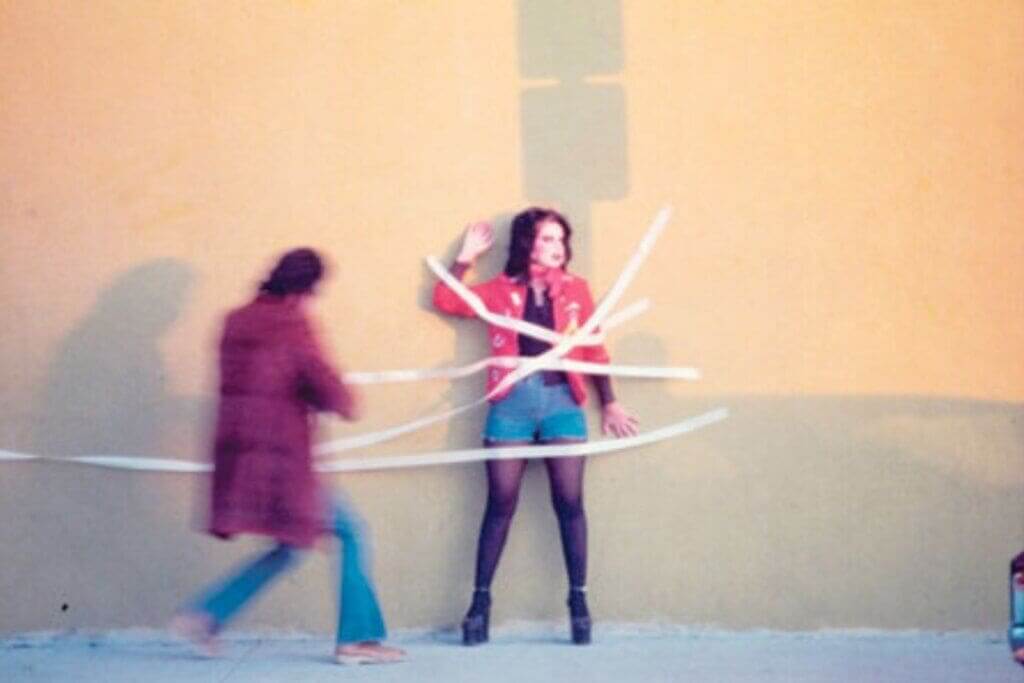
Instant Mural by the ASCO art collective, featuring Patssi Valdez and Humberto Sandoval. Courtesy of ASCO
Transforming the stereotypes and outsider projections into pinpointed artistic proclamations isn’t a new sentiment. Thrust into the whirlwind of the ’70s Chicano Walkouts and Chicano Moratorium, ASCO’s co-founders Harry Gamboa Jr., Willie Herron III, Gronk and Patssi Valdezs’ emergence into the experimental art world of LA was heavily intertwined with the urgency of the political moment of the time. East LA’s organized response to the systematic inequalities in public schools and the disproportionate death and exploitation of Mexican-Americans in the Vietnam War ushered in a new wave of creativity that was necessary to amplify attention to the myriad of issues plaguing the community.
The lasting impression of AHORA, like ASCO’s early monumental work, uniquely echoes the past while honoring how to process our current reality.
With the goal of expressing anti-war sentiments and expanding the limits of Chicano art in 1970s LA, ASCO’s public art piece Instant Mural features members Patssi Valdez and Humberto Sandoval duct-taped to a public wall. In many ways, the rebellious frequency that ASCO was tuned to throughout the 1970s and 1980s parallels the new-age creativity of the artists in AHORA.
Set to a backdrop of external collapse, public life becomes a creative playground and nostalgia serves an artistic purpose. Upon my own visit to the second-story room in the Muzeo Museum and Cultural Center that housed the exhibit, the lasting impression of AHORA, like ASCO’s early monumental work, uniquely echoes the past while honoring how to process our current reality.
***
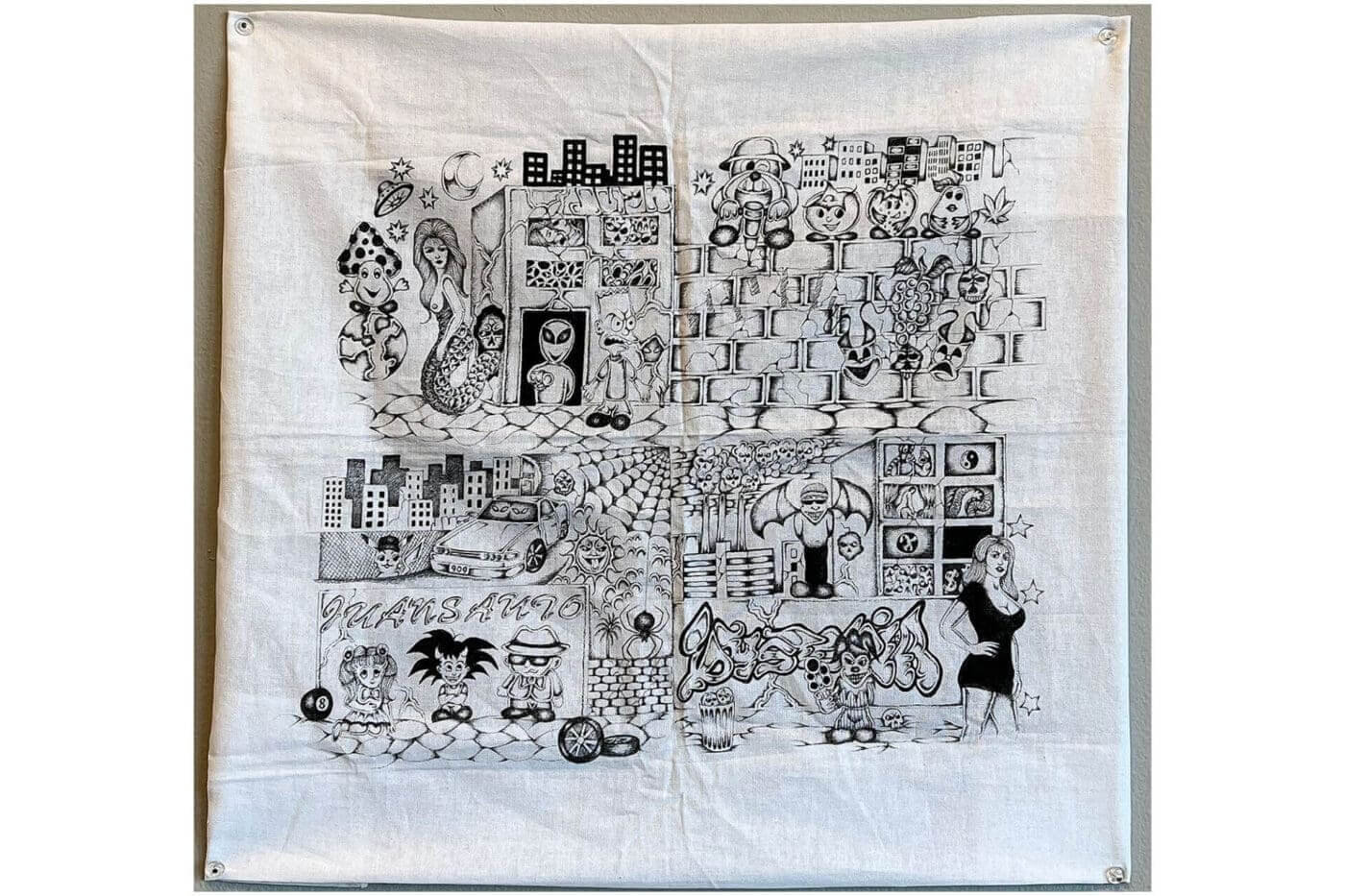
Juan’s World by Juan Medina. Courtesy of Thinkspace
Artists from the AHORA exhibit command entry into the space of memories in a way that’s expansive and discernable to locals. Juan Medina’s Pano drawing, Juan’s World, depicts a detailed inner world of sirens, aliens and cartoon characters all existing in one singular fantasy. These whimsical drawings and characters are found throughout Medina’s work. Juan’s World doubles as a metaphoric cloth memory-box stored with pen-stained sketches taken from the margins of notebook paper and ink-lined skin. He achieves this through a pano-on-pen technique, an art form originating from incarcerated Chicano artists, to communicate a visual story of the self.

110 Freeway Lowrider by Josh Young. Courtesy of Thinkspace Projects
Other works in AHORA confront the familiar more directly. Take Josh Young’s 110 Freeway Lowrider. It is a snapshot of a gold Buick Grand National entering the 110 freeway, capturing a moment that many people in South LA witness regularly. Upon closer inspection, the low-rider appears to not have a driver behind the wheel as it cruises towards the on-ramp. Like much of South LA, the mystery in Young’s photograph only adds to its regalness.
The art in AHORA also reflects the blistering political tensions of the now. Sachi Moskowitz’s Roe v. Wade tile captures a stain and glazed stoneware in the image of a Los Angeles Times headline that reads “Shock waves from Roe draft.” Etched in a dark blue monochrome, the crowd in Moskowitz’s Los Angeles Times stoneware front page hold up protest signs and cover their despair-marked faces. Responses to the Supreme Court overruling of Roe v. Wade in late June emerged from cities across the country in an attempt at unity amidst the forthcoming unknown of just how grisly our new reality surrounding reproductive rights will become.
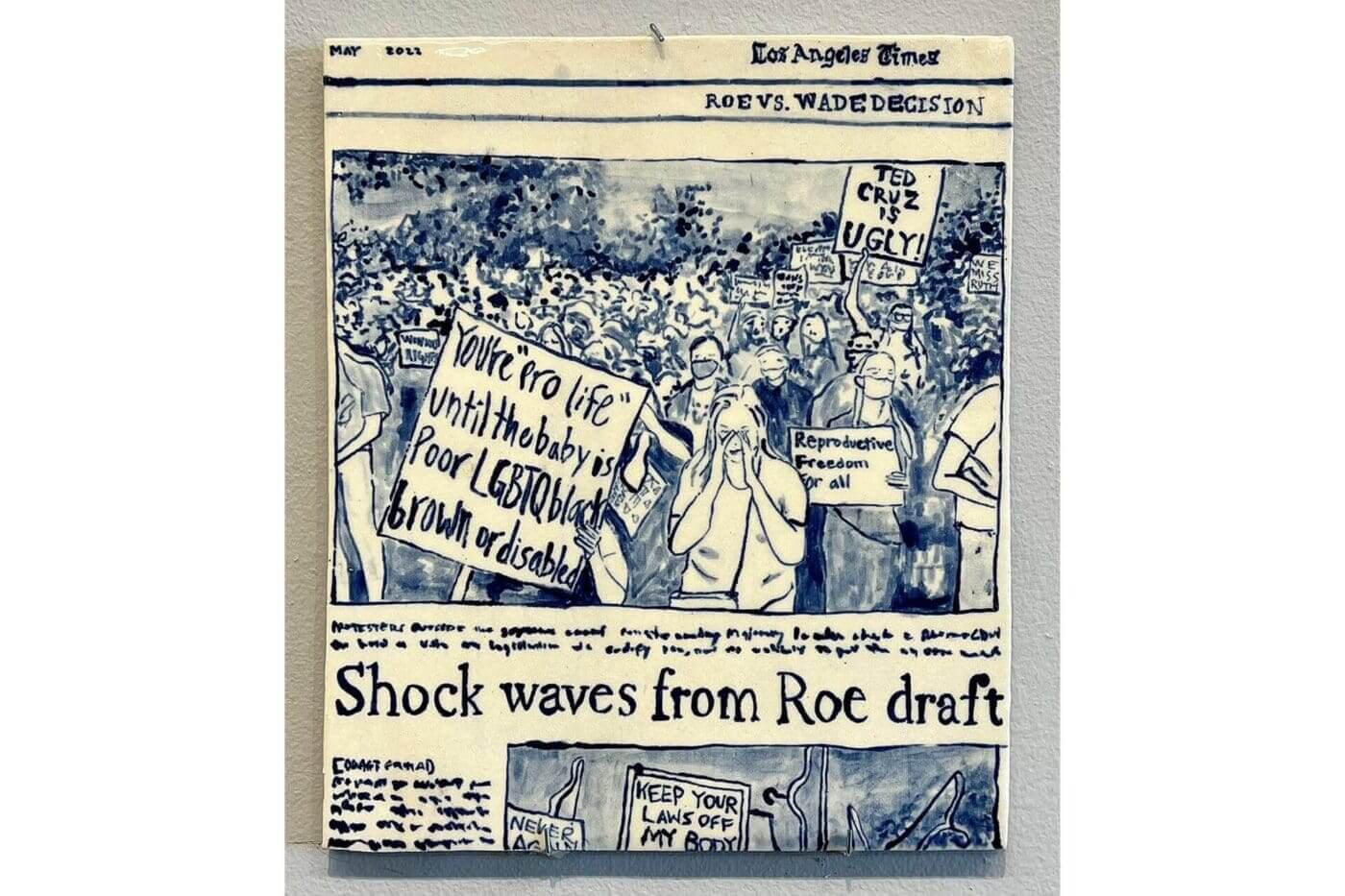
Roe v. Wade tile by Sachi Moskowitz. Courtesy of Thinkspace Projects
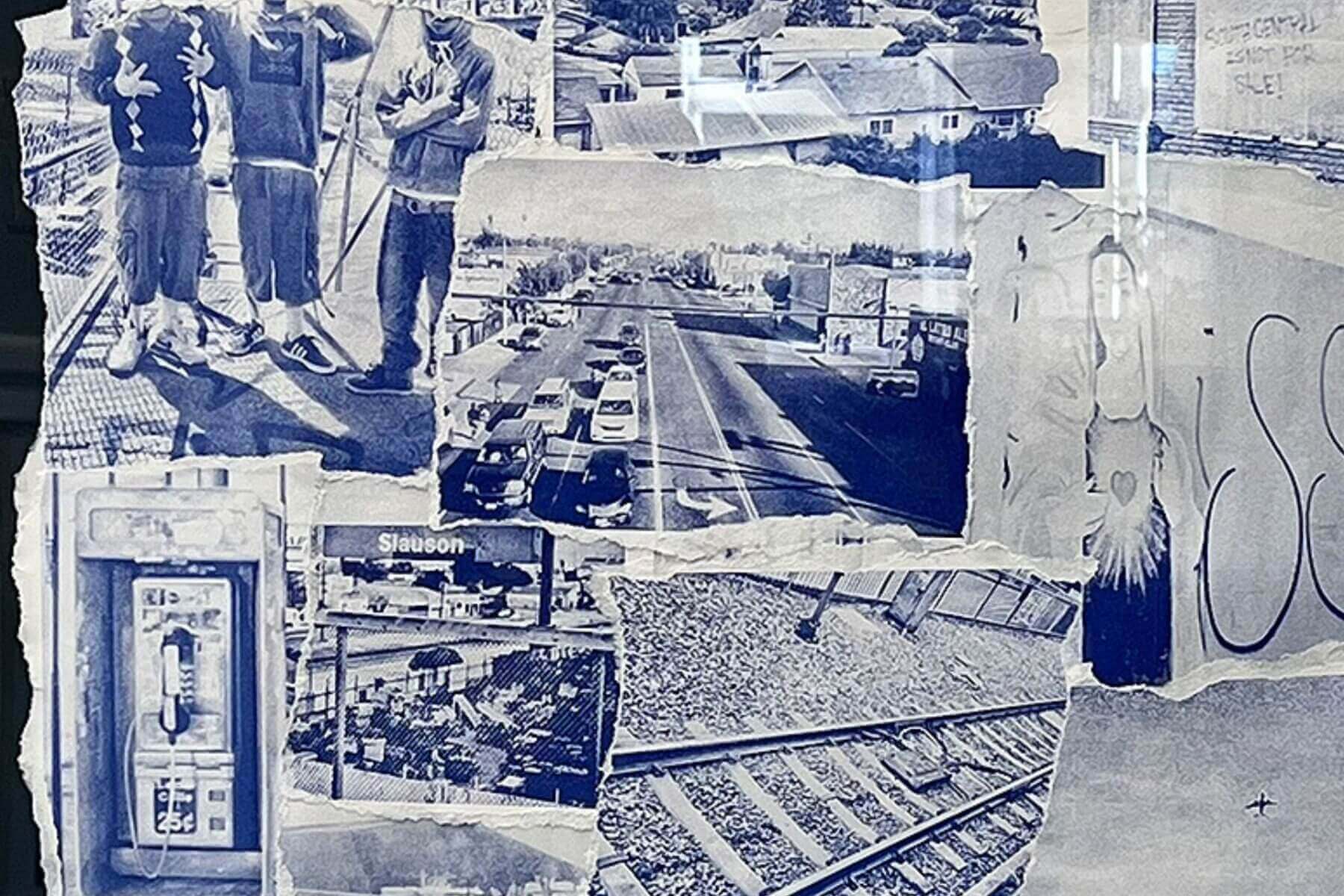
Into the transitory realm of sun-drenched memories, Valerie J. Bower’s print collage Florence Blue Line Series springs from a place where her mastery of photography first began. Before picking up photography as a high school student in the Harbor region of LA, the images that would shape Bower’s perspective stemmed from late 90’s and early 2000’s fashion magazines, photographs from Estevan Oriol and familiar landmarks in her own neighborhood.
“My mom’s friends would just give me tons of [editions of] W Magazine, which I had never even had access to before,” says Bower, in an interview with Red Canary Magazine. “I would have stacks and stacks of that or Rolling Stone.” The eclectic nature of Bower’s influences don’t muddle her own feminine photography style, but rather highlight how refined that style is.
Bower tends to rotate using star lenses, pastel monochromes and dreamy filters in her work to lean into the overall softness of her perspective. She describes her own outlook on her photography as, “the perspective of a low-rider guy’s little sister.”
“I have so much love for LA. It’s embedded in my work and I’ll always shoot it. It will always be a part of me, it’s a part of my soul.”
Bower’s photographic dreamworld is also heavily influenced by black and white Japanese photography, particularly the works of photographer Daidō Moriyama. The seductiveness of Japanese photography — which Bower describes as containing non-stop shooting, black and white and high contrast — lies in its freedom. Following her instinct by freeing herself from the formalistic restrictions of traditional American photography, Bower stresses the importance of documenting what’s going on in the present while also touching on her own memories.
The majority of the street-style photographs that Bower grew up admiring are saturated with gang-imagery. Her work attempts to expand the borders of our own nostalgia when looking back on the history of LA life and culture. Bower’s love for her hometown runs deep, and markedly influences her work. In Florence Blue Line Series, a pastel blue monochrome print collage seamlessly blends an array of images taken from various streets and neighborhoods around Southern California. “I have a photo of an ice cream truck with a couple in front of it. That’s one of my favorite pieces,” Bower says. “I have so much love for LA. It’s embedded in my work and I’ll always shoot it. It will always be a part of me, it’s a part of my soul.”

Florence Blue Line Series by Valerie J. Bower. Courtesy of Thinkspace Projects
The photo that she’s talking about precisely unveils Bower’s insight into the people and places she photographs. In an alternate context, the black and white photograph of the young couple in front of the ice cream truck could swiftly be interpreted as a still from a music video or film. Like the best of Bower’s work, this photo seems to capture a fleeting moment. Bower’s past work is made clear through three-person motorcycle rides in the Philippines, teenage skaters and pickup basketball games played at sunset.
Released in 2017, her photobook, Homegirls, presents an assortment of photos of three girls, two of which are sisters, in their uninterrupted state. Canela, Morena and Luna apply eye makeup and lip gloss to each other, rest on sun-soaked bleachers and laugh in unison in mid-air on park swings. To women that were once girls, these images demonstrate a look back on a sacred time and space fueled on intimacy and shared connection. Bower’s lens offers a fast-paced glimpse into a community’s most timeless moments.
***
Near the end of my conversation with Bower, we discussed the landscape of post-2020 LA. She mentions that, since the start of the COVID-19 pandemic, LA feels decidedly different, both in appearance and atmosphere. Classic landmarks have vanished while new infrastructure — like the 6th Street Bridge — have materialized after years of construction. She plans on exploring this new-era of LA on her own terms in her future work.
In the upper-right corner of Bower’s previously-mentioned Florence Blue Line Series collage rests a picture of the iconic Florence Car Wash in Huntington Park, California. She highlights how memorable the image of the Florence sign from 1964 is, but is unaware if it is still there today. In addition to the countless memories that live on in the minds of Florence residents, Florence Car Wash is also notable for its Googie architecture — a notable architecture style that dominated the streets of 1960s Los Angeles. While now scarce, the Googie aesthetic still finds representation through the retro McDonalds in Downey and the futuristic Theme Building at LAX.
Although Metro Florence, LLC brought forth plans to demolish the Florence Car Wash to make room for a new mid-rise apartment complex in 2019, the original building still stands today. While the future of the Florence Car Wash is uncertain as LA continues to unravel onto its ever-changing terrain, Bower continues to visually chronicle the sweet life, building onto the historical repertoire of LA artists before her. “The culture here is so embedded in not only me, but in so many other artists from LA,” said Bower. “Even if I’m shooting in other places while traveling, I like to find similarities of things that remind me of home.”
The AHORA Exhibit was free to attend from June 12, 2022 through July 24, 2022. Though, a virtual video tour and photography tour of the AHORA exhibit is now available through Thinkspace.
For information up current and upcoming exhibits curated by Thinkspace, visit their exhibition calendar.
Help us sustain independent journalism...
Our team is working hard every day to bring you compelling, carefully-crafted pieces that shed light on the pressing issues of our time. We rely on caring supporters like you to help us sustain our mission. Your support ensures that we can continue to provide deeply-reported, independent, ad-free journalism without fear, favor or pandering. Support us today and make a lasting investment in the future.

RELATED STORIES


Award Winning


Today’s environmental and social justice challenges are unprecedented, and require an unprecedented collective effort.


Stay updated on our latest features, events and more. Subscribe to our Note From the Nest newsletter!
