
Sometimes, It Takes a Herd

When I pulled my hands away from the goat Lookie Lou, they were black as coal. Fitting, in Pittsburgh — a city that only exists as such because of coal, a town described as “hell with the lid taken off” during its industrial prime.
But that was then, and this is now: an era of eco-consciousness, exponential extinction and reckoning with the mistakes of yesterday to salvage the concept of tomorrow.
This is not a story of endings. It’s a story of hope — and goats.
***
My first run-in with Allegheny Goatscape — a Pittsburgh-based 401(c)(3) non-profit that does exactly what you’d expect — happened back in September, at a soon-to-be (in the next few decades) massive urban greenspace. Pittsburgh has over 165 parks, and the area called Hays Woods is set to be the next. A sprawling 626 acres of undeveloped land, Hays Woods once served the coal gods; the land was deep-mined, torn and abandoned as if by a pack of wild dogs. Today, it has an air of tangled wilderness. The greenery is beautiful, almost intoxicating, if you do not know a thing about plants.
As Aldo Leopold wrote in A Sand County Almanac, “One of the penalties of an ecological education is that one lives alone in a world of wounds.”
On this land so disrupted by mining, non-native invasive species have taken over — bush honeysuckle in particular, though the usual Pennsylvania recidivists are also present, including Japanese knotweed and stilt grass, garlic mustard and dame’s rocket.
Another Leopold quote: “A thing is right when it tends to preserve the integrity, stability and beauty of the biotic community. It is wrong when it tends otherwise.”
Invasive plant species are very much otherwise, and at Hays Woods, the goal is to return the land to its original state. Or, something like it. Mines mar the contours of Earth in a way that tends to last, but plants? Well, surely plants are an easier fix. Right?
Easier, yes. Easy, no. At Hays Woods, the brush is thick and the terrain is rugged. Machines, expensive and emission-heavy, cannot reach the plants. Herbicides — or, as local hero Rachel Carson called them, biocides — are irresponsible (and also, expensive).
There’s only one thing for the job: a creature perfectly designed, with a special set of stomachs, to help eradicate the invasive plants through ceaseless gluttony.
I am, of course, speaking of goats. Something Allegheny Goatscape has in spades.
Or herds, rather.
***
On that September day, I organized a group of nature-loving volunteers to help the goats with the task at hand. A few years ago, fresh out of quarantine and desperate for friendship (and exercise, and purpose), I launched something called Sustainability Club through a local rock-climbing gym. It’s a group of friendly, Pittsburgh-based folks who share two interests: climbing and environmental stewardship.
Having recently read Carson’s Silent Spring together as a summertime book club affair, we were champing at the bit to do some good. Truth be told, when I started Sustainability Club, the concept seemed too niche to work. Yet, somehow, I had an ever-growing, rotating cast of folks ready to help our community in any way possible. Turns out a lot of climbers have their own inherent set of land ethics and all they need is someone to plan the when and where. Hardly had I spoken the word “goat” before ten people signed up to help Allegheny Goatscape remove invasive bush honeysuckle from Hays Woods.
Here were a dozen wet volunteers grinning as they performed strenuous manual labor when they could have been warm and dry in bed, all because a herd of ungulates happened to be nearby, happily chewing on the plants we cut down for them.
Although the goats are quite insatiable browsers — meaning they enjoy the woody parts of plants, as opposed to grazers, who prefer grass — and impeccable climbers (a point of jealousy in our club, to be sure), they still need help accessing the tallest plants. In many cases, what makes invasive plants such successful colonizers is their ability to vine, which effectively blocks life-sustaining sunlight for low-height native plants.
Armed with scythes, saws, machetes and loppers, our group set out with Allegheny Goatscape community engagement coordinator Erin Gaughan to tackle the bush honeysuckle problem at Hays Woods. Gaughan was crunchy-cool and outgoing, friendly yet impassioned, and perhaps best of all: she had 24/7 access to goats.
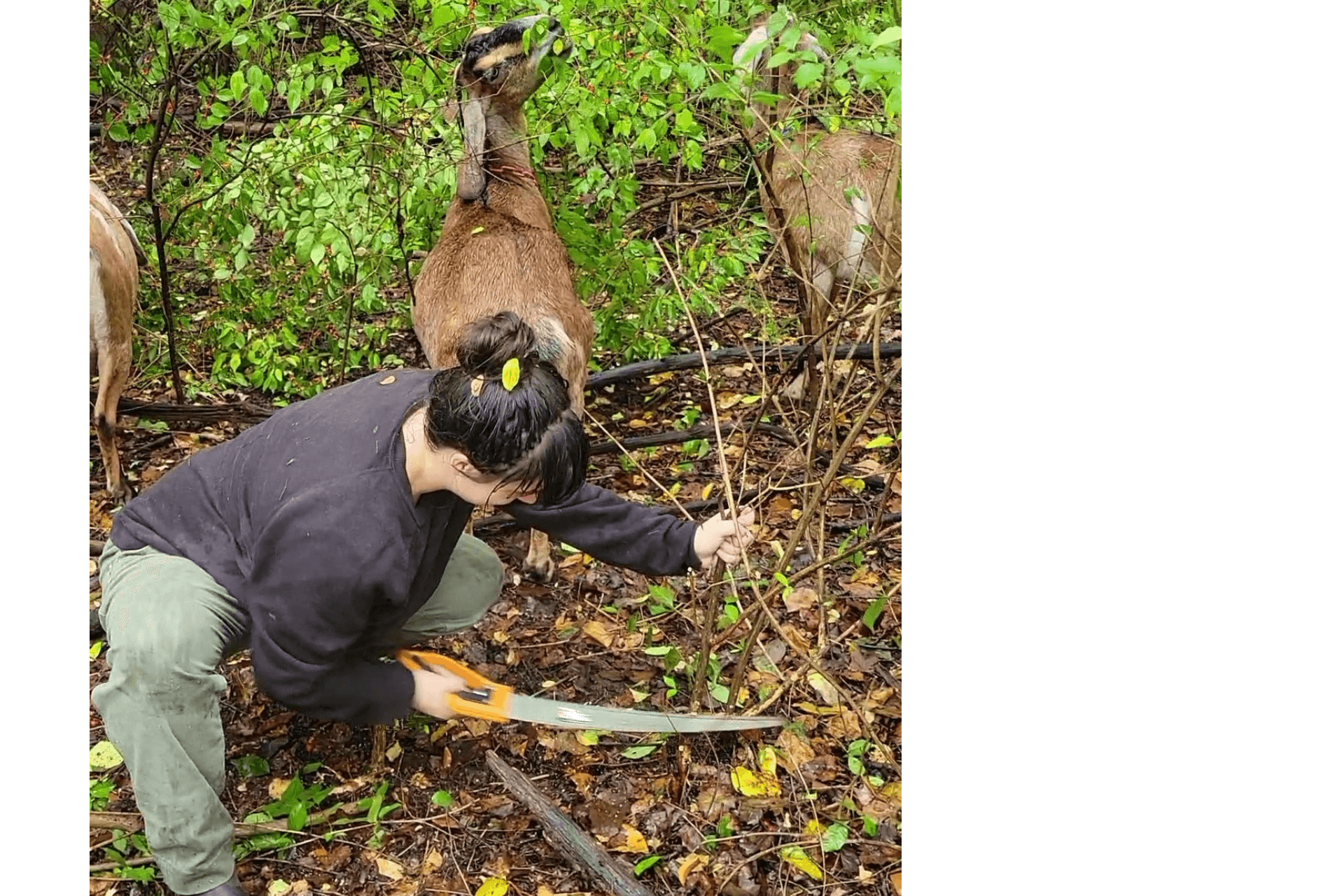
Goats prefer to eat leafy growth and wooden stems, including plants that are harmful to humans and other livestock, such as poison ivy. Photo by Gretchen Uhrinek
What is it about goats, anyway? The Saturday we volunteered, the rain was cold and the brush was thick. And yet, here were a dozen wet volunteers grinning as they performed strenuous manual labor when they could have been warm and dry in bed, all because a herd of ungulates happened to be nearby, happily chewing on the plants we cut down for them. As we pushed through brambles and studded ourselves with ticks (I pulled several off in the shower, later), the goats used our work-bent backs as stepping stools, hard hooves on human spines, stretching bell-bedangled furry necks towards the sugary red berries vining ripe overhead.
We laughed at our own discomfort.
In the background Hobo, a miniature donkey who protects the goats from coyotes at night, harrumphed. Then, as we felled branch after branch, he ate the berries, too.
***
A few months later, I posed a question to Gaughan: Why do goats make people happy?
We were inside a little makeshift goat shed at a small urban farm, a place where the herd hunkers down for the winter when wild browse is scarce. Here, I petted Lookie Lou and delighted in the filth of my hand. Gaughan was busy trimming hooves — Allegheny Goatscape is a small crew, so even community engagement coordinators get their hands dirty — but paused to consider my question.
Eventually, she responded. “There’s a sort of stoicism about a goat. How they just sit and stare, sit and chew their cud. That’s the whole ruminating thing. And that’s what goats are: they’re ruminants.”
A shy black goat with one horn, Lilly, cautiously wandered over for ear scratches as Gaughan continued: “You know how when you’re ruminating on something, you just sit and stew on it? That’s what they do. They sit and chew their cud and ruminate, and I feel like that’s just calming. Relaxing. Also, the sounds — it’s like ASMR.”
We listened to their munching on hay for a while. The shed was much warmer than the cool November air outside and smelled pleasantly of silage, manure and mud. I do not care much for “traditional” ASMR (whispering ladies who strum plastic combs with long fingernails feel dystopian, somehow), but the sound of goats chewing? Totally different. My brain tingled in ecstasy.
Goats bring so much joy that goat therapy has become a trend. Across the commonwealth from Pittsburgh is the Philly Goat Project, a program that connects urban residents to nature via goats through animal-assisted therapy and community-oriented events. Like any therapy animal, these goats are trained to respond to both verbal and non-verbal cues. Their sweet strangeness and funny eyes are just a bonus.
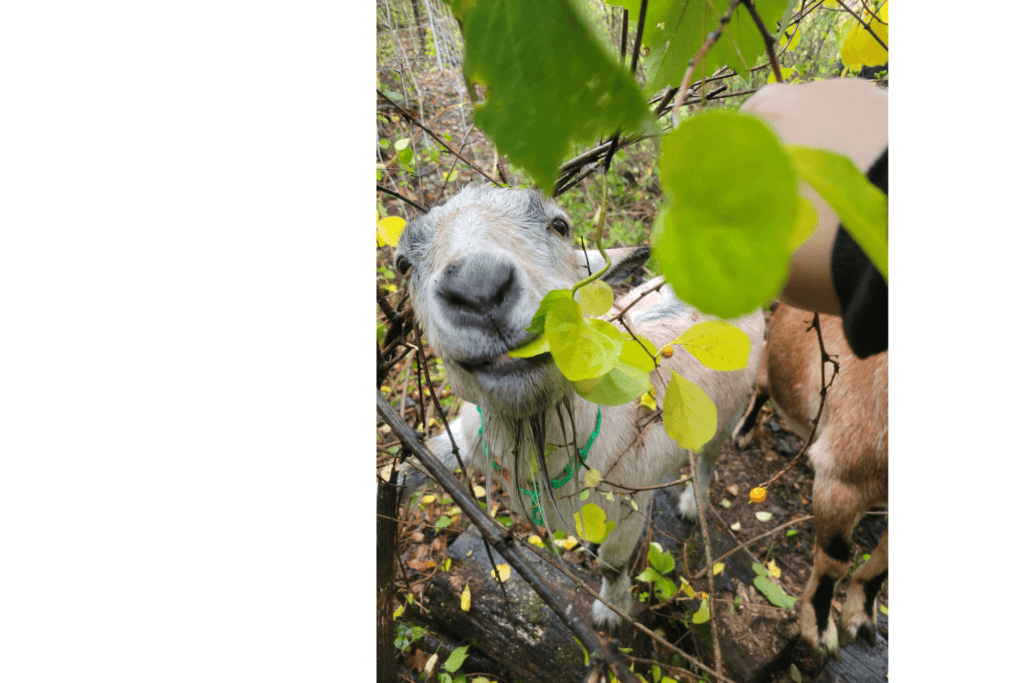
A 2018 study suggests that goats can pick up on emotional cues and prefer positive emotional expressions. Looks like they return the favor. Photo by Gretchen Uhrinek
As goats are therapy for humans, so too do they help heal the land. Goat manure is high in nitrogen, making it one of the most beneficial animal manures for fertilizer. And, due to an enzyme in their saliva that neutralizes certain types of seeds and the intricate architecture of their stomachs, which are split into four chambers, any seeds consumed are no longer viable by the time they hit the ground, preventing invasive plant seeds from being dispersed via waste.
This was confirmed in a 2020 study led by Dr. Katherine Marchetto, entitled “Goat Digestion Leads to Low Survival and Viability of Common Buckthorn (Rhamnus cathartica) Seeds.” (Side note: Is there anything better than a paper whose title relays the abstract?)
Buckthorn is a highly invasive shrub native to Europe and western Asia, and goats are often enlisted to help control their spread here in the U.S. In Marchetto’s study, diapered goats were fed buckthorn berries and their excrement was examined at 24-, 48- and 72-hour increments for intact seeds. After what can only be assumed a painstaking, squint-inducing and generally foul process, it was found that while two percent of buckthorn seeds survived goat digestion intact, of those, only 11 percent were viable. For those who are lazy and/or scared of math like me (I am a grown adult woman and had to ask my calculus-professor mom to double check the arithmetic here), that means only 0.0022 percent of the ingested seeds germinated after consumption. Not too shabby, goats.
Although goats were domesticated as early as 8,000 BCE, there are not many studies exploring the long-term success of goatscaping as invasive-species management. But “not many” does not mean “none.” Most recently, in 2022, Dr. Richard Bowden of Allegheny College co-published a paper exploring the effects of repeated goat grazing in multiflora rose-infested regions of Erie National Wildlife Refuge.
The Erie National Wildlife Refuge is a temperate deciduous forest located on Haudenosaunee land smack-dab between Pittsburgh and Lake Erie. Lake Erie itself is named after the Eriehronon (or Eriquehronon) tribe, likely members of the Iroquois nation. The Erie National Wildlife Refuge is the only refuge in the U.S. that protects endangered northern riffleshell and clubshell mussels. The area is also home to a population of protected bald eagles. The most biologically diverse stream in Pennsylvania, French Creek, flows near the refuge as well. Overall, the Fish and Wildlife Service reports that the area supports at least 670 different species.
The ecosystem is part of a fragile balance made topsy by the pervasive growth of multiflora rose, a thick, thorn-covered ornamental brought from eastern Asia. A single rose bush can produce one million seeds per year, and the seeds can remain viable for up to two decades. This, paired with the plant’s ability to quickly sprout anew from existing roots, makes it extremely difficult to eradicate. While some may resort to herbicide use against these indomitable invasives, in a protected area such as the Erie Refuge, chemicals are a last resort; the potential to contaminate water is simply too high.
So, bring in the goats.
***
In 2023, Allegheny Goatscape completed its fifth and final year of prescribed browsing at Erie National Wildlife Refuge. When the goats arrived for their maiden munching, about 80 percent of the treatment area was covered with multiflora rose. While Bowden and his team plan to conduct a follow-up study this autumn to re-evaluate the long-term effects of repeated goatscaping at the refuge, their existing findings already indicate positive results:
“The first thing we noticed was that all the stems were shorter,” Bowden stated in a webinar. He and his students found that, after the first year of goat browsing, multiflora rose stems were reduced by 35 percent. They also found that leaf mass had been reduced by 56 percent, effectively starving the plants of life-giving carbohydrates. As goats eat the leaves, the plant’s energy reservoir is depleted.
“What they’re doing is taking away the photosynthetic machinery of the plants,” said Bowden.
Of course, as in all things, there are some unintended consequences. “The goats were happy to eat the rose,” said Bowden, “but they were also happy to munch on anything else they could put their lips on.”
After the first year of goat browsing, multiflora rose stems were reduced by 35 percent.
The team sampled 356 trees in the goats’ browsing vicinity and found that 8.7 percent were girdled, 18.3 percent were browsed and 6.5 percent were nibbled. In particular, the goats had a taste for the thin-barked, sweet-sapped red maple: 41.2 percent of these were browsed and 23.5 percent were girdled after one year.
“I’ll say, in this case, red maple is ubiquitous. It’s over-represented across the state of Pennsylvania, so there’s probably no real concern for the loss of red maple,” said Bowden. “But it does point out that there can be unintended consequences that one needs to consider.”
But what of the intended consequences? Although Bowden’s 2024 review of the Erie National Wildlife Refuge goatscaping experiment will reveal more concrete answers, his previously published findings and aerial maps of the goats’ treatment area, which visually depict a reduction in overall invasive plant mass, show promise.
As we wait for Bowden’s team to share their latest data, a similar five-year experiment hints at positive results. In a 2021 paper, Indiana forester Ron Rathfon and his cohort analyzed the effects of multiflora rose goat grazing in a mixed-hardwood forest. Originally, the evaluated timber stand’s multiflora rose population covered between 60 to 70 percent of the area. After five years of goat grazing, coverage was reduced to 16 to 32 percent.
“Over a period of days, you can watch a miraculous transformation taking place,” Rathfon told Purdue, where he serves as a regional extension forester. “Thanks to our little furry, cud-chewing friends, what was once a seemingly hopeless, dense, impenetrable tangle of nasty thorns suddenly doesn’t seem as daunting a menace.”
***
Goatscaping is used for ecological purposes in lands far beyond the deciduous forests of Pennsylvania and Indiana.
In the western U.S., where deadly wildfires consume with an indiscriminate hunger that puts goats’ appetites to shame, the prevalence of dry understory brush poses a serious danger. The fact that many of these plants, like star thistle and cactus, are downright painful to handle only complicates matters. But strangely, wonderfully, goats seem immune to mouth pain when food is involved (not unlike myself with a too-hot slice of pizza). In 2023, California’s Wildfire Prevention Grant Program put a special emphasis on project proposals that incorporated prescribed grazing as part of its wildfire prevention plan.
Leap back east, to Martha’s Vineyard in Massachusetts, and you’ll see goats being paddled by canoe to prescribed grazing sites, where they munch on invasive oriental bittersweet vines and poison ivy.
After Martha’s Vineyard, hitch a ride on a boat bigger than a goat canoe to Håøya, an island in Norway, and you’ll find a large herd of free-range goats rewilding the land — and producing milk for world-class cheese in the process.
And when you’re done taking in the fjords and fields, return to good ol’ Pittsburgh, Pennsylvania, where we know it takes more than a village to fix a broken land. Sometimes, it takes a herd.
Help us sustain independent journalism...
Our team is working hard every day to bring you compelling, carefully-crafted pieces that shed light on the pressing issues of our time. We rely on caring supporters like you to help us sustain our mission. Your support ensures that we can continue to provide deeply-reported, independent, ad-free journalism without fear, favor or pandering. Support us today and make a lasting investment in the future.

RELATED STORIES



Award Winning



Today’s environmental and social justice challenges are unprecedented, and require an unprecedented collective effort.


Stay updated on our latest features, events and more. Subscribe to our Note From the Nest newsletter!
