
Essential Reading For Your Inner Environmentalist
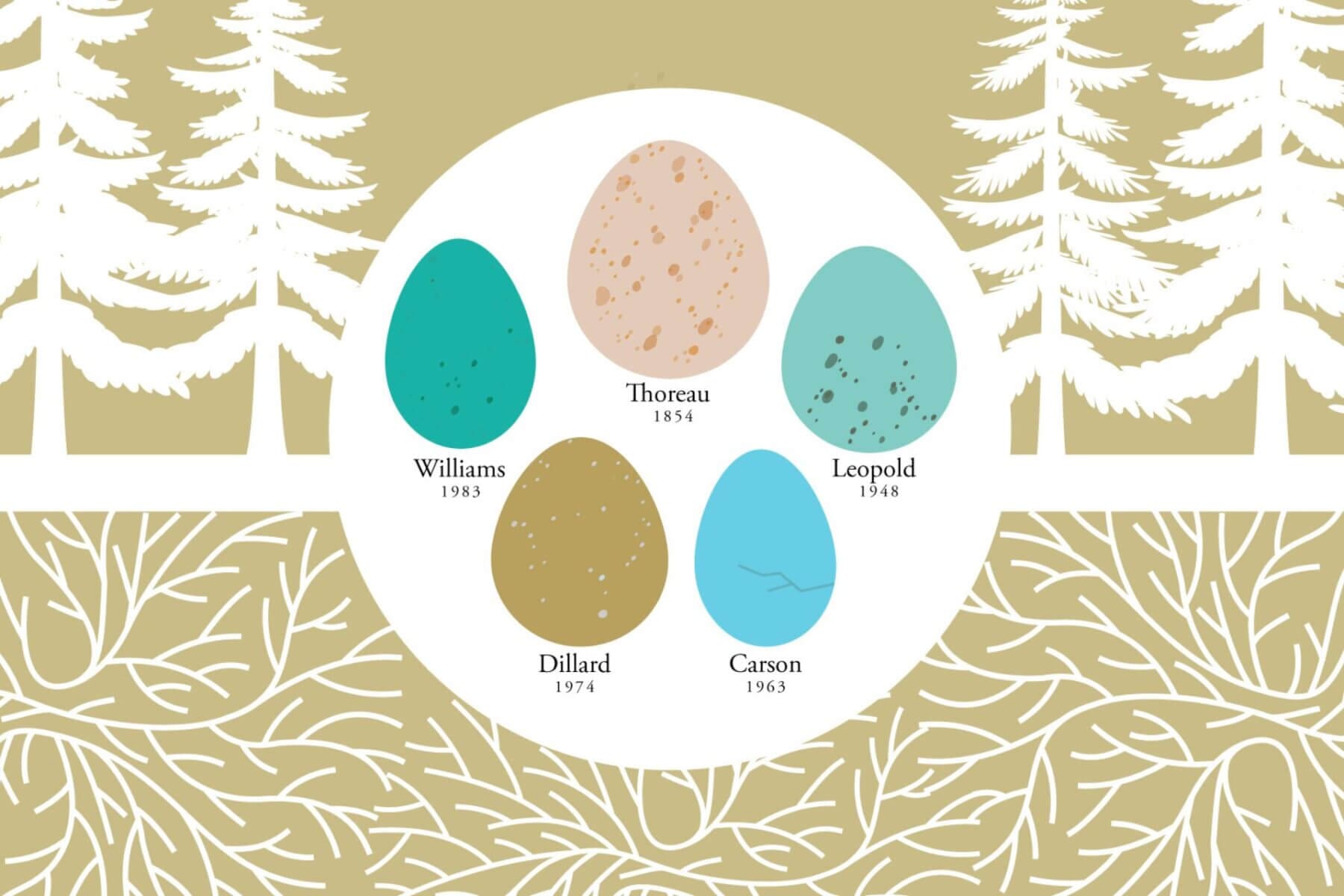
Sometimes we read about nature to return to the source of our being, to hear the wild geese, as Mary Oliver wrote, “announcing your place in the family of things.” Even if we are lucky enough to place our feet on wild paths every day, we like to hear them described and described anew. Sometimes we read for a new understanding of a world we thought we knew. And sometimes, when the family of things is under threat, we read to summon the Furies — to be wound up and sprung into action.
In this moment, when climate change and mass extinction are full-blown emergencies, we present a list of the best books for environmentalists — some nature writing, some ecological or philosophical texts and some environmental battle cries. Each of them draws from a sense of the sacred in nature, no matter how deeply buried. As John Muir wrote, “Every natural object is a conductor of divinity.”
These are books that change your life. Immersion in these texts helped me recognize the healing power of nature in my own family when my brothers and I remade our relationships with our dad during the process of restoring wildlife habitat on his hunting camp in Michigan. The resulting 2019 memoir, The Deer Camp, owes a debt to all the books presented here. They each present a different take on how our minds, relationships and material lives are shaped by the more-than-human world.
This list will grow and stretch — it’s not anyone’s idea of definitive — and it invites and demands your participation. Let us know what you’d add or subtract, and share your reviews. Upcoming volumes of book recommendations will follow. We encourage you to read the following books as if putting on spiritual armor; nature needs a good, outspoken hero right now.
***
Silent Spring, Rachel Carson
Often credited with sparking the modern environmental movement when it was first published in 1963, Silent Spring rattled the industrial establishment. Carson, a best-selling marine biologist who was known for her accounts of sea life, pulled no punches in revealing that many widely-used pesticides (including DDT), which were hailed in cheerful ads as a boon to mankind, were in fact destroying species all the way up the tree of life — most famously decimating bald eagles by making their eggs too fragile to hatch — while also causing cancer in humans.
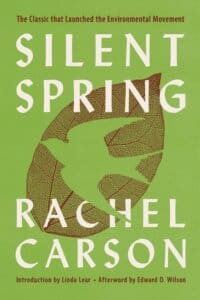
Working methodically from an exhaustive collection of scientific studies, including those conducted by chemical companies themselves, Carson lays out the effect of most-used sprays (which she calls “biocides”) on living organisms, their interaction in nature, and how their continued use would result in a world devoid of birds and more.
Dying of cancer at the time herself, Carson was viciously attacked by the chemical industry, but her dogged reliance on good science prevailed. DDT and many other substances were eventually banned. Most importantly, she popularized an ecological approach that showed how, as John Muir had said, “When we try to pick out anything by itself, we find it hitched to everything else in the Universe.”
This story of the science-empowered do-gooder became the model for legions of crusaders from Greenpeace’s efforts to end nuclear testing in the 1970s to Erin Brockovich’s fight for clean water in California to Bill McKibben’s work on climate change.
***
A Sand County Almanac, Aldo Leopold
Only a month before he died in 1948, Leopold wrote in the introduction to this book of essays: “We abuse land because we regard it as a commodity belonging to us. When we see land as a community to which we belong, we may begin to use it with love and respect.” That ecological idea of the land community, as spelled out by a science-based professional land and wildlife manager – in other words, a land user – marked a turning point in American environmental ethics that is still growing and evolving today.
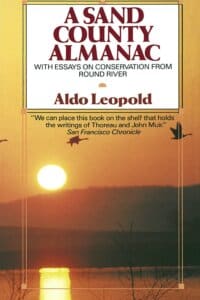
The Almanac itself chronicles 12 months on Leopold’s 80-acre camp near Baraboo, Wisconsin, with beautiful observations of the other creatures and their numinous powers. For instance, Leopold describes how migrating geese always know to arrive just days after the spring ice-out. The other essays compiled in the book include “The Land Ethic,” in which he spells out why the nonhuman world is deserving of ethical consideration for its own sake. In “Thinking like a Mountain,” Leopold bears witness to the “fierce green fire” in the eyes of a dying wolf and suddenly grasps that predator “management” threatens the viability of the whole community.
We mention these two books first because, in a way, they stand as twin pillars of our modern environmental consciousness. In a world in which we can no longer set aside patches of off-limits wilderness and blindly develop the rest, Leopold builds an ethical case for mindful stewardship of every square inch of the planet, and Carson provides a replicable model for how that stewardship can be actionized as targeted, science-based regulatory policy. The why and the how in our bid to continue living on earth.
***
Walden, Henry David Thoreau
Published in 1854, Thoreau’s two-year experiment in living wild forms the DNA of the American environmentalist narrative. After building a tidy cabin near Walden Pond from an old shanty he had purchased, Thoreau reports on all aspects of his life — from his naturalist’s notes on the brown thrashers who eat his garden beans to the salutary effects of sleeping under the stars — all the while building a case for why the nonhuman world is the center of moral purity and political freedom. He finds the woods far more supportive of individual liberty and conducive to the pursuit of the divine than the human society of nearby Concord, Massachusetts, whose train whistles he can still hear.
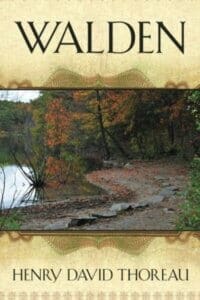
He explains, “I went to the woods because I wished to live deliberately, to front only the essential facts of life, and see if I could not learn what it had to teach, and not, when I came to die, discover that I had not lived.” The Transcendentalist movement he promoted, along with his pals Ralph Waldo Emerson, Margaret Fuller and many others, sought to explore the divine in the material world, rather than some far-off paradise accessible only by death. Thoreau’s mother and sisters are rumored to have done his laundry and brought him meals, but his belief in the preservation of wilderness to counteract the negative effects of industrialism set an agenda environmentalists are still pursuing today. Walden is often published with Thoreau’s essay, “On the Duty of Civil Disobedience,” an earlier work advocating self-reliance and individualism as a tonic against the corrupting effects of governments and civilization in general.
***
Refuge, Terry Tempest Williams
This profoundly moving essay sets the particulars of a family struggling with generations of illness alongside the epic powers of weather and water, masterfully demonstrating how forces (natural and unnatural) work in our bodies and lives. In 1983, Williams’s mother is dying of a recurring cancer. That same year, the Great Salt Lake is in flood and the rising waters are inundating the Bear River Migratory Bird Refuge where Williams and her family have been tracking birds for years — phalaropes, burrowing owls, egrets and many other species.
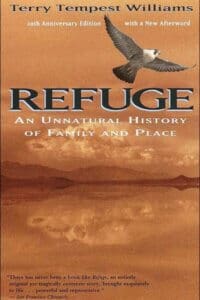
As the waters rise, this Mormon family confronts death and discusses how the many cases of cancer in the women among them are likely related to living in the wind-blown “shadow” of radioactive fallout from the Nevada nuclear weapons test site — hearkening back to Carson, who used fallout as a metaphor for the spreading effects of pesticides.
As Williams’s grandmother is also diagnosed with cancer and Williams has a second cyst taken out of her own breast, she chronicles the folly of a government administration that seeks to spend millions to “manage” the floodwaters in the refuge — the same kind of control of nature that led to nuclear weapons testing and the spread of illness across the country. The visionary final chapter, “The Clan of the One-Breasted Women,” is a feminist call to action that does what great activist books do, no matter what the topic: sends you out the door to change the world.
***
Pilgrim at Tinker Creek, Annie Dillard
Dillard’s take on the “year alone in the woods” story is approached as a pilgrimage, probing and chasing the sacred in her close, poetic, scientific and philosophical observations of a local creek and its fauna. It is a book about seeing, like Moses saw the burning bush, highlighted by a startling encounter with a cedar tree lit by sun so that it seemed to be aflame — the “tree with the lights in it” — about which she writes, “The vision comes and goes, mostly goes, but I live for it, for the moment when the mountains open and a new light roars in spate through the crack, and the mountains slam.”

Constructing a kind of theodicy, she piles up instances of the ingenious monstrosity of death, such as praying mantises eating their siblings and a giant water bug sucking the life out of a frog, leaving it like a collapsed bag. She then counters that with an even taller pile of life’s incredible fecundity, stacking the horrifying profusions of insect offspring, for instance, and marveling over evolution’s tendency to give almost any life-form a shot, no matter how grotesque or cruel. The fact that she makes all these incredible observations from an ordinary home where she lives with her husband within the city limits of Roanoke, VA, only makes the narrative that much more compelling (even though she never mentions these things). The thing mounts up like a hymn and will have you seeing pure light pouring from every muskrat hole and culvert.
Help us sustain independent journalism...
Our team is working hard every day to bring you compelling, carefully-crafted pieces that shed light on the pressing issues of our time. We rely on caring supporters like you to help us sustain our mission. Your support ensures that we can continue to provide deeply-reported, independent, ad-free journalism without fear, favor or pandering. Support us today and make a lasting investment in the future.

RELATED STORIES


Award Winning



Today’s environmental and social justice challenges are unprecedented, and require an unprecedented collective effort.


Stay updated on our latest features, events and more. Subscribe to our Note From the Nest newsletter!
