
The Great Texas Water Crisis
- Shows how Texas cities, after learning from what happened in Corpus Christi, are trying to head off a water shortfall that could arrive in less than four years
- Explains why Austin can no longer rely on the Colorado River alone, and what its 100-year Water Forward Plan proposes instead
- Tracks how the data center boom and other business needs are colliding with residents’ water needs
This story was produced in conjunction with the Austin Free Press.
This year, the South Texas port city of Corpus Christi became among the first in the U.S. to nearly run out of water following years of drought and industrial expansion, and lack of long-term planning. It was saved this summer by the very thing that had put it in a dangerous spot—increasingly extreme, climate-change-driven weather.
Massive rainstorms and flooding saved Corpus Christi for now, but the entire state of Texas is betting its future on water it might not have. Over 4.5 million Texans (out of 35 million) are experiencing a drought right now, according to the national drought monitoring system. Robust economic and population growth are simultaneously testing the state’s water supply.
As extreme weather patterns converge with rising water needs, municipal water planners forecast the need for strict conservation ahead. In fact, without establishing new conservation or use plans, Texas’ water demand could outpace supply in less than four years.
Under extreme drought conditions, the Texas Water Development Board projects that the state could face a water shortage of 3.6 million acre-feet by 2030. That’s enough to supply roughly 8 million U.S. homes for a year, as one-acre foot is roughly 325,900 gallons.
. . . without establishing new conservation or use plans, Texas’ water demand could outpace supply in less than four years.
These sobering estimates do not take into account the proposed statewide data center build-out that could lead to a demand increase of 494,000 acre-feet in 2030, according to a Houston Advanced Research Center (HARC) study published earlier this year and before Governor Greg Abbott put a temporary hold on August 3 on those facilities and directed an audit of them. That’s like adding 1.1 million homes to the demand queue.
Texas water demands are climbing with or without the proposed data centers.
“Right now, with all of the water supply projects that we currently have available, we will not meet our water needs,” Margaret Cook, vice president of water and community resilience at HARC, told Red Canary Magazine.
“We have to mobilize funding and construction to add additional infrastructure and water supply projects,” Cook added, pointing to the need for water lines and treatment plants for people to receive water. “The price tag to get to that point of having enough water supply available is about $174 billion.”
In the capital city of Austin, the city-owned Austin Water utility projected in 2024 that demand will increase by at least 154 percent over the next 100 years, or by 450,000 homes. Austin Water initiated its 100-year Water Forward Plan following the historic 2008-2016 drought, as the region’s housing and economic boom was just starting to hit high gear.
That drought “revealed the need for a long-term, integrated approach to water-supply planning that accounts for a growing population and the possibility of droughts more severe than those we have seen before,” Austin Water staff explained in a statement to Red Canary.
In the wake of the drought, the Austin Integrated Water Resource Planning Community Task Force—composed of community members who work in the water, energy, and sustainability sectors—drafted the first Water Forward Plan, which the Austin City Council approved in 2018 (and updated in 2024).
The plan details future water needs under multiple demand scenarios, taking regional growth and worsening weather conditions into account. For an extreme drought scenario, the plan recommends bolstering supply through reclaimed water, currently untapped lakes and reservoirs, aquifer storage and recovery, or brackish groundwater desalination.
One of the major areas of concern is the metropolitan district’s reliance on the increasingly unreliable Colorado River. Due to decades of drought, rising temperatures, and increasing use, the river’s flow has dropped 20 percent over the past decade and a half. “We were completely dependent on the Colorado River,” water attorney and task force member Sarah Faust told Red Canary. “We did not have another plan for access to potable water. For a big city, that needed to be undertaken.”
Uncharted Waters
Falling as precipitation, water supplies accumulate above ground and below. Surface water is found above ground in lakes, rivers, and streams. Aquifers are kind of like natural cisterns where water gathers in underground rock or sediment deposits.
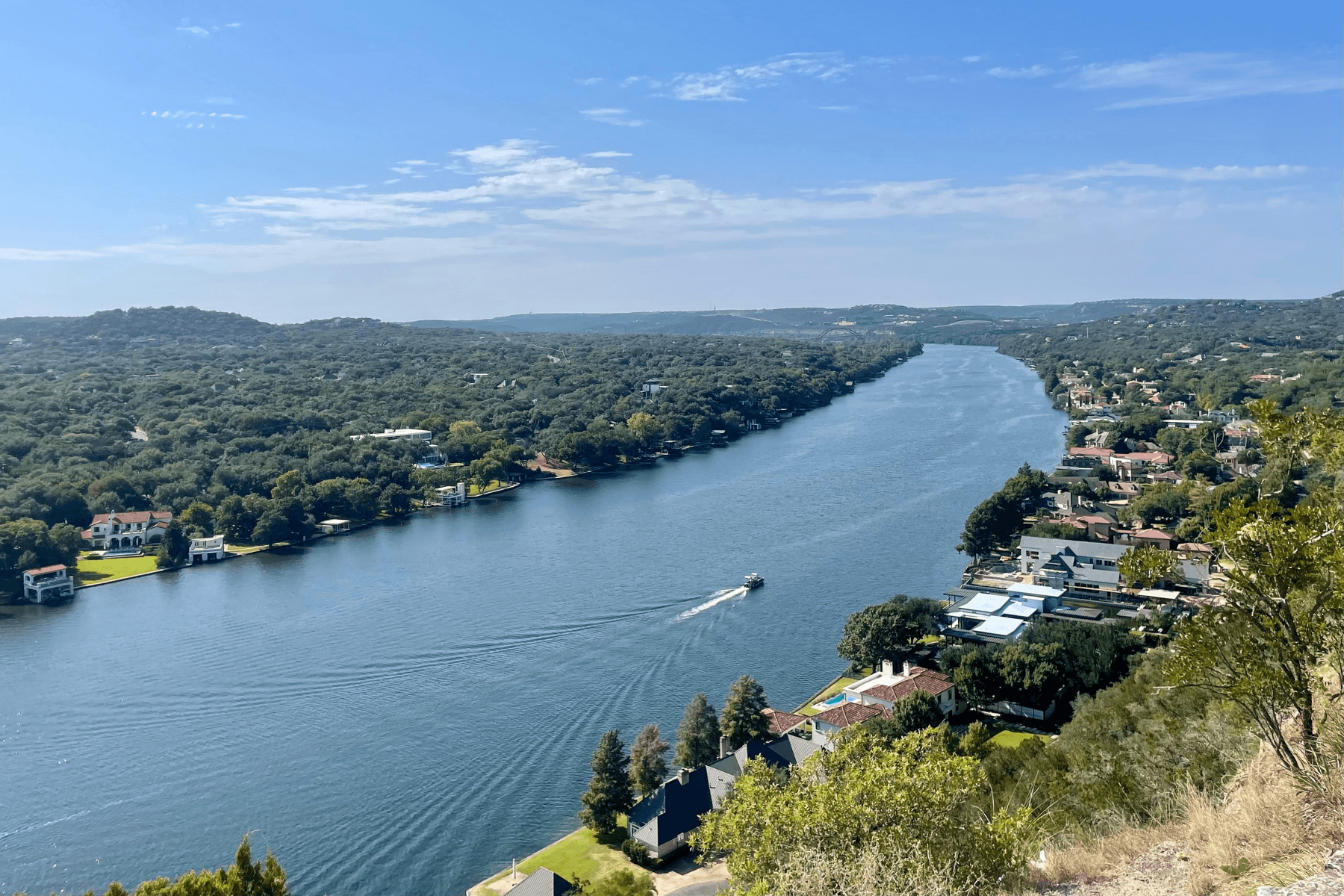
Austin Water obtains most of its supply from Lake Travis and Lake Buchanan, which were created by damming the Colorado River above Austin in the 1930s and 1940s. Austin Water has secured rights to use up to 325,000 acre-feet of Colorado River water a year and currently uses around 50 percent of that, according to utility representatives.
The Lower Colorado River Authority (LCRA) manages the climate-fluctuating inflows into these Highland Lakes. Central Texas sits at the confluence of subtropical and arid climates, subjecting the region to both flooding and drought. Floods in 2025 and this summer replenished Lakes Travis and Buchanan to 99 percent of capacity, according to the LCRA.

Overlooking a nearly full Lake Travis, which helps supply water to more than 1 million downstream residents. Photo by Piper Guinn
The lakes hit their all-time lowest levels in 2011, when inflows plummeted to 11 percent of the historic average, according to the Water Forward Plan. Levels remained low throughout the drought of 2008 to 2016 and dipped again in 2022 and 2023.
Without access to the lakes, Austin’s neighbors in Hays County are in a more precarious position. They get their water from the Edwards-Trinity Aquifer, which is currently at its lowest level in 20 years, according to the Hays Trinity Groundwater Conservation District. The conservation district predicts that the probability of drought ending in six months is less than 6.5 percent, further stressing the supply.
Texas rainfall has come less frequently in recent decades and often arrives in short, intense bursts instead of predictable “rainy seasons,” according to the Meadows Center for Water and the Environment at Texas State University. Meanwhile, higher temperatures evaporate surface water more quickly.
Historically, hydrologists plan for the so-called “drought of record,” the worst drought ever recorded in a given area. But some experts worry that climate change could be pushing Texas into uncharted waters and that historical precedence is no longer a reliable predicate.
Cook, of HARC, said that water plans must account for changing temperatures. Hotter summers and cooler winters can cause infrastructure, such as pipes and transmission lines, to deteriorate or fail. Extreme temperatures also strain heating and cooling systems, which then consume even more water.
“Water is impacted when it’s too cold, too hot, too much, too little,” said Cook. “If you exacerbate the drought and the heat wave that people are experiencing, we could see even more shortages, and we are not planning for that.”
Too Thirsty?
A compounding factor is the growing popularity of the Austin region. As climate change squeezes Texas water supplies, the state’s increasing numbers of households and businesses are greatly increasing the demand for water.
The Austin metropolitan area added 510,875 residents between 2013 and 2023, according to the city’s planning department. Its annual gross domestic product grew from $114 billion to $207 billion during that time.
Driven by rapid growth in Travis, Williamson, Hays, and Bastrop counties, municipal water demand in the lower Colorado River region is expected to nearly double between 2030 and 2080 (from 380,187 to 743,729 acre-feet), according to the 2027 Texas State Water Plan.
Water consumption for Texas’ manufacturing sector is projected to grow from 1.6 million acre-feet of water use in 2030 to just over 2 million acre-feet in 2080, according to the plan. For the lower Colorado River region, manufacturing’s water use is projected to rise from 58,602 acre-feet in 2030 to 71,293 acre-feet in 2080.
Those projections preceded the recent spike in applications to plug almost 250 data centers into the state’s electric grid to power the artificial intelligence boom, adding to the hundreds of facilities already in operation in Texas.
Driven overwhelmingly by data centers, the state’s electric grid currently has requests for 474 gigawatts waiting in the queue, according to a memo from the governor’s office. That’s more than five times the state’s all-time peak energy use of 90 gigawatts.
Waterborne Data
Hyperscale data centers running more than 5,000 servers require massive amounts of water—directly and indirectly. Data center servers consume massive amounts of electricity, generating enough heat in the process to overload the servers if not cooled properly. As a result, most data centers rely on water-based cooling systems to stay online. Most also run on electricity from fossil-fuel-based power plants that also use water for cooling.
Most hyperscale data centers use between 100 and 300 megawatts, which requires between 190,000 and 570,000 gallons of water per day based on estimates from Lawrence Berkeley National Laboratory, or the daily water use of between 475 and 1,425 homes.
Efficient closed-loop systems continuously recycle the water used for cooling. However, those systems, which consume less water, cost more and use more electricity, Cook said. With current technologies, data centers face tradeoffs between water or power use.
The impact of Abbott’s temporary pause on that data center buildout “depends on how long that pause is in effect,” Cook said. She added that while Abbott’s directive lacks the enforcement teeth of a state law, major artificial intelligence companies (such as Google, Amazon, and OpenAI) have announced that they will follow the directive.
Responding to public concern over data center water demands, Austin’s Water Resource Task Force urged the city council to require any new or existing large volume water users—those that consume more than 85 million gallons a year—to conserve water through reclamation or reuse, and to report their water discharge.
Despite concerns over the sustainability of its water supply, Faust added that Austin’s city council in May directed staff to draft economic development incentives for businesses, including large manufacturing and industrial facilities, to set up shop in Austin. “It was talking about actively going out and recruiting what could be some high-water-use industries, so we wanted to try to get a handle on that,” Faust said.
Acting on that suggestion, District 7 Austin City Council Member Mike Siegel sponsored a resolution that the council passed unanimously on July 23. It directs the city manager to recommend measures requiring applicants for large volumes of city water to conserve, recycle, and report on their water use.
“The city is working to regulate and limit data centers, and hopefully prevent any so-called hyperscale data centers from locating in the Austin area,” Siegel told Red Canary.
Siegel warned against the city “being too eager to attract big businesses without considering the impact on water supply.” He pointed to Corpus Christi as a cautionary tale of an industrial city that’s on the brink of running out of water after failing to plan out its long-term water needs.
Austin Water Plans
To manage resources, Austin Water has a Drought Contingency Plan in place in addition to its Water Forward Plan. Municipal water providers across the state have similar planning documents. These detail existing and potential future supply strategies, as well as what to do when water runs low.
Austin Water’s conservation strategies ratchet up and down in response to regional drought conditions. When lakes Buchanan and Travis are at steady levels—as they are now—Austin Water remains in the conservation stage. During this stage, commercial and residential irrigation is limited to once per week and end-of-hose watering is limited to twice per week. Austin Water also has mandatory commercial irrigation, cooling tower and car wash efficiency assessment programs.

The Edwards Aquifer, which lies beneath southwest Austin, is at its lowest level in 20 years, underscoring a legacy of regional drought. Photo by Piper Guinn
When lake levels fall, conservation scales up. Under emergency Stage 5 drought conditions—the worst-case scenario—outdoor irrigation, car washing, powerwashing, and pool filling is prohibited for Austin Water customers, per the Drought Contingency Plan. Approval of new irrigation and single-family pool permits are paused as well.
With these measures in place, combined use from Austin Water’s customers totalled 170,000 acre-feet last year. “Changes to watering requirements and a strong conservation response from Austin Water customers has helped to mitigate growth in water demands despite continued population growth,” a statement from the utility said.
Neighbors Face Dire Straits
In more residential areas like Austin and Hays County, one-third of municipal water use goes toward lawns and gardens. Cook advocated for efficient home-management practices such as xeriscaping, which introduces dry-climate plants and landscaping designed to use less water. Comprehensive, individual water education is also essential to long-term solutions, she said.
“Behavioral changes are how you conserve water,” Cook said. “If folks understand the value of water, they’re connected to their water and they’re more likely to support additional [measures]—for example, bonds—to pay for water projects in the future.”
Other key parts of the solution, Cook said, include incentivizing homeowners to install water-efficient technologies and fixing water leaks in municipal water pipes. Austin Water provides rebates, or refunds, for customers who transition toward water efficiency by redoing their lawns or renovating their faucets, sinks, and toilets. The utility also has a pipeline renewal program underway.
Rebates and repairs “do cost more money” in the short run, but pay off over time, according to Cook. In contrast, she said “public education and adjusting landscaping processes may be less expensive.”
Parts of the state also are considering (often costly) plans to harness new water supply sources. This includes recycling more residential, commercial, and industrial wastewater, or reclaimed water. Austin’s purple pipe program brings reclaimed water to establishments for non-potable uses, such as toilet flushing, irrigation, and cooling. All commercial, family, and mixed-use developments located within 250 feet of a reclaimed water line are required to connect to purple piping, per a city ordinance.
Hays County is investigating potable reuse strategies, which would treat wastewater to drinking water standards. For instance, Dripping Springs approved a grant application earlier this year for an advanced purification project and rainwater collection system to offset water used for irrigation at Dripping Springs Ranch Park. The project is expected to produce a 10 percent water surplus, and that “extra” water will be treated for potable reuse.
Planners also are considering desalinating saltwater. Brackish groundwater desalination in border city McAllen is in its preliminary planning phase and is expected to bring between 6 and 10 million gallons of water per day to residents, according to the city’s public utility department.
Cook said seawater desalination is on the horizon. However, the only seawater desalination project listed in the 2027 state water plan—at Inner Harbor in Corpus Christi—is inactive as of September 2025. The Corpus Christi City Council voted not to continue action on the project, citing the $1.2 billion price tag as too expensive.
But many of these schemes to tap new water sources are costly, Cook said. Reclaimed water requires additional investment in wastewater facilities and dedicated water lines. Desalination can cost $1,400 per acre-foot, according to the Texas Water Development Board. And long-haul water transfer calls for the build-out of water storage and treatment facilities in rural areas.
Given the steep charge associated with new water use strategies, the state water plan and Austin Water Forward Plan stress the need for water conservation. As drought persists, mandatory measures like those in Austin are cropping up across the state. If you live in Texas and you’re still watering your lawn every day, look out for a flashing conservation notice coming to a town near you.
“The cost that’s involved is frequently the major hurdle. That’s why water conservation is so important, because it pushes back in time the need to think about more expensive methods of making water available,” Cook said. “Conservation is the lowest-hanging fruit. Reuse should be evaluated after that.”
- Sign up for information on upcoming public outreach events and updates on the plan: Austin Integrated Water Resource Planning Community Task Force
- Check the drought stage and watering rules under Austin Water’s Drought Contingency Plan
- Read the Austin Water utility company’s Water Forward Plan
- Understand the benefits of xeriscaping
Help us sustain independent journalism...
Our team is working hard every day to bring you compelling, carefully-crafted pieces that shed light on the pressing issues of our time. We rely on caring supporters like you to help us sustain our mission. Your support ensures that we can continue to provide deeply-reported, independent, ad-free journalism without fear, favor or pandering. Support us today and make a lasting investment in the future.

RELATED STORIES

Award Winning




Today’s environmental and social justice challenges are unprecedented, and require an unprecedented collective effort.


Stay updated on our latest features, events and more. Subscribe to our Note From the Nest newsletter!
