Wake Up to the Earth
I recently sat down with Jessica Jacobs to talk about her new poetry collection, unalone, an extended and provocative conversation with the Book of Genesis that makes for fantastic reading on its poetic merits and offers a guide for applying talmudic literature and learning to contemporary contexts. unalone confronts the past to understand the origins of our present troubles and examines the roots of ideology, the hands of judgment and of grace, and the way language creates walls but also gates: “Make a fence,” say the rabbis, “around the Torah,” and Jacobs responds: “Let every fence in my mind have a gate. / With an easy latch and well-oiled hinges.”
Jacobs is well known in the poetry world, having authored Take Me with You, Wherever You’re Going, one of Library Journal’s Best Poetry Books of the Year, winner of the Devil’s Kitchen and Goldie Awards, and a finalist for the Brockman-Campbell, American Fiction, and Julie Suk Book Awards. Pelvis with Distance, a biography-in-poems of Georgia O’Keeffe, won the New Mexico Book Award in Poetry and was a finalist for the Lambda Literary Award. She is the founder and executive director of Yetzirah, a nonprofit literary organization providing a community for Jewish poets.
unalone is, arguably, her most universal work. It is a book that goes back to the Garden to understand how we have fallen so far and fast towards environmental catastrophe, though the Earth itself scolds us like a mother to a child: “I am trying / to warn you….I send wrong weather, drain / reefs of their color, let whole species / go extinct. Yet you go on. / Enough. Too much,” she writes in “And the Ground Opens Its Mouth to Speak.”
It is, as she says in another poem, “Elegy in Prophetic Perfect,” “A vision / of the future so certain / it is already past,” the way prophecy in Hebrew is an event in the future presented in the past tense. unalone goes back to the Tower of Babel to find the origins of autocracy, the way language embodies the massacred and enslaved body, as with “Africans branded with the captors’ initials,” or the way Jews were given new names in Nazi IDs and “Then, / in the camps, shorn to nothing / but numbers.”
Framed by bookshelves, gracious and funny despite the gravity of our conversation, Jessica talked with me about how Biblical visions of apocalypse tie into our stewardship of nature and of each other, and how we can hope to transcend our corrosive belief in exceptionalism – humans above the animals and peoples against each other. We discussed how Jewish religion can stretch to better include women, lesbians and others who feel excluded from traditional teachings, and much more. The following conversation has been edited for concision and clarity.
***
Tony Barnstone: The proem for the book is a poem called “Stepping Through the Gate,” in which you present the Torah as a scripture surrounded by barriers and fences, rules of right behavior, language that tells you “Thou shall not.” How do you see your book as creating a gate in the barriers set up by religious proscriptions?
Jessica Jacobs: That’s a beautiful question. Coming to Torah from a very secular background, but also as a queer woman, it feels like there’s often not just as a big fence, but an insurmountable wall. Yet, I have been shown gates and given the codes to get through them by the people who came before me.
Poets like Alicia Ostriker and Eleanor Wilner, and Christian poets like Marie Howe engaged midrashically [seeking underlying meanings] with the biblical text. They taught me how to have these conversations and to look at what could be seen as very Orthodox men’s stories as stories that are mine as well, that I can engage with and find myself within. I’m very, very grateful for that.
Your book uses word derivations, linguistic roots and branches, as in the poem “And God Speaks,” where you flirt with the idea of prelapsarian language in which when you name the thing, it becomes the thing, and the thing and the word are the same. Do you see, perhaps in these poems, that language can be a gate that takes us back to unity versus separation?
I taught myself just enough biblical Hebrew to get in trouble, hopefully good trouble. But in Hebrew, the word davar, literally means word and thing, [used, for instance,] when God says light. It is both the word for light and the light itself.
I’ve been really fascinated by this idea. As writers, we create worlds with our language, and that is so powerful. Though, it could also be very dangerous and very destructive if we don’t do it with care and intention. I think that’s really what I was striving for in reading these texts and doing the study: to see what worlds were created within me that then also woke up memories and helped me to maybe see other parts of history that previously had felt very distant from me. And then how could I take these new understandings and through my poems, give them to a reader?
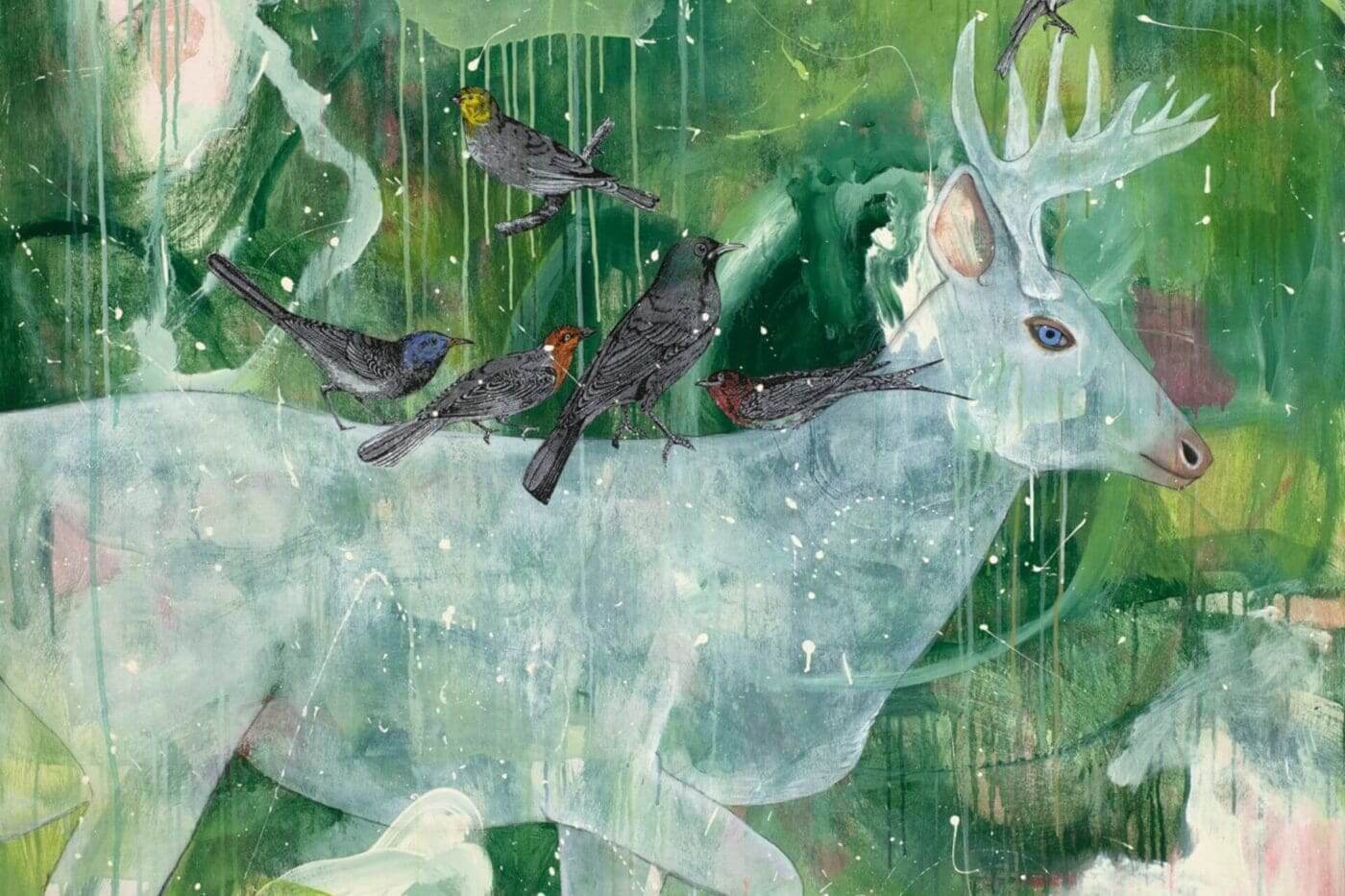
“The Divine Breath.” Mixed media. Illustration by Alexandra Eldridge
In the Garden, Milton has the angel Raphael tell Adam that God made us “free to stand or fall” because he didn’t want us to be robots, so to speak, but, rather, free entities who chose the path of God through what Milton called “right reason.” On the other hand, the philosopher Richard Sapolsky argues that our notions of free will are wrong, but that we are just not knowledgeable enough to understand how every action we make is determined by internal and external drives and forces.
Your poem, “Free Will,” dives into this debate. You talk about the doubleness of choice, which we can use for either good or for evil, in the same way that an object is only defined as a weapon after it’s used as such. How do such debates tie into religious notions of sin and grace, transgression and faith, religious codes of conduct and commandments, fate and free will?
Why don’t you give me a hard one?
I would say just that idea that we’re free to stand or we’re free to fall already creates a dichotomy: here’s a good thing, here’s a bad thing. And yet we talk about falling in love, right? Sometimes the fall is the thing that you need to see more clearly, to feel more clearly. I don’t really care if we truly have free will or not. I don’t really care if the Torah was written by people or by God channeling through people, because we’ve treated it as a sacred text for millennia. So it would be saying, “Do you believe in gravity?” Well, who cares if you do? Because here we are, we’re not on the ceiling. These texts and the idea have a pull. They have a weight to them.
And so in terms of free will, what would it mean to walk through our lives as though we have no control? There’s a quote to this effect at the end of Man’s Search for Meaning by Viktor Frankl, who was the originator of logotherapy which subverts Maslow’s Hierarchy of Needs, saying, shelter and food are important, but the thing that you most need is a will to live.
This is someone who was in the camps during the Holocaust and saw everything material taken from people, including their lives. You must have some reason to live. And that is the thing that cannot be taken from us.
My understanding of free will is that I can do everything I can to try to create the life that I want, but there will always be things that are far beyond my control. What is mine is how I react or do not react to what happens.
In “And the ground opens its mouth to speak,” you address the medieval notion that part of God’s punishment for the fall was to change the nature of nature so that the lion no longer lay down with the lamb, animals were carnivores and weather became wild — tsunamis and hurricanes. Nature itself became sublimely terrible in its ocean trenches and mountain heights. In your poem, this discourse takes on an environmental urgency.
There’s an amazing book by a writer named Mari Joerstad, called The Hebrew Bible and Environmental Ethics: Humans, Nonhumans, and the Living Landscape, in which she talks about the animacy of the natural world within the Torah, where it is a force that conspired to help people win victories and valleys weep or mountains shudder at the approach of God. So it’s an understanding that the world is active and very much engaged with us. And within this poem, I thought, what if this isn’t just a horrible climate crisis? What if it isn’t just the karma for how inattentive we’ve been and how we’ve been using the natural world? What if it’s actually the world saying, “Hey, we’re in a relationship and I really care about you. And I’m trying to warn you by giving you all these terrifying things, like fire seasons that last forever and floods. So, however bad you think this is, this is actually me saying, ‘Wake up, because it’s going to get so much worse,’ like how we might scare our child when they’ve done something that scares us so they don’t do it again.”
The epigraph for this poem and the title comes from Genesis, Chapter 4, when God says to Cain, “Cursed are you from the ground that opened its mouth to take your brother’s blood from your hand.” The question is, how much is the Earth going to swallow before it strikes back?
So we are all cursed.
We’re all cursed. But Cain also has a lineage that we don’t talk about very often, where he founded a city and, by some telling, was the progenitor of Noah’s wife. So, yeah, we’re cursed. Yeah, we have the mark of what we’ve done wrong, but we can repent and we can maybe live a little bit better.
Yeah. Beautiful. It recalls for me that moment when Thoreau in Walden writes, “I’ve never met a man who was truly awake. If I ever did, how could I look him in the face?” And this is why his book is one of the seminal texts of American environmentalism, right? Because being awake is not just being awake to the self, but also awake to nature.
Absolutely. And that immediately makes me think of the description of Moses when he comes down from Sinai and his face is glowing with such brightness that people can’t look at him. He’s carrying the divine encounter.
This discussion makes me think of human exceptionalism — the Enlightenment idea, with a lot of negative results, that humans are above animals. I love humans. I love civilization. But is human exceptionalism to blame for where we are, the idea that animals are here as food resources, like we talk about human resources or natural resources? Is nature a reserve to be mined? If the coming environmental catastrophe that we bring on ourselves causes the extinction of humanity as we know it, do you think the world would even notice, when seen from the perspective of the long history of geologic time?
I mean, the world might not notice, but we sure would.
I would. I’m not arguing for it!
I have a poem called “Wake, you sleepers from your sleep!” which is a quote from Maimonides, but it’s talking in part about the shofar, which is a ram’s horn that has been hollowed out to make a ritual call or back in the day, a battle call. It begins, “Our creatures only value the sounds we make through them.”
I think it’s exactly what you’re talking about. Our animals are only good to us for their hides or the food or labor they provide. This is the danger that happens when we “other” people or beings as things, as with exceptionalism: I’m up here, you’re down there because you’re not me. And therefore, you’re no longer worth paying attention to. When human populations are othered and equated to being animalistic, horrific things are done.
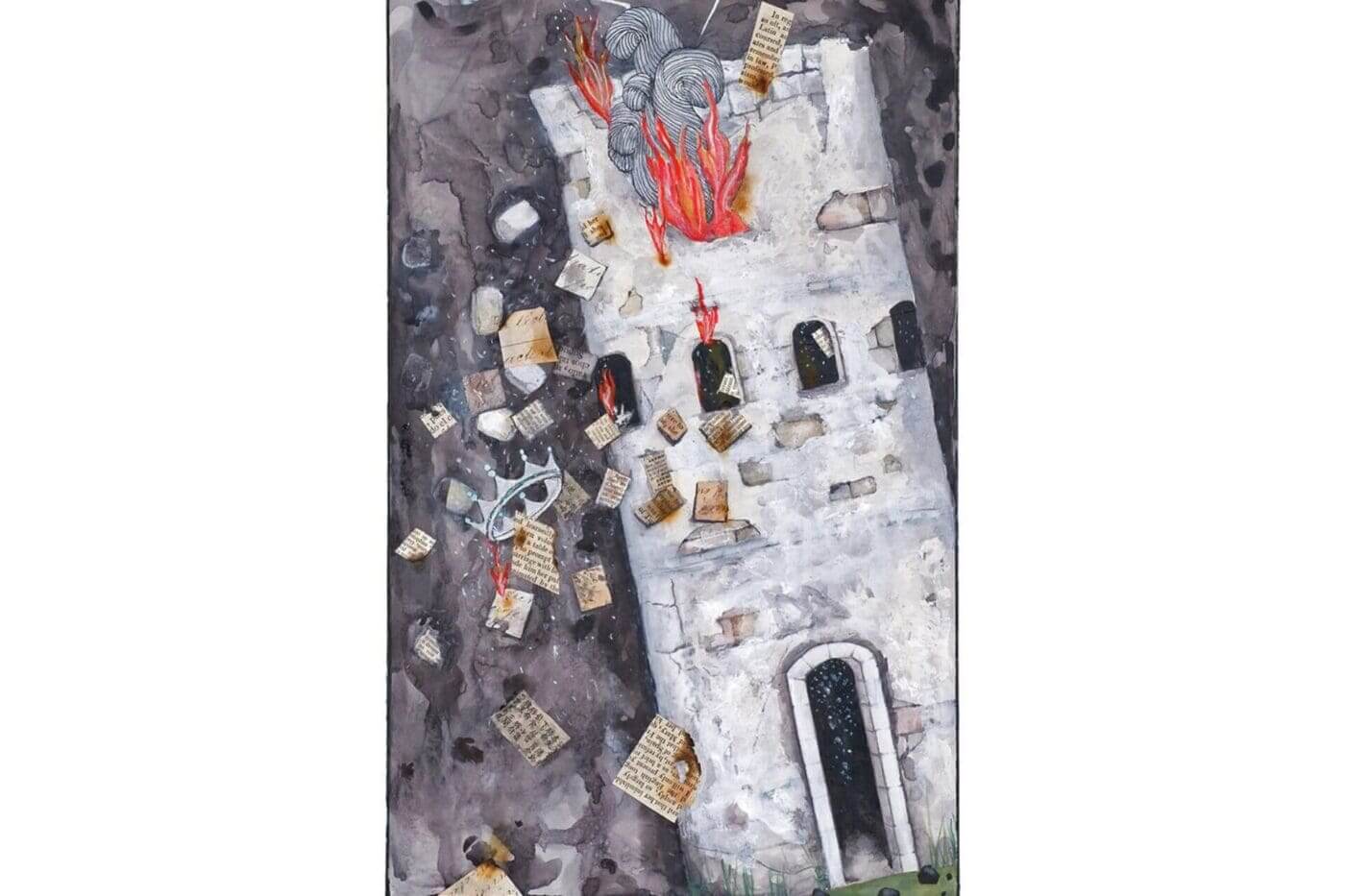
“The Tower Card.” Pigment print on hot press. Illustration by Alexandra Eldridge
It’s something that ties into your poem, “In the Shadow of Babel.”
You go back to the question of prelapsarian language, the language in which everyone on Earth could communicate, and which was denied to us by God after the Tower of Babel was raised by humans to storm the heavens so that humans might become gods. The story is usually interpreted as Promethean — the question of hubris, the human seeking to be more than human and punished for it, like the rabbis in Prague who make the Golem or Dr. Frankenstein or the Manhattan Project. Yet God throws down the Tower and takes away our common language out of fear that we might actually become gods. This is a jealous God, a punishing God, a small and selfish God.
In the poem, you talk about some of the results of not having a common language, such as slavery, genocide of Jews and Native Americans, the use of monocrops, which damage biodiversity. Is your poem saying that we’re not being punished for our hubris, but for being like God, jealous of others, punishing others, fearful of others, small and selfish, and trying to remake the whole world in our image?
I’m going to offer a slightly different interpretation of that poem. If you look at the endnotes, there’s a quote from the Netziv, Rabbi Naftali Zvi Yehuda Berlin, who interpreted Babel as the world’s first manifestation of totalitarianism; this was a really foundational interpretation for that poem. I had that same feeling you mention: what could possibly be wrong with the beauty of us all speaking the same language and being able to communicate? Yet, Netziv writers that, since the opinions of people are not identical, those in charge feared that people might abandon this philosophy and adopt another. And one who veered from this uniformity was judged with burning.
It wasn’t that people had the privilege of all speaking the same language. It was that they had no choice. That’s really what the poem is looking at, whether it was taking enslaved people from Africa and forcing them into white colonial culture and names, or putting Indigenous people in Indian schools and making them no longer speak their own language — constantly trying to put people in the “right” box.
So monocrops lead to crop disease, like monoculture leads to fascism or totalitarianism.
Exactly. And that actually fits beautifully with what I was saying about when we “other” instead of learning. I think umwelt is the term for the way in which an animal might experience the world differently than us. The fact that an octopus can taste through its tentacles, or, my God, you just take a dog for a walk in a neighborhood and you realize how our senses are just so dead compared to theirs and how amazing it would be to have that experience of the world. Okay, so we do that with animals. We lose so much in not understanding the way that they move through the world.
And then we look at other people and we ask, “Why don’t you agree with us? Why don’t you see things like I do?” I think of the amazing conversations that I have with poets and theologians who come from different cultures than I do, and how much that helps me see the world in a new way. It gives me new metaphors. It gives me new pathways into seeing. That is why I think exceptionalism is so dangerous, like monocrops, because what you’re saying is there’s one right way, and it’s my way.
In “Collective Nouns,” you talk about climate apartheid, in which the rich will save themselves while the poor suffer. Here it’s about Noah and the Ark. Do you see Noah’s saving of himself and his family and some of the animals in the Ark as equivalent to the creation of billionaire shelters and paradises for the Elon Musks of the world to save themselves when climate apocalypse hits?
Well, you have to love someone whose plan is to either make a bunker or go to Mars.
Or make a bunker on Mars. But you are writing about Noah here.
So first off, in the text itself, it says Noah is the most righteous man of his generation. So already, we have to keep in mind this is a generation that God has said deserves to be wiped from the Earth. So, to be the best of the worst is not so great. There’s a teaching, I think it’s Hasidic, where there’s something called a tzaddik im peltz, which means a righteous person in a fur coat.
So what it means by this is, okay, you’re freezing. And that type of righteous man, when he’s cold, is going to take a minute to first put that fur coat around himself before figuring out how to help other people not be cold, as opposed to a truly righteous person who, even though they’re cold, is going to first build a fire. Because that fire is going to warm him while it’s going to warm everyone around him. So Noah is referred to as a righteous person in a fur coat. Also, keep in mind, the first thing that he does post-flood is plant a vineyard and get real drunk.
In another poem, “Elegy in Prophetic Perfect,” you present prophecies of famine and destruction by Joseph to the Pharaoh and God to Noah as having already happened, as already fated. So in that sense, not in the future, but in the past tense, I guess. Is that where we are now in terms of a climate apocalypse? Are we already fated? Is that what you’re trying to suggest?
I think a good reason to keep looking to the past is so we can make changes. I didn’t read the Torah until I was in my 30s. I think that’s why I was so startled: Oh, this is a book about right now. I don’t know how that’s possible. Yet, how can you right now read about the flood and not think about the island nations that are about to disappear? The poem is asking, Yeah, that’s great, Noah. You saved the animals and your immediate family, but what about all those people who drowned? What are the ways that we can build a fire that’s going to warm everybody? How can we build enough ships or stop doing things that are going to make the whole world flood? I don’t think that we have the luxury of despair. I think we have to keep pushing.
God is shown as on the one hand the love-giving parent who’s saying, “I kept warning you. I kept warning you. Why don’t you pay attention?” But on the other hand is the inflictor of plagues and famines and apocalypses upon the world, the hand of flame versus the hand of love. It makes me think about your poems about Abraham and Isaac, in which God orders Abraham to sacrifice his only son, and Abraham is willing to do it, but God intervenes and has a ram sacrificed instead.
So, that cruelty of God, which we can also see in the story of Job, is revealed. Yet you say in the title of one of the key poems that there is no Hebrew word for “obey.” So if following God could lead to disaster, can you have faith without obedience?
We are taught in the second Creation story in Genesis that we are made in God’s image. But whether we think the Torah somehow came down with Moses from Sinai or it was transmitted through various authors’ hands, I would say that we can also flip that and say, “We made God in our image.” That, in writing this text, we wrote a God we could understand. We are angry, we are sad and we are flawed, and so we wrote a God who mirrored us and made us see ourselves, maybe not always in the best light. And then there are moments when we can get past ourselves, and we see that in a transcendent God. But there are many versions of God within this text.
What does God look like without obedience? What does faith look like without obedience? I think it looks like a relationship. If you look at the translation of “Israel,” which becomes Jacob’s name after he wrestles the angel, it means “one who wrestles with God,” a God wrestler. I have Presbyterian pals that talk about “the frozen chosen.” If you believe something and you never question it, then the first time that you do question it is so terrifying it can break you entirely because you’ve never shored up your belief system. You’ve just blindly believed. But if you doubt and you wrestle, you’re building those muscles so that when something horrible does happen, you have the fortitude to continue on.
You’re talking about wrestling not just with an external supernatural figure of God, but also some social and psychological construct that holds the God position?
Absolutely. I will flatly say I don’t know how I feel about God. I wouldn’t tell you that I’m a believer. I don’t really know what that means. I know that I have my own concept of what God is, that I’ve been developing through this writing and this study.
I walked away from Judaism when I was 12 because, in the Judaism of my childhood, I didn’t see women in it. I never saw a woman carry a Torah until I was in my 20s. I didn’t see queer people there. I didn’t see a place where I was allowed to ask difficult questions. I wasn’t interested in that because I couldn’t wrestle with it. I couldn’t engage with it.
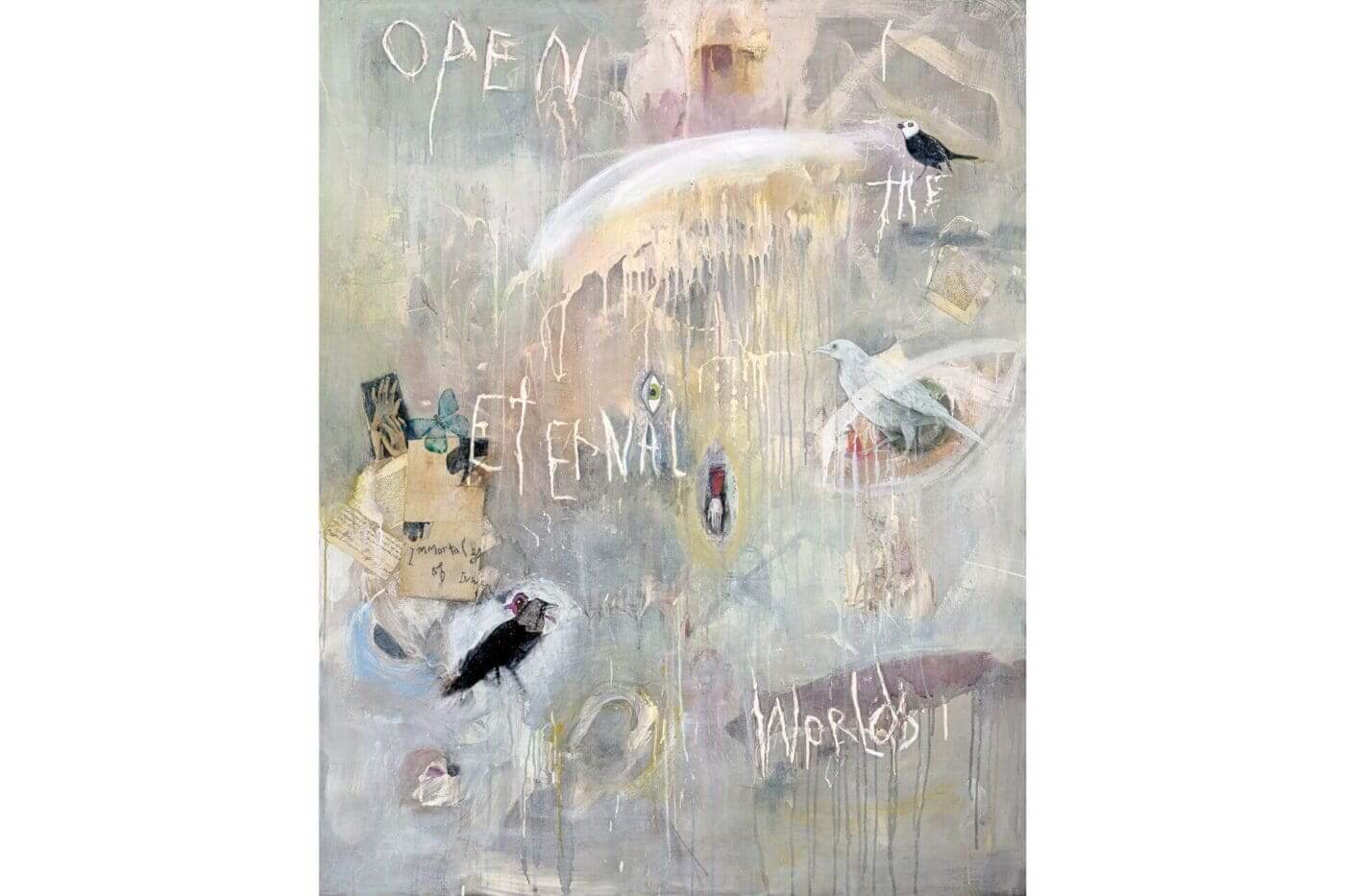
“Open the Eternal Worlds.” Mixed media. Illustration by Alexandra Eldridge
Returning to the idea of exceptionalism, in this book you address the idea that “One nation shall prevail over the other nation.” You present this in terms of your own family conflict with your sister, and also in terms of Solomon threatening to cut the baby in half. Yet, you celebrate joining, not division.
I guess my question is, how do you construct a religious, spiritual, national, and ethnic identity that doesn’t divide? Isn’t that the essential question with all religions? The same year that the Jews and the Moors were kicked out of Spain was the start of the Inquisition and the year that Columbus quote unquote, discovered the Americas, not only to find spice and gold, but also to bring the Catholic religion to those who didn’t have it, coming from the same ideology of exceptionalism. And out of that, slavery, disease, genocide, and the rest.
Your quote, “That one nation shall prevail over another nation,” is the epigraph from a poem called “In the village of my body two people.” The poem is about Rebecca, who is barren and becomes pregnant through divine intervention with twins, Jacob and Esau. But they’re fighting. I can imagine them having fistfights inside of her to the point where she cries out to God, Why are you doing this to me? Why are you punishing me?
The idea was that there was the animal soul and the divine soul within her. Everything is a metaphor for everything else if you just pay attention. So I feel that battle within myself — the intellectual side and the animal side.
As to cultural exceptionalism, I think it’s damaging. I think it’s dangerous. I am not going to be someone who figures out what’s going on right now with Israel and Palestine. But I can tell you that although in our country, where, fortunately, most of us aren’t under direct physical attack, we still can’t sit and have a real conversation with each other. Each of us believes we are so right, so we can’t talk to a person who believes something different.
Yet, in our place of relative safety, if we can’t sit and have a thoughtful conversation about what we, especially we as writers, can do to come together and maybe do something for positive change, how do we ever expect that to happen in a place where people don’t have food and where there are literal bombs falling? I’m struggling with that a lot right now. I think it’s very scary from whatever your position or belief.
Poems in the book deal with questions of and barriers restraining desire — heterosexual, homosexual, lesbian — but also, in one notable poem, talking about its physicality, and particularly, circumcision. Circumcision was one of the key problems with Judaism as a religion that wanted to spread, so those Messianic Jews, later known as Christians, solved the problem by eliminating the surgery and saying, instead, we should have “a circumcision of the heart,” drawing from Jeremiah and Romans.
Circumcision is a marker of Jewish identity. Yet this marker on the body was also used to identify Jews as a group to be shot or put into death camps; Nazis who suspected someone of being a Jew would have them drop their pants. Circumcision is a marker of grace but also a tag for slaughter. How do you see it?
To be Jewish is not just a religion, but depending on what time period you’re in or how you see things, it’s also race, it’s ethnicity. With the Nuremberg Laws, if you have one fraction of Judaism in your history, it doesn’t matter if you say you’re a Christian. It doesn’t matter if you speak perfect German and integrate into the culture, you’re Jewish and you’re going to die.
I want to do outreach and have a beautiful cross-pollination within different groups of people. I also don’t want to hide who I am, as someone who passes as white — though there was a time in this country when Jews were not seen as white — as someone who easily passes as Christian and who passes as straight. I am at a point in my life where I have a lot of privilege — and part of how I want to use that privilege is to openly claim the identities that make me different and then see how I can help people.
I have friends in London who send their kids to day school, and they’re told to take off any identifying clothes, such as a yarmulke, which identifies them as Jewish, because these kids are getting harassed on public transportation. Yet there are many people, like black people in our country, who cannot hide who they are, even if they wanted to. I, too, don’t want to hide who I am.
A lighter note. A lighter note. For a final question. Can we go back to talking about gay beaches in Provincetown? I’m happy to do that.
Okay, a lighter note. In the poem, “Lemme tell you the one that killed at canasta,” you tap into the Jewish tradition of joke-telling. The poem is framed around a long Jewish joke. It reminds me of Robert Pinsky’s fantastic poem, “Impossible to Tell,” his elegy for Elliot Gilbert, who was famed as a joke-teller. Like yours, Pinsky’s poem is woven around an extended Jewish joke about death. Tell us about your interest in Jewish culture and poetry as manifested in humor? Why do you use it?
Well, first off, that joke really is a direct quote of my grandmother, Bernice, who just celebrated her 99th birthday. I had the absolute honor of giving a reading that she attended, and as I read that poem, she laughed at her own joke through the whole thing. It was amazing.
Yet I come from a family where outside of my fabulous grandmother, no one can tell a joke to save their lives. So my attempts at humor might be like redemption for my family to see if I can be a little bit funny on their behalf. Like my dad, who after telling an incredibly long joke whose punchline he forgot by the time he got to the end, actually said to me, “Well, like a broken clock, I’m right at least once a day.” Oh, no.
I think any time you have real sorrow, when everything is arrayed against you, you can curl into a ball and close your chest, or you can laugh, which is throwing back your shoulders. And so I feel like the Jewish cultural choice to laugh is beautiful. It’s resilience and defiance, in a beautiful way.
Well, I think that’s a good note to end on. Thank you so much for this wonderful conversation.
Help us sustain independent journalism...
Our team is working hard every day to bring you compelling, carefully-crafted pieces that shed light on the pressing issues of our time. We rely on caring supporters like you to help us sustain our mission. Your support ensures that we can continue to provide deeply-reported, independent, ad-free journalism without fear, favor or pandering. Support us today and make a lasting investment in the future.
RELATED STORIES

Award Winning


Today’s environmental and social justice challenges are unprecedented, and require an unprecedented collective effort.


Stay updated on our latest features, events and more. Subscribe to our Note From the Nest newsletter!
