
Listening to the Rains of Nairobi
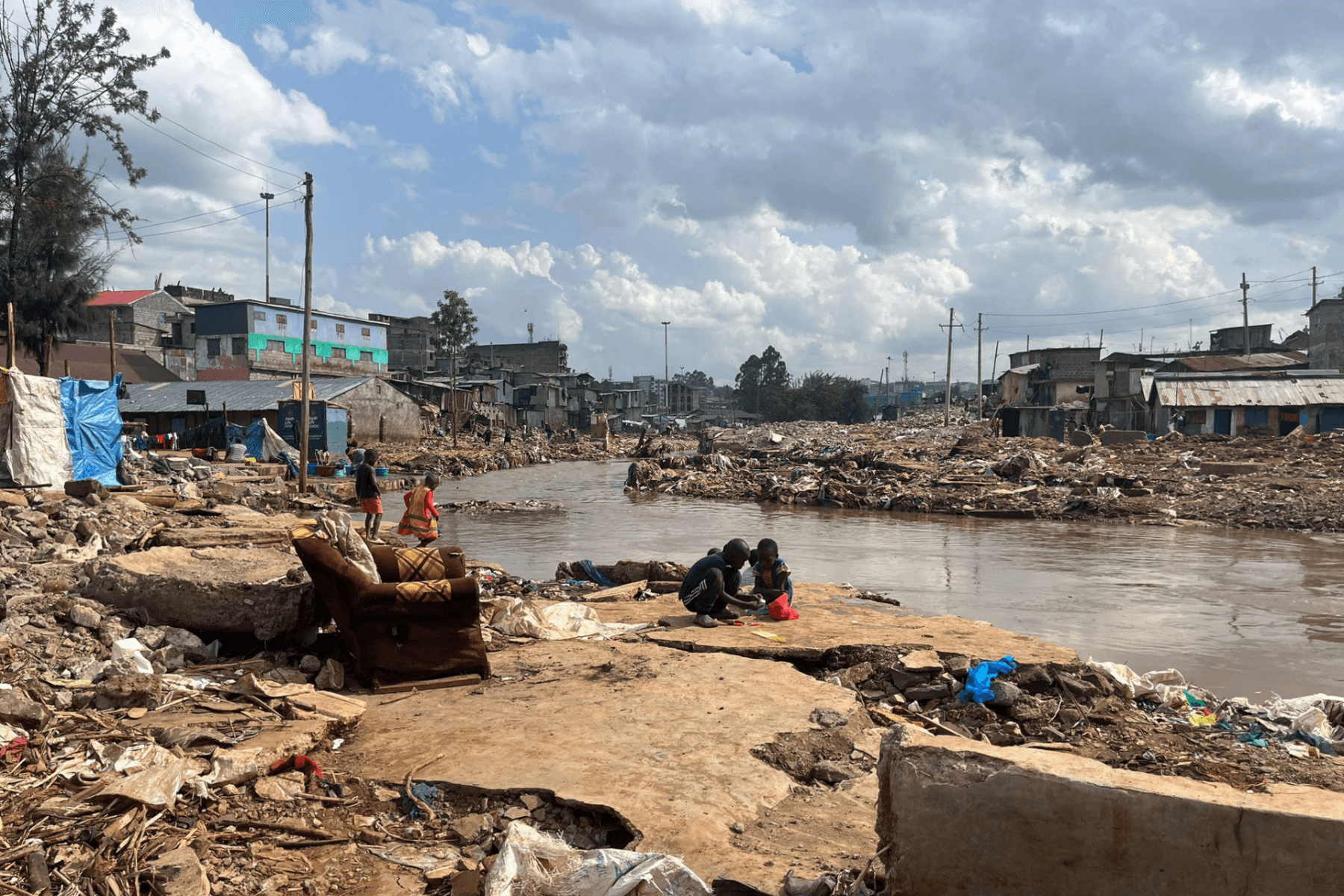
The rainfall is a wavering wall through which I can see chocolate-muddied earth running in rivulets over the grass. An estuary has formed in my garden. Streamlettes gather momentum to form a fast-flowing river — cappuccino froth on brown coffee. There are whitewater rapids outside my back door; a chair sails past. The dog loses his footing and disappears momentarily, only to reappear a few meters downstream. The water knocks down the garden wall and crashes into the road, where it joins other newborn rivers. Together, they tear apart potholes until a section of the road falls away. Mud and tar join the giddy waters and vanish under a neighbor’s hedge. An electric storm punctures the sky. It’s been raining for 15 days.
Since its formation, the valley has permanently puckered with ominous pimples, some of which erupt to form volcanoes. One cone-shaped mountain sat atop the rift, where it huffed at the blue skies for a few millennia until the earth shuddered and its walls collapsed. All that remained was a string of rolling hills, which teetered above the rift’s vertiginous drop to the south, and a plateau of brackish waters and forested swamps to the north. These fisted knuckles, now known as the Ngong Hills, have watched over Nairobi’s clawed and hooved inhabitants ever since. The sun steadily observed the rise and fall of the earth and the subsequent arrival of man and beast without comment. Nature knows that change is inevitable. Predictably the day came when it was noted that the balance had once again shifted. Instead of mouse shrews and armadillos, hyenas and hyrax, there were donkeys and dukas, cocaine and crack whores, and a ceaselessly multiplying army of humans who hummed with goodness, boldness and badness.
Pale-skinned men had sailed tall ships along the edges of Kenya for 700 years. They caroused the coastline, trading beads for bones until they stuck a flag near the creek of Mombasa and called the land their own. The traders muttered to themselves about the riches that may lay beyond the coastal waters, but their small forays beyond the palm-peppered frontier had revealed an inhospitable place filled with wild animals and disease. God became impatient at their reticence and demanded the white men carry his name into the hinterland. So, it was the missionaries who first crossed the unforgiving expanse of burning red soil and baobabs. In their wake followed explorers and evangelists, entrepreneurs and opportunists. These adventurers walked 500 kilometers until they stopped, where three rivers crossed below a knuckled row of humpback hills.
Nairobi means “place of cool water” in the Maasai dialect. To weary travelers, the land where Nairobi would be built was a heady balm, breathtakingly cool compared to the heat and humidity of the coastal lowlands. Beneath the Ngong Hills, off-flow from the mountains and moorlands of the Aberdares formed thick pools of black cotton swamp sketched with delicate waterways, crisscrossed by the fertile waters of three rivers.
The adventurers thought this was a fine place to settle and set the local Maasai, Akamba and Kikuyu tribes to work building houses. Such was the idyll that people from all over the world began to join them. The Indian workers, Kenyan slaves, the Italian soldiers and the British aristocrats brought their women and birthed their children in Nairobi. The rivers fed the burgeoning mass of humans, who siphoned the waters into bottles, barrels and the gaping mouths of long-horned cows. As the humans took from the earth, the rivers faded to little more than brooks of polluted water clogged with refuse. Nairobi’s cool waters became buried beneath a spaghetti junction of soaring roads. The plains at the foot of the Ngong Hills were pebble-dashed with concrete towers; tin-roofed houses were built on the riparian floodlands.
***
Water creeps over my doorstep and into my house. We’ve had no electricity for four days. Rotted food sits in bin bags surrounded by water. Thunder is a stuck record, rolling over and over again on repeat. The rain pounds the roof so hard that my three children sit with their hands over their ears. My phone flashes with a message:
750ml more rain expected over the next week.
Where will it all go?
60 percent of Nairobi is slums. The largest, Kibera, is a sinuous wave of poverty that stretches as far as the eye can see. Kibera houses two million people and was built on swamp land. This wasn’t a master feat of engineering, like Venice or Amsterdam, but a city thrown together in haste. The first houses were built on the high ground, but over the years, an unrelenting series of lean-tos have been added, stopping only at the waterline. In the dry season, Nairobi’s fine red dust filters through the open windows, turning every once-white shirt pink. The dust goes up and down and around, painting the entire vista in copper. The air is thickly acidic, catching at your throat. It makes you want to claw your way out of this stifling hell, scratch the dust from your skin and choke the fetid odor of feces and rotted food from your mouth. It is as if, by showering deeply, you could ignore the misery man has brought upon himself — and upon Nairobi. In the wet season, residents have no escape.
“120,000 people have been displaced,” the man on the TV says. “Two hundred confirmed dead, with another 350 missing.”
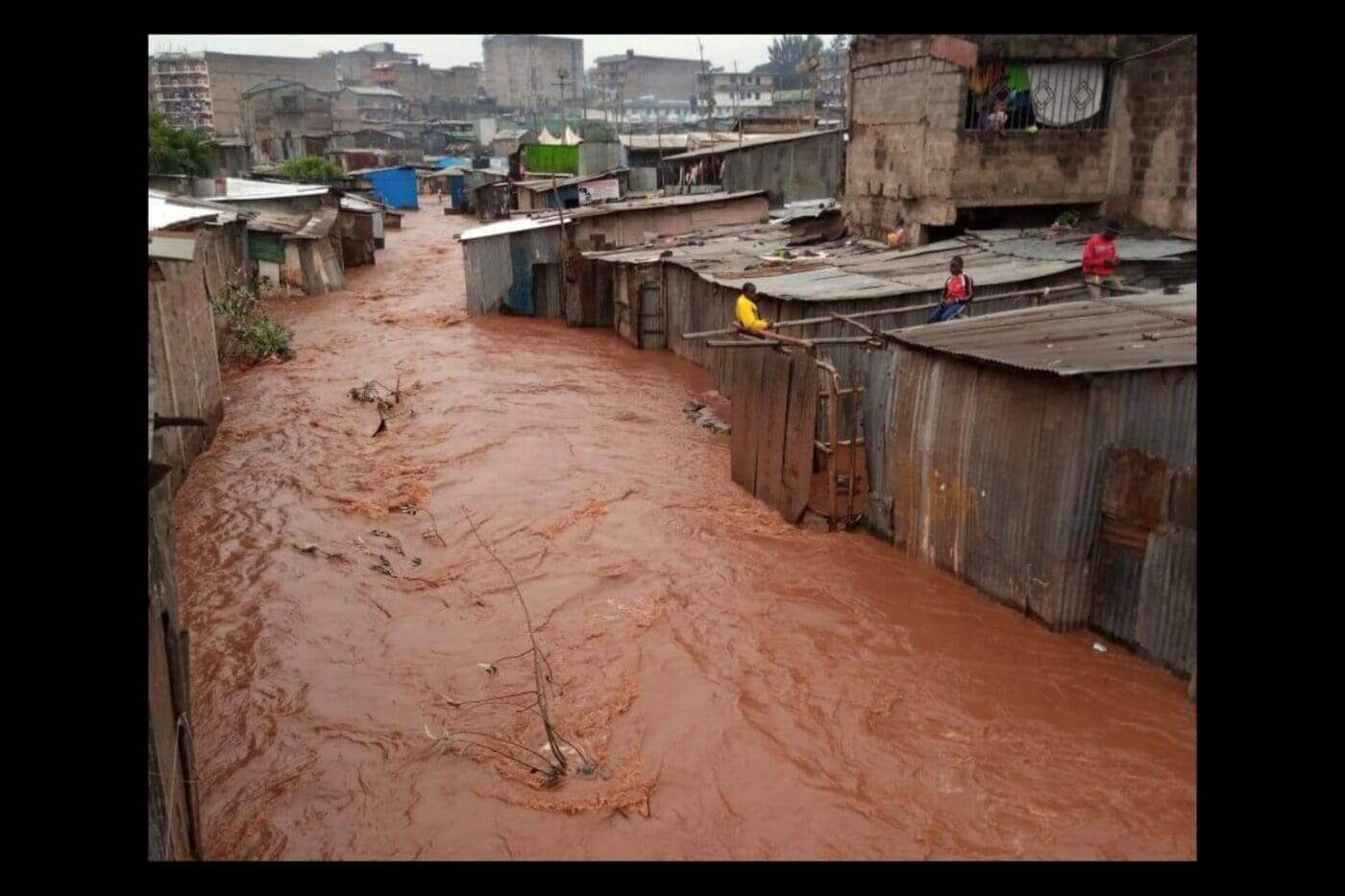
On the first day of the floods in Matharein late April 2024, children and adults climbed to the rooftop in attempt to save their lives. Courtesy of Rachel Mwikali / Changing Lenses, Changing Lives
Flooding has turned Kibera into a lake this spring; the water has risen so high that all that remains are the tips of the corrugated iron roofs. The TV camera films the slum, zooming out to show a mosaic of shattered buildings surrounded by ruddy water. Now and again, men who were never taught to swim whizz past — caught in the rapids — and a crowd of onlookers scream. The camera zooms in, and we see a Maasai in a red shuka asleep on a roof. A family throws their young children to safety across the brown water. A Sacred Ibis takes refuge in the bloated body of a dead cow.
“Many people are lost. Feared dead,” booms the TV guy, as a scrolling headline at the bottom of the screen states, “Rivers reclaiming their riparian land within Nairobi City. . . leaving destruction and death in their wake.”
One wonders what inspires humankind to take an Aslan fresh patch of greenery and bury it beneath concrete towers and human debris. I think about David Attenborough’s bold statement, “Humans are a plague on the Earth.”’ When it comes to Nairobi, I can’t help but feel that he is right.
There is a place near my house where you can view the whole city. From this lookout, I spy the comforting ridges of the Ngong Hills and, beyond them, the great gash of the Rift Valley, flickering like a purple scar. Nestled within are the dormant volcanic mounds of Suswa and Longnot and the silver slice of Lake Naivasha, to the east is Kilimanjaro. As usual, its sugared snowcap is visible above its skirt of clouds, giving the impression of a floating citadel. Turning north, I look down on our human achievement. Nairobi — the biggest, best and most glorious city in East Africa — is a sea of humanity, poverty and corruption, and greed and hunger, topped with a wave of sweltering smog.
The water comes to the wealthy. A hotel sits twelve meters above the banks of the Embakasi River. Unlike the slum dwellers (who assembled their shacks on riparian land), the monied owners of these hotels high above the waterline. But, the rainwater doesn’t care about designated floodplains, nor how much money you have. The Embakasi River rises to twelve meters, and then to thirteen. Into its raging waters go the hotel’s safari cars, the rope bridge, the dhow furniture, the crystal glasses, Turkish rugs and Scottish whiskey. The water leaves nothing behind at all. No one is beyond judgment.
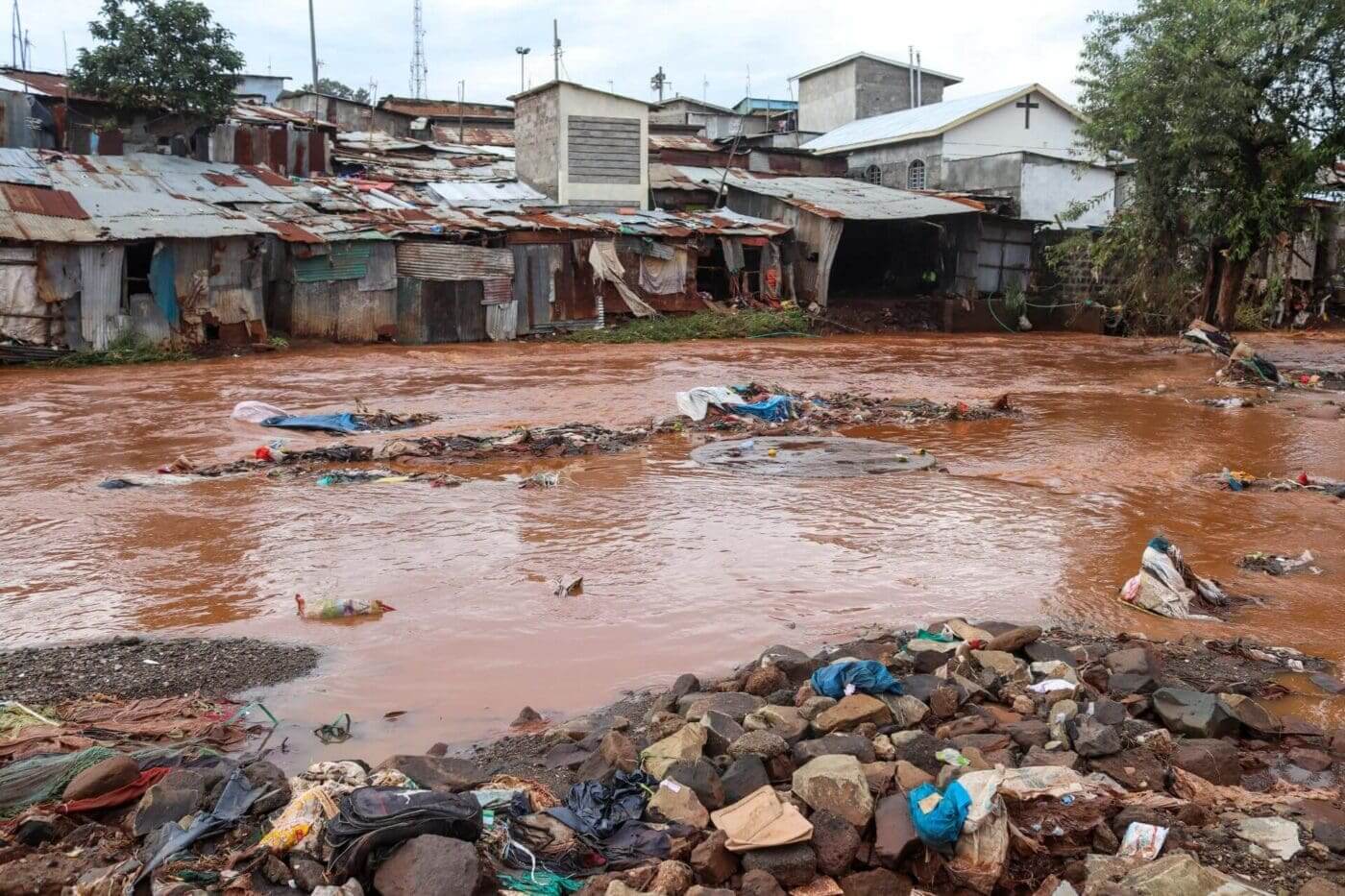
Courtesy of Peter Ndichu
Nairobi is Ruto’s hustles and matatu muscles — another city that never sleeps. Nairobi’s seething hordes of humanity are a dark droplet on a once bright watercolor, greyness blotting out the greenness of the trees and the red of the earth, plugging the mocha waters of Kenya’s great rivers with plastic and metal. It occurs to me that the land is fighting back.
Unlike the world’s great cities — London, New York and Paris — whose land has been pounded flat over the centuries, the undulations of Nairobi’s valleys and swamps are visible beneath the construction. In Kibera, a startling purple bougainvillea envelopes a crumbling house, and calla lilies bloom along an open sewer. Along the highway, a lion sleeps as traffic backs up and people snap photos. A lone wild olive tree offers shade to the Maasai cows on the roundabout opposite State House. In the business district, the prehistoric-looking Marabou storks build gargantuan nests on the top of skyscrapers. At the bottom of my garden, giraffes lean their heads over the fence and bushbabies stare boggle-eyed from the treetops. Last week, a leopard killed the dog next door. In Nairobi’s largest park, I spot a yawning red gash beneath a tawny mane. A sunbird bothering Amarillo weavers, and a frozen impala gazing at me between the ginger grass.
There are still places in this city where the old magic remains — jade green jewels gleaming in the rough in Oz-like places, born in technicolour. Go and lie beneath a sky that burns with blueness. Hold yourself still until dust coats your skin in a tangerine glow. Listen to the cries of the fish eagle’s cries and the frogs’ glub in the stream. Make peace with the calf that lies in bloodless bones across the valley and the hunter that rendered it so. In these places, you can feel the heartbeat of ancient Africa and share in the lives of a billion animals that have risen and fallen over countless millennia.
Nature does not hurry and does not worry; it knows that we are only temporary.
In the end, this season’s rains displaced over 212,000 people and killed nearly 230. The financial impact of the damage to the city is in the billions. In time, the community will raise money to rehouse the residents of Kibera. The shacks will be rebuilt in the riparian flood zones; the hotel will fix its bridge and buy new rugs. The sun will come out, and mud will turn to dust. The river in my garden will retreat, the grass will grow back and the dogs and kids will forget that there was once a lake under the date palms.
It took 120 years to transform a place of bounteous wilderness into a city of squalor. Men and women fought hard to eradicate wildness — to create a city that mimicked their homeland in a country that wasn’t theirs to change. We have slaughtered animals in their millions, burned the forests and buried the swamps. We have drowned the lion’s roar and the hippos’ snort beneath the clamor of pneumatic drills and honking tuk-tuks.
But nature does not hurry and does not worry; it knows that we are only temporary. Our tall ships and tall buildings, our ghettoes and our farms, our slum dwellings, our five-star hotels, our human achievements and our desperate regrets are only a moment in time. Nairobi and the Ngong Hills will endure long after humans disappear. Our time here is finite. Never has it been more important to stop and listen to what the earth is telling us.
Help us sustain independent journalism...
Our team is working hard every day to bring you compelling, carefully-crafted pieces that shed light on the pressing issues of our time. We rely on caring supporters like you to help us sustain our mission. Your support ensures that we can continue to provide deeply-reported, independent, ad-free journalism without fear, favor or pandering. Support us today and make a lasting investment in the future.
RELATED STORIES


Award Winning



Today’s environmental and social justice challenges are unprecedented, and require an unprecedented collective effort.


Stay updated on our latest features, events and more. Subscribe to our Note From the Nest newsletter!
