
Your Land

The American concept of geography has undergone a powerful shift. Place is less important than it has ever been to those who can free themselves from it, yet more important to those who aren’t able to leave it. The economically privileged can live where they please in the ethereal non-space of the information sphere. St. Augustine speculated that God was a circle where the center was nowhere and the circumference was everywhere; he might as well have been describing the Internet. In his seminal 2002 book The Rise of the Creative Class, the sociologist Richard Florida laid out a vision of winner cities like Portland, Washington, D.C., San Francisco, Austin, and Missoula that offered charms to lure the soldiers of the laptop army who would set their own schedules and dream transformative dreams for the rest of us. “Where once people had to go to a particular place—a telephone box, a computer—to communicate, now communications come to them, in the form of a pager, a mobile telephone, or a laptop with a phone jack,” wrote The Economist in 1997, in the midst of the detachment revolution.
But not for most people. The shift in manufacturing capacity to Asia and the rise of corporate farming has made shells out of healthy towns like Gloversville, New York; Concordia, Kansas; and Cairo, Illinois. Those without the means or desire to move out are caught in a web of diminishing opportunities. The championship cities of urban America and its information-based trades have economies growing more entangled with London, São Paulo, and Beijing than with fading cities like St. Louis, Cleveland, or Bakersfield.
The new zones of exclusion have shut out Americans from their own country, through ways that are both literal and perceived. Winner cities have become havens of inequality and nearly impossible to navigate for those drawing old-school paychecks from retail jobs or public schools. Tiny fragments of San Francisco today contain more gross national product and fluid capital than entire cities. The liberal values of these places come under increasing suspicion by those on the geographic outside of them. Our recent simplified dialectic of “coastal elites” versus “real Americans” is actually more about location than values.
Some places in America were set up from the beginning to be sacrificial zones—a repository of industrial overspill, shabby real-estate, or neighborhoods redlined by racial discrimination. The New Jersey marshes on the west side of the Hudson River became a haven of unregulated dumping of garbage and chemicals that benefitted the shining city nearby; the town of Opportunity, Montana, was built around a giant copper smelter belching arsenic and heavy metals from copper mined from nearby Butte; Native Americans were pushed into some of the least valuable lands in the West; virtually every city founded by railroads created class distinctions based on the cleaving line of the tracks.
What was once a regional practice is now happening on a national scale, as entire portions of the country—primarily rural and in politically conservative regions—are written off as lost. Residents of West Virginia used to complain that they were treated as an “internal colony” by the rest of the country, stripped for coal and left empty; such can now be said of broader swaths of Appalachia, the Midwest, and the Mountain West where joblessness and life expectancy are diverging in large proportions from those of the cities where the economic winners live. Resentment builds. National cohesiveness frays. It is commonly said that America is the first country to be based on an idea rather than a shared ethnicity. Yet our nationhood is also heavily dependent on a shared place.
Here is our lowest common denominator: we all stand on the same land.
If you want to know Americans, look at where they live first. Look at the land. Geography is our bounty; it has also become a curse.
American place is not what it once was—neither in shape, nor optimism. Bank mergers have destroyed local institutions that took the long view of civic development and strategic lending. Changes in agricultural technology have made the family farm an even chancier proposition than ever before, with its emphasis on mechanization and gigantic yields. Consolidation of wealth in fewer hands leaves fewer chances for rural entrepreneurship and innovation, which opens a vacancy in the national spirit. “To be rooted is perhaps the most important and least recognized need of the human soul,” wrote the French theologian Simone Weil. To live as an American citizen implies a form of ownership in the future of the country, a tiny garden patch of responsibility for its fortunes. But in today’s uprooted America, “your land” means less than it ever did—but, paradoxically, much more.
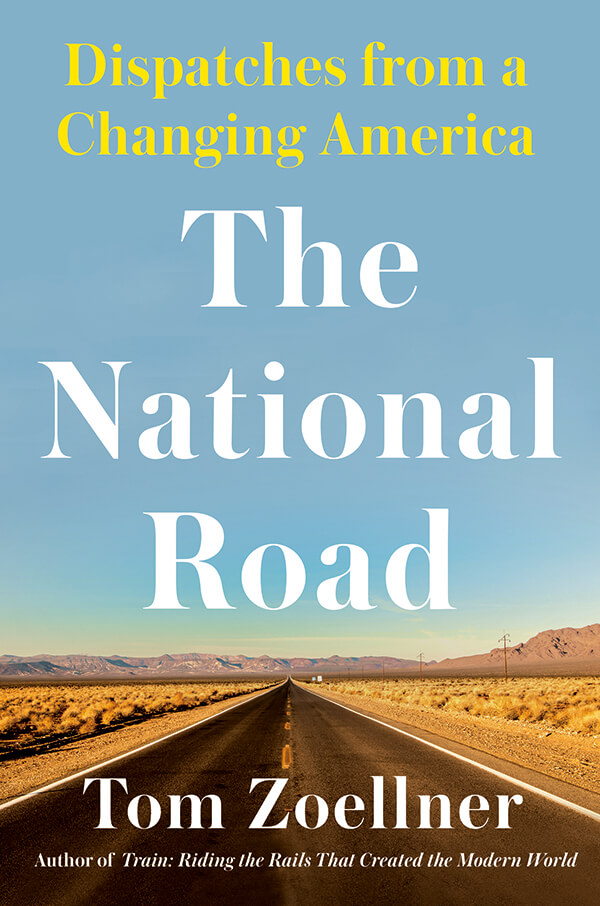
Credit:Copyright © 2020 by Tom Zoellner, from The National Road. Reprinted by permission of Counterpoint Press.
Help us sustain independent journalism...
Our team is working hard every day to bring you compelling, carefully-crafted pieces that shed light on the pressing issues of our time. We rely on caring supporters like you to help us sustain our mission. Your support ensures that we can continue to provide deeply-reported, independent, ad-free journalism without fear, favor or pandering. Support us today and make a lasting investment in the future.

RELATED STORIES




Award Winning



Today’s environmental and social justice challenges are unprecedented, and require an unprecedented collective effort.


Stay updated on our latest features, events and more. Subscribe to our Note From the Nest newsletter!
