
The Accidental Affirmations of Nein, Nein, Nein!
Across four decades, Jerry Stahl has built a career — haphazard, by his own reckoning — that plenty of writers would die for.
Stahl has published novels, essays and short stories. He has written for the movies, for magazines and for TV. A quarter-century after its release, his 1995 memoir, Permanent Midnight, remains a landmark debut: a searing chronicle of the author’s early successes, addictions and professional-grade self-loathing, shot through with a jet-black humor that has informed his work ever since.
In his 2004 novel I, Fatty about the calamitous life of the silent-film star, Roscoe “Fatty” Arbuckle), his 2015 essay collection OG Dad about becoming a father again in his 50s, and in pretty much all of his work, Stahl casts a knowing eye on life, celebrity, addiction, sex, death and especially, unsparingly, himself.
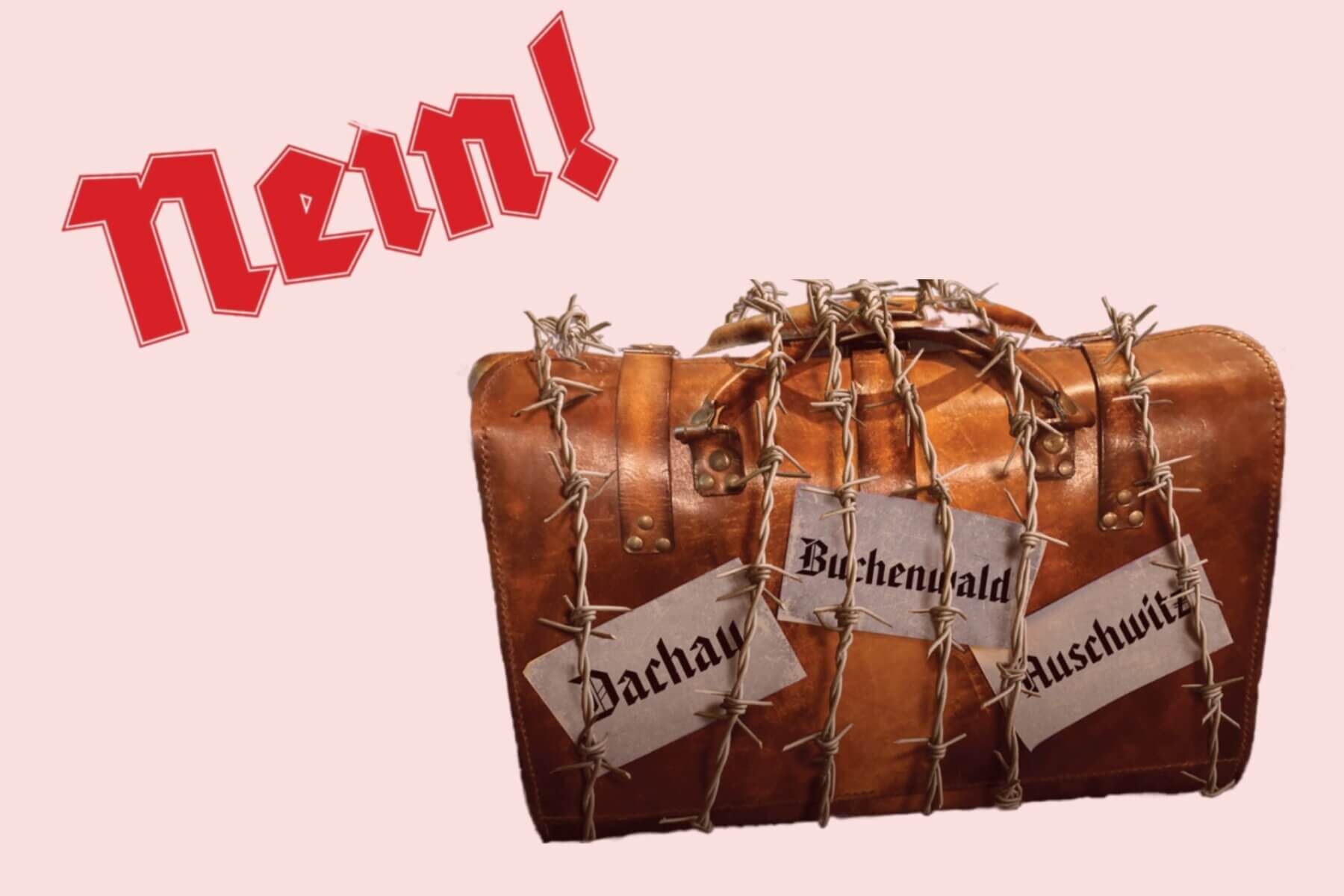
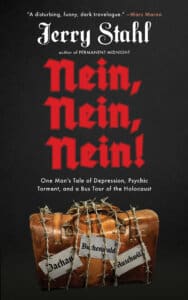
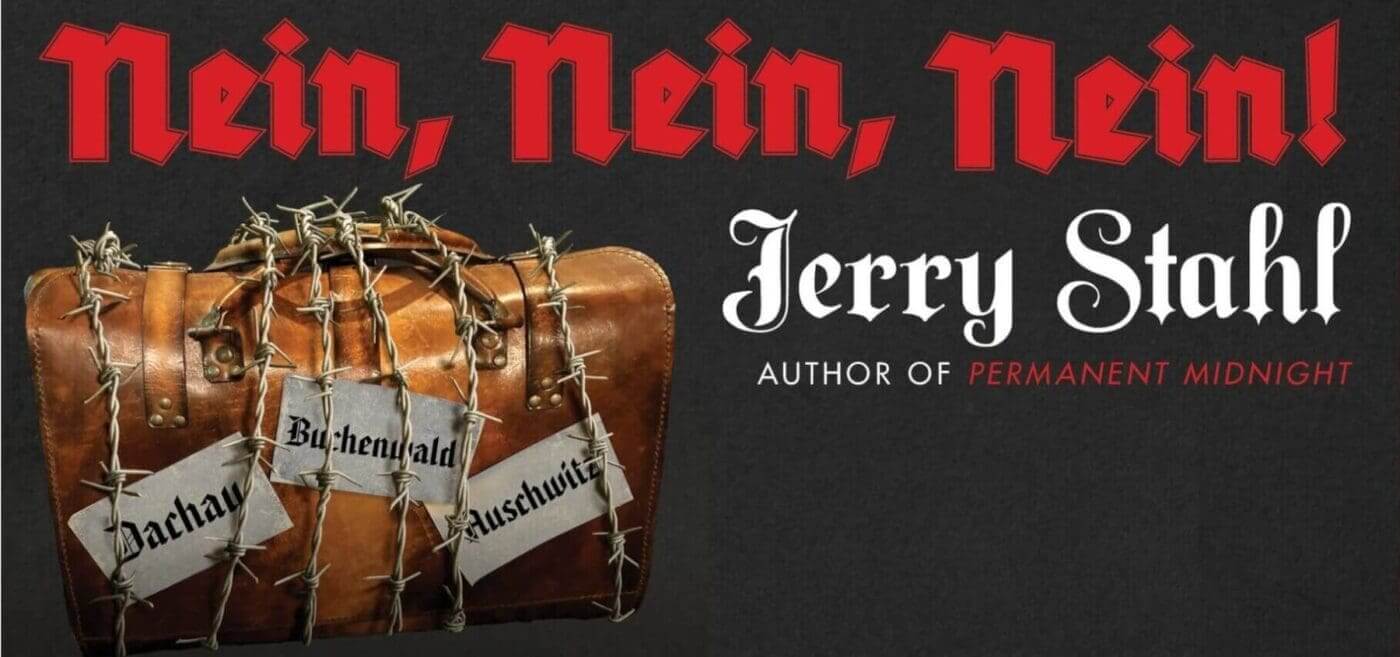
This brings us to Nein, Nein, Nein! One Man’s Tale of Depression, Psychic Torment, and a Bus Tour of the Holocaust, a book that Stahl has been hurtling toward — or one that has been hurtling toward him — his entire writing life.
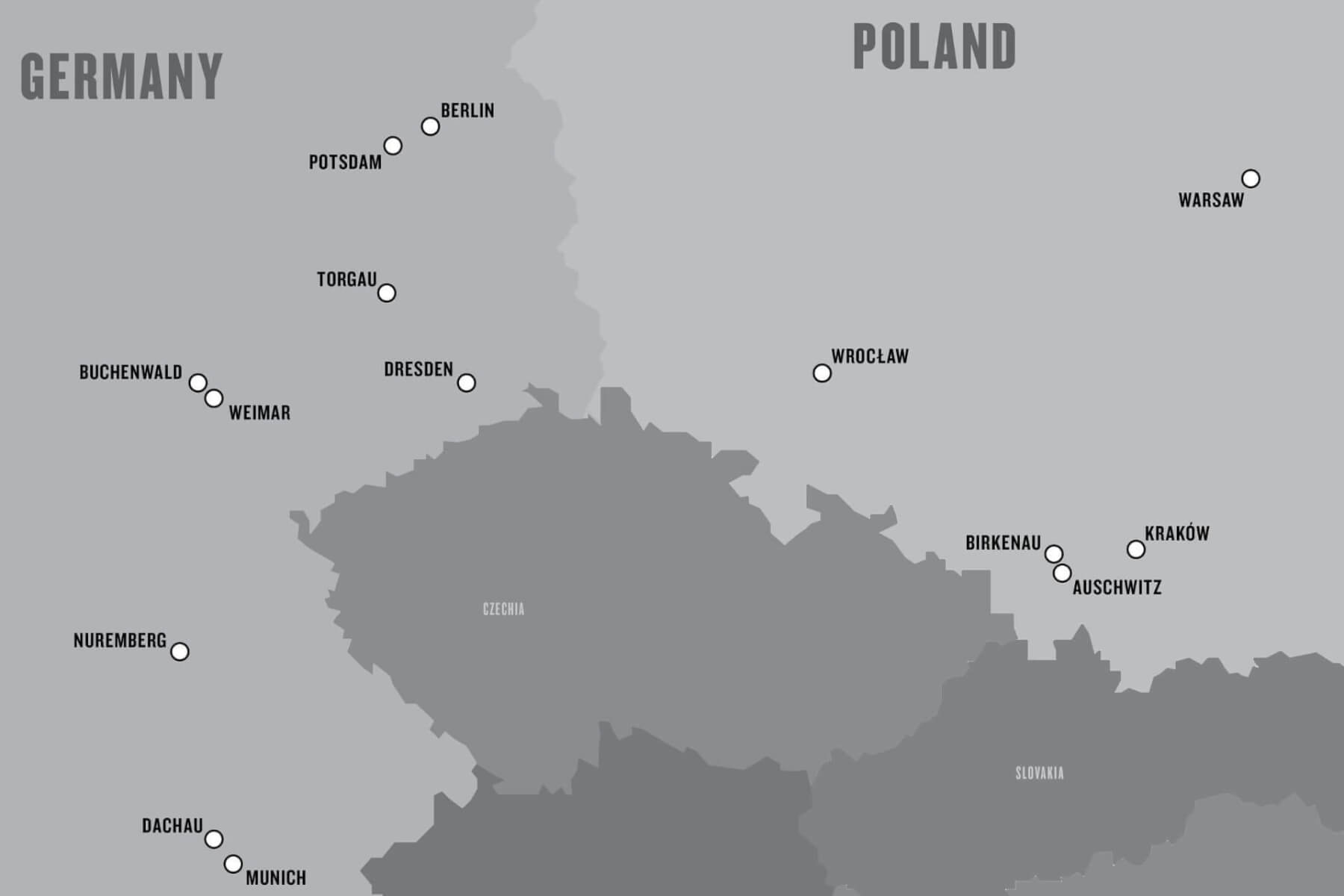
A perverse, MAGA-era take on a vintage conceit — Americans bumbling around inscrutable old Europe (think Holly Martins in The Third Man, but street-wise, Jewish and armed with wi-fi) — Nein! explores the fallout from Stahl’s decision, in 2017, to sign on for a guided bus tour of Nazi death camps. Some of the material derives from a series of articles Stahl wrote about the experience for Vice, augmented with riffs on more recent obscenities, like the Jan. 6th coup attempt. Further deepening the disquiet, the author embarks on this ghoulish holiday in the face of mass-produced misinformation, berserk conspiracy theories and resurgent fascism everywhere. Then, he writes about it all in the midst of a mid-life crisis that is pulverizing even by Stahlian standards.
The absurd abounds in these pages — how could it not? — when a group of Asian tourists at Auschwitz mistakes Stahl for Michael Richards (Seinfeld’s Kramer), or when the author pulls a “total douche move” at Buchenwald and is poleaxed by instant karma: “I stomp out of the cafeteria, fast, to show [that] it bothers me to see people eating where so many suffered. And then, BAM. Like a fucking idiot, I walk full speed into a plate glass sliding door and stagger backward, bleeding from the forehead.”
Meanwhile, readers familiar with his work will not be surprised to find that, whether recounting death-camp savageries or mulling his own moral implosions, Stahl veers from blunt honesty to smart-alecky, beatnik-inflected jive and back again with unsettling speed. Reading the book can sometimes feel like the literary equivalent of riding that carnival midway mainstay the Scrambler.
For all of its familiarity, though, Nein, Nein, Nein! is unexpected in one regard: Stahl’s joke-cracking is, somehow, less discordant here than in his other work. Put another way, his affinity for Borscht-Belt-ready gags doesn’t just seem appropriate. It seems essential.
Jonathan Swift, Shirley Jackson, Vonnegut, Joseph Heller, Kafka, and many other writers have understood that when confronting the unspeakable, humor can serve as both sword and shield. (Readers who have never viewed Gregor Samsa as a comical figure might consider revisiting The Metamorphosis with an eye toward laughter, rather than dread.) Nein, Nein, Nein! fits in this lineage — somewhere between Gulliver’s Travels and Slaughterhouse-Five.
For example, in the midst of the Covid pandemic and still grappling with what he witnessed in Poland and Germany, Stahl writes:
I should point out that these last few days have been, well, tricky, on the free-floating-despair front. Is quarantine pink eye a thing? Psycho-emotional pink eye?
I can’t go on, I’ll quote Samuel Beckett.
It’s been a challenge, diving back into the past in these pages. I have, in fact, been FDOM for twenty-four hours. Facedown on the Mattress. F. Scott Fitzgerald said, famously, “In a real dark night of the soul it is always three o’clock in the morning.” Maybe. But, speaking personally, three in the afternoon packs much more of a face-in-the-mirror-screaming-“What happened?” opportunity than three in the morning. But that’s me.
Shut up and write, white man.
Or this, on the everyday barbarities at Dachau:
[T]he grotesque charade of “medical experiments” at Dachau was used to torture prisoners in ever more arcane and diabolical fashion. Among other notions, it was [SS doctor] Sigmund Rascher’s idea, by way of warming up the freezing subjects, to take them out of the ice-cold vats and toss them into boiling water. Surprisingly — to no one, ever — this technique did not work. Another of Rascher’s ideas was to enlist the aid of prostitutes, often Romani ladies plucked from the women’s concentration camp at Ravensbrück. The idea was to press the poor, unconscious individual’s body between the females for a slow “body massage.” This last, for reasons we can probably surmise, was so appealing to Rascher, he brought in Himmler to observe the proceedings. Who said Nazis couldn’t let their hair down?
Even when the jests in Nein, Nein, Nein! occasionally fail to land, other passages — some tender, some brutal, and some, improbably, both at once — refocus the narrative. In those moments, the book transmits a palpable charge, as if the reader has grabbed hold of a stripped, live wire:
Some families have elongated earlobes; mine sprout suicides.
For Jews … the gruesome stew of history is forever simmering.
I am visiting this place because I want to feel the dead.
You can, by walking the topography of blood and screams, transform the abstract to the visceral.
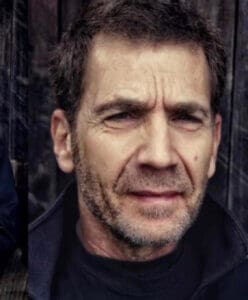
In the end, Nein, Nein, Nein! highlights a core, schizoid aspect of Stahl’s talent: namely, that while he impresses with loose-jointed rants that shove history’s horrors right up alongside today’s inanities, he is at his best when he reins himself in. The restrained Stahl, it turns out, is the more engaging artist, even if the new Stahl — same as the old Stahl — remains furious, insightful and in his own way, a riot.
I spoke to Jerry Stahl in late July 2022, as America’s own homegrown fascist problem was receiving prime-time attention, courtesy of Congress’ Select Committee to Investigate the January 6th Attack on the United States Capitol. Our conversation has been edited for length and clarity.
***
Benedict Cosgrove: Publishing a book about touring the death camps when actual, flag-waving Nazis are marching in America’s streets feels a bit like, forgive the expression, a political act. Did you ever have the feeling or the hope when you were writing Nein, Nein, Nein! that you might affect change, somehow — even now, when we’re all so polarized?
No. Not once. It never occurred to me. That sort of intent is not in my toolbox of misbegotten writing motivations. I might write out of fear, or because I have an intense itch that needs scratching, but I’ve never consciously written to persuade anybody of anything. Then again, maybe that’s the only reason I write. Who knows? I don’t think we always know why we do what we do.
In my dotage, I find the idea that anything is fully planned or calculated to be more and more dubious. I think there’s an illusion that we have control over what we do. But that’s just me. I’m not speaking for humankind here.
Let’s talk about this idea of control. I won’t say that the book feels haphazard, or random, but it doesn’t feel as if it’s very clearly mapped out, either.
I think that’s right. And that’s kind of how I write fiction, too. It’s a bit like Norman Mailer’s definition of writing a novel. You see 20 feet ahead in your headlights, and when you get there, you see the next 20 feet. Just keep going.
Generally speaking, I don’t know what I think until I write. This is not a terribly original idea, but writing is a way of seeing what’s in your head. And it’s not always pleasant. Sometimes, even after you write it down, you have to make sense of what you’ve written, which is a whole other level of terror.
Well, there’s personal terror, and there’s historic or geopolitical terror. I want to ask you about something that really struck me at the end of the book that touches on this notion of living through terrible times. You sort of challenge the reader to consider where we are now, and how this historical moment relates to past horrors — world wars, pogroms, the Inquisition. Seen from one perspective, those horrors are not the exception in human history, but the rule.
Yes. But maybe it’s more accurate to say that I thought I was writing a book about the past, and I ended up feeling that I wrote a book about the future.
Courtesy of Akashic Books
It does have a kind of Orwellian vibe. I’m thinking especially of some of the essays Orwell wrote during the war, when he suggested that what the world was living through in the Thirties and Forties was probably more a glimpse of what the future was going to look like than a period that historians would look back on and argue about.
I don’t know. That’s quite an insight from Orwell, but it’s obviously really hard to see past where we are right now and imagine a future, or how the future might see us.
Does it matter? Do you write with that intention — with the future in mind?
I don’t think there’s a whole lot that’s intentional in this book, to tell you the truth. You have to remember that I wrote a series of articles about visiting the camps for Vice , but that was different from this book, because they wanted nothing about all of the personal shit I was going through.
Did you see the book as a chance to get all of that stuff about your own life onto the page? Did you have a moment where you said to yourself, ‘Oh, I know what I want to do with this now’?
I think you’re flattering me. Those articles were published in 2017, and I didn’t write this book until 2021. I had to spend all those years engineering a situation where the only thing more miserable than writing was not writing, and it takes time to get to that stage. It doesn’t just happen by itself. You’ve got to work for that. It was a fucked up few years in my life, for a lot of reasons — most of which are in the book — and when I finally started writing, it was as if I was living in another era. It was another era — for all of us.
Also, I’m probably a lot closer to being dead now than I am to, say, being 40, so I kind of write like a man being chased. That’s chased with an “ed,” not chaste with a “te.”
What’s chasing you?
Mortality, I guess. I want to get it all out while I can. All sorts of shit is roiling around inside. I don’t know what it is, but I know it wants out.
“Some books just have to come out. Nein, Nein, Nein! was one of those.”
Are you writing like somebody who’s being chased, or someone who’s chasing something?
That’s a good question. Maybe there’s no difference, and it’s just a matter of what angle you see it from. I will say that you reach a certain point and you can’t be afraid to write something that other people are going to hate, or something that other people are going to think is pretentious. I don’t know if that’s age or idiocy or some combination of the two, but some books just have to come out. Nein, Nein, Nein! was one of those. I had the same thing happen with a novel I did, I, Fatty. I knew the book was there, somewhere, but I couldn’t write it for the longest time. I kept thinking, “I can’t do this.” And then, at the last minute, I thought, “Well, maybe I’ll just sit down one last time …” and something broke, and it all just poured out.
I don’t have the discipline to turn that on and off. It kind of turns me on and off, if that makes sense.
It does. And I want to stay with this idea of intent for a minute. There’s a back and forth dynamic in the book, as if you’re having a debate with yourself. Almost every issue or topic you bring up, whether it’s touring the camps, dealing with your agent back home, thinking about your kids, it’s always Jerry versus Jerry.
I suppose the dynamic behind the book is wrestling with why I should be writing the fucking book in the first place.
What does that mean?
You want to see humanity, and then you go and you see humanity. I want to have this great, profound, soul-stirring experience at Auschwitz, and I get there and there’s some mook in an “I’m With Stupid” t-shirt sitting in a snack bar, slamming a Fanta and chomping on a slice of pizza. That’s just the reality.
Let’s talk about the other people on the tour. We definitely get to know them over the course of the book, and at first there seems to be some contempt on your part, and then gradually there’s empathy —
Okay, with respect, I would argue that at no point do I feel contempt for these people. Contempt for myself, sure. But not for the other people on the tour. It’s sort of like the old Jonathan Swift chestnut: I detest mankind, but I love every Tom, Dick and Harry. I ended up really, really liking my companions on the bus. Did I judge them, initially? Of course. Did I think they were all in the fucking 4-H Club? Of course. But the joke was on me, as it always is, and if it ended up sounding like contempt, then I did my job wrong. The last thing I wanted to suggest was that I was in any way better than these people.
I love subcultures, and now I know there’s this population of not-rich people, mostly retirees, who travel the world by bus. Like, last week was the Finger Lakes, and today we’re in Dachau, and next week we’re in Ireland. It’s a whole world I didn’t even know existed. I don’t think I’m going to do it again, but God bless them.
You want to see humanity, and then you go and you see humanity. I want to have this great, profound, soul-stirring experience at Auschwitz, and I get there and there’s some mook in an “I’m With Stupid” t-shirt sitting in a snack bar, slamming a Fanta and chomping on a slice of pizza. That’s just the reality.
For me it wasn’t so much the existence of these bus tours that felt jarring, but the fact that people are touring death camps as the U.S. — or much of the U.S., anyway — seems to be sliding further down a terrifying rabbit hole. All over the world there seems to be a craving for authoritarian strong men — a need for somebody to step up and tell people what to do.
That’s one way to look at it. But you have to understand that none of that was operating when I started the book. In the years between conceiving the book and writing it, all this shit happened, so I was also wrestling with that on the page.
Well, the rise of MAGA Trumpism happened in the past few years, but before that, we had Erdogan, Putin, Berlusconi, and lots of other strong men who were already operating by the classic autocracy playbook. And almost all of them were elected. They didn’t have to seize power. It was handed to them.
It’s true that Trump is just another particularly large boil on the abscessed rectum of America. It’s not like he started it. He’s just the latest version.
That’s a helpful lead-in to a discussion of the humor in Nein, Nein, Nein! On pretty much every page, you’re taking the piss out of yourself — with puns, jokey asides, obscure pop-culture references that date you, or make it seem that you’re more comfortable in the last century than in this one. But this sort of self-disparagement isn’t really anything new in your work, right?
Well, I have a lofty theory of journalism, which is that you should always make yourself the biggest asshole in the story. Then, even if all is not forgiven in the end, at least you’re not trying to look good at somebody else’s expense. That has followed me through all of my writing, such as it is. I don’t use the word career. I don’t know if I have one of those.
Is humor a protective device, then? A way to get in the first punch before somebody else who’s bigger and meaner can get a piece of you?
I suppose that if you punch yourself in the face, it can be disarming to the guy who’s about to smack you. But again, it’s not calculated, and there is the old theory that oppressed people — whether African American, or Jews or Irish — are the funniest people, perhaps as a defense mechanism. A very funny guy I used to imitate when I was learning to write, Bruce Jay Friedman, always said, “If you write a sentence that makes you squirm, keep going.” That resonates with me.
Courtesy of Akashic Books
I want to go back to something we touched on earlier, and that’s the end of the book — or rather, the surprising tone at the end of the book. I’m not giving anything away when I say that the last lines are really moving — at least they were to me — and weirdly uplifting, especially in light of everything that came before.
I’ve had other people tell me that, too, and I find it strange because this book was my response to the realization, “Jesus, I am so depressed. I’m going to think of the most depressing place on earth … and go there.”
Were you surprised by your reaction to what you found there?
It was nonstop surprises. I don’t know much about life, but I do know that things never fuck up the way you think they’re going to, and they don’t succeed the way you think they’re going to. It’s always some third way, and that’s kind of how Nein, Nein, Nein! worked out. I mean, I’ve had people tell me, “God, this book is so life-affirming.”
I’ve been accused of a lot of shit in my day, on the page and off, but life-affirming has never been one of them.
The inadvertent affirmer.
Accidental Affirmation: The Jerry Stahl Story.
Help us sustain independent journalism...
Our team is working hard every day to bring you compelling, carefully-crafted pieces that shed light on the pressing issues of our time. We rely on caring supporters like you to help us sustain our mission. Your support ensures that we can continue to provide deeply-reported, independent, ad-free journalism without fear, favor or pandering. Support us today and make a lasting investment in the future.
RELATED STORIES


Award Winning



Today’s environmental and social justice challenges are unprecedented, and require an unprecedented collective effort.


Stay updated on our latest features, events and more. Subscribe to our Note From the Nest newsletter!
