Midnight in America?

Listen to an audio version of the story, read by the author.
In 1947, the team behind the Bulletin of the Atomic Scientists debuted what they labeled the “Doomsday Clock.”
This rhetorical device was created by some of the same folks who had recently conceived the A-bomb, and now wanted to communicate to the rest of the Post-Hiroshima-and-Nagasaki world just how close we were to an atomic apocalypse.
Seventy-five years later, their project remains both annual and necessary. Per their website: “The Clock has become a universally recognized indicator of the world’s vulnerability to catastrophe from nuclear weapons, climate change, and disruptive technologies in other domains.”
One of those “disruptive technologies” mentioned by the Nobel laureates and others behind the project is the Internet. As part of their January 2020 clock-setting, the Bulletin wrote, “the existential threats of nuclear weapons and climate change have intensified in recent years because of a threat multiplier: the continuing corruption of the information ecosphere on which democracy and public decision-making depend.”
That 2020 statement was a prelude to setting their Doomsday Clock at “100 seconds to midnight.” This was — and the bold and italics are ours — “closer to midnight than ever in its history.”
Good news is relatively rare these days, so here’s a silver lining: In their January 2021 announcement, the scientists did not move the Doomsday Clock any closer to midnight. They kept it the same, 11:58:20pm.
The Bulletin usually releases their time for the coming year in late January. So, meanwhile, as the one-year anniversary of a dangerous insurrection in the worrisomely fraying United States of America has just passed, we thought we’d reach out to scholars and democracy-watchers to ask a related question, and one that is less globally-focused: “If there was a ‘Doomsday Clock’ for American democracy, and 12 a.m.-Midnight meant ‘Doomsday,’ then what time would that clock read right now?”
Answers diverged, but sadly, no one said anything along the lines of, “Hey, it’s all good. Set that clock for 10:30 a.m. Go to pilates. Get some brunch.”
***
Michael Kazin is a history professor at Georgetown University, emeritus co-editor of Dissent magazine, and author of a forthcoming book about the history of the Democratic party. When I ask where he’d set the doomsday for U.S. democracy, Kazin says, “It depends where the clock was when U.S. democracy was healthier, no?”
“Arguably,” he says, “it was healthier in the mid-1960s when the Voting Rights Act was passed, which paved the way for Black people to vote in the South in large numbers for the first time since the late 19th century. Before the VRA, the U.S. was not truly a democratic nation, since a sizeable minority of its citizens could not exercise the right to vote.”
Kazin points out the connection between a greater threat to democracy and a lower voting turnout. “Ironically, participation in the 2020 election — at 66 percent of those eligible — was higher than at any time since 1900, when few women [could vote] and many Black men could not vote,” he says.
Though he won’t propose a specific time on our clock, Kazin does say, “the current threats to democracy, being pursued through state legislation and angry rhetoric mostly, are not apocalyptic, but gradual.”
So, if this precise moment in time isn’t (quite yet) our democracy’s closest moment to midnight, when was? “The greatest threat was the Civil War, of course,” Kazin says. “Eleven states sought to create their own nation, based explicitly on white supremacy and the institution of slavery — anti-democratic at their core.”
Michael A. Genovese is a professor of political science and international relations at Loyola Marymount University in Los Angeles, and president of the university’s Global Policy Institute. He’s the author of more than 50 books, including “How Trump Governs: An Assessment and a Prognosis.” What time does Genovese think it is right now?
“If the U.S. was at one minute to midnight in the Civil War, today we are about 10 minutes to midnight,” Genovese says. “In early 2021, we were about two minutes to midnight, but were able to pull back from the brink.”
Genovese says that lately the clock has been “moving steadily towards midnight.” But, he offers a caveat and a question: “It has also done so in the past. But in past years, we always ended up saving, or salvaging, democracy from the threats of authoritarians, bullies, racists and frauds. Can we do so again?”
He brings up The Global State of Democracy Report 2021, a recent publication from the International Institute for Democracy and Electoral Assistance (IDEA). Spoiler alert from the report’s summary: “The world is becoming more authoritarian.”
So, yeah, things are so bad right now that even the word hence sounds ominous.
Per Genovese, the IDEA “gave the U.S. low marks, citing ‘democratic backsliding,’” with the report saying that “the United States, the bastion of global democracy, fell victim to authoritarian tendencies itself, and was knocked down a significant number of steps on the democratic scale.”
Anyone reading this article likely already knows so many of the details of what those downward steps were. Nevertheless, if you are looking for a terrifying — and urgently important — piece to read to accompany this one, read Barton Gelman’s recent story, “Trump’s Next Coup Has Already Begun,” that posits, “January 6 was practice.” (Or, check out Andrew Gumbel’s take, published in Red Canary last year. )
Red Canary, The Atlantic, and the IDEA are far from the only folks worrying about the d-word these days. Genovese was one of more than 100 academics who co-signed a Statement of Concern posted last June by the think tank, New America.
Subtitled, “The Threats to American Democracy and the Need for National Voting and Election Administration Standards,” the statement itself is far more than merely concerning. It begins:
“We, the undersigned, are scholars of democracy who have watched the recent deterioration of U.S. elections and liberal democracy with growing alarm. Specifically, we have watched with deep concern as Republican-led state legislatures across the country have in recent months proposed or implemented what we consider radical changes to core electoral procedures in response to unproven and intentionally destructive allegations of a stolen election. Collectively, these initiatives are transforming several states into political systems that no longer meet the minimum conditions for free and fair elections. Hence, our entire democracy is now at risk.”
So, yeah, things are so bad right now that even the word hence sounds ominous. Or, as Genovese says, “Democracies need defending. Especially now… We can push the hand of the clock away from midnight, if we so desire.”
Genovese notes as well that our form of government hasn’t had a perennially smooth run. “Democracy is being attacked and is on the defensive, but this is an old story,” he says. “From the time of Ancient Greece, up until the 19th century, ‘democracy’ was a dirty word. For most of human history, democracy was not practiced, and most great thinkers doubted it could work – see Plato. It wasn’t until the 18th century that great thinkers started to take democracy seriously.”
The professor labels what took hold here in the former British colonies as “a brand of democracy.” He talks about the Federalist Papers. He brings up Honest Abe, sounding worrisomely prescient about potential mob violence not just then, but now. “In 1838, a young Abraham Lincoln gave a speech in Springfield, Illinois,” Genovese says. “In which he asked, ‘How might American democracy die?’ His answer? ‘If destruction be our lot, we must ourselves be its author and finisher.’”
Historically great speeches aside, is there a sort of checklist that we should keep in mind when considering where we stand with democracy? Or, does that oversimplify things?
Genovese says there is no set litmus test, and lists a baker’s dozen questions. As you read this next paragraph, keep your own running tally of how many check-marks the previous President earned.
Here’s his list: “Does the leader appeal to the best, or the worst in us? Or our hopes, or our fears? Does the leader attack the press, or stand up for a free press? Does the leader follow the rule of law, or see it as an unnecessary impediment? Does the leader show respect for the other branches of government, or use them as a foil? Does the leader find and exploit ‘enemies’ at home, or are we truly one nation? Does the leader try to strengthen the rule of law, or suggest ways to trim the sails of law? Does the leader abide by the will of the people as expressed in elections, or try to overturn their will? Does the leader acknowledge the legitimacy of political opponents, or suggest they be imprisoned? Does the leader give support to armed gangs and militia, or stand up for law enforcement? Does the leader condemn, or condone political violence? Does the leader try to expand civil liberties, or shrink them? Does the leader stand with democratic leaders abroad, or stand with autocrats?”
***
Mark Lloyd is a professor of communication at the USC Annenberg School for Communication and Journalism. He served as associate general counsel and chief diversity officer at the Federal Communications Commission, was a broadcast journalist and a communications lawyer, and is author of the book, Prologue to a Farce, Communication and Democracy in America. He thinks Americans now are misunderstanding how democracy works — that it’s a practice, not just an idea.
“John Dewey argued that ‘Democracy is a way of life controlled by a working faith in the possibilities of human nature. . . This faith may be enacted in statutes, but it is only on paper unless it is put in force in the attitudes which human beings display to one another in all the incidents and relations of daily life,’” Lloyd says. “We Americans use the word democracy like a magic word. We too often fail to appreciate it as a working faith, requiring listening and a sustained patience with opposition. We want results. Democracy is not about getting what you want,” Lloyd adds. “Except for all the other systems of government that have been tried, democracy is maddening.”
Lloyd thinks that President Biden understands the above concept. “He exhibits what Dewey called a working faith,” Lloyd says. “Despite uniform opposition from the Republican Party, President Biden has pulled us back from the near midnight of January 6, 2021 and the lead up to that terrible day that began when former President Trump declared himself the winner on election night 2020.”
Pulled us back, but how far? And, how sustainable is our counterclockwise motion?
“We are not where we were at the start of the year, but make no mistake, one man’s working faith will not prevent the ruin of American democracy if the tools needed to preserve democracy fail,” Lloyd says. “As we begin 2022, local election officials are receiving death threats, partisans are rigging the machinery of voting to guarantee an outcome that keeps them in power, and local journalism is being gutted by predatory hedge funds.”
He points out how public policies that once helped media in “advancing informed democratic deliberation” have been gutted since the Reagan era, paving the way for a hyper-partisan media ecosystem.
“We Americans use the word democracy like a magic word. We too often fail to appreciate it as a working faith.”
Lloyd is well aware that today’s battle for American democracy can’t depend on just the Commander in Chief. “If the Senate carves out a filibuster exception to protect American democracy by passing voting rights legislation that the majority of Americans agree we need; if lawmakers do the work necessary to support local journalism; and if we protect local election workers, our fragile experiment in a government of, by and for the people may withstand the present dangers,” he says. “If not, January 6 was just the first shot, and President Biden’s working faith in human nature will not be sufficient to preserve our democracy. We are two minutes from midnight.”
***
Mark Lloyd just mentioned elections, so let’s take a deeper dive on that topic with Matt A. Barreto and Adrienne Jones.
Barreto is a professor of political science and Chicana/o & Central American studies at UCLA, as well as a founder of the Latino Policy & Politics Initiative and the UCLA Voting Rights Project. Jones is a professor of political science at Morehouse College and a writer whose doctoral dissertation was titled, “The Voting Rights Act Under Siege: The Development of the Influence of Colorblind Conservatism on the Federal Government and the Voting Rights Act of 1965.”
Barreto recognizes the importance of recent events, and, as with Jones and others interviewed for this story, also points back to a long history on this continent of inclusion and democracy — or a lack thereof. What time does Barreto think it is on our doomsday clock?
“I don’t really think that there is a clock, because democracy is a work in progress, and across history, we have constantly had to improve,” he says.
As for January 6, 2021, Barreto says, “It was, no question, the lowest day since 1965 Voting Rights Act was passed. For the 200 years before that — when we excluded an entire racial group from being able to vote — was about 200 years of our lowest point. There’s no comparison to the enslavement and systematic exclusion of Black people from our country for 400 years — at all, nothing — but after the passage of the Voting Rights Act, we thought that we were on a path towards inclusion. And, if we had to sue and take it to the Supreme Court, we would do that.”
Barreto dates our democratic backsliding to a retrograde reaction by some to the inauguration of President Obama. “We find ourselves here, after the insurrection, in a completely more extreme territory,” Barreto says. “But I think there’s a clear path to it that starts with the election of a Black president and the voter suppression that followed.”
Of course, dictatorship, or autocracy, is the devil with the guitar at our 2022 crossroads.
On the plus side, Barreto catalogs some other successful efforts to expand voting rights, in addition to the VRA. These include the 19th Amendment which gave women the right to vote in 1920, the 26th Amendment which lowered the voting age to 18 from 21 in 1971, and the 1975 amendment to Section 203 of the VRA which permitted voting in languages other than English. “There have been times when we’ve been able to pass bipartisan reforms to improve our democracy,” Barreto says. “And we’re sort of at that crossroads right now.”
Of course, dictatorship, or autocracy, is the devil with the guitar at our 2022 crossroads. Barreto says U.S. democracy is probably at its most perilous point in modern times. “Where you have elected officials questioning election results, it’s very dangerous. We have a lot of work to do to ensure that everyone has the right to vote, that every vote is counted, and that, when the votes are counted, the election results are honored,” he says. “Many of us never thought that that would be the risk. “[Perhaps] we would be fighting over gerrymandering, or we would be fighting over Voter ID laws, but now we’re fighting over whether or not the election results themselves are to be honored. And that’s a scary thing, so we have a lot of work to do.”
Some of this work is taking place in Adrienne Jones’ classroom. Current conditions have led the professor to make changes to her curriculum. “I have started having folks who understand fascism, authoritarianism and democratic theory talk to my students about the line between where we want to be and authoritarianism,” Jones says. “Why? Because they need to know that, here we go.”
Jones is one of the approximately 200 academics who last November signed a “Statement in Support of the Freedom to Vote Act.” Similar to the other statement mentioned earlier in this story, this too was posted by New America.
“This is no ordinary moment in the course of our democracy. It is a moment of great peril and risk,” the statement reads. It continues: “Though disputes over the legitimacy of America’s elections have been growing for two decades, they have taken a catastrophic turn since the 2020 election. The ‘Big Lie’ of a stolen election is now widely accepted among Republican voters, and support for it has become a litmus test for Republicans running for public office. Republican state legislatures in Georgia, Florida, Texas, and across the country have enacted partisan laws intended to make it harder for Democrats to win elections. Most alarmingly, these laws have forged legal pathways for partisan politicians to overturn state election results if they are dissatisfied with the outcome.”
Like Barreto earlier, Jones emphasizes the history of disenfranchisement. “The first 200 years of this joint was no democracy,” she says, citing 1966-1970 as the closest the country has come to fitting its definition.
Jones also shares a history of the civil rights movement that led up to those five years she mentions, calling the VRA a “sea change” in registration and ballet-casting access. “It’s a cultural moment, too,” she says. “It’s not just the decision of the law, it’s the people trying to pass the Edmund Pettus Bridge, and managing to get President Johnson to push the VRA forward. It’s the moment in which people—kind of like with the George Floyd summer—are just saying, we have to come along with some more of this equity. But we still live in this white supremacy situation where Black people are not considered equal.”
***
Sheri Berman is a professor of political science at Barnard College, Columbia University whose latest book, Democracy and Dictatorship: From the Ancien Régime to the Present Day, focuses on political systems in Europe during the past few centuries.
Berman signed both of the academics’ Statements mentioned in this story, so she is clearly not thrilled about the state of American democracy. Ask her what time our clock should read, and she says it’s a tough question, and that predictions are a tricky business. “There’s absolutely no doubt that we’re facing some very, very serious threats to democracy today,” Berman says. “Both from a normative and an institutional perspective.”
She elaborates, “The normative part is that a significant number of Americans and the vast majority of Republicans believe that our electoral system — and democracy overall — is seriously flawed by fraud, by cheating, and by all sorts of other stuff. And so they’ve lost faith in that system. And when people lose faith in that system, they’re willing to consider doing a variety of things that are really very problematic from a democratic perspective. Acceptance of violence against the other side has gone up, and a willingness to engage in a whole variety of manipulative tactics limiting access to voting.”
Berman also says that if many of the changes in voting laws that many members of the Republican party are pushing now had been in place prior to the 2020 election — had those “11,000 votes” been “found,” if recounts happened under partisan rather than neutral election officials, and so on — Berman says, “there is a very, very good chance that Donald Trump would have been reelected. And that would’ve meant that the United States could no longer be considered a true democracy because without free and fair elections, democracy has no meaning.”
To level-set, Berman concurs with others that by the standards and criteria her profession uses to define full democracies, the U.S. didn’t fit that definition up until the 1960s. Perhaps the fact that we made advances before matters here, because when we tell Berman we are worried, she — a scholar who has a new book in part about dictatorships in 20th century Europe — says that she is less pessimistic than some others.
“I do not like using the term ‘fascism’ to describe where the United States is now,” she says. “I think that is very dangerous. I think it justifies actions that are not justifiable. So look, I think things are very bad, but I believe that people ultimately care about our democratic system and I hope that the Democratic party and the moderate Republicans that are left can convince their voters that there is a bipartisan way to move forward.”
***
Satirists are society’s truth-tellers and soothsayers. So, before we wrap this article up, let’s check in with one of American’s best, cartoonist and writer, Mr. Fish.
Mr. Fish — given name, Dwayne Booth — works regularly for ScheerPost.com and has contributed to outlets such as Harper’s Magazine, Vanity Fair, The Advocate, the Village Voice, and the LA Weekly. Mr. Fish’s books include And Then the World Blew Up, which features a cover drawing of President Trump dressed in a Captain America costume and a suicide bomber’s vest full of dynamite. Booth is also a lecturer at the Annenberg School for Communication at the University of Pennsylvania.
How to best sum up Booth’s thinking about the state of democracy in these United States? Well… He says he’s already making contingency plans to leave the country—and he doesn’t sound at all like he’s joking. “If I have to make a prediction right now, every part of me is ready for Donald Trump to be elected in 2024,” he says. “And it’s not even a stretch of the imagination: if he was elected again, I don’t know when there would be another election.”
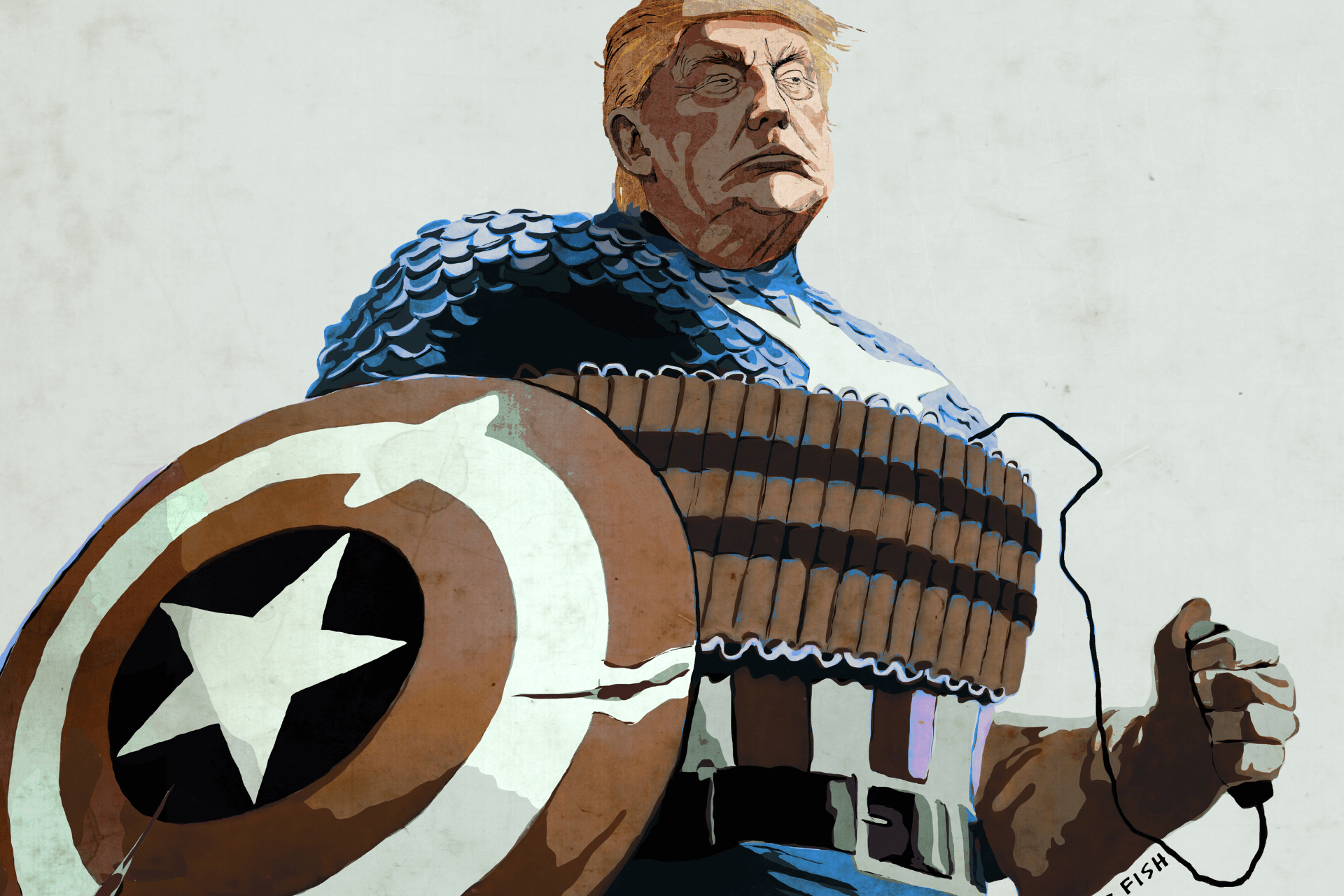
The cover image from Mr. Fish’s “And Then the World Blew Up.” Illustration by Mr. Fish
Booth also says that our doomsday clock has not only already struck midnight, but rather it has kept moving. “We may already have gone around the clock a few times, and now we’re just getting used to residing in ‘the existential winter’ that has us inside the dark, and it’s become our new normal,” he says.
Why is that? “You know, our curiosities are no longer,” he says, in part. “I would argue what used to be our antenna for what real injustice is, is no longer really there. We feel so powerless ultimately as a culture that we’re already laying dead on the ground. Now the question is, can we will ourselves into being aware?”
“We may already have gone around the clock a few times, and now we’re just getting used to residing in ‘the existential winter’ that has us inside the dark, and it’s become our new normal.”
He’s not completely confident that we can, given our voluntary melding with technology. “We’ve basically downloaded our humanity into this mainframe of social media and this technology,” he says. “There’s all of these signs why that’s a horrible thing to do.”
One of those signs, Booth says, is what happens when you try and type the word, “bullshit” into a device and autocorrect doesn’t recognize the word. “As if bullshit is the biggest thing that is threatening us and how we interact with each other,” he says, “and the machinery of the culture is just like, ‘What are you talking about? I’ve never heard that word before.’”
Ultimately, even a metaphor — such as the doomsday clock — risks doing the opposite of what’s intended, becoming another way of trivializing something grave rather than rallying people around it.
“What is the language of revolt and outrage? You know, we don’t really have it,” says Booth. “We’re being encouraged to think that it’s indecipherable, or it’s inappropriate, or it’s ineffective. And that’s when all of a sudden we find ourselves in this place where you have to ask that question, of where are we, with doomsday sort of converging around us.”
Help us sustain independent journalism...
Our team is working hard every day to bring you compelling, carefully-crafted pieces that shed light on the pressing issues of our time. We rely on caring supporters like you to help us sustain our mission. Your support ensures that we can continue to provide deeply-reported, independent, ad-free journalism without fear, favor or pandering. Support us today and make a lasting investment in the future.
RELATED STORIES


Award Winning



Today’s environmental and social justice challenges are unprecedented, and require an unprecedented collective effort.


Stay updated on our latest features, events and more. Subscribe to our Note From the Nest newsletter!
