
When Street Art Reaches for The Sky

If you haven’t seen them yet, you have probably read about the billion-dollar, abandoned towers that ascend over Downtown Los Angeles with mirror-like windows shrouded in graffiti. These three vertical structures are known as Oceanwide Plaza, or, depending on your perspective, as a polarizing guerilla art installation, with the tallest tower kissing the sky at 675 feet high. Northwest of the Los Angeles Metro Pico Station, the development was intended to provide luxury housing, retail spaces and a two-acre private park to the South Park Neighborhood. The failed venture now stands empty and unfinished adjacent to Crytpo.com (formerly Staples) Arena, home of the cherished Los Angeles Lakers.
As a photographer interested in politics, the environment and social discrepancies, the towers, as they stood in their disheveled state, represented both a stalled development and an active street-art canvas. While some, including me, love graffiti and street art, many LA residents reasonably deem the massive graffiti tags to be an eyesore, an act of vandalism and a reminder of the problems the city of LA faces year to year. I needed to shoot the buildings.
Upon approaching the Oceanwide Plaza, I first noticed its massive scale. I had looked at photos from journalists and locals alike while researching the site, but no image prepared me for how enormous the failed development was. Once I found my way into the backside of the Los Angeles Convention Center parking lots, I captured an image of all three buildings juxtaposed with the pristine Chase building, providing a new perspective and bringing this reality of scale to light. As I circled the towers in the passenger side of my friend’s truck, the three massive structures loomed over a mix of unhoused people struggling with mental and physical health issues, everyday pedestrians and a festive group of sports fans surrounding the Crypto.com arena.
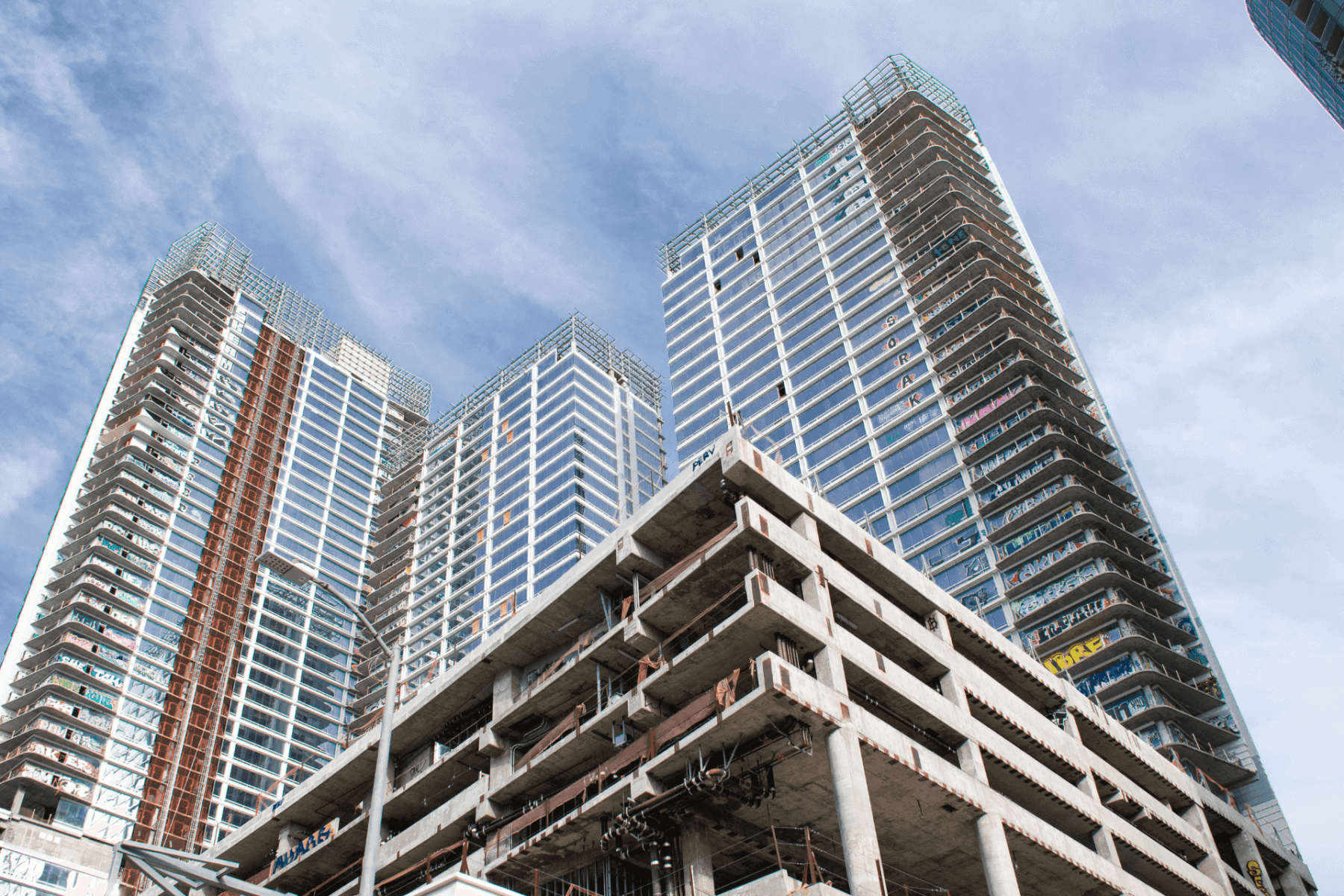
Photo by Shannon Aguiar
On my first loop around the structure, I caught the eye of one of the few police officers on the street guarding the fenced-off tower and I stuck my body out the window to better determine how I would proceed in photographing the subject. I had to be tactful with steady hands and sync up the speed of my shutter to the speed of the car to make the images appear crisp and still. All of my shots were taken from the moving vehicle in the middle of the road so I could capture the tower from spots not yet utilized by other photojournalists.
Initially, I wanted to see what was going on inside. However, I had read that street artists and other occupants were lurking in the dark of the building. After catching the attention of the police guards on the third loop, I realized entering the building was not a safe or legal option. By then, I had made some decisions: I wanted to capture the consistency and vibrancy of the artwork that adorns the reflective glass from top to bottom, the unfinished skeletal metal structure at the very top, and the enormity of project failure the site represents. In an ideal world, I would have also liked to photograph one of the adrenaline-seeking base jumpers I read about in other articles, but the sparse police presence seemed to put a halt to that. Although, it was clear artists had effortlessly trickled through that barrier before.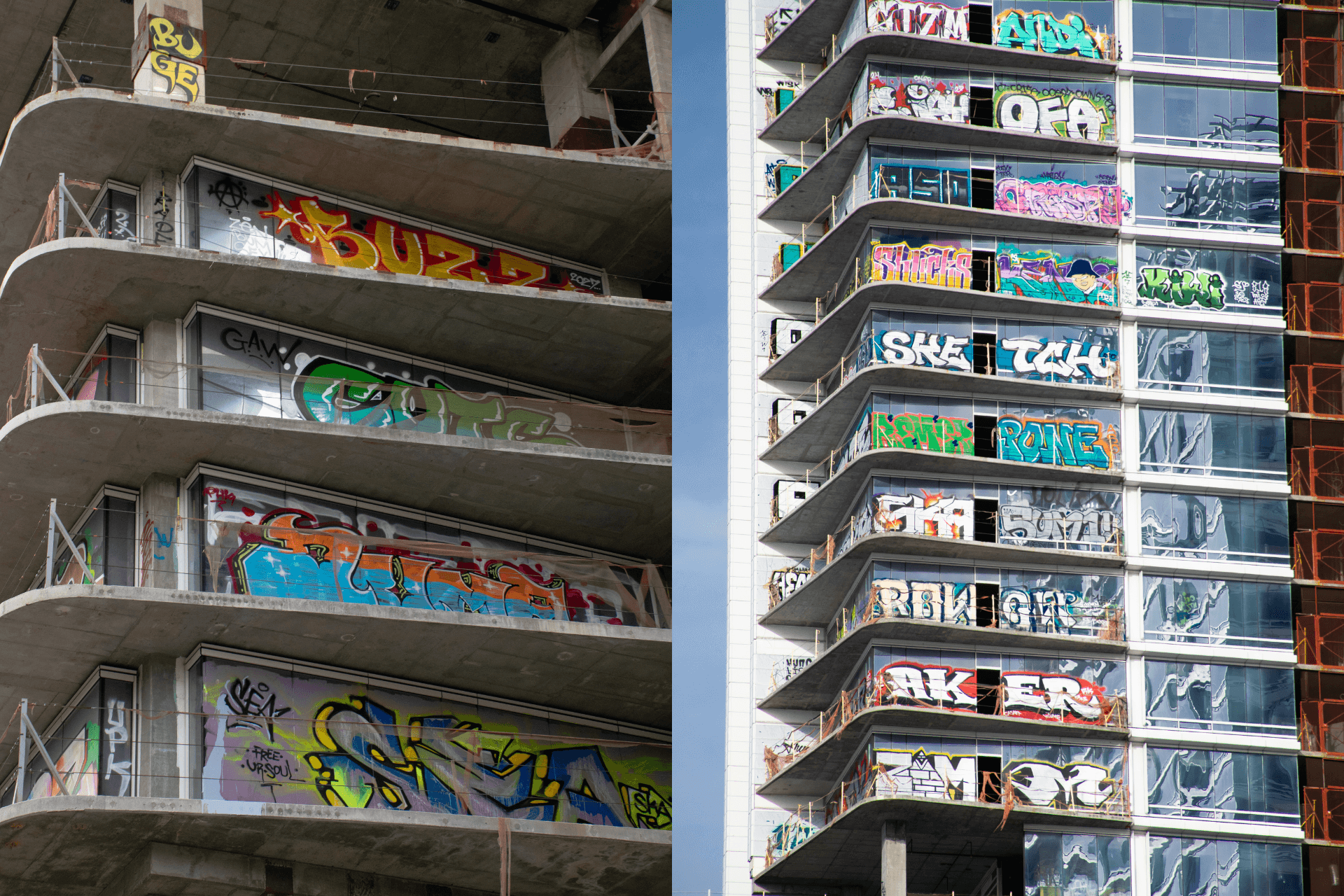
Photo by Shannon Aguiar
What also caught my attention was the scale and consistency of the graffiti on this property. Not a floor is untouched. When I went back to review my images, I zoomed in and panned up and down the building to admire the graffiti work. Every floor is marked, and every floor is unique.
LA is not the only city where Oceanwide Holdings, the development parent company, has left failed projects in its wake. The firm purchased its “Oceanwide Center” at 50 First Street in San Francisco for $296 million in 2015 and began their estimated $520 million construction project in 2019. Progress on the San Francisco project was similarly halted on some of the center’s towers in 2019, and the rest of the center in 2020. The company also lost its development in the New York Financial District after defaulting on a $175 million loan from Midtown-based DW Partners in 2021. LA, though, is the only city that’s made an art project out of its failures at this scale.
Like chickenpox, the graffiti, a symptom of the greater issue, has spread so far that it cannot be ignored. While I find this metaphorically diseased building mesmerizing, I also wonder about the social and environmental impact of an unfinished project of this size. All of that work, materials, concrete dust, noise, and pollution that went into this with no benefit to the locals. There’s no new housing, park, or commerce, and contractors have been left with unpaid bills. It has also left the Los Angeles City Council and Mayor Karen Bass trying to figure out what to do with the development, which ran out of funding in 2019. Although an affordable housing project is in discussion, the LA City Council approved a motion to allocate $3.8 million in city funds only to secure the property and remove the graffiti — an arguably futile effort that won’t resolve the issue estimated to require an additional $2 billion.
As I rode around in circles, I saw hundreds of people on the ground — a woman with a stroller crossing the street on high alert to avoid two young men, one carrying a blowtorch, and the other yelling to an imagined reality. I saw what I assume was a tourist couple looking at their phones seemingly overwhelmed by the hustle and bustle of downtown. And I saw locals with their heads down with clear intention, as they traveled on foot or by scooter to get from point A to point B. But when I looked up at the architecture of Oceanwide Plaza, all of the people below were overshadowed by the humor and beauty of the graffiti tags — KIWI, BUZZ and RANGER — that tattooed stories climbing to the sky in vibrant bubble letter fonts.
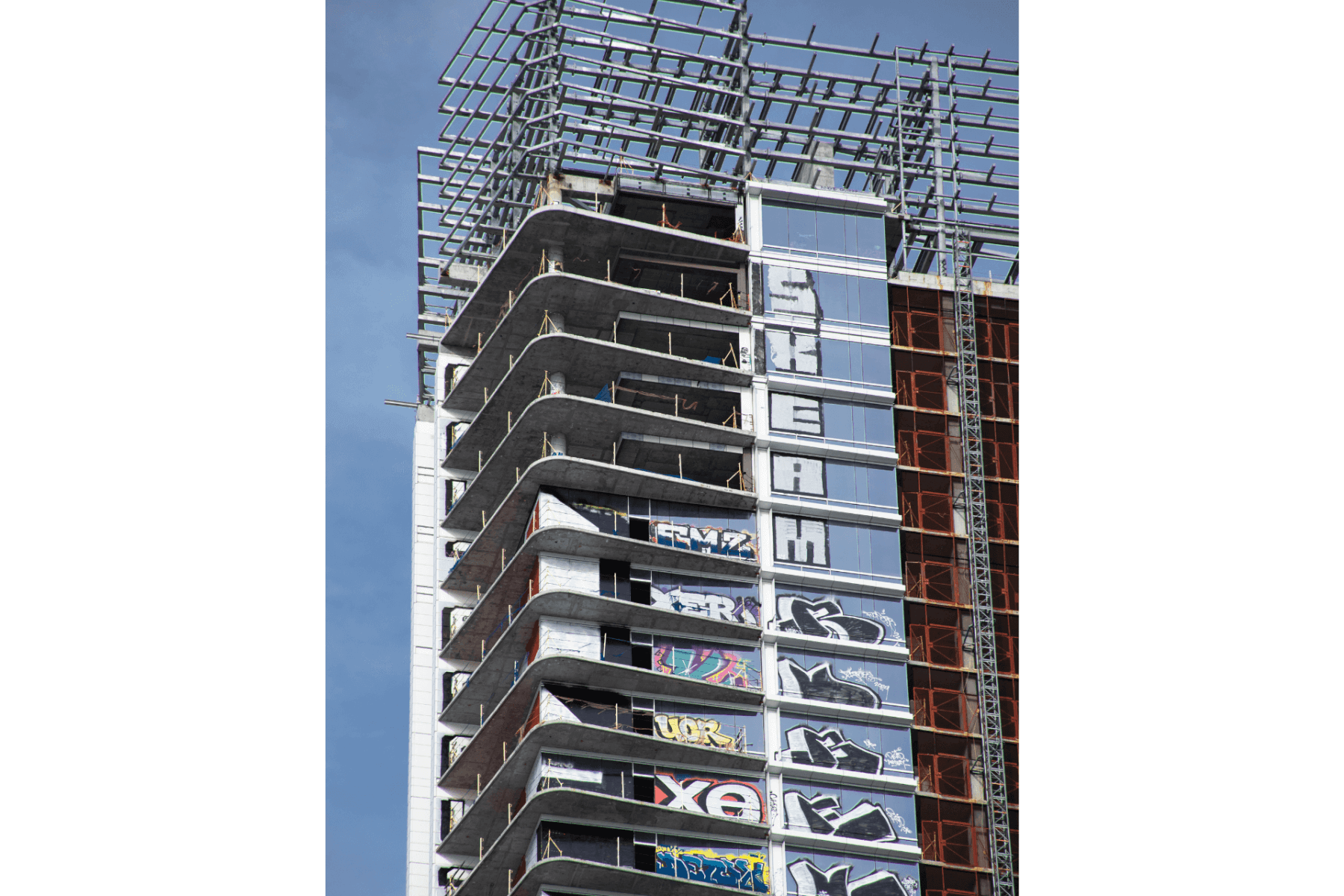
Photo by Shannon Aguiar
When I find a subject I want to photograph, it is usually on an impulse. Following that impulse, I am presented with the question of “why.” I often find myself drawn to post-apocalyptic scenes and the potential that lies within them as well as the confrontation of systemic failure. Similar to photographing the aftermath of a fire or a snowstorm and watching nature eventually reclaim the land, the Oceanwide Towers are the remains of a disaster being actively reclaimed by the community.
While the LA City government works to find a purpose for this unexpected centerpiece for Downtown LA, artists have converted it into the largest canvas I have encountered in my lifetime. Although a grim reminder of the rich and bureaucratic failing the community, it is also a confrontational mass of energy, color and humorous language — characteristics I admire about the community of Los Angeles.
Help us sustain independent journalism...
Our team is working hard every day to bring you compelling, carefully-crafted pieces that shed light on the pressing issues of our time. We rely on caring supporters like you to help us sustain our mission. Your support ensures that we can continue to provide deeply-reported, independent, ad-free journalism without fear, favor or pandering. Support us today and make a lasting investment in the future.

RELATED STORIES


Award Winning



Today’s environmental and social justice challenges are unprecedented, and require an unprecedented collective effort.


Stay updated on our latest features, events and more. Subscribe to our Note From the Nest newsletter!
