
Build Black Better

This article was updated on January 31, 2024.
The title of Michael Anderson’s self-published 2021 book, Urban Magic: Vibrant Black and Brown Neighborhoods are Possible, is partly rhetorical — of course they are (and have been) — and partly a call to action for leaders to make it so. “Vibrant” is the keyword.
Originally from St. Louis, Missouri, Anderson attended the Southern California Institute of Architecture and became a licensed architect in 1992. It was a momentous year in Los Angeles. Starting his career in the aftermath of the civil unrest that left much of the city’s core in need of rebuilding and reimagining, Anderson immediately directed his ambitions at transforming — economically, aesthetically and culturally — LA’s black and brown neighborhoods into what he calls “great places to live.”
When I met Anderson in 1993, as a reporter for the Los Angeles Times covering Crenshaw and southwest LA, I was immediately taken with this simple but radical idea. I had covered numerous mundane community discussions and rebuilding proposals — a restaurant here, some beautification there. But Anderson’s vision of rebuilding was much more comprehensive and was imbued with a passion and an impatience for slow-paced change which resonated with me. In the eternal black struggle to strike a balance between ideals and reality, Anderson was firmly on the side of ideal, which to him is the most efficient approach to change; anything less is just nibbling at the edges.
We became friends and fellow travelers. Anderson is engaging, a fast talker with a distinct midwestern accent who still bristles with indignation about the fact that places like South Los Angeles are not as prosperous as places like Santa Monica or West Hollywood, something he elaborates on in Urban Magic. In our ongoing conversation, we agree that what has been missing all along is not money, but political will — the belief that neighborhoods of color deserve the same quality of life as predominantly white ones.
When I met Anderson, he was shopping around the Crenshaw Economic Development Corridor (CEDC) plan, the first big idea he developed after the unrest of ’92. It sought to build a nine-to-five office job economy from the ground up in the Crenshaw district, partly by modernizing its aging medical buildings as a way to sustain the neighborhood into the future. The plan attracted considerable political support but ultimately did not secure the necessary funding.
Though disappointed, Anderson continued to nurture big ideas. In Crenshaw, he designed six affordable homes along Vernon Avenue in Leimert Park in 1997, a modest project that planted the seeds for the much bigger one he’s working on now. He’s also done a wide range of urban planning and redevelopment work, from transit stops to schools to municipal buildings, in underserved communities such as Compton, Inglewood and South Central. Most recently he was an associate architect for the Intuit Dome, the new $1 billion home of the LA Clippers in Inglewood that’s scheduled to open later this year. All of the work fueled his original dream of doing a single, broadly impactful project to make Black LA a great place.
Anderson might finally get his moment. His latest proposal, Accelerated Housing and Transit Development (AHTD), is another big-scale neighborhood transformation plan that aims at two of LA’s most vexing problems in 2024: homelessness and gentrification. Far more ambitious than the CEDC and drawing on multiple funding sources, the AHTD uses Los Angeles County Metropolitan Transportation Authority (Metro) transit-stop improvements as a springboard for expanding 100,000 single-family homes in Black and brown neighborhoods into courtyard-living rental properties. Anderson says that the plan accomplishes several things at once: improves aesthetics, modernizes infrastructure, creates jobs and, most importantly, dramatically increases housing stock while preserving and growing Black communities by making multigenerational living not just viable, but preferable.
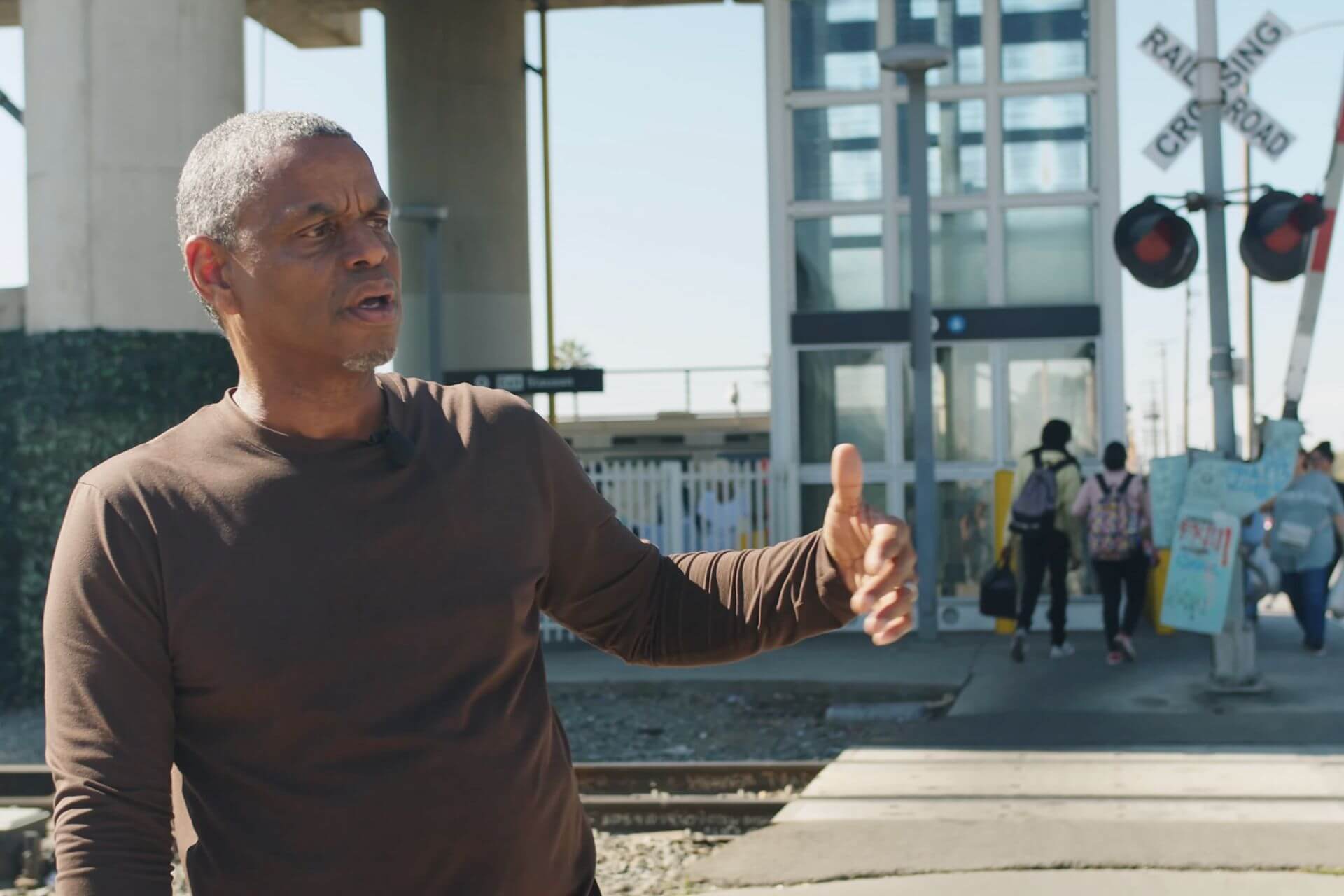
Anderson, standing in front of the A Line Slauson Station, explains the need for connecting pedestrians with public transportation. Courtesy of Anderson Barker Architects
Though the plan is his, its core idea is not: the courtyard-living model is adopted from a couple of winning entries of an architectural design competition sponsored by the City of LA in 2021. The competition called for new models of low-rise multifamily housing that could work within land use and zoning policies, and that could break the patterns of racial and environmental injustice that have long defined housing in Southern California. Anderson is determined that these proposals do not, like so many inner city improvement proposals, wind up in a drawer.
At his office, a light-filled suite in a high-rise just outside of LAX, Anderson talked to me about the plan and his career-long determination to achieve developmental justice.
***
You’ve been at this a long time, envisioning large-scale improvements to Black communities, not just a storefront here and there. In the past, you got lots of attention but couldn’t get the necessary funding. What’s different this time?
This plan is based on 40 years of conducting studies in underserved communities and never seeing a business plan behind them. Because of that, I saw millions of federal and other dollars left on the table, money going to communities that had shovel-ready projects (projects ready to be funded). Our community never had shovel-ready projects because we didn’t have the money to study them.
Having done studies for Metro, I decided to design an economic strategy that was mutually beneficial to everybody — people, government, transit and utilities. I designed — the name keeps changing — Accelerated Housing and Transit Development. Basically, it’s an underserved community modernization strategy for South LA.
Everybody knows the pain now, which is that LA County needs 800,000 units of housing. The City of LA says that, by 2029, they’re going to build 460,000 units. When I built six affordable homes in Leimert Park in 1997, the city needed 180,000 units. I don’t see this getting any better, and the barriers are worse — land scarcity, utilities being outdated and not having the capacity and limited funding. The delays make the costs go up.
So, Metro has this idea of creating 15-minute walkable cities, which they started studying four years ago. The goal is to do this before the Olympics in 2028. When Biden passed his infrastructure funding and climate program in 2021, that made $1.2 trillion in funds readily available, and it must be committed by 2026. Forty percent of this money is prioritized for underserved communities across the country, to be spent in four years. How do we make a deal large enough for LA, at a scale that generates the right economic chemistry where we can pay it back, while also growing the community’s wealth, and also making existing homeowners part of the housing solution?
At Metro, I was the architect of transit-oriented development for Crenshaw. I looked at six existing Metro studies of transit-oriented development. There were all these studies, but no one had ever turned it into a business plan. So, I decided to focus on these three transit corridors that go through primarily underserved communities: the Crenshaw LAX line, Blue Line and the West Santa Ana line, which will go through cities in Southeast LA County. They bring investments to three county supervisor districts and four congressional districts. It’ll improve 40 neighborhoods. Overall, this project is an ambitious initiative to catalyze investments in 24 communities of color through transit-oriented development. That’s scale. Plus, your passenger experience on the rail gets better because every station becomes a great place.
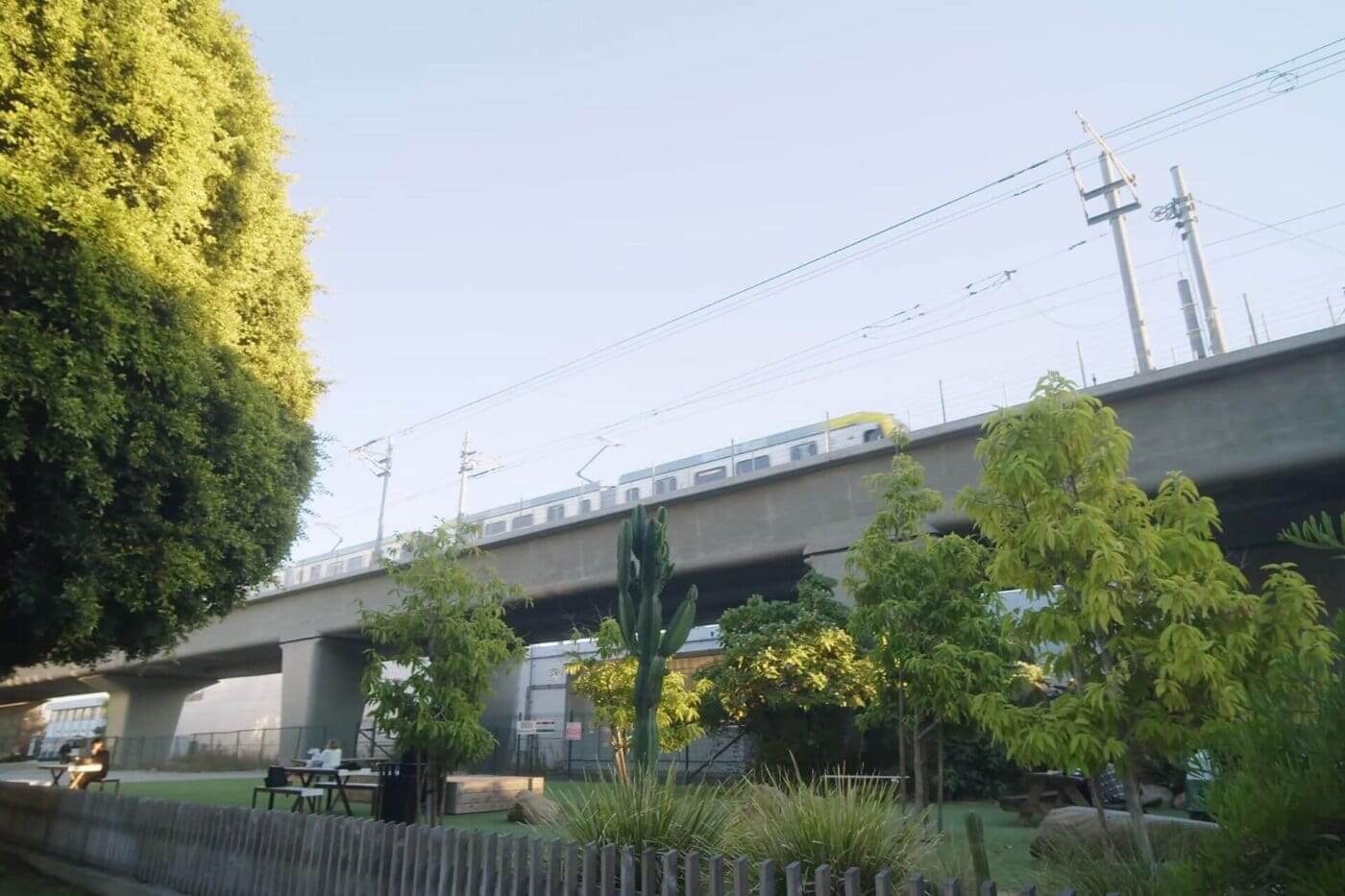
Located at the intersection of Washington Blvd and National Blvd, Anderson points to the E Line’s Culver City Station as an example of what he wants for all Metro stations in Los Angeles — a family-friendly green space with nearby shopping, restaurants and industry that encourages people to connect with their community. Courtesy of Anderson Barker Architects
My key thing is the preservation of Black and brown neighborhoods. This plan is aimed at helping older homeowners — retirees who have houses they bought decades ago and now can’t afford to maintain, nor can their kids afford housing in the city. A big thing this plan does is give homeowners funding to remake their single-family house into a courtyard apartment complex. In doing that we solve two problems: give the homeowners a revenue stream, and replenish the culture by bringing their kids back home.
The government will pay for developments within a half-mile radius of the transit stations. We’re going to ask for $60 billion to $35 billion for grants for 100,000 families of color to remodel their single-family houses into a courtyard fourplex. That’s converting 4,000 single-family homes within half a mile of each station. They’ll have a house and three units. Twenty-five billion is for infrastructure, to allow communities to rebuild utilities and broadband, and to make everything climate-smart. We’ll rebuild and modernize parks, streets, alleys and open spaces — everything within a half-mile radius of the transit stations.
So, homeowners become landlords, adding value to their property with money they don’t have to pay back?
Right. We hear people talk about equity. Equity is cash. If you’ve got a million-dollar house and owe $100,000, you’ve got $900,000 in equity. The homeowners get a $350,000 grant to make this courtyard addition affordable. Improvements will cost approximately $800,000 to do this, but you have $450,000 for a piece of property that’s now a house plus three rental units, it is now worth $2 million. You’ll have a positive cash flow, and the value of the property will increase over the years. This is beyond doing an additional dwelling unit; it’s courtyard living, 1920s-style. The courtyard units are prefab, made in a factory. They get built and then put down in a day.
And there’s infrastructure. We’re rebuilding all the utilities, wet and dry. Storm drains can collect the water for recycling; gray piping water coming from sinks can connect to the main utility system. We’re going to have water reclamation stations at each transit stop. So, every year, you’re recycling 365 million gallons for drinking and you’re making communities more sustainable.
How would these courtyard apartments look? Is there space to fit them on the existing lots? Would they change the character of neighborhoods?
[Former] Mayor Garcetti had this great design competition, for which 380 architects submitted designs for almost every lot configuration in LA. So, I just chose the winners — one for new construction and one for remodeling the existing houses. I applied those designs to the plan. And then I met with a factory that does custom houses. To get buy-in for this from homeowners, we just have to wait to build the first one. If we do a fantastic job, neighbors will come out and say, who did your yard? Wait till you tell your neighbor that you got a $350,000 grant to make it happen.
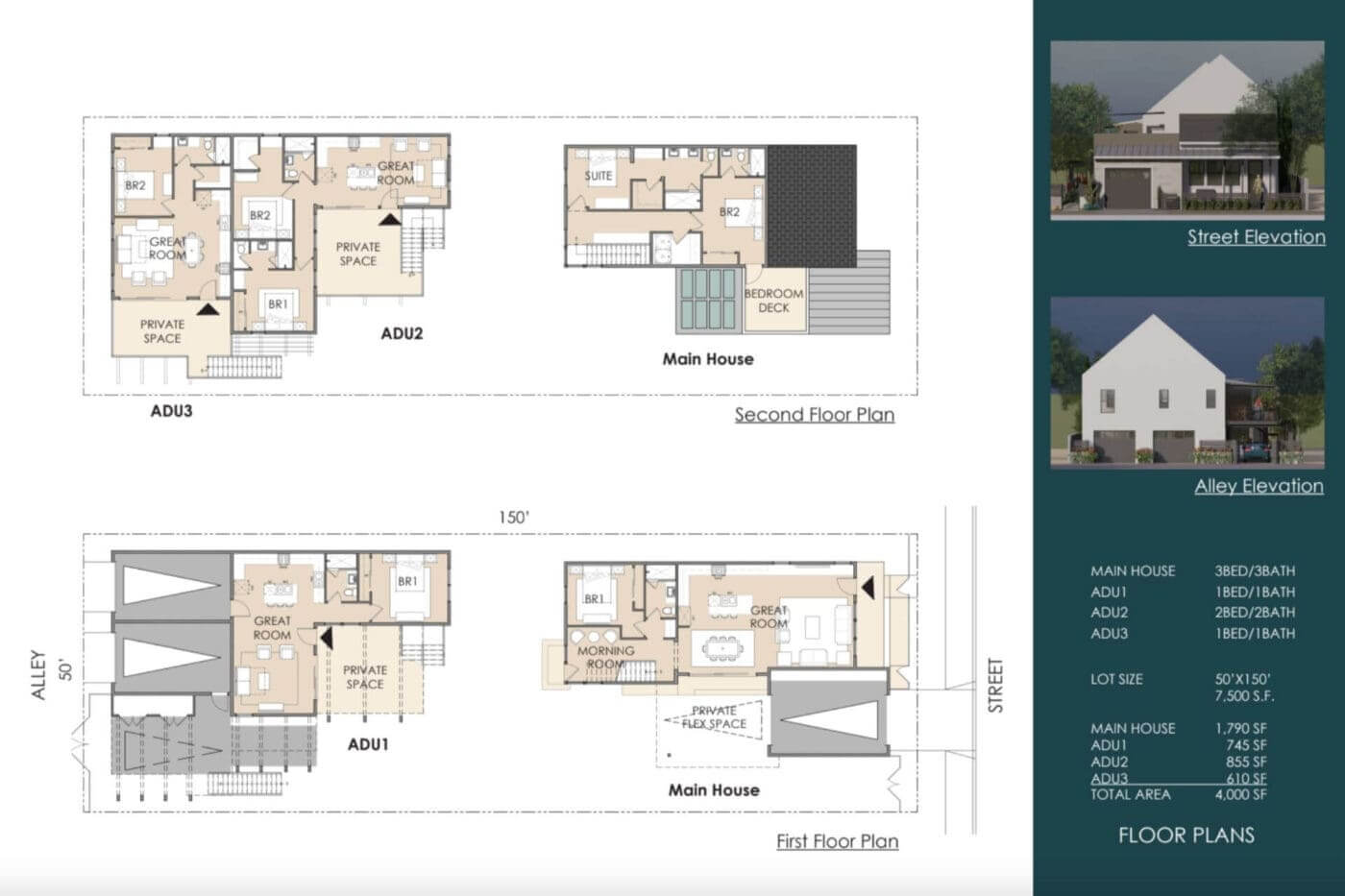
This is courtyard living — a house with two one-bedroom units with large balconies, and one unit is low-income. By the way, it’s a cheaper way of bringing low-income units into the market — it typically takes $800,000 to $1 million to build one unit. Current homeowners get a $350,000 grant and first-time buyers of a brand-new house get $500,000. By designating money for communities that are underserved and living near transit, I know we’re going to get more Black and brown people. There aren’t any white people living in those areas now.

Anderson uses the winning architectural design for “Fourplex” category by Omgivning and Studio-MLA for the Accelerated Housing and Transit Development proposal. Courtesy of Omgivning and Studio-MLA/City of Los Angeles
There might be. Given the rate of gentrification, that could change…
But this is how I solve gentrification! There are a lot of Black and brown homeowners living on fixed incomes who can no longer afford maintenance on their houses. They have a house but they’re struggling. Their kids have moved way out of the neighborhood because the neighborhood wasn’t a good place to raise their kids, plus LA isn’t affordable. My project is designed to bring the kids back home. They’ll sell their house in Corona, or rent it out, to come live with Mom and Dad because then they’ll live closer to their jobs and near a transit station. Now, they’re not spending three to four hours in traffic every day.
What will the rent be for the units?
About $2.50 a square foot. A one-bedroom might rent for $2,000 a month.
Still pretty expensive. Are the kids going to be able to afford it?
I think so, because they can rent their house out in Corona. Or, sell the house in Corona for $700,000, and then you don’t really have to pay rent here.
What we’re doing is increasing household incomes in the urban core. Say the retired homeowner makes $50,000. Her kids are two couples that make $75,000 each; the renter of the one-bedroom makes $75,000; the person in the low-income unit makes $25,000. So, we have $300,000 in household income where at one time we only had $50,000. The property’s now worth $2 million. If you did ten of these in one block, you now have $3 million in salary, and you’ve added $20 million in real estate. That’s the added value that makes tax revenue go up and also attracts investors. The other thing I’m doing is, when the kids come back, their younger lifestyle will come to the commercial corridors. Those mom-and-pop businesses are now going to get new customers. Now, you have a new market.
This might sound a bit pie-in-the-sky to some. How close is this to happening?
A top-tier global think tank, McKinsey and Company, conducted a feasibility study of this project on behalf of Neighborhood Housing Services and California Community Foundation. This is what they found: if we did this plan 100 percent, the county would earn $40 billion in tax revenue in ten years. This project has a beneficial effect in 45 categories, including environmental, social and economic. For example, carbon emissions would drop by 360,000 metric tons per year — that’s like eight hundred million pounds.
There’s a five-step process to get funding, and the Department of Transportation says we’re past step one. All we need is a letter of intent and we’re ready to meet with underwriters.
We’ve met with consultants from home manufacturers. If we start in 2024, we could get 4,000 homes done in 2025, 16,000 the next year and 32,000 the following year. If we did this, we would add 320,000 housing units to LA’s market in 10 years. We’d be adding about $200 billion worth of real estate. That’s economic development.
Another model in the Accelerated Housing and Transit Development proposal, this one Tia Rosa design by Danielian Associates and Urban Arena of Irvine illustrates what courtyard living could look like. Courtesy of Danielian Associates and Urban Arena/City of Los Angeles
You really don’t think it’s too late to interrupt or even reverse the trend of Black people being squeezed out of LA?
Single-family homeowners have relatives who are living in the neighborhood as renters. As soon as new people start moving into the community, landlords start raising rent. That’s when you have displacement. With this project, that $350,000 grant allows one unit to be low-income. We’re delivering 100,000 of these, so at each transit station, there’ll be 4,000 affordable units on what were single-family lots that are now courtyard living. It becomes a way for parents to live with family and to rent to family members at a cheaper price. Then, it becomes generational wealth, because when Mom or Dad dies, the kids living in the big units are likely to move into Mom’s unit or rent it out. Their debt service is going down. The point is to put families in the houses as fast as possible.
You started out with a vision 30 years ago with the Crenshaw plan. This is a bigger version of that plan, which sought to upgrade a significant Black community and bring it up to the level of Santa Monica or West Hollywood. Talk about how this connects with your original passion to do that.
After the civil unrest in 1992, I wanted Crenshaw to become a business center. People said it was a center but it wasn’t. It had no daytime jobs; it still doesn’t. They put affordable housing where there should have been salaried jobs. Ironically, the one project I was allowed to do in Crenshaw was affordable housing — those six homes in Leimert Park on Vernon Avenue in 1997. I used those homes to develop this solution. Those houses went for $150,000 in 1997. I got the families $54,000 in grants and they paid $8,000 down. Now imagine if those had been a duplex or a triplex. Those families would be enjoying a revenue stream now.
What about economic development, those daytime salaried jobs, which was at the heart of your CEDC?
One of the benefits of using prefab housing is that it’s done in factories. About a dozen in Southern California do quality housing that I would be using. The scale is going to be so large in this project — 320,000 units of housing in ten years — that I see younger people in the community learning skills. I see them being sent to the factories to learn how to assemble houses. They come back to the neighborhood and say, this is the house I helped build.
This project will make so many jobs, with parks and other infrastructure. Our objective is for younger people to get paid $20 to $25 an hour while these projects are going on. The scale is such that we’re going to require firms to employ young men and women to work in their offices. As we implement these solutions to big crises like houselessness and gentrification, we are making it so that younger generations get that instant, hands-on learning as well as getting paid decently.
“What blows me away is that the middle class has been left out of the housing solution. That has to change.”
I know this big-scale plan of improvement was always a hard sell politically, for various reasons. Has it gotten easier?
It’s better now, frankly, because there are more women in charge. In the past, I always ran into egos. I’ve been dreaming about this since I was in eighth grade. I wanted to be an architect because my godfather was an architect. I realized that buildings are what make communities. I also learned that the difference between a poor and an affluent community is having a balanced income. In LaClede Town in St. Louis, the diverse neighborhood where I grew up that was kind of a social experiment, my mother paid $150 in rent and a neighbor paid $350. But, it didn’t matter because the place was vibrant.
These courtyard houses reflect a balanced-income community. Multiply that into the hundreds of thousands and you get past these gaps that exist between wealthy and other communities. What blows me away is that the middle class has been left out of the housing solution. That has to change.
Help us sustain independent journalism...
Our team is working hard every day to bring you compelling, carefully-crafted pieces that shed light on the pressing issues of our time. We rely on caring supporters like you to help us sustain our mission. Your support ensures that we can continue to provide deeply-reported, independent, ad-free journalism without fear, favor or pandering. Support us today and make a lasting investment in the future.
RELATED STORIES



Award Winning


Today’s environmental and social justice challenges are unprecedented, and require an unprecedented collective effort.


Stay updated on our latest features, events and more. Subscribe to our Note From the Nest newsletter!

I love this article.