
Honey In Me
Listen to an audio version of the story, read by the author.
I have always loved dogs, although for most of my life nobody really knew it.
After our family dog died in 1982, when I was 20, I had no thought about acquiring a dog myself. I was content to drift along, attracted to them, galvanized by every stray I came across, but ultimately I left them alone. I couldn’t keep one, I always told myself, because I didn’t have the right living space or enough leisure time. Dogs were a serious endeavor. I wasn’t qualified.
That all changed in 2005, during Hurricane Katrina. Day after day, Black people fending for themselves in the watery wreckage wrought by the storm and broken levees while the federal government bumbled repeatedly and the rest of the country gawked. I couldn’t believe what I was seeing. My family on both sides is from New Orleans, and members were among the victims. One set of cousins fled the Ninth Ward, never to return, and another cousin, the oldest relative on my mother’s side, was one of a group of vulnerable patients at a Catholic nursing home who survived the storm but sat for days afterward without power or emergency aid. She ultimately died of exposure.
It was all so crushing and humiliating. Is this what the country thought of us? Like my unfortunate cousin, I felt horribly exposed, with no protection left.
Up to that point, racism in my life had been real, but it also was often abstract, a point of historical argument or a recollection of my family’s Southern roots. Now it was a gut punch being delivered again and again, image-by-image, a flesh wound that wouldn’t stop bleeding. Dazed, I finally understood what I — what Black people — were up against. The induced chaos of Katrina left no room for abstractions, illusions or even hope. My usual righteous fury was no match this time for an emotional paralysis that threatened to swallow that fury, and everything I thought I believed in, whole. The only thing to do was to do. That’s when my husband Alan and I decided to rescue a dog.
***
Dogs, of course, had been abandoned in New Orleans, too — stranded on roofs, drowning in filthy water. The worst thing was that people had been told they had to leave behind their pets in order to be rescued themselves — an awful proposition that underscored how animals in this crisis were an extension of the dispossessed Blacks in the city. The plight of the dogs further infuriated — so many desperate animals in a big city brought home the fact that America sees Black communities everywhere not as American communities, but as third-world countries.
But the dogs showed me a way out of the paralysis. We saw it enacted en masse by Best Friends, the rescue organization that went into the flood with motorboats and crates to pick dogs up off of roofs and reunite them with their families, if they still had them. Taking in a dog would be intervention, a way of stepping up.
Saving a dog was timely in more than one way. My husband Alan had also had harbored a lifelong love of dogs but, like me, had not taken the step of getting one. Now, the stars were aligning: We had just bought a house with a yard. I finally had the time and resources to give a dog not just a home, but a good life free of stress and want — the kind of holistic justice that Katrina had made clear wasn’t forthcoming for Black people, to put it mildly. That didn’t mean we give up the fight, but in the meantime rescuing a dog could be done quickly and completely, a small act of proxy justice that was nonetheless a reminder to do what can be done. In early 2006 we connected with Rover Rescue, a nonprofit in Redondo Beach, California, and in short order adopted Toby, a golden retriever mix with a happy disposition who’d previously been homeless in the streets of Compton, near Los Angeles. Toby was exactly the dog we needed, and who needed us. We had no thought of adopting another.
Almost on cue, though, strays started showing up.
I realized that I had absorbed a hoary stereotype that Black people did not have the surplus humanity needed to routinely help other species — only white people were qualified for that.
They appeared while we were walking or driving, wandered onto our street or sat in the driveway. Each time this happened, Alan and I were compelled, as we had been compelled by Katrina, to do something: coax it to take food or water, figure out if it belonged somewhere, find it a home. Dogs appeared to us so regularly that by 2015 we had taken in and helped roughly 20 and adopted five (three over the legal per-household limit in Inglewood, where we live, but well worth the legal risk.)
It was crazy, unexpected, but also wondrous — our planned small, symbolic act was becoming one big continuous act that was beginning to feel like a movement. Who were we to stop it? As rescue became a permanent feature of our married life, I began feeling better about our political future, or I didn’t feel quite so enraged and paralyzed. In rescuing dogs on the fly — saying “yes” —we were defying the resounding “no’s” of racism, countering the utter lack of compassion and imagination that were its chief characteristics. And rescuing bolstered my own sense of humanness and power to help: I realized that I had absorbed a hoary stereotype that Black people did not have the surplus humanity needed to routinely help other species — only white people were qualified for that. That’s what I had been thinking subconsciously all the years I told myself I wasn’t qualified. It wasn’t just about not having the right income or circumstances; it was about not being the right color.
Friends, both white and Black, didn’t really see the politics fueling the phenomena of us having a houseful of dogs at any given time. But they all lauded our rescue efforts as heroic and heartwarming. They assumed all the dogs we helped were heartwarming, too — grateful, lovable and, of course, people-oriented because they had found us or sought us out. They were, with one exception: Honey.
***
Perhaps no other dog we took in was more in need of justice than Honey. She’s a black Lab mix, the third of the five dogs we kept, and the most complicated. To say she isn’t heartwarming would be wrong. She is very grateful, as well as obedient, patient, sensitive and eager to please — to me. Everyone else is another matter. Honey has a lot of trouble with trusting. Over the years she has nipped, bitten and barked code-red warnings at a whole array of people, family, friends and strangers alike. For 12 years I’ve had to monitor close human encounters or keep them from happening altogether because so much — and so little — can trigger the fear and insecurity Honey’s had since she came to us at 6 months old. Insecurity runs in the background of all of her other, many wonderful qualities, like the hum of a refrigerator, ebbing to near silence at points but never going away.
Her volatility has always been worrisome and makes for problems that can’t ever be fully solved by logistics, love or even by justice. But that’s exactly the reason I’ve bonded more intensely with Honey than I have with any of my other dogs. In some ways I’ve had no choice. Defending and accommodating her is a necessity that has become an art.
It’s also been a profound challenge. To rescue a dog is to advocate for it, and Honey has held me to that that, even when I would have preferred not to. But advocacy is part of the pact of rescue, the most important part. Vouching for someone’s basic worth and right to be who and what they are is the very definition of justice. And, of course, advocating for Honey is also about advocating for myself. In striving to keep her calm and happy in the world at large, I am also striving to project myself as a capable, in-control human who is also calm and happy. Striving is the key word; much of the time I don’t feel any of those things. Honey knows it, as dogs always know your true emotional state. More than knowing, she empathizes: She doesn’t feel those things either. On our daily walks, as I work to maintain the appearance that we are both OK, we keep each other’s secret, though she has proven to be much better at keeping mine that I am at keeping hers.
Honey wasn’t initially in our path at all. One day in 2008, my friend Lena called me to tell me that a stray on her block in Gardena had gotten hit by a car the night before. Up until the accident, this dog had assiduously avoided people, taking food when it was offered but refusing human advances. Now it was immobilized, in pain, in need of help. Normally Lena would take in such a dog, but the timing was off. She and her husband had too many animals at the moment, plus — and this was the bigger, but unspoken concern — the cost of Honey’s future loomed. It was the summer of ’08, and the economy was cratering; all sorts of things, like caring for a dog that is not your own, were fast becoming luxuries.
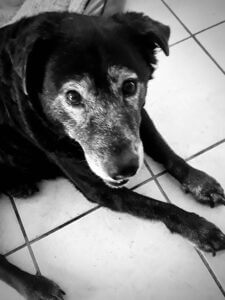
Honey, in her element. Photo courtesy of the author
Yet Alan and I quickly agreed to take Honey, even before we’d seen her. We decided to treat this latest dog appearance as part of the post-Katrina rescue movement that was still growing in our lives and gathering momentum. Taking a dog we’d not met, one with injuries and a questionable temperament, was a big gamble. But it felt cosmic, something that was becoming commonplace. Saying no to Honey simply didn’t feel like an option.
The gamble paid off. Honey’s worst injuries turned out to be bruised ribs and a front leg she had to keep off of for a while. The vet bill wasn’t astronomical. And Honey seemed more than amenable, eager to make good on our investment. At our house she lay quiet, alert but uncomplaining. She settled right in with our two dogs, Toby and Maude, a German shepherd mix, both of whom checked her out and then magnanimously ignored her. She was smart, housetraining quickly and learning a few commands even faster. She was also beautiful — coal-black with a white blaze on her chest, sleek but sturdy, with long puppy legs. The wary stray Lena had described seemed entirely absent. After a month, we decided we could find Honey a home and put a notice online. Perhaps our cosmic duty was done.
It was not. When a woman came to our house to see her, we eagerly led Honey out to the driveway on a leash, proud foster parents. In a flash, Honey reverted to form: froze, barked and lunged. It was clear that she was not interested in going anywhere with anyone. She was already where she wanted to be and who she wanted to be with. It dawned on us, with more than a little dread, that Honey might be what people labelled a bad dog. Toby and Maude were certifiable “good dogs” — quirky in some ways, but basically people-friendly. They seemed to understand that they were our representatives in the world and acted accordingly. Honey, though we loved her already and she loved us, was not our representative in this way. She was merely herself. Our pact with her was going to be different.
On our daily walks, as I work to maintain the appearance that we are both OK, we keep each other’s secret.
I suppose I would have preferred that Honey be a “good dog” — it certainly would have been more convenient. But I also had no problem with how she was. Part of rescue, and justice, is acceptance: doing right by dogs because they’re cute or winning or appealing, and also because they aren’t. Giving Honey the good life she deserved, what all dogs deserve, was going to mean following lots of rules. For one thing, she could never be off leash. For anyone who approached her, the rules were no petting, no hands in the face, no touch, no eye contact, no talking directly to her or even calling her by her name.
There was the option of enlisting a trainer to work with Honey and with us to change her behavior. Alan and I were not opposed to this. We watched “The Dog Whisperer” on TV religiously. We accepted that Honey’s insecurities were not character flaws so much as they were the result of us not doing enough to make her feel safe. César Millán’s m.o. was fixing people, not dogs. Dogs, he said over and over, were always doing things that made sense to them. It was owners who were out to lunch.
We never got a trainer, though Alan always claimed to be “working” with Honey, `a la César Millán. Mostly he taught her more commands, which she learned easily enough — sit, stay, give paw, lie down. She even learned to cease and desist from barking — somewhat — when people came over. Still, we had to keep an eye on her. But the truth is, we didn’t mind. We decided, without saying it aloud, that Honey, despite the problems she presented, was fine, and that the outside world could go to hell. Monitoring the border between her and the outside world was preferable to making great efforts to make her into a more docile dog that she clearly was not. That she was not docile and black made us that much more willing to love her as is. Call it a counteraction to the Black Dog Syndrome, a longstanding belief among many in the rescue business that potential adopters view big black dogs more negatively than light-colored ones, regardless of their temperament. The syndrome may be more myth than real, but the parallels to racial bias are unmistakable, and for us it was another compelling reason to give Honey the full benefit of the doubt. We both actually admired the fact that Honey was the inverse of everything her name suggested — instead of golden and reliably sweet, she was a dark, prickly, badass.
Maybe this kind of advocacy made us bad owners, or lazy, or even irresponsible. But we didn’t care whether the world took to her; taking to the world was not her job. Shaving off her edges, conforming to a demand that she not make people uncomfortable, felt like bowing to the tenets of racism we were trying so hard to refute.
We could be all the world she needed. We understood her and that was justice enough.
***
That didn’t mean there weren’t disasters, times when Honey slipped the boundaries we tried so hard to monitor. Over time she fear-nipped more than one neighbor, bit several family members when they startled her or acted too familiar. Each time they forgave her, cut us slack. But they were pained and more than a little pissed: What was wrong with Honey? What was wrong with us?
Illustration by Phuong-Cac Nguyen
The crisis peaked one summer when Honey bit two white people in neighboring El Segundo on two separate occasions. These were strangers who, because I was walking her on a leash in their neighborhood, bought our act — that is, assumed it was OK to touch her or at least come close. When Honey lashed out at them, the world transformed: I suddenly was not her owner or advocate, but an accomplice to a crime that I had no power to explain or mitigate. I felt helpless to protect or defend her in a white neighborhood where people were probably already wondering who was the Black woman who regularly walked all these dogs — surely I didn’t live there? It was my nightmare scenario: Honey exposing me as an impostor and all of us as outsiders. In my own fear and panic, I briefly saw Honey as the world generally saw her: deviant, sinister. A Bad Dog. She had not only bitten, she had betrayed me, betrayed our pact. Exposed all of our secrets.
But I had enough presence of mind to defend her, as I always did. As I had to. To the white people I apologized profusely and assured them that Honey was essentially a good dog, that what had happened was an aberration. That wasn’t really true, but saying she was a dangerous dog, too dangerous to be out walking, wasn’t true either. I had simply failed in my vigilance. It was, and the Dog Whisperer would have agreed, my fault. Shaken, I decided not to tell anyone at home, not even Alan. I would harbor yet another secret, one Honey had to keep, too.
Months after that the most fantastic and terrible thing happened, something I never anticipated at all or thought to guard against. Alan died. Everything changed instantly. Half of the humans Honey trusted in the world disappeared; I became a single parent to five dogs who suddenly felt like 20. The special vigilance Honey required that had been a joint project was now mine alone to maintain. And it was put to the test like never before: In the wake of Alan’s death, visitors came to the house in a steady stream, more people than had come in the 10 years we’d lived there. I was grateful but overwhelmed, both with grief about losing Alan so abruptly and anxiety about keeping Honey at the distance from people she still needed to be. I couldn’t afford any more crises with nipping or biting, no losses of control or breaches of boundaries. Now, I truly needed calm, not just faking it.
Almost subconsciously, I began to use Honey and her reputation to keep people at a distance and to limit their time with me. I started using the wire pen that had kept Honey still while she recovered from her injuries to corral her inside the house. “Hold on while I put Honey in her pen,” was my shouted greeting to people at the front door while the dogs were all barking, Honey most ominously. When they came in, Honey was secured but close, fully within sight of us and watchful. During the visit I checked on her constantly, talked to her over my shoulder, gave her treats at regular intervals. Captive but the center of attention, Honey produced the desired outcome: She didn’t hurt anybody and nobody stayed too long.
But here’s the thing. Honey, though happy to oblige being the enforcer, wasn’t quite that. She never was. Despite her bad-dog reputation, which I was now exploiting to keep myself safe, she liked people. She was curious about them. Her heart was always open this way, even as her behavior obscured it. This was part of her complication, a secret I sometimes liked to keep to myself. Honey was the only one of my dogs to befriend the cats that started showing up after Alan died — one, who I named Little Bit, regularly wound through Honey’s legs as Honey looked down at it, fascinated and anything but fearful. Honey didn’t trust the world, but that never meant she gave up on it. Sometimes when I glanced at her during people’s visits, I felt a pang of guilt to see her caged. She was willing to be there, even expected it. But the way she stared so intently between the wires was like a prisoner peering between bars, dreaming of a life on the other side.
***
Honey is 12 now, maybe closer to 13. She’s still beautiful; black but white-muzzled, and slower. When I take her out on walks, which are still daily, she is more consumed with the temperature and impending fatigue than with being afraid of strangers. These days, out in the world beyond our driveway, she observes and analyzes more than barks or lunges — she has mellowed out to a degree. But as soon as I think that, she barks full, furious warnings at the mailman or the gardener who’s been coming around for more than 10 years or an approaching skateboarder. She reminds me she is still who she is. But when we walk through well-appointed white neighborhoods, the El Segundos, I don’t worry about her nearly as much, chiefly because she isn’t so quick to show her teeth anymore, and also because the COVID pandemic has created a new habit of distance between people that feels normal. The net effect of the distance is that out in the world, the pack and I are alone. For the first time, I don’t feel obligated to assure the world Honey is OK, because the world isn’t really there anymore. It isn’t looking.
I still have five dogs. The cast of characters has changed: Toby and Maude died in 2018 within a few months of each other. While I was struggling to catch my breath, an impertinent, reddish Yorkie appeared on my porch in the usual, unexpected way and stayed. In 2019 I took in a stout Lhasa mix and an enormous Husky, and for the next year-and-a-half I had six dogs, the most I’ve ever had at one time, a number that I think even Alan would have thought excessive. And then one of those recent acquisitions, Mookie, the Lhasa mix, died a year-and-a-half later, in 2020. He was Honey’s half doppelganger: singular, utterly himself, but as tolerant as she was wary. He resisted the world not at all. Quite unlike Honey, Mookie was gone as suddenly as he had arrived. The deep hole he left in the pack, a hole on top of other holes, hasn’t been filled yet. I don’t think it will be this time.
Through all the enormous turbulence of the last 12 years — personal, political, racial — Honey remains the emotional anchor, the fixed center who still must be watched. I’ve mastered that watching as a single parent, as much as it can be mastered. But her profile has changed. Once the problem child, she’s aged into the den mother. She’s also living history, last of a threesome that established a multiple-dog household as normal and faith in the great unknown ordinary.
Honey doesn’t wear seniority well. She is still in many ways a child, defined by her fears, but at the same time still searching for connection, encounter by encounter. Like a child, she expects acceptance for who and what she is — that is, she expects justice. I give it to her, as I’ve given it to her virtually all of her life. And I continue to hope.
Help us sustain independent journalism...
Our team is working hard every day to bring you compelling, carefully-crafted pieces that shed light on the pressing issues of our time. We rely on caring supporters like you to help us sustain our mission. Your support ensures that we can continue to provide deeply-reported, independent, ad-free journalism without fear, favor or pandering. Support us today and make a lasting investment in the future.
RELATED STORIES


Award Winning


Today’s environmental and social justice challenges are unprecedented, and require an unprecedented collective effort.


Stay updated on our latest features, events and more. Subscribe to our Note From the Nest newsletter!
