
A Dream No Longer Deferred
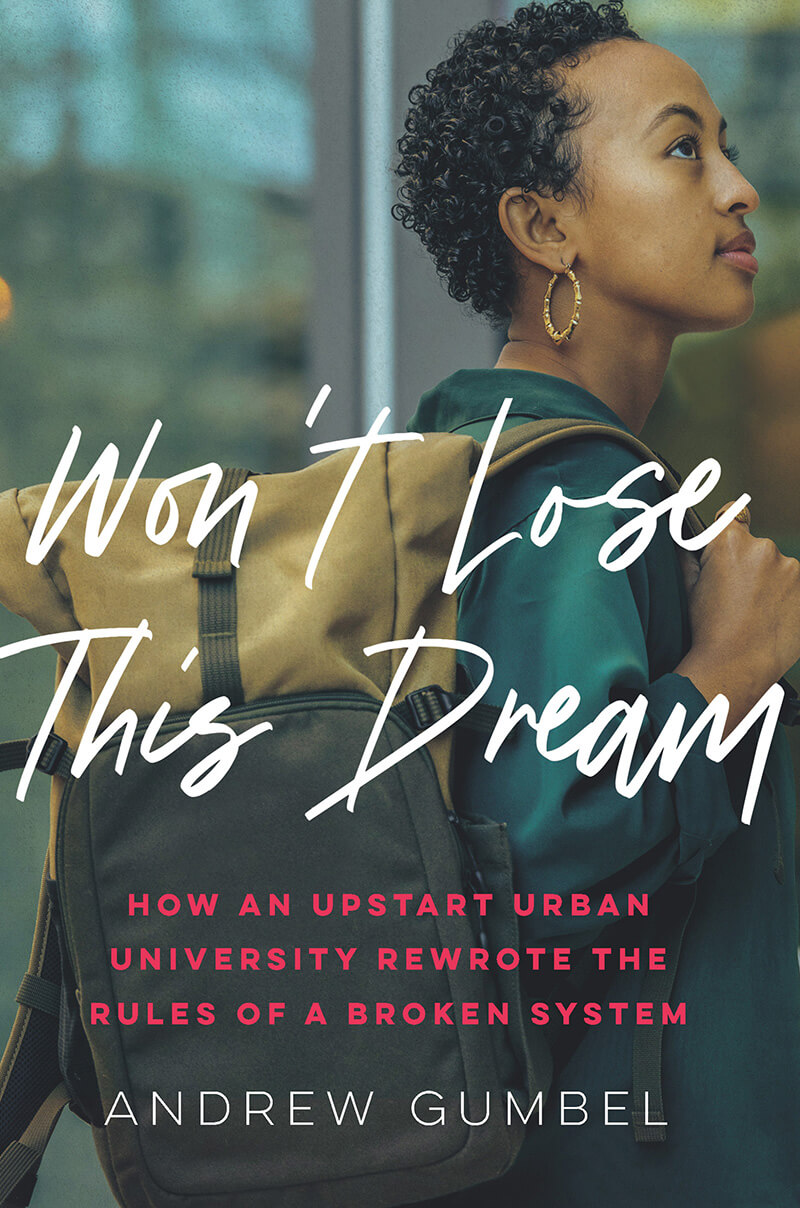

Won’t Lose This Dream is Andrew Gumbel’s impassioned account of a potentially arid subject: reforming public higher education. But this story of how Georgia State University went from being a nondescript public university system to a national model of student success over the course of a decade is no ordinary tale about bureaucratic change or single saviors. Instead, it is a story about the simple, but radical, vision of administrators to upgrade the school by upgrading its support of the students, the majority of whom are of color and low-income.
Seeds of this vision had been planted long before GSU President Mark Becker and Assistant Provost Tim Renick started developing their approach in 2010. But it was these two who took it to new heights, and the University never looked back. Becker, a former statistician, and Renick, a former religious studies professor, combined a sense of moral mission with a near-religious fervor for data and analytics to craft reform centered on identifying what students really need day to day—from housing to finances to freshman communities—and then addressing those needs on a big scale, in real time.
The results have been nothing short of breathtaking. Between 2003 and 2015, graduation rates at Georgia State University skyrocketed from barely a third to about 60 percent, with the black and Latino students graduating in slightly higher numbers than the university average.
This model of student success couldn’t be more timely as Americans facing an economy devastated by rising wealth inequality and a once-in-a-century pandemic look once again to education—a quality but moderately priced education– to better their fortunes.
Such an education was once a cornerstone of the American dream, and the story of GSU’s turnaround has shown how it can be rebuilt, even in the midst of crises.
Racial inequality is an eternal crisis that has become current in a big way. The need for black lives to matter in fundamental ways is even more urgent that it was in the ‘60s. The educational successes Gumbel charts in Won’t Lose This Dream are framed more as triumphs for public education, than as triumphs over anti-black racism. But the truth is that bolstering black students in great numbers, especially in a Deep-South state with a long history of school segregation, and segregation in general, is inherently anti-racist.
GSU does not solve the country’s bigger existential problems with the color line, but its slew of student-centered programs, driven by an unwavering belief of administrators in the potential of “non-traditional” students (i.e., black and financially challenged) show us a crucial way out of the morass. The bottom line is, for GSU, black lives matter. That’s an ideological stance, but also a practical one—as a core clientele of the University, they have to matter. If black students don’t advance, neither will the institution.
This is a great lesson for American universities that have long operated on models of exclusivity and competition, a capitalistic model where the highest-achieving students define the institution, and everyone else attempts to live up to that definition. Of course, this model is never as strictly merit-based as it sounds; it’s color-coded, with whites the perennial winners and blacks at the bottom. A 2018 Hechinger Report, citing the Georgetown University Center for Education and the Workforce, revealed that enrollment in the 468 best-funded and most selective four-year institutions is 75 percent white.
Yet university admissions and college culture is the space where neoliberal and even progressive America clings hardest to the myth of meritocracy, and to corollary myths of intellectual superiority. Black and low-income people would be more of a presence at universities, the myth goes, if they had what it took. We would love to have them here, but they don’t belong.
GSU took the radical step of assuming that its students did indeed have what it takes—and then some—they just needed to remove the obstacles blocking their way to graduation.
In helping to remove those obstacles, in making that their job, GSU made itself a real partner in students’ educational journeys, not gatekeeper or disinterested bystander. It has done nothing less than redefine the purpose of the university itself. Tim Renick says GSU isn’t coddling or hand-holding, as some might claim: it is simply clearing a path of fulfillment that everyone with talent and desire should have the opportunity to travel. Renick told the Chronicle of Higher Education in 2018 that he essentially sees his job, and the University’s, as troubleshooting. “We’re tipping students off earlier on that there might be a problem,” he explained, “and giving them a fighting chance to correct it.” Unglamorous, perhaps, but utterly vital. The data doesn’t lie.
In Renick’s common-sense job description is a complete reimagining of higher education as a great leveler, not a divider. That has theoretically always been its role, especially the role of public universities supported by tax dollars. Social and political realities, and increasingly harsh economic realities, though, have obscured that ideal for decades now. Indeed, white anxiety over affirmative action in college admissions, a very modest effort at leveling, has never really abated: every generation since the ‘70s has argued about, litigated and re-litigated, who should get into a public university and who shouldn’t, who really belongs and who doesn’t, who qualifies for a spot in the lineup and who is better off in the minors.
Part of the problem has been that public universities have gone from being sites of opportunity to sites of scarcity, yet another public-sector entity that anti-government conservatives have been trying to starve for the past 40 years. The result of that has been that the top-tier state university systems—University of Georgia, University of California—have become ever more competitive and elite, and second-tier universities, such as GSU, stagnate as dumping grounds for the less competitive (i.e., black, brown, poor and other).
Georgia State rejects that binary not only as false, but wasteful. It has made the cliché of all students matter a reality, not with soaring rhetoric—something virtually every university president pulls out at graduation ceremonies—but with hard work. The work is built on something even more important: empathy. The strategic, innovative, technology-based plan that GSU began fleshing out in 2010 and stuck to wouldn’t have had a chance if its architects and implementers didn’t deeply believe that its students were worth the effort, and that those efforts have to constantly grow and evolve. The University has rightfully touted its success, but it knows it can never rest on its laurels.
Given the current climate for a reckoning with the very issues of access and equity Georgia State University has been out in front of, I was eager to talk to Andrew Gumbel about Won’t Lose This Dream.

Before taking on this project, the British-born journalist admitted that while he knew there were problems in higher ed related to long-standing inequality, he hadn’t thought deeply about them. The months spent researching the details of GSU’s renaissance, especially the remarkable stories of its students, was an epiphany that comes through in Gumbel’s narrative style—unsentimental but inspired and urgent. One of many things Gumbel realized is how resistant Americans are to the data that proves inequality is real, and how resistant they are to correcting it.
“They don’t want to believe that this country is as racist as it is,” he says. He had to be fully converted to that truth himself. “I have to admit, when I first moved here and started reading American history, my jaw just kept dropping,” he says.
Appropriately, we talked in the backyard of Gumbel’s home in Santa Monica, a picturesque, typically detached part of L.A. that gained national attention for being a ground zero of the Black Lives Matter protests that erupted in May. The weather was balmy, and because of the Covid-related restrictions, it was far quieter than it usually is during the tourist season. Gumbel looked a little abashed at being in Santa Monica at all, but also satisfied. After all, his neighborhood is a place where certain things are never supposed to happen, where the story was written and the trajectory set long ago. The story of Georgia State University cured him of such thinking. He hopes we all get cured.
Erin Aubry Kaplan: So there’s been almost a 75 percent increase in Georgia State University graduates since 2003 and 2018, the majority of them black and poor—that’s amazing.
Andrew Gumbel: It’s actually almost better than that, because the percentage of students that end up graduating from somewhere, if not GSU, is in the 80s. This is over a six-year period.
You describe a group of students as the “murky middle,” which is actually the bulk of the whole student body, middle-performing students—not terrible, not great– who are actually in the greatest danger of dropping out. Within that group are the “swirlers,” students who kind of go around and around with no clear direction.
The key is figuring out what’s happening or going wrong in the first six weeks. Is your mom sick, did your car break down? What are the chances of you succeeding in this chosen path? You look like you’re pretty good at this other thing. Nobody ever tells students—you can’t carry on with this or that. But your chances of getting into the nursing program based on this first grade set is 15 percent, however, you can switch to health informatics, and your chance of graduating are 85 percent. You choose.
It’s not quite like that, but they have a conversation.
That’s all part of predictive analytics, right? If you don’t pass math the first or second time, your chances of passing go down to almost none, therefore you change your path. But is there a danger of a student being deterred from what they really want, like being a doctor?
A student named Savannah Torrance started out in chemistry and her counselor specifically asked her: Are you quitting because it’s difficult? She said, “No, I’m quitting because it doesn’t make me happy.”
She switched to speech communications. She said GSU helped her figure out not just her major, but who she was.
That’s about more than education—that’s philosophical, existential. I always thought it’s really important to learn in college what you’re not good at.
Right. It’s also a matter of your options—how much money do you have? How much time do you have? What are the best things you can do with the resources you have available? That’s another reality. (Student advisor) Crystal Mitchell told Gabriel Woods, a student who was having great trouble with the music department at GSU, “I’m not telling you that you can’t graduate in music.” She was telling him it’s going to take longer than he had resources to pay for. She said to do communications because he could get a degree in that.
The lack of a music degree ended up not mattering. Gabriel, who is now a professor of music at Savannah State University said, “Of all the students in the music program, only three of us got jobs in music, and I’m one of them. And I’m the guy they threw out.”
Helping students was definitely a moral vocation for Tim Renick, and Mark Becker made the economic argument—these students have to pay off for us. Nobody could really argue with that.
In terms of his political posturing, Becker understood that if he made the argument about race or racial equality, he was going to have doors closed in his face. Not that race wasn’t sometimes explicit anyway. Somebody came up to him once, a senior administrator from another university in the Georgia system and said, “Thank you so much for educating those people so that we don’t have to deal with it.” There are a lot of these kinds of attitudes around.
So, he stays tunnel-visioned on student success as a concept, because race is so toxic.
He found some attitudes about race appalling. There are a bunch of public universities in Georgia that are considered historically black– Savannah State, Albany State, which I mention briefly in the book, the one where they had the flood in 1994. A state legislator said at the time, “This is God’s way of telling us we shouldn’t be educating those people.” And the chancellor at the time, who was a Brit, turned right around and said, “No, that’s God’s way of saying we shouldn’t be building on a floodplain.”
I think Mark Becker is deeply conscious now of being a white university leader when that may expose him in certain ways. And he worries about that. I say, why not trumpet what you’ve done? He says number one, I don’t know that people want to hear that, and number two, I don’t know if they want to hear it from a white guy. And by the way, I’m a white guy too, telling the story. So my answer to him, which applies to me as well, is: “It doesn’t just have to be about you.” This is about a lot of people, and if you want voices telling the story at GSU that aren’t white, take your pick.
There are lots of black people in the story who are that voice. One, Allison-Calhoun Brown, a counselor who works with Tim Renick, says that to say students can’t achieve because of their circumstances—which includes being black—is racist thinking. She pushes against the elite college thing. This is a moral mission for her, too. The fact that she and everybody else at GSU is really serving their students, their needs—students who happen to be black, and poor or whatever—is really the key here. That’s everything. That’s what everybody should be doing.
Yes. Treating their blackness as a symptom tells you nothing, because they all have different needs.
Mark Becker said, “Data will set you free.” He would say that because he’s a statistician. But really, data makes things easier, less complicated to address. It makes the moral vocation easier to carry out.
Yes, it makes the job of serving the students easier. And easier to make the case with skeptical constituencies. My favorite moment is when they do a pilot project of the math lab– adaptive learning, where you learn math in a computer lab, rather than in a classroom with a lecturer. You do a pilot study, you find this method of learning that is dramatically better, and take that data to the head of the math department. What’s the head of the math department going to do, say “I don’t believe the data tells the truth?” They have to say, this is good, let’s do it. It’s irrefutable.
In the book, The Education Trust, a national organization that advocates for underserved students, praises GSU for demonstrating that public institutions “can foster access and academic excellence simultaneously.” That seems to be a radical idea. In this country, we seem to think if you have access, you don’t have excellence. One cancels out the other.
That’s an old-fashioned way of thinking. Michael Crow, president of Arizona State University, had this great line: Most universities define themselves by who they exclude, and they even see it as a badge of pride. They need to rethink their mission about being who they include.
They’re proud that they exclude, and probably about who they exclude. That’s what they don’t say. The fact that a place like Harvard is mostly white doesn’t bother people at all—it’s supposed to be that way.
That’s why I think Allison Calhoun-Brown’s line is so brilliant—the idea that universities justify all these things as being about quality, but it ends up being about racism. That’s why I found the GSU efforts so admirable—they devised a strategy to meet these particular student needs and stuck to it. They tracked their success, grew the campus physically, grew their presence and prestige as a university. They did all the things they would have done for another student population.
That’s one of the reasons that on a human level, I admired Tim Renick. I get why you’d feel strongly about kids in your own classroom—you have a relationship with them one-on-one, you believe in them. He’s able to have the same level of commitment in the abstract to these tens of thousands of kids he’ll never meet. And that translated to the whole team.
One of the big aha data moments, a turning point, was realizing that SAT’s weren’t a good predictor of student success at GSU. Grade point averages were. So the team had to take the bold step of nixing SAT scores in favor of GPA’s. Later on they developed a chatbot to communicate with students online, to keep up with them, check in. Moves like these made the student feel not just paid attention to, but cared about.
Yes, the chatbot is great. When the COVID19 pandemic erupted, they used it to say, “If you have nowhere to go, let us know.” Within 24 hours they had 8,000 students saying, “Here are my circumstances,” and the school has an opportunity to do something about it, or intervene. Without a chatbot, the university would never have known anything was going on. Students say when they talk to the chatbot they can open up, they don’t feel judged, which I thought was fascinating.
Here’s a principal problem the chatbot helps to solve: if you’re low-income and you’re filling out FAFSA (federal aid) forms, you need help. The paperwork is daunting, discouraging. You miss deadlines, and disappear. GSU considers helping with all this stuff its job. That’s the powerful idea in all this.
Choosing to admit students with high GPA’s and low SAT scores lowered its ranking, but GSU didn’t care. Defying rankings wasn’t done. But they did it. So much about university culture is, nothing ever changes. The culture at Georgia State is, if there’s a problem we can find a solution. That can-do attitude makes change.

You talk near the end of the book about a big oversight at GSU: career counseling, what the students need to do after graduation.
Career services was GSU’s big three-year plan, before Covid hit. There was a lag there because career counseling was part of Student Affairs, and that was run before by a guy who basically did nothing with it. With Tim Renick, helping students from families without connections to get internships is key. They made that a priority from day one, actually before day one, at student orientation. GSU talked about portfolios, adding things to your portfolio to show employers. They don’t push vocational studies, they also say, if you’re going to be studying English or philosophy or whatever, the professor and student need to be mindful of critical thinking, analysis—these are amazing job skills. If you think of those studies in those terms, you can sell employers on those terms.
While it was building access and student success, GSU also was building itself as a top-tier research university.
It’s a rare combination. But it doesn’t have to be. GSU is considered relatively competitive now—you need to be a B-average student or better to get in. But its policy for years has been to not increase its admitting criteria. They just admit more people, and then figure out, do we have enough for them? Enough buildings, classrooms? At this point, they’re very confident their student-centered model will work. Find more classrooms, keep hiring more professors.
One thing you start out saying that struck me is that public universities everywhere had been defunded for 30 years, so that by the time you get to the early 2000’s, it’s a permanent crisis. Then comes the 2008-09 Recession. How did GSU do all these innovations without extra money? Or how did it raise money?
What they realized is that these programs were moneymakers. They pay for themselves, and then give you money back… I thought that was fascinating, again, to have this economic argument that’s more effective than the social justice argument. And it works: When you look at the states that are doing well on student success, it’s Georgia, Tennessee, parts of Texas, they’re all deep South, red states. In California where everybody thinks they’re progressive, serving students equally, diversity, can be just lip service.
As you researched the GSU story and wrote about it, did it change your mind about anything? Any light bulbs go on?
I had underestimated the mismatch between people’s potential and the opportunities that they’re given. I didn’t have my head around that at all. I thought about the concept of success, but I didn’t think about it enough. On some level, I probably thought that if you had certain disadvantages, you had to be all the more exceptional to break through those disadvantages.
If you look at the people who’ve been left behind, yes, they’ve had terrible circumstances and all that, but there’s all this potential left behind.
I had completely underestimated that. That was a big revelation. And then, to meet all these high-achieving low-income kids, to understand what led them to achieve at a high level, what they had to go through—I just hadn’t acquainted myself with that. Maybe because I think I’m slightly allergic to those feel-good, overcoming-adversity stories that Hollywood loves.
It’ll be interesting to see what the Covid crisis and the economic crisis that comes along with it does. In 2008, the reaction of most public schools, with the exception of GSU, was to say, “OK, enrollment is up, people don’t have jobs so they’re coming back to college. Let’s make our admissions a little more exclusive, move up our ranking in US News & World Report.” I think this time there will be a realization that they don’t have that kind of leeway.
This model of success exists; they have a choice now. It used to be a model nobody talked about. Now everyone’s talking about it.
Help us sustain independent journalism...
Our team is working hard every day to bring you compelling, carefully-crafted pieces that shed light on the pressing issues of our time. We rely on caring supporters like you to help us sustain our mission. Your support ensures that we can continue to provide deeply-reported, independent, ad-free journalism without fear, favor or pandering. Support us today and make a lasting investment in the future.

RELATED STORIES



Award Winning



Today’s environmental and social justice challenges are unprecedented, and require an unprecedented collective effort.


Stay updated on our latest features, events and more. Subscribe to our Note From the Nest newsletter!

My associate and I actually loved reading this magazine post. I was just itching to know, do you commerce featured posts? I am at all times looking for somebody to make trades with and merely thought I might ask. http://www.piano.m106.com
That’s a very good feedback. What are your thoughts on expansion on a global scale? People obviously get frustrated when it begins to affect them locally. I will be back soon and follow up with a response.
This website has more than enough good information on it, I check on it every few hours. I wish other sites spent as much time as this one does making information available to readers like myself. I recommend this site to all of my facebook friends.
I happened to stumble across this website searching for something different, glad I stumbled into it though. Very interesting.