
Undaunted

Mulvenna knew he didn’t want to end up like his mother, who had lost her job at a pharmaceutical company during the recession and now struggled to make ends meet as a checker at Kroger’s.
As more students started finding their confidence and their stride at Georgia State, a sense of indomitability began to spread across campus, a visceral feeling that no problem, no frustration or failure, was too big to surmount. Renick and his staff were forever on the lookout for the next data-driven solution, the next obstacle to identify and remove. That energy also extended to the students, who now had the self-belief to push back against adversity and expect to come out stronger on the other side.
One such student was Tyler Mulvenna, who arrived at Georgia State in the fall of 2013 with all imaginable momentum working against him. He was the first in his family to go to college, and one of only a few from his high school in Newnan, 40 miles southwest of Atlanta, to make it to the big city. Mulvenna knew he didn’t want to end up like his mother, who had lost her job at a pharmaceutical company during the recession and now struggled to make ends meet as a checker at Kroger’s. He knew, too, that he didn’t want to end up like his two older sisters, who both had babies when they were teenagers and led lives far short of what either had dreamed. Mulvenna was bright, athletic and popular, and his mother had given him all the support and guidance she could to excel academically. But he also had no money — he’d worked from the age of 15 so he and his mother could scrape by — and knew that if he couldn’t figure out a way to pay for college a degree was going to be out of reach.
Mulvenna graduated high school with a 2.97 GPA, tantalizingly short of the 3.0 cutoff for a HOPE scholarship, so he made a plan to work for the summer before school and vowed he’d buckle down after that to make sure his grades improved and he qualified for HOPE the following year. That plan went up in smoke, though, when he crashed his car toward the end of the summer and was left with no transport to get to and from a job. Instead of arriving at Georgia State with cash in hand, he was flat broke and accumulating extra debt from a string of last-minute high-interest loans. Because he couldn’t afford to live on campus, he was forced to take a 7:30 a.m. bus from Newnan and another back no later than 6 p.m. He had a weekend job as a stocker and cashier at a sporting goods store in Newnan, but he couldn’t work during the week because he was enrolled in the Panther Excellence Program, a less intense, regular-session cousin of the summer academy that required him to be on campus full-time Monday through Thursday.
The program was very good for Mulvenna in that it provided him with a structure to excel and helped fill the gaps from his high school education. But it also created other problems, because the number of credit hours he could take was capped at 12 for the first semester and 15 for the second. That left him three credit-hours short of the 30 required for the HOPE scholarship. Mulvenna applied for a summer study program in France, good for another six credit hours, and won a scholarship to cover some of the travel expenses. But he was still around $2,000 short. The HOPE money wouldn’t come through until fall, and the bill for summer tuition was due up front.
This was where Mulvenna’s refusal to be daunted kicked in. He happened to meet Crystal Mitchell through his GSU 1010 course, recognized her as someone with an unusual ability to make extraordinary things happen, and peppered her with questions to see if she could somehow get him to France, short of upending the laws of the universe entirely. Mitchell came up with the idea of applying for a Panther Retention Grant. In theory, students weren’t supposed to apply for them at all, on top of which they were designed for seniors, not freshmen. But in Mitchell’s mind Mulvenna was a good fit all the same — a promising student with a 3.2 freshman GPA, facing a financial emergency that threatened his chances of earning a degree. So he applied, and the grant came through, the France trip was back on, and with it his HOPE scholarship. Most importantly, he learned never to take no for an answer. “Every time I needed something, I went to Crystal to figure out a way to circumnavigate the system,” he said. “What I learned from her was how to get around certain obstacles. I do a lot of that still.”
Sophomore year was no less of a white-knuckle ride. Even with HOPE money, Mulvenna was drowning in debt, so much so that he received a second retention grant within weeks of his return from France. He needed to work at least 20 hours a week, and that was only going to happen if he could lay his hands on a car. He still had the 2000 Ford Fusion he had smashed up in the accident, and while it wasn’t remotely roadworthy by any normal definition he got a family member who was an auto mechanic to stretch out the crumpled bodywork to the point where it could do a plausible imitation of holding the road. Soon, Mulvenna wasn’t just driving around in the car. For most of the fall semester, he was also sleeping in it to save himself the gas driving back and forth to Newnan. That meant a singularly high-stress existence, because almost everything about the vehicle was illegal. “It couldn’t pass an emissions test, so I couldn’t get tags,” Mulvenna said. “And I couldn’t have it on the street for fear of getting tickets. I got four of them and couldn’t pay them.”
For a while, Mulvenna parked the car overnight at friends’ apartment complexes so he wouldn’t get cited or towed. Soon after Thanksgiving, though, he decided to ditch the car and take a job that he could walk to, selling memberships at a YMCA across the street from Georgia State’s main administrative buildings. Not only was this more convenient and better paid than working in Newnan; it also offered networking opportunities with YMCA patrons that led him to a valuable internship with the IHG hotel group and, in time, his first full-time job. He moved in with his sister, who lived on the MARTA rail line in the north Atlanta suburbs, and slept either there or on his fraternity brothers’ couches.
In short, he survived. By junior year, he was living on campus, racking up class credits and internships, and earning himself an invitation to join the prestigious student ambassador program known as the 1913 Society. None of this came easy: the stress of working 30 hours a week on top of his multiple campus commitments caused him to come down with one infectious disease after another — first shingles, then strep throat, tonsillitis and mononucleosis. In his senior year, he was so close to penury again that he needed a third and final retention grant.
Mulvenna came through his trial by fire, graduating with distinction in international business, French and marketing and going on to a high-powered career, first with IHG and then with IBM. At no stage did he lack in inventiveness or grit. But he also typified the sort of student who routinely drops out of most colleges; one who, through no fault of his own, is perpetually walking a tightrope and has nobody to catch him when he falls. Without Georgia State’s array of student success programs and the can-do attitude they fostered, there would have been no France trip, no HOPE scholarship, next to no likelihood Mulvenna would have made it much past the beginning of his sophomore year. He would have been remembered, if anyone remembered him at all, as just another poor biracial kid who didn’t make it. And yet he was a model student.
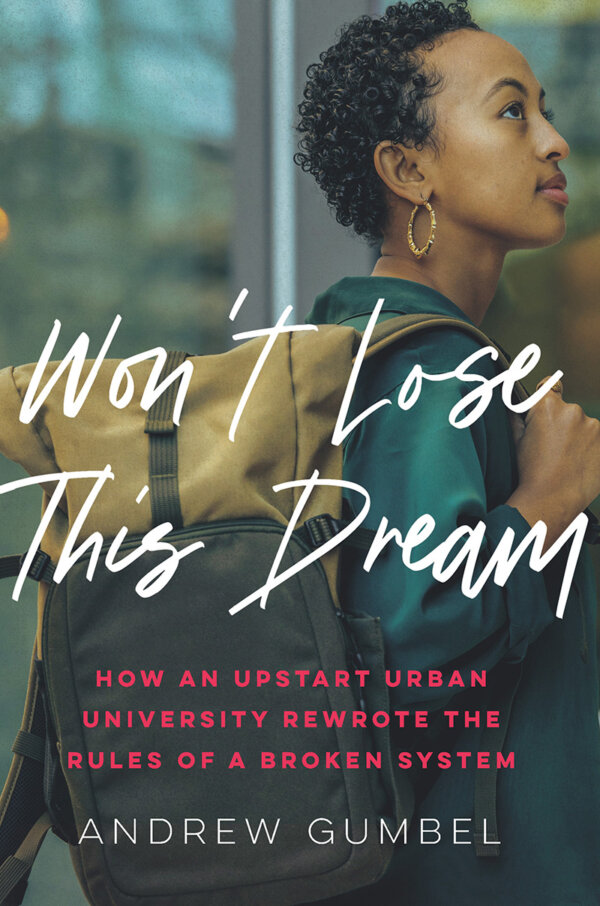
Copyright © 2020 by Andrew Gumbel. This excerpt originally appeared in Won’t Lose This Dream: How an Upstart Urban University Rewrote the Rules of a Broken System, published by the New Press. Reprinted here with permission.
Help us sustain independent journalism...
Our team is working hard every day to bring you compelling, carefully-crafted pieces that shed light on the pressing issues of our time. We rely on caring supporters like you to help us sustain our mission. Your support ensures that we can continue to provide deeply-reported, independent, ad-free journalism without fear, favor or pandering. Support us today and make a lasting investment in the future.
RELATED STORIES



Award Winning



Today’s environmental and social justice challenges are unprecedented, and require an unprecedented collective effort.


Stay updated on our latest features, events and more. Subscribe to our Note From the Nest newsletter!
