
Wet Dreams

This year, Los Angeles had an epochal winter. Days on end of steady, soaking rains, temperatures dipping into the 30s at night and even a little frost here and there at moderate elevations. We saw snow in the nearest mountains, whose pure white peaks you could still see in the drizzly early spring, from all the eastbound freeways that carve up Southern California. As I write on a drizzly early spring day, crabgrass persists in my native plant garden, but it comes up by the roots with just a weak tug due to the saturated soil. The manzanita sprouts light green new growth, while the sage and mallow are in the throes of a super bloom.
The mind plays tricks, and you think it will always be like this. But the plants remember: they are rooting deep into the soil, preparing for the years when they must survive without any water. And who knows, that year might be starting now. As a heat dome settles over the West in the late spring, forecasters predict a summer of record-breaking heat. After those historic floods of the early 1860s, the U.S. Geological Survey used to model what extreme precipitation would do to the modern West. Cattle died in their tracks of dehydration; there was simply no water to be found.
For the last couple of centuries, since Europeans colonized the Western U.S., water — its abundance, its scarcity and its unpredictability — has been the defining factor of survival in all of California, but especially in these southern reaches. Here, the difference between a rainy year and a dry year is wider than anywhere else in the country. Here, floods in one year prompted authorities to box up rivers in concrete, and in dry years inspired William Mulholland, the founder of LA’s water system, to bring down water from the Sierra Nevada via the engineering marvel of a gravity-fed aqueduct.
Historically, the City of LA has relied on that aqueduct for much of its freshwater supply. It’s excellent water, too — clean and pure, fed by mountain springs and an alkalinity superb for human health. The more readily obtainable water, the native water of the LA River Watershed, has mostly gone to waste. Some of it percolates into the ground and collects in the San Fernando Basin, the vast underground aquifer that once irrigated the fields and farms of the San Fernando Valley. But the overwhelming bulk of it gets rushed off the land as quickly as possible, diverted into storm drains and channelized rivers that scarcely see the sun.
This way of doing things has had more implications for our urban ecosystem than simply wasting water. Sunlight kills viruses and bacteria, and soil takes up nutrients. But, water that moves too fast carries lethal pathogens and chemicals that sicken people and leave lifeless patches in the ocean. So, a movement arose, back in the 1980s, to change how LA manages its water. It began with a successful fight to get the city to stop dumping raw sewage into coastal waters and evolved into an ongoing effort to restore the city’s and the region’s natural hydrological resources. Early activists infiltrated the government by serving on commissions; municipal authorities began to budge. Now, nearly 40 years after Dorothy Green founded Heal the Bay in 1985 to address the pollution in Santa Monica Bay, even the general public cares about what happens to the rain.
“The number one thing I hear during the rainy season is people asking me, ‘Why don’t we do a better job of capturing all the water that I see in the LA River?’” says former Heal the Bay president Mark Gold, an erstwhile activist who later infiltrated the government and now serves as the director of water scarcity solutions at the Natural Resources Defense Council. “People literally get upset when they see how full the LA River can get during these wet years and big storms.” That, in itself, is a victory, Gold says. “To me, it’s taken a long time to get to that point. But I think we’re finally there.”
Stormwater capture figures made the evening news last February, amid the stories of swift-water rescues and car-wrecking mudslides. LA County voters even approved a property tax increase in 2018, ballot Measure W, to fund $300 million every year for projects that capture and reuse stormwater, and at the same time create better parks and open space. “Multi-benefit” projects, they call them, which are designed to make everyone happy.
The total stormwater captured in LA County this last wet winter was 96 billion gallons. That was certainly cause for celebration — not least because the goal of Measure W’s Safe Clean Water program is to capture 97.8 billion gallons per year. Mark Pestrella, the director of LA County Public Works, declared it a “super year,” telling the LA Times that the more than $1 billion invested in collecting rain and runoff has “paid off.” Grist magazine heralded LA as a “sponge city,” claiming that by “replacing impermeable surfaces, like concrete, with permeable ones, like dirt and plants,” the city has evolved into a model of restoration.
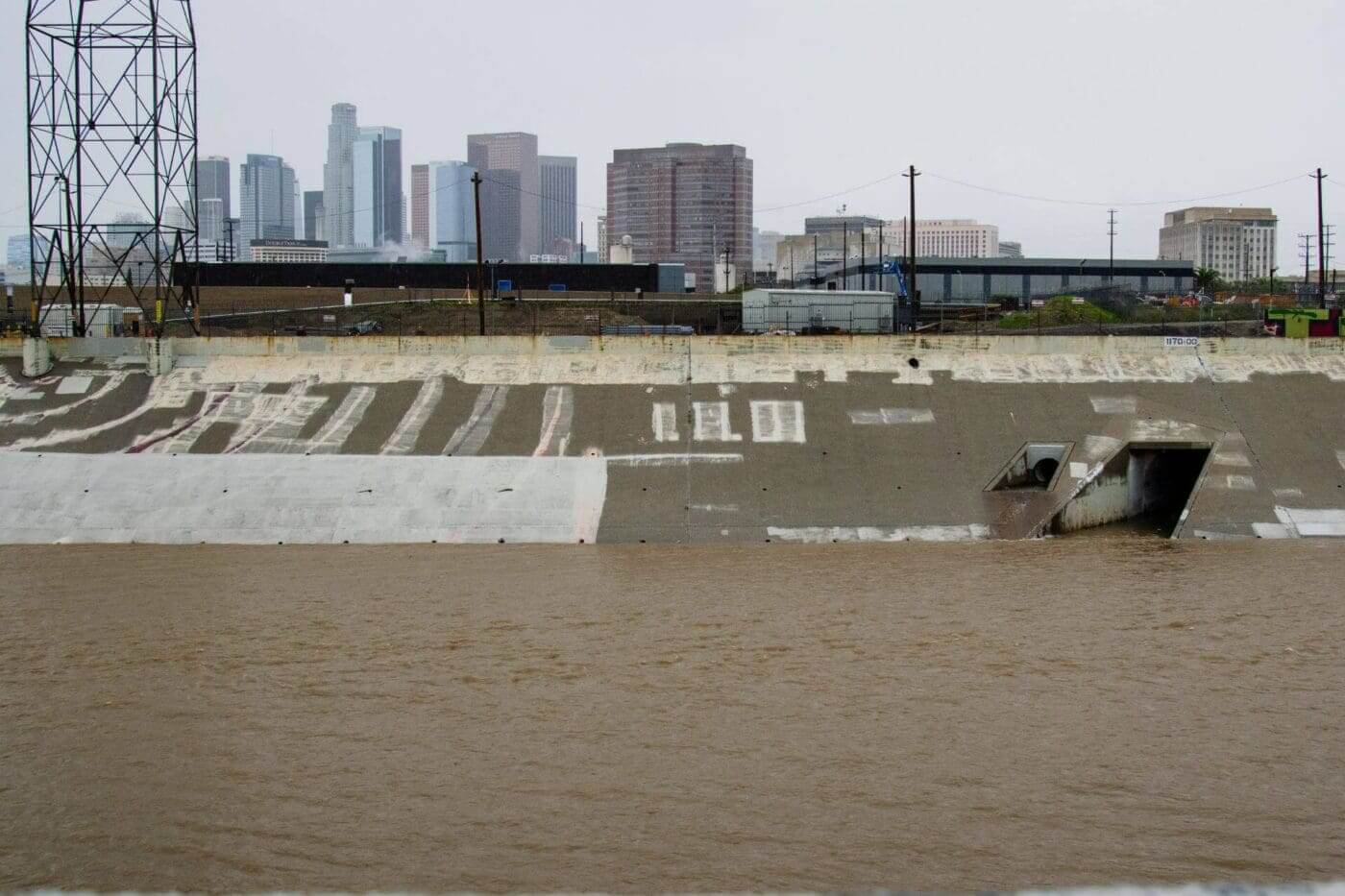
Raging waters: The LA River surges to the sea during late-winter deluge. Photo by Shannon Aguiar
LA is a very long way from being anything resembling a sponge. Even with all the progress (including a multi-million-dollar upgrade of the Tujunga Spreading Grounds in the north San Fernando Valley that doubled its stormwater capturing capacity, and the networks of parks outfitted with underground cisterns for storing rainwater), LA is still more like a city of slick plastic tarps. Hundreds of billions of gallons still slide down its concrete sluices and disappear into the ocean forever. In a single storm in early January of last year, 18 billion gallons of water went into the ocean from the LA River.
Yet, we still aren’t thinking big enough. We’re not unboxing rivers and creeks; we’re not creating or restoring wetlands, or moving buildings out of the floodplains. That last bit may not be possible in the future of Southern California’s civilization before geological time finally has its way with our buildings and canyon roads and LA itself slips into the sea. Housing is too scarce; real estate is too precious. But at least we can move beyond individual rain gardens and retrofitted parks to accomplish something large and radical, something that will stop the word drought from striking terror in water managers’ hearts.
And that’s the question, says Gold: “How do we move more from playing small ball, building one modest-sized project at a time, to actually building large-scale, multi-use projects that can infiltrate thousands of acre-feet of stormwater runoff?” The projects that LA officials boast most about, the retrofitting of dams and spreading grounds, “are 40-plus years old and were created for flood control.” To collect enough stormwater to guard against the looming threat of the climate crisis and its effect on the Sierra snowpack, both the city and the county need to think more radically about how to keep water on land.
“Between what we can do and what we are doing, there’s a huge disconnect,” Gold warns. “We are not where we need to be.”
***
I spent the better part of the early 2000s writing about Southern California’s local water resources — both their fickle abundance and their systemic waste. I followed scientists, engineers and landscape architects around the city learning about where the water collected naturally, where it came from, the multiple benefits of floodplains and where overflowing rivers can spread out and water can sink back into the aquifer for later reuse.
Jessica Hall, an influential landscape architect, took me around the city and county to show me where natural streams were plowed underground and paved over; Melanie Winter of The River Project, a nonprofit dedicated to restoring LA’s hydro-ecology, taught me to dream about free-running, meandering streams and replacing loading docks with greenways. Mark Abramson — the rugged and influential defender of Malibu Creek and lagoon, who spent decades working with Heal The Bay — made me hope for the return of anadromous fish, the ones that spawn inland and die, while their offspring swim back out to sea. “There’ll be steelhead trout swimming here in no time,” he told me once, as jackhammers slowly went to work on the concrete dams that had straitjacketed the creek for decades. (Abramson died last year at age 56, before the trout even had a chance to remember where that river met the ocean.)
I expected things to move forward somewhat linearly — people would stop infilling backyard waterways to install their swimming pools and concrete lots would become relics of a lost way of life. Some things did indeed progress. Rain gardens and bioswales (vegetated spaces that can absorb and infiltrate groundwater back into the basin) have bloomed around the city and county since the turn of the millennium, modeled on a project in the northern San Fernando Valley at Elmer Avenue, a name now famous to the City’s water activists.
Parks around the region have been outfitted with underground cisterns, so when rain falls, it sinks into the earth and is collected. Engineering strategies (many of which originated with the nonprofit organization Tree People) to catch the raindrops running off rooftops into rain barrels and planting vegetation that retains water have now become normal for green space redesigns.

More concrete? One of the proposed project sites identified in the LA River Master Plan, the Compton-Paramount Connector, creates a connection across the LA River and the 710 Interstate with a platform park and a pedestrian bridge. Image from the LA River Master Plan 2021, LA County Public Works, OLIN, Gehry Partners, Geosyntec
In other ways though, the city and county both have gone backwards. A low-impact development ordinance passed in 2013, which required new properties to retain more stormwater on site instead of encouraging it to run off into the street, has been tacitly abandoned — a casualty of the lack of staff to administer it and the urgency of the housing crisis. A plan to re-engineer the lower LA River became an excuse for more development, with the famous architect Frank Gehry proposing a concrete bridge over the river, alongside a paved cultural center — an edifice that could stand anywhere in the city, but instead has been situated in the river’s floodplain.
The rivers still run in concrete channels, a fact that no one appears to be interested in changing anymore. When the last big storm hit, I went to the Tujunga Wash, down the street from where I live, to watch the enormous volume of water head for the LA River, on its way out to sea. There were wakes, even whitecaps, and lots and lots of trash. Some of that trash (maybe even most of it) will be caught before it meets the ocean by basins built for that purpose, such as the solar-powered catch basin at the mouth of Ballona Creek that a Dutch nonprofit installed at no cost to the city. Such devices, where they exist, are a clear win for both marine life and surfer health. But there are few, if any, plans to restore the rivers and “daylight” LA’s creeks, almost all of which have been run underground into culverts. When the floods and landslides of 2022 through 2024 are followed by rainless winters, 90-degree days in January and wildfires tearing through desiccated foliage, we will forget the swift-water rescues, the closed highways and the days on end when we couldn’t venture out without our rain gear. We should regret that our founders designed a landscape that lets so much of that rainwater rush out to the ocean, and which now seems beyond repair.
***
“Everything takes longer to do than people think it should because they haven’t been in government,” says Felicia Marcus, a visiting fellow at Stanford University’s Water in the West program. Throughout her storied career, Marcus has served at just about every level of government, in almost every capacity concerning water management and the environment. She was the Region 9 administrator of the U.S. Environment Protection Agency, chaired the California State Water Board, and served as president and commissioner of the City of LA’s Board of Public Works. In between, she has offered her expertise in various roles at nonprofits. She is funny and optimistic, and jokes that she’s sometimes put on panel discussions to keep more dour panelists from “jumping out the window.” And she sees in LA not an impending apocalypse brought on by foot-dragging administrators, but a big city struggling to adapt to a changing world and its competing imperatives. “There’s really a lot going on,” she assures me when I complain about the concrete rivers and lost water. “It’s just happening slower than you want it to.”
All major change is “the art of the possible,” Marcus says. “If I always say the sky is falling, nobody wants to even try.” If the projects funded by the Safe Clean Water Program so far have been the ones the engineers already knew how to do, it’s because “They’ve been on deck,” she says. The City of LA had already done quite a lot with the $500 million it received for water improvement projects when it passed Prop O in 2001: a wetlands project in South Central LA, the transformation of Elysian Park into a stormwater basin, the remediation of Echo Park Lake and the Machado Lake ecosystem restoration in the Los Angeles community of Wilmington. “Those are the examples that allowed people to dream about this bigger [Measure W’s] $300 million a year.”
Gold agrees that Machado Lake is “an extraordinary project.” The LA Bureau of Sanitation removed DDT that had long poisoned the water, ripped out invasive plants and replaced them with native species, and installed a treatment system to remove contaminants from stormwater before it reaches the lake. But those transformations aren’t happening yet with Measure W funds, because, as Gold puts it, “it’s pay as you go.”
$300 million a year isn’t enough to fund the large-scale, big-ticket undertaking LA needs to capture and store significantly more of its rainfall. Projects like that, “the multi-use projects that can be recreational open space, habitat, flood control, water supply and reduced water pollution,” need financing with bonds and debt that can be paid back over time. “That’s what’s missing in the effort that’s going on right now,” says Gold.
He compares it to transportation funding: “Think about what would’ve happened with light rail and subways in this region if you only did pay as you go. I mean, you’d never build anything. Yet our mentality when it comes to stormwater infrastructure is we’re going pay as you go. And that just doesn’t make any sense.”
It makes even less sense when you remember that the engineering projects — the dams, concrete channels and burying of streams — that altered every Southern Californian river cost hundreds of millions of dollars in their day. The same goes for the LA Aqueduct, the gravity-powered marvel that brought fresh water down from the mountains without threatening public safety. These projects weren’t financed with an annual half-penny sales tax hike, but with large sums of money from the federal government and massive amounts of debt.
“If I always say the sky is falling, nobody wants to even try.”
In 2018, Gold, then UCLA’s associate vice chancellor of environment and sustainability at the University of California LA, led a study on how the City of LA could reduce, or even end, its dependence on imported water by 2050, without resorting to the energy-intensive, ecologically fraught undertaking of building new desalination plants.
Predictably, city residents would have to conserve much more than they do now, reducing the city’s total water consumption by about one-quarter. Recycling would also have to play a larger role, providing water not only for parks and highway meridians, but also for potable tap water. Capturing and infiltrating stormwater into the local aquifers also factored in, but to a lesser extent than seems possible now. The study imagined infiltrating as much as 150,000 acre-feet into the local aquifers per year. Measure W’s goal is twice as much, about 97 billion gallons, or, two-thirds of the city’s annual water supply.
Most of that infiltration goes into the San Fernando Basin, which underlies the valley north of the Santa Monica Mountains and south of the San Gabriel Mountains and adjacent foothills and is as ideal for retaining water as it is for mining gravel. This is for the same reason: small-to-medium-sized rocks roll down from the mountains and collect in the Valley, where they’ve piled up over many thousands of years and created a vast, open underground space. The San Fernando Basin holds more than 90 percent of the water in the LA River’s upper watershed, says the Upper Los Angeles River Watermaster, and can yield around 50,000 acre-feet per year without causing the land to subside or otherwise damage the land around it. The City of LA has held the rights to that water since before it was a city; its “pueblo water right” dates back to the mid-18th century, and has since been reaffirmed by the courts.
That water is not all drinkable or even suitable for irrigating roadside gardens. Some of it is contaminated with carcinogenic degreasing agents, dry-cleaning solvents, paint-stripping chemicals and chromium 6 or hexavalent chromium, which occurs both naturally and in manufacturing runoff (California’s aerospace industry in particular left behind a toxic plume of chemicals). Both the city and the county are working with the U.S. Environmental Protection Agency to hold those who allowed chemicals to leach into the San Fernando Basin responsible. It can be done, according to Marcus. “The San Gabriel Water Authority has shown over time that you can pump, treat and serve previously contaminated groundwater.” So has the City of Santa Monica, which extracted a multi-million dollar payout from Chevron to clean the gasoline additive MBTe from the Charnock Well Field (and pay for replacement water in the meantime)
“Twenty years ago, people were uncomfortable with that,” she says. “Now you’ve got 20 years of experience making it work.”
Treatment is expensive, but not as expensive as buying Colorado River water from the Metropolitan Water District, and it’s more sustainable. Besides, all of Southern California’s imported water depends on snow-packed mountains; as the planet warms, those snowpacks may not be there even in future wet years. Mountain snow, like coral reefs and polar bears, is a threatened species.
***
The city’s progress toward restoring the local water supply is good news. But to me, as a citizen of this city and county, as someone who once had dreams of renewal and believed other people shared them, there’s something still missing, and something that I hope won’t always be missing. It’s not so much that we lack infrastructure, or bonded projects and master plans, but a grander evolution in our thinking about nature and the natural systems that once did for free what infrastructure struggles to do now.
I find myself lamenting daily what LA could have been, had its early founders only respected its boundaries and listened to someone like Frederic Law Olmstead, who in 1930 proposed that the river not be channelized, but adorned with a network of parks and green spaces that would allow the river to meander and rise in wet years and disappear in the dry ones, as ephemeral rivers commonly do. His proposal was not just to protect against floods, but because “with the growth of a great metropolis here, the absence of parks will make living conditions less and less attractive, less and less wholesome.”
That LA officials chose instead to destroy its own water supply, as author Jenny Price has written, “draining it with unbelievably profligate water use, and by treating it as a sewer and a trash dump,” strikes me as colossal stupidity informed by arrogance. It should have all been undone long ago. But I fear I have sunk into the resignation that it never will, as the once romantic plans to reclaim the river have succumbed to a Disney Center-like Gehryification.
The war on nature that this city began has infected everything. We celebrate our local mountain lions and ignorantly spike their food — small animals, for the most part — with blood-thinning poisons meant to give rats a slow, painful death. Everyone wants bees, butterflies and hummingbirds in their garden and yet spray their roses with the pesticides that kill them. We blow away leaves with machines that leave behind toxic clouds of gas fumes. Some of my neighbors have transitioned to drought-tolerant landscapes, but they’ve done so by paving over their front yards with plastic grass and white rocks and concrete. My lush native plant garden, with its thriving manzanitas and blooming sage, invites solicitations from local landscapers to “fix” my yard.
When I explained to one that my garden, a powerful carbon sink, not only needed no water but captured all that fell in the August tropical storm last year, he was taken aback. “Oh!” he said. “You actually like it this way?”
In Kim Stanley Robinsons’s novel Ministry of the Future, there’s a chapter devoted to the Big LA Flood, in which the main protagonist dusts off her kayak and paddles around the city, from the mountain foothills to downtown. It’s not a happy story, but it is a bracing one, and it reminds us of that hoary adage we take for granted, but seldom heed: nature, in the end, always wins.
And maybe that’s what it will take to truly reimagine the city into the place Jenny Price, Jessica Hall and Olmstead imagined — a place that honors the beauty and bounty that was here before we messed it up. Because one day there will come a flood that no engineering marvel can control, and we will be forced to reckon with the consequences and, finally, to accept that the place we live functions best when it’s wild and free. I know that sounds crazy. But nothing will ever be as crazy as sending a river down a concrete channel into the ocean and then complaining that we’re running out of water.
Help us sustain independent journalism...
Our team is working hard every day to bring you compelling, carefully-crafted pieces that shed light on the pressing issues of our time. We rely on caring supporters like you to help us sustain our mission. Your support ensures that we can continue to provide deeply-reported, independent, ad-free journalism without fear, favor or pandering. Support us today and make a lasting investment in the future.

RELATED STORIES


Award Winning



Today’s environmental and social justice challenges are unprecedented, and require an unprecedented collective effort.


Stay updated on our latest features, events and more. Subscribe to our Note From the Nest newsletter!
