
Shooting the Breeze
Across six decades, Simon Winchester has entertained countless readers and sparked both admiration and envy in fellow authors by writing on whatever subject he damn well pleases.
In books on the Irish Troubles (In Holy Terror), the birth of modern geology, lexicography, Korea, the Balkans (The Fracture Zone), the 1883 eruption of the Indonesian volcano, Krakatoa—so violent that it was reportedly heard 3,000 miles away—and literally scores of other topics, the British-American author has given rein to an unflagging curiosity while writing in a wry, agreeably self-assured style.
The result is a body of work that, in lesser hands, might come off like the bibliography of a know-it-all. Instead, Winchester’s books read like the collected lectures of a treasured, idiosyncratic professor of . . . well, everything.
His latest, The Breath of the Gods, is another foray into the arcane—this time, as the subtitle tells us, tackling nothing less than “The History and Future of the Wind.”
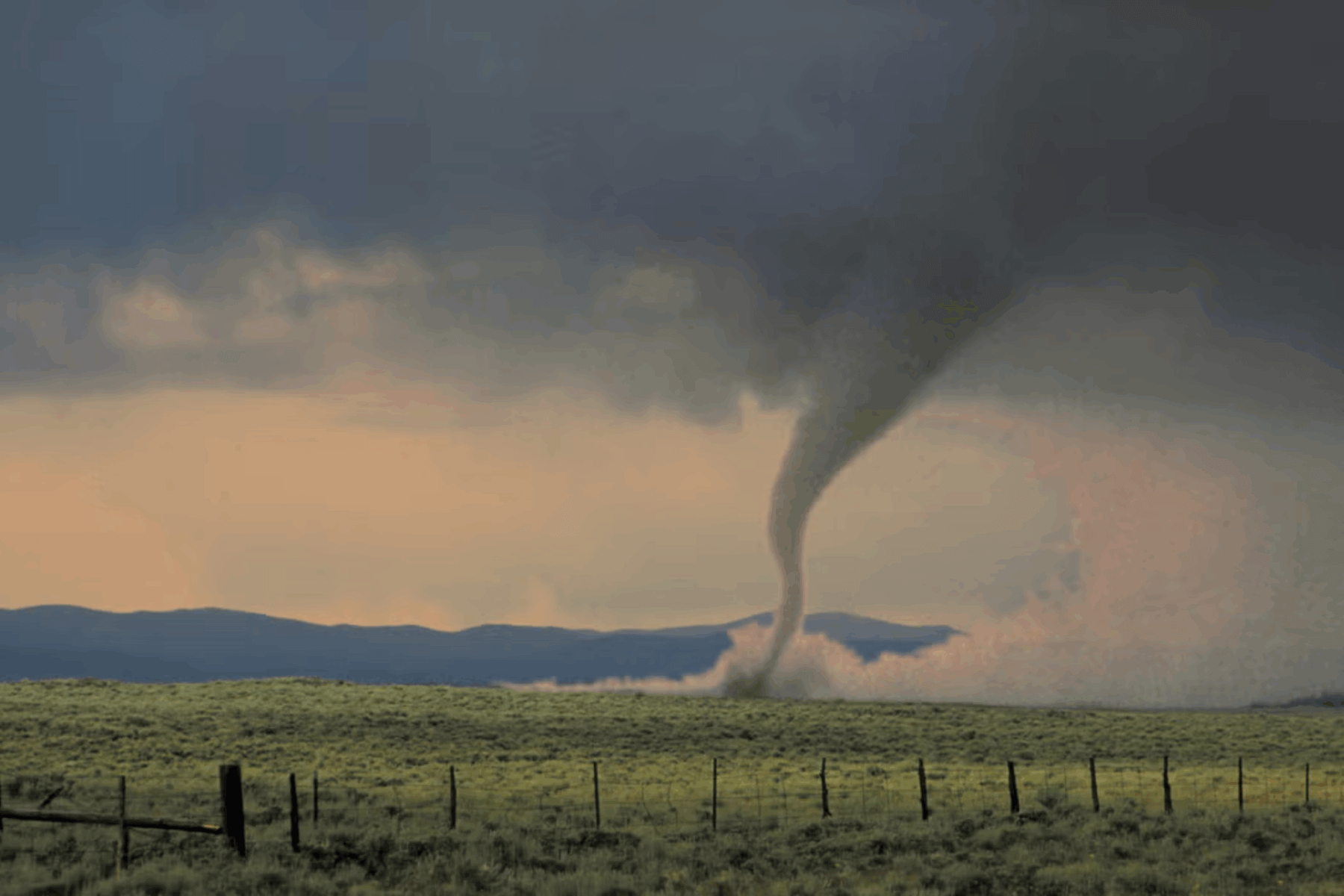
Not, mind you, the history and future of hurricanes, or the jet stream, or derechos, but of the wind: its generative and cataclysmic power; its changing nature in the Anthropocene; its embodiment in myths and folk tales; its role in global trade, transportation, and energy; and on and on, wind without end, amen.
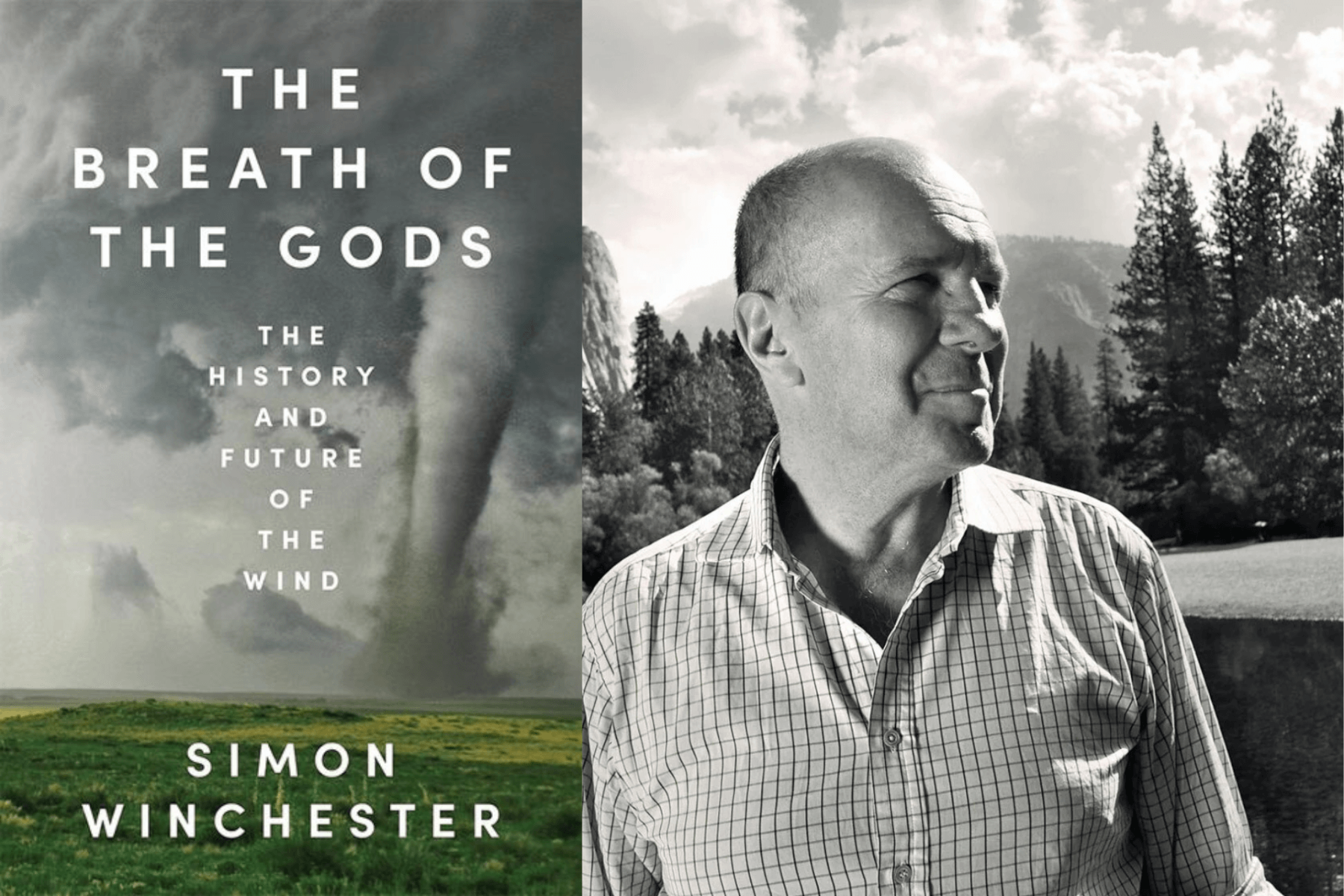
Photo by Setsuko Winchester. Courtesy of HarperCollins
Winchester guides the reader unhurriedly around the globe, stopping here and there to examine, say, the lowly, wind-driven tumbleweed, or the genius of ancient mariners, or the mind-blowing tech behind today’s wind turbines, or the firestorms generated by the savage Allied bombings of places like Tokyo and Dresden. The fact that the author manages to neatly weave together these and so many other narrative threads is a testament not only to his formidable narrative skills but to an undimmed sense of wonder.
Wonder, of course, is a state of mind usually associated with the young. And yet, in Winchester’s case, as he navigates his ninth decade on the planet, his sensibility remains essentially, unmistakably playful. It takes a certain amount of energy, after all, for a writer of any age to readily pursue what might at first seem wildly divergent lines of inquiry. Reading Breath, I often pictured Winchester inching further and further out on a rhetorical limb—arm outstretched, reaching for a metaphor or observation that would tie together some improbable series of wind-related phenomena. And always, the further out he got, the wider and more mischievous his grin. It’s hard to resist that sort of impish erudition.
Take the chapter titled “Robust and Working Winds,” for example. It begins with Winchester considering sea breezes in present-day Hawaii before jumping, at once dramatically and logically, to the image of Benjamin Franklin homeward bound from London aboard a ship that “bounced around in variable winds and breezes” that seemed bent on “pinioning the vessel in English waters, as if unwilling to let her go.”
These days, it is sometimes easy to forget what it must have been like to be out in the open ocean and at the mercy of the winds…. [Centuries ago], large cargo vessels and warships were powered by human rowers—triremes and quinqueremes [warships rowed by oarsmen arranged in groups of three or five] and then the galleys that were in military service until the Battle of Lepanto in 1571 finally saw them off—that did offer a degree of maneuverability that sailing ships were to lack. You could, for instance, move in reverse in a galley—if you flogged the men hard enough to back their oars.
There’s a lot on offer in those few words, including some history on warfare, maritime technology and human cruelty—all of it in relation to the world’s winds. But in the same chapter, Winchester drops a footnote that illustrates his willingness to go down rabbit holes of his own making, as well as his refreshing tendency to speak his mind on matters that clearly get under his skin.
“That Ben Franklin appears here for the second time [in this book] is no accident,” he writes.
His polymathic abilities and range of interests were such that his presence would be welcome in books about numismatics, typography, philosophy, physics, political discourse, diplomacy, publishing, Latin, and a score of other conceits. He was a far more clever and intellectually well-rounded figure than Thomas Jefferson, and was in later life a keen abolitionist, while Jefferson, even when president, owned hundreds of enslaved men and women.
Does bluntly contrasting the moral character of two Founding Fathers have anything, ultimately, to do with the “breath of the gods”? Of course not. Does it make for an entertaining, thought-provoking read? Yes, it does.
While Winchester’s own polymathic abilities might not be quite Franklinian—whose are?—they’re not far off, and in every one of the book’s tightly connected chapters, those abilities are on tireless display.
Case in point: How many of us are aware of the four-decade phenomenon with the excellent name, Global Terrestrial Stilling, that had meteorologists and others scratching their heads from the 1970s through the 2010s, when the average speeds of our planet’s winds dropped more than two percent per decade? Not only does Winchester offer a compelling sketch of the stilling and its possible causes and connections to climate change, but he also uses it as a jumping-off point for a discussion of the effect of weather—of wind—on humans throughout recorded history.
[Wind] remained both ever-present and enigmatic: a power, perhaps a deity, but unknowable because unseeable.
After a brief summation of the civilizations that matured with astonishing speed millennia ago in what we now know as the Fertile Crescent, Winchester presents us with “one plain and unassailable fact: five thousand years ago, five words were invented from scratch.”
One of them, lil, denoted the bewildering idea of wind as an entity. Four others were born to signify the gods of the directions along which Mesopotamian air moves. The appearance of these five lexical inventions marks the first time that humankind ever attached words to this invisible and magical mystery.
Was it really “the first time” that anyone, anywhere, named or described the cardinal winds? Maybe. Maybe not. There are likely more than a few anthropologists or linguists who would beg to differ.
What’s certain is that homo sapiens (and our highly evolved next of kin, Neanderthals and Denisovans, who very likely communicated in some form of spoken, long-extinct language) had known of the wind’s effects—sandstorms, waves on the sea, treetops thrashing in a gale—for thousands of generations. But in Winchester’s telling, until the naming of the wind, it remained both ever-present and enigmatic: a power, perhaps a deity, but unknowable because unseeable.
“It was,” Winchester claims, “if the metaphor may be mixed, a watershed moment.”
For once it had been achieved in the deserts of West Asia, so the very notion of wind as a linguistically definable entity took off everywhere. Wind words proliferated and spread with untamed promiscuity, as did wind gods, all around the planet.
At times, to be sure, Winchester’s evident eagerness to be all things to all readers—the celebrated author of deeply researched best-sellers who also knows his pop culture lore cold—does him no favors. For example, he illustrates two points, in separate chapters, with references to the 1951 British sci-fi novel, The Day of the Triffids. (Triffids, for those unfamiliar with the tale, are huge, carnivorous plants that can walk. It’s a scary story, well-told.) Surely, one triffid would do?
But enough quibbling. The Breath of the Gods is marvelous: a wide-ranging, good-natured biography, in a sense, of a presence that has touched every human culture that has ever existed, in ways great and small.
“A world without wind is just too dreadful to contemplate,” Winchester writes near the end of the book. After spending so much quality time in these pages with this most generous of authors, it’s hard to imagine that any reader would disagree.
Help us sustain independent journalism...
Our team is working hard every day to bring you compelling, carefully-crafted pieces that shed light on the pressing issues of our time. We rely on caring supporters like you to help us sustain our mission. Your support ensures that we can continue to provide deeply-reported, independent, ad-free journalism without fear, favor or pandering. Support us today and make a lasting investment in the future.

RELATED STORIES
Award Winning



Today’s environmental and social justice challenges are unprecedented, and require an unprecedented collective effort.


Stay updated on our latest features, events and more. Subscribe to our Note From the Nest newsletter!
