
Handfuls of Hope
Artist Naomi White’s new solo show, Handful of Earth and Sky, is inspired by time spent immersed in the archives of seminal science fiction writer Octavia E. Butler, housed at the Huntington Library in Pasadena — Butler’s hometown.
“My engagement with her archive at the Huntington, along with reading and working with other writers, thinkers and artists, deepened this connection,” White says in her artist statement to support the show. “There, I examined her vast collection of newspaper clippings tracing how the media distorted the climate crisis. Her clippings reveal not only the complicity of the media with politicians and corporations, but also the erasure of marginalized communities — those most vulnerable to environmental disaster.”
Handful of Earth and Sky, which shows at The Art Gallery at Glendale Community College through November 17, features mid- to large-size collages, all capturing White’s efforts to continue on canvas the conversations that started with Butler on the page. It strings together three of her past collage projects that draw upon Butler’s prescience in her science fiction writing and her ingenuity in imagining a way through ecological and societal collapse.
White’s work also expands beyond the imaginings of Butler and confronts the historical impact of the camera as a medium that can reveal both critical moments of erasure and glimpses into the future. Her collage work represents a thorough contemplation of the various ways to visually conceptualize history through the lens of photography by examining its shapes, forms and sources.
If we visualized historical moments as a one-dimensional map, what would emerge in the spaces left barren by the buried and forgotten stories of people living on the margins? These are questions that continue to probe White’s collage series. Through a gradual integration of sourcing vintage Life magazine clippings alongside her own photographs of rocks and natural landscapes in Wyoming, to an inclusion of archival photographs from various sources, Handful of Earth and Sky presents an accumulation of work dedicated to carving out a thoughtful interrogation of the past, the chaotic present and a new way of visualizing our future.
I first spoke with White last summer before the debut of her group show, Landscapes of Illusions and Possibilities: Maps, Materials, and the Lens. A few months later, intense wildfires devastated several neighborhoods in Los Angeles County. The Palisades and Eaton reduced much of the Pacific Palisades and Altadena to ashes. As with author Lynell George’s essential 2020 book A Handful of Earth, A Handful of Sky, White’s artistic interest in Octavia E. Butler, a Pasadena native, reenters Butler’s most popular fiction, such as the Parable series, into the changing climate and political environments we unfortunately find ourselves in.
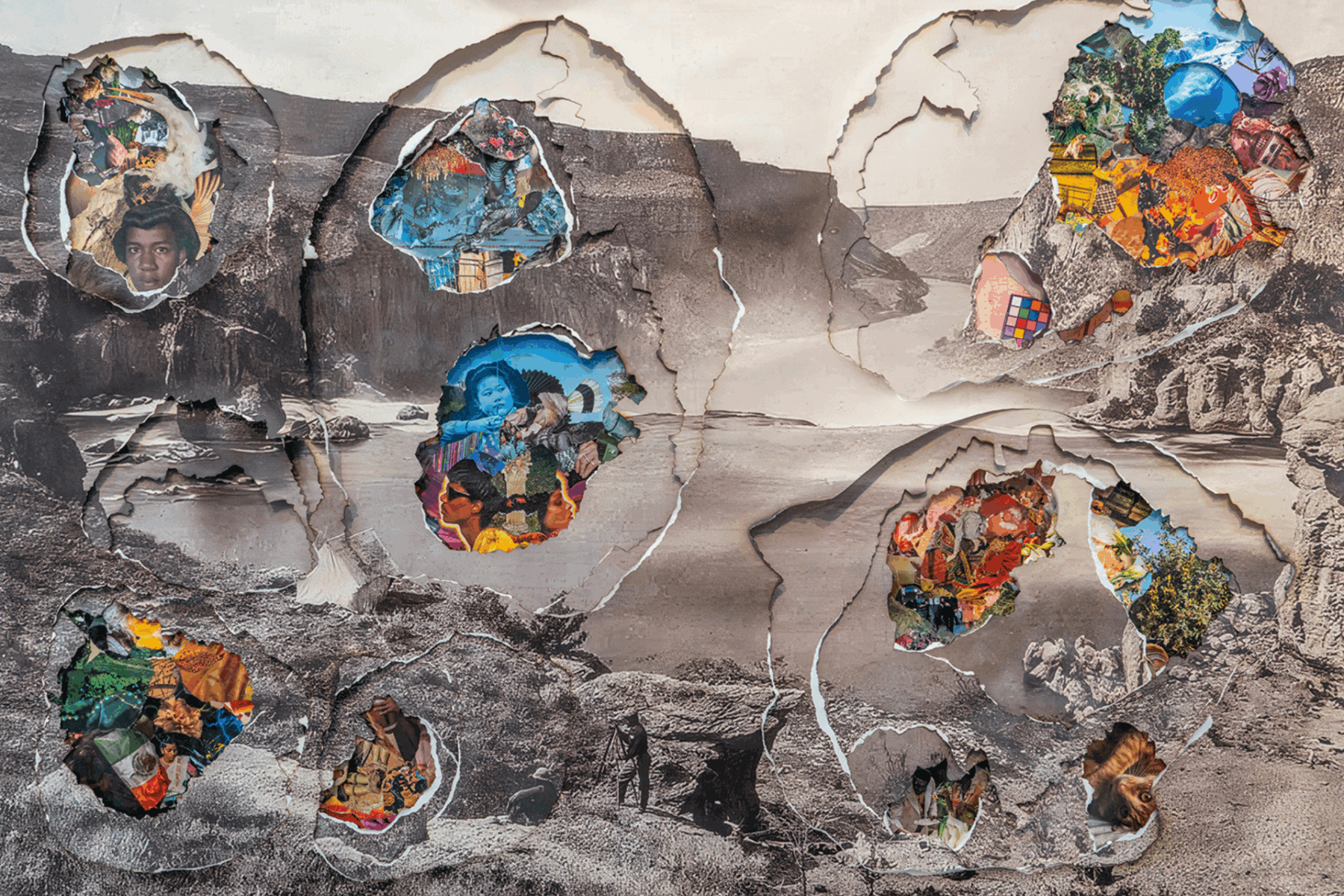
During my visit to White’s studio last summer, the bones of Time Enters The Landscape (Landscapes of Illusions and Possibilities), one of the new large-scale collage pieces featured in Handfuls of Earth and Sky, were still developing. Time Enters has since undergone the addition of several new layers of found, original and archival pigment prints. The piece has developed into one of the highlights of White’s new solo show, capturing the inner workings of White’s reckoning with a fragmented past. Clippings of a Butler portrait are set in the upper-left corner of the canvas behind singed layers of collaged images of wildlife and textures found in nature. The images White chose beneath the layers of fire and ash illustrate her ongoing artistic commitment to uncovering a regenerative path forward.
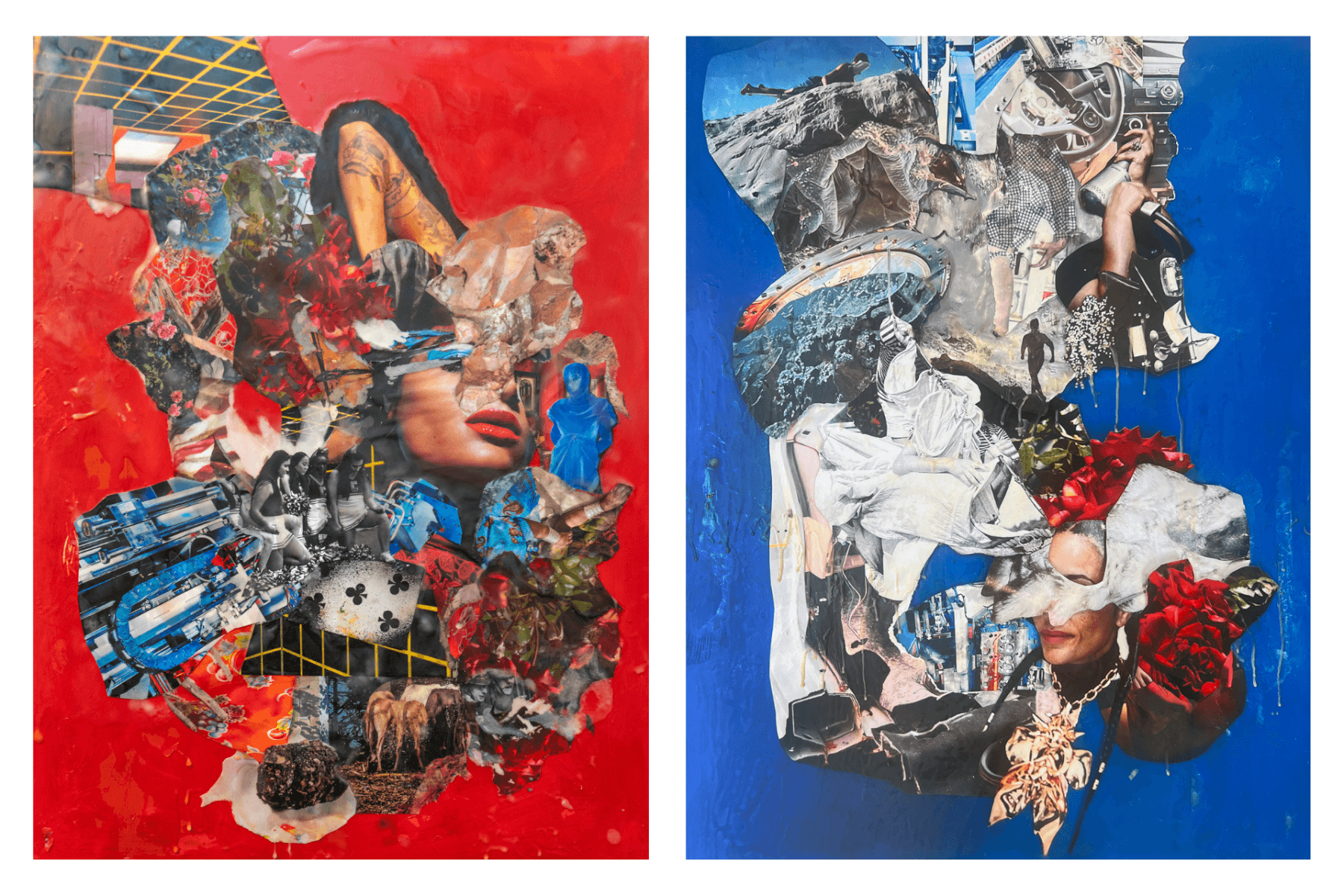
(Left) Red Disruption, 30×40, 2025. (Right) Blue Malfunction, 30×40, 2025. Courtesy of Naomi White
White’s new show gave us an opportunity to visit again and discuss Butler in her ever-expanding context. While showing me Red Disruptions (States of Refusal, #2), White pointed out a black and yellow grid that appears throughout the collage. “This is a printout from a Star Trek set. I printed out all these sets that were from Star Trek TV shows,” she explained.
White tells me that at the opening of her new show, one of the visitors pointed out the yellow Star Trek grid as sharing similarities to a smaller grid from a mural right outside the gallery. The pull of White’s collages is that they offer endless viewpoints into a reimagined way of engaging with photographs and what they ultimately represent.
Here’s our conversation, edited for clarity and concision.
***
Last summer, we met to discuss your work in the group show, Landscapes of Illusions and Possibilities: Maps, Materials and the Lens. Since then, we’ve had the Palisades and Eaton fires, Los Angeles and the world have markedly changed. Thinking about how Octavia E. Butler’s archive at The Huntington was a source of inspiration, how does your current collage work make sense of the close-to-home chaos experienced at the beginning of the year?
I had a friend who lost their home while he was photographing the wildfires in the Palisades and the intensity of that moment reminded me of Parable of the Sower. We read that, and then it happened.
When I started to burn the original images for Excavations, it was much more about, “How do climatologists get the gases out of the rock?” Like, how does this work?
Burning and tearing into my own photographs was a kind of metaphor for that extraction, but it doubled as way to bridge expanses of time as if peeling away layers. The holes act as portals to other moments in history, but also appear as wounds, addressing the violence of colonization and chattel slavery in our traumatic past. There are so many things the landscape hides.
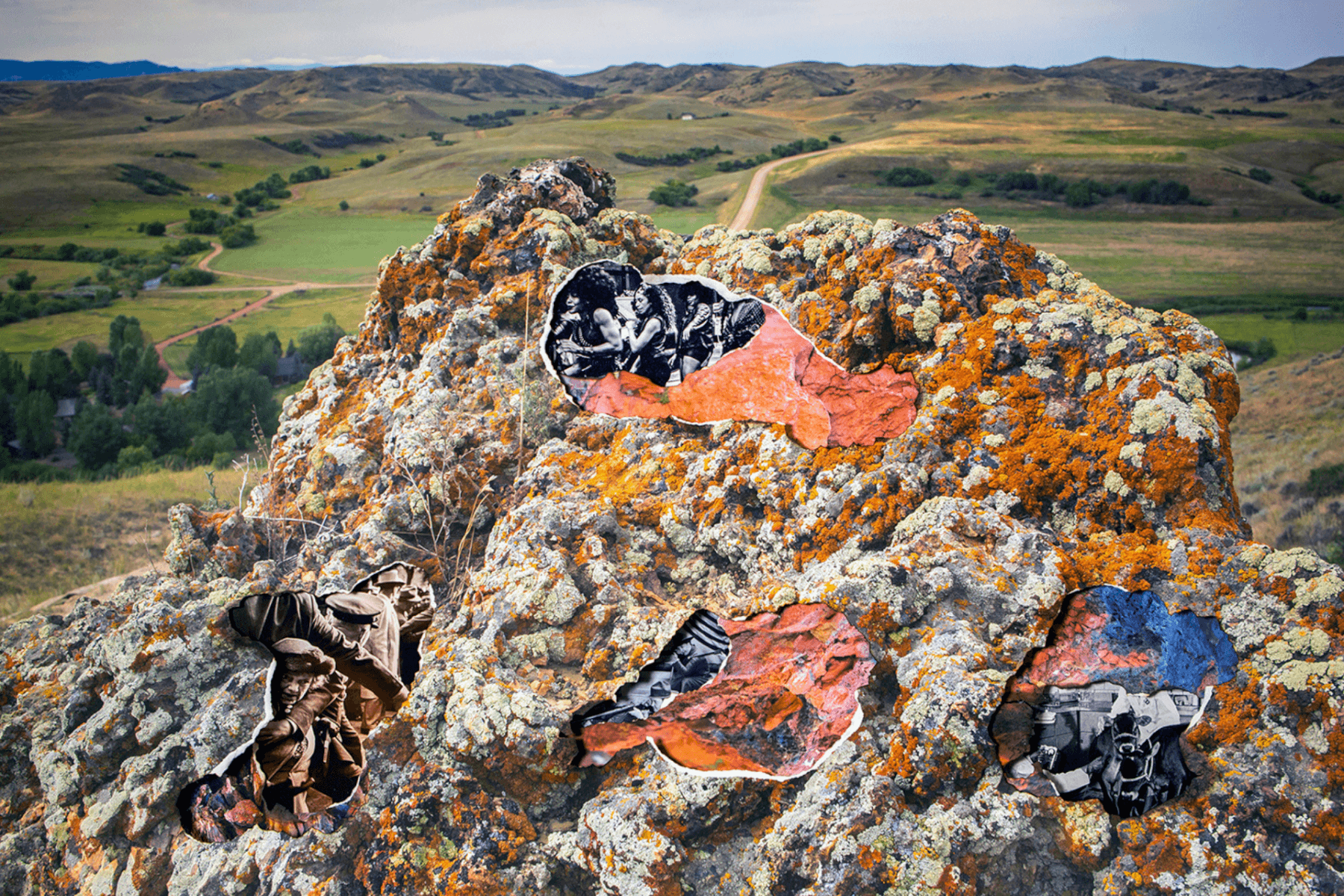
Excavation 12, 30×40, 2022. Courtesy of Naomi White
But, of course, in Parable, people are addicted to setting things on fire, and that was definitely on my mind when the fires broke out. The speed at which the fires overtook homes, mountains, trees, was so terrifying. Altadena and the Palisades, and the speed at which it happened, was so terrifying. It reminded me of Butler, the whole kind of desire for us to be prepared because things do happen fast.
We need to be ready for whatever’s going to occur. I studied martial arts for five years in New York and I remember one of my teachers saying, “It’s fine to be a pacifist, but when push comes to shove, you always want options. Are you going to be able to fight and defend yourself if you don’t study defense?”
I feel like Octavia was doing something similar, where she’s like, ”It’s not something you need to dwell on, you need to live your life, but you just need to be prepared.”
Aside from the destruction caused by the fires, the rest of the year has also been fraught with political conflict in our immediate community with mass deportations, the ongoing tragedy in Gaza and Trump’s second presidential term. How has this politically charged landscape informed the images that you are thinking about while creating visual collage work?
It shifted things for me. My collages got more chaotic and messy, and I didn’t really care about straightening them out. I allowed myself to just have a strong response. I also have students whom I feel a certain level of responsibility for — people are so scared.
Everyone’s just living in a lot of fear, which is really wreaking havoc on everyone’s mental and physical health. A lot of my time working with students has been trying to empower them and uplift them. My work has been responding to this moment through varied images collage and thinking about how I can put my unearned privilege to work. What else can I do to help people?
Thinking about my work and how it has changed, it has also loosened. There’s not been a concept except to lean into ideas of glitch and error, and the intentional stopping of the capitalist machines, and instead invest in care and community, just trying to help each other through the hard parts.
The title of your current solo show references an Octavia Butler quote found in one of her personal notebooks. Butler describes the science fiction genre as “…a handful of earth, a handful of sky, and everything around and between.” How would you describe collage art as an artistic medium that you engage with, especially in the context of your most recent work.
She said it so well. It is so open; you can use anything in collages. You can use photos, paintings, your own drawings or random materials you find. I see the materials I use as these wonderful traces. I am always looking at trash or discarded materials and wondering how I could repurpose it into collage. We have so much material all around us that is wasted so whenever possible I try to ask, what else can I do with that?
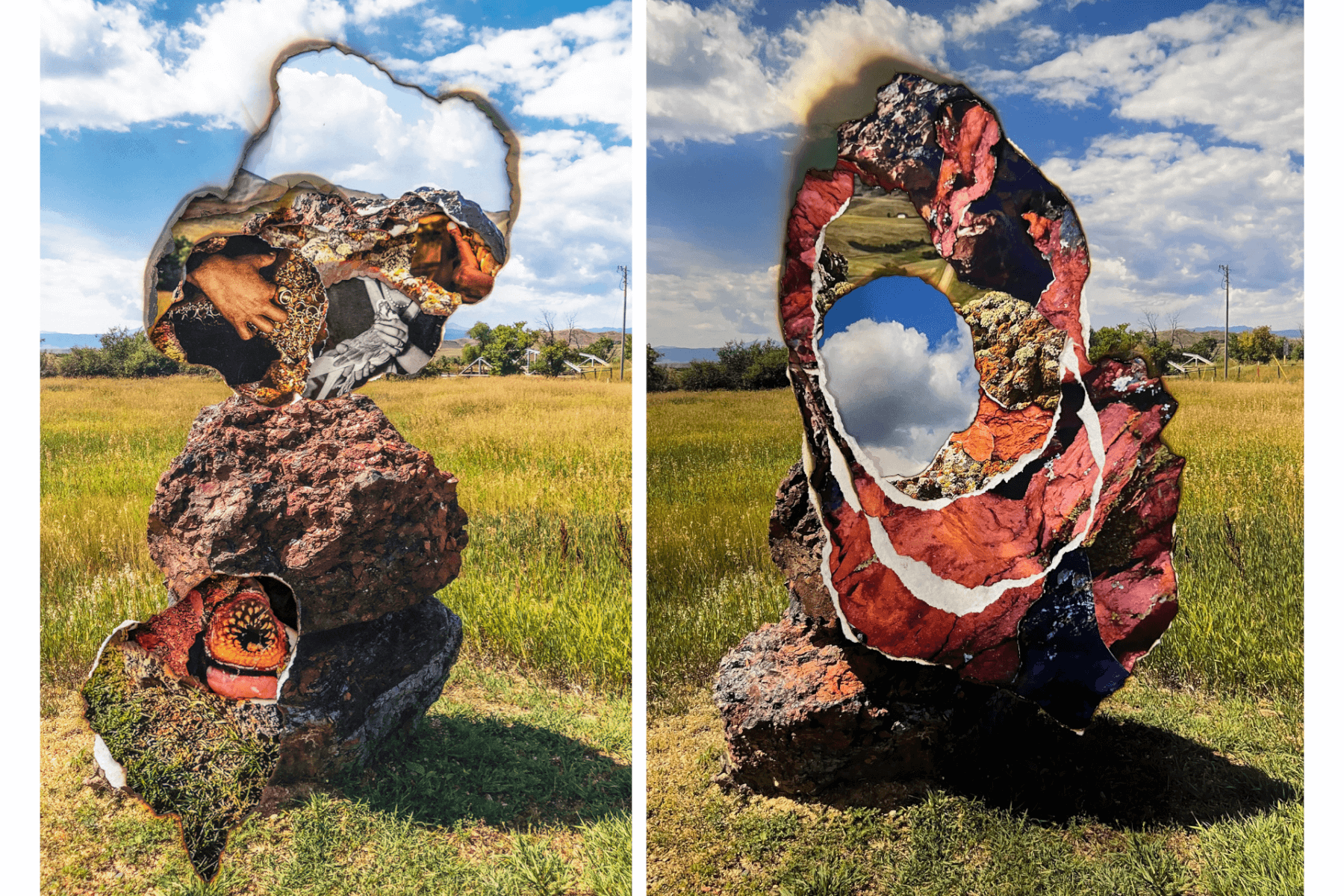
(Left) Excavations 26, 2023. (Right) Excavations 22, 2023. Courtesy of Naomi White
It has made me rethink things in different ways, which I love. From trash to beautiful things that may be expensive to tear up. The earth and the sky, handfuls of earth and sky, we’ve registered are often in these works. It offers an image to the mind that is open and uplifting, a beacon of hope. And that’s why I chose it as the community image to signal that.
I also think that we can’t have just handfuls of sky. In science fiction and in collage — maybe in art in general — you can have whatever you want. It is your expression and your fantasy to bring to life.
It has always been very important to people in general to have that liberation — if not in the real world, then at least in your work or in your mind.
The quote also suggests the marriage of two different worlds. Your own work is interested in the world of natural landscapes and the world of photographs. What continues to draw you to these places as entry points into your art?
Photographs that are archival are flipped in these works. The photographs of the rocks are images I took, and the landscape photographs inside are other people’s, and then the interiors are a mixture. It becomes bound in a critique of what photography is and what it does, how it operates and what we expect from it. That is what I’m really interested in because I love photography. I love all forms of photography, from street photography to portraiture and landscape photography. So, I’m just thinking about the harm it has caused and trying to understand, going forward, how we can mitigate harm with photography.
As you’ve continued creating these large-scale collage pieces, memory is presented as both an ecological concept and a symbol of photography throughout history. What makes a photograph most like a memory to you?
I have two MFA students who just wrote about this in their thesis projects, and they were talking about how when you take a photograph, you actually forget a lot of what actually happened because you are now dependent on that photograph standing in for the memory.
That dynamic is interesting, especially now that we check our phones to remember where you were on a certain day. It’s a complicated relationship. I think I experience the present very acutely when I know I can’t photograph it or I can’t hold all of it in a photograph.
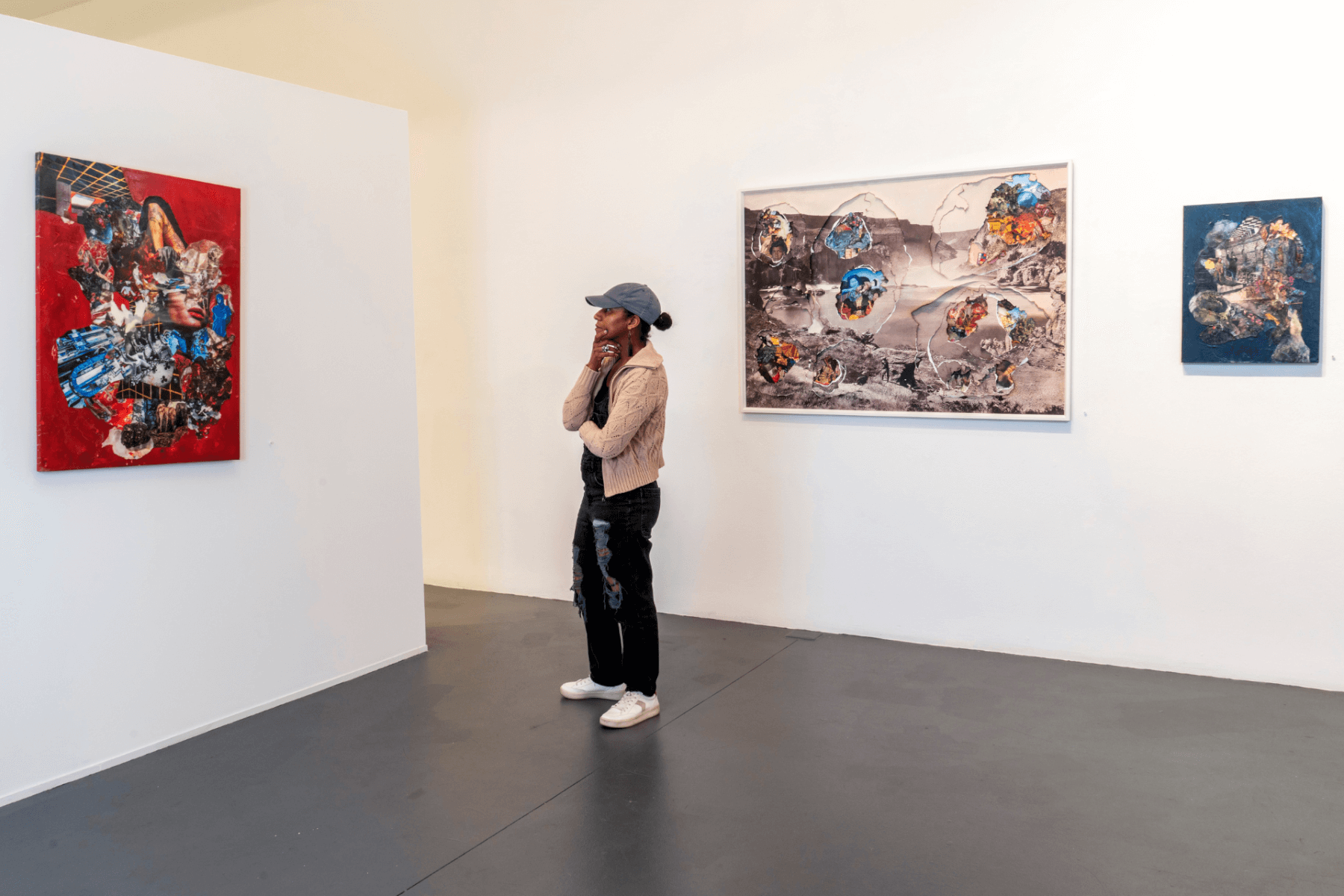
The pieces curated in White’s new show demonstrate distortion and connection — two themes that reflect and build upon Butler’s novels and notes. Courtesy of Glendale Community College
When I first arrived at the gallery, you showed me Time Enters The Landscape (Landscapes of Illusions and Possibilities, #6) (pictured above), and mentioned that you were trying to invoke feelings of hope. Could you describe what you were thinking about while constructing this piece?
Early humans evolved the ability to see color, initially distinguishing only between red and green to identify edible berries and food. Over time, as our vision adapted and expanded to detect a wider spectrum of colors, we developed the ability to perceive all colors effortlessly. Similarly, our capacity to envision worlds beyond corporate greed and human suffering is evolving. Just as our perception of color has grown more refined, we can also hone our ability to imagine and work towards a more just and equitable future taking shape.
I was thinking about the color wheel, and I kept trying to evoke that in that piece because it was sort of like that struggle. The idea of hope was implanted in the question of how to go forward without dissolving into despair. We have to stay hopeful for the children. For everyone, as James Baldwin says.
When I was wrestling with these ideas, I was looking at photographs of things that gave me hope or places that I felt were healing — like the Kern River, my cats, my son, flowers, beds, and the oak trees swaying in my backyard.
These are mine but they are also relatable by many and my hope is that they allow viewers to wander through the work and make their own connections.
Help us sustain independent journalism...
Our team is working hard every day to bring you compelling, carefully-crafted pieces that shed light on the pressing issues of our time. We rely on caring supporters like you to help us sustain our mission. Your support ensures that we can continue to provide deeply-reported, independent, ad-free journalism without fear, favor or pandering. Support us today and make a lasting investment in the future.

RELATED STORIES

Award Winning


Today’s environmental and social justice challenges are unprecedented, and require an unprecedented collective effort.


Stay updated on our latest features, events and more. Subscribe to our Note From the Nest newsletter!
