
The Inferno
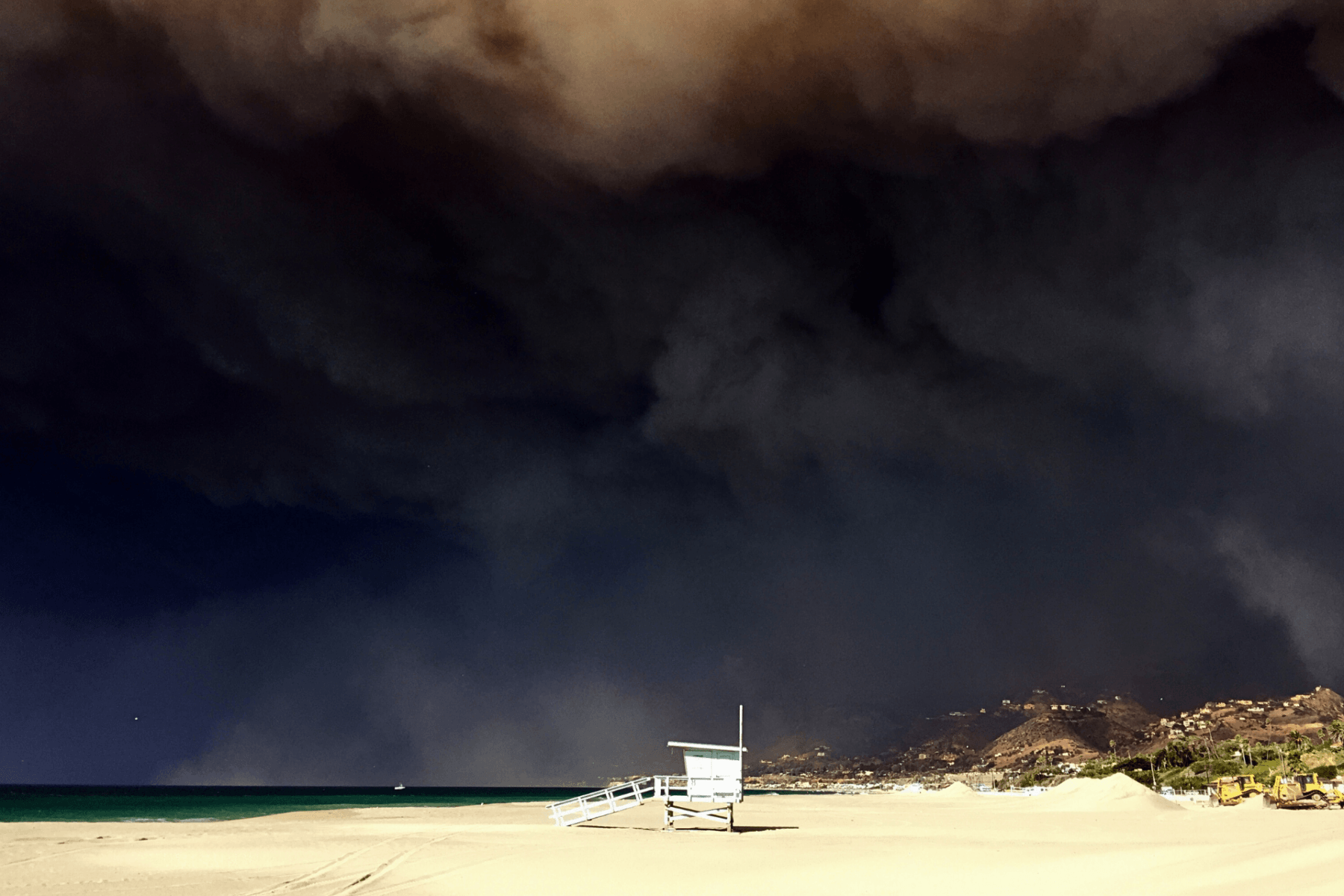
Like the rest of my Point Dume neighbors, I awake on Friday, November 9, 2018, to a text alert: “Mandatory evacuation for the entire city of Malibu.”
I yawn at the message and take my sweet time. I grew up in Los Angeles, which is to say with wildfires. They’re etched into my nervous system right alongside earthquakes, rattlesnakes, shiny black SUVs and red velvet ropes that I was typically on the wrong side of. The text alert is nothing new, so I make coffee, check emails, log on to Surfline.com to see what the waves are doing.
I grab my car keys, wallet, phone, laptop, writing stuff, a change of clothes and get in my car. By the time I hit PCH, traffic is at a standstill. It takes me over an hour to move a mile and a half. Fuck this, I think, and circle back to my house, grab my board and wetsuit, and head to Zuma Beach, where I’ve been surfing since the late 1970s.
Dropping down Birdview, I see what looks like a giant tidal wave of black smoke rising above the beach and the mountains, casting in comical miniature Trancas Canyon and the big luxury homes that speckle the hillside. Orange flames burn at the crest. They’re moving westward — towards exclusive Broad Beach. “Brangelina” used to live there; I believe Neil Young still does.
Zuma is not the usual scene of families enjoying a fun day at the beach, but a meeting point for those who haven’t yet fled: the wildfire-hardened, dyed-in-the-wool Malibuites, many of whom have brought their animals — dogs, cats, rabbits and more. A group of lifeguard stations has become a makeshift stable, with horses, ponies, goats, a llama and some kind of donkey-zebra hybrid, adding a dash of Fellini to this Noah’s Ark-like scene. There’s a thick vibe of fear and bewilderment: just how serious is this fire, and will it cross PCH?
Alongside the restrooms behind Tower 7 (where Lisa K’s braces still had flecks of Nacho Cheese Doritos stuck in them when we made out in ninth grade), I see a silver Hummer with a blonde woman standing next to it. She’s on her phone. I weirdly flashback to the time I pulled up alongside a Hummer back when they were still a novelty, Arnold Schwarzenegger at the wheel, chomping smugly on a cigar.
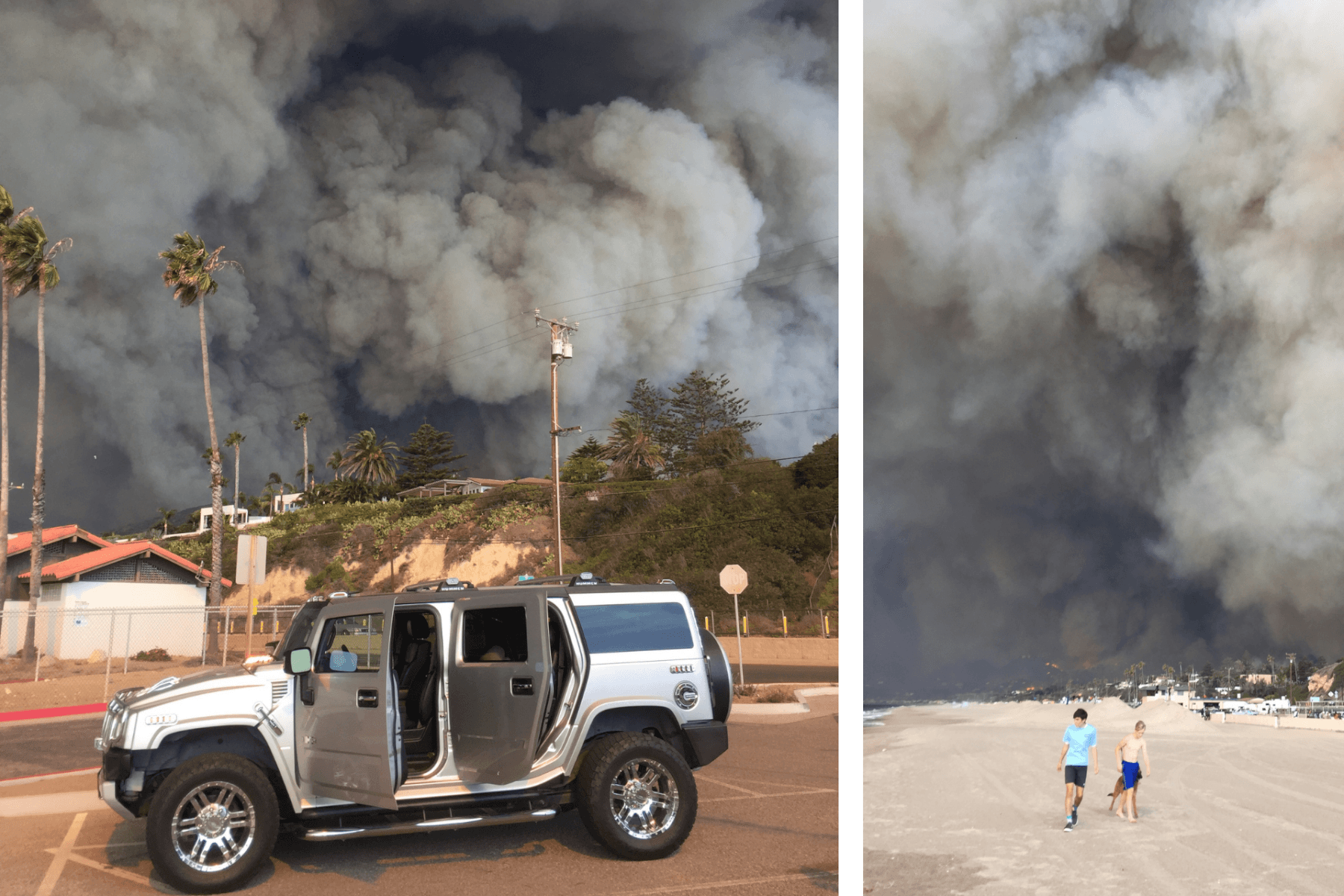
Zuma Beach. Photo by Jamie Brisick
Wispy orange flames and monstrous black-grey smoke rise behind the woman, eating up the hillside shrubbery. Clad in pink sweats and Ugg boots, hair perfectly mussed, heavy makeup, possibly fake boobs, the woman and her Hummer form a surreal juxtaposition of flimsy status symbols against force majeure.
Fire on the hillside, pandemonium in the parking lot, a horse whinnying, the whine of sirens in the distance, I run for the water the way I have since early adolescence. I’m not consciously aping the famous “surf or fight” scene in Apocalypse Now — when Lance B. Johnson paddles out to playful Vietnamese waves amid explosions and gunfire and swooping helicopters — but it’s in the back of my mind somewhere.
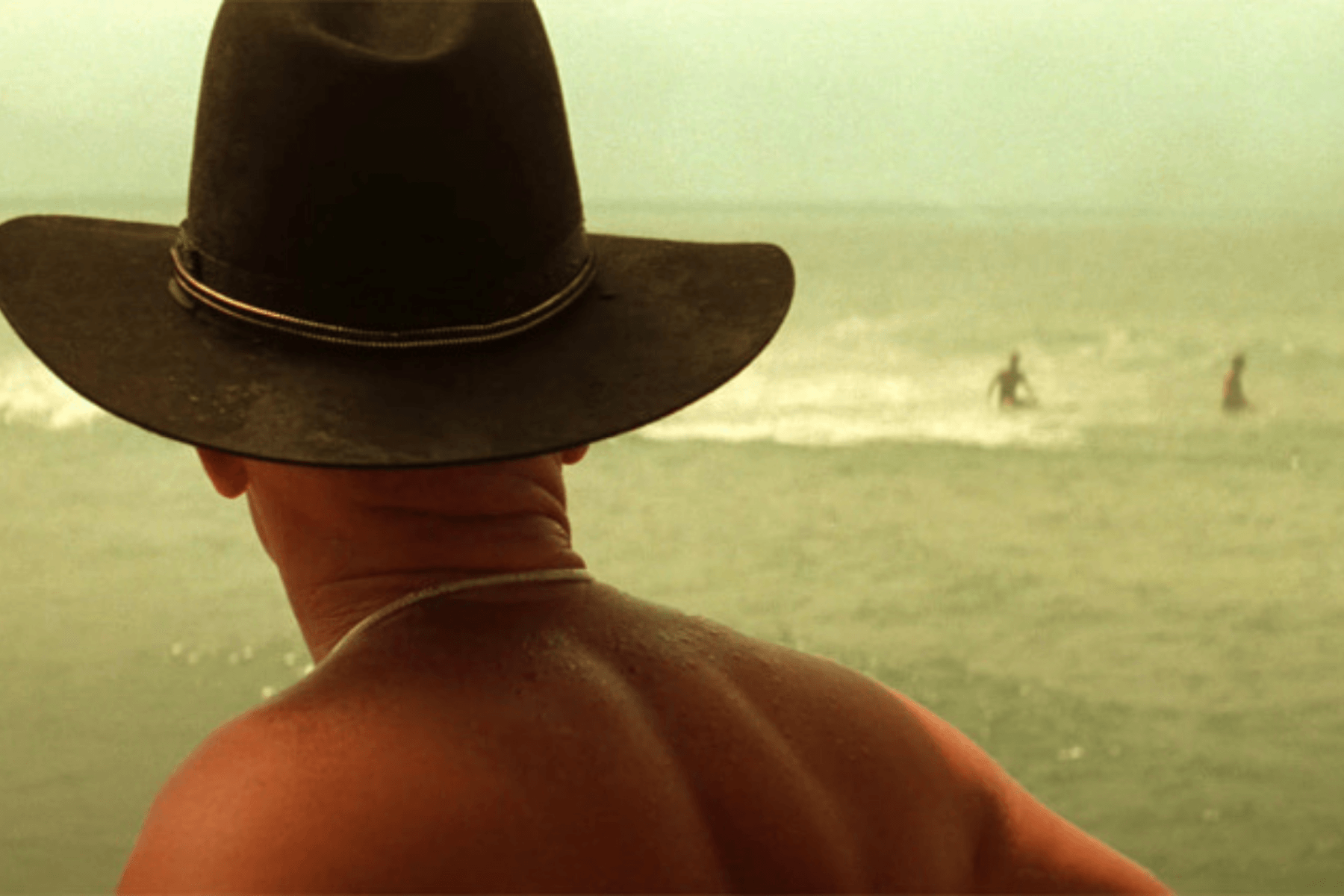
Courtesy of Zoetrope Studios and Lionsgate
The wind has sculpted the sand into Sahara-like micro-dunes. The water’s refreshingly cold. The first dunk slaps me into hyper-alertness. The carpet of sapphire ocean is speckled with orange iridescence. The dazzle — that stripe reflected from the sun — has an eerie tinge of brown, less a color than an italicized proclamation: Nature is breaking from its wondrous norms today.
I do what we surfers do: I try to get tubed. The waves are small and closed out, so I elect to bodysurf rather than board-surf, which makes it easier to fit into those fleeting cubbyholes. I duck into several, one a heaving left that gives me an indelible glimpse: the spiraling tube curling over my head, and out the eye of it, in the distant background, flames creeping down to Broad Beach, many luxury homes in its path.
I flop around for about 30 minutes. When I come in, the silver Hummer’s still there, and the blonde woman’s still on her phone. Changing out of my wetsuit, the gusts of Santa Ana wind carry smoky heat. I cough, and notice that some people are wearing gas masks. I exit the parking lot and drive slowly past Zuma Drainpipe, where I’d put in thousands of surf hours in high school. I weave up Birdview, turn left on Bob Dylan’s street, putter past Bob’s house, look in, see what I always see: no Bob Dylan. The sky’s a hellscape of grey and black smoke. Ashes land on my windshield and collect on the wiper blades. Further down the block, an elderly woman stands at the edge of her driveway waving for me to stop. I pull up alongside her, roll down the window.
“My gate won’t open,” she says. “I packed up all my things to evacuate, but I can’t get out.” She aims her clicker at the wooden gate and presses. Nothing. “They must have cut off the power. They do that during fires.”
“Let’s have a look,” I say, and park, and get out.
She appears to be in her eighties, big-boned, round face and a strong gaze.
“How long have you lived in Point Dume?” I ask.
“Moved here in seventy-three.”
“God, we’re lucky.”
“Sure are.”
She leads me up the footpath and onto the driveway. The gate slides to the left on a roller. There’s a vertical beam down the center. I get a firm grip on it with both hands, bend my knees, and heave. It budges just a little. I heave again and it budges a little more. After about six or seven heaves, I manage to get it open.
“You’re a saint,” says the woman. “I couldn’t have done that on my own.”
She hops into her SUV, drives to the other side of the gate, parks and steps out. From the front lawn, she grabs a cardboard sign that she’d made: POOL IN THE BACKYARD. HELP YOURSELF!
“For the firemen,” she says, and leans it against her mailbox.
She thanks me for my help and shakes my hand. “Where do you live?” she asks.
“Just over there on Dume Drive.”
“Aren’t you going to evacuate?”
“Not sure.”
She smiles. “We never used to evacuate. But my husband died a year ago, and I’m not about to stay here on my own. I mean, look at that.” She points at the mountains directly behind us. A line of flames throws black smoke into the sky.
“Not good,” I say.
She wishes me luck. We say goodbye.
I drive to the end of Bluewater, turn left onto Dume Drive, and the street’s empty. I roll right past my house, almost forget it’s there. I could so easily stop, fill my car with valuables, but I don’t. My attention is consumed by the smoky sky. It’s turning blacker, greyer. Flames creep down the hills above Kanan Road.
“We never used to evacuate. But my husband died a year ago, and I’m not about to stay here on my own.”
I turn right onto Heathercliff and right again onto PCH. A siren wails, growing louder. A fire truck flies past, and then a second one behind it. I turn right onto Portshead, hoping to get a better view of the flames. Up ahead is a cluster of cars I recognize from surfing, and a group of guys gathered in the adjacent field. I park next to a dusty white pickup with a longboard poking out the back. There’s a blue Prius with a perfect wave ironically airbrushed on the hood.
I get out and follow the dirt trail up to where they stand. I know their faces and their surf styles, but not their names. The swarthy guy’s a goofy foot. The dreadlocked guy rides a red longboard. There’s little eye contact. We’re focused on the burning hillside less than a mile away. To the north, a plane spills pink fire retardant on the flames.
“Unless the wind switches, we’re fucked,” says one of the guys.
“Wind ain’t gonna switch, bro,” says another.
“You don’t know that.”
The dreadlocked guy turns to me. “Where you coming from?”
“Zuma,” I say.
“Heard the high school’s burning.”
“It looked like it. That whole neighborhood up Morning View was on fire.”
“Sodom and fucken Gomorrah.”
“Trancas is toast, and all those homes at the top of Encinal and Decker.”
“Neil Young lives up there.”
“Hope he grabbed his guitars.”
“Is it just me, or does that look like an asshole?” says one of the guys, pointing at the swirling smoke cloud above us. It sucks into some kind of whirlpool effect, grey on the edges, black at the center.
There are chuckles.
“That’s an asshole, alright.”
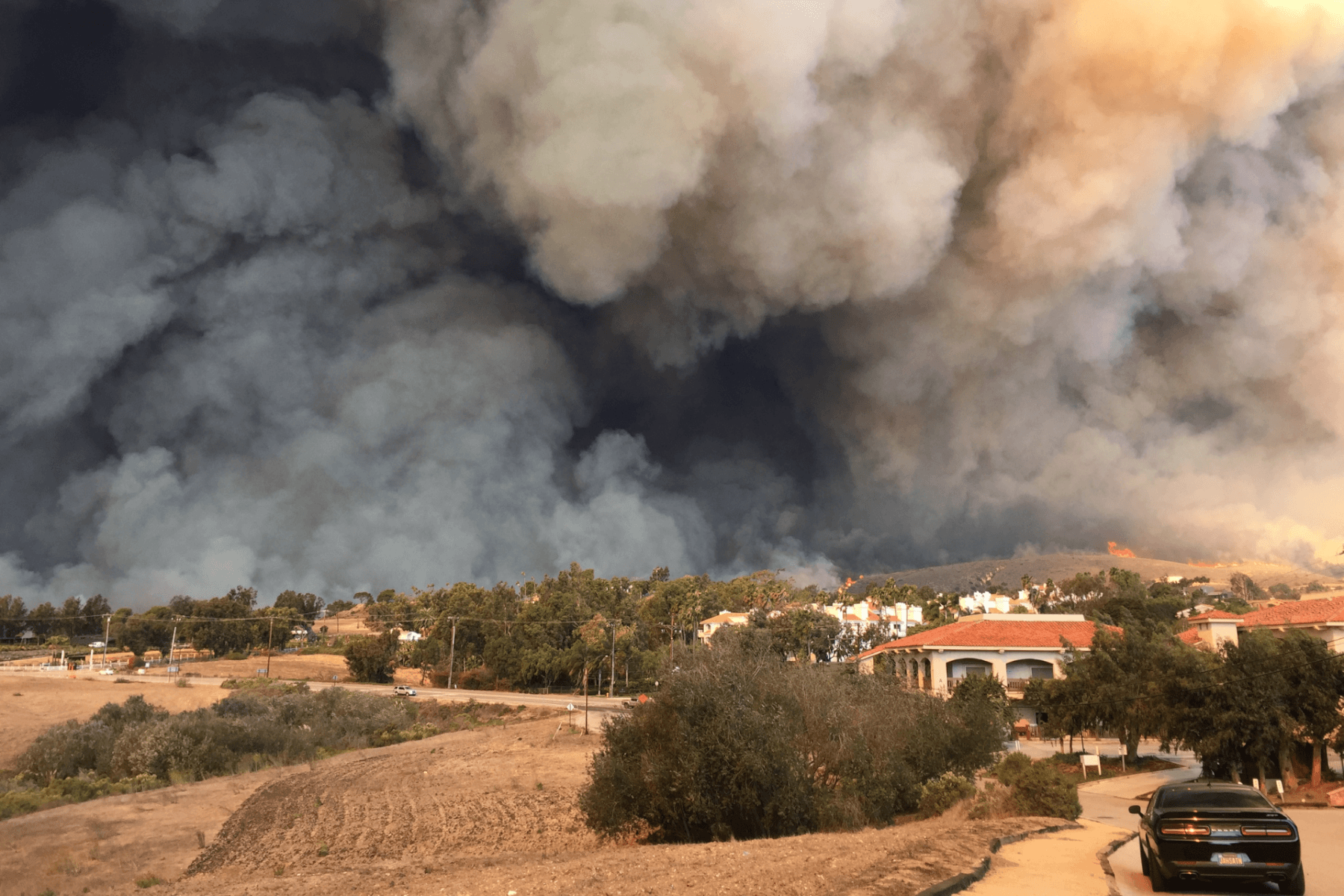
Portshead Road in Malibu, directly off the Pacific Coast Highway. Photo by Jamie Brisick
The dreadlocked guy goes to his truck and returns with a six-pack of Coors Light. The asshole whirls and whirls until it seems to turn itself inside out. Then it’s gone, subsumed by the chinchilla smoke. It looks soft and pillowy. Like something you could lay your head against. Ashes collect on my sunglasses. The wind feels thick and hot.
It’s definitely time to evacuate. I get in my car and head south on PCH. Traffic is still insane. Not because half of Malibu is trying to evacuate (that has already happened), but because Cal Trans has closed all the usual exit points. It takes me over three hours just to get to Santa Monica.
By this point, I’m in bad need of a drink. I go to The Talpa, a family-run Mexican place on Pico. I park myself at the bar and sip margaritas and nervously munch chips and salsa, my eyes glued to the TV. KTLA shows footage of the day’s damage. Hundreds of homes have burned in Agoura Hills, Bell Canyon, Oak Park, Malibu Lake, Malibu. And the fire isn’t even close to contained.
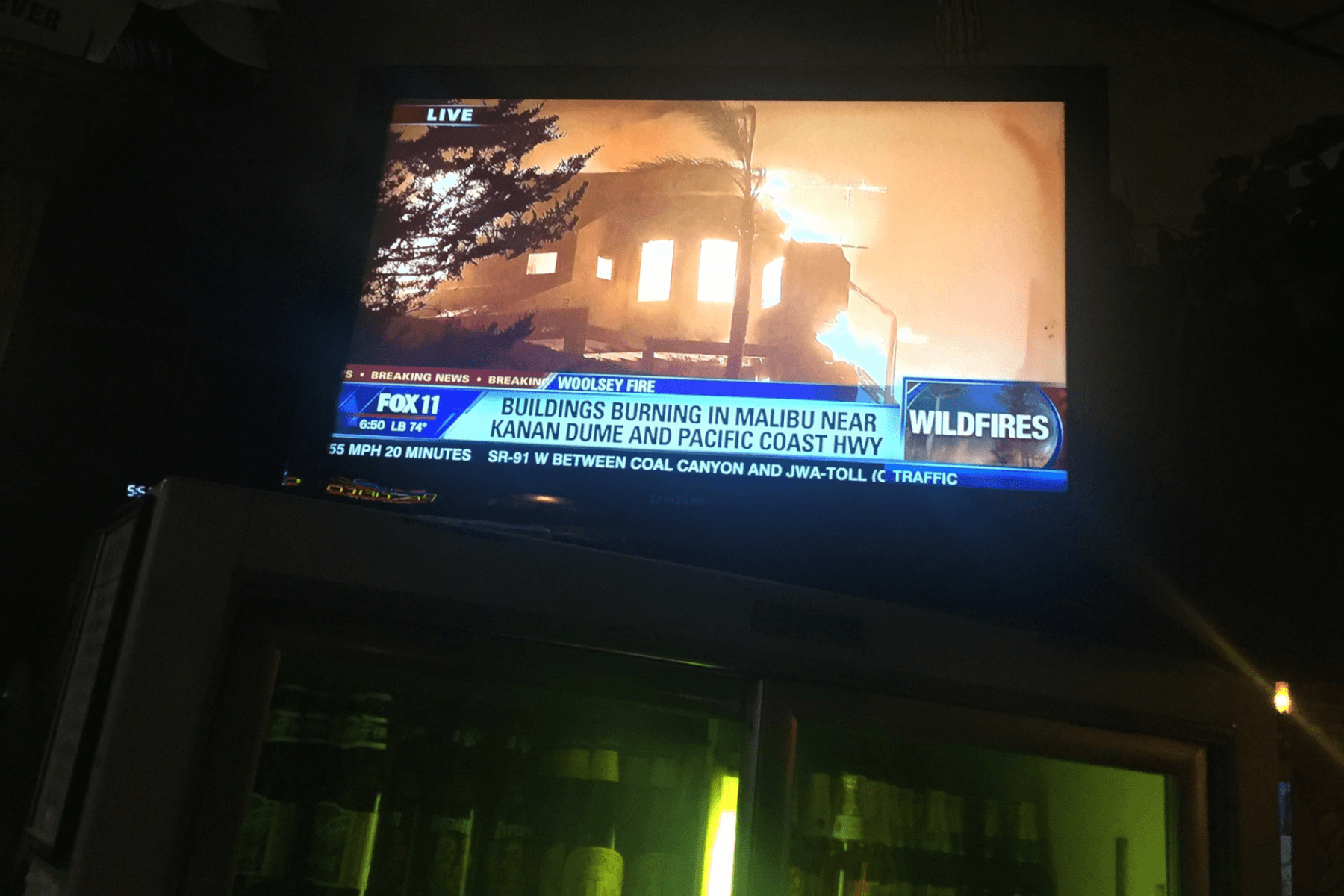
The Talpa. Photo by Jamie Brisick
I drink three margaritas. Possibly a fourth. I fantasize about my waitress taking me home for the night. She asks if I have a ride home and offers to call me a taxi. “I’ll be okay,” I say. I crash in the back of my station wagon, wet wetsuit at my feet, rolled-up beach towel for a pillow.
The next afternoon, I’m watching local news with my friend Vava in his Venice Beach studio. They show footage of a firefighter blasting water at a burning bedroom. “That looks like your place,” says Vava. My phone pings. It’s my roommate: “Is that our place?”
It is, and it feels like a coup de grâce for a chapter in my life that had my nightstand stacked with titles such as Radical Acceptance, When Things Fall Apart, Grief is the Thing with Feathers, A Grief Observed, along with the gummies, magnesium, melatonin and Xanax.
Several days later, a longtime friend would call to ask how I made out. After bringing him up to speed, he said, “Well, you’re a relatively young widower, and now you’ve lost your home in a fire. You always wanted to be a writer, and a writer needs material, so…”
***
The 2018 Woolsey Fire burned nearly 100,000 acres, destroyed 1,643 structures, prompted the evacuation of more than 295,000 people and killed three. It ignited on November 8 and was not fully contained until November 21. It came just in time for the holidays. Just in time to say yes to every social festivity, to bury myself in wine and people, to make a joke when friends and acquaintances offer their condolences. “I became a Buddhist by default” was my usual response.
Still is. My logic: I’d spent the last five years putting myself back together since my wife died in a cycling accident. I’d done therapy, ayahuasca, tai chi, yoga, TM, the Hoffman Process, read through the entire Pema Chodron catalogue, etc., and I couldn’t afford to make losing my worldly possessions in the fire some huge tragedy. I concocted my little story and lived in it. You people are so distraught over the loss of your big houses and big cars, you have no idea. And it worked. Some self-preservation mechanism (one I couldn’t locate in my twenties) kept me from mentally itemizing all that I’d lost in the fire. The letters from my brother Kevin, who died in 1987; the photos of Gisela during Carnival in Rio; Dad’s hand-me-down clothes (he’d died a few months earlier); the painting from Kim; the photograph from Vava; the signed book from Raymond—I kept them all at arm’s length. I didn’t go there. Not until years later. And only piecemeal, never in one eviscerating gulp.
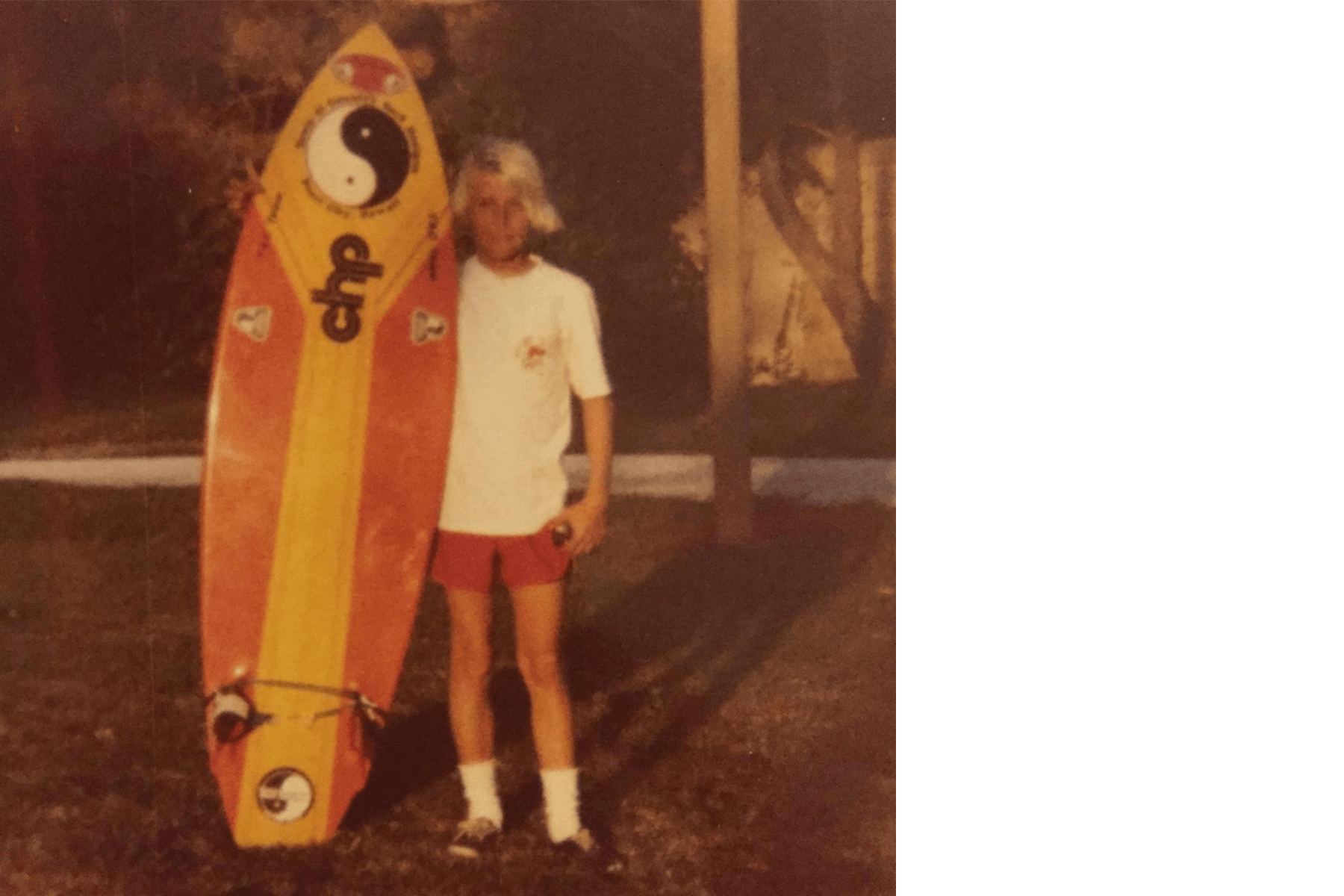
Brisick family home. Courtesy of Jamie Brisick
There was a photo my father shot of me in the backyard of our family home. I’m holding my new Town and Country twin fin, bought secondhand from Randall Kim, a Hawaiian pro surfer who’d ridden the board around the world. The photo carried memory, finger smudges, Dad’s DNA, vestiges of a chicken dinner eaten in 1979. That board was a talisman, a magic carpet. It set me on a path. And, of course, so did Dad. Thankfully, I’d scanned the pic.
***
Woolsey wasn’t my first big wildfire. The first was in the mid-1970s, near our home in Westlake Village, then just a new housing development, saplings, lots of those terraced lots that were perfect for BMXing. My brothers and I were at school. The smell was the first thing that hit us. Acrid, like a burning Christmas tree. It grew stronger. Ashes in the wind. Sirens in the distance. The fire was now up in the hills known as Three Hump; you could see the flames. They sent us home. Fire trucks were parked on our street. Dad was up on the roof with a hose. I think Mom took us to the beach — our usual refuge. When we returned that evening, the fire had been put out — a close call, no homes lost.
[The fires] were merely the price of admission for living in these desired locales. The same way sharks were the price of admission for the great joy that is surfing.
The next morning, I went out to inspect the damage. Charred black right up the edge of our cul-de-sac. Same with the grassy park where my parents pushed my little sister on the swings. Same with the Toilet Bowl, a drainage ditch that we skated daily. Not so lucky with Three Hump, where rumor had it that if you went back far enough, you’d find a tribe of devil worshippers who sacrificed humans, ideally kids and occasionally cats. There was a cross back there, about ten-feet tall, with stuffy toys scattered around it. Now that was all burnt. Now we’d never know.
In the weeks ahead, my brothers and I got used to Mom shouting at us for tracking ashes in the house. Black smudge. It was everywhere. The hills had the look of a freshly-shaven sleeping black dog. I remember coughing between Berts in the driveway during our nightly skate sessions. And coughing in bed while falling asleep to KMET on the radio.
The fire, or really, the many fires, were not a known global warming thing (that was still years off). They were merely the price of admission for living in these desired locales. The same way sharks were the price of admission for the great joy that is surfing.
***
Skateboarding led us to surfing. That low-center-of-gravity style, the tai chi hands, the way we’d tuck low under hedges and run our fingers along the foliage — it was all surf proxy. I felt most myself in the water. It was far easier to steer the oversized board my brothers and I shared across a head-high glassy wave than to, say, express the scary, hormonally exaggerated feelings I had for Lissa F in third-period English class.
We wanted to be at the beach, but we lived in the valley, which meant driving Kanan Road, a winding, vertiginous two-lane highway through the Santa Monica Mountains. I remember being squashed under surfboards, elbows and thighs pressed against other elbows and thighs, about a half-dozen of us packed in, Mom or a friend’s mom at the wheel. And I remember all that sun-drenched wilderness out the window: the chaparral-draped slopes; the craggy, volcanic peaks; the deep, gorged ravines; the haunted-looking wild oaks.
I got good at surfing, competed, turned pro, and did the ASP World Tour for five years. During this time, my parents divorced and my oldest brother found hard drugs, struggled with addiction and overdosed in 1987. And while nowhere really felt like home during this period, the place that felt most like home was that 20-minute trek to the beach over Kanan Road. I got to know it so well I could almost drive it blindfolded. The trees hugged me. The mountaintops were my friends. I liked watching the colors change: the arid yellows of summer, the fecund greens of winter.
I worked through things on these drives. There was just so much: my parents, my brother, the unrequited crushes, the girls I was certain would be a part of my future, but who so swiftly disappeared. There was also the surf contests I imagined myself winning, and the way surfing was a kind of machete: I could express myself far better on a board than I could with words. I went inward, thought, processed and made sense of what seemed so nonsensical. I cultivated an interior life. And when I was far away from Los Angeles — and far away from myself — I could project myself there and feel comforted.
The Woolsey Fire decimated this place. It felt like a crash course in the notion of impermanence. Or like a DM from God: Not only can we burn down your home and possessions, but also those hills that have swaddled you through your toughest times. It made me wonder if I was overly sentimental, shackled to the past. It got me thinking about the very slippery construct that is identity.
The ocean, on the other hand…
***
In “Los Angeles Notebook,” Joan Didion writes:
“The Santa Ana comes from the mountain passes, blowing hot and dry and weird with local sin. You can feel it coming. You can hear it in the dry rustle of the palms. The city burning is Los Angeles’s deepest image of itself.”
In “Red Wind,” Raymond Chandler writes:
“There was a desert wind blowing that night. It was one of those hot dry Santa Anas that come down through the mountain passes and curl your hair and make your nerves jump and your skin itch. On nights like that, every booze party ends in a fight. Meek little wives feel the edge of the carving knife and study their husbands’ necks. Anything can happen.”
In “Santa Ana Winds,” the Beach Boys sing:
“In waves of elation / My part of creation / Becoming one with the boundless sea.”
Brian, Dennis, etc. knew what we surfers know: that the Santa Anas burnish the wave faces to a velvety smoothness. They blow away the haze and render the sea in a sharp, almost CGI-enhanced, relief. Surfers look forward to Santa Ana winds the way skiers look forward to powder.
I was out surfing in Venice when I first noticed the Old Topanga Fire in 1993. The waves were small and lackluster, but the gusting Santa Anas blew plumes of spray off the pitching lips, making them look bigger, dreamier. There were those wispy rainbows. When the spray rained down on your head, it felt like a thousand icy needles.
“That’s my fire. That’s nature showing off and having fun.”
Looking north, a cartoonish billow of smoke blew seaward. It quickly expanded, fattened, turned brown, grey and black. In its variety of shades, you could almost pick out what had burned, the lighter tones nature, the heavy black the man-made shit.
It was so striking, I got out of the water to take photos of it — photos I kept for 25 years, until they burned in the Woolsey Fire.
The Old Topanga Fire burned for ten days. Friends lost their homes. Bassist of the Red Hot Chili Peppers, Flea, lost his home. Janet MacPherson lost her Spanish-style home up Rambla Pacifico, with views of First Point, where she’d surfed the salad days with Miki Dora, Johnny Fain and Lance Carson.
In the ensuing weeks, Malibu became a tourist destination. There was a macabre beauty to everything torched, everything black. I’m reminded of George Carlin’s “I Kinda Like It When a Lotta People Die” monologue:
“When you see a big fire on TV, don’t you hope it spreads? Don’t you hope it gets completely out of control and burns down six counties? You don’t root for the fireman, do you? I mean, I don’t want him to get hurt… but I don’t want him putting out my fire! That’s my fire. That’s nature showing off and having fun.”
***
In 2001, I moved to NYC and swiftly landed a job at Big magazine. Like a good Californian, I rode my skateboard to work every day. The Big offices were in Tribeca. I’d take the less-trafficked streets, among them MacDougal, where I’d often see Patti Smith seated on the stoop, writing, coffee-ing.
I like to think that she was working on Just Kids. I like to think that her scratching pen was kicking up some kind of Cupid dust, and I caught some of it as I skated past, because right around that time, I met my soon-to-be wife, Gisela Matta, from Sao Paulo, Brazil.
A filmmaker, Gisela was passing through New York en route to Barcelona, where she planned to live indefinitely. A mutual friend introduced us. Despite my limited Portuguese and her limited English, we had loads in common, namely a commitment to making work that was close to our hearts, and to traveling and immersing in other cultures. If this meant a certain vow of poverty, we were okay with that. We wanted to grow and expand. We shared an anthropological curiosity.
Our consummation happened in Italy. In Venice, we wandered the labyrinthine streets drunk not on wine or pasta but each other. We went to Rome and Milan. And in each of those cities, there were posters for Patti Smith shows on the streets, as if she were following us. And at Milano Malpensa Airport, passing through security on my way back to NYC, now wildly in love with Gisela, who do I see loading her guitar into the X-ray scanner right in front of me but Patti Smith.
Gisela and I lived happily for over a decade. When Just Kids came out, we felt what I’m sure thousands of other starving artists in love on the streets of NYC felt: kinship, recognition. Seen. And like the couple in the book, our once rock-solid relationship got wildly complicated. I met someone else and ran with it. Amid my running with it, amid my confusion, Gisela died in a cycling accident in Rio de Janeiro, on April 1, 2013. She was 36 years old.
Some survival instinct told me to surf. I paddled out despite myself.
Suddenly, surreally, I’m at her funeral in Sao Paulo, pallbearing with people I don’t know, with my wife in that coffin on my shoulder. But was she my wife, given recent events? I felt like the shittiest person in the world.
And so after the funeral, after making amends with her family, after a lot of apologizing to the sky, I moved back to LA — to be near family, to think. Never had I felt so hollow; never had the leap from a tall building looked so alluring. Self-pity was a quicksand that wanted to swallow me. I could barely work or do anything for that matter. I imagined pushing away all my friends, living out of my car, being ashamed of myself for living out of my car, and thus becoming more alone and destitute. Nothing felt good. But some survival instinct told me to surf. I paddled out despite myself. And unwittingly, my love of surfing was rekindled. I can pinpoint the exact wave.
On a sherbety late afternoon at Little Dume, I caught a waist-high peeler, angled sideways on my 8’6” Scott Anderson semi-finless board, and glided in a manner akin to a pelican drafting on a swell. At Little Dume, there’s a bend in the shoreline where the wave either expels on the sand or continues, reforms and gains a second wind on the next scallop of shoreline. Mine nearly expelled. I was practically on the beach, the water about ankle deep. I was barely moving. My mother could have handed off a sandwich, a salami on Roman Meal, heavy on the mustard, like the ones she made me back in high school. But the wave kept going, it reformed, renewed, got bigger and gave me a burst of speed. A whoop of stoke shot through me. I was no longer a broken 46-year-old fresh widower. I was back to my more innocent, lighter self, a sandwich in hand.
In bed that night, I vowed to surf as much as I could. I gave myself permission.
***
The wildfires blur, shuffle and slide around my mental timeline. There was the 2017 Skirball Fire, one of several that broke out across So Cal that windy December. Sparked by an illegal cooking fire at a homeless encampment along the Sepulveda Pass, it spread into wealthy Bel Air. It seemed allegorical, ironic, begging to be adapted into a screenplay. It destroyed six structures and damaged 12. It also threatened the home of Frank Luntz, a Republican party operator and climate change skeptic. His near miss caused him to change his tune. “The courageous firefighters of LA saved my home, but others aren’t so lucky,” he said in a speech. “I was wrong. Rising sea levels, melting ice caps, tornadoes and hurricanes more ferocious than ever. It’s happening.”
There was the Thomas Fire, which burned from early December 2017 into January 2018, engulfing over 280,000 acres across Ventura and Santa Barbara counties. At the time, it was the largest wildfire in modern California history. On January 9, the fire not yet fully contained, a heavy storm slammed the hillsides of Montecito, triggering major mudflows that resulted in 23 confirmed deaths and over 100 homes destroyed.
Those same rains caused a rise in the creeks and rivers that would create lovely sandbars at some of the popular SB/Ventura surf breaks, a silver lining of sorts. I remember riding fabulous waves at Pitas Point, the water an eerie shade of murdered-out black, the rocky beach strewn with charred black tree branches and stumps. At Santa Clara Rivermouth to the south, there were stories of a dead cow floating through the lineup.
***
After the Woolsey Fire, after a peripatetic year or so, I found my way back to a modest rental in Point Dume. Strangeness was afoot. Building permits moved at a glacial pace, making the neighborhood feel like one big sprawling construction site. I became intimately familiar with the term disaster gentrification. “New people” moved in. Or as my neighbor Bernie put it, “the billionaires have priced out the millionaires,” which is to say that Point Dume’s intrinsic soulfulness had diminished considerably.
Still, I was residing there quite happily on the morning of January 7, 2025, when, en route to a yoga class in Santa Monica, I saw the familiar west-blowing smoke plumes coming from what looked like Pacific Palisades. Passing Cross Creek and the Malibu surf break where I had earned my wings, I half expected to be turned back due to road closure. But no. I slid into yoga. And when I exited class an hour later, everyone was on high alert. The fire was indeed in the Palisades. And it was raging. They’d closed off not just PCH, but the entire north end of Santa Monica.
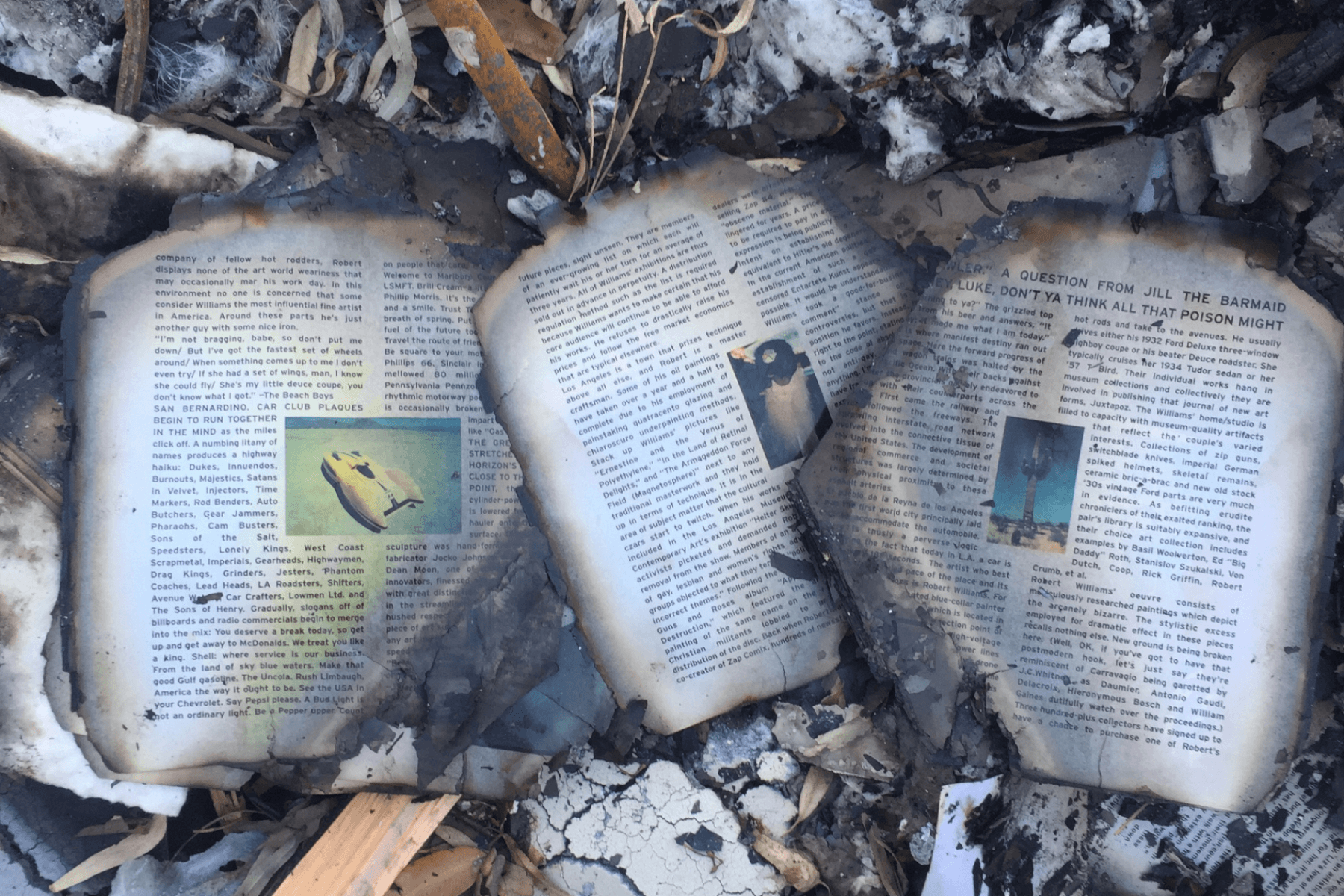
Dume Drive after the Woosley Fire. Photo by Jamie Brisick
I went to my mother’s house in West LA, and for the next three days, we sat glued to the TV watching the Palisades Fire and the Eaton Fire. LA in flames. It was devastating. I felt a queasy mixture of PTSD and déjà vu. Dozens of friends and acquaintances lost their homes. My gut said, ‘You do not need to go through this again.’
So I skipped town, headed up to West Marin, where the Headlands Center for the Arts was receiving LA fire refugees. And of course, it was the classic ‘no matter where you go, there you are,’ because while I was geographically distanced from LA, my head was right there. I tried not to think about the Woolsey Fire, but I inevitably did. I remembered things I’d lost.
In the early 1990s, on one of my first LSD trips, my friends and I stumbled into Soap Plant on Melrose. There was a carnival mirror that reflected my warbling, confused self in what felt like divine epiphany, and there was a postcard featuring a Ralph Steadman-style image of a convertible Cadillac in the desert, maybe en route to Vegas. It was as if I were a hitchhiker, and the Cadillac pulled up alongside me, and the driver’s face was smeared and distorted the same way I felt smeared and distorted, and the caption read “Hola Pepe, which way to the miracles?” It leapt out at me. I bought it and kept it, a totem, a north star along the lines of, say, the dog-eared copies of Siddhartha, On the Road, Tropic of Cancer, Dylan and Lou Reed and The Replacements cassette tapes, the stuff that shaped me when I was probably most malleable. All of which burned in the Woolsey Fire.
When a surfboard burns, it becomes a sort of husk, not unlike the shed skin of a snake. That 8’6” Scott Anderson semi-finless surfboard that had lifted me out of the depths of grief after my wife died — that, too, I lost in the Woolsey Fire. I can still see it amid all the charred ruins.
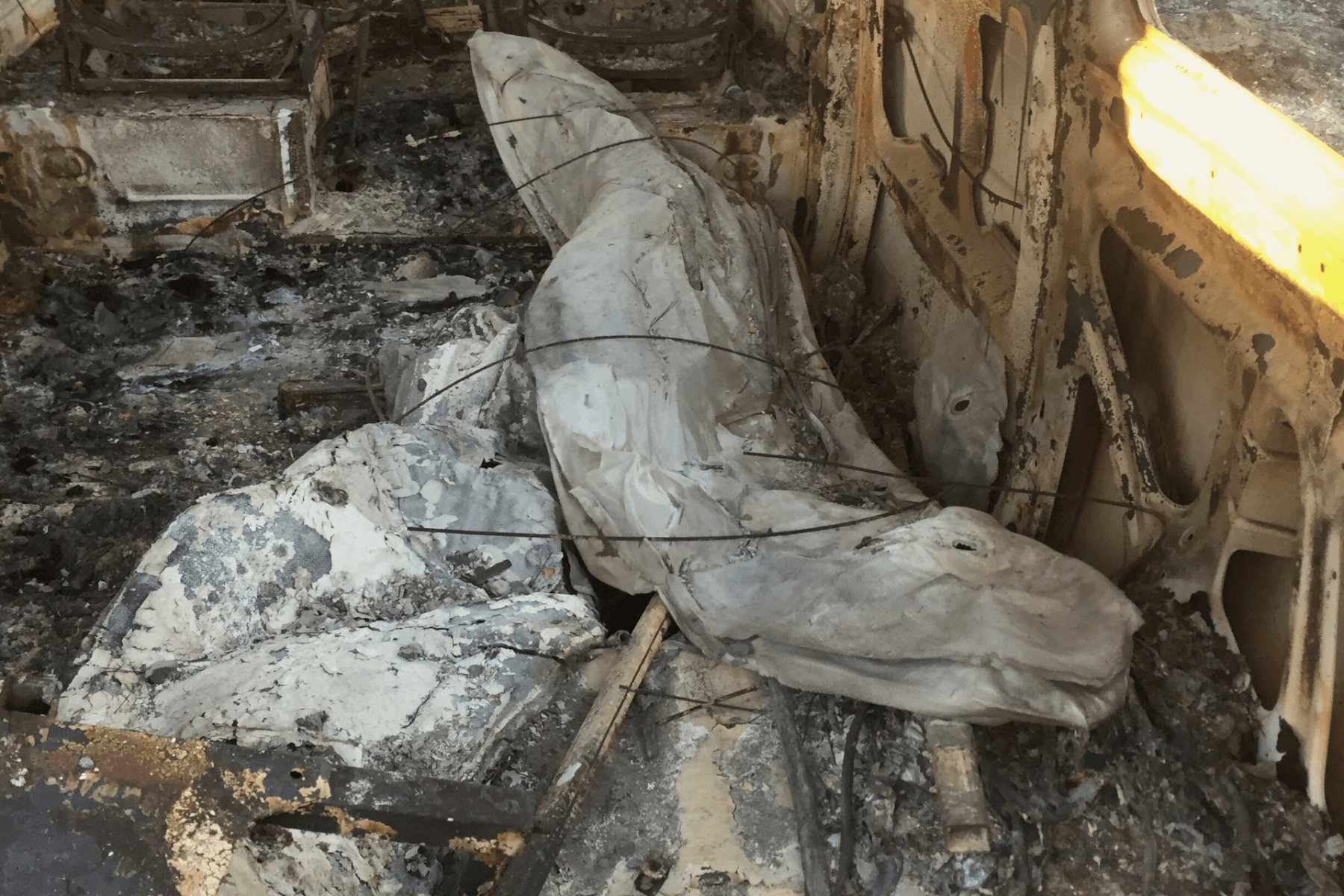
Woosley Fire aftermath. Photo by Jamie Brisick
It was a couple of months after the Palisades fire before I made it back to Malibu to see all that had burned. The stretch along PCH from Pacific Palisades up to what’s known as Billionaire Beach resembled some sort of haunted house ride at an amusement park. It felt like a personal attack on so many spots I held close to my heart.
The Reel Inn, where I’d enjoyed many a meal with wife, family and friends. The beachfront apartment where Dickie Franz had lived in the mid-‘80s, and where we had a Fourth of July rager involving an impromptu surf comp in which you had to down a tequila shot before paddling out to your heat (I surfed the final, stumbling drunk and nude, as did the winner, Steve Morris). The house up Big Rock, where I’d once rented a room during my pro surfing days. The beachfront home where I’d attended a funeral service for Dennis Dragon of Surf Punks fame. The house where my 12th-grade buddy Craig C had sex with a Brat Pack actress in an upstairs bedroom while I waited angrily and jealously in the car. All gone.
The ocean, though, remained permanent.
About a year after Gisela died, I returned to New York for the first time. I anticipated an emotional trip in which I’d revisit all the cafes, restaurants and bars we used to frequent. I imagined sitting in the same booths we’d sat in, and summoning her, and maybe speaking aloud to her as if she were actually there. But so many of those places were no longer. They’d changed hands, become something new. It was as if New York or God was saying, “Move the fuck on.”
Malibu was sending a similar message. The ocean, though, remained permanent.
I’ve come to see the human home as an effort towards security, organization and control. And while we may sleep with those roofs over our heads and those floors under our feet, I know firsthand how it can all so swiftly disappear. Loss plunged me to a bottom I perhaps needed to hit. It liberated me, helped me. After my wife died, I shed a certain self-consciousness. As a result, I became more real and more honest. If anything, the fires fortified this. Loss showed me how much I actually have.
I’m reminded of something my father said to me in the mid-1980s. I was a fledgling pro surfer, full of myself, heading out to a party in my sponsor’s garb, when my father stopped me and said, “You know, when you’re with a girl, it’s just you. It’s not Jamie the pro surfer, or Jamie the guy in the surf magazine, or Jamie the guy with the cool car. It’s just you, standing naked. And that’s enough.”
Help us sustain independent journalism...
Our team is working hard every day to bring you compelling, carefully-crafted pieces that shed light on the pressing issues of our time. We rely on caring supporters like you to help us sustain our mission. Your support ensures that we can continue to provide deeply-reported, independent, ad-free journalism without fear, favor or pandering. Support us today and make a lasting investment in the future.
RELATED STORIES
Award Winning


Today’s environmental and social justice challenges are unprecedented, and require an unprecedented collective effort.


Stay updated on our latest features, events and more. Subscribe to our Note From the Nest newsletter!
