Surfing in the Fallout Zone
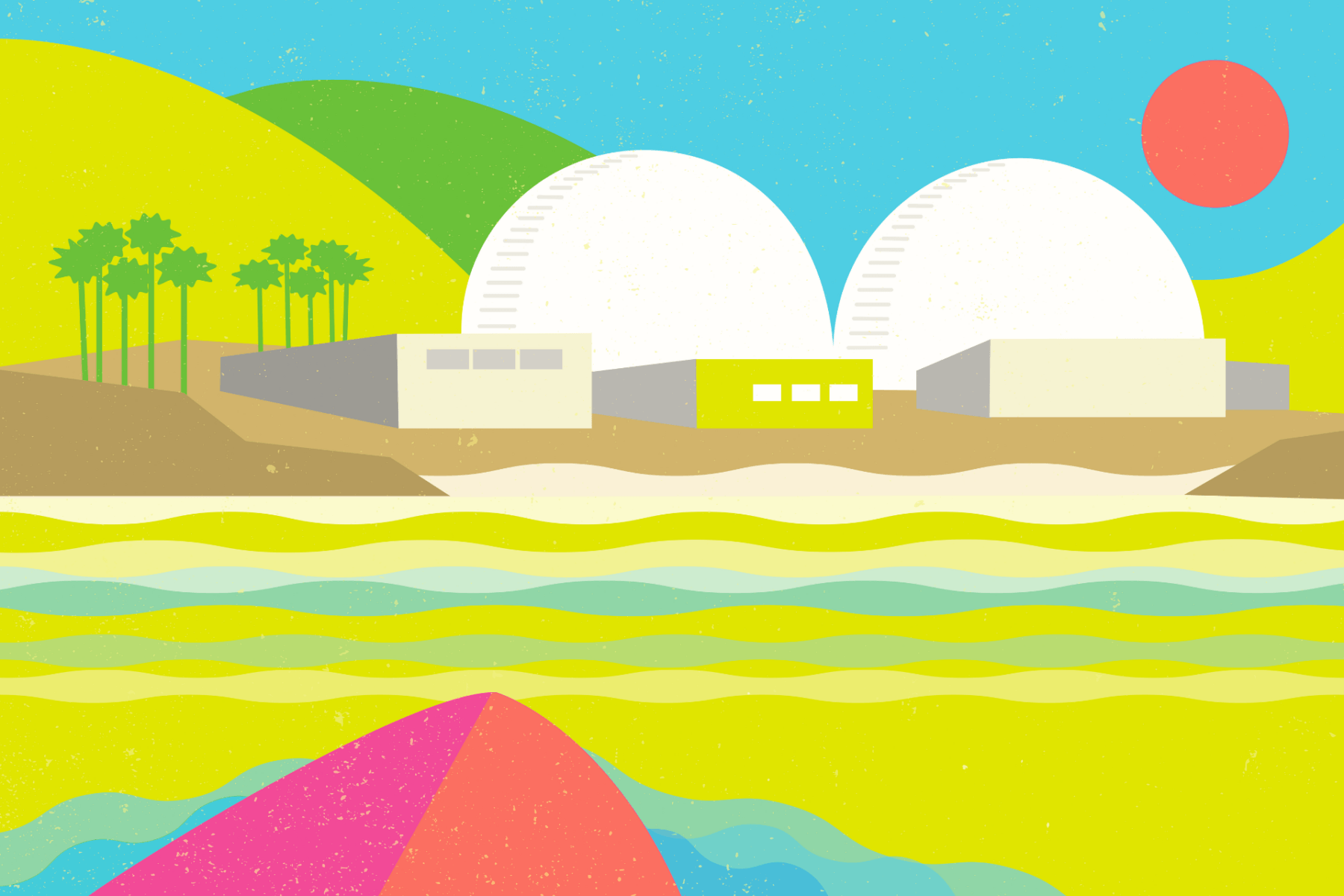
I am sitting on my surfboard at Old Man’s, a surfbreak at San Onofre State Beach, when I realize how exposed I feel.
The board is nine feet long, soft-top, bubblegum pink, buoyant enough to float me high above the water and impossible to miss in a lineup dominated by fiberglass and familiarity. My board is the kind you buy when you are still learning, when buoyancy matters more than precision. Every small shift of my weight sends the nose rocking. I steady myself and look toward the horizon, trying to read the swell the way everyone else seems to do without thinking.
Old Man’s does not rush anyone. The wave approaches slowly, almost politely. When it finally reaches me, I turn late, paddle hard, and feel the board catch. I stand awkwardly but stay upright as the wave carries me forward in a long, gentle glide. There is time, almost too much time, to think about my feet, my balance, and the way the water moves beneath me. When the wave fades, I step off and paddle back out, breathing harder than I want anyone to notice.
Around me, surfers sit calmly, chatting about tides and conditions. No one is aggressive. No one is in a hurry. Old Man’s is known for its patience, a place where beginners, retirees and longtime locals share the same surf. You learn quickly that etiquette matters more than performance. Do not rush. Do not snake. Do not pretend you know more than you do.
I turn toward shore as I settle back into the lineup. Behind us, pressed between the Pacific Ocean and Interstate 5, sits the San Onofre Nuclear Generating Station.
From the water, it appears deceptively quiet. The iconic domes that once defined this stretch of coast are being dismantled, and their absence makes what remains seem almost modest. Low concrete pads, fencing and industrial geometry hugging the bluff. If you did not know what was there, if you had not followed the site for years, it could pass as just another piece of coastal infrastructure, something absorbed into the landscape through repetition.
But I know exactly what is there.
Since 2024, I have reported on the nuclear generator’s decommissioning and the ongoing storage of spent nuclear fuel at the shoreline. I have interviewed Southern California Edison officials, environmental advocates, physicists and longtime local activists. I have attended community engagement panel meetings and site tours, listened to engineers explain steel thicknesses and inspection schedules, and sat through public comment periods where residents argue over risk, responsibility and time.
For me, as a surfer learning the lineup at San O, as well as a reporter, the plant is no longer just a policy story. It is a presence that hovers over every session — sometimes visible, sometimes not, but impossible to forget.
The San Onofre Nuclear Generating Station operated for more than four decades, beginning with Unit 1 in 1968 and expanding in the early 1980s with the addition of Units 2 and 3. Together, the reactors supplied Southern California with nuclear-generated electricity during a period when atomic power was promoted as a reliable, emissions-free energy source. Unit 1 was permanently shut down in the early 1990s. Units 2 and 3 continued operating until 2012, when unexpected wear was discovered in newly installed steam generators.
The defects triggered an extended outage, intense regulatory scrutiny and growing public opposition. Rather than repair the equipment, the plant’s owners announced in 2013 that the site would be permanently closed, bringing power generation to an end. Decommissioning began soon after, a process expected to take decades. While the reactors themselves are being dismantled, the spent nuclear fuel remains stored on-site in dry casks near the shoreline, an arrangement originally described as temporary while a permanent federal disposal solution remains unresolved.
That unresolved status lingers in the back of the mind of surfers and residents alike. For me, as a surfer learning the lineup at San O, as well as a reporter, the plant is no longer just a policy story. It is a presence that hovers over every session — sometimes visible, sometimes not, but impossible to forget.
The waves roll in slowly at Old Man’s, breaking wide and soft, offering long rides to anyone patient enough to wait. It is a place where people talk about aging bodies and bad knees, about how long they have been coming here, about how the break has not changed much over the years. The ocean feels steady, reliable and familiar. The nuclear plant does not.
***
I have walked the San Onofre nuclear site wearing a hard hat and safety vest, standing where reactors once operated. During one tour in October of last year, a Southern California Edison manager pointed to an aerial photo of the plant taken when Units 2 and 3 were still active, explaining how much of what once stood there had already been removed. The work now underway focuses on demolishing remaining structures down to several feet below grade, filling basements and flattening the site.
“What remains,” he said, gesturing toward the shoreline, “will be the dry storage facility, the switchyard and the seawall.”
The language was precise and practiced. Above grade. Below grade. Passive cooling. Design margin. Everything had a name, a category, a protocol.
We walked toward the dry storage area where spent nuclear fuel now sits sealed inside thick steel canisters housed in concrete vaults. The systems rely on passive cooling and are designed for air to flow naturally through vents without pumps or power. Radiation monitors nearby showed levels barely above background. Inspectors use cameras and robotics to check for surface marks or corrosion, tracking changes over time.
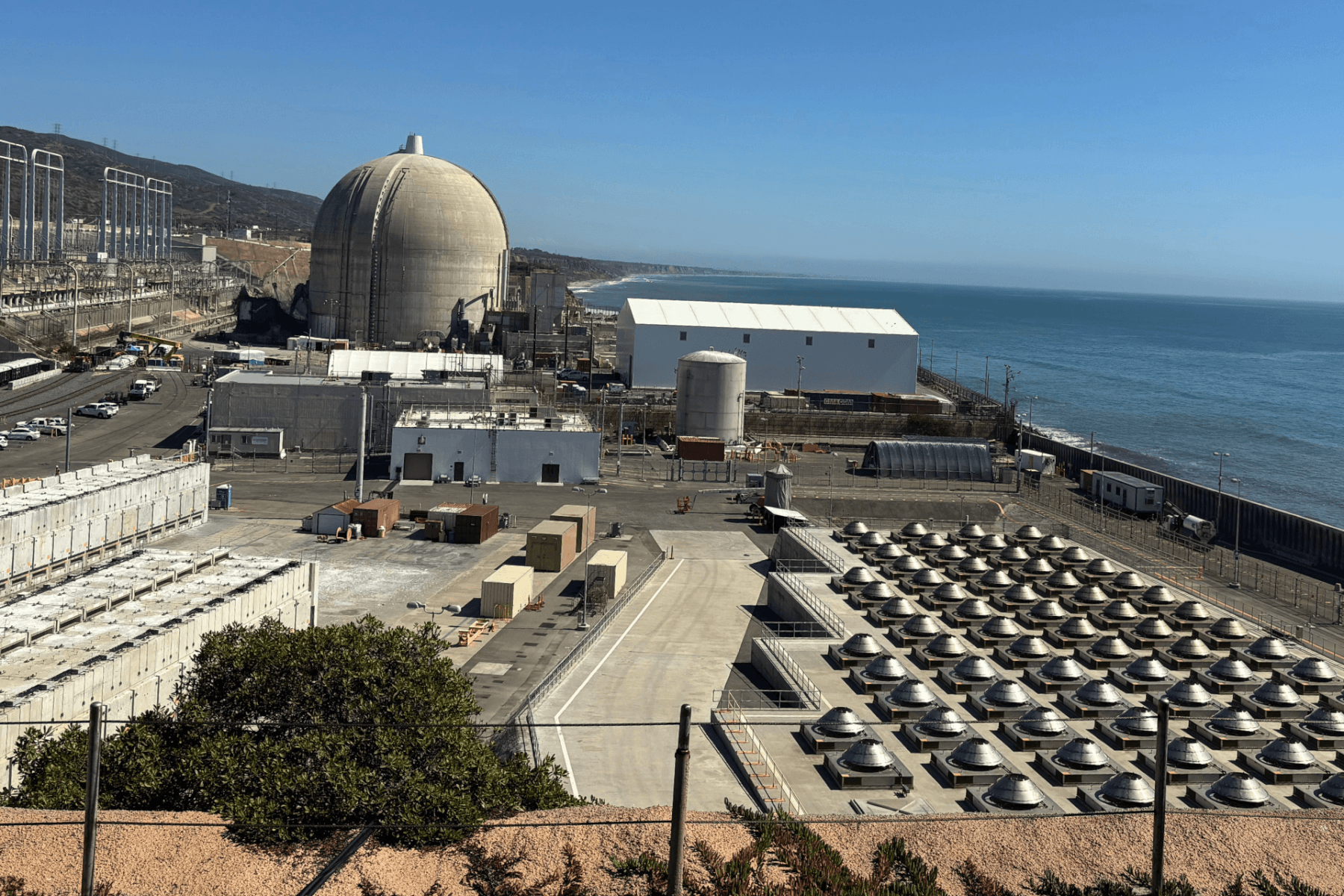
The San Onofre Nuclear Generating Station along the Southern California coast, where reactors are being dismantled while spent nuclear fuel remains stored on-site in dry casks near the shoreline. Photo by Angélica Escobar.
Officials emphasized numbers meant to reassure. Exposure limits. Inspection intervals. Steel thickness is measured in fractions of an inch. Words like ‘safe’ and ‘indefinite’ were delivered calmly, without drama.
Standing there, the ocean visible just beyond the fencing, I was struck less by fear than by the choreography of reassurance. Every question had been anticipated. Every risk had a corresponding mitigation. This was not denial. It was management.
That same tone carries into the Community Engagement Panel meetings, which unfold with the familiarity of civic ritual. Folding chairs. PowerPoint slides. Microphones passed down the aisle. At one meeting in San Clemente, engineers walked the audience through inspection photos and contingency plans, explaining how surface marks on canisters were documented, measured and tracked over time.
“All canisters inspected so far are in good condition,” an Edison executive told the room during a community meeting in October. “None require repair.”
During public comment, the mood shifted. One resident urged immediate removal of the waste, citing sea-level rise and coastal erosion. Another thanked Edison for transparency and asked that the conversation stay grounded in science. A longtime activist warned that waiting decades for off-site removal would be too late, as climate-driven sea level rise continues to reshape the coastline. A physicist suggested that California should lead in developing future clean energy technologies rather than retreat from them.
Again and again, the conversation returned to the same unresolved point. The waste was never meant to stay here. The federal government was supposed to take possession. Years later, it has not happened.
The crisis is not an immediate safety failure. The crisis is that what was built as temporary storage has become open-ended, with no federal repository, no removal timeline and a growing sense that the shoreline may be asked to hold the waste far longer than anyone originally planned.
Covering San Onofre has taught me how people understand risk differently depending on where they stand in relation to the site itself.
In meeting rooms, risk is something you model. It is broken down into probabilities and thresholds, into charts that show what is likely and what is merely possible. Officials talk about redundancy and design margins, about systems built to fail safely, about inspections meant to catch problems long before they become threats. The message is consistent. The canisters are performing as designed, and the site is being monitored. But the crisis is not an immediate safety failure. The crisis is that what was built as temporary storage has become open-ended, with no federal repository, no removal timeline and a growing sense that the shoreline may be asked to hold the waste far longer than anyone originally planned.
Outside those rooms, the conversation shifts. Environmental advocates say that time is the real danger. Not today, not tomorrow, but decades from now. They point to sea-level rise projections, coastal erosion and the way Southern California’s shoreline is already changing faster than anticipated. They ask what happens when on-site dry storage in steel canisters, coastal seawalls meant to protect the facility and ongoing monitoring programs designed as interim measures stretch into something closer to permanent. They ask who is responsible when the federal solution for removing the waste, a national repository and off-site transfer, never arrives.
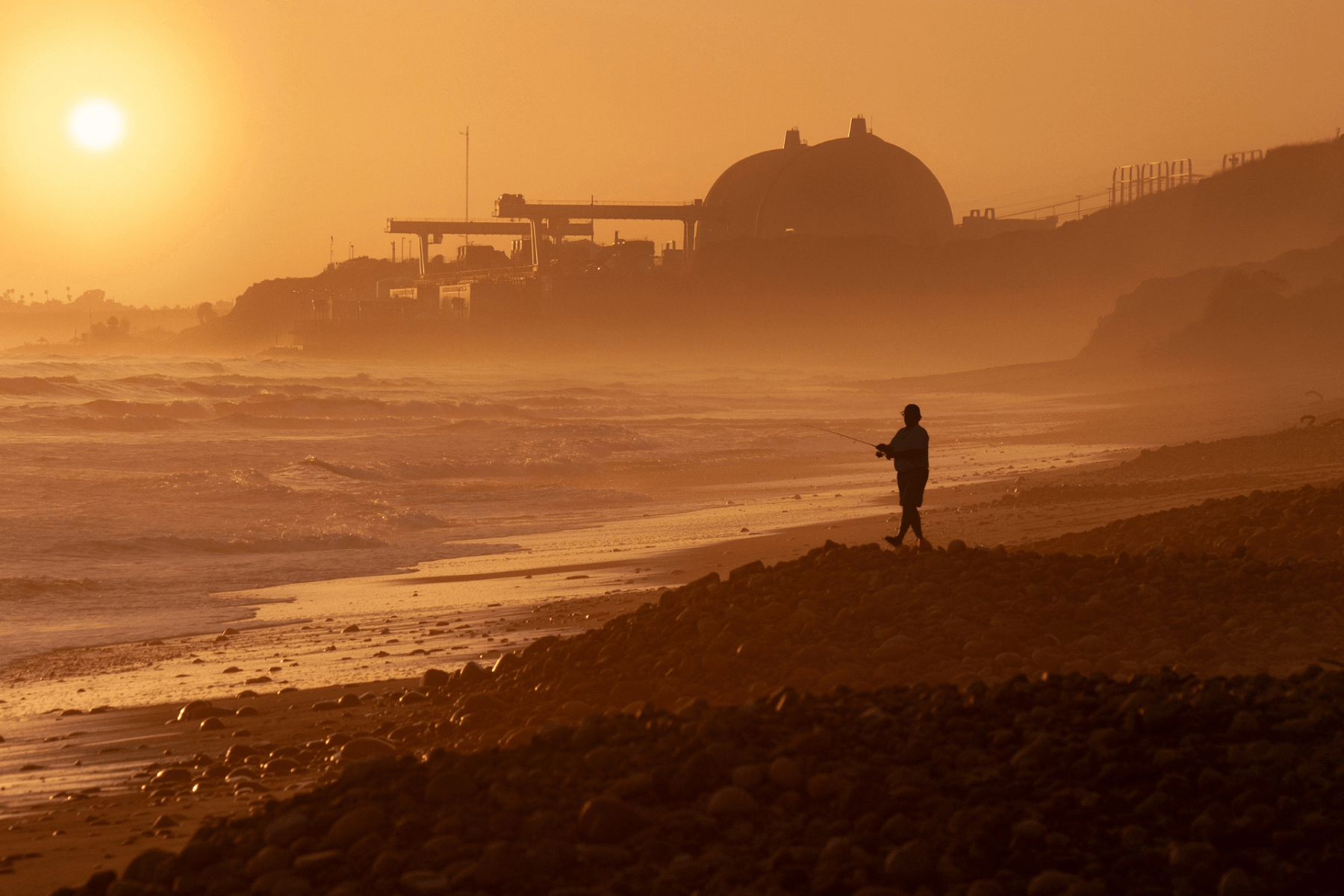
San Onofre State Beach is in the top five most popular state parks in the state, with 2.5 million visitors per year and attracting both tourists and locals for its waves and camping. Photo by F. Armstrong / Adobe Stock
Local residents live somewhere between those positions. Some trust the engineers and the data. Others are uneasy, not because they expect disaster, but because they resent being asked to accept uncertainty on behalf of the rest of the country. San Onofre sits in a region defined by recreation and beauty, by beaches and trails and family traditions. The idea that radioactive waste is part of that landscape, even if safely contained, feels like an imposition to many people who never agreed to host it.
Clean nuclear energy sits at the center of that tension. For decades, San Onofre represented the promise of carbon-free power in a state increasingly shaped by climate change. Its closure in 2013 reduced California’s supply of emissions-free electricity, a reality that matters in a warming world. The waste left behind matters too. The electricity stopped flowing. The fuel did not.
As a reporter, I am trained to hold all of those perspectives at once. To listen without inflaming. To present facts without dramatizing them. To acknowledge that clean energy can coexist with long-term consequences. That training does not disappear when I paddle out.
Even after touring the demolition site, standing beside the canisters while told — carefully and repeatedly — that everything is safe, the thought still follows me into the water. It is not panic. It is quieter than that. It is the awareness that I am surfing next to something that requires constant explanation, monitoring and reassurance. The thought is simple and stubborn: this does not belong here. Not because failure is imminent, not because disaster is looming, but because the coastline was never meant to be a long-term holding space for radioactive waste. I trust the engineers. I understand the data. And still, when I sit on my board waiting for a set, that knowledge settles in the back of my mind. Not fear, but unease — an understanding that safety here is something actively maintained, not something inherent.
Back in the lineup, none of that language surfaces. No one talks about federal responsibility or inspection cadences. Risk feels abstract, pushed far into the background by the immediate demands of balance and timing. The ocean does not negotiate. It simply moves.
Out here, danger and beauty coexist without much commentary, and learning to live with that coexistence, rather than resolving it, feels less like a surfing lesson than a reflection of how we move through the world now.
I paddle for another wave and miss it completely, my timing off again. The surfer next to me smiles and shrugs. “Next one,” he says. There is no judgment in his voice, just acceptance. It’s the kind of acceptance that feels familiar lately, an ability to hold missed chances, background risks and small pleasures at the same time. Out here, danger and beauty coexist without much commentary, and learning to live with that coexistence, rather than resolving it, feels less like a surfing lesson than a reflection of how we move through the world now.
In the water, the debates flatten into something quieter but more persistent. I sit on my pink board and watch the horizon, aware that I am floating in a place shaped by competing ideas of time. The waves arrive in minutes. The waste will remain for decades, maybe longer. Surf sessions end. Canisters of radioactive waste do not.
I catch another wave, better this time. I stand more smoothly, ride longer, feeling the board settle beneath me. For a few seconds, everything narrows to motion and balance and the simple satisfaction of staying upright. When I fall, it is gentle. The water breaks my fall, and I surface laughing despite myself.
That joy is part of the story, too.
San Onofre is beloved because it feels accessible and communal, a place where people slow down and share space. Surfers, engineers, activists and officials all occupy the same coastline — each carrying a different relationship to what sits behind the fence. Waves and waste. Pleasure and precaution. Paradise and permanence.
As the session winds down, surfers drift toward shore, boards under their arms. Conversations pick back up in the parking lot. The ocean erases our tracks almost immediately.
On land, the debates continue in meeting rooms, in reports, in policy fights that stretch on with no clear end. Out here, the waves keep coming, indifferent to human timelines.
I walk up the trail with my pink board tucked under my arm, salt drying on my skin, aware that I am learning more than just how to surf. I am learning what it means to live inside contradiction, to seek joy in a place where risk has been engineered, managed and deferred, and to paddle out in paradise knowing a nuclear legacy sits quietly at your back.
Help us sustain independent journalism...
Our team is working hard every day to bring you compelling, carefully-crafted pieces that shed light on the pressing issues of our time. We rely on caring supporters like you to help us sustain our mission. Your support ensures that we can continue to provide deeply-reported, independent, ad-free journalism without fear, favor or pandering. Support us today and make a lasting investment in the future.

RELATED STORIES
Award Winning



Today’s environmental and social justice challenges are unprecedented, and require an unprecedented collective effort.


Stay updated on our latest features, events and more. Subscribe to our Note From the Nest newsletter!
