
Houses on Fire
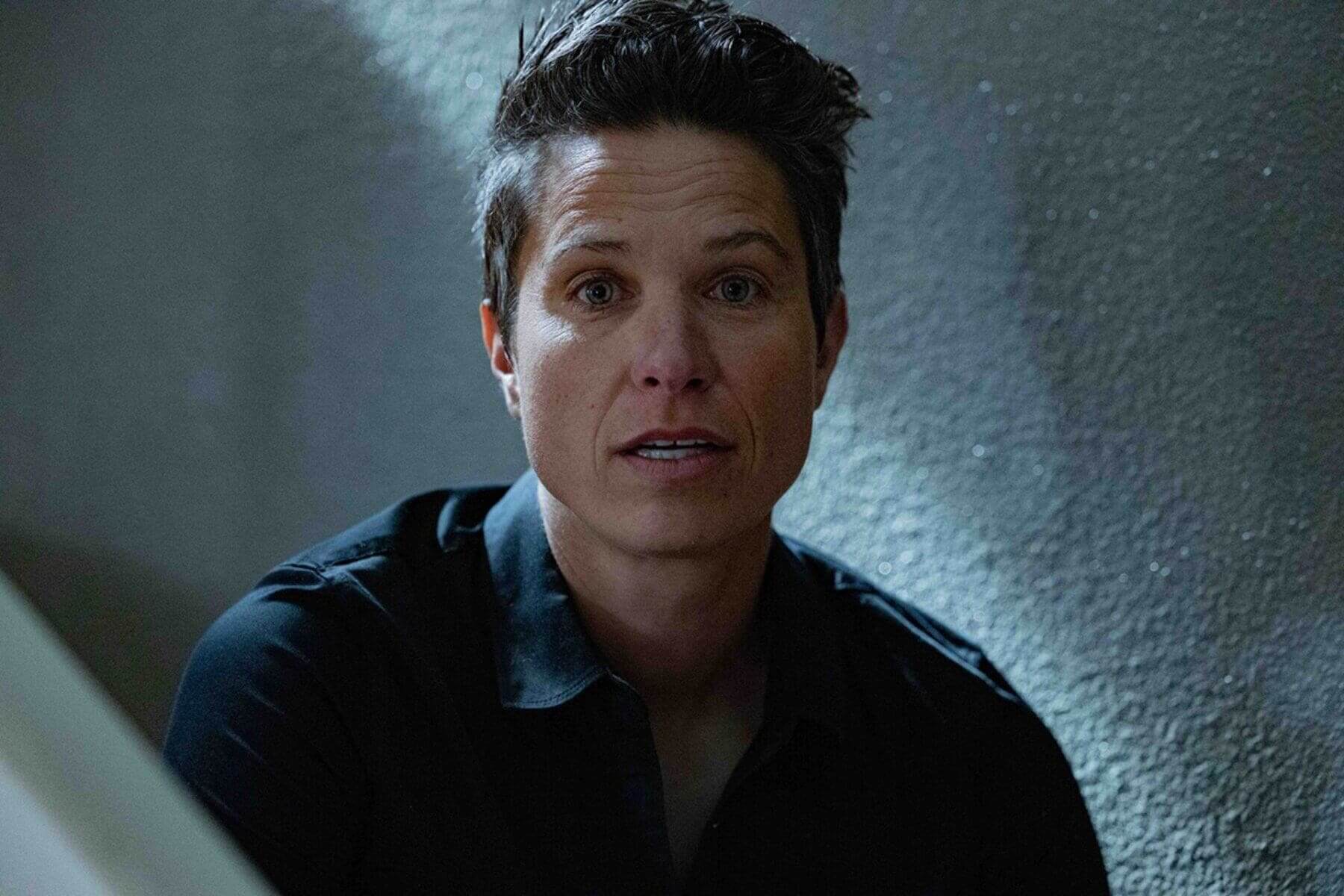
As soon as she set her heart on becoming a firefighter, Lauren Andrade understood she would be one of just a handful of women in a world ruled by men. Still, that didn’t prepare her for the moment in 2013 when she returned to work just three-and-a-half weeks after giving birth to realize she had no private space inside her firehouse where she could pump milk for her newborn son.
In the frenzy of rushing back and forth to answer emergency calls, she had to find a few minutes in which she could lock herself in one of the firehouse bathrooms, which were not segregated by gender. Her heart raced every time one of her male colleagues banged on the door demanding to be let in. Here she was, with her shirt off, sitting up on the washbasin because there was no chair, with Metallica booming through the station sound system. For all her efforts down the years to be accepted as one of the boys, she was now the very antithesis of a macho firefighter in a situation ripe for personal humiliation.
At the time, she didn’t complain or allow herself to think there was anything particularly wrong with this situation. She’d endured years of a fire service culture in which women and minorities were vastly outnumbered by white men and, in the hothouse atmosphere of a fire station where everyone on shift eats, sleeps and washes under the same roof, routinely suffered discrimination and abuse. That was true in Orange County, where she had spent most of her career, and across the country.
“I can’t be vulnerable,” Andrade told herself, on this and many other occasions. “If I show who I am, they’ll eat me up.”
For her first 13 years as a firefighter, both before motherhood and after, she stayed in survival mode, keeping her focus on the tasks at hand so she’d be accepted, however grudgingly, as a tough, reliable sister in the firehouse brotherhood. Andrade was competitive by nature, kept herself in peak physical condition and had a love for the job that helped her overcome many of the obstacles that prevented other women from breaking into the profession — or from lasting long if they did.
Andrade developed a skin thick enough to resist the frat-house humor and dismissive attitudes of her male colleagues — particularly as she started moving up the promotional ladder, and they taunted her, unjustly, that she was receiving special treatment because she was a woman. In fact, she’d learned to expect such taunts; a lot of women, she knew, preferred to stay at the lower end of the career ladder, as ordinary firefighters and paramedics, precisely to avoid this sort of grief.
In fact, she’d learned to expect such taunts; a lot of women, she knew, preferred to stay at the lower end of the career ladder, as ordinary firefighters and paramedics, precisely to avoid this sort of grief.
Then, in 2017, she was promoted to captain, and other women working for the Orange County Fire Authority started coming to her for help. This is the 21st century and we don’t even have our own bathroom, for Chrissakes, they’d tell her. As Andrade knew from her own experience, they’d often be kept waiting, in fire clothes contaminated with bodily fluids or carcinogenic materials, until the men had finished washing up and changing into clean clothes.
Not only was this outrageous, Andrade decided, but it was incumbent on her, as one of the very few women to hold a command position in OCFA, to take action. As she looked into the issue more deeply, she learned that separate bathrooms and lactation facilities were a requirement under both federal and state law, a fact that cast her own earlier experiences in a new light. Both Los Angeles and San Diego counties, she learned, had fixed the problem as far back as the 1980s. OCFA was a newer agency, established in its present form in 1995. But still: What was taking Orange County so long?
Andrade asked her union if OCFA was planning to install separate women’s bathrooms in all its firehouses (72 at the time; 77 now), and the union assured her there was a line item for it in the budget. Then she spoke to a retired deputy chief, whose wife had also been a firefighter, and learned that management had been promising the same thing for a decade but had not made an inch of progress.
That conversation, she says now, was an “aha” moment. “I understood,” she says, “that if I didn’t make them do it, it wasn’t going to happen.”
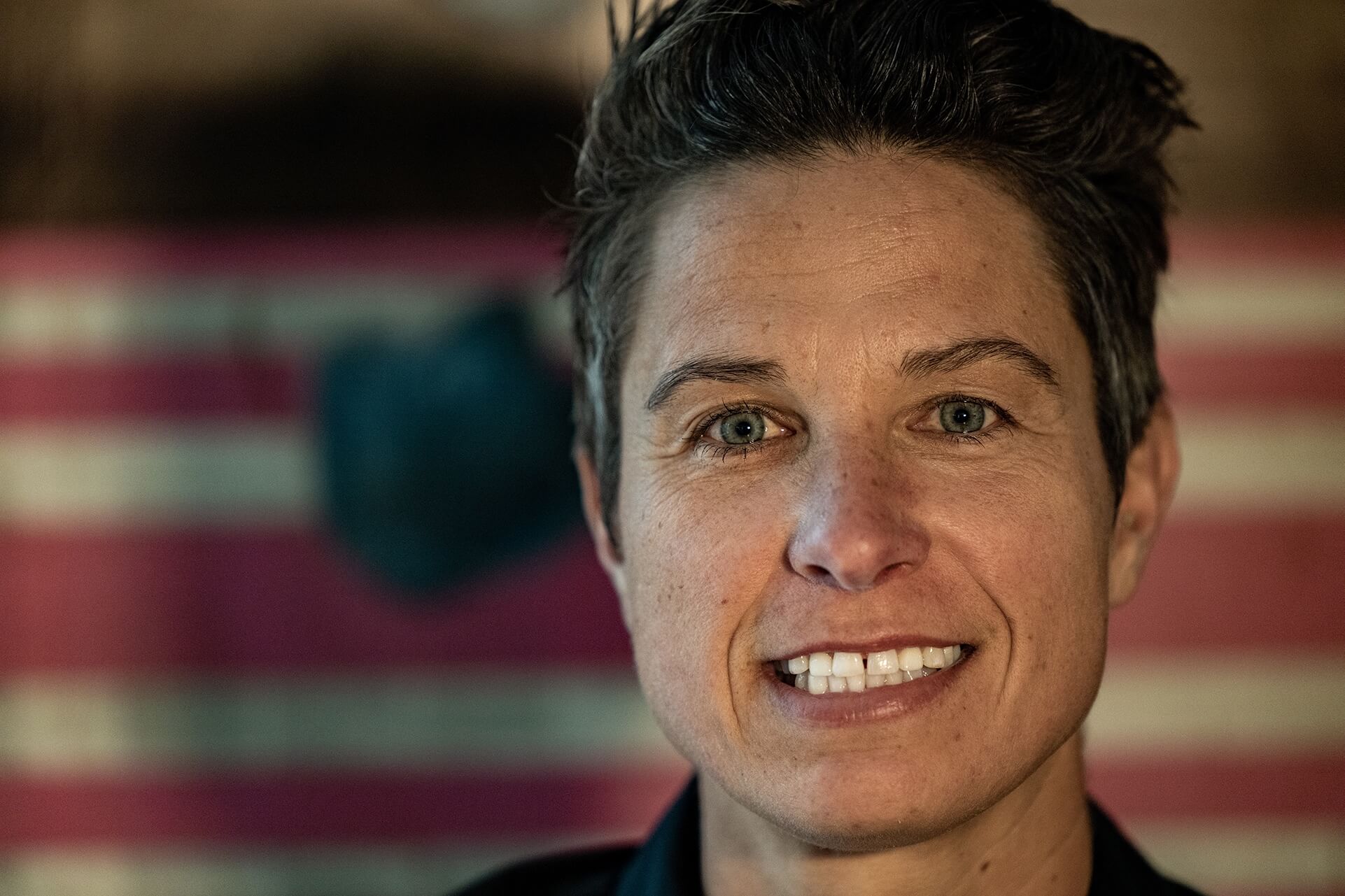
Lauren Andrade is no longer the “yes” girl. Photo by Sam Slovick
And so Andrade became an activist as well as a firefighter — a combination of roles that she knew was unlikely to sit well with her male colleagues, but one she felt compelled to assume with the same drive that had propelled her to excel in practice drills and live calls since she entered the academy in 2004.
For months, Andrade lobbied OCFA Chief Brian Fennessy to make progress on these and other issues. When that effort yielded few results, she teamed up with two gender equity specialists from the American Civil Liberties Union, Minouche Kandel and Aditi Fruitwala. In a succession of meetings and email exchanges, the attorneys laid out the legal requirements and pressed Fennessy on everything from bathrooms, to the low numbers of women and minority entrants at the OCFA academy, to the possibility that bias, either implicit or explicit, was skewing the interview process in favor of white males.
The purpose of bringing in the ACLU was not necessarily to file a lawsuit — as aggrieved women and minority firefighters around the country have done with some success in recent years, and as one of Andrade’s OCFA colleagues is due to announce publicly this week. Rather, it was to let everyone know Andrade was serious about pressing her employers into following the law and would not quit until they did.
As she started looking into working conditions across the agency, Andrade was horrified to learn that OCFA had not hired a single woman firefighter in nine years, in large part because the training requirements had changed since she went through the academy, growing more stringent in ways that could only discriminate against women and smaller-bodied men. Training requirements now involved more activities with fewer breaks and often left the most strenuous tasks — picking up and positioning heavy ladders, for example — until the very end, when trainees were sapped of energy.
This struck Andrade as wrong, not least because the training now far exceeded the physical demands of the job. In 19 calls out of 20, firefighters responded to medical or personal distress emergencies, not fires, and needed to be adept in many skills beyond brute strength. As she saw it, there was no excuse for OCFA to employ just 15 women in a total force of more than 1,500. Only one woman had ever made battalion chief, and there were divisions of the agency, such as air operations, that had been exclusively boys’ clubs for as long as OCFA had existed.
To remedy this, Andrade wanted the department to rethink training and testing to bring it closer to what she’d gone through in the early 2000s. OCFA needed women instructors, women role models and a baseline acceptance across the board that firefighters came in two genders, not one.
Andrade knew she was unlikely to be thanked for making such demands. Indeed, as she tells it, it wasn’t long before male colleagues found petty, vituperative ways to let her know she was stepping out of line. She’d go into the kitchen and find two tangerines and a cucumber arranged in a bowl to resemble male genitalia. Or, in the bathroom, novelty soaps with names like “filthy ass” and “filthy pussy” along with a mirror decal that read, “Objects in mirror are smaller than they appear.”
Once, she says, she sent a pair of contaminated firefighting gloves for special cleaning after a job and they came back filthier than before. On another occasion, she says, her “turnouts” — special top-to-toe clothing for fighting wildfires — disappeared, only to show up at a different station. When she tried to find out what had happened, she was told she must have left them there herself.
This was a sharp and jarring turnabout from her previous experience as the tough girl who knew how to be one of the boys. “I’d done everything right until I opened my mouth,” she reflected.
Still, she refused to be deterred. Rather, as she kept pushing forward, she made common cause with other firefighters around the country — women, mostly, but also African Americans facing their own forms of discrimination — and learned that harassment and acts of retaliation against anyone seen as different or speaking out against the status quo were depressingly common. Discrimination in the fire service was a hornet’s nest, she decided, and she was more than ready to help it kick over.
“I turned the map around,” she said. “The ‘Yes’ girl became the ‘F_ck No’ girl.”
***
A firefighting department should, ideally, reflect the community it serves. But in practice a department is more often like a college fraternity or an old-fashioned country club that prides itself on a certain traditional way of doing things and can’t understand the furor over its reluctance to accept women, or religious or ethnic minorities.
“If you look at the statistics, you’re telling me that 50 percent of black people can’t do this job, and that’s a total lie.”
That may help explain why, in the age of #MeToo and Black Lives Matter, 96 percent of active firefighters are men, and 82 percent are white – statistics far more dismal than those for police departments or the armed forces. Many fire chiefs say they want to do better, but even under the best of circumstances — even without the hazing or casual cruelty or sexual vulgarity or deliberate retaliation against anyone who complains about the way they’ve been treated — the unfairness is flagrant, pervasive and self-perpetuating.
Picture a female firefighter, 5-foot-9 and muscular, performing a practice drill in pants and boots that are way too big on her, using equipment designed for men 6 inches taller and 100 lbs. heavier. She’s good at what she does but, as she puts it, she looks like “a soup sandwich” climbing a ladder. Add to that a male colleague standing beneath her and criticizing her every move. “That hurts,” the firefighter, who did not want to be named because of an ongoing labor dispute, told me. “Not for a minute did he stop to think, why is she in pants 10 inches too wide for her waist? If I’d said anything about it, I would have been a whiner. We set people up for failure when we do that.”
It’s easy, under such circumstances, to lose confidence in yourself, the firefighter said. And when you lose confidence, you aren’t going to perform as well, which only undermines your confidence further. “It takes will and determination and stubbornness to break that cycle,” she said, “to keep an image of your own excellence in your mind. Everything in the fire service is designed for people who are abnormally large, but you don’t need to be abnormally large to do this job. There’s a whole lot of men in worse shape than I am.”
The cards are similarly stacked against African Americans, although for different reasons. Promising candidates who ace the qualifying test and meet the physical demands often find themselves undone for other, largely subjective reasons: either because they fail a background investigation, which is generally conducted by retired white officers with little or no understanding of the candidate’s life experiences, or because a training supervisor takes a dislike to them, or because they fall foul of the firehouse culture during the rookie probationary period.
“If you look at the statistics, you’re telling me that 50 percent of Black people can’t do this job, and that’s a total lie,” said Robert Hawkins, executive vice-president of the Los Angeles City Stentorians, a firefighters’ association that promotes diversity and racial equality in a city that kept firehouses racially segregated until 1956. The Drill Tower — the LA Fire Department’s training program that often takes place in an actual tower — was a “cesspool,” Hawkins said.
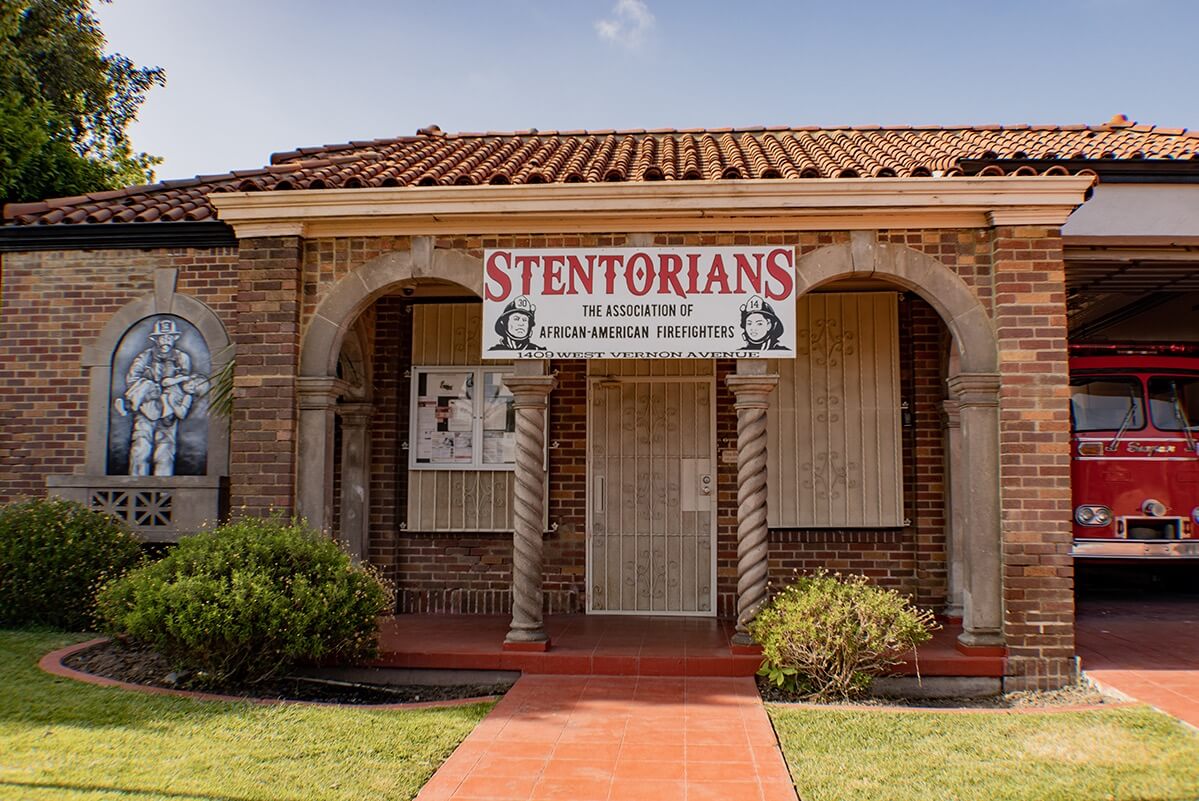
The LA City Stentorians headquarters in South LA was one of two all-Black firehouses when the LA Fire Department was segregated. Photo by Sam Slovick
Hazing rituals for Black rookies in recent years have, according to the Stentorians, included episodes of white colleagues urinating in their mouthwash bottle, mixing dog food into their meals or leaving a stuffed monkey on their equipment to make an ugly racial point.
Often, Black firefighters say, those who make it through will be taunted as a “diversity hire” — in other words, someone who doesn’t truly deserve to be there. (On one of the many occasions that Gerald Durant, the president of the Stentorians and a 34-year LAFD veteran, heard this, he retorted, “You really think the system gave me a pass?”)
The truth is likely closer to the opposite: that highly qualified candidates who happen not to be white get turned away all the time, often without explanation. One recent example is Rondell Johnson, a 32-year-old from South Los Angeles who has led seasonal fire crews in the Angeles National Forest, has experience as an emergency medical technician, organizes food drives and other community services, has excellent references, scored perfectly on his entrance test and met all the physical requirements.
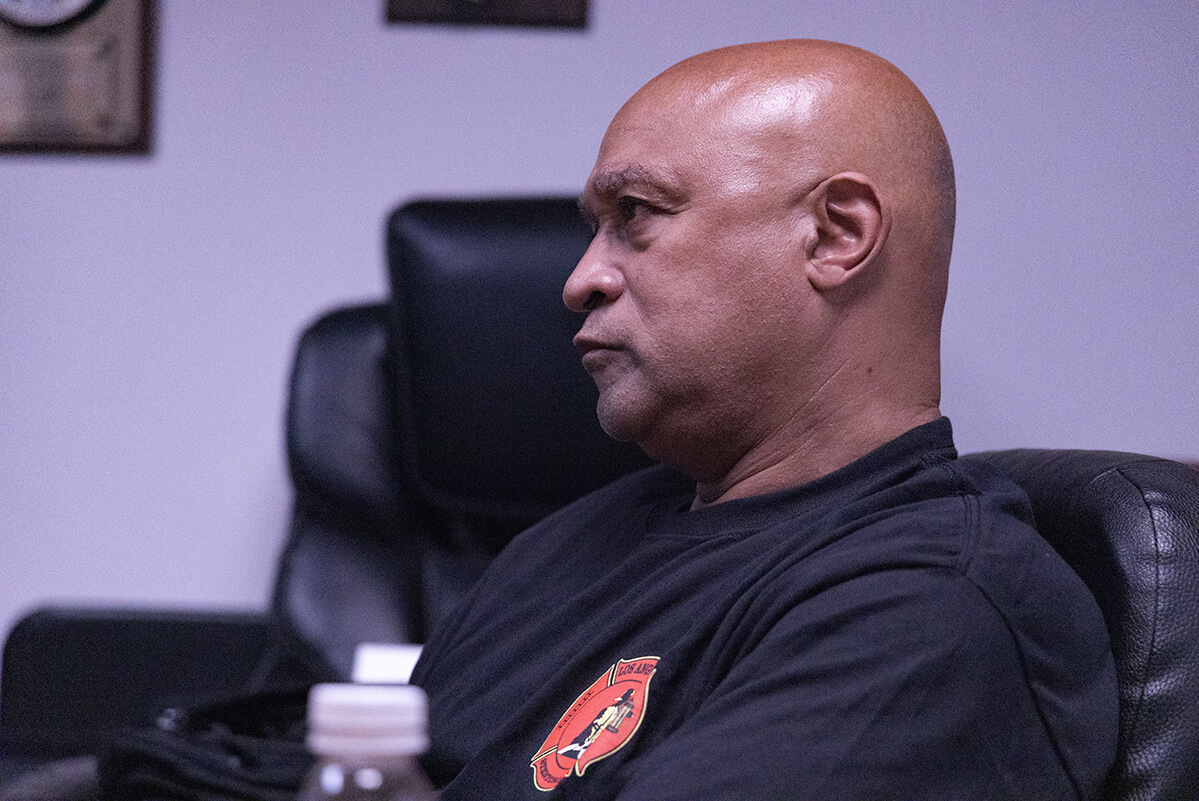
“We have a voice, and we can preach something different.” Stentorians President Gerald Durant. Photo by Sam Slovick
Yet, in March, Johnson was told he’d been removed from the LAFD selection process and had no right to appeal. The letter he received gave no reason, and a subsequent attempt by the Stentorians to learn more was unsuccessful. Johnson suspects his rejection might have had to do with his background check: Like many of those who are lower-income, he’s had problems with his credit, and he volunteered to his background investigator that he’d recently received a speeding ticket. Neither of those things should have disqualified him, according to the Stentorians.
“The way the background check works, they ask Black kids from South Central questions like, ‘Is your brother in a gang?’ or ‘Have you ever shot a weapon?’” explained Durant. “You say no, and nobody believes you.”
Whenever advocacy groups like the Stentorians or Los Angeles Women in the Fire Service demand action to correct such pervasive inequities — more closely aligning the training requirements with the demands of the job, say, or introducing more transparency, or getting equipment and clothing designed to fit firefighters who don’t happen to be 6 feet 3 inches — the standard response is that the department is committed to maintaining its excellence.
“The truth is, candidates fail to graduate from the Drill Tower because they do not meet the required standards for completion,” the head of the LA firefighters’ union Freddy Escobar wrote in a 2019 letter to the department and the city’s political leadership after a member of the fire commission complained that the training program was excluding too many women.
This argument about maintaining standards is a well-worn one and has not always stood the test of time. In the 1940s and 1950s, when the LAFD assigned Black firefighters to just two firehouses in South Central and maintained a whites-only policy everywhere else, it did so in the name of upholding the department’s high standards. A similar argument was offered after the department was forced to integrate and white firefighters refused to let their Black colleagues eat with them in the station house or even use the same dinner plates. “There is a history to the argument about standards,” Hawkins said. “And in some ways, that history is coming back.”
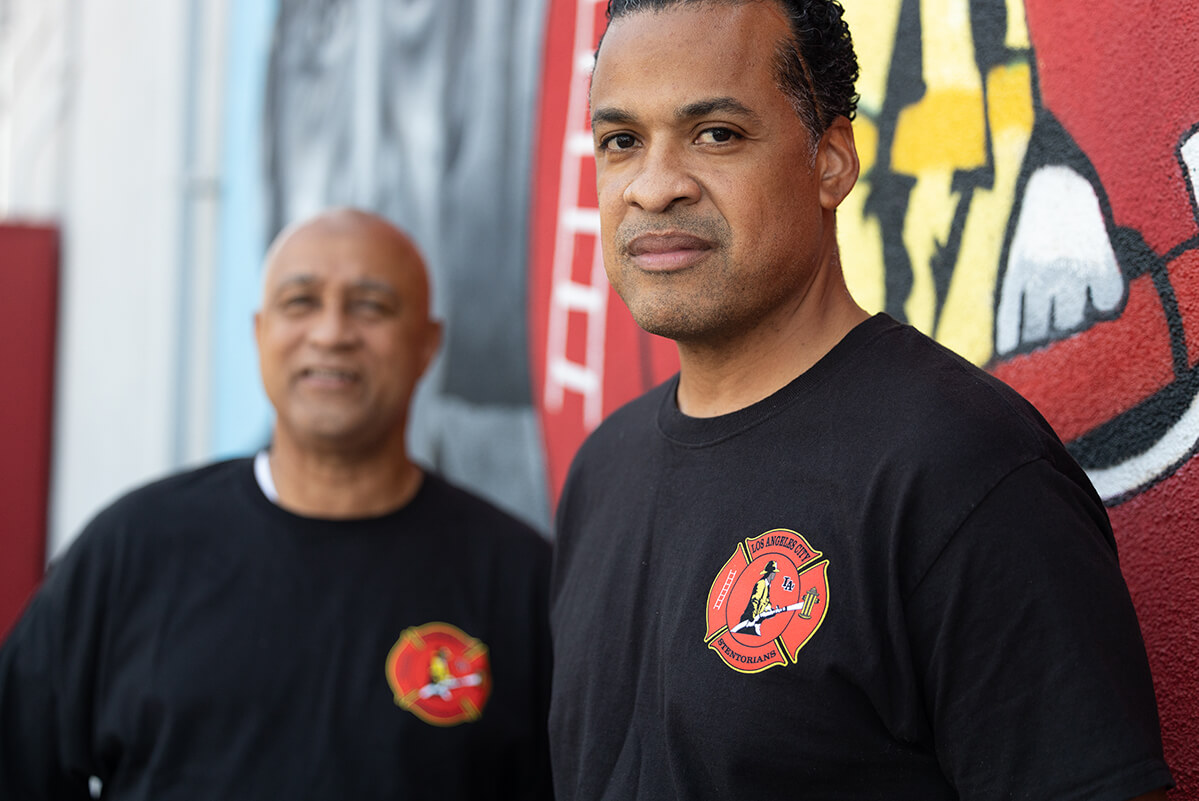
Stentorians Executive Vice President Robert Hawkins (foreground), with Durant. Photo by Sam Slovick
What Hawkins meant was a startling uptick in episodes not just of systemic racism in the fire service, but also of racist speech and actions. The problem appears to have grown worse as the country’s politics have become more polarized and the legacy of Donald Trump’s presidency, in particular, has made people more willing to flaunt their opinions, no matter how ugly, in the workplace and in other public arenas.
White firefighters and dispatchers have periodically been caught using the N-word in radio traffic, according to the Stentorians, and there has been no public indication of disciplinary action against them. Last year, a white firefighter was suspended after the Los Angeles Times revealed that he’d punched a Black detainee handcuffed to an ambulance gurney and constricted his breathing by pressing a towel over his face. After Breonna Taylor, a blameless Black medical worker in Kentucky, was shot dead by police during a botched drug raid on her building in March 2020, provoking a national outcry, a firefighter working out of the LAFD’s San Pedro station, Paul Sasso, called her a drug dealer on Facebook (in all caps, with four exclamation points). His Facebook profile picture at the time showed him posing in front of a fire truck, in apparent violation of LAFD policy that says people identified as employees on social media have to dissociate their views from the department; he has since changed the picture.
On January 8 this year, two days after a pro-Trump mob stormed the U.S. Capitol, an Instagram post showed 12 white firefighters serving in LAFD’s Station 64 in Watts – including the captain — under the caption: “Always Trump Proud! Proud Boy Fire Department.” Given that Watts is 98 percent Black and Latino, and the Proud Boys are an extremist group affiliated with white nationalists, it is difficult to read the message as anything other than a racist taunt aimed at the population the firefighters serve.
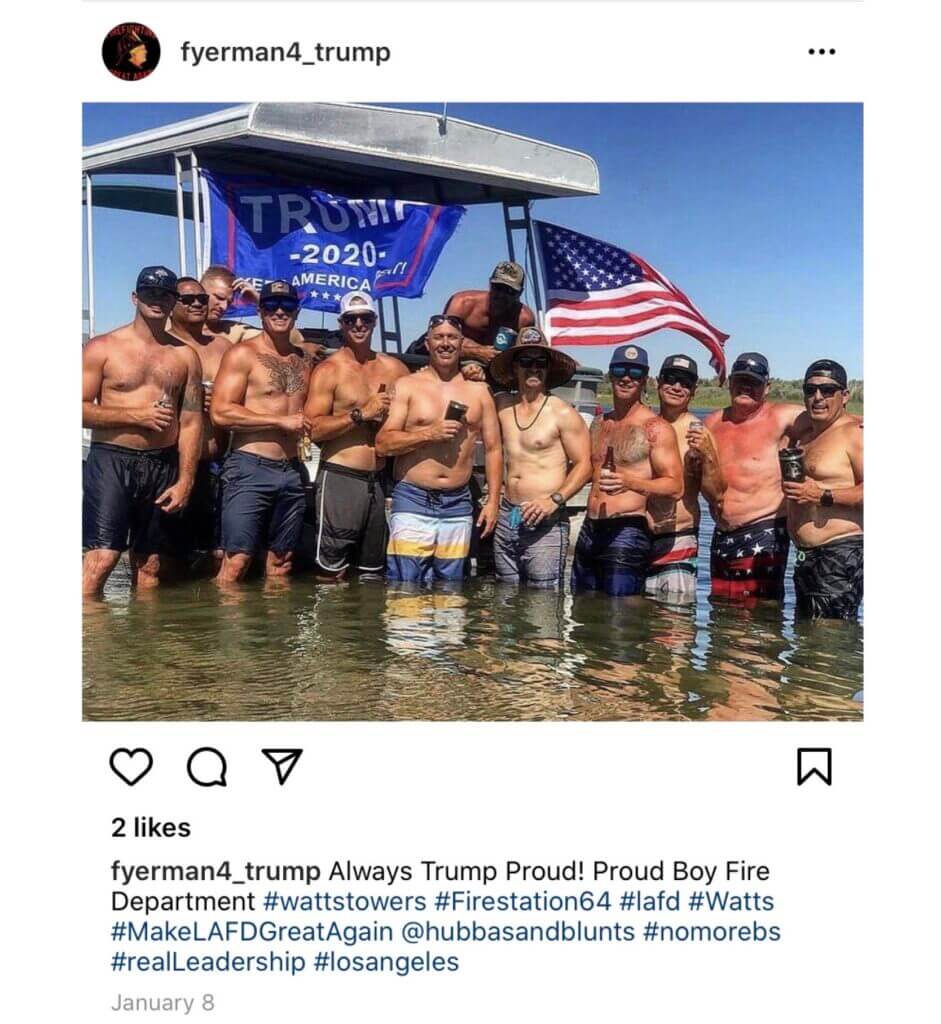
Partying out of bounds? Members of LAFD Station 64 in Watts, including Captain Larry K. Bandy (second from right), Photo from May 2020 reposted with hashtags on January 8, 2021, two days after Trump supporters stormed the U.S. Capitol. Screenshot provided by the Stentorians. (Note: caption has been updated for accuracy)
Politics is supposed to stop at the firehouse door, but it is increasingly common for Fox News to be playing on station televisions, for Make America Great Again ball caps to appear on shelves and desks, and for pro-Trump slogans to pop up on walls and doors, as multiple photographs from different agencies seen by Red Canary Magazine make clear. Firefighters who happen not to be Trump supporters — many of them women or African Americans — see this as a power play, pure and simple. Not only are you not allowed to change the channel or switch off the television, they say, you are also expected to like it.
***
Around the time Lauren Andrade started making noise in Orange County, her department was busy expanding — bringing extra firehouses in the city of Garden Grove into the agency, introducing a 24-hour helicopter service with infrared night flying capability, adding a second hazardous materials response team, and more. Making long-deferred accommodations for women was far from a priority, though. “They’re buying helicopters, but not bathrooms,” was the way Andrade put it. To which one male fire captain she talked to about reorganizing his station house retorted, “We don’t need another bathroom, we need another kitchen.”
Resistance of this sort only increased in the spring of 2020 when, at the ACLU’s urging, the department finally agreed to do a facilities audit of all its firehouses and put Andrade in charge, on a six-month detachment, later extended to nine months, from her usual duties heading up an engine company. She was happy to discover that a number of the crews she visited were receptive to her ideas. Often, though, she would show up at a station and the entire company would, in firefighting parlance, “load and leave” — meaning that she was left alone with nobody to talk to.
At a handful of firehouses, she saw separate bathrooms for men and women — an improvement over what she found elsewhere — but the rooms had a connecting door that anyone could swing open at any time. In each case she’d suggest filling in the doorway with a wall, but this did not always go down well with the captains.
At Station 4 in Irvine, she saw a sign on the gate printed with “The Fraternity”, and “Station 4 Fraternity” T-shirts being distributed inside, which she took as a direct rebuff of her efforts. When she asked the captain if he thought this was appropriate, he answered that, to his mind, fraternal meant brothers and sisters. But he also admitted that he had not sought approval for the sign or the shirts. They were soon gone.
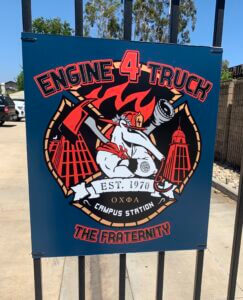
Sign of the times?: “The Fraternity” sign has since been removed from the gate of Orange County Fire Station 4 in Irvine. Photo by Lauren Andrade
“The thing with these captains is, they want to be the cool guy, not a square guy,” Andrade said. “That’s why all this… what did Trump call it? — ‘locker-room talk’ is tolerated. Being popular is more important than being professional.”
Many times, cajoling the department into fulfilling its legal requirements felt like lonely work, and Andrade had to steel herself accordingly. OFCA’s official stance has been that it is in compliance with federal and state law already and is merely working to exceed those standards. Andrade strongly disagrees. “Why hire me to do the audit if everything was fine already?” she asks.
But she also knew that she was not fully alone, because other firefighters, some in her department and many others around the country, were hitting their limit, as she had hit hers, and choosing to push back.
In San Diego, a fire captain named Sara Alfaro filed a gender discrimination and sexual harassment lawsuit alleging that she’d been unfairly blocked from promotion and that male colleagues had “groped her, unzipped her shirt, placed their exposed genitalia on her possessions, Photoshopped a picture of a penis onto a picture of her… and sent her multiple sexually suggestive text messages.” Last year, the city paid Alfaro more than half a milllion dollars to settle the case.
In Tucson, Arizona, Carrie Clark won an even bigger payout — $3.8 million — after a 2019 jury trial in which she said she was denied her right to a place to pump breast milk and then suffered discrimination and retaliation when she spoke up about it. Clark described being disciplined for making “excessive” demands and was told she was “out of [her] friggin’ mind” if she thought she could have a room to herself every two to three hours.
In Orange County, a Black former professional football player, DeWayne Patmon, filed a wrongful termination suit and won after he was drummed out of the fire service shortly before he was due to complete his probation. He’d graduated from the academy with a 94 percent score, and his physical fitness was second to none. Despite the coolness factor of having a former defensive back for the New York Giants on the force, though, it soon became apparent that he was not wanted.
As his complaint alleged, he was forced to perform menial tasks that no white rookie was asked to do, such as refilling people’s coffee cups, and generally treated as a second-class citizen. He’d been dropped because of a fire hose drill that his superiors said he’d failed two out of the three times he tried, but Patmon argued that he’d performed adequately and the outcome of the test was determined in advance. The real reason he lost his job, the suit alleged, was that he was African American. He quickly found another job with the Los Angeles County fire service, but went ahead with the suit anyway. He told Red Canary Magazine, “You’re doing this so the next person doesn’t become a victim of the same thing.”
The captain responsible for Patmon’s dismissal, Vincent Carpino, is named again, this time as the Air Ops Division Chief, in a brand-new suit filed by Desiree Horton, the first woman helicopter pilot hired by the Orange County Fire Authority who, like Patmon, was drummed out shortly before she was due to complete her one-year probation. Unlike Patmon, Horton was vastly experienced when she was offered what she describes as her “dream job” at OCFA in 2019. She had 30 years of flying under her belt, half of them spent fighting fires from the air for other agencies — far more experience than any of her male counterparts. Yet, according to her complaint, she was “ignored, undermined, disrespected, disparaged, and made to feel as though she was incompetent, all because [she] was a woman in a place believed to be a man’s world.”
‘There’s a mythology they tell themselves,’ she says. ‘They have this self-image of heroes that can only be men. But to me, leadership is about being a team. It’s about saying, here’s who you have, here’s what they can do, make it work. They say they are committed to diversity and integrity, but the actions don’t meet the words. And they need to.’
Horton’s supervisors, the suit alleges, deprived her of training opportunities, evaluated her unfairly and lied to her about the requirements for passing probation, thus damaging her stellar reputation and sending the message “that women are not wanted at the OCFA and need not apply.” OCFA has yet to respond to the suit. Like Patmon, Horton says she is not suing for the money. The complaint asserts, “Ms. Horton is a trailblazer and, as she has done her entire career, is fighting back for the equal treatment she and other female pilots deserve.”
Such sentiments are music to Andrade’s ears, because they vindicate her own advocacy efforts and help boost the morale of other female or Black firefighters who, too often, have felt they are battling the inequities and abuses of their workplace alone. Challenging the status quo is never easy, and it is particularly daunting in a profession where jobs are highly sought after, and transfers from one department to another relatively rare. Speaking out not only goes against the culture of the fire service; it can seem like an act of supreme self-sabotage.
Yet, it is occurring to growing numbers of firefighters that this is the time to stand up and demand change. American politics may be polarized, but the push for racial and gender equality has never been stronger than in the wake of the #MeToo scandals that brought down Harvey Weinstein, and in the wake of George Floyd’s killing at the hands of the Minneapolis police. As Gerald Durant of the Stentorians put it, “The fire service reflects what’s happening in America today. We have a voice, and we can preach something different.”
Andrade is fighting for her bathrooms and lactation stations harder than before, because the Covid-19 pandemic has slammed the brakes on most, if not all, of the major construction projects she proposed. OCFA says six fire stations have building projects “in process,” with another 30 scheduled for modifications down the line. But Andrade disputed the assertion that the agency has made meaningful construction progress since last summer. “Saying they are in process does not mean they are moving, or that they’ve even broken ground,” she says. By her count, 17 stations are still in need of major work to provide women with the facilities to which they are legally entitled.
As she sees it, she is still pushing back against a mentality that sees male firefighters as brothers and female firefighters as stepsisters, at best. “There’s a mythology they tell themselves,” she says. “They have this self-image of heroes that can only be men. But to me, leadership is about being a team. It’s about saying, here’s who you have, here’s what they can do, make it work. They say they are committed to diversity and integrity, but the actions don’t meet the words. And they need to.”
Help us sustain independent journalism...
Our team is working hard every day to bring you compelling, carefully-crafted pieces that shed light on the pressing issues of our time. We rely on caring supporters like you to help us sustain our mission. Your support ensures that we can continue to provide deeply-reported, independent, ad-free journalism without fear, favor or pandering. Support us today and make a lasting investment in the future.
RELATED STORIES



Award Winning



Today’s environmental and social justice challenges are unprecedented, and require an unprecedented collective effort.


Stay updated on our latest features, events and more. Subscribe to our Note From the Nest newsletter!

Excellent article!!
Thank you for telling this important story.
Want “equality” but can’t piss with the men. “Separate, but equal”
Maybe you should gather the correct facts & do your research before writing your article
Story seems very one sided and no facts to back up the accusations. I have a lot of history with these issues and have found most of these people don’t realize that they are the issue not the fire service. Keep an open mind to both sides of the story! Most don’t.
Wow, there is a lot to unpack in this article. I have to agree with much about our need to change and advocate for one another. The biggest change has to happen individually. Each person on the job has the same feelings, vulnerability, and needs. Unfortunately tribalism is at the heart of mistreatment and misunderstanding of people different than the collective. That is how I have seen it go for 28 years on the job. Even minority and women entrenched in a team, shift, or battalion can lose compassion for a newer person on the job simply because they don’t fit in yet. New people are always a little wonky, and instead of creating environments that cater to simply training and preparing coworkers, we tend to ‘test’ them, or vilify failures, forgetting how it was for us when we were new.
So much has changed in the world. And much has changed in the fire services. We need each other, our differences, and our humanity much more than politics or traditions that have a good intent, but a horrible outcome. Such as high standards training, in the old pass or fail mindset. Good intent, poor execution and outcome. I hope that we can continue to build teams that mature and include valuable diversity.
I applaud Desiree for having the courage to question the blank stares from firefighters, captains, and whatever other rank that watches this kind of crap happen, and ignore it. I know that her skill, her comportment, and her qualifications mattered less to a supervisor who is focused on perception of his national contemporaries and popular acceptance of him in his new position at OCFA, than he was at mentoring and supporting a valuable team member with all the support and backing of the community and no doubt the Fire Chief who knew her personally, but could not protect her from a respected position holder who threw her under the bus. I only hope the citizens of OCFA will regain confidence in the agency and its leadership when the legal dispute is settled and either Desiree or the chief pilot are back to work focusing on the mission.