
Taking the Pulse

Aaron Gilbreaths’ fascinating new book, The Heart of California: Exploring the San Joaquin Valley, will inevitably draw comparisons to the work of the late Kevin Starr, California’s former Emeritus Librarian and voluminous chronicler of the Golden State’s state of being, and also, maybe, D.J. Waldie, the former Deputy City Manager of Lakewood and voluminous chronicler of Southern California’s suburban cultural history. That’s good company to keep. Both have contributed greatly to a larger understanding of those things that California is supposed to lack–history and a sense of place. In some ways, though, such comparisons are wanting. Gilbreath’s account of his San Joaquin Valley excursions, excavations and obsessions, held together by the clever narrative conceit of retracing Frank Latta’s quixotic 1938 attempt to navigate the Valley from Bakersfield to Oakland by boat, has a sense of urgency and adventure that often escapes more academic Golden State anthropologies.
Latta was a high school teacher and an amateur ethnographer who wrote extensively of the native Yokuts in the 1920s and 30s as well as other vestiges of the pre-industrialized San Joaquin Valley. Despite his yen for cultural history, Latta, though, was no preservationist. He was interested in promoting the type of damming and engineered environment that has resulted in the Valley becoming one of the most agriculturally productive swaths in the world, as well as the home of California’s fastest-growing metropolises and a landscape confronting myriad, unsustainable stressors.
Gilbreath, who hails from Arizona and lives in Portland, writes about all of this with the joy of wide-eyed discovery and the wizened perspective of someone who has put in too much time and too many miles to be under any illusions. In both exhuming Latta and finding his own way through the Valley, he reckons with what we have wrought and the challenges facing this critical landscape at this critical time.
There’s a strong current of nostalgia running through The Heart of California, as there should be in any worthy accounting for the California Dream, though without a trickle of sentimentality. The many characters Gilbreath encounters in this unfathomable place are treated with genuine affection and the landscape is met with respect. The what ifs point in both directions: to past transgressions, of course, but also towards a future that, however tenuous, is not yet written in stone. We got to talk with Aaron recently about his timely and highly readable journey to the center of our earth.
It’s so vast it escapes comprehension, like a frontier that renews itself eternally, beckoning you to explore further.
Aaron, tell me about your decades-long obsession with California’s Central Valley?
It started with a drive. In the summer of 1995, my best friend and I were returning to Arizona from four weeks road tripping around California and the Pacific Northwest. When we took Interstate 5 down from Oregon, we ended up in this hot, flat, smelly rural place that was not at all like typical California and that went on forever. It was an accidental encounter, but it changed my life.
I think it was Calvin Trillin who said that writers’ main subjects — the themes or stories that preoccupy us for our entire careers — are forged before we graduate college. Whoever said that was right about me. I write about summers, the Valley, California, etc, etc. These subjects also choose us, attaching themselves to our minds like cockleburs to hiking socks.

Okay, summer and California are easy obsessions to understand–they’ve launched a thousand ships of pop culture– but California’s Central Valley is a bit more obscure to most people.
When I try to explain to people how the Valley chose me, the most concise version is that, first, the landscape’s aesthetics grabbed me: the colors, the smells, the vastness of its horizon, the dizzying breathless sense of scale. I had never been anywhere so wide and so flat. Then, when I began to read about the place, its original ecosystem fascinated me. It was so complex and unique, unlike any other part of California. In fact, it was like a bunch of different regions smashed into one: forests, oak woodlands, desert, grasslands, marshes.
The dense riparian forests that grew along its waterways remain my favorite habitat. They were so thick, draped with vines and lianas, that I started calling that habit La Selva Californica, the California Jungle. I was in a taxonomic mode at that time in college. Adding to my obsession was the landscape’s sense of vulnerability. So much of that native ecosystem — as huge as it was — had been replaced by agriculture and development. Same with the Indigenous Yokuts people: the densest population of nonagricultural Native People in North America, and few of them remained. It’s cultural and ecological genocide on an unprecedented scale.
But the farms that replaced Native land had their own profound beauty. I loved how this farmland looked and smelled, and obviously I valued its food. My dad’s side were country people from Oklahoma and Texas. I have always loved the country, but my experience of the Valley was complex and conflicted. As I read and explored, the proverbial plows kept knocking over more riverside trees, cementing over more grasslands and scrub. Native Valley land was precious partly because it was nearly erased. What small preserved remnants remained were few and far between. I compulsively visited most of them.
Sweetening the attraction was the sense that this interior California was a lost world, not only eradicated by civilization, but overlooked by modern hikers, nature writers and travel guides, and worse, looked down upon by the world that cheristed the Golden State’s iconic coast and mountains. It’s the underdog of California. I love an underdog, because I’ve always felt like an outcast. In that way, this Valley and I were kin. But to clarify, although I love the entire Central Valley, my book is about its southern half, the San Joaquin Valley.
So, an area of interest, geographic and topical, turns into a muse?
Once my reading expanded beyond the landscape into our animated world of Indigenous cultures, European settlers, and American expansion, I couldn’t stop thinking about the place, past and present. I would take trips there whenever time and money allowed. While college students drank beer on beaches, I spent my spring breaks driving Valley backroads and visiting nature preserves and wildlife refuges, reading and taking notes in cafes and motels.
And while I was exploring and trying to understand the Valley, I had it in my 20-something writer brain to write about the Valley. In college, I knew I wanted to learn to write nonfiction stories. When I found this place, I naturally wanted to write about it, but for whatever reason, that process took 20 years. Partly because I was learning to write in general while I was trying to write about this place in particular. It was too big a subject for a dude who struggled to write a good three-page personal essay in college!
Writing takes years of practice. Understanding the Valley takes more than one lifetime. At the age of 45, I still barely understand a sliver of it. That’s another reason I love it: it’s so vast it escapes comprehension, like a frontier that renews itself eternally, beckoning you to explore further. For instance, mainly farmers and scientists can understand the complexity of soil variation here, or how to recognize a change in the soil from crops’ slightly different rates of germination in a particular place. That frontier is subtle and grand.
Maybe that says something about the difference between literary nonfiction and fiction–the obsession for nonfiction writers lies outside themselves? Or, am I being too facile? You did mention identifying with the Valley’s underdog status? What do you mean by that?
I had to look up facile. I would say that yes, with all due respect, that is too facile! I’m a poor fiction writer, so I can’t speak for that genre, but I can say that many of us narrative nonfiction writers obsess about our own experiences, too — our inner worlds. My first book is a collection of personal essays, so we can focus on the worlds inside and outside ourselves. One reviewer said something about how he hoped I could one day write about the outside world the way I did about my own life, which kind of stung but was also something I was trying to do.
The Valley is to California what the Midwest is to America: a fly-over region that many coastal denizens ignore or dismiss. It gets labeled all these horrible classist things about being redneck and backwards, which is simplistic, dismissive thinking. It’s farmland, so it tends to be politically conservative, but it also contains some of California’s fastest growing cities, so it has a lot of urban culture, sophistication, literary and musical arts, and big-city problems, too.
The Valley faces the great environmental and social challenges that our country at large faces, and individualistic, capitalistic values are bending life and land there to its breaking point.
The landscape also gets dissed because the casual observer cruising through on the highway only sees a flat, hot landscape of farms, suburban sprawl and fast-food chains. It seems simple. To outsiders it also all looks alike. And yes, it is flat and hot. But what my book tries to do is both dispel those cultural stereotypes and show readers the landscape up close, by taking them off the highway, out of their cars and letting them really see the beauty and complexity of this seemingly simple place.

Your book is sort of a classic quest narrative–you’re searching for, as the title says, the heart of California. Why is the heart of California so important to a guy who lives in Portland?
Haha, good question. First off, I’m a desert rat from Arizona who only lives in Portland. My Gila Monster heart relates to arid places like the San Joaquin Valley. As California goes, so goes the nation. What’s that old New York City saying: If you can make it here, you can make anywhere? Well, if California can’t make it, America can’t make it. From overpopulation and water management, to forest-fire management and prevention, to policy around plastic grocery bags and single-use plastic water bottles, well-drilling, recycling — California sets certain standards about how to confront modernity’s ills.
The Valley matters because what Americans eat depends on what Californians grow, so even if you think you hate Los Angeles and you don’t care about Redwoods and you never plan to stick your toe in the Pacific Ocean, our fates are all tied to the fate of the Golden State, particularly its rural interior farmland. It produces that much food. You can’t dismiss it. So let’s get to know it.
The quest element of the narrative was my own inability to separate the Valley from the experience of the Valley. So much of the landscape involves perception, which is to say misperception — cliches, stereotypes, driving by, etc. I am the book’s reader: a person not from here who wants to know more about it. But a book about a place is not a story, it’s like an idea. It doesn’t have any energy or movement on its own.The trip I took along Frank Latta’s boat route allowed me a narrative framework– a plot. Latta was my character, and his trip provided movement. When I weaved the story of Latta’s journey with the story of my journey, there were dual protagonists, and a narrative trellis for me to hang various subjects and narrative diversions on. That’s great for an essayist, whose genre is often called “messays.” If I was a smarter person, I would have seen that ahead of time. I was just plonking around and discovered that literary benefit as I went along, tinkering with stuff.
Right, to get metaphysical, if a place doesn’t have stories, does it really exist? Don’t answer that! I want to return to the idea that as goes California, so goes the country. I’ve distilled that down even further in a seminar I’ve taught the past few years to: as goes Los Angeles, so goes the country. There are plenty of arguments against that hypothesis, but I maintain that the battle for the soul of the country is being fought here. We are either going to build a bridge to the future in a spirit of sharing and inclusiveness, led by the most inclusive and stressed state in the country, or it’s going to be Mad Max out there. I mean, from Cesar Chavez to Devin Nunes, you see that all unfold in the Valley, don’t you?
Absolutely. The Valley faces the great environmental and social challenges that our country at large faces, and individualistic, capitalistic values are bending life and land there to its breaking point. From your seminar, it sounds like you’re the better person to address this question, so can we all sit in on your class on Zoom? I want to hear the arguments against the “As goes Los Angeles, so goes the country” hypothesis and see how it applies to the Valley, because I bet it does. I love LA, it’s always fascinated me as a visitor, and I’m sure you could illuminate things I have sensed but never been able to articulate. I have spent so much time exploring that city far from the beaches and popular spots. I’d love to write more about that one day.

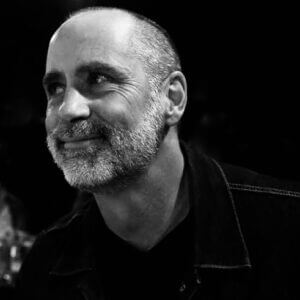
Photo by Steven Gute
Well, as The Moody Blues once said, it’s a question of balance, isn’t it? In a word, sustainability. We keep eating the geese that have laid our golden eggs, and some of what you’re doing is bringing that metaphor to life, right?
In a literal sense, yes, I am. As rural folks like my Granddad used to say: what goes in the well comes up in the bucket. We know that idea more commonly as never shit where you eat. In terms of growing food in a way that erodes our ability to grow food, it’s not too late to change the system, but the economics might make it too difficult to change enough of it quickly enough to preserve topsoil, groundwater, etc.
It’s too easy to reduce growers to symbols of environmental issues, but they are people, and now more than ever, we all need to treat each other with humanity, empathy, and respect as we talk about the challenges our world faces.
In what you might call a literary sense, I’m trying to show the Golden State as the Eden that it is, naturally shaped by regular catastrophes like drought, floods, fires and quakes, as well as the beauty that comes after. California is a poppy that blooms between disasters. But the Golden State is the goose whose golden egg is losing its color. In a sense, my book is a depressing kind of portrait of rumination, of paradise lost.
Can you elaborate a little on that?
Absolutely. Even though my book isn’t only about the Valley’s landscape and industrial agriculture’s effect on it and its fertility, a big part of it portrays the land’s condition: Soil subsistence, salinization, groundwater depletion, poisoned water, and further paving of good land all continue to plague the rural Valley and threaten its ability to produce food in the long-term. You can’t raise dairy cattle in a near desert, or raise such thirsty, chemical dependent crops as it does in an arid land like this forever. It has rivers and once had a lot of groundwater to make up for its low rainfall. That groundwater will not save it forever. Neither will bringing in water from the wetter north.
Here’s the thing: Farmers — the local ones, not the corporate, outsider ones — just want to make an honest living like anyone else. As landowners who exist in a chemical economy, they’re in a bind. It often takes a lot of land and a lot of work — and financial risk — for most growers to survive. It’s too easy to reduce growers to symbols of environmental issues, but they are people, and now more than ever, we all need to treat each other with humanity, empathy and respect as we talk about the challenges our world faces.
In a way, to strain the limits of acceptable analogy, your book is something like a doctor doing an electrocardiogram. In your estimation, what condition is California’s heart in?
The Golden State’s heart is still golden. As an outsider always passing through, its heart appears full of life, hope, endurance, invention, and promise, pumping as vigorously as ever, because it’s as much a spirit of place as a location. It’s still the land of constant renewal and new beginnings, but the passages that carry the heart’s blood could use some scraping out. Angioplasty maybe? My dad was an Okie who ate a lot of gravy. The rural Valley has a lot of gravy running through its veins. California isn’t all avocado toast and burritos.
Help us sustain independent journalism...
Our team is working hard every day to bring you compelling, carefully-crafted pieces that shed light on the pressing issues of our time. We rely on caring supporters like you to help us sustain our mission. Your support ensures that we can continue to provide deeply-reported, independent, ad-free journalism without fear, favor or pandering. Support us today and make a lasting investment in the future.
RELATED STORIES


Award Winning



Today’s environmental and social justice challenges are unprecedented, and require an unprecedented collective effort.


Stay updated on our latest features, events and more. Subscribe to our Note From the Nest newsletter!
