Social Security for Everyone

For 30 years and counting, deep-red Alaska — which has given its electoral-college presidential votes to a Democrat just once during its statehood — has paid every adult just for being Alaskan.
The cash comes from oil money, specifically Alaska’s Permanent Fund Dividend, and the amount doled out varies annually; in 2021, it was $1,114. There are no restrictions on what recipients can do with the dollars, and there are no eligibility or means-testing boxes to check to qualify. The program is wildly popular, with 90 percent of the population approving of how it works.
Yet, the lower 48 has traditionally viewed long de rigueur programs such as this with suspicion. Now, traction for programs such as Alaska’s has increased as a method to mitigate against the era of increasing socioeconomic inequity and the rise of robots.
In libertarian-friendly Silicon Valley and the techno-philosophical concentric circles that emanate from there in ones and zeros, an expectation of ongoing automation of the workforce has led thinkers to consider how people whose jobs disappear will receive income.
And in liberal bastions — from Cambridge, Massachusetts to Madison, Wisconsin; Newark to New Orleans; Providence to Oakland — a plethora of pilot programs are underway, often funded by public-private partnerships and accompanied by academic studies, most of which are under the rubric of helping lift people out of poverty in a way that simultaneously seems completely obvious and too good to be true: just give people $500 (or $1,000, or a similar relatively modest amount of money), monthly, on top of other pre-existing benefits they may already receive.
This concept has a heritage that dates back to early American pamphleteer Thomas Paine, includes Dr. Martin Luther King, Jr., and remains relevant through a recent presidential candidate who introduced the topic to new audiences. When we talk about basic income, keep in mind the well-quoted statistic that 40 percent of U.S. residents have less than $400 in emergency savings. Consider, too, the first-hand experiences gained by the American public during the pandemic as multiple stimulus checks were sent out by the federal government and the Child Tax Credit (CTC) that was, for a brief period of time, altered. Put all that together and you’ve got a real come-to-Jesus moment for a heretofore-wonky policy movement that crosses all sorts of seemingly intractable ideological, political, philosophical and ethical divides. Yet, it’s a movement that just might turn out to be the one big economic idea that Americans can unite behind.
That idea? Universal basic income, which emerges in this moment in a variety of flavors: basic income, guaranteed income, cash transfer program, or negative income tax. Depending on whom you talk to, though, those various terms are either synonymous concepts, slightly different, or definitely bifurcated along the lines of need versus universality. The bottom line is generally the same: paying people – period. Specifically, it is paying people a modest amount, not for working or in lieu of other social programs, but as a way to urgently lift people out of penury.
“Poverty is a policy choice,” says Dorian Warren, co-president of Community Change, one of the ten organizations that endorsed or funded the creation of a proposal for Congress to provide a federal guaranteed income to every adult earning less than $50,000 annually. People who earn the least would receive the most, about $1,000 monthly. “A Guaranteed Income for the 21st Century” — the name of the proposal — “would literally eliminate poverty, lifting nearly 14 million households out of poverty,” said Darrick Hamilton, one of its authors.
Advocates say this, or a similar plan, is not just a nice idea, but a necessity in an era where the bottom 50 percent of adults in the nation have an average income of $18,000, and the middle 60 percent of households have less total wealth than the top one percent of households.
“Poverty is a policy choice.”
Indeed, despite all the massive health, employment, and other hardships endured during the COVID-19 pandemic, studies show that the federal stimulus packages (a form of basic income) gave most American adults $3,200 in 2021 and, as a result, it had an extraordinary effect. Columbia University researchers projected that the poverty rate in 2021 would hit an all-time low, including cutting childhood poverty from 14 percent to six percent.
Federal pandemic stimulus and now-expired federal Child Tax Credit stimulus-equivalent aside, most of the basic income prosperity experiments are taking place hyper-locally, and are organized and promoted by the political leaders of cities and towns. As the website for the growing nationwide network, Mayors for a Guaranteed Income (MGI), put it: “Economic insecurity isn’t a new challenge or a partisan issue. Wealth and income inequality, which have long plagued our country, continue to grow. Rooted in Dr. King’s legacy, mayors across the country are coming together to advocate for a guaranteed income — direct, recurring cash payments — that lifts all of our communities, building a resilient, just America. Everyone deserves an income floor through a guaranteed income.”
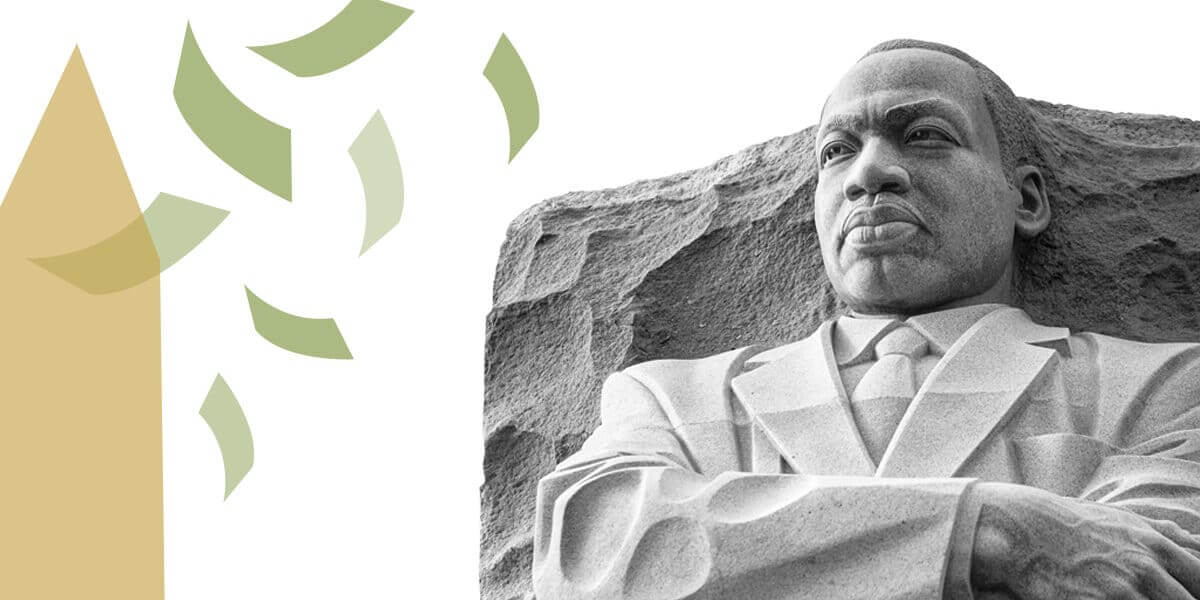
Dr. King is often noted as one of the figure heads in support of basic income policies. Illustration by Nancy Hope
MGI lists 63 mayors from 26 states who have aligned with the movement so far. At least 15 pilot projects are taking place. Last October, for instance, Los Angeles announced BIG:LEAP, which was promoted as the country’s largest basic income pilot program. This $38 million investment serves 3,203 families with income below the federal poverty level that have been through hardship during the pandemic. Recipients receive $1,000 per month for one year.
“This program is a small but steady investment in a simple concept,” LA Mayor Eric Garcetti said when the program was announced. “When you provide resources to families that are struggling, it can give them the breathing room to realize goals that many of us are fortunate enough to take for granted: put food on the table and cover childcare with less stress, keep their children’s focus on education and pursue new opportunities with fewer worries about the day-to-day needs of their household.”
Cambridge — as mentioned — is another city that launched a pilot during the past year. Despite being home to multi-billion dollar universities Harvard and MIT and having a median household income that is 28 percent above the national average, there is still significant poverty in the small, yet consequential city. According to the Boston Globe, in 2021, 20 percent of Cambridge residents earned an average of just $13,000 per year, and 10 percent of families with children under the age of 18 lived below the poverty line.
The city’s basic-income program disburses $500 monthly to 130 one-caretaker households with incomes at 80 percent or lower than the city median. As a precursor, Cambridge Mayor Sumbul Siddiqui told Red Canary Magazine about how she and colleagues were able to launch a Mayor’s Disaster Relief Fund in the early days of the pandemic. “That money was going directly to residents. Folks who were housing insecure, who needed money for groceries or diapers… who lost their jobs,” Siddiqui said. “It helped during an emergency.”
So when she heard about the MGI call for pilot proposals, Cambridge applied for funding. $500,000 came in, as did funds from other sources, including foundations and the local universities. The city’s program began last September, under the moniker Cambridge RISE, an acronym for Recurring Income for Success + Empowerment.
“I grew up low-income,” said the Mayor, who emigrated from Pakistan when she was two years old. “I grew up in affordable housing in Cambridge; Cambridge is my hometown. I think I understand the lived experiences of many of the folks who I grew up with, who go paycheck to paycheck, who are struggling, and who, if an emergency comes up, don’t have cash. Having that kind of perspective (I’m also a legal aid attorney by background), this concept of giving a guaranteed income makes sense.”
Siddiqui continued, “Particularly, I’ve seen how COVID has really exacerbated just everything in so many households – and especially Black and brown people – how it’s disproportionately affected them health-wise. The economic fragility piece, I’ve seen it firsthand in the community.”
Interestingly, it turns out that giving away money isn’t as simple as a Robin Hood story or Mr. Beast YouTube video might make it seem. Governments have rules that need to be followed, particularly when it comes to public-private partnerships. And the public, rightly wary of offers that sound too good to be true, requires some convincing. “There were people who thoughts this was a scam,” Saddiqui said with a laugh. At first, they were like, ‘What? $500 a month, no strings attached? Right.”
“I’ve seen how COVID has really exacerbated just everything in so many households – and especially black and brown people – how it’s disproportionately affected them health-wise. The economic fragility piece, I’ve seen it firsthand in the community.”
In truth, in Cambridge and elsewhere, it does take some bureaucratic untangling — a.k.a. “benefit mitigation” waivers with administrators of other anti-poverty programs — to make certain that strings are indeed not attached. Otherwise, increased income can bump recipients above thresholds where they qualify for other government programs. Gaining $500 free per month doesn’t sound as good if it winds up disqualifying your subsidized rent or funds from the state’s Department of Transitional Assistance. In short, the RISE money doesn’t come with caveats or…conditions.
***
Almaz Zelleke is a political science professor at New York University, Shanghai. She is working on a book about the ethics of unconditional basic income in the United States. Note that we didn’t write “universal” basic income.
“The more important ‘u,’ as far as I’m concerned, is unconditional,” Zelleke told Red Canary Magazine.
This means, as the professor and others explain, that in this conception, money isn’t targeted at a particular group – for example, veterans, mothers or unemployed people. Nor is it a reward for an action or behavior — the way that in some developing nations, parents receive cash transfers for taking kids to doctors. Rather than having to qualify, there are no conditions necessary to receive the income.
Michael Lewis, a professor at Hunter College’s Silberman School of Social Work, has been working towards a similar no-strings-attached approach. In 1999, Lewis and four other academics co-founded a conference that would ultimately become a non-profit organization called the U.S. Basic Income Guarantee Network. (Lewis now serves on the organization’s advisory board — as do Zelleke and Soomi Lee, who we’ll meet shortly.)
The conference used to not have the word “guarantee” in its title, but intentionally added it. “I use ‘basic income,’” Lewis said. “But what I mean by ‘basic income’ is what others mean by ‘universal basic income.’”
What is basic income, in Lewis’ definition? “It’s a non-work conditioned grant to individuals periodically, from some government,” he said. “And, it’s universal. Everyone gets it – rich, poor, criminal record or not – they all get it.”
Lewis and others with expertise in this field are often, at least in part, policy wonks. Lewis calls the field a “technocratic approach to addressing poverty.” These experts know that the ideas they advocate for must pay for themselves. They know the U.S. tax code is byzantine, and they know their concept by definition alone isn’t a panacea. “Basic income isn’t necessarily enough to get you out of poverty,” Lewis said. “If it’s big enough – I hope it would be, but there’s no guarantee — it could be [enough] and be sustainable. It depends on effects on prices and incentives and things like that.”

Illustration by Nancy Hope
When Lewis, et al., started the Basic Income Guarantee (BIG) Conference, there was no raging pandemic and no modern social media to spread ideas. There was no Andrew Yang running for the Democratic presidential nomination in 2019 with a one-note platform pushing for a $1,000 per month “Freedom Dividend” – a.k.a. basic income – for every American adult. In short, this field was a bit of a niche. Now? As of August 2020, 55 percent of Americans polled said the government should have a universal basic income program, which is a 12 percentage points increase from 18 months earlier.
“When I first started out, I was focused on policy as a way to alleviate poverty,” Lewis said. “I knew there were questions about its cost and its effects on incentives, but in principle, I thought it was a way to address poverty.” Lewis did his dissertation on welfare reform during the 1990s when welfare morphed into workfare. “I was not a fan of the shift toward emphasizing work and prioritizing that to address poverty,” he said. “I saw basic income as a way to address poverty in a way that didn’t overemphasize work, but was responsive to work incentives.”
A sociologist who has studied economics, Lewis sees social workers, philosophers, political scientists and, particularly, political theorists, interested in basic income as well. “They may be more attracted to the normative questions, like the ethical questions around justice and fairness and equity,” Lewis said. “What kind of society should we have, and how people should be treated?”
Bolstering wonky policy with philosophical arguments may seem like intellectual parlor games, but guaranteed income would be a paradigm shift in our economic culture, and those cases often need to be made on higher ground. Enter Matt Zwolinski. In 2020, the philosophy professor at the University of San Diego, wrote an article headlined, “A Moral Case for Universal Basic Income: A neoliberal argument for UBI based on individual freedom and property rights.”
Zwolinski, who is director of University of San Diego Center for Ethics, Economics, and Public Policy, began his article by acknowledging: “Fans of free markets and limited government would seem to have little to love in the idea of a Universal Basic Income. After all, what could be more anathema to these ideals than a big government program that doles out free money to everyone?”
Zwolinski then refuted that notion, writing that “the radicalism of a UBI is often overstated,” mentioning neoliberal economist Milton Friedman’s Negative Income Tax idea as similar to UBI, and connecting UBI to the work of another 20th-century neoliberal economist icon, Nobel Prize-winning Austrian emigrant Friedrich Hayek.
“A little bit of money in your pocket can go a long ways towards giving you a kind of buffer and the freedom to live your life as you see fit.”
“The best neoliberal case for a UBI is not merely pragmatic,” Zwolinski wrote. “It is moral. It follows from two of the most central political commitments of neo-liberalism: individual freedom and property rights.”
When reached by Red Canary Magazine, Zwolinski elaborated on the libertarian case for basic income. First, there’s the practical reason that if you favor limited government and less intrusion, then basic income beats “a bureaucratic labyrinth of hundreds of programs that spend lots and lots of money, much of which doesn’t really make an effective difference in improving the lives of poor.”
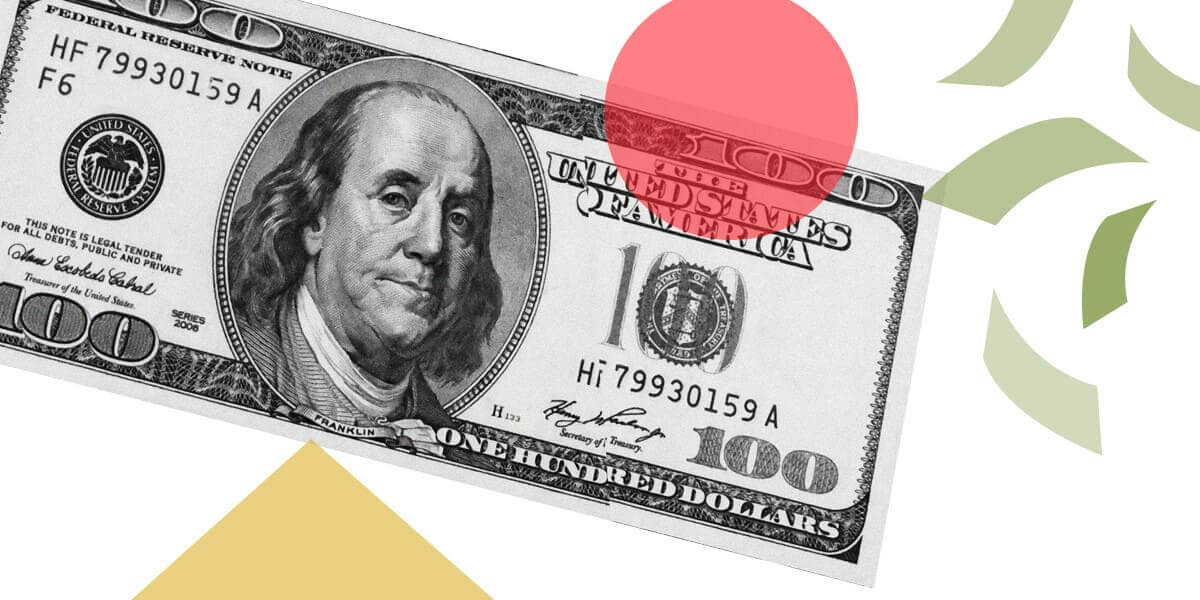
Illustration by Nancy Hope
Basic income simplifies all this: “All of those could be consolidated theoretically into one simple cash transfer program which would both vastly reduce government bureaucracy and achieve a much greater effect on poverty reduction for the same cost or possibly even a lower cost,” Zwolinski explained.
He then detailed the principled libertarian case for basic income — which boiled down to keeping the government, and others, off your back. “If you don’t have to do what your boss says because you can afford losing that job for a little while, then you have the freedom to say no to that boss in a way that you don’t if you’re completely dependent upon him for your financial wellbeing,” he said. “Same with an abusive spouse. Same with an overbearing landlord. If you don’t have any other options, then you have to do what those people tell you. But a little bit of money in your pocket can go a long ways towards giving you a kind of buffer and the freedom to live your life as you see fit.”
In others words, there is no freedom without the freedom to say no.
***
As mentioned earlier, Soomi Lee, Associate Professor in the Department of Public Health and Health Administration at the University of La Verne, is a BIG board member. When Red Canary Magazine spoke with Lee, we asked if she thought basic income had become a cross-political party idea, or was it being pushed by, let’s say, just one wing of just one party?
“There are two lines of argument,” Lee said. “One is automation – ‘the robots are coming’ – and labor market changes and disruption. That’s more a Silicon Valley-driven discussion.” The other, she says, is “people who want this as poverty liberation, and use UBI as a tool.”
Lee recognizes that the cost of basic income programs isn’t trivial and needs to be counted and considered. But the professor noted there’s a much larger systemic issue that needs greater attention: Our 21st-century economy is based on outdated principles.
“Current social policies and welfare assistance is based on the assumption that we have a 20th-century labor market, a 20th-century financial market and a 20th-century family arrangement,” Lee said. “It’s different these days. People don’t get married; they raise their children by themselves [and] grandparents take care of grandkids. Society’s changing and the labor market’s changing, and technology really revolutionized how we produce things. But, the old social welfare assistance system and social policies are based upon 20th-century society.”
Lee points out that policy is always lagging. “Things happen first and then we want to fix the current policies to catch up and then rethink about how to reform the social policies…to transfer money to a certain segment of people,” she said. “UBI is basically social security for everyone.”
Social security itself may have been a direct reaction to a famous proposal for a generous basic income. NYU’s Zelleke recounted some of the 20th-century policy plans and socio-economic movements that served as forerunners to today’s basic income efforts. These include The Townsend Plan Movement, the Welfare Rights Movement, and the Wages for Housework movement.
The Townsend Plan was a wildly popular Great Depression-era proposal to give American 60-year-olds and above $200 per month — equivalent to $4,300 per month today — and raise the money with a two-percent federal VAT. Two years later, the far more modest, albeit still radical, Social Security Act was signed. Black women helping one another navigate unfriendly social-benefits processes led the Welfare Rights Movement in the 1960s. Wages for Housework was an effort by women to get men — and male policymakers — to recognize and value their contributions. “They were arguing for the inclusion of women, and housewives in particular, in the labor movement,” Zelleke said. “And through that process of making that argument, they came to understand that what capitalism has been successful at doing is separating the wage for the labor that creates profit that the capitalists can capture.”
In short, Zelleke said they were stating that a wage shouldn’t just be for profit-generated activity, but also for the “activity of living.”
Oh, and in case any of this sounds outside the mainstream – now or then — in 1969, President Richard Nixon proposed and the House passed, a basic income bill that would have given today’s equivalent of $11,000 per year to poor, nuclear families. The Senate voted the bill down.
***
So, what else could potentially go wrong if basic income turned out to be, well… basic?
Inflation is, as of this writing, at a rate not seen in 40 years. Is there any chance that’s directly due to the recent stimulus packages? It is not likely, Zwolinski said, since the money supply isn’t increasing, but rather, it’s just moving around differently.
What about politically? Could the Tucker Carlson and company crowd torpedo the movement by painting basic income as — gasp — socialism? Not necessarily. Remember, deep-red Alaska has been doing this for decades and even though conservatives whisper about it every election cycle, talking about getting rid of the social security benefit out loud is considered a political third.
“It’s far from some socialist ideal,” Zwolinski said. “The point isn’t to make everybody equal or eliminate the rich, the point is just to put a floor in place — not a cap, but a floor — so at least everybody has some ability to determine the shape of their own lives.”
Indeed. Perhaps the seed of the current basic income movement that has of late sprouted across the nation came a few years ago in Stockton, California — known as the largest city in the country to file for bankruptcy in 2012. The Johnny Appleseed of this basic income endeavor was then-Mayor Michael Tubbs, who was elected in 2016 at age 26 as the first Black Mayor of this Central Valley city after being endorsed by then-President Obama.
From 2019 through 2020, the Stockton Economic Empowerment Demonstration (yup, SEED) gave $500 per month to 125 people for two years. The studies that came out of this project showed that the people involved became healthier, gained more employment, and made more secure life choices. Was the additional money used for legal vice? Hardly. Only a penny from every dollar was spent on alcohol and tobacco, researchers determined.
Tubbs’ was voted out of office after one term, but he then went on to found MGI. Tubbs also served as a special advisor for economic mobility and opportunity to California Governor Gavin Newsom — who budgeted $35 million for basic income programs for eligible pregnant people and young adults who had recently been in foster care. Tubbs also penned a memoir The Deeper the Roots: A Memoir of Hope and Hope that got the attention of Oprah Winfrey, and he now has launched an organization called End Poverty in California.
Last year, on Martin Luther King, Jr. Day, NPR interviewed Tubbs and played clips of King’s famous “The Other America Speech” from 1967. “It seems to me that the civil rights movement must now begin to organize for the guaranteed annual income,” King said, in part.
“I was inspired by studying Dr. King,” Tubbs told NPR. “Realizing that, for all the speeches and days of service, no one had told me about a guaranteed income, this radical idea.” Tubbs explained the SEED results: “What we saw was that it did not take away people’s work ethic. It did not change us into a different country, but it actually allowed folks to have a floor to persist during times, especially like these.”
And when NPR asked a question about similarities from the late 1960s to today, Tubbs was ready. “It has to be now,” he said. “We are literally at ground zero with sort of the racial reckoning we’re having but also with the economic impacts of COVID-19. When I think if we can get a guaranteed income, an income floor, at this time, we also have to have a conversation about the moral awakening our country needs because again as Dr. King said, poverty robs us of the richness of a society where everyone’s given the opportunity to realize their full potential.”
Help us sustain independent journalism...
Our team is working hard every day to bring you compelling, carefully-crafted pieces that shed light on the pressing issues of our time. We rely on caring supporters like you to help us sustain our mission. Your support ensures that we can continue to provide deeply-reported, independent, ad-free journalism without fear, favor or pandering. Support us today and make a lasting investment in the future.
RELATED STORIES


Award Winning



Today’s environmental and social justice challenges are unprecedented, and require an unprecedented collective effort.


Stay updated on our latest features, events and more. Subscribe to our Note From the Nest newsletter!
